Jump to ratings and reviews
Rate this book

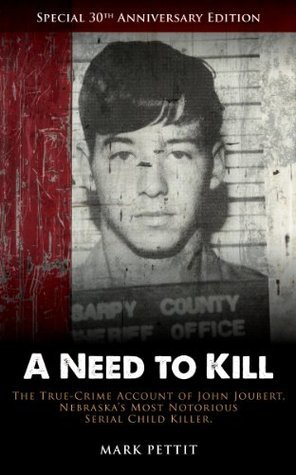
A Need to Kill: The True-Crime Account of John Joubert, Nebraska's Most Notorious Serial Child Killer

Rate this book
FINALIST! USA BEST BOOK AWARDS--TRUE NON-FICTION It was one of the most terrifying times in Nebraska's history. The year a young Air Force Airman went on a killing spree, leaving two young boys dead and a community gripped by fear. Now, dramatic and chilling new evidence comes to light exposing the sinister thoughts running through the mind of John Joubert--the man behind the Nebraska killings. Former TV news anchorman, investigative reporter and three time Emmy winner Mark Pettit returns to the case to write the final chapter in his best-selling, and now newly updated A Need to The True-Crime Account of John Joubert, Nebraska’s Most Notorious Serial Child Killer. In the spirit of Truman Capote’s “In Cold Blood,” Pettit delves into the Joubert case to tell the dramatic story from all angles as a non-fiction novel. In a series of exclusive, face-to-face interviews with Pettit, Joubert admits to a string of violent crimes and another killing that sends investigators into a frenzy ending with Joubert being convicted for a third murder and ultimately executed in Nebraska’s electric chair. Now, 30 years after the murders in Nebraska, Pettit uncovers shocking new evidence from Joubert’s prison records that proves the killer was fantasizing about committing more violent crimes. Never-before-seen death row drawings made by Joubert while he waited to be executed once again send a chill through Nebraska and those touched by Joubert’s horrific crimes. In the updated version of his book, Pettit opens his investigative files to the public and for the first time, shares handwritten letters Joubert wrote to the journalist while in prison. Pettit also reveals aspects of Joubert’s personality gleaned during the exclusive interviews and details from the death row discussions that have never been shared publicly.

265 pages, Kindle Edition

First published June 1, 1990

38 people are currently reading
303 people want to read

About the author

Mark Pettit

5 books4 followers

Ratings & Reviews

What do you think?
Rate this book

Friends & Following

Create a free account to discover what your friends think of this book!

Community Reviews

5 stars
112 (33%)
4 stars
117 (34%)
3 stars
73 (21%)
2 stars
27 (8%)
1 star
8 (2%)
Displaying 1 - 22 of 22 reviews
Profile Image for Mark Jordan.
24 reviews3 followers
January 25, 2016
Many true crime books are repulsive and sensationalistic. Mark Pettit provides a model for what true crime writing can be in "A Need to Kill." Based on interviews and reporting that Pettit did as a journalist in Nebraska, this book examines not only the disturbing facts of what serial killer John Joubert did, but also portrays the ripple effects of Joubert's trail of destruction on family, friends, and community. And, most important of all, the author delves as far as possible into Joubert's disturbed mind, trying to sort out how someone could develop from a bullied child into a murderous monster.

Joubert will always remain a troubling figure, because he does not easily fall into either of the two usual groups: 1) Normal people whose development went awry, turning them into violent criminals, or 2) Born psychopaths. There is some evidence of the latter, as Joubert in his confession said that he could remember having murderous thoughts as early as age six. But yet his family life was already very chaotic by that point, and it's impossible to determine just how much Joubert's mental state was created by chaos. He displayed a total lack of empathy in his killings, yet could become very upset about what he had done when he made the effort to think about it from his victims' point of view.

One of the strangest moments of Joubert's disconnection came right before he confessed to the police about the murders. He first asked for one last chance to talk to a boy that he had mentored in the Boy Scouts. "Jeremy," Joubert said, "I just want you to know that I'm involved in this, but whatever you hear, you were never in danger. I would never have hurt you." It appears that Joubert was capable of emotional empathy, so he wasn't a pure, classic psychopath. Yet he seemed incapable of tapping into that empathy on a consistent basis, making him very dangerous when his fears and frustrations became fueled by his own deep-seated sexual confusion.

In terms of understanding the workings (and potential failings) of the human mind, "A Need to Kill" is one of the most important true crime profiles I have read, for Pettit not only makes the effort to dig deep into the story, he also tells it evocatively, with a sure hand for haunting details that bring these tragic events frighteningly to life.
Profile Image for Suzanne.
710 reviews153 followers
October 1, 2024
What I enjoyed the most about this book was it wasn't all about the court case. I am not a huge fan of this it was more about how he was caught. This was a well written true crime book told by the POV of the victim's parents, police and the suspect.
Profile Image for Demetri Papadimitropoulos.
358 reviews22 followers
December 17, 2025
Mark Pettit’s “A Need to Kill” arrives with the calm, practiced authority of a newspaper series that has been allowed to expand into book length: scene, fact, forward motion; the case laid out with a reporter’s eye for the telling procedural detail and the quiet human tremor underneath it. The story itself is, in outline, brutally familiar to American true crime: a child taken from the ordinary geometry of a morning route, a community frightened into vigilance, law enforcement learning in real time how to name a predator, a courtroom converting grief into record, and a state ultimately converting record into ritualized death. What distinguishes Pettit’s account is not novelty of event but steadiness of assembly – and, at its best, an insistence on what these stories too often avoid: the long tail of aftermath, the years of waiting, the moral haze that gathers around punishment when the headline certainty has already passed.

Pettit begins where fear begins: in routine. The early chapters move with a clipped, reportorial cadence, attentive to time stamps and small domestic textures that will later read as unbearable: the hour a boy wakes, the rhythm of a paper route, the initial confusion of missing deliveries, the first calls that turn irritation into alarm. It is one of the book’s strengths that it does not hurry the reader past the ordinary world that is about to be ruptured. In these passages, Pettit writes as if the civic promise of the suburb – order, safety, recognizable faces – must be rendered vividly before it can be credibly shattered. The effect is not sentimental; it is structural. When violence arrives, it lands not as genre thunder but as a terrible intrusion into a believable morning.

From there the book widens, step by methodical step, into the machinery of response. Pettit has a feel for institutional rhythm: the way a local investigation begins with a scatter of calls and assumptions, the way it tightens into a task force, the way a case becomes a wall of maps, interviews, and theories that are always one detail away from collapse. He understands, too, the peculiar tension of investigations that revolve around children – the constant sense that time is not merely passing but accumulating risk. The chapters that track law enforcement’s narrowing focus are paced to reflect that pressure. You can feel the case becoming both more coherent and more dangerous: as suspicion condenses, the prospect of spooking the offender grows, and the ethics of restraint become an active plotline. Pettit respects that tension. He knows that the most consequential moments in criminal justice are often uncinematic: a decision not to push a question too far; a pause held longer than comfort allows; a lead pursued with patience because impatience would ruin it.

As the narrative advances from investigation to prosecution, Pettit’s voice becomes more formally controlled, almost judicial in its sequencing. The trial is presented as translation: horror rendered into admissible units, emotion regulated into testimony, lives reduced to the language of motive and aggravation. Pettit does not sentimentalize the courtroom, but he also does not pretend it is purely rational space. The presence of families, the public appetite for certainty, the quiet performance of authority – all of it presses against the legal ideal that a verdict is only an outcome of evidence. Here, “A Need to Kill” reads less like a thriller than like a civic document written with narrative skill: a record of how a community tries to restore order by naming what happened, assigning responsibility, and imposing consequence.

And then comes the book’s most distinctive stretch: the long descent from sentence to execution. Many true crime narratives treat conviction as climax and punishment as epilogue. Pettit does something more unsettling. He shows how capital punishment, in practice, is not a single act but a prolonged condition – years of appeals, political impatience, procedural rehearsals, the slow conversion of a human life into a date on a calendar and a set of assigned roles. These chapters are among the strongest in the book because Pettit is at his most observant about systems: how institutions maintain distance through language, how responsibility is distributed so that no single person bears the full moral weight, how finality becomes both promised and deferred. The prose here flattens deliberately, adopting the coolness of bureaucracy, and that flattening becomes a form of critique even when Pettit refuses to announce it as such. The reader is left to sit with a bleak question: what does it mean for a state to carry out death as a scheduled administrative act?

Still, the book’s steadiness is also what sometimes exposes its limits. Pettit is a clear writer with an instinct for scene, but clarity can shade into the kind of vividness true crime has trained itself to mistake for honesty. In the book’s earliest murder reconstruction and in scattered returns to the killer’s interior world, the narrative occasionally leans too hard into proximity: the minute-by-minute physicality, the repeated emphasis on compulsion, the temptation to let the perpetrator’s own framing of his urges stand with only light interrogation. It is not that Pettit wallows in gore; often he does the opposite, keeping description brisk and factual. But true crime’s ethical line is not only about explicitness. It is also about where attention rests. A book can be restrained in language and still grant the killer a kind of narrative primacy, especially when the killer’s self-mythology is reported with a smoothness that feels, at moments, too accommodating.

This tension becomes more pronounced as “A Need to Kill” approaches its late, peculiar appendix-like investigation into the fate of artifacts – drawings, objects, remnants that survive the person. On one level, this material is genuinely fascinating because it complicates the book’s central concern with finality. If execution is the state’s attempt at ending, artifacts are evidence of what does not end: fascination, memory, the persistence of evil in tangible form. Pettit’s pursuit of these items is written with the same procedural energy that animates the casework earlier in the book, and the section reads almost like a second investigation – a hunt not for a suspect but for what the culture wants to keep. Yet it is also here that the book flirts most openly with the genre’s danger. When you chase the killer’s artifacts, you risk making them important. You risk converting depravity into a collectible, or allowing the “public’s right to know” to become a cover for a darker appetite. Pettit seems aware of this trap – he marks the sadism of the material and signals discomfort – but the very act of pursuing and narrating the quest draws narrative oxygen toward the perpetrator again, at the moment the book has otherwise worked hard to shift attention back to consequence.

There is also, threaded through the final third, a question about the book’s relationship to capital punishment. Pettit’s reporting on the process is strongest when he allows the mechanics and delays to speak, when the reader is left to feel the coldness of the system’s practiced movements. But at times the framing leans toward a tidy logic of deserved finality – a sense that the execution resolves what the crime disrupted. The book’s own best insights undercut that logic: families do not receive peace on schedule; a community does not recover by decree; violence does not become less violent because it is lawful. The death penalty chapters, read closely, do not offer catharsis. They offer procedure. But the surrounding rhetoric occasionally threatens to smuggle catharsis back in, as if the end of the offender could stand in for the restoration of moral order.

And yet it would be unfair to reduce “A Need to Kill” to the tensions it cannot entirely escape. Pettit’s most admirable quality is his refusal to treat this story as a puzzle solved by cleverness. The book repeatedly returns – in its pacing, its attention to families, its long view of time – to the reality that true crime is not entertainment for those who live inside it. Pettit is at his best when he shows the costs of knowing: the way an investigation rewires a town’s sense of safety, the way parents replay small choices as if replay could alter outcome, the way law enforcement carries responsibility that cannot be lightened by success. He understands that a solved case is not an erased case.

Reading “A Need to Kill” now, one feels both the usefulness and the insufficiency of such a book. Useful because it records, with diligence, what happened and how a system responded. Insufficient because no record, however thorough, can supply the meaning the human mind demands after senseless violence. Pettit does not pretend otherwise. His writing style – firm, forward, attentive to the sequence of events – becomes, in the end, an argument: that the honest way to tell such a story is to keep moving through it, to resist ornamental interpretation, to let the reader confront the bleak fact that understanding is not the same as repair.

That ethic is why the book holds attention, and why it also invites critique. It is a serious, capable work of true-crime reportage, often compelling, occasionally compromised by the genre’s gravitational pull toward the killer and toward punishment-as-closure. Taken as a whole, I’d place it at 69 out of 100 – a book with real strengths of structure and narrative discipline, shadowed by the moral and aesthetic risks that come with looking this closely at violence and calling the looking, however responsibly done, a form of public service.
Profile Image for Jlsimon.
286 reviews9 followers
April 21, 2015
This book moved me. I was the same age as Christopher Walden. I lived less than 30 miles away. It was not common for parents to allow children to know the details of a story like this one at the time. Things like CSI and Criminal Minds were far in the future. When we watched T.V. it was more like, "Family Ties" and "The Cosby Show". We were not exposed to violent television. This case was one that got the attention of everyone, even the children in a sheltered community. We were afraid. We knew someone was killing boys. We didn't know who was in danger and who was not. We didn't find out what happened beyond the fact that an arrest was made and someone went to jail.

I was aware when Joubert was executed, and though I am against the death penalty for anyone who protests their innocents, in this case I was glad. Sounds callous, but it is how I felt about it at the time. Having completed this book I feel even more justified in having felt that his death was justice. Joubert did not protest his guilt, he proclaimed it.

My heart goes out to the mothers of Danny Joe and Christopher. Even more than 30 years later I have do doubt they still ache for their boys. My son is now 21. He has never understood why I protected him so fiercely. Having read this story, I think I now know why I watched him so closely.

If this story teaches us anything it is, "Love your children. Trust your instincts. Guard your families. Admire the courage of the families that stand up to worst life has to offer, and learn from them."

Profile Image for Mzfitted.
50 reviews
April 13, 2016
The Child Killer / Eagle Scout.

John Journey was stationed at Offcutt a young normal looking man but a man who was plagued by fantasies of torture and killing .Both of his victims were young All American type boys. He kidnapped and killed. He was caught after a botched attempt of a woman .Good TC
Profile Image for Fishface.
3,307 reviews245 followers
January 23, 2016
Good book, in the sense of being disturbing and twisted. Luckily this guy got caught before any other lives were lost.
Profile Image for Daniel.
200 reviews8 followers
December 5, 2024
This could have been so much more. It's an interesting story as it is but it leaves so many issues unanswered. Most of all the why. Who was he, and why did he "need" to kill? It almost felt like a "just the facts" account and it was over all too quick.
Profile Image for Deity World.
1,435 reviews27 followers
October 12, 2022
There are a lot of serial killers in the world and this is one I have never heard of before. I feel for those families, feel for the boys and I’m glad the families got justice.
Profile Image for Amber Jones.
558 reviews5 followers
August 28, 2010
I'm not sure I can put into words how I feel about this book.

Long story:

When I met my husband 14 years ago the John Joubert execution had either just happened or was scheduled to happen soon. He was terrified of this guy when he was a kid and so this was something he closely watched.

Apparently I bought him this book when we first got together and he has misplaced it. (I do not remember this but he tells me that I am the only person who has bought him a book.)

He asked that I find it for him again. I did. He read it again and told me to read it.

I sobbed my heart out. What a wretched person. The book was gut wrenching and that is why I did not like the book. In fiction these topics do not bother me, but when I know it is true it tears my heart out. When Danny Joe Eberle's mom was picking out his outfit for the funeral and his white socks I felt like I was burying my own child.

If you like true crime and these types books don't impact you, read it. If you are a parent this book will break your heart. I had horrible nightmares. Good riddance John Joubert.
116 reviews2 followers
August 16, 2014
I met the author last weekend so I was very interested in reading this book. It's not the type of subject matter I usually seek out, and it's not the most pleasant, but it's a very well written account of the man behind the brutal murders. Anyone with a direct connection to the events in the book would most likely be interested in it, or even anyone who wants to mix it up a little with a bit of non-fiction. It's a very quick read.
Profile Image for Jennifer Whittington.
3 reviews2 followers
July 15, 2014
A well written book of the horrific murders that took place in my hometown of Bellevue, NE. My heart was with those families as I read of Joubert's sick obsessions. My brother and I were about the same age as the boys were when they were murdered, and I remember my folks being terrified, as were most families. Joubert forever changed the wholesome core of Bellevue. I hope he is rotting in Hell!
42 reviews1 follower
June 16, 2008
This was a story close to my heart as it documented the murders of two young paperboy's from my home town - Bellevue, NE. Local reporter put the story together in a decent manner, focusing on the technical details that did not come through in many news stories.
Profile Image for Micky Lee.
135 reviews1 follower
January 12, 2016
A well written book about a very disturbing young killer who if not caught when he was could have killed a lot more I have no sympathy for child killers or any killers but to
Take the lives of young children is the worst John joubert is or was a monster who does not deserve forgiveness from anyone
This entire review has been hidden because of spoilers.
3 reviews1 follower
July 6, 2015
Well written

Well written with many perspectives considered. Good historical perspective on the life of a severely troubled individual and details that never allow the reader to forget the people whose lives were forever changed by his actions.
Profile Image for Traci Ahlbrandt.
57 reviews1 follower
December 30, 2015
I really thought this book was well written. I didn't live in Omaha at the time this took place, but being a Nebraska native, I was familiar with the case. Really glad I read it and am grateful for the recommendation from a friend.
Profile Image for Lucii Dixon.
1,104 reviews54 followers
January 12, 2014
well written book showing different sides of the case. a harrowing read about a disturbed child killer. he got what he deserved in my opinion!
1 review
Read
February 5, 2014
Astounding

such a sad society we live in. god bless these families.the sadness and devastation is tremendous god b with you
Profile Image for Michael.
652 reviews6 followers
June 10, 2015
An interesting perspective on a truly hideous series of crimes. Well reported.
Displaying 1 - 22 of 22 reviews

Can't find what you're looking for?

Get help and learn more about the design.