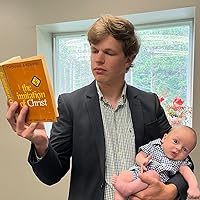
It is rare that a second book in a series captures me in equivocal ways as to the first. Perhaps I’ve read too many “second book syndrome” cases. The Warrior Prophet, I am glad to report, is not one of them.
Following the Holy War on its marches to Shimeh, we discover the true depths of Kellhus’ power. He is a terrifying force with the way he can persuade and manipulate people. I wouldn’t call him a villain in the traditional sense, but I would not say he is a hero by any means, at least not one that I would stand behind.
The way he completed dismantled Cnaiür… he reduced a warrior to a mad man. Using Serwë against him, cutting to the heart of his soul. And let’s not forget what he’s done to Esmi!
Her relationship with Achamian was one of my favorite parts about this book. Their love is so genuine and real, and I loved their scenes together. What Kellhus did to her is unforgivable. I cannot stand by what he does; I didn’t fully support him before, but now I can see what he truly is. He’s the antithesis of Paul Atreides.
Another character I found intriguing besides our main three was Cnaiür. His struggle with his feelings towards the Inrithi was really interesting. He has wanted to belong ever since the betrayal that broke him, and for years, his tribe wouldn’t accept him back. Now, he starts living and fighting with his former enemy, and he can’t help but start viewing them as similar to his people. We’re all not so different from each other as we think, and he slowly starts to slightly care, I think. He shows mercy and compassion; he’s formed a sort of bond with Proyas. I find him more fascinating as I keep reading, and I’m intrigued to see how his journey ends.
Speaking of Proyas, I loved his journey with his faith. He is the epitome of a true believer, fully backing Maithanet and this Holy War. But because of his faith, he lost the two people who he was closest to, Xinemus and Achamian, and he starts questioning if that was worth it. By the way, the aftermath of Xinemus and Achamian’s escape was so devastating. I feel so bad for Zin, and Achamian struggling with feeling guilt is so real. Really well written.
Achamian also struggled with his doubt. He was so certain that Kellhus signified hope and was willing to sacrifice everything, his School, his sacred knowledge, his life, everything, for this man. When he comes back and realizes what he’s done to Esmenet, he starts to question what really is worth saving the world. Does he follow his heart or his head?
I think more people are starting to question this Kellhus guy. Of course there were always the doubters, like Conphas, but I have to believe that people will wake up to what he is. Achamian certainly has started to doubt who he is. He destroyed his relationship and only befriended him and took him on as a teacher to secure more knowledge to better manipulate.
This series will continue to get darker, I fear, if that last section was any indication of how brutal and disgusting things can get. I hope it also continues to explore the theme of faith and what monstrosities people are willing to commit in the name of it.
I’m not a religious person myself, and by my saying this, I’m not in any way trying to disparage others for their faith, but I’ve always viewed faith as a sort of crutch for some people. Needing to believe in something greater, to give a purpose to their lives. I’ve also seen the wars that have arisen because of faith. People so certain in their beliefs that they refuse to acknowledge the existence of doubt, calling any non-believer an enemy of god.
Faith and doubt can, and should, coexist. The world always has balance. When faith becomes certainty, destruction and violence follows.
I’m excited that I’ve finally made it to the last book and am ready to finish this journey. I have no idea how this will end. Shimeh is the key to everything, so we’ll see what happens when the forces converge there.
Quotes
"Never again," Achamian said… “Nothing. No man, no School, no threat. Nothing will take you from me again."
"When I can't find you," he said, "or even when you turn away, I feel... I feel hollow, as though my heart's a thing of smoke... Isn't that 'we'?"
Even when one floated, there was always a current…
Always something to fight.
"And 'barbarity,' I fear, is simply a word for unfamiliarity that threatens."
Fate was but one more world-born subterfuge, another lie men used to give meaning to their abject helplessness. That was why they thought the future a Whore, something who favoured no man over another. Something heartbreakingly indifferent.
The heart recited no scripture.
Love is lust made meaningful. Hope is hunger made human.
How does one learn innocence? How does one teach ignorance? For to be them is to know them not. And yet they are the immovable point from which the compass of life swings, the measure of all crime and compassion, the rule of all wisdom and folly. They are the Absolute.
“When we witness, we testify, and when we testify we make ourselves responsible for what we see. And that—that—is what it means to belong."
It was strange, to be known—truly known. To be awaited rather than anticipated. To be accepted instead of believed. To be half another's elaborate habits. To see oneself continually foreshadowed in another's eyes.
Was that not love? To know, to trust a mystery…
And he knew he belonged to Esmi—not the world.
She was his covenant. Esmenet was his wife.
For events to have purpose, their ends had to determine their beginnings, and this was impossible. Things were governed by their origins, not their destinations.
To open a book was not only to seize a moment of helplessness, not only to relinquish a jealous handful of heartbeats to the unpredictable mark of another man's quill, it was to allow oneself to be written. For what was a book if not a long consecutive surrender to the movements of another's soul? Achamian could think of no abandonment of self more profound.
He read, and was moved to chuckle by ironies a thousand years dead, and to reflect pensively on claims and hopes that had far outlived the age of their import.
If women were hope’s oldest companions, it was due to helplessness.
Nothing etched the shape of one’s impotence with more galling meticulousness than the blank passage of time.
Could anything be so clear, so pure? Outstretched like great, fluid arms the holy warriors embraced their enemy. The sermon was simple. Break. Die.
“He who believes he is defeated is defeated.”
The Prophet simply turned and caught the descending blade between his thumb and forefinger. "No," he said, then swept around, knocking the man to the turf with an unbelievable kick.
What made one response more true than another? Was it one's blood? Was it another's words of reason? Was it one's God?
Or was it, as Moënghus had claimed, one's goal?
For what was madness, if not a kind of overpowering impatience, a need to seize at once what the world denied?
Beliefs were the foundation of actions. Those who believed without doubting, he would say, acted without thinking. And those who acted without thinking were enslaved.
“What if the choice isn’t between certainties, between this faith and that, but between faith and doubt? Between renouncing the mystery and embracing it?”
"I don't know."
Why were these words so difficult?
"Because men want to murder," Achamian had explained afterward. "Because men want their gold and their glory. Because they want beliefs that answer to their fears, their hatreds, and their hungers."
"Men," Kellhus said, "cannot dominate their hunger, so they dominate, domesticate, the objects of their hunger. Be it cattle..."
"Or women," she said breathlessly.
Sitting speechless before the Great Names, Drusas Achamian realized that he held his Heart in one hand and Apocalypse in the other. And as he hefted them in his soul, it seemed that he couldn't tell which was the heavier.
They would sag from the nails that fixed them, collapse into heaps about the base of their trees. And to anyone who listened, they would whisper a revelation... The secret of battle.
Indomitable conviction. Unconquerable belief.