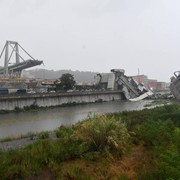
The central character of this story is the consciousness of a bridge. A bridge that knows what it is and understands its meaning: to connect two points on an abyss.
The bridge has theoretical consciousness about its death: "once erected, no bridge can stop being bridge without collapsing".
However, no one has ever experienced to use this bridge.
And even though it was forgotten, it was still a bridge.
So the first time someone tried to get cross her, he hurt her, deeply. She (the bridge) felt the pain. And she wanted to know who did that to her. She realized it was a man. And she understood how he hurt her. But she did not know the intensity of it.
And before discovering this, curious to see his face, or at least his form, she break down and falls.
So even knowing of her meaning, she never had utility.
And then a new question arises: do things lose their sense of being when they have no utility?
----
Dessa vez, o personagem central dessa historia é a consciência de uma ponte. Uma ponte que sabe o que é e compreende o seu sentido: o de unir dois pontos sobre um abismo.
A ponte tem consciencia teorica tambem sobre sua morte: "uma vez erguida, nenhuma ponte pode deixar de ser ponte sem desabar". No entanto, ninguem jamais passou por ela. E embora fosse esquecida, ainda era uma ponte.
Entao, a primeira vez que alguem tentou passar por ela, a machucou, a violentou. Ela sentiu a dor. E quis saber quem fez aquilo com ela.
Percebeu que foi um homem. E compreendeu como ele o machucara. Mas nao soube a intensao dele. E antes de descobrir isso, curiosa ao ver a face dele, ou pelo menos sua forma, morreu, machucada, mesmo sabendo de seu sentido, nunca teve utilidade.
E então surge uma nova questão: as coisas perdem o sentido de ser quando não tem utilidade?