Hiroshi Yamamoto(山本 弘) was born in 1956 in Kyoto. Began his career with game developers Group SNE in 1987 and debuted as a writer and game designer. Gained popularity with juvenile titles such as February at the Edge of Time and the Ghost Hunter series. His first hardcover science fiction release, God Never Keeps Silent became a sensation among SF fans and was nominated for the Japan SF Award. Other novels include Day of Judgment and The Unseen Sorrow of Winter. Aside from his work as a writer, Yamamoto is also active in various literary capacities as editor of classic science fiction anthologies and as president of To-Gakkai, a group of tongue-in-cheek "experts" on the occult.
Do you ever read a book and just think ‘I wish someone had just made that a TV show?’ It happens to me rarely, but in the case of MM9, this just didn’t work as a book unfortunately. The content was there but it was poorly executed as a ‘novel’, if you could even call it that. It’s basically five short stories centred around an anti-monster unit in Japan which deals with natural disasters of ‘monster magnitude’. . I was confused as I thought they were chapters, but every one started by reintroducing the characters, as though we hadn’t just left them behind a page before. That’s why it would work as a TV series, as each section has a new monster to deal with and there isn’t really a principal narrative running through it. . The translation by Nathan Collins was mostly fine, although I spotted a few clunky phrases here and there. But even an excellent translation can’t do much for lazy characterisation. The women in this book... on the one hand we have Yuri, a single mother simultaneously juggling raising a child and being a badass astrophysicist for the MMD. But then on the other hand, there’s Suraka who, within a line of being introduced, is described as ‘not gorgeous, but with a cute, round face like a baby raccoon.’ What??? I could provide further examples but I’m sure you get the gist. . But I was compelled to keep reading (not just because it’s only 250 pages) because the monster side of things WAS cool. We have kaiju (mega monsters) and yokai (mythical creatures which mostly live among humans and wildlife peacefully). They were well explored and it was interesting how Yamamoto combined science and the supernatural. . Overall disappointing but with some cool concepts - like I said, a TV show with lots of women on the production team to get rid of the bullshit and it’d be good watching for fans of sci-fi and myth!
Kaiju (giant monsters) and Yokai are real, Japan is a hotspot for them, there's a government agency (Monsterological Measures Department) tasked with observing and explaining them so that the Japanese army can find a way to blow them up safely. That's all there is to it - a few interconnected episodes culminating in a boss fight, with a kind-of logical explanation as to why kaiju are even possible (with a twist concerning our own reality at the end).
It's a fun short read that doesn't try to be anything more than it is, and what it does it does well. Who cares for feelings, characters, or insights into human nature? We want giant many-headed serpents shooting energy beams from their mouths!
This book is part of the currently ongoing Humble Book Bundle, you get it along with others if you pay more than $15. Legend of the Galactic Heroes Vol. 1, 2, and 3 is also part of the bundle, I've written about part 1 here and about part 2 here.
MM9 means "Monster Magnitude 9." In this case it's kaiju. For those not geeky enough to know this word, never fear, Trike is here: it means Godzilla and the like. If you don't know Godzilla, I can't help you.
Anyway, the MM scale is similar to the Fujita scale for tornadoes. The bigger the number, the more destructive it is.
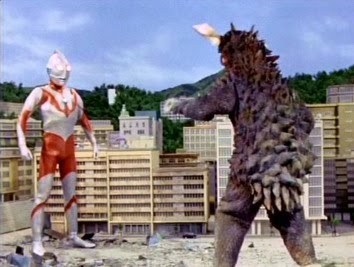
Although I've seen numerous giant monster movies over the years and grew up watching the original Ultraman smash toy cities, I've never read a book about kaiju before. This is pretty much unlike any Gamera movie I've ever seen.
Ultraman!
“This is kaiju!" Yojiro barked. "When did they ever give a damn about adhering to science!” -- MM9
Yamamoto has worked out an entire pseudo-scientific way for kaiju to exist. By their very nature, they violate all kinds of natural law: biology, physics, you name it. There's no way for a creature the size of a building to be able to walk around. We suspend our disbelief because it's cool. For Yamamoto, though, that's not enough; he wants a rationale for them. What he comes up with works just fine, but it's one of those explanations that would actually be better suited with a little less detail. However, it's needed once he ties everything up in the confrontation at the end of the book.
I'll put the explanation behind this spoiler tag, but be forewarned it does come into play for the finale:
Yamamoto does fall into the cliche of the 1950s monster movie that we all know as the "As you know, Bob" moment, where the scientists stops the story for an infodump. I don't know what the Japanese version of Bob is (Hiro? Akira?), but the effect is the same. There's also a lot of awkward phrasing and dialogue, and I don't know if the source of that is in the original text or is due to translation. I desperately want to rewrite this as a movie, smoothing out the bumpy parts, because there is a really fun little -- well, okay, gigantic -- fantasy story at the heart of this.
The idea is quite good, but the execution leaves something to be desired. These appear to be five novellas woven together, so there is some repetition, but overall it's a pleasant enough read.
After reading The Stories of Ibis by the same author, I decided to give MM9 a try.
This is an interesting take on the genre: the Monsterological Measures Department deals with monsters that have caused destruction since ancient times. However, each chapter reads like a stand-alone story, with no character development or growth.
The monsters, in turn, are facsimiles of mythological creatures by design since the author wants to try and explain their presence in a more grounded way.
The story takes a while to start. When it does, it's hard to put down, especially if you do your best to ignore the absurd science that explains it all...I know. The 'Fi' in 'Sci-Fi' means fiction, but this 'fiction' is pure, unadulterated nonsense.
There's also the fact that women are written as overly emotional dummies. A glaring mistake on the author's part. It made me dislike the book a bit.
The translation is defective at best.
I'm sad to say that this is a book I cannot recommend.
Japan is a country constantly beset by natural disasters -- earthquakes, typhoons, tsunami, and giant kaiju. But in the modern age, Japan has used its vast technological resources to ameliorate the problems caused by all these phenomenon. Leading the way is the Japanese Meteorological Agency's Monsterological Measures Department which devotes itself to the tracking and study of kaiju. Whenever a prehistoric monster or mutant crab threatens the Home Islands, MMD is there.
Too bad their PR department isn't as good as they are. Any time a monster makes it into a populated area and kills someone, MMD gets the blame -- and anytime they issue a kaiju warning and nothing happens, they get the blame as well. Mocked by the Japanese populace and paid at civil service rates, the men and women of MMD face a dangerous and thankless job.
MM9 is a fix-up novel consisting of five short stories, each one focusing on a different monster. There's a bit of a story arc as the MMD learns about an apocalypse cult that's planning to commit kaiju-terrorism, but mostly the stories are linked through recurring characters. Unfortunately, they're written with as much personality as Captain Scarlet and half the charisma. It's easier to tell them apart by their jobs -- scientist chick, driver chick, boss man -- than personality. But then, isn't that how kaiju movies operate? Let's face it, out of all the Stomp Tokyo movies ever made, there are only two notable human characters -- Raymond Burr and Kenny, and you only remember Kenny because of MST3K. The real stars of kaiju films were always the monsters.
Unfortunately, we don't get any monsters as memorable as Godzilla or Ghidorah here -- we don't even get Gamera and Gaos. Instead we get things like a giant triffid and a little girl who's grown to hyperfauna size. In a longer series, such outings would be fine, but with just five stories the lack of serious urban remodeling is disappointing. Only the final boss approaches the level of ferocity you'd expect from the premise, but there isn't enough time to draw the story out as needed. After some good Quatermass-style build-up, we get one rushed naval battle and a final show-down that only lasts a couple pages. The story really could've benefited from a full length treatment.
One of the treats of the book is Yamamoto's references to giant-monster movies. Surprisingly, the Japanese kaiju films are given short shrift in favor of Western movies. I suspect this is because the kaiju all have trademarked names while Hollywood and European movies rarely bothered with such things (the Ymir from Twenty Million Miles to Earth is the only one I can think of) making it easier to reference the monsters without getting sued. Any sci-fi movie buff will be able to recognize the films based upon descriptions of the monsters and the mayhem the caused, with an added bonus in their military code-names. A giant spider is named "Arnold," a reference to the great B-movie director Jack Arnold whose many classic sci-fi films include Tarantula (the movie that had Leo G. Carroll over a barrel), and the sea monster from The Beast from 20,000 Fathoms is Ray after Harryhausen and Bradbury.
This is a fine collection of pulp stories, but ultimately nothing more than that.
Very enjoyable, lightweight story cycle, reminiscent in composition to old school SF like Sector General or Magnus Ridolph or Titus Crow, but starring super-giant monsters in Japan and a science patrol very similar to the ones in Ultraman, Inframan, et al. The monsters and the problem-solving plots are lots of fun, and with just a little more characterization or wit or emotion to it (as in Sector General), this might have been a classic. There was a very slight touch of metafiction to it, which I liked, but the allusions to other monster stories were subtle enough not to break my suspension of disbelief.
I enjoyed this book. It's a light, quick, fun read. It tells the story of the MMD (Monsterological Measures Department) through five short stories. The characters seem the right level of complexity for the weight of book. The monsters are entertaining and not too kitsch. The problem solving of the characters is reasonable and moves at the right pace. Each story is almost entirely self contained (two of them share a thread but neither is required reading for the the other). I've not seen any book like this before and I strongly recommend this as a light read about B-movie/mythological monsters.
I picked this up thinking it would be a bit on the cheesy factor, but it turned out to be a lot more interesting and fun (and not really cheesy) than I had thought! I found the translation to be good, the action just right, and background information to be perfect. I could see this being made into an anime!
from the back cover... "Japan is beset by natural disasters all the time: typhoons, earthquakes, and ... giant monster attacks. A special anti-monster unit called the Meteorological Agency Monsterological Measures Department (MMD) has been formed to deal with natural disasters of high "monsterological magnitude." The work is challenging, the public is hostile, and the monsters are hungry, but the MMD crew has science, teamwork... and a legendary secret weapon on their side. Together, they can save Japan, and the universe!"
In that blurb is mentioned a legendary secret weapon. No, it isn't Godzilla or Gamera or Ultraman or Jet Jaguar or.. no, it is something else so don't get your hopes up. Enjoy the book for what it is.
It is set in a world where kaiju are a relatively common occurrence and the MMD are similar to hurricane trackers... where will it appear? where will it go? how bad will it be? and then to help decide what to do about it. It moves quickly, a good amount of action with some character development, and a good scientific explanation for the existence of kaiju and how the world has changed over the centuries. A fun book that I can recommend to monster fans.
I had to read this book for a college class on science fiction. I feel like the book was a useful example in discussions about certain things for the course, but at the same time it really just isn’t college reading and there’s probably better material out there that could serve the same purpose. Besides that, the book alone really wasn’t great. The writing was poor at times and that could just be blamed on it being translated, but there were issues as well.
This book is a good tribute on the kaiju movie/tv with a touch of bureaucracy. The monster is cool, the world building is very good. The universe at the end of story is weird. But it is a very nice story!
Features competent protagonists defeating monsters through investigation and rapid problem-solving. Has action, teamwork, and science talk. The pace is brisk in all but one chapter. All these features are plusses to me.
not my favorite book in word, don’t really like science fiction, it was very mathy, which got hard to understand at time but overall i actually really liked the way it was written and the storyline behind it!
MM9 is the kind of book that frustrates me on so many levels, but primarily it's a difficult read because it couldn't been a much bigger, much more human book than what it was. I know that may sound weird to say, considering it's a book that deals with Kaiju and gigantic creatures stomping all over the Earth and particularly all over Japan, but I felt the characters could've been fleshed out more, given some more backstory, and developed to a point where I could tell one from the other. I almost couldn't in this story, and I think anchoring a fantastic tale of giant dragons and poisonous, overgrown flowers and other Kaiju nasties to a sense of any kind of reality, you absolutely need to have some humanity in the story too. There sadly wasn't much to offer here. I think, too, the problem is that the book is very short. It's only around 251 pages or so, give or take. That's not enough paper to write down all the wonderful ins and outs of this great idea that Hiroshi had come up with for MM9. And this kind of story could have gone so many different directions, been explored thoroughly, and shown us far more than a few Kaiju encounters that the MMD team has to deal with. Instead, the book just abruptly ends, and none of the stories that were kind of being put in place for the few human characters we got to meet were even really resolved. How disappointing. The other MM9-size problem, if you will, was that Hiroshi was waaaaaay too literal and scientific for this book to be enjoyable. Don't get me wrong, I am all about an author doing their research and making me believe and feel the world that they are allowing me to enter. It's important to get facts right, and I think it's also important to let your readers know a bit about the mythology and the history of any subject matter you want to talk about or write a book about. That makes sense, you know? I think of Dan Brown and The Da Vinci Code, and how Dan took timeouts from the narrative in each chapter to really explain what Robert Langdon was dealing with as he uncovered all those crazy, religious mysteries. And Hiroshi often takes timeouts to talk about the physics of certain situations, such as how a large creature couldn't possibly swim a certain speed in the ocean (yawn), or how the Anthropic principle is how the Kaiju have entered our world and affected it (yawn again), and, well, the difference I suppose between what Dan Brown did and what Hiroshi has done is that the explanations of the fantastic and mystical were, in Dan's case, highly interesting and flowed really well with the overall narrative even for being like timeouts in the storytelling, and Hiroshi's explanations started to become distractions to everything that was happening. Honestly, I could care less about the projectile distance of a missile hitting a Kaiju if shot from a certain height. I started to feel like I was reading an instruction manual, not a cool story about a world all too familiar with the likes of Godzilla-like baddies. One other really disappointing turn off for me was that one of the Kaiju was a young girl who could grow into a large giant. I won't say more for fear of ruining the plot or how this girl (unoriginally called "Princess" by the MMD) figures into the important final scene of the book, but let me just say that the moment I read about this girl, I felt Hiroshi just was being lazy with his writing. Why did the Kaiju have to be human? Why couldn't you just keep Kaiju monsters from the deep or another universe or whatever? I kept asking myself this as I read more and more about Princess. It just dulled my interest a lot. The flip side to this book is that it's a quick read, a fascinating read at times, and if are the kind of person who saw Pacific Rim or watch a lot of anime that deals with monsters, then this book could be a much more easier read to digest. And I hope it is, because I think somebody out there who reads this and is an author themself could really be inspired by what this book could've been, and decide to write something similar and improve upon the experience that Hiroshi tried to give us with MM9. Now, that is a book that will probably keep my interest, and make me gush, for years to come.
So, speaking to my own interest in writing a kaiju-based novel, I decided to pick up as many previously written kaiju novels as possible.
Which amounted to three that I could find. This is the first of the three that I've decided to read.
MM9 details in a few short stories the trials and tribulations of Japan's underfunded kaiju analysis and support agency, responsible for the direction of the military and the country's response to kaiju attacks. We follow a few of the main members of the field team and a couple of the head scientists in the headquarters through multiple kaiju attacks over the course of some seven or eight short stories.
What really impressed me the most about this was the amount of thought put into the explanation behind kaiju in this world. It all revolves around something called the parallel anthropic universe theory in which humanity and the development of science and reason has a direct effect on the influx of magic and impossible creatures in our world, splitting the universe in two. In one universe, impossible things like magic and kaiju exist, and in the other, our real world exists. The problem comes from the accidental crossover between these two universes (and sometimes purposeful crossover, when the novel wants to go into the instances of kaiju terrorism). The science sounds great, with a little handwaving, and fair amounts of the text are dedicated to explaining the world around us.
It's refreshing to see that kind of thought put into a giant monster story - something you don't often see in the kaiju films of old.
That aside, each monster was interesting in its own way, like a big puzzle waiting to be put together by the field team and the scientists back at the command center. Each one had some unexpected thing about it, and it made the novel fun to read, if you're in to new ideas and outside the box thinking.
Unfortunately, beside those couple of things, the rest of the book didn't grab me as much. The characters were definitely serviceable, but only illustrate how much emphasis needs to be placed on them to really draw you in to a work. Each had surface level characterization, and served in the same way, generally, as characters would in a big budget kaiju movie, where most of the focus is on the monster and how to deal with it. I think I expected that, to be honest, so it didn't ruin anything for me, but solidified some things in my own work.
The thing I was most curious about, honestly, in all three of the books I've purchased about kaiju, was how they get around the idea that a kaiju battle is such a visual event. I mean, they started out at special effects extravaganzas, and when you don't have that crutch to lean on, your descriptions really count triple. There's only really one big kaiju to kaiju fight, and it's honestly a little anticlimactic, so I guess it's heartening to feel like I could do better.
I learned a lot about what to do with a kaiju novel and what not to do, so the experience was a valuable one. I'd recommend this to anyone who has even a passing interest in kaiju and kaiju-related literature, but not anyone else. I don't think the novel is strong enough to stand on its own without a prior interest in the genre or material.
This entire review has been hidden because of spoilers.
Hiroshi Yamamoto brings us MM9, an entertaining novel following the exploits of Japan's Monsterological Measures Department, a group of civil servants tasked with predicting, studying and handling Japan's defenses when it comes to kaiju (giant monster) attacks!
This is an incredibly fun read. It's light, breezy and very entertaining. The book is essentially a short story collection, each chapter telling a tale of one of the MMD's encounters with a kaiju. The stories are primarily linked by the small ensemble cast of characters more than any over arching plot line, though there is a vague one of those in a few of the stories as well. Hiroshi Yamamoto does a great job at capturing the feel of the monster movies with stories echoing and bringing to mind some of the various movies fans of the genre know and love. The entire book is also a love song to the genre as a whole with references and nods to not only Japans pantheon of kaiju but the international contribution as well. Keen eyed readers will pick up on passing references and nods to Lovecraft, the movie Them!, various myths from around the world and more. None of the characters are terribly fleshed out or three dimensional but that really only serves to reinforce the feeling of a kaiju movie and series where characters tend to have one or two pronounced personality traits and roles to fill. The explanations and scientific theories that are used to explain how the monsters exist are interesting and dabble lightly with ideas like consensus reality, quantum physics, Schoedingers Cat and more.
Obviously I'm not familiar with the original Japanese edition but this English language translation from Nathan Collins reads quite well. There's not a lot of awkward phrasing or verbiage though this causes the one or two moments that an odd turn of phrase pops up too really jump out at the reader. Still it was light and easy, casual read.
Haikasoru has generally been promoting itself as a hard sci-fi/fantasy line, carrying the best and most popular works of the genre from Japan. This, however, feels like a light novel and not in a bad way. It's incredibly and incredibly simple and easy read which bats around some high minded sci-fi concepts but doesn't delve into them to the point where the text becomes dry and boring. Add this to the whole giant monster concept, a dedicated group of scientists battling and directing operations when it comes to them, some rather thin characterization and you have a recipe for a bad light novel. Thankfully, it's not. In fact it's exactly the opposite. All the ingredients gel together wonderfully and the result is the kind of light, easy read that makes for perfect vacation, traveling and beach reading. In the end, MM9 is an enthralling, fun read and in a perfect world more folks would be talking about it.
After I saw Pacific Rim, someone suggested I read Hiroshi Yamamoto's kaiju novel MM9. I did, and let me tell you, in some ways it is better than Pacific Rim.
The story takes place in the present. Ryo, Sakura, Yuri, Chief Kurihama and the others at Japan's Monsterological Measures Departmanet work night and day to protect the country from kaiju attacks. Unlike Pacific Rim, kaiju are fairly commonplace in this world; the MMD records an average of 200 new ones a year, and they've been showing up for decades if not centuries. In fact, they're actually somewhat benign; they usually don't mean any harm, but they're so big they can't help but cause trouble. Their size ties into each kaiju's Monster Magnitude rating, which is pretty much a measure of their destructive potential. The bigger they are, the higher the rating. An MM9 could potentially wield almost godlike power. No MM9 has ever been reported, but as you can probably tell by the title, that's about the change.
Now, you may be wondering: How do they deal with the kaiju that threaten everyone's livelihood? Do they use giant robots like in Pacific Rim and anime? Nope, they're stuck with conventional weaponry. It sounds weird, but MM9 is a more believable kaiju story. The Japanese SDF must consistently find a way to defeat the monsters using present technology. I like this, because it means the beasties aren't dispatched by simple brute force. Yamamoto really used his head, and so each kaiju threat plays out quite differently than the previous one.
I also like the characters. They're not battle-hardened warriors; they're just regular people trying to protect Japan from otherworldly dangers. From serious-but-likable Ryo, to wreckless youth Sakura, to motherly Yuri, to cranky Kurihama, the characters are adequately fleshed out.
However, the real stars of the novel are the multitude of supernatural creatures that Yamamoto thought up. You've got your garden-variety animals that grew large through unknown means, plant-based kaiju, radioactive flying kaiju, sentient yokai, and...well, I won't spoil the best ones. Suffice to say, this book is brimming with imagination.
Oh, and I can't forget the serious research that went into writing this novel. Yamamoto references a lot of scientific theories in the story. Are you familiar with the parallel anthropic principal? What about the law of causality? Do you know what a paradigm shift really is? You will, thanks to MM9. It's educational as well as entertaining.
So, in conclusion: This is a more realistic kaiju story, grounded in real science, and that's why I like it. If you're a kaiju fan, you absolutely must give this a read.
I thoroughly enjoyed this book. It was recommended to me by the professor of a Japanese Disaster Fiction class I took. Basically, this is a natural disaster book/movie-style of story, but instead of earthquakes/tornadoes/volcanoes/the end of the world, the damage is done by kaiju (the Japanese word for massive, physics-defying monsters a la Godzilla, King Kong, the Kraken, etc.).
This is not fine literature, but it's a really fun story, well-told and well-translated. Basically, each chapter follows the MMD (a Japanese Kaiju Defense Agency)as it wrestles with different kaiju. There is a definite through-line to the story, but it is clear by the way they number each kaiju after it appears but before it is named that the story does not simply follow the MMD as it sequentially takes on each kaiju. In other words, each chapter jumps forward several weeks or months. It even has a slightly multi-genre aspect to it as chapter 3 is told largely in the format of a teleplay and is presented from the perspective of a television crew following the MMD around as they deal with the current threat.
The story is creative and is a neat adaptation of disaster story conventions--it has the feel of any number of natural disaster movies...but with giant monsters. There is even a reasonably plausible (within the conceits of the novel anyway) explanation of just how kaiju are able to defy our laws of physics. About 20% of the explanation requires a certain suspension of disbelief, but I'd say that's not so bad. I was pleased to see the issue addressed at least, and creatively so as well (the explanation also explains the long history of monster stories around the world and throughout mythology).
One thing I liked was that the monsters aren't treated as a new phenomenon in the story. The author assumes that they've always been around, and describes how an American was the first to develop a "Monster Magnitude" ("MM") scale, which, much like the Richter Scale, has been adjusted and tweaked over the years as larger monsters have occurred. These monsters didn't just appear out of nowhere, they are a fundamental part of our history, and always have been. For some reason, that was very satisfying.
I have a weakness for books about Kaiju, and this one manages to be clever with some nice backstory and in-jokes for Kaiju fans.
The MMD is an advisory group to the Japanese government that identifies, tracks, and draws up plans to help stop rampaging giant monsters from across the globe. In this book, 5 different monsters rampage and are dealt with by the MMD, as they find out also they have a shadowy enemy that has plans for the kaiju.
While the characters are typical, the ideas behind the kaiju and the types of them are pretty interesting. There is a scale-the MM scale, which ranks them by size from 10 feet (MM0) to hundreds of feet or more (MM9, the title of the book.) The MMD encounter various types in the book. They all are creative, and aren't monsters in rubber suits.
The cosmology also is pretty damn good for the genre. There are two universes, the big bang universe (our normal one) and the mythic universe. Kaiju exist in the mythic universe when alive, which means they don't follow physical laws like mass-energy ratio or others that make giant animals like them impossible to exist. When they die, their corpse enters our physical universe. It's a really clever conceit that becomes a plot point in the finale, and with that extra twist actually becomes a little profound.
There's a lot of in-jokes for the Kaiju crowd. Surprisingly, monsters from across the globe show up in here. All the past monster attacks referred to off camera are expys of other monsters. Quite a bit of them too.
It's probably a four or three star book for others, but I really enjoy kaiju and this is probably one of the best treatments of them I've read in a book that isn't a parody. It's a very brisk and action-packed read too, and I really wanted more. So five stars from me, and I wish they would make this into a movie.
MM9 tells the the story of the Meteorological Agency Monsterological Measures Department (MMD), a department of the Japanese government that is in charge of handling situations involving giant monsters (kaiju). The MMD is more of a National Weather Service for monsters than it is a military organization: it is in charge of tracking kaiju, predicting where they will make landfall, what category they are (based on a Richter Scale inspired 'Monster Magnitude' system), whether or not the kaiju will be a danger to humans, and ultimately how to handle the monster. I thought this was a nice change of pace from most kaiju media which is usually "shoot the monster with increasingly bigger guns until it dies".
I'd call this a collection of inter-connected short stories, though you could argue that they are chapters. For the most part, I enjoyed the book...up until the final (and coincidentally, longest) story/chapter. There was a lot of build up to a somewhat lackluster finish, and the endgame monster is...uh...well, it might just be the definition of "trying too hard" ().
Up until the final story, I was going to give this 4 stars. After the final chapter, I give it 3.
A really fun novel. It has an unusual explanation for Kaiju, and references to many of the old 60's american giant monster films.
One of the things I really liked in this novel is the group fighting the Kaiju aren't a group of soldiers or superheroes, but civil servants. Giant monsters are so common that the office in charge of them is part of the meteorological services. They work with the JSDF in an attempt to not just kill Kaiju, but to do so with as little damage as possible. This adds an element that isn't often found in Kaiju stories. The novel has an unusual structure, feeling more like a fix up than a traditional novel. It is split into several more or less independent stories, each of which focus on a different Kaiju. Most of them, while having some similarities to movie monsters, are different enough to stand out. Especially the first and last monsters in the novel. It delves into mythologies from many different cultures and creates a very interesting mythology. It's honestly on par with the weird usages of mythology in Snow Crash.
A must for fans of giant monsters of any kind. Also for those who like odd, shaky theology and philosophy.