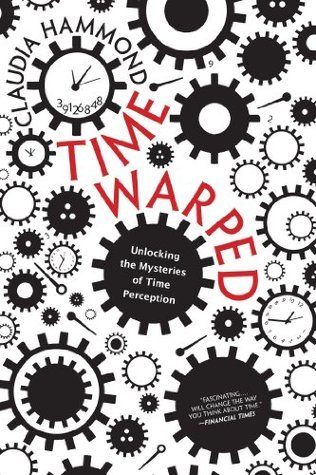
There tends to be a lot of overlap between books when it comes to reading pop psychology, but Time Warped offers something different. It is narrow in focus yet broad in scope, examining time perception, the idea that the experience of time is created by our minds—that time is weirdly elastic.
The book covers a panoply of topics, from how our brains seem to naturally measure time passing to our visual representations of time (The latter section was very abstract to me, probably because I always view time as linear and not as a three-dimensional slinky or oval. Now I feel boring). The journalistic writing style is very engaging, combining human interest stories with research studies, à la Malcolm Gladwell. The anecdotes were fascinating; you’ll read about a cliff diver, a prisoner in Gaza, a man isolating himself in a cave in France, and a plane hijacking, among others.
The sections can feel disjointed, as if part of separate news stories. There’s a lack of flow. The topics are obviously related, but Hammond lectures like a passionate professor, excited to blurt out every piece of information that comes to mind. You can hear her enthusiasm in the tone and it is very contagious, but hard to follow at times. One other minor annoyance for me was the repetition of “I’ll talk about X more in chapter #,” even toward the end. I know there’s more book left! You don’t need to tell me that every time.
There was one idea that particularly resonated with me, and it is the idea that our brains are stuck in the future tense. The anticipation of a trip as you’re planning it often feels more gratifying than the trip itself (like a different definition of “it’s the journey, not the destination”). You try to “be in the moment” and take in a beautiful view without allowing yourself to be distracted by dinner plans or what to see next. Most of us don’t keep journals describing all the big and small moments of happiness in our lives, and those memories fade quickly into obscurity, forever lost. It can be depressing to think about how our brains are wired.
Hammond also provides insights about memory that I hadn’t considered: “Our unreliable memories might feel like a deficit, but they facilitate mental time-travel into the future.” Less cognitive load means more flexibility. She also suggests that perhaps the primary purpose of memory “has nothing to do with looking back, but more to do with allowing us to look forward and imagine possible futures.” I have read a lot about memory over the years, but that blew my mind.
People seem fond of turning their noses up at self-help books, but I really enjoyed the practical tips given at the book’s end. Here are a few of my favorites (mostly for the benefit of my future self):
+ Practice mental imagery for the things you want to accomplish. If you need to remember to get eggs at the store, visualize the steps it takes to get there, including finding the aisle and checking for cracks in the eggs. Instead of imagining the outcome (like acing an exam), imagine the process (studying at your desk in the evenings). Picture every detail. You’ll be more likely to complete the task.
+ To make time pass faster and increase concentration, practice mindfulness techniques. Take deep breaths. Notice the details in the mundane.
+ You will not have more time in the future. Before you agree to do something, imagine that it is happening next week instead of months from now and see if you feel the same way.
+ To better estimate how long something will take, ask someone else how long they think it will take you. We tend to underestimate the duration for ourselves but not for others. (I asked my wife how long she thought it would take me to finish writing my novel and she said, quite frankly, “Two years.” I’m banking on that.)
+ If you’re constantly anxious about the future, imagine putting your individual worries into a box under the bed and closing it until you decide to retrieve them again. Or set aside 15 minutes in the morning to do nothing but worry about the future. Make a list of your worries and think about them, but once the time is up, remind yourself not to contemplate them again until your next scheduled worry time.
+ Most importantly, more memories are the key to a longer life. My own advice: Have a lot of interests and be open to new experiences. Plan vacations or even day trips throughout the year. Visit museums, eat at new restaurants, volunteer, go for walks in a different park every weekend, seek out events and classes, from blacksmithing and painting to improv comedy and LEGO conventions. There is so much to do and see in this world. Experience it.