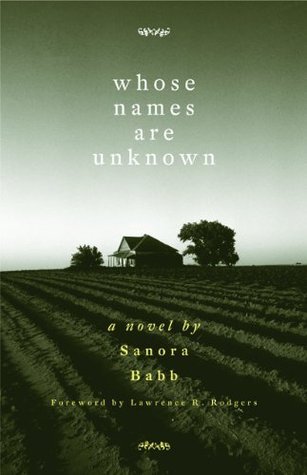
Sanora Babb's long-hidden novel Whose Names Are Unknown tells of the High Plains farmers who fled drought and dust storms during the Great Depression. Written with empathy for the farmers' plight, this powerful narrative is based upon the author's firsthand experience. Babb submitted the manuscript for this book to Random House for consideration in 1939. Editor Bennett Cerf planned to publish this "exceptionally fine" novel but when John Steinbeck's The Grapes of Wrath swept the nation, Cerf explained that the market could not support two books on the subject.
Having read that, you know that this is a book of historical fiction about life in the Oklahoma Panhandle during the Depression and the ecological disaster of the Dust Bowl Era. You will feel you are choking from the dirt during the wind storms. You are starving. You are being thrown from your land by the banks and big businesses. What do you do? The Dunne family joined the stream of other migrant workers traveling westward to the promised land of California, to work on the fruit farms and cotton fields. Hard work, low wages and high costs for housing. A loosing battle. Not a chance in the world to succeed. Have you read about this before? If so, you know what lies in store for the family. Through this book you experience it. YOU are one of the despised Oakies in California. You are in their shoes....if you are lucky enough to have shoes!
Sanora Babb, the author, lived herself on the Oklahoma Panhandle. In the 30s, she herself worked through the Farm Security Administration (FSA) camps with the refugee farmers in California. At night she wrote. This book speaks the grim truth. The author knew up close what these people endured. Are you brave enough to find out? She was closer to their lives than Steinbeck ever was. It shows. I loved The Grapes of Wrath too, but the plight of the migrant workers feels somehow more intimate here. Two different authors, too different writing styles, even if the theme is the same. To my mind both are equally good. Both are excellent. Babb has her own way with words - wonderful depictions and wonderful dialogs. She captures how children speak to each other. Babb's is maybe grittier, less abstract. That Random House judged Steinbeck's novel to adequately cover the subject matter is, in my view, completely wrong!
Furthermore, I loved the reading of the audiobook by Alyssa Bresnahan. Five stars for the narration too.
The ending? It was perfect.
If I may say so, Random House made a huge mistake. It is a crime that so few people know of this book. It deserves high acclaim. I will soon be reading An Owl on Every Post, the author's memoir of her childhood on the Great Plains.
Oh, one more thing. There is compassion and sharing and love in this book too.
SANORA BABB In the late ‘30s, Sanora Babb wrote a book about the “Okie” migration to California during the Great Depression. It was said to rival John Steinbeck’s The Grapes of Wrath. Steinbeck’s book was an immediate best seller that won the Pulitzer Prize and the National Book Award. A movie based on the book, directed by John Ford, was nominated for seven Academy Awards, winning four, including Best Picture.
Sanora Babb’s situation was a case study in bad timing. Random House was preparing to publish her novel, Whose Names Are Unknown, when The Grapes of Wrath hit the market. Bennett Cerf, the head of Random House, made the decision to shelve her book because he said it was too much like Steinbeck’s and would appear to be too much of an imitation. Babb tried to interest other publishers in her book, but to no avail. The other publishers agreed with Cerf.
She put the manuscript in a box and put it away.
ONE TALL WOMAN Whose Names Are Unknown is impossible for me to review without writing about its author, but it would take up too much space to tell her whole story. However, I will include some details about her personal life that are pertinent to an understanding of her book, but if you want to read more about a relatively unknown writer who deserves to be better known and whose life is another case study, one that teaches us to never give up, that through perseverance the many obstacles placed in our paths can be overcome, here is a link:
I have a GR’s shelf that I have titled “Tall Woman.” The title has two sources. The first was a “strong woman” shelf that belonged to one of my GR friends, the late Kirk Smith, which gave me the original idea. And the other is the title of Wilma Dykeman’s novel, The Tall Woman.”
I have made a place on that shelf for Sanora Babb.
Though neither of her parents were Native American, Sanora Babb was born in 1907 on the Otoe Reservation in Oklahoma. Walter and Jennie Babb and their two daughters, Sanora and Dorothy, moved to the southeastern corner of Colorado to live on the homestead of Walter’s father. Sanora and her little sister, mother, father, and grandfather did not live in a house. The five of them lived for four years in a one-room dugout. In other words, they lived in a hole in the ground.
Her father and grandfather attempted to grow broom corn on the homestead, but because of drought only one crop out of three or four was ever harvested. There were many times when the family went to bed hungry. It was during that time that Sanora developed an awareness and appreciation for the nature of class differences, the struggle to retain dignity in the face of soul-shattering poverty, and, more important, the most basic struggle of all, wondering where the next meal would come from.
In 1929, Babb moved to Los Angeles and after struggling and even being homeless in the wake of the stock market crash that year she was soon able to make a living as a journalist. Because of her experiences of growing up poor she later took a job with a New Deal agency, the Farm Security Administration, as assistant to manager Tom Collins, setting up tent camps for the Dust Bowl migrants who were harvesting California’s fruit, vegetable, and cotton crops.
One of her jobs was to keep detailed field notes. Since she was a writer she soon began to use the notes to write a novel which would become Whose Names Are Unknown.
At the same time John Steinbeck was traveling through the same area doing research for the novel that would become The Grapes of Wrath. He became acquainted with Tom Collins and they hit it off and unbeknownst to Babb, Collins gave Steinbeck copies of her field notes.
Here is Steinbeck’s dedication in The Grapes of Wrath:
To CAROL who willed the book.
To TOM who lived it.
Carol was his wife; Tom was Tom Collins.
Neither Collins nor Steinbeck knew that Babb was writing a novel. I should also add that there is no way of knowing if Steinbeck made use of her notes or, for that matter, even read them. But the publication of his book killed the chances of her book being published.
What a shame that was. She personally knew what the so-called Okies had experienced because she was one of them. She knew about the dust storms first hand, because she visited her mother in Kansas in 1934 and heard her mother talk about what people were contending with in the Dust Bowl. That is why, unlike Steinbeck's book, over half of her book is set in Oklahoma. What she wrote was partly based on what her mother described to her and partly based on her own life living in that dugout during her childhood.
She also had firsthand knowledge of what the migrants experienced in the California orchards, pea patches, and cotton fields because she was there attempting to make their lives a little more bearable. She knew what happened to the workers when they organized sit down strikes in an attempt to get a few cents increase in pay for their labor in the fields owned by huge corporate farms. They didn’t have much success because the corporations, driven by the bottom line, had no conscience.
WHOSE NAMES ARE UNKNOWN This is the notice that the strikers received, which is also the source of Babb's title:
“To John Doe and Mary Doe, whose names are unknown:
“You and each of you will please take notice that you are required to vacate and surrender up to me the premises now occupied by you; said premises being known as the California Lands Unit 20. -- Manager, Hayes and Berkeley Company”
It is the California portion of Babb’s book that most closely resembles Steinbeck’s and that caused publishers to reject it after the publication of The Grapes of Wrath.
Whose Names Are Unknown was eventually published by the University of Oklahoma Press in 2004, sixty-five years after Sanora Babb had written it. She died on the last day of the following year. She was ninety-eight years old.
1930's, Oklahoma panhandle and the horrifying Dust Bowl, dust that coated everything. The food, the crops, lung diseases, animals dead or dying and finally killing the hopes of many of these tough, hardworking people. Most left their farms of many years, heading to the migrant camps in the West. I have read non fiction books, seen the PBS documentary but for me this book made a huge impact.
I think it was because we get to know some of these families. Their pride, their hopes, just trying to get a little ahead so they could feed and clothe their families, send their children to school. It became more personal to me. It is one thing reading a book, another thing feeling that book and that is what this book does. We grieve with the mothers watching their children have next to nothing to eat, sleeping all day so they would not feel their hunger. Watching many die and yet with so little still sharing what they have with those who have none. Amazingly strong people, who never give up hope, you think it a disgrace to take a government handout. All they want it work, work that pays fairly for their labor, they are willing to do anything they need to do. So they travel, go to where there is supposed to be work. Living in tents, yet still not making enough to hang their hats on, feed their bellies.
Unions, organized sit-ins all the precursors to the modern day fairness that we expect in our workplaces. Labor laws and the rest, all because of these starving, amazing people. They came first and fought, starved, died and as with many other instances in history we owe them a debt of gratitude.
Before saying anything about the book, I want to thank Dave Marsland and Diane Barnes for making this copy available to me.
Sanora Babb’s exposé on the dust bowl migration of the depression era is a marvelously done tale, with characters that become very real over the course of their journey from the hard life of the suffocating dusts of Oklahoma to the untenable exploitation of the California fields. The novel was awaiting publication by Random House when Steinbeck’s Grapes of Wrath hit the publishing world, sidelining the Babb work permanently. Thankfully, The University of Oklahoma Press has favored the world with the publication of this novel at long last, and one can only be sad that it is even now a work that is not readily available to readers.
I find The Grapes of Wrath and Whose Names are Unknown to be vastly different in both their construction and their style. I will confess to actually preferring this work over the Steinbeck, which seemed to go on too long for my tastes.
Like no other time in our history, the Depression separated the haves from the have-nots.
“Funny how we talk about our roots when our people have been here for generations."
"Interesting, too," Anna said, "how we're not really divided according to our nationalities, but by how much or how little money we have. Most of the differences are acquired, they depend on what money can buy you.”
Perhaps the hardest thing to imagine is watching your children slowly starve while you are out all day gathering in the fruits and vegetables that will grace the tables of the more wealthy members of society. The work is hard and the rewards non-existent, and there are memories of the life you once had before nature turned on you and the banks seized your land and farming equipment. Most of these people had seen better and more independent times, and all were working hard and long hours for subsistence pay.
I seem to be reading a lot of books lately with emphasis on the difficulties of farming, the fickle nature of Nature, and the ways in which the government makes a bad situation worse. That there is any element of hope is almost miraculous, but Babb finds that in the strength of these people. A meaningful historical read.
The story behind this book is the decision not to publish it in 1939 because John Steinbeck beat her to the punch with "The Grapes of Wrath", and it was felt to be too similar in theme and subject to compete with a well known author. The real crime here is that it was forgotten until 2006, when it was unearthed and published by The University of Oklahoma Press. Adding insult to injury, it is not readily available at libraries or bookstores, and can be hard to find and expensive when you do, even for used copies.
I read Grapes of Wrath at least 50 years ago, and yes, it was a powerful book about the loss of farms in the Depression, during the drought and dustbowl years, leading the "Okies" as they were known, to head west for possible work on migrant farms. Sanora Babb, in a first novel, did exactly the same, giving us the story of Milt and Julia Dunne, their two young daughters, and neighbors in the same circumstances. The first 2/3 of the book is their story of trying to save the farm with backbreaking labor, which is useless without rain to make the crops grow. She puts a human face on these people in the midst of a climatological disaster during a worldwide economic depression. They literally had nowhere to turn for help and no one to turn to except each other. So they hit the road along with a neighboring family, and head to California, the land of opportunity.
Except that it wasn't. The huge vegetable farms and orchards were mostly run by huge corporations that had no heart and offered backbreaking labor for pennies a day, then taking those pennies away in company stores charging exorbitant prices. Keeping your dignity is really hard when your children are starving.
This book made me ashamed of my complaints about inflated food prices in the grocery store, and my whining about the extreme summer heat and humidity this year. At least there is food available. I have air conditioning and a protected living environment. If you think you have it hard, read this book and try to imagine yourself in their shoes, because we have been destroying our environment for a long time, and the dustbowl tragedy was just a warning shot.
I wish this book would become more widely available. I have Dave Marsland to thank for sending me this book, with the stipulation that I share it with others. I readily agreed, and will send it along to another reader soon.
First, I must offer thanks to those who made it possible for me to read this book: Thanks to Dave Marsland, Diane Barnes and Sara Steger for keeping the book alive! And Howard who brought it to our attention in the first place. All of their reviews are worth checking out.
Life could not be any harder than it was or money more scarce.
This is a novel that is hardly known and should be known by everyone. Written in 1939 by a woman who was just edged out on the publication of her novel by John Steinbeck’s Grapes of Wrath, Sanora Babb had a masterpiece in her hands and the world wouldn’t know about it until it was finally published in 2004. This novel demonstrates the plight of the farmers who tried and failed to farm on the high plains of Oklahoma in land that was so unforgiving. These families withstood the droughts and the dust storms that occurred during the Great Depression and Babb writes with her first hand experience.
In this story, the Dunne family live a life of drudgery and hardship with no way to fight the natural disasters that wipe out their hopes and dreams - simple things like building a house of their own and having enough food to eat. Try as they might, the Dunnes are barely making ends meet when they are forced to abandon their land and head west to California where they expect to find a glorious promised land of blooming crops and green valleys and plenty of work and food for everyone. What they find is a place overrun by people just like them - destitute and starving refugees looking for work and living in tents or their cars hoping for a break that will help them feed their families. Many are immigrants but all are hardworking men and women who just need to work in order to survive. Their lives become migratory as they move from place to place picking peaches, prunes, apricots, cotton, etc. They discover a flawed system in which ‘those who have’ lord their power and status over ‘those who have nothing’.
In the last few years they had learned how to do without things they always considered necessities in other days. Maybe you wouldn’t call it hunger, he thought, but it’s a kind of left-handed starvation in more ways than one.
Babb’s novel is thankfully becoming more known and I hope that it will continue to spread its recognition. This is an important piece of history written by one who knew poverty. She was able to pack a big punch of themes into this slim novel - natural disasters, greed of banks and corporations, misuse and exploitation of workers. By the end, readers understand that men and women want to live lives with dignity.
A conversation with grandpa:
”Do you know everything, Konkie?”
“Not by a long shot! If I did I wouldn’t be in the fix I am.”
“Maybe when we grow up we can find out how to fix you,” Myra said.
“Maybe so. Maybe so. Maybe you can fix the world. It’s out of joint somewheres.”
“Maybe if it was fixed there wouldn’t be any poor people like us.”
"The desperation of living came up in him again, in anger and in humiliation; in anger he shook his fist, shook it hard and fierce at something in the world”
This is an absolute gem of a book. Written in the 1930s but not published until 2006 because it was completed around the same time as Steinbeck's The Grapes of Wrath but was considered too similar. Maybe that was true but Whose Names Are Unknown stands the test of time, and really shouldn’t have been hidden away for so long. It follows the plight of Milt and Julia Dunne and their family. Farming in the Oklahoma Panhandle they are faced with terrible choices. Their crops consistently fail while the dust storms becomes ever more destructive. The chapter where Julia writes a diary describing the storms is terrific.
"April 27. Black as night nearly all day. This is one of the hardest weeks. Many nights we can hear the cattle bawling for water. They sound pitiful and helpless, and there’s nothing any of us can do. We need groceries today but don’t dare venture out. With our wheat gone our credit won’t be worth anything”
Dispossessed and ashamed they flee to California, in the hope of a better life. It doesn’t exactly work out that way. It’s a powerful, compelling story that gathers resonance as you unpeel the layers. The destruction of the environment, economic migration, greedy and rapacious banks/ corporations, low wages, exploitation. It went straight on to my favourite shelf.
During the Great Depression, Milt and Julia Dunne and their two young girls are struggling to survive the Dust Bowl in Oklahoma during the Great Depression. They, along with a neighboring family, travel to California, where they become migrant workers. They eventually join the labor movement.
This book has an unusual backstory. It was scheduled for publication in 1939. However, it was shelved after John Steinbeck’s The Grapes of Wrath was published to wide acclaim earlier that year, since they are similar in plot. It was eventually published in 2004 when the author was ninety-seven. It takes its title from eviction notices in the Depression era.
I have now read both books. This one is more closely focused on the family’s travails and their daily interactions, whereas Steinbeck’s novel is a sweeping epic with dramatic set pieces. I see them as complementary.
As a side note, this book would make excellent reading for authors writing historical fiction set in the Great Depression era. This author lived through it and wrote this book contemporaneously.
I fell in love with this book the instant I started listening to it. The audio narration is excellent, the writing gorgeous and the characters so well drawn that I was immediately captivated from the first page. This novel has some incredible descriptive writing, clearly the author's forte. I don't think that I will ever forget the dust storms described in this book. It's really a shame that this author wasn't published in the 1930s. I hope this book finally finds the many readers it deserves.
Thank you Lori, Diane, Sara for introducing me to this book. Having heard that this book is difficult to find I was happy to so easily find the audiobook on Hoopla.
I put this book on "Hold" through The Library Network after watching The Dust Bowl documentary on PBS last year; this book finally arrived a few weeks ago, just in time for PBS to rerun the documentary. The story behind this book: Random House editor Bennett Cerf was going to publish this work until John Steinbeck's The Grapes of Wrath beat him to the punch, and Babb's book was considered to be "a sad anticlimax." I have read The Grapes of Wrath; I have found "whose names are unknown" to be a better read. Babb's book is a more intimate character study of farmers who started out to be self-reliant and were then beaten back by the weather and poor government policies. Babb's character studies are breath-taking and her observations are profound. Here is a sad statement from the local doctor: "He always thought it better that no one see how he lived. As he closed the door he could see impersonally the whole jumbled intimacy of the room as that of a lonely man. It made him strangely uneasy, this feeling of having left part of his live unlived. When there are no years left for changing, he thought, these disturbing thoughts are only lulled by the attendant weariness and hopelessness of their repetition." Babb's own story is equally absorbing and is shared in the foreword.
This is the book that should have won the Pulitzer Prize in 1940 instead of Grapes of Wrath because it was written by an author who had lived the story, and I think she wrote a well crafted narrative.
In the early 1900s Sandra Babb as a child grew up in a one-room dugout home in southeastern Colorado on a failed homestead. Later during the 1938-39 dustbowl years she worked for the FSA during which time she kept detailed notes on the tent camps of the Dust Bowl migrants to California. During this same time she was receiving letters from her mother who lived in the Oklahoma panhandle and in these letters she described multi-day dust storms.
She combined the information from these notes and letters to write this novel about a family who had lived a number of years in the Oklahoma panhandle region and were forced by drought and repeated crop failures to move to California to seek work as migrant farm workers.
Random House planned to publish Babb's novel, but Steinbeck's novel was published first with great sales success. Because of the similarities of the two novels Random House decided not to publish Babb's novel. It remained unpublished until 2004, one year before Babb's death.
The first half of Whose Names Are Unknown is devoted to describing farm life and the neighboring community in the Oklahoma panhandle. Thus the book provides considerable character development prior to the family arriving in California, and the reader knows more about where the family came from than what is provided in Steinbeck's novel.
The Grapes of Wrath has more allegory and religious references so it's possible literary critics would have preferred it had both books been published in the 40s. However, I think Whose Names Are Unknown describes its story more realistically.
Whose Names Are Unknown is a fictional book about the dust bowl and the lives of those who migrated to the farm fields of California. Babb writes of the hopelessness and loss of dignity visited upon these people less than a hundred years ago. They starved with their crop failures and were repossessed of their farms in Oklahoma, leaving behind their elderly kin, and then were starved and denigrated in the fields and orchards of California.
As the dust ruins crops and the people run out of resources, she writes about those who would like to help.
“He felt suddenly impatient, not with the woman before him, but with the whole business of watching people live and die and being able to give them very little more than a half measure of help in either. If he questioned this woman about her diet, he knew what he would find out. It was the same with all of them. No use to ask, when he could not help. He could give them his time, his knowledge, his skill, but he could not give them what they needed. They could not afford to pay him and the ones who could put him off. More and more the poor farmers brought him eggs or milk or butter whatever they could spare as a token of their intention.”
She writes descriptively of the dust and its effects, as in this passage where Mrs. Starwood, whose husband has died, tastes her tears “…along with the grit on her teeth and the powdery dryness of her tongue. There was a scratchy feeling in her throat, and she remembered her husband— remembered him as she imagined him in the ditch with the thick black dust blowing over him, remembered him afterward as she watched him die, his lungs rattling and blowing his chest up hard and full in that determined ever-quickening instinct to keep alive.”
In California, everyone of the migrants who could work had to work, if they could find work. The food they travelled with to the golden state ran out before they could find work. When they got there, they faced hardships and discrimination. The work in the deserts of Southern California was back breaking and hot. After the first picking jobs were harvested, the fruit orchards of Northern California were something of a relief to those who could be hired on.
“Here, in the pleasantest of all crops, the migratory workers, toiled to make their winter stakes. Orchards lay on the undulating slopes to east and west and north and south. Between the trees, along the thousand fragrant aisles, people moved with baskets and pails, up the ladders, into the dark leaves, working, speaking across the heavy branches. ….Outside and beyond the trees, waiting, were the people who did not find work, who looked every day for odd jobs, who asked every day to pick fruit, who lived with the fear of winter, and slept every night with this fear, tramping up and down in their dreams.”
My grandmother, born in 1895, who had primarily grown up north of Spokane, was estranged from her first husband. With her first child, she sought work in the logging camps, canneries and orchards of Oregon and California, moving ever south. This was in the 1920s, and all my grandmother had was spunk and a need to support herself and my aunt. The day my next aunt was born, she was picking peaches in the central valley. So this story resonates with me as she was a poor woman without any prospects on the eve of the Great Depression when my own mother was born.
A major theme of this book is how human beings can find dignity in work that earns enough money to actually house, clothe, and feed themselves and their families. Moreover, there is no dignity in employment that fails to provide sustenance.
“He was no different from any other man in this, his wordless, hunger, for dignity, to have faith in men, who seemed to him misshapen by the world they lived in, never reaching their fullest bloom. Living was a sorrowful business to an old man, and all the people he knew, filled with hard work, worries of every kind, fear, and doubt for the future. A man forgot his youth and securing his old age, and there was no certainty even in this.”
The hopelessness of the times weighs down the words of this book. “The man with words is not the only man who thinks and weeps with the deep question of his being. Let no one ever think himself apart in this. Let him sit down and talk to any man and feel his shame; the unsayable things come out as clear and simple as a bell at night in every word he speaks. He wants more than bread and sleep; he wants himself – a man to wear the dignity of his reason.”
I give the book 4.5 stars. The half point off is because at times I thought I was reading a magazine article documenting the troubles of the migrant farm workers, and a bit less involved in the fictional story of individual characters. Nevertheless, this book belongs on the same shelf as The Grapes of Wrath.
This entire review has been hidden because of spoilers.
I was over halfway finished with this book when I realized that I couldn't read anymore. It was boring. Thinking about it, it was more like a juvenile book.
I wished I could remember more about the history of this book. I only know that she wrote it before Steinbeck wrote his Grapes of Wrath, but his was published, hers wasn't. And now that it is published, I wonder how many people read it?
Like Steinbeck's book, it's a story about a migrant family. I can't even tell you 1 thing about this family, that is how boring it was.
I happened upon this at the library. When I researched the author, I can't believe I haven't heard of her. With this novel in particular, Babb lived in Steinbeck's shadow. It seems he used her notes for living at the federal government camps during the Depression to help him write his story of the Joad family in The Grapes of Wrath. When Babb submitted the manuscript, she was told there was already a novel about the Depression - didn't want to flood the market.
I think what this book captures (in so many fewer pages than Steinbecik) is women at the center of the novel. Julia and her husband, along with their two daughters, struggle to keep their farm running during the dust storms of thirties. When things get too difficult, they leave her father and the farm behind.
California isn't easy nor is it welcoming. Babb highlights the many highs and lows the family encounters with a focus on how women come together and create found families and homes. Yes things were tough on the men, but the women had to keep not only their family together, they had to find a semblance of home.
This is a wonderfully drawn narrative with just enough of the family dynamic to keep things moving along.
My understanding is that Sanora Babb’s research notes for this book were shared (without her permission) with John Steinbeck, and that his resulting book, The Grapes of Wrath, then created publication difficulties for hers. It is sad that this happened and that her novel isn’t more widely read. Her novel is a solid one, which depicts the downfall of good people trying to make a living as farmers in Oklahoma during the 1930s. To them, their land is a “gold brick.” Until the dust storms come, life is hard but bearable. Yes, the farmers must buy groceries on debt until their harvest pays. Yes, they must hike miles to take weekly baths in creeks. But there is hope for the future, community solidarity, plans for marriage, plans for farm expansion, even newly purchased land waiting to be planted. However, when the dust storms arrive, they black out the sky and change everything.
“Seems queer that just at the time the world is hardest to make a living in, nature turns on us too.” (p. 93)
Farms are ruined, communities are destroyed, lives are decimated (note: trigger warning for suicide), and the farmers are forced to move to California in search of work. In California, they live in migrant camps, or, if they can pick enough crop (900 pounds a day), in company cabins. There, to their shame, they must take government relief. There they face stigmatization from Californians as well as violence from land owners’ hired muscle—armed men paid to put down strikes and prevent labor organization. There they are often forcibly evicted from company cabins while their kids are at school, such that all their belongings are left outside on the ground. What comes through clear is how hard and unfair poverty is, how heartless people can be toward the poor, and how easily inequality can spark social conflict and violence.
“When a man works and makes a good wage and knows he’s taking care of his family … he feels mighty good. He don’t want trouble.” (p. 221).
Whose Names Are Unknown follows the Dunne family and their community as they attempt to survive the Dust Bowl before making their way to California, where they are met with discrimination and exploitation.
This book is often described as unsentimental, and I can understand why. The prose is deceptively simple and restrained. However, I would have to disagree with that assessment. I am a heaux for prose, especially the lush, lyrical kind, but the pared-down, direct writing perfectly suits the time, the place, and the people who inhabit these pages.
These characters feel like the salt of the earth: decent folks simply trying to survive an impossible situation. There is no need for grand allegory or sweeping philosophy to captivate the reader when there is such raw, unvarnished humanity on the page. Despite the novel's relatively short length, I became deeply invested in these characters and desperately wanted them to succeed. There are several truly harrowing and heartbreaking moments that hit even harder because they feel like they really happened to someone. The novel often reads like exceptional narrative nonfiction, and that's exactly why I loved it so much. It takes remarkable talent to write fiction that feels this real.
One of the biggest surprises for me was how progressive the book feels. I have grown so accustomed to encountering racism in books from this era, and, let's be honest, in books published today, that it was refreshing to see something different. While the prejudice of the time is certainly present, there are also moments of genuine progress. A white man considers a Black man to be his equal and even admits that he wants that man's respect. Filipino and Mexican men and women are also portrayed with dignity and respect. It was a beautiful reminder that there have always been people who rejected bigotry and refused to see others as beneath them.
Lastly, I have not yet read The Grapes of Wrath, so my perspective comes from someone who has read some Steinbeck, but not the book most often compared to this one. I plan to return with thoughts and comparisons once I finally read it.
Sanora Babb's book is about Oklahomans who hung on to their farms though most of the Dust Bowl years, then walked away from their land and pressed on to California in hopes of a better life. I'll tell no more of the plot than that, because I can't possibly do justice to her magnificent prose.
Babb sent the manuscript to a New York publisher who at first was agreeable to publishing the book -then turned her down when the better known John Steinbeck brought in his manuscript for "Grapes of Wrath." Said publisher told her the market wouldn't bear TWO novels covering the same subject area. (What a fool. And how wrong he was. And again - what a fool.)
Since Steinbeck availed himself of research done by other writers, including Babb, it is possible - just possible - that HE was inspired by HER.
At any rate: she shelved the novel, wrote other things and this didn't get into print until some 70-odd years later.
I have longed believed "Grapes of Wrath" to be one of the finest books ever. But "Whose Names are Unknown" is better by far.
Sanora Babb's Whose Names Are Unknown suffers somewhat from its strident tone and perhaps a bit too-cartoonish characters, and certainly suffers in comparison to The Grapes of Wrath, a much-superior literary work. But the book itself--with its history of acceptance-then-rejection--serves as a scrappy, uplifting tale of ultimate victory that its own plot lacks.
With many story elements in common with Steinbeck's masterpiece, Babb's tale of displaced Okies is notable for its spare prose style and a lack of lush description. Instead, the book hammers its political viewpoint with steady, unblinking realism and almost no "speechifying."
The most depressing element of the book, for me, was its continued relevance today. Every point Babb makes about class, wealth, power and greed is as true in the 21st Century as it was during the Great Depression.
Haunting story reminded me of Dorothea Lange's photographs of migrant families during the Great Depression. Many good scenes that focus on the women's experience of Dust Bowl conditions in Oklahoma. For example, a recently widowed woman gets a foreclosure notice from the bank because she can't pay the home loans. She walks into the bank with a dead skunk, drops it on the bank manager's desk, and tells him off. He says he's going to call the police because she's disturbing the peace. She replies "You've been disturbing my peace for years!" and walks out laughing...
Why isn't everybody reading this book? It's as brilliant as THE GRAPES OF WRATH and more people should know about it.
"'Maybe when we grow up we can find out how to fix you,' Myra said.'Maybe so. Maybe so. Maybe you can fix the world. It's out of joint somewheres.'" (25). "Anna had until the last few years looked upon a bank as a public aid to people who found themselves in need of immediate money until the next harvest. Finally, as she learned more of its various functions and more about the hardworking, sacrificing families involved in its existence, she began to see it as a mercenary business profiting most off the misfortunes and desperate circumstances of others. It seemed now to her, strangely intertwined as it was with her own personal life, a monster gorging itself on the farmlands and crops of the people she knew, who had lost their independence either through accidents of nature or through the fluctuating prices for crops and animals and--in general--the depression" (32-33). "Deep in his mind was a lingering and eager belief in man as a human being. Some indefinite thing in himself that had been pressed back, unused, decided him. He was no different from any other man in this, his wordless hunger for dignity, to have faith in men, who seemed to him misshapen by the world they lived in, never reaching their fullest bloom. Living was a sorrowful business to the old man and all the people he knew, filled with hard work, worries of every kind, fear and doubt for the future. A man forgot his youth in securing his old age, and there was no certainty even in this" (38). "Was not Christ a man with blood in his veins and a heart for people. He did not die that they might be saved; he was murdered, as good as lynched, for his ideas that woke the poor enduring people like the ones now in this little church in town, he was killed for his ideas that threatened the enthroned greed of the times. Why was the earth he loved--with its tender magnificent beauties, its treasures within and without, its order and change--not a fit place for a joyous life? Work, yes, because work itself is no hardship, if done in reason, a reason connected with life. Why should a man wish to leave his body and the earth to reach completion? Had he no respect for himself and for the world? What of the many lifetimes wasted in endurance. Could not these lives moving together change the world?" (38). "Concerned only with death as a gateway to a spirit utopia, they missed the simple, lusty joy of being alive on the earth" (59).
"Was it some planned contrariness of nature or some vast mistake in the framework of men's lives? What things were in the world that he would never know or see because the simple needs of staying alive captured his life from sun to sun and year to year? Why was one man with leisure to waste and another with no hour to spare?" (60). "Since the depression it 'pears to me the same troubles bothering us are the ones bothering everybody else in the world. Everybody has to keep his nose so close to the grindstone he can't know his neighbor or anybody else. When you get right down to it, everybody has a lonesome life" (72). "She felt a vague stir of relief, but disappointments had come with such frequency that she wondered if the greatest of all, the loss of this year's crop, if it had happened, would have aroused any feeling but helpless resignation in her" (81). "'If the world wasn't going to hell I'd like to come back to earth a hundred years from now and see the women. But a hundred years from now won't be nothing left with these newfangled wars.' He sighed deeply" (84). "The best should go to the top to help and advise us. I ain't saying things is run that way now, but people change the world all the time, and who knows?" (97). "'Interesting, too,' Anna said. 'how we're not really divided according to our nationalities, but by how much or how little money we have. Most of the differences are acquired, they depend on what money can buy you. I suppose they influence in some way the differences that aren't acquired.' She paused and looked out the window over the forlorn and ravaged plain" (105). "As she walked back to their own tent and sat down outside, she tried to feel guilty so that her promise would be for real, but she felt only a vague sense of having protected them. Maybe she did wrong. She had never wanted to steal anything, and this did not seem like stealing. Who were They? There weren't any big houses around where They lived. The fields were just there by themselves as if they were growing for everybody. She knew nothing like that ever happened, but where were They, those mysterious people whom everyone was afraid of? *She* was not afraid. But she would have to find out who They were before she could defy Them. She began to imagine ways of helping these poor people she knew. In ehr thoughts, she walked strongly through tale after tale, finding out what they needed, giving them back their farms, giving them houses instead of tents, giving them herds of cows and gallons of milk, giving them happiness. She saw them without their worried looks, working in the fields, in the houses they had built; she saw them singing and dancing and laughing; she saw them the way they were now, and it seemed they were waiting for her because she was not afraid" (151).
"'Say, you're full of questions tonight,' he said. 'Why, some around here in town, but mostly it's a big concern called Hayes and Berkeley; it ain't nowhere and it's ever'where at once" (153). "Would a businessman sell his goods below cost? they asked one another. Then, how could they sell their labor below cost? And what was the cost of a man's life? Enough to feed him and his family, to clothe them, enough for a shelter over their heads. Nothing more. And that was not much was it? Was it, really, here where shelter was only a tent and food less than enough? A man could want more, of course, but in these years, they said to one another, a man was lucky to eat and sleep But less than that? No. It was better to starve than to become a sullen thing who fed his belly and slept in his sweat and forgot about his heritage. Such a man would forget his dream. And everything new swas begun in a dream. Man's destiny suspected and unsolved would crash in the darkness because he was too puny to assert his soul. These words may not have been on their tongues because the stirrings in a man's mind can be wordless. The man with words is not the only man who thinks and weeps with the deep question of his being. Let no one ever think him self apart in this. Let him sit down and talk to any man and feel his shame; the unsayable things come out as clear and simple as a bell at night in every word he speaks. He wants more than bread and sleep; he wants himself--a man to wear the dignity of his reason" (203).
"'When a man's got a clear conscience, he don't carry a gun,' Julia said quietly" (221).
"South to north the valleys curved in a long green flowering bowl, filled with food enough for a nation, while hunger gnawed these workers' bodies and drained their minds" (222).
This is a book that follows families and comments on the community and world at large during the Dust Bowl after the Depression. The characters feel very real as well as everything that happens to and with them. This book will stick with me long after reading it as I think about the imagery of hopelessness but also hopefulness.
I read this because it was one of Kristin Hannah’s inspirations for The Four Winds. The structures are similar, but this was far less developed and left things unresolved with the characters. The dust bowl makes for a really interesting story, but just read The Four Winds instead.
You may already know the story of Whose Names Are Unknown and its path to publication. If so, you may wish to skip the next paragraph. I'm including it because I found it fascinating. Truly, it's the primary reason I picked this novel up.
In the 1930s, author Sanora Babb was working as a volunteer for the Farm Security Administration in California. She helped in the camps for displaced farmers. Under the recommendation of Tom Collins, the same Collins who served as the primary source for The Grapes of Wrath, Babb began to compile notes about her experience. Twice, she crossed paths with John Steinbeck. Babb went on to write about the workers and the camps in Whose Names Are Unknown. In 1939, she found a publisher for the novel in Random House. All was set. Then The Grapes of Wrath became a sensation. It won the Pulitzer. It won the National Book Award. It was the best selling book of the year. And suddenly, Random House was no longer interested (though they did pay her). In fact, no publisher wanted anything to do with Babb's novel. All knew it would be viewed at best as an anti-climatic follow-up to Steinbeck's novel, at worst a horrible imitation. So Whose Names Are Unknown remained unpublished and unknown until it was picked up by a university press, sixty-five years later, in 2004.
Since its publication, there has been some question as to whether one writer was trying to capitalize off the other's project. Some question as to whether one writer used the other's notes. Personally, I think both were just moved by the situation and had the same great idea at the same time. Unfortunately for Babb, her time came a tad too late.
Undoubtedly, there is quite a bit of similarity between the two novels. Both focus on an Oklahoman family, despite the fact that the Dust Bowl affected other states as well. Both show their journey to California, bouncing around from camp to camp. Both show the desperation of a family being pushed to its limits. While I strongly feel Whose Names Are Unknown stands on its own, I agree with the publisher: at the time, it would not have had the best results.
Yet, Whose Names Are Unknown is not The Grapes of Wrath. Yes, the plots and characters are certainly similar. Even the tone of both pieces, a tone of sadness and protest, was similar. But while Steinbeck moved the Joad family out west as soon as he could, Babb took her time moving the Dunne family. While Steinbeck was much more obvious with his meandering metaphors, Babb stayed primarily focused on the central plot. While Steinbeck unleashed the longest work he'd written up to that point in his life, Babb kept her story incredibly concise. Two sides of the same coin? Yes. But both were stellar in their own regard.
As a long-time Steinbeck fan, I'm quite partial to Steinbeck. That said, Whose Names Are Unknown could've easily earned a place alongside The Grapes of Wrath in my heart, but it did fail on one regard: it was too concise. There are times when the Dunne family seems on the brink of collapse. Then the next chapter they're getting along decently. There's no bridge or explanation. This was particularly noticeable at a point in the story when the family is thrown from their small home with all their possessions. The next chapter, the family is in their kitchen with all their possessions. Was this a new home? The old? What happened? There are a few too many moments such as these that keep an observant reader asking, “what did I miss?” I can't help but wonder if word got out about Steinbeck's upcoming novel, and if there wasn't a rush to finish this one. That would certainly be a logical reason for some of the holes in the story. Even with the holes, however, the reader can surmise what happened in the in-between and not miss too much.
So fellow writers, remember the lesson of Babb and Steinbeck: while you're sitting on your wonderful idea, a muse may be handing your novel to another writer. Not that I think Babb was sitting on her idea, or made any wrong choices in the matter, but it's still a valuable lesson. No, I think the misfortunes of Whose Names Are Unknown can be chalked up to the cosmos or fate or chance or whatever you want to call it. Fortunately, we now have access to this great work, and while it may be too late for the migratory workers of the 1930s, it might be just in time for our current mounting troubles with the climate and worker's rights. Maybe the fates had reason to delay this novel's publication.
The environmental catastrophe that was the dust bowl is one of the most depressing things I've read about. Just as much so, it's important history to be known and remembered.
This book itself has an interesting history. Sanora Babb wrote it based on first hand experience back in the 1930's but Random House passed on publishing it at the time it was submitted because John Steinbeck's Grapes of Wrath, about exactly the same subject, had beaten her to publication and swept the nation. No other publisher was interested at that time. It was finally published in 2004.
This was slow reading for me. I preferred the first half about the dust storms, set on the high plains of the Oklahoma panhandle. I was more invested in the characters there. Old man Dunne was special, and I felt invested in the Brownells, Max and Anna. Perhaps it's a realistic lesson, relating to real life at that time, to abandon those characters when the Dunnes go west for migrant work, but it didn't satisfy me in a storytelling sense. The second half of the book takes us to migrant labor camps in California, their poor working and living conditions, big agriculture and attempts at workers unionizing. Many important historical aspects are touched on. Discrimination, poverty, economic and social class among them. The struggle for human dignity is ever present. I love that there are strong female characters.
I'm conflicted in rating it and might refrain from a star rating out of respect for Ms. Babb and when it was written. I found it a choppy and meandering reading experience. Again, not unlike the migrant worker experience of picking up and starting again over and over. It's important in many ways and has its moments of being especially good, but as a novel I thought it might have been better. Pieces will stay with me, like the snowbirds, alfalfa greens, and pepper tea, Flannery the storekeeper, and the infants who tried to make it into the world during such grim, desperate conditions.
Sometimes timing is everything. Sanora Babb wrote a wonderful book about the contemporary issue - the Dust Bowl and the subsequent migration of folks from the mid-West towards Arizona/California, but unfortunately for her, John Steinbeck, whose path she crossed during her research, got to a publisher first with his epic The Grapes of Wrath. Her work passed out of history and was only relatively recently brought back to the public. It is perhaps less epic than GoW in that it doesn't ask existential questions about the "big soul", but it definitely talks more about the fate of women during this turbulent period. There were lots of similarities to GoW in terms of plot and even locations, but Babb spends more time than Steinbeck in Oklahoma to describe life before and after the great dust storms, whereas Steinbeck drops his protagonist out of prison into the situation where the Joads are already getting ready to leave, and I appreciated this quite a bit - particularly the terrorizing descriptions of living through the storms and their aftermath.
It is critical to mention that both Babb and Steinbeck did extensive research into their works, living with refugees and recording their stories. Babb was even more intimately connected to the story because her family was one of those which fled the Oklahoma panhandle towards Arizona.
I would recommend this book to lovers of GoW, but also readers of women's literature where particularly difficult periods are traversed and the fate of women is dreadfully impacted. I think that GoW was better written - I mean in terms of being grandiose in dealing with human tragedy - whereas Babb concentrates on the horror affecting the families with some perspective on the economic impact overall.
Because the subject matter and descriptions are so stark and the circumstances so dire, many give this a 4 or 5 star. I stretched to give it a 3 for the characters of Milt, Myra, Mrs. Starwood. I absolutely understand why The Grapes of Wrath overshadowed it. This reads like a strident, exaggerated, nearly cartoonish in tragedy, radical politico proof copy. Not to say that these horrific failures and suffering did not happen. It's just the language of the portrayal. To me it is also choppy in its transitions. So much so that it nearly has no continuity as one novel and I became confused in character referrals. The California sections don't seem to carry the individuality of the characters that were so formed during the first half. Their depth of thought patterns or emotions just seemed to get translated into want and need. So much so that it becomes an invisible narrator tale. "Milt did this, Lonnie did that" kind of recital. You no longer seem to be within the sod house family dynamic. Maybe that was planned?
I believe this book gets the rating it does because of the empathy level of the readers. The first half is a full 3 star, but objectively or subjectively, IMHO on the entire, it is not written well. I find it hard to begin to compare this to Grapes of Wrath other than the time period or dust bowl farmer condition as the core topic.
This is an excellent account of the Dust Bowl and the Okies in California. Written around the same time as The Grapes of Wrath, the author unfortunately could not get it published after Steinbeck's novel came out.
I think this book is much better written than Steinbeck's classic. It comes out as more immediate and authentic to me. The characters are more real.
Everyone should read this book and The Grapes of Wrath. Especially today. Especially Tea Party and Conservatives. People need to realize that people are what's important, not the insensitive machine of corporations.
Ironically this book was almost unknown. In 1939 editor Bennett Cerf was finalizing publication plans for it, when John Steinbeck's http://en.wikipedia.org/wiki/John_Ste... Grapes of Wrath captured national interest. Cerf mistakenly judged that Steinbeck's novel had covered the subject and shelved the manuscript. Unknown for 30 years except for an underground network of scholars, Sanora Babb's work http://www.boston.com/news/globe/obit... now provides a welcome companion to Steinbeck's classic epic. In certain aspects, Babb's novel is more realistic and insightful. Having worked as a journalist for a few years during the Depression in the Farm Security Administration (FCA) at government migrant camps in California, Babb's writing shows a deeper understanding of the displaced people's lives. She also provides a female viewpoint of that turbulent and challenging era. Steinbeck devoted much of his book to the male view and details of the road trip to California. Similar to Steinbeck, Babb setup her novel's basis with the story of the Dunne family's dust bowl farm experience in the Oklahoma panhandle. When the Dunne's are finally forced to leave, she quickly moves them to California, fieldwork, and their mistreatment as migrant workers. Like Steinbeck, she sympathetically focuses on experiences that led to changed perceptions and lives. She moves the Dunnes from emotions of confusion and despair to glimmers of hope. Babb's masterpiece is a wonderful and equal companion and deserves to be placed alongside The Grapes of Wrath. (lj)