This is the third volume of a new series of publications by Delphi Classics, the best-selling publisher of classical works. A first of its kind in digital print, the ‘Masters of Art’ series allows Kindle readers to explore the works of the world’s greatest artists in comprehensive detail. This volume presents the complete paintings and letters of the Dutch master Vincent van Gogh. For all art lovers, this stunning collection offers a personal and unique digital portrait of one of the world’s greatest artists.
Features: * the complete paintings of Vincent van Gogh — over 800 paintings, fully indexed and arranged in chronological order * features a special ‘Highlights’ section, with concise introductions to the masterpieces, giving valuable contextual information * beautiful 'detail' images, allowing you to explore van Gogh's celebrated works in detail * numerous images relating to van Gogh’s life and works * includes over 800 letters — explore the artist’s vast and scholarly correspondence with his brother Theo * EVEN includes the detailed biography by van Gogh’s sister-in-law * hundreds of images in stunning colour - highly recommended for Kindle Fire, iPhone and iPad users, or as a valuable reference tool on traditional Kindles
CONTENTS:
The Highlights STILL LIFE WITH CABBAGE AND CLOGS AVENUE OF POPLARS IN AUTUMN THE POTATO EATERS SKULL WITH BURNING CIGARETTE SELF-PORTRAIT WITH STRAW HAT THE WHITE ORCHARD PORTRAIT OF THE POSTMAN JOSEPH ROULIN STILL LIFE: VASE WITH TWELVE SUNFLOWERS VINCENT’S HOUSE IN ARLES (THE YELLOW HOUSE) THE CAFÉ TERRACE ON THE PLACE DU FORUM, ARLES, AT NIGHT PORTRAIT OF DR. GACHET VINCENT’S BEDROOM IN ARLES VINCENT’S CHAIR WITH HIS PIPE THE RED VINEYARD SELF-PORTRAIT WITH BANDAGED EAR THE STARRY NIGHT WHEAT FIELD WITH CYPRESSES IRISES WHEAT FIELD WITH CROWS
The Paintings THE COMPLETE PAINTINGS ALPHABETICAL LIST OF PAINTINGS
The Letters THE CORRESPONDENCE OF VINCENT VAN GOGH
The Biography MEMOIR OF VINCENT VAN GOGH by Johanna Gesina van Gogh
Reading this book has been a significant investment of time and brain power, proving to be both tiring and demanding yet incredibly insightful.
I have discovered new favorite paintings and also found new admiration for certain individuals. I am on a mission to share with anyone who loves art, especially Vincent van Gogh's 'Starry Night,' about Vincent's devoted and supportive younger brother, Theo. Theo not only provided financial assistance for a decade but also believed in Vincent when others had given up. Equally important is Theo's wife, Joanna, whose resilience and dedication were instrumental in shaping Vincent into the artist we know today, nearly 150 years later. Unfortunately, this book doesn't delve much into her contributions. As a widow with a young child, Joanna tirelessly promoted Vincent's work, sold his paintings worldwide, organized exhibitions, wrote his memoir, published his letters, and secured his place in national museums. She exemplifies the struggle and dedication of a patron of the arts.
Unfortunately I also found a painter I will forever despise. Paul Gauguin. I understand all the other people in Van Gogh's life who may have mistreated him, my animosity towards Gauguin remains strong. I find him a hypocrite and egomaniac.
Vincent Van Gogh is the epitome of starving artist.I was particularly surprised by his exceptional writing skills. I firmly believe that if he had written a book, it would undoubtedly be considered a classic today, regardless of his fame as an artist. His avid reading habits also enriched my own reading list whenever he mentioned a book he enjoyed. Vincent's unmatched dedication to his work was truly admirable. Contrary to my assumption that he would be a natural at drawing and painting, I'm glad to have learned that this wasn't the case, as it challenges the popular belief that drawing is a talent only some people are born with.
Supplementing my reading with medical articles on his mental illness added a fascinating dimension to my understanding because Temporal lobe epilepsy was not even in my differentials. I'm glad to have gained valuable medical insights.
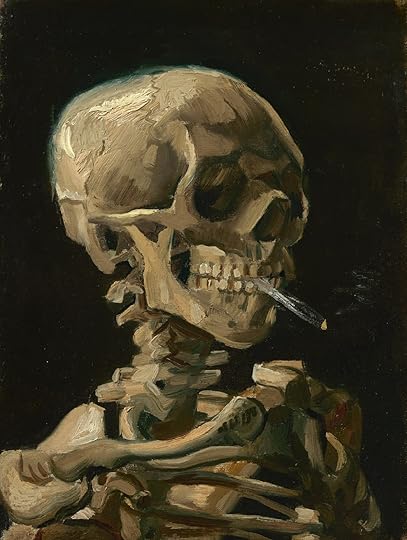
While I was tempted to list all my new favorite paintings by Vincent van Gogh, I realized it would be too much, so I'll mention the one with the greatest shock factor. It's titled 'Skull Smoking a Cigarette.' In this painting I see a profound representation of "memento mori" intertwined with "memento vivere." The image of the skull reminds us of our mortality ("memento mori"), yet the relaxed and chill demeanor suggests that while life is serious, it's also important not to lose ourselves in its seriousness ("memento vivere"). The skull, being a symbol of the dead, appears to have lived without regrets, embodying a sense of acceptance and peace with its past life choices.
I am proud to be the first person on Goodreads to have reviewed this edition of "Delphi Complete Works of Vincent Van Gogh". That is probably because of the sheer length of the ebook. Goodreads lists it as being 4,112 pages and Amazon.com (where I purchased it) says that it is 4,617 pages. Either way, "Delphi Complete Works of Vincent Van Gogh" is easily the longest book I have ever read. It was well worth the time and effort.
I should note I am not an art scholar or art historian, and certainly not already an expert on Van Gogh. I’ve never taken a University-level art class. I read this book because I wanted to further my knowledge of the subject and because I genuinely enjoy the art. Even the most ignorant American who has made his or her way through high school knows a little about Van Gogh. Even to my uneducated eyes, I perceive great beauty in his paintings and can tell that their level of craftsmanship was the product of countless, painstaking hours of practice on the artist’s part. I can't say I have the same appreciate for most Modern Art.
In addition to over 800 of Van Gogh’s paintings (although not his sketches, unfortunately), we get his complete letters. They take up the bulk of the ebook (9%-97% on my Kindle), and also include letters relating to him. In these we get a remarkable look into his life, his work, and his struggles with mental illness. In their collected form, I think they deserve to be considered some of the 19th century’s greatest works of literature. In addition, we get a biography of Van Gogh by his sister-in-law Johanna van Gogh-Bonger, a person who actually knew the man. All this for less than $3. I got to give it to Delphi Classics. The company does excellent work.
I’ve spent the last few hours reading “The Letters of Vincent van Gogh” and then going through the entirety of the art section of this book; 1000 pages of art and commentary.
Tonight, I saw every surviving work (painting) of Vincent van Gogh - and what a time I had!
It was nice to see my favourite of his paintings again, and a delight to see every other one and to have new favourites. I wish I knew how to attach images on reviews (maybe one day I’ll bother to learn and then do so) to show them here. For now, I’ll just keep the screenshots of the ebook on my camera roll.
I can’t really say anything about the art - only that it is brilliant and it was a wonderful journey to see his art evolving in chronological order from 1881 to 1890. With the years, especially towards the last few years (1887-90) Vincent van Gogh found his signature style and how brilliant it was to see! I also love that not all the paintings are masterpieces and some were significantly more detailed than others - I love how I not only got to see his best work, but even the first or second or third drafts of the same painting until he settled on a final draft. It was truly an experience, and made it not hard to keep in mind that the man behind the art is human, and complex and messy and imperfect, because the art was so.
This book definitely gives you biography of Van Gogh and display his paintings. I notice that in some of his paintings, there is a man in a yellow straw hat among figures of people. I wonder if that is Van Gogh himself? A couple of complaints I have with the book. First, I wish that when a painting is mentioned in the biography, please include that painting (ex. The Reaper). I spend a lot of time googling these works so I can understand the biography. Second, the last painting which the book shows was dated in 1897; Van Gogh died in 1890. So what’s going on? Who made that painting and why is it included? (And no mention of it in the biography). Anyway, I like the format of the book. Very consistent.
Reading the letters gave me a different perspective of Van Gogh. I have always enjoyed potato his paintings. I now have a better insight about his work.
Me gustó mucho leer y ver la historia de van gogh a través de sus pinturas. Habían detalles de su vida que no sabía y ver sus obras en un libro me gustó bastante.
I have heard of Vincent van Gogh but never really knew all that he did until this Delphi collection which includes his art as well as his letters. One negative in this edition is the letters stop May 1889, I needed to find another source for the letters that completed his correspondence, July 1890. When I first saw his paintings, I really liked them but not until after reading his letters, did I fully appreciate his works. After reading his letters, I decided to look at his art again, able to understand him better. His paintings of nature are my favorites, though some portraits like very much. It is interesting to see how his paintings that started out dark became beautiful with color.
En realidad solo "leí" un cuarto de libro porque había 1500 páginas o más de cartas que no pensaba releer lol Por lo que chusmee por arriba está bastante completa, y está bueno que incluyan cartas de Anna y Theodorus a Theo y las cartas de André a sus propios padres hablando de Vincent (las conocía, pero nunca las había encontrado). Si bien está buenísima toda la recopilación de pinturas, la calidad es una mierda. Incluso wikipedia las tiene más bonitas. Me pareció un lindo detalle incluir la biografía que escribió Jo. Ya la conocía, pero no la había leído hasta ahora. Se nota que ella conoció a los hermanos, porque está bastante endulzada (y me encanta igualmente). Y la fotito de Vincent con Émile 🥺🥺
Van Gogh's work deserved a lot better in terms of picture quality... Most pictures in this book (Kindle version) are very pixelated and you'll need to google them. The Van Gogh Museum in Amsterdam has a fantastic collection of free, high-resolution scans of his work. Aside from the terrible picture quality though, the book has some decent background information about his life and work.
This book has many pieces of Vincent's works that I haven't seen in any other books about him that I own or have read elsewhere! I was also surprised that many of his personal letters are included after the paintings.
If you love van Gogh's work, you may enjoy browsing through this book!