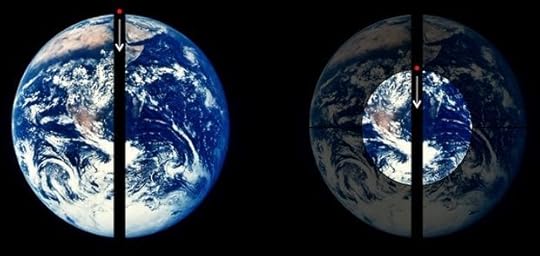
It was an idea right on the thin line between madness and genius: Penetrate the Earth and build a tunnel through its core. Using nothing beyond gravity and inertia one could now travel from the eastern to the western hemisphere in less than an hour. The future of travel was not the sky, it was deep below the earth. It all came crashing down when its inventor was accused of crimes against humanity. With its creator a monster in the eyes of the world the tunnel has fallen into disuse, but now it will be used once more ...
-Otro trabajo del imaginativo y todavía no muy famoso autor chino.-
Género. Relato.
Lo que nos cuenta. En el futuro, las diferentes potencias con mayor influencia en el mundo han llegado a distintos acuerdos sobre temas tan dispares como el armamento nuclear y la Antártida. Shen Huabei es uno de los científicos chinos encargados del desmantelamiento y detonación subterránea del arsenal nuclear de su país y al que la leucemia está matando, por lo que será introducido en un programa de hibernación criogénica. Cuando despierte, algo más de 74 años después, el mundo ha cambiado mucho y el nombre de su hijo, de cuyas obras muchos hacen responsable al propio Shen, es odiado.
¿Quiere saber más de este libro, sin spoilers? Visite:
The Longest Fall was another interesting short story from Liu Cixin, one that is connected to another short story but works perfectly fine as a standalone story. As interesting as this one was, I never quite felt the connection to it that I had hoped for. I wanted to see how the pieces came together, but the characters failed to have an impact upon me.
All in all, another interesting story from the author, but not the best example of their work.
You'd expect someone who researched the concept of a tube through the middle of the earth to have come across the problem of air resistance. Sure, in a vacuum, you'd keep accelerating to the point where you'd come to a stop on the other side, but that's clearly not mentioned here.
Now that I have that rant out of the way, let's get down to the story itself. It's simply awful. It makes no sense on any level. People go after the father of the person who came up with the tunnel because that's just how upset they are. Apparently there were some difficulties during its construction that left a few people worse off, but instead of blaming the government or construction company, they go after the father of the inventor who even resigned from the project to take up a simple engineering role.
I'll be honest with you: I might have gotten dumber after reading this. I'm seriously disappointed that Goodreads doesn't allow 0-star or even negative-star ratings for the special garbage like this.
My version was titled Cannonball but it shares the same plot as this so I assume it's just a different title.
I wanted to love this, the set up is very interesting, but the science is too far beyond my suspension of disbelief (a few changes could have rescued it enough)
But then it just didn't make sense...
*Spoilers* "Sins of the father" is one of my most hated things and all this just because of a simple hypothetical conversation?? And all the hate towards the engineer because he designed something that failed even though it had the input of hundreds of other people?? And are there really that many natural resources in Antarctica to spend so many resources building a tunnel through the earth to reach them?? (Well the story answered this: no) Criminals get suspended animation even when they have no ties to the present??
I liked the ending though
This entire review has been hidden because of spoilers.
The story of how a mad scientist's vision becoming true and ruining the lives of countless individuals is not original, but Liu's execution of it was pretty great. It's a story of how the father of a mad genius has to pay for the crimes of his son. What's fascinating is that through the father's punishment, he and the readers learn what exactly made everyone despise and hate his son so much and the full impact of his actions.
Liu did a great job creating an interesting premise and did a great job keeping the story interesting and captivating. The plot twist at the end where it's revealed that this story is in fact connected to several other short stories from him was unexpected and shocking. I especially enjoy how connected this story is with Liu's "With Her Eyes". It's revealed in the story that the girl from "With Her Eyes" is the granddaughter of the protagonist of this story.
The story overall was interesting but the logic behind how Shen Yuan (the son) became public enemy number one, right next to space Satan (an actual detail mentioned in the story) is illogical. The inherent evil of being the mastermind and advocate behind a failed superinfrastructure doesn't make sense given how much people hate him. Liu's premise was valid but based on Shen Yuan's mother's portrayal of him and the people's opinion and reaction suggested that Shen Yuan was a modern-day Hitler and not what Liu presented. Liu should've worked on giving Shen Yuan some more terrible deeds to commit and make him more cruel and inhuman. Simply being the mastermind of the tunnel across Earth makes little to no sense given his reception. Besides this logical flaw, I think the story was quite fascinating. The pacing was pretty great. I was really captivated by the development and by the actions of the characters.
One minor flaw is that I strongly disagree with the translation of this title since the original Chinese title, "Earth's Cannon" is better. I prefer the original title because I think to some degree, "The Longest Fall" gives away some interesting revelations.
This entire review has been hidden because of spoilers.
Collected in The Wandering Earth: Classic Science Fiction Collection, this story is also known as Cannonball. In a world where resources are so scarce humanity turns towards Antartica, one of the last unexplored continents. Shen Huabei, a scientist, through deep earth core experiments and "sugar coating" has discovered a phenomenon that compresses matter, calling it "new-solid-state". Unfortunately he has terminal leukemia and will be going into hibernation until a cure can be found, so his precocious son, has a choice.
The son, Shen Yuan decides to stay awake. Over 74 years later, Shen Huabei is awakened, then kidnapped by a group that wants to punish him for his son's crimes! Apparently his son conceived of an idea to Penetrate the Earth and build a tunnel through its core. Using nothing beyond gravity and inertia that will enable people to travel from one end of the earth to the other!
Unfortunately, the Antartic Entry Project cost millions of dollars, ruined the country's economy and many lives were lost. Yet it failed. Its inventor, Shen Yuan was accused of crimes against humanity, so the many many victims blame the architect's father!
The story's hard science contrast with a ton of questions about the morality of various factions. This is the kind of big picture hard science fiction with philosophy and moral dilemmas that Liu Cixin excels at, with the final arc and epilogue being the best. There's a huge twist, it's a good one, and there's even a small part towards the end that makes me convinced this is the sequel to With Her Eyes.
“Yours scientists were so preoccupied with whether or not they could that they didn’t stop to think if they should.”
I had a feeling as soon as they started talking about the Earth’s Core that this would be related to “With Her Eyes”. I was fully expecting the guide at the end to be his granddaughter (and very dramatically rolling my eyes) but am glad that didn’t turn out to be the case.
I liked the idea of the story but not the execution. I didn’t buy how angry people were with Huabei about his son’s mistakes. They painted the son as this huge supervillain, but when it’s revealed what he was responsible for, the death toll seemed pretty tame. And he stepped down well before the Lost Bolt, though I can understand the victims still blaming him for that.
Was the environmental damage centered around the tunnel? Was it focused on one end? Was it more widespread? I had so many questions.
Most frustrating to me was when Mr. Deng would alternate between saying there wasn’t enough time to explain something before Huabei died and then went into detail about other things. I guess he fell into the danger of monologuing.
It felt like there was far too much time between the Core Breach disaster and the Lost Bolt for *nothing* similarly disastrous to have happened. At least converting it to a one-way cannon eliminates the danger of collision.
This entire review has been hidden because of spoilers.
The story of how a mad scientist's vision becoming true and ruining the lives of countless individuals is not original, but Liu's execution of it was pretty great. It's a story of how the father of a mad genius has to pay for the crimes of his son. What's fascinating is that through the father's punishment, he and the readers learn what exactly made everyone despise and hate his son so much and the full impact of his actions. Liu did a great job creating an interesting proposition and did a great job keeping the story interesting and captivating. The plot twist at the end where it's revealed that this story is in fact connected to several other short stories from him was unexpected and shocking. I especially enjoy how connected this story is with Liu's "With Her Eyes". It's revealed in the story that the girl from "With Her Eyes" is the granddaughter of the protagonist of this story. One minor flaw is that I strongly disagree with the translation of this title since the original Chinese title, "Earth's Cannon" is better. I prefer the original title because I think to some degree, "The Longest Fall" gives away some interesting revelations. Overall, I recommend this book to any sci-fi lovers out there, and ofc Liu Ci Xin lover's should hop on and dive right into this book.
Ya düşmek, anlayamayacağımız cevapları barındırıyorsa? The Longest Fall, insanlığın en temel korkularından biri olan serbest düşüşü ele alıyor, ancak Cixin Liu, bunu basit bir düşüşten çok derin bir keşfe dönüştürüyor.
Hikaye, yerçekimi ve sonsuzluk üzerine cesur bir keşif yaparak hayatta kalma ve insan anlayışının sınırları hakkındaki varsayımlarımızı sorguluyor. Liu'nun bilimsel sertlik ve felsefi derinliği bir araya getiren üslubu tam anlamıyla öne çıkıyor, okuyucuları düşüşün her saniyesinde yaşam, zaman ve uzay hakkında yeni bir şeyler keşfetmeye sürüklüyor.
Kişisel olarak, bilinmeyene yaklaşımımız hakkında düşünürken buldum kendimi. Düşmek korkutucu olabilir, ancak aynı zamanda bildiğimizin ötesine geçmek için bir fırsat anlamına gelebilir—Liu, bu temayı mükemmel bir şekilde yakalıyor.
Kısa ama etkili bir hikayede, The Longest Fall, hem bilimsel bir bulmaca hem de felsefi bir deneyim sunarak, rahatlık alanlarımızın ötesindeki genişliği hatırlatıyor. Eğer entelektüel olarak zorlanmak ve biraz huzursuz olmak istiyorsanız, bu hikaye tam size göre.
Very disappointed. The plot was interesting in the beginning but became lame pretty soon. The whole build up about the crime of the supposed supervillain resulted in almost nothing. There are a bunch of plot holes. The ending wasn’t that good either. Probably would’ve given 2 stars if this was written by some unknown writer, but this is from Cixin and the expectation was high.
This entire review has been hidden because of spoilers.
Again, utterly fascinating. I'm not sure how accurate the scientific details are, but it sparked more than mere interest. Loved it, if you didn't already know that.
This is an excellent science fiction short story. It's built around a single idea, that of a tunnel travelling through the Earth to connect the opposite sides. It then explores the possibilities of such a creation in an ever worsening of the world's environment through human exploitation.
I can't speak to the veracity of the science, although much of it seems plausible and more importantly it is presented in a coherent manner. More than that it's a bold vision. For me the best science fiction stems from asking big questions. This story does that, the premise is cool and how the story unfolds is nicely done. The fall itself is a wonderful read.
It's a translation so it's difficult to comment on the writing itself, but the translation is good. I didn't encounter any jarring phrases. It's a crisp read and doesn't take long to read. This is a fine and imaginitive look at a game changing event.
3 stars seemed a little low, and 4 a bit high, so I'm erring on the generous side, as I think it's worth taking a look at this Chinese writer's work, especially since you can start off with this free (at least for now) story -- is 55 pages a short story or novella?
Anyway, the translation seems to be pretty good, and the tone and style reminded me a lot of '60s style sci-fi concentrating on the science, with some of the less optimistic forebodings or later decades. I'll probably take a look at one of his novels pretty soon, to see how he develops things in that longer form; plus it's interesting to me to see what someone in a different culture -- at least as different as any developed nations can be in this communication age -- is doing in my favorite genre.
The technology described in the book is interesting and the idea of a brilliant idea that leads to utter disaster and then much later results in ultimate success is good but precious little of the story works from an emotional, plot, or character point of view. Not a single one of the characters in the book seems real or compelling or even attractive. Motivations are missing or wholly unclear. Good concept, terrible execution.
If the original Chinese name is translated directly, it would be "Earth:The Biggest Cannon". ("The Longest Fall" is a name more suitable, of course.) This is another interesting idea to send object including human through the atmosphere into the space without using propelling rocket. So it starts me to think: Is there any other ways--except for Rocket, Earth Cannon, Space elevator or Babel Tower...
Read this because the air is the top seller in the scifi genre in China. Unfortunately, it must be because their readers lack access to more developed works. There is one interesting concept in the book but it's not fully fleshed out. The characters are pretty much cardboard. Perhaps other works are more worth reading than this.
This is old-school science fiction and while the science part of the story is well done, the people part of the story could have been better. I finished reading this with no insight into any of the characters and certainly no empathy for the protagonist.