

What do you think?
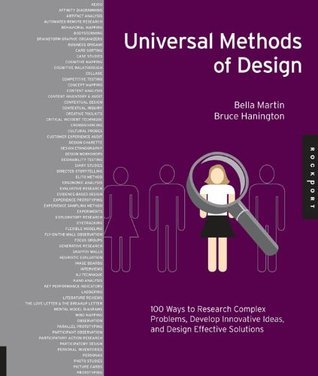
Universal Methods of Design: 100 Ways to Research Complex Problems, Develop Innovative Ideas, and Design Effective Solutions
This comprehensive reference provides a thorough and critical presentation of 100 research methods, synthesis/analysis techniques, and research deliverables for human centered design, delivered in a concise and accessible format perfect for designers, educators, and students. Whether research is already an integral part of a practice or curriculum, or whether it has been unfortunately avoided due to perceived limitations of time, knowledge, or resources, Universal Methods of Design serves as an invaluable compendium of methods that can be easily referenced and utilized by cross-disciplinary teams in nearly any design project.
This essential guide:
- Dismantles the myth that user research methods are complicated, expensive, and time-consuming
- Creates a shared meaning for cross-disciplinary design teams
- Illustrates methods with compelling visualizations and case studies
- Characterizes each method at a glance
- Indicates when methods are best employed to help prioritize appropriate design research strategies
Universal Methods of Design distills each method down to its most powerful essence, in a format that will help design teams select and implement the most credible research methods best suited to their design culture within the constraints of their projects.
This essential guide:
- Dismantles the myth that user research methods are complicated, expensive, and time-consuming
- Creates a shared meaning for cross-disciplinary design teams
- Illustrates methods with compelling visualizations and case studies
- Characterizes each method at a glance
- Indicates when methods are best employed to help prioritize appropriate design research strategies
Universal Methods of Design distills each method down to its most powerful essence, in a format that will help design teams select and implement the most credible research methods best suited to their design culture within the constraints of their projects.
208 pages, Kindle Edition
First published January 1, 2012
Ratings & Reviews
Friends & Following
Create a free account to discover what your friends think of this book!
Community Reviews
Displaying 1 - 30 of 42 reviews

May 17, 2022
This book has the basics of design research methodologies. It is a book that I open every week and at any time it's able to provide me with more relevant information
February 3, 2014
Quantity or Quality?
The reader is promised 100 design methods, although the term »method« seems to be very broadly defined. The authors do not provide any basics, like an introduction to research design or research ethics, which might be a problem, especially for beginners. The methods are structured alphabetically. Additionally they are assigned to different phases in the research process, which is explained very briefly in the introduction. The phase to which one method is assigned is indicated through a number between 1 and 5 (one method can be assigned to several phases). The introduction text and the explanation of the process is so brief and riddled with specialist terms, that someone new in this field might feel overwhelmed and confused.
The book presents exactly 100 methods. Each method is presented on exactly two pages, regardless if it is »Focus Groups« or »Word Clouds«. The extent of each chapter therefore does not follow the content or reflect the complexity of a method (And I would definitely argue that Focus Groups require more explanation than one page of text).
This leads to the next, main problem of this book: Each method is described so briefly, that the book cannot be considered anything else than an annotated list of methods and references. To actually learn how to use the methods and conduct research, one would have to get the books/papers listed as references. It needs to be mentioned, though, that the references given, are all very relevant and worth reading.
Each method is illustrated by a brief case study. Furthermore the authors present several keywords to classify a method. These keywords are e. g. qualitative, quantitative, generative and so forth. Generally this kind of classification would be very useful and handy. Although, these keywords are not explained anywhere in the book.
The strength of the book is the mere quantity of methods and therefore it can serve as a good collection of reading tips. Although, the above described weaknesses outweigh this strength in my opinion. I was disappointed and a little irritated by this book, because I think it creates (maybe unintentionally) the impression that design research is just something fun and unscientific that everybody can learn in 5 minutes.
This Review was originally posted on my blog http://blog.romina-maidel.de/blog/201...
The reader is promised 100 design methods, although the term »method« seems to be very broadly defined. The authors do not provide any basics, like an introduction to research design or research ethics, which might be a problem, especially for beginners. The methods are structured alphabetically. Additionally they are assigned to different phases in the research process, which is explained very briefly in the introduction. The phase to which one method is assigned is indicated through a number between 1 and 5 (one method can be assigned to several phases). The introduction text and the explanation of the process is so brief and riddled with specialist terms, that someone new in this field might feel overwhelmed and confused.
The book presents exactly 100 methods. Each method is presented on exactly two pages, regardless if it is »Focus Groups« or »Word Clouds«. The extent of each chapter therefore does not follow the content or reflect the complexity of a method (And I would definitely argue that Focus Groups require more explanation than one page of text).
This leads to the next, main problem of this book: Each method is described so briefly, that the book cannot be considered anything else than an annotated list of methods and references. To actually learn how to use the methods and conduct research, one would have to get the books/papers listed as references. It needs to be mentioned, though, that the references given, are all very relevant and worth reading.
Each method is illustrated by a brief case study. Furthermore the authors present several keywords to classify a method. These keywords are e. g. qualitative, quantitative, generative and so forth. Generally this kind of classification would be very useful and handy. Although, these keywords are not explained anywhere in the book.
The strength of the book is the mere quantity of methods and therefore it can serve as a good collection of reading tips. Although, the above described weaknesses outweigh this strength in my opinion. I was disappointed and a little irritated by this book, because I think it creates (maybe unintentionally) the impression that design research is just something fun and unscientific that everybody can learn in 5 minutes.
This Review was originally posted on my blog http://blog.romina-maidel.de/blog/201...

January 20, 2018
Great collection of useful and practical methods!
It's really nice each method takes up just 2 page (explanation on one page, example on the other). Some methods do require a longer explanation as they are too complex to fit on one page. But you can always find more information online as they are commonly used.
It's really nice each method takes up just 2 page (explanation on one page, example on the other). Some methods do require a longer explanation as they are too complex to fit on one page. But you can always find more information online as they are commonly used.

November 3, 2023
3.75! I’ve skimmed this book many times in the past year or so. Marking it as read bc it’s time. It has good info and I like the way it’s laid out!

July 8, 2014
Mais um livro de consulta do que outra coisa, é ótimo tanto para avaliar rapidamente técnicas que podem ser usadas em determinados contexto, quanto para se aprofundar, através das indicações de leitura, em métodos específicos. Bastante util.
Read
July 14, 2020The format — aside from some introductory remarks and their (pretty good!) breakdown of how they categorize the different methods— is a general overview of a method and where it comes from. This tends to point you in the right direction if you want to learn more about it or employ it yourself.
To be honest, I have not read this book cover to cover (though I've probably tried on more than one occasion). It's a good reference: 1 method per 2-page spread. Writeup and references on one side, illustrations/pictures/diagrams on the other. On the other hand, there isn't a thread pulling you through the whole book. Perhaps one criticism (If I remember correctly, maybe I don't) is that I wish methods in the table of contents were ordered differently.
I've found it useful when I needed a bit of inspiration by reviewing methods I haven't used in a while, or to learn about something entirely new. If you want to follow a method to a 't,' and not as something for inspiration or remixing into something else in design research, there's a good chance you'll want to do more digging or research for advice on how to prep and conduct out the method.
To be honest, I have not read this book cover to cover (though I've probably tried on more than one occasion). It's a good reference: 1 method per 2-page spread. Writeup and references on one side, illustrations/pictures/diagrams on the other. On the other hand, there isn't a thread pulling you through the whole book. Perhaps one criticism (If I remember correctly, maybe I don't) is that I wish methods in the table of contents were ordered differently.
I've found it useful when I needed a bit of inspiration by reviewing methods I haven't used in a while, or to learn about something entirely new. If you want to follow a method to a 't,' and not as something for inspiration or remixing into something else in design research, there's a good chance you'll want to do more digging or research for advice on how to prep and conduct out the method.

June 22, 2023
I don't know how to classify the book. It's not light enough to be a quick read, and it is certainly not extensive enough to be a textbook. The book provides a quick summary of some design methods and that's all for it. It serves for scanning purposes at best. I liked the fact they provide further reading on each method though.
I would also say that 100 methods is a bit of an exaggeration as several of the mentioned 'methods' are more or less the same. Maybe, technique is a better label but it wouldn't make much difference for me as well. I think the book did not really show 100 methods or techniques.
On the plus side, the book shows this nice visual cue of where the method can be applied in terms of the design model. Unfortunately, little info is provided on the model and the phases, rendering the visual cue useless in some way.
In general, the book is useful if you have sufficient background on the methods beforehand or intend to read more about a method you intend to use in your project after looking at some suggestions from the book.
I would also say that 100 methods is a bit of an exaggeration as several of the mentioned 'methods' are more or less the same. Maybe, technique is a better label but it wouldn't make much difference for me as well. I think the book did not really show 100 methods or techniques.
On the plus side, the book shows this nice visual cue of where the method can be applied in terms of the design model. Unfortunately, little info is provided on the model and the phases, rendering the visual cue useless in some way.
In general, the book is useful if you have sufficient background on the methods beforehand or intend to read more about a method you intend to use in your project after looking at some suggestions from the book.

October 10, 2019
A great read to overview an extensive collection of research methods if you're starting out as a design researcher, especially if you’re clueless on which method to use and what is a really cool thing is that it maps the appropriate stage of when to use this research method and the purpose of each.
It does cover qualitative and quantitative research methods but it doesn’t include many design thinking/service design methods (i.e service blueprints, Value Proposition maps, empathy/emotion maps)
I find that this is a great start for a beginner design researcher, but you'll need to read much more about each method when you need to.
It does cover qualitative and quantitative research methods but it doesn’t include many design thinking/service design methods (i.e service blueprints, Value Proposition maps, empathy/emotion maps)
I find that this is a great start for a beginner design researcher, but you'll need to read much more about each method when you need to.
July 30, 2019
An anthology of design research to keep as a handy reference
This book is a reference to 100 different, but many times interconnected methods of design research.
Although it doesn’t go into a deep analysis of each method, it provides a description and reading references, should the reader want to explore things further.
I often found that looking at the images at the end of each section first, and then reading the main text, provided me with a better understanding of the material.
All in all a not-so-easy-to-read book, but rich in content nonetheless.
This book is a reference to 100 different, but many times interconnected methods of design research.
Although it doesn’t go into a deep analysis of each method, it provides a description and reading references, should the reader want to explore things further.
I often found that looking at the images at the end of each section first, and then reading the main text, provided me with a better understanding of the material.
All in all a not-so-easy-to-read book, but rich in content nonetheless.

March 3, 2017
If you're looking for an overview of design techniques this is your "vocabulary". You will find the techniques neatly structured by design phase and alphabet. Plus the methods are classified based on many facets (e.g. behavioral/attitudinal, generative/explorative/evaluative, etc.). The hardcover edition is nicely layed out in two-page spreads with lots of visuals and graphics accompanying the textual descriptions.

May 28, 2017
Great overview of design research methods. This book is an excellent overview providing a helpful taxonomy for the different research methods, visuals for easy access and a quick general overview of the essentials of each method. Not appropriate for a deeper more differentiated study of individual methods.

November 2, 2023
The content of the book is brilliant and enormously helpful for participatory design, but the structure of the book is terrible: It lists 100 "methods" alphabetically. The list reaches from tools how to prompt participants to sort cards, whatever these cards may contain, to research approaches like PAR.

March 20, 2024
Its concise, simple and practical... The book is an important resource for design and creative researchers. I liked the way the authors compiled a diverse research methodologies with implementation and examples. I wish I got this book a little earlier.

May 22, 2017
This is an awesome book on designing ideas for developing creative session and effective workshops to help the team come up with new ideas in an organisation.

November 19, 2017
An encyclopedia for user research & design methods.

December 29, 2018
This collection of methods can help prepare workshops for any phase of a design process.

April 24, 2019
É uma lista de métodos com descrições... Mas não te ensina a fazer de fato.
August 21, 2019
I skimmed through some parts of this as it's mainly a good resource that can be referred to when working on different projects. One-pager on each method is good jumping-off point.

September 22, 2019
Cant name it a book, but rather a journal/textbook with different methods. Got some interesting learnings to apply in my field although never worked in service/product design.

December 17, 2019
This is one of the best book that mentions all possible research method technique that helps in design research.
September 1, 2020
Tiene muchos métodos que no conocía pero me parece que la explicación de la mayoría es muy general, quedan inconclusos algunos sobretodo en su aplicación en proyectos reales.

September 10, 2020
A good overview of 100 methods to conduct research as a designer. Reading it as an architect but found interesting methods that could apply to the architectural design process.

August 22, 2021
For me, this is one of those must-reads. And one time will not be enough. It will be opened, over and over again to remember the nuances of each method till they are all memorized.

February 28, 2022
A tool book like a dictionary. Not sure why Service Design is one of them which is a subject in little universities already or a trending we could see. So how does a discipline develop?
Read
February 28, 2023Universal Methods of Design: 100 Ways to Research Complex Problems, Develop Innovative Ideas, and Design Effective Solutions by Bella Martin (2012)

August 12, 2013
Amazing variety of design methods with short descriptions and illustrations to accompany. A must-have dictionary for designers. I was very impressed by how each of the 100 methods references similar methods on the bottom of each page. Each method's descriptive summary also shows how the particular method fits into the overall design process, making it easy to see if a method is being used to its full potential.

August 24, 2014
مرجع لجميع المصمين على اختلاف اختصاصاتهم .. يسجل الكتاب 100 طريقة واسلوبا متبعا في مختلف مراحل العمل بدئا من البحث مرورا بالتصميم والانتاج وانتهاء بالتقييم
في المجمل تبين الطرق المذكورة اساليب استخدام العقل الجمعي بدلا من الاعتماد على العقل الفرد في التصميم للوصول الى تصاميم مميزة وخالية قدر االمكان من العيوب القاتلة .. التصميم عمل جماعي
أعجبني فيه التنظيم الدقيق والتصنيف الميسر مع وفرة المراجع والمصادر
لا بد من اقتنائه!!
في المجمل تبين الطرق المذكورة اساليب استخدام العقل الجمعي بدلا من الاعتماد على العقل الفرد في التصميم للوصول الى تصاميم مميزة وخالية قدر االمكان من العيوب القاتلة .. التصميم عمل جماعي
أعجبني فيه التنظيم الدقيق والتصنيف الميسر مع وفرة المراجع والمصادر
لا بد من اقتنائه!!
July 25, 2012
Fantastic collection of research methods, laid-out and explained thoroughly and concisely--great starting points that enable readers to explore the concepts on their own. Bruce and Bella are both experts in design research, and this is a great showcase of their combined knowledge and efforts. Bravi! :)
September 19, 2022
I would say this was a medium-good book, I certainly got some interesting thoughts from it but I have a hard time imaging how I would use a research method based on reading a single page description of it. It's a catchy title and idea and I am trying to read more books about HFE but this is probably too focused on being digestible and not focused enough on going into depth.

August 15, 2012
Great reference book. Love the format, each research methodology has two pages. One page has a short description, the other has visual context and example. Both pages provide reference for further research. Very handy.
Displaying 1 - 30 of 42 reviews