

What do you think?

God Wills It! A Tale of the First Crusade.
This book was converted from its physical edition to the digital format by a community of volunteers. You may find it for free on the web. Purchase of the Kindle edition includes wireless delivery.
- GenresHistorical Fiction
289 pages, Kindle Edition
First published September 1, 2007
About the author
William Stearns Davis
165 books8 followersWilliam Stearns Davis was an American educator, historian, and author of both fiction and non-fiction.
Ratings & Reviews
Friends & Following
Create a free account to discover what your friends think of this book!
Community Reviews
Displaying 1 - 4 of 4 reviews
June 8, 2015
God Wills It! A Tale of the First Crusade by William Stearns Davis written in 1901 is a book I stumbled onto while researching the middle ages. I got wrapped up in it before I knew what I was getting myself into, and I’m glad. I don’t think I would have read it any other way. 588 pages! I would have told myself I couldn’t afford to spend that kind of time right now on fiction, and I would have passed it over. So I’m glad for all the idiosyncrasies that ebooks have that usually drive me crazy: you don’t have a back cover copy or can’t see how thick the book is you’re starting. Those of you ebook fans probably know ways around these issues, but I read them seldom. I prefer to do it old school and have those dusty pages in my hand.
So I read the reviews and they were very good. And I got started. And fell right into it. I couldn’t put it down, and had no idea how long I would be reading. I kept looking at that little blue line at the bottom of the book and saw it barely moved. It took me a ridiculously long time to think: this is a long book! Maybe I should put it down. But by then it was too late. The characters are amazing! The plot intricate and beautiful. The only way I can express it is by bringing up another book. It’s how I felt while reading Little Women. It made me think: I want to be a better person!
Richard Longsword is the protagonist. The book begins to find him young, carefree, and autonomous. He is the master of his own fate and owes nobody anything. Quickly he meets Mary Kurkuas, the heroine. A wild horse breaks from it bonds and Richard races in to tame it. Ahhh romance! (yes, it is written by a man. Astonishing!)
Mary is quickly kidnapped by Barbary pirates no less. And Richard races into save her and the others taken. Here, he not only saves the woman he will soon love, but also his soon to be best friend, Musa, one of the greatest characters I’ve ever read… yes ever! (Gushing? Maybe.)
Musa is a Spanish Moslem and Richard (a Frank) and Mary (a Greek) are both Christian. Mary and Richard fall in love, and it is clear, though subtly, that Musa is also in love with Mary, the Star of the Greeks.
What follows is adventure, religion, jealously, passion, sacrifice, honor, fidelity all wrapped in a beautiful history lesson. What doesn’t this book have?? Musa’s love for his brother (as he and Richard call each other brothers) is put to the test when Mary, his heart’s passion, is placed in his protection and power. The Crusade comes between the brothers, but they make it clear that while their duty drives them apart, they will always be brothers. The final act of the book is like nothing I’ve ever read. I’ve always been one for characters over plot, but this plot blew me out of the water. Musa finds a way to protect his love from her enemies and… oh, I can’t say! But how the author resolves the conflict is nothing short of brilliant. The solution to what will happen between Musa and Richard when they meet in battle… will they fight do the death? Though brothers? Or will they abandon their duty? I can’t give it away. But it is beautiful!
At the end of the book, Musa says truthfully: “Yes, I have been faithful to my love, – my brother, – my promise.”
Totally worth the read if you have the time!
Some of my favorite quotes:
When Mary is kidnaped (yes, again) and taken to a harem, another woman there, who loves her captor and is tormented he has fallen in love with Mary, gives her two glasses. One is laced with poison, and she doesn’t know which. She says, “Taste! You cannot tell. All is in the hands of God – whether you bow your head to your fate, or tonight the moonbeams are your pillow; or whether I am escaped from all my heartache; can flit over your couch on unseen wing and teach you to endure, as best you may, till the hour comes when hand in hand we can fly up the path of the sun and join in the dance of the winds.”
Mary is tempted, but then answers, “Dear God! Spare me this temptation! Nor do you commit this wickedness. Never shall we so tempt God. Though the grief be a thousand times more great, yet will I trust His mercy. I am a Christian, and Our Lord did not hang on the tree in vain to make us strong to bear. Death would be sweet. But had we God’s wisdom, our present pangs would seem nothing, hid in the speeding ages of joy. Let us, each after our manner, call on God to show us pity. But never shall one of us stand before His face unsummoned, and cry, ‘I am too weak to bear what Thou appointest!’”
Amidst war, Richard asks Musa to take Mary and escape while he stays and fights. And Richard tells his friend, “Where the arrows sing, I must be. And if I fall Mary will be alone. Not a kinsman remains at Constantinople. You must… you must swear to me that you will love her; that if I die, she shall be your wife. For Moslem as you are, no man breathes I would rather see with his arms about her than you. You alone can make her forget me; make her look forward and laugh in the sunlight.”
Musa replies, “Brother mine, you ask a great thing; yet I accept it. If it is written by the stars that you fall, I swear I will stand in your place to the Star of the Greeks. May she never want love and service while life is mine! Until that day, I will be to her as a brother, no more, no less; and let Allah speed the hour when I can give her back spotless to your arms.”
As he rides away, Richard’s thoughts go over his life again and again. “Life was not long; yet not once, but many times he lived it over during that ride – the good things, the evil; and the evil were so many! And always before his sight was the vision of that face, pale as marble, the eyes fairer than stars – that face he had put away because of the love for the unseen Christ.”
And there are many, many more!
So I read the reviews and they were very good. And I got started. And fell right into it. I couldn’t put it down, and had no idea how long I would be reading. I kept looking at that little blue line at the bottom of the book and saw it barely moved. It took me a ridiculously long time to think: this is a long book! Maybe I should put it down. But by then it was too late. The characters are amazing! The plot intricate and beautiful. The only way I can express it is by bringing up another book. It’s how I felt while reading Little Women. It made me think: I want to be a better person!
Richard Longsword is the protagonist. The book begins to find him young, carefree, and autonomous. He is the master of his own fate and owes nobody anything. Quickly he meets Mary Kurkuas, the heroine. A wild horse breaks from it bonds and Richard races in to tame it. Ahhh romance! (yes, it is written by a man. Astonishing!)
Mary is quickly kidnapped by Barbary pirates no less. And Richard races into save her and the others taken. Here, he not only saves the woman he will soon love, but also his soon to be best friend, Musa, one of the greatest characters I’ve ever read… yes ever! (Gushing? Maybe.)
Musa is a Spanish Moslem and Richard (a Frank) and Mary (a Greek) are both Christian. Mary and Richard fall in love, and it is clear, though subtly, that Musa is also in love with Mary, the Star of the Greeks.
What follows is adventure, religion, jealously, passion, sacrifice, honor, fidelity all wrapped in a beautiful history lesson. What doesn’t this book have?? Musa’s love for his brother (as he and Richard call each other brothers) is put to the test when Mary, his heart’s passion, is placed in his protection and power. The Crusade comes between the brothers, but they make it clear that while their duty drives them apart, they will always be brothers. The final act of the book is like nothing I’ve ever read. I’ve always been one for characters over plot, but this plot blew me out of the water. Musa finds a way to protect his love from her enemies and… oh, I can’t say! But how the author resolves the conflict is nothing short of brilliant. The solution to what will happen between Musa and Richard when they meet in battle… will they fight do the death? Though brothers? Or will they abandon their duty? I can’t give it away. But it is beautiful!
At the end of the book, Musa says truthfully: “Yes, I have been faithful to my love, – my brother, – my promise.”
Totally worth the read if you have the time!
Some of my favorite quotes:
When Mary is kidnaped (yes, again) and taken to a harem, another woman there, who loves her captor and is tormented he has fallen in love with Mary, gives her two glasses. One is laced with poison, and she doesn’t know which. She says, “Taste! You cannot tell. All is in the hands of God – whether you bow your head to your fate, or tonight the moonbeams are your pillow; or whether I am escaped from all my heartache; can flit over your couch on unseen wing and teach you to endure, as best you may, till the hour comes when hand in hand we can fly up the path of the sun and join in the dance of the winds.”
Mary is tempted, but then answers, “Dear God! Spare me this temptation! Nor do you commit this wickedness. Never shall we so tempt God. Though the grief be a thousand times more great, yet will I trust His mercy. I am a Christian, and Our Lord did not hang on the tree in vain to make us strong to bear. Death would be sweet. But had we God’s wisdom, our present pangs would seem nothing, hid in the speeding ages of joy. Let us, each after our manner, call on God to show us pity. But never shall one of us stand before His face unsummoned, and cry, ‘I am too weak to bear what Thou appointest!’”
Amidst war, Richard asks Musa to take Mary and escape while he stays and fights. And Richard tells his friend, “Where the arrows sing, I must be. And if I fall Mary will be alone. Not a kinsman remains at Constantinople. You must… you must swear to me that you will love her; that if I die, she shall be your wife. For Moslem as you are, no man breathes I would rather see with his arms about her than you. You alone can make her forget me; make her look forward and laugh in the sunlight.”
Musa replies, “Brother mine, you ask a great thing; yet I accept it. If it is written by the stars that you fall, I swear I will stand in your place to the Star of the Greeks. May she never want love and service while life is mine! Until that day, I will be to her as a brother, no more, no less; and let Allah speed the hour when I can give her back spotless to your arms.”
As he rides away, Richard’s thoughts go over his life again and again. “Life was not long; yet not once, but many times he lived it over during that ride – the good things, the evil; and the evil were so many! And always before his sight was the vision of that face, pale as marble, the eyes fairer than stars – that face he had put away because of the love for the unseen Christ.”
And there are many, many more!
Read
September 13, 2019An absolutely terrible book.

maybe
December 4, 2012
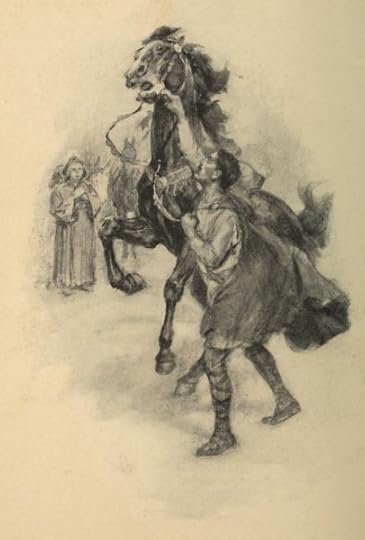 "IN A TWINKLING RICHARD WAS AT THE HEAD OF THE RAGING BRUTE"
ILLUSTRATIONS BY LOUIS BETTS
Opening: It was early dawn in May, 1094. The glowing sun had just touched the eastern mountains with living fire; the green brakes and long stretches of half-tropical woodland were springing out of the shadow; a thin mist was drifting from the cool valleys; to the north the sea's wide reach was dancing and darkling. Upon a little height overlooking the Sicilian town of Cefalu three men were standing, very unlike in age and dress, yet each with attention fixed on one object,—a white falcon which the youngest of the party had perched on his fist. Two of the men were past the prime of life. Of one, the swarthy countenance, sharp features, bright Oriental dress, ponderous blue turban, and crooked cimeter proclaimed him at once a Moor, undoubtedly a Moslem; the other, taller, thinner than his comrade, wore a coarse, dark mantle; his hood was thrust back, displaying a head crowned with a tight-fitting steel cap, a face stern and tough, as if it were of oxhide, marked almost to deformity by plentiful sword scars. He wore a grizzled gray beard; at his side jangled a heavy sword in battered sheath; and in his hands, which lacked more than one finger, he held a crossbow, the bolts for which swung in a leathern case at his thigh. The two stood by their third companion, who was holding up the falcon on a gold-embroidered glove, while the other hand readjusted the feather-tufted hood over the bird's eyes.
This could be good
January 30, 2015
What a great read!
Absolutely loved this book. Adventure, romance, suspense, great friendships. A great insight into days gone by. I would recommend this book to anyone.
Absolutely loved this book. Adventure, romance, suspense, great friendships. A great insight into days gone by. I would recommend this book to anyone.
Displaying 1 - 4 of 4 reviews