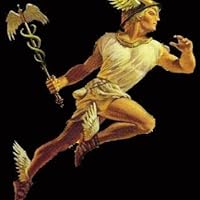
Principe's summary and evaluation of hermetic alchemy as understood by occult practitioners of the late nineteenth and early twentieth centuries is at best myopic. He conveniently overlooks in this section natural poetical metonymy of language (though he appears to love the term Decknamen), the overt mythological and theological references in dozens of pre-nineteenth-century alchemical plates, paintings, and treatises, and Blake's, Scot's and others' treatments of alchemy years before the occult revival and the popularization of mesmerism. However, Principe mentions throughout the book that Christ is used to symbolize the Stone - but nothing more - and the alchemical process is often analogized to or allegorized as Christ's passion. Perhaps Principe should take another look through the Theatrum Chemicum to see just how closely tied many thought (and still think) alchemy and Christianity were...
On page 182 Principe is quick to suggest that Chaucer "takes a position in his Canterbury Tales" on alchemy after quoting a few lines from a modern translation of "The Canon's Yeoman's Tale." Principe shows here his inability to understand the complexity of literature, and especially the personalities of Chaucer's various characters in the Tales: The Yeoman's position on alchemy is not Chaucer's position at all. (And in the original Tales, Chaucer's Yeoman attributes much of what Principe quotes to Hermes, though I can't speak for Principe's edition.)
And not to mention Carl Jung's life's work refuted in a mere 20 pages! Well done, Lawrence.
Many of the pieces necessary to understand the esoteric side of alchemy are here: Mesmer's animal magnetism/Jung's libido, Christian and Greek mythology, layers of meaning, interconnectedness of all things within and without, above and below (spirit and matter), Chaucer, Jonson, Donne, Shakespeare, Rowling - he even includes Fludd's image of the Great Chain of Being that echoes the Tree of Life on page 197 and Valentine's Azoth on page 120! - but, unfortunately, he doesn't quite come away with the "secrets" of alchemy in the end, and neither do we.
In short, this book contains many of the necessary shells, but Principe does not crack them open - look behind or within them - to discover the common meat. Because of this, at times I felt he was misleading, but I rated The Secrets of Alchemy four stars because of the depth of understanding he has of what some call contemporarily exoteric alchemy. Principe would do well to study the layers of language and symbol that to me appear to be lacking in his consciousness yet which he mentions occasionally in his book. The grammatos kills, Principe, but the pneuma gives life.