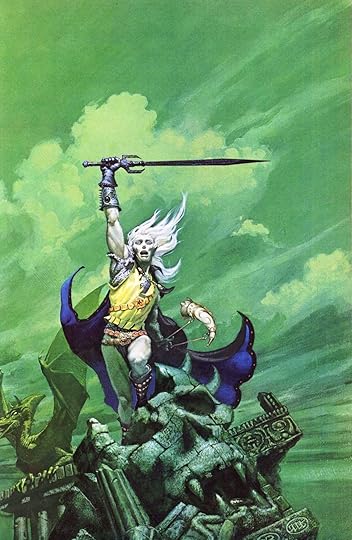
When Michael Moorcock began chronicling the adventures of the albino sorcerer Elric, last king of decadent Melniboné, and his sentient vampiric sword, Stormbringer, he set out to create a new kind of fantasy adventure, one that broke with tradition and reflected a more up-to-date sophistication of theme and style. The result was a bold and unique hero–weak in body, subtle in mind, dependent on drugs for the vitality to sustain himself–with great crimes behind him and a greater destiny ahead: a rock-and-roll antihero who would channel all the violent excesses of the sixties into one enduring archetype.
Here is the first volume of a collection of stories containing the seminal appearances of Elric and lavishly illustrated by artist John Picacio–plus essays, letters, maps, and other material. Adventures include “The Dreaming City,” “While the Gods Laugh,” “Kings in Darkness,” “Dead God’s Homecoming,” “Black Sword’s Brothers,” and “Sad Giant’s Shield.”
Michael John Moorcock is an English writer primarily of science fiction and fantasy who has also published a number of literary novels.
Moorcock has mentioned The Gods of Mars by Edgar Rice Burroughs, The Apple Cart by George Bernard Shaw and The Constable of St. Nicholas by Edward Lester Arnold as the first three books which captured his imagination. He became editor of Tarzan Adventures in 1956, at the age of sixteen, and later moved on to edit Sexton Blake Library. As editor of the controversial British science fiction magazine New Worlds, from May 1964 until March 1971 and then again from 1976 to 1996, Moorcock fostered the development of the science fiction "New Wave" in the UK and indirectly in the United States. His serialization of Norman Spinrad's Bug Jack Barron was notorious for causing British MPs to condemn in Parliament the Arts Council's funding of the magazine.
During this time, he occasionally wrote under the pseudonym of "James Colvin," a "house pseudonym" used by other critics on New Worlds. A spoof obituary of Colvin appeared in New Worlds #197 (January 1970), written by "William Barclay" (another Moorcock pseudonym). Moorcock, indeed, makes much use of the initials "JC", and not entirely coincidentally these are also the initials of Jesus Christ, the subject of his 1967 Nebula award-winning novella Behold the Man, which tells the story of Karl Glogauer, a time-traveller who takes on the role of Christ. They are also the initials of various "Eternal Champion" Moorcock characters such as Jerry Cornelius, Jerry Cornell and Jherek Carnelian. In more recent years, Moorcock has taken to using "Warwick Colvin, Jr." as yet another pseudonym, particularly in his Second Ether fiction.
I took a journey into the world of darkness, and I am surprised at how much I enjoyed it. Being me, I tend to embark on new adventures in an atypical fashion. Such is my introduction to sword and sorcery fantasy. I read one Conan story prior to reading Elric: The Stealer of Souls (written by L. Sprague de Camp in an anthology). And I started reading The Savage Tales of Solomon Kane as my first official story written by Robert E. Howard, who is probably one of the founding fathers of this genre (if not the founding father), so it's interesting that one of my first protagonists to read in this genre is more of an anti-Conan. He's not big and muscled. He's slender and physically frail. He cries, he whines, and he does a lot of moping. I'm not really surprised that this worked for me. I love flawed characters in fiction. I love characters with a weakness to them. I think they mirror reality much more than perfect ones do. In my life, I have been haunted by a fear of failure, and I can identify with a character who does feel like he doesn't measure up and sometimes feels like a screw-up, right or wrong. While I don't enjoy depressing literature at all, I like a good genre story that shows a character who is never going to be perfect and get everything right. That's Elric in a nutshell.
A few years ago, I had heard about Elric, and I was intrigued when I read that he was considered the burned-out rock star of heroic fantasy, with his dependence on drugs. Okay, part of me was repulsed at the drug-dependence part. I'm glad I read the story all the same. Elric has had to take herbs because of the inherent frailty of his constitution due to his inherited albinism. That is a minor part of the stories in this book. Really, his more dangerous and much more harrowing dependence is on the vampiric sword Stormbringer. Let me tell you, I never thought I'd hate an inaminate object the way I hate the sword. I imagine poor Elric feels the same way, but fifty-thousand times worse. You see, Stormbringer is evil. It enjoys being used to kill, whether the victim is good or bad. When it kills, it sucks the soul out of its victim, and part of that energy goes to Elric (who uses it to keep his vitality), and part remains in the sword. Stormbringer will actually direct itself to deliver killing blows to friends and allies of Elric. Elric is by no means a good person, but he does have friends (and a lover) that he would not wish to betray, and some of the fall to the sword, inadvertently. However, being deprived and away from the sword for a prolonged period brings on a loss of vitality that eventually would be fatal to Elric. Thus he cannot rid himself of this 'hellwrought' blade. Elric has this on his conscience, and also broods the loss of his love and his kingdom. Yes, Elric is very much a brooder.
I found these stories to be very imaginative, and often brutal and dark. The elements of dark sorcery were chilling, yet enthralling. When Elric would say the words of dark spells that were passed down from his sorcerous, maleficent ancestors, my eyes were glued to the page. He encounters dark beasts from a person's imagination or nightmares gone to hell. And he has to fight for his life and that of his friends. I could imagine how vivid some of those scenes would look on a movie screen. Yet I was taken out of my own reality and to the ancient, fallen worlds that Elric travels through. Some of his journeys in this book are motivated by self-interest, and some out of the greater good. However, blood will be shed along the way, both from the virtuous and the wicked.
I like the way Mr. Moorcock mingled some familiar elements of fantasy with things he could have only dreamed up in his mind. I also appreciated the way these stories are a little bit horror, tragic drama, and fantasy all combined together. The tragedy rests in the fact that Elric is a man who is doomed to follow a dark destiny, and being around him too long can be bad for a person's health. One other very much appreciated element is the multiculturalism of his stories. There are characters of various types and races, and they are not described in a way that is bigoted and demeaning, which is common with some of the older pulp fiction (even Mr. Howard, whose writing I admire except for this aspect). There is some degree of philosophy and mysticism that could tend to go over one's head (myself included). I recommend just reading the stories. If you catch some of it, by all means. But a deep understanding of the balance between Law and Chaos is not required to enjoy these stories.
If I could mention a couple of quibbles I had, it would be that women are poorly characterized in these stories. What I mean is they don't come off as being very deep and meaningful. In some of Mr. Moorcock's writing included, he admits to this fact. The women that come in and out of the stories (and Elric's life) serve mainly as plot points. While this is fantasy with a male lead character, I would hope to see a little more depth in the females featured, some of which are quite pivotal in the story and in Elric's development as a character. My other quibble is that the death of some fairly important characters is treated in a somewhat anticlimactic fashion. I realize that in this world, death is an everyday, harsh reality. Yet, I expected there to be a little more pomp and circumstance in the demise of some very important, and somewhat important characters. Those are small issues with the overall writing that I had. Otherwise, I would say that for what it is, this is near perfect storytelling. There is a tendency to be melodramatic, but come on, it's heroic fantasy. Drama is important (in the same way it's a crucial element in Harlequin Presents novels).
Being a neophyte to the sword and sorcery genre (and high fantasy overall, other than some brief forays as a young reader), I may not be the best source of advice. However, I am of the opinion that if you are about to embark on a foray into heroic fantasy, you should read this book. It wasn't boring, although it might be hard to keep up with the odd names and the storylines at times. Personally, I found this to be a book that you read in spurts. This is a collection of short stories and a novella, so it lends itself to that type of reading. In the reading of this story, will find a hero-villain within the pages of this book like no other, one who will keep your interest, inspire pity and sometimes frustration, and one who will linger in your mind long past the point at which you close the book.
So this book gets two stars - and still belongs onto my favourites & recommendations shelf. It is, objectively, not a good book. Moorcock is not always a good writer and these are among the first stories he has written - far away not only from the genius of "Behold the Man" (read it, really, read it!), but even from the fun of the later Elric stories (and the comics).
Yet ... This is where things start. This is where the Chaos symbol is seen for the first time, this is where Eternal Champion takes his first steps, this is where Sepiriz tells Elric "Meaning, Elric? Do not seek that, for madness lies in such a course.", this is where the Ph'oorn (dragons and perhaps more) first appear, this is ... These are stories which started the change, stories which inspired so many people, so many stories to come after them. If you want to go back and find out where it all started, you'll have to go back to here. Don't expect them to be good stories - they are pulp. Don't expect them to be consistent. Don't expect the language to shine. But if you are like me: expect them too touch you, to stir something in you, to settle down deep in your soul, in your reader's and writer's mind. Expect them to change you.
(And if you have childhood memories of them - oh, expect all the bittersweet memories. And so much thankfulness for having experiences them when you did not recognize pulp for pulp.)
I’ve given this book way too many chances and I have to DNF @ 50%. The plot is too simplistic, the writing is that of a bad 60’s fantasy novel, and I couldn’t have cared less for the characters.
If you wish to get into Michael Moorcock's utterly brilliant 'Elric' stories, then this Del Ray version is the edition to read. It reprints each of the stories in the order that they were written (and thereby the order in which the mythos, character and themes were all formed) rather than in the chronological order of the stories themselves which - if followed - would cause a reader to be thrown into some adventure of a young Elric traveling backwards in time to a different multiverse without any grounding on who Elric, or what that multiverse, actually is...
If you do not yet wish to get into Michael Moorcock's utterly brilliant 'Elric' stories, then you should for the following reasons:
(A) - They are some of the best pulp fantasy stories ever written after Howard's 'Conan' and Leiber's 'Grey Mouser' tales. Not only is Moorcock a brilliant storyteller, and an imaginative genius bubbling with new ideas for strange gods, magic, potions, spells and pages so rich in psychedelic 60s symbolism to to make you believe again that Fantasy can actually tell us something worthwhile about the world in which we live, but his stories are also a wonderful deconstruction of what came before, setting the stage for all the fantasy that came after.
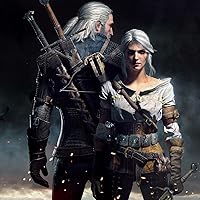
(Indeed, a canny reader will notice many of the things that writers, not least Games Workshop, have pilfered from his work, from the amoral dichotomy of Law and Chaos, to the multiverse dimension hopping to the stat-boosting potion chugging of everything from The Witcher to Elder Scrolls).
(B) - They are a crucial piece of the genre's history, a mini revolution in the hands of the genre's most unfortunately named writer. Written in direct response to the omnipresent Conan-knock offs that were polluting the byways of the genre at the time, Moorcock set out to write the 'Anti-Conan', and in the process created one of the most brilliant and tragic figures in modern Fantasy. Gone is the thrilling power fantasy of Conan, where a strong-armed thief rises by his might and wits to become a king, defying fate on the back of his own magnificent will; here is a born emperor in service to dark powers, weak, intelligent, and utterly at the mercy of a destiny that he despises as lovers, friends, family and fortune are all cruelly and irresistibly snatched away.
In this volume alone, containing the original Elric Saga from its inception in 'The Dreaming City' to its conclusion in the magnificent 'Stormbringer', manages an epic scope that lesser authors would have taken tomes to achieve. The future volumes all contain fine tales that explore more ideas within his life (the prequel novella 'Elric of Melnibone' in Vol. 3 being a particular highlight) but the key stories are all here, sensibly organized to a degree that many other editions of the Elric stories are not.
(C) - The writing is utterly, hilariously bad.
I mean this affectionately, but Moorcock cannot write. By this I do not mean he cannot tell a story - he absolutely can - nor that his characters are flat - they absolutely are not - nor that his ideas are boring - the contrary could not be more the case. Indeed, Moorcock is a unique example of a master storyteller who simply does not know how to string together a sentence. In another time, perhaps, he would have been an oral poet, a wandering bard, a born teller of tales spreading deep truths and wonder amongst the people. Alas, he lives in a literate world and had to make do with what was wanted.
Therefore, despite being one of the best critical minds of the entire sci-fi/fantasy scene, a visionary pushing the genre to knew heights and in directions no one else could even see, a writer deserving of comparison with other legendary contemporaries such as Le Guin and M. John Harrison, his clear sighted mastery of the artistic scene and potentialities of the fantasy form are translated to the page in the clumsiest prose imaginable. Years later I still laughingly cringe at a line in 'Stormbringer' about how "Elric rode on his horse like a giant scarecrow." This lack of sophistication in comparison to the stories themselves is present on almost every page, for (and here is the secret) Moorcock wrote and published these stories almost all (as far as I can tell) as first drafts.
This should not put you off. It is a testament to Moorcock's brilliance that he could revolutionize a genre with such swift work. To be fair to the man, I am also saying nothing here that he does not say himself, with his famous remark that "I think of myself as a bad writer with big ideas, but I'd rather be that than a big writer with bad ideas." Undoubtedly, they are big ideas, and much of Moorcock's brilliance was never fully swallowed by the later writers who tried to gulp down his ideas to push out their inferior plagiarisms (try going back to 'The Witcher' with its white haired warrior chugging potions whilst being called 'The White Wolf' without gasping at the shamelessness!). Accordingly, these original stories, however awkwardly penned, retain a power all of their own. Learn an affectionate tolerance for Moorcock's prose, and you'll be ready for some of the most invigorating and exciting adventures in Fantasy.
As an unashamed, and at times avid, reader of pulp sci-fantasy, and media tie in (if you can't tell from the list of books I have read, I am a bit of a Warhammer Fantasy/40K fan), I was incredibly pleased to have received this book as a Christmas gift late last year. Michael Moorcock was someone whose work I knew alot about, but had never personally dived into. Moorcock was one of the founding pillars of British dark fantasy, a literary genre that is, now, most prominently associated with Game of Thrones, Warhammer, and possibly the Witcher series. Moorcock has been listed as an influence for dozens, if not hundreds, of genre authors, and all of the glowing reviews set a pretty high bar for this particular series of his. Unfortunately, while I didn't dis-enjoy this (did I just create a word?), neither did I thoroughly enjoy this one. I have read far too many other novels (most notably the Malus Darkblade series from Warhammer Fantasy, which in tone and even certain plot points, is about as close of a copy as one can get to the Elric saga without actually being one) which were incredibly similar for me to really, fully become immersed in this omnibus. The writing was excellent, but since most of the stories inside are upwards of fifty years old, they felt a little dated. And as dark as this series could get, the more modern works tend to outclass Moorcock in that regard. I fairly well enjoyed the nod to Eastern, specifically Persian, mythology that was contained in the series, and also really liked the world building (essentially, the Elric saga takes place on Earth, but in a long forgotten past that predates earliest recorded human history). From my own perspective, Elric and his people, the Melniboneans, are essentially Dark Elves to put it in more of a fantasy trope. Their Empire, once the greatest ever in the world, has collapsed, and they are a dying people. The younger kingdoms, all of them human, are replacing them, and Elric, of the royal bloodline, and the last King of the Empire, is a fugitive, kept alive by a demonic sword which drains the life essence of its victims, which gives Elric his power and vitality (this is so similar to Malus Darkblade, that I found it hard to overcome). Elric is not, exactly, a sympathetic character, but he is a badass, and his adventures are fun, in a bit of an antihero kind of way. For me, however, I just couldn't get into it deep enough to dive into the rest of the series. But I can reccomend it to those who may not have had their tastes spoiled by too much of the modern fare of the same genre. Or if you are looking to see who, and what, inspired so many of the modern authors, give this one a try.
Elric: Stealer of Souls is a chronological collection of Elric stories starting with the first, "The Dreaming City". Elric is a sword & sorcery hero, or more precisely an anti-hero, unlike any other. He is an albino not exactly up there in the strength department. He is aided by his vampiric sword named Stormbringer that not only kills with gusto but eats the souls of his victims. It is Elric's torturous relationship with his parasitic and apparently sentient weapon, often to the point of self-loathing, that fuels much of the excitement of this series.
Unfortunately, the problem with this first book of a series is that the first few Elric stories are not very good. Moorcock was a young writer at the time and his writing style is immature and awkward. Also, the themes of the Elric tales are not well developed until later. The many one and two star reviews for this book are probably from those who gave up after the first few tales. I would have done the same if I was not already familiar with some of the later Elric novels.
But this book also includes the four novelettes that make up Stormbringer, the first fully realized Elric tale. It is here that Moorcock brings in two essential themes: the ideas of the multiverse (a word I believe Moorcock coined) and the Eternal Champion. The ongoing battle between Chaos and Law, one that Elric is not always sure which side he is on, is also developed. Most importantly, Moorcock is now a mature and mesmerizing writer that can immerse into the reader into his weird alternate reality.
So where are we? A generous two stars for the early tales and a solid four stars for "Stormbringer" giving the total book a strong three stars. If you are new to the Elric legend I would keep in mind that the first stories are not the ones you should base your opinion on or go straight to the four parts of "Stormbringer". Then fill in the rest of the saga afterward.
Elric of Melniboné – The name and the character standout in my memory in ways that so many others do not. I’m quite certain that I read the Elric stories before any of Michael Moorcock’s other “Eternal Champion” tales. Originally in used paperbacks that bore the “Lancer” imprint. Later on, I’m sure I re-read them in the DAW issues. Because the two series of books have different issue order/numbering I was always a bit confused about the “correct sequencing” of the stories.
Even then, I realized that the author had worked quickly – just like some of the more memorable pulp fiction dating back to the 20s and 30s. There were echoes of “space opera” (before the term was rehabilitated), H.P Lovecraft, and others, but the chronological inconsistencies were not specifically from rapid creation. As I later learned, the character was created and then, almost immediately destroyed along with his world. Since then, the author has had to “invent” stories that fall before the original tale, occur in the “gaps” between published stories, or yank him out of his world to another time and place in the multiverse.
These reviews are intended for both the latest re-read (the Del Rey series) and for the older versions. I’ll keep the same “introduction” for all and add the appropriate “body” to each.
Elric
I don’t read tons of Sword and Sorcery fiction, but over the years I have enjoyed several versions of this sub-genre. I readily admit to liking all of Tolkien’s tales, the “Farfhd and the Grey Mouser” stories by Fritz Leiber, “The Eyes of the Overworld” by Jack Vance, everything “Amber” by Roger Zelazny, Poul Anderson’s “The Broken Sword”, the “Book of Swords” series by Fred Saberhagen, and so on (I’ve left many out). And as good as all of these authors (and others) are only a handful remain clear even when recalled decades later:
The Amber Series Middle-Earth Elric
And each does so because they are so different in so many ways from each other and all of their forerunners, contemporaries, and followers.
2013 Re-Read: Chronicles of the Last Emperor of Melniboné: Volume 1 “The Stealer of Souls”
This excellent series reprints the Elric stories in the order of composition (mostly) and interspersed with them are several ancillary stories as well as informative introductions by Michael Moorcock. It is an understatement that this edition has helped to clarify the chronological issues that I recall from so long ago.
The Stealer of Souls
The second major component of this volume is the four-part novel, Stormbringer.
Stormbringer
Thoughts and Ranking:
Thus ends the first two paperbacks. With their great popularity, Moorcock found many ways to write further Elric stories, but he never brought him back from the grave (at least not in the original stories through the 80s). For better or worse. Elric and his world were dead and for that I have to say thanks. Not every author would stay within the lines once he had painted himself into a corner, but MM did.
These stories are wonderful and great. They are fantastic (in the original sense), they are imaginative, and they are escapist. If you only want to be diverted and entertained, then they will do that and do so better than many others. But they also hold deeper meaning. The hero is not just a swashbuckler; he is conflicted. He thinks of things that his people do not understand. His ideas on morality and justice may reflect modern Western man’s philosophy, but they are alien to the cruel and powerful Melnibonéans. This is why he has destroyed his people. This is why he has been selected to be Fate’s champion. And this is why he invades our thoughts and sticks in our memory. If only these two books were written, it would still be a powerful and evocative series. These books deserve Four and One-Half (4.5) stars, but I’ll show Four (4).
I was totally blown away by this collection, featuring the early Elric stories by Moorcock and then topped off by the novel Stormbringer. Previously I had been exposed to Elric in comics and graphic novels from Marvel and First Comics. Nothing could match how inventive the character or the world that Moorcock created in prose form. In the very first story, "The Dreaming City", Elric is practically the villain of the story, leading an attack on his own homeland to rescue his beloved. After that, Elric roams the Earth seeking wealth, truth, love, etc. In truth he is a bit of a sorcerous rebel, an angry young man lashing out against wizards and warriors the way young men rebelled against authority in the 1960s. His mighty blade Stormbringer, which consumes the souls of whoever it kills, has a mind of its own and is liable to kill Elric's friends as well as his enemies.
The novel Stormbringer had a conclusion that left my jaw on the floor. I had known, roughly, what happened to Elric's world at the end, because many articles on sword and sorcery mentioned it. But that spoiler alone didn't convey how operatic and poetic the final fate of Elric becomes at the end. I loved Robert E Howard's Conan as a character but always longed for a fantasy character with deeper thoughts and perhaps a deeper meaning to the entire story.
The rest of this volume is packed with great content. Alan Moore writes a nifty introduction. The original introductions to each story from Science Fantasy magazine are included, too, as well as letters, correspondence, maps, etc.
My only problem now is that I have read the final fate of Elric, I don't know if I can read any of the later stories--which are all prequels?
It's been a long time since I read the original Elric series, and I'm pleased to find that they still hold up. The writing is sometimes a bit clumsy (unsurprising given that Moorcock was in his early twenties when these were written), but the stories are fast-moving and the Doomed Albino Prince still has a sinister mesmeric effect.
Having said that, I'm a bit conflicted about this edition, at least as an introduction for someone who hasn't read Elric before. It's interesting to approach the stories in the order of composition (rather than in order of internal chronology) and the notes & essays are fascinating. But for me the best of all possible Elric experiences remains the original six-book paperback series, either the yellow-spined DAW editions with the Michael Whelan covers or the silver-spined Berkeley editions with the Robert Gould covers. Preferably read in sequence with the Corum, Erekose and Hawkmoon books.
Still, highly recommended and I'll be moving on to the next book in the edition.
Kitap, Elric'in düzensiz, kısa bir kaç hikayesi ile başlıyor. Karakterin yaratılış kısmı ve yazar ile ilgili çok fazla ön bilgi var. Kitabın sonunda da karakter ve seri ile ilgili mektuplar, bazı çizimler ve ek bilgiler var. Bu yönü ile Elric'i ilk defa okuyacak olanlar için bir tanıtım kısmı da içeriyor diyebiliriz. Ancak okuduğum baskıda çok fazla yazım hatasının olması okurken beni ara ara rahatsız etti. Umarım sonraki baskılarda bu hatalar düzeltilir.
Elric'in kısa hikayelerinden sonra ana tema ile bağlantılı olan kısma geçildiğinde kitabın geçtiği evren ile ilgili bilgi edinmeye başlıyoruz. Bu da benim kitaba kendimi kaptırdığım kısım oldu. Çünkü dağınık hikayeler ve tanıtım amacı taşıyan kısımlar kitaba adapte olmamı zorlaştırmıştı.
Elric karakterinin fantastik edebiyat dünyasında çok sayıda anti - kahraman figürüne esin kaynağı olduğu zaten tanıtım kısmında yazılmış. Okurken de fark ediliyor zaten. Ancak diğer anti-kahramanlardan farklı olarak Elric'in zayıf yapısı, bağımlılığı, içinde bulunduğu çıkmazdan kaynaklı depresif yönü ve kötü yönüne yapılan vurgular ile yazarın yarattığı karanlık dünya okurken bir süre benim de içimi karartmadı değil. Bu yönden yazarın anlatımının etkili olduğunu düşünüyorum.
Ancak ben de seriye yabancı olduğum için sonraki kitaplarda hikayenin akışı nasıl olacak tam olarak çözemedim. Kafamda sanırım evreni tam olarak oturtamadım. Elric karakteri dışında evreni biraz bunaltıcı buldum, belki tam olarak kavrayamadığım içindir. Serinin diğer kitapları ile fikrim netleşir diye tahmin ediyorum. Elric karakterinin ise daha çok tanınmayı hakettiğini düşünüyorum.
Kitabı ilk başlarda okurken bir yanım olayların fazla olaysız olmasından dolayı kitabı bırak diyordu. Mesela bir yemeğe ne kadar tuz atarsanız atın sanki tadında bir değişiklik olmuyormuş gibi gelir ya bazen, işte bu kitapta da ne kadar macera, entrika, gizem olsa da yine de insanı sıkan ve akıp gitmeyen, akıcılığa gölge düşüren bir yönü vardı. Diğer yanım ise kitabı bırakmamı istemiyordu. Çünkü kitap durgunluğuna rağmen farklı bir büyüye sahipti. Sempatik bir yönü vardı. Çelişkili bir kitaptı ve bu çelişki bile onu farklı ve çekici kılıyordu. Kitapta baş karakter hem fiziksel yönden hemde karakteristik olarak dört dörtlük değil. Kırmızı gözlü, albino, zayıf bir yapısı var ve çok da iyi birisi değil. Ben böyle karakterleri daha çok seviyorum. Daha doğal, hayatın bir parçası gibi hissettirişlerini seviyorum. Onların hata yapabileceklerini görmek hoşuma gidiyor. Kitaptan çok Elric karakterini sevdim. Onu içimde öylesine bambaşka, öylesine orijinal, öylesine farklı ve eşsiz canlandırdım ki belkide yazarı bile bu denli hayal gücü sarf etmemiş olabilir diye düşünüyorum. Favori karakterlerimden birisi oluverdi. Kitabın anlam veremediğim bir noktası olayların çok hızlı olup bitmesiydi. Normal şartlarda belki tek bir serinin veya kitabın tamamına hakim olabilecek nitelikte bir olay, burada kısa bir bölümde hemen anlatılıp çözüme kavuşturuluyordu. Belki de bu kitabın ilk çıktığı zamanlar sayı sayı yayımlanan bir çizgi roman tarzında olmasından kaynaklanıyordur ya da yazarın tarzı budur diye kabullendim. Ama olayların giriş-gelişme-sonuç döngüsü içinde sürekli değişmesi ve kolayca neticelenmesi okuyucu açısından biraz heves kırıcı olabiliyor fikrimce. Belki çok fazla fantastik ve heyecanlı macera kitapları pek okumamış kişiler ya da lise çağındaki kişiler için biraz daha eğlenceli, onlara hitap eder şekilde basit kurgulanmıştı. Ancak daha kaliteli eserlerin tozunu yutmuş olanlar aradaki kalite farkını kolayca görebilirler. Bu nedenle herkese olmasa da 13-17 yaş aralığına daha çok tavsiye ederim. Detaylı yorum için: http://yorumatolyesi.blogspot.com.tr/...
I had a longstanding plan to never read Michael Moorcock. Something about his presence in pop culture and sinister existence as the anti-Tolkien turned me off, and I felt sure that I was not missing anything. I finally picked up this volume because I had decided to embark on a survey of 60s fantasy, and discovering that Elric was from the 60s and not the 70s found that I must do my due diligence.
This volume collects the earliest Elric stories and novellas the last four of which were stitched together to form the first Elric novel STORMBRINGER.
From the very beginning Elric took my breath away. "A Dreaming City" was the first Elric story and remains my favourite of this collection. I find myself somewhat in awe of Mr. Moorcock who is not brilliant in execution but clearly a genius in many other areas. The Elric stories remind me so much of myself and I find a terrific kinship in them as well as a loneliness. These Elric stories, written by Moorcock in his early 20s feels so much like the dream-fantasy musings of my own early 20s. But they come with such a force of vision and awareness of their ideas, an uncompromising originality and a prescience. The future of fantasy was written in these stories, and I look forward to more.
Kitap Karakterimiz Melnibone'un Son Kralı Olan Elric'in Parça Parça Oluşan Hikayelerini İçeriyor.Karakterimiz Elric Albino Ve "FırtınaYaratan" İsimli Kılıcına Ölümüne Kadar Bağlı Ve Ondan Ayrılamıyor.Kitapta Hikayeler Ne Kadar Sıra İle Olmasada Olaylar Çabuk Gelişsede Kitap İyidi.Okumak İsteyen Ve Kararsız Kalan Kişiler Var İse Kitabın Arkası Sayfasını Okuyarak İşe Başlayabilirler.Kitap Gerçekten Güzel Ve Seri 6 Kitaptan Oluşuyor 2. Kitabına Geçmek İçin Sabırsızlanıyorum Daha İlk Kitabından Böyle Olaylar Olduğuna Göre 2. Kitapta Olaylar Nasıl Gerçekleşecek Nasıl Bir Yol İzleyecek Merak Etmeden Duramıyorum.Okuduğunuz İçin Teşekkür Ederim.Herkese İyi Okumalar
For those not familiar with his work, Moorcock's Elric stories are some classic post-Tolkien British fantasy of the sword-and-sorcery variety. I've called Moorcock the British Howard, for there is something like the world of Howard's Conan in Moorcock's stories, though the heroes could not be more unalike. In fact, Elric is deliberately an anti-Conan: physically weak where Conan is strong, reliant on drugs and sorcery where Conan relies only upon his own might and main, darkly brooding where Conan is jovial and boisterous, decadently civilized in a way that the barbaric Conan despises above all else. Elric is the damned antihero, and yet is enjoyable to read for all that. Moorcock was one of the big influences on the creators of D&D (he's on the Appendix N of Gary Gygax, along with Howard, Jack Vance, Tolkien, et al.) and I think he's worth reading for any fan of classic fantasy. Be warned though - Moorcock's Elric anticipates the antihero of modern literature quite strongly - he is far more amoral than you may be expecting . . .
I can't, like, recommend this in good conscience because i don't think moorcock has ever met a woman in his life, but if you want some good eldritch cosmic horror fantasy and can get around the rehashing of the same information constantly then let me tell you, this book is for you.
Listen. I have a lot of problems with it but at the end of the day you give me a frail man with long hair and an evil soul-sucking sword and I'm content.
Päätin palata pitkästä aikaa Melnibonean Elricin tarinoiden pariin. Elric hahmona on epämiellyttävämpi kuin olin muistanut ja tarinankerronnassa tökkää tietyt valinnat, mutta Elricin seikkailut ovat yhä ehdottomia suosikkejani kaikista fantasiatarinoista. Mikä saattaa olla outoa, koska hahmo, tarinat ja maailma ovat masentavia ja epätoivoisia.
This is my third time through this material, the second via a strict original-publication-chronology, and three times is enough for me. There are whole midpart sections and stories where you can tell that Moorcock just wasn't feeling it, and the plots and images devolve into fetch quests and exquisite corpse monster battles and Elric calling for metaphysical help and whining an awful lot.
But when Moorcock is on task, he's on task. He throws out little ideas here and there--that the Melnibonean magic is dream-state, that these people straddle the line between humanity and inhumanity--that the author admits will become raw material for revisions and successor generations of Eternal Champion. The fervor behind "The Dreaming City" and "Doomed Lord's Passing" is shown in powerful imagery and intricate ideas. And these are the ones where we see into the life of Immryr and their decadent, dreaming, tortured society.
And you have to admit that dropping the whole of _The Stealer of Souls_ and _Stormbringer_ into the middle of this thing is a real cop-out. I would rather have seen a more curated set of material of what Moorcock favored or felt was essential, even if the total set was smaller and consisted of excerpts.
The essays are worth the price of admission, in particular Alan Moore's "The Return of the Thin White Duke", which Moorcock-wise posits an alt-history unfashionable Melnibonean ancestry in England and proceeds to a scathing appraisal of competing works. It is compulsively quotable.
And Moorcock's own introduction and follow-on material is not just interesting for its backstory and set of influences, but also for the anecdotes. (It turns out that he did not like the pointy-helmet design that Jack Gaughan cooked up for a book cover, which in turn became part of the graphic novel character designs. So it goes.) He does not discuss the Eternal Champion origin or evolution other than mentioning that Jerry Cornelius is a twisted photocopy of the Elric original. This ties into how Moorcock appears to operate by iteration, refining and revising already-published material and producing sequels and prequels and fix-ups in an endless program of tinkering with what he already has.
And in the middle here is a Sojan story, "Mission to Asno!". I have absolutely no idea why.
The fascination with this read-through was, first, that Stormbringer is eventually gendered as female, and I'm not certain where this started. Significant? I don't know, but there comes a point where Zarozinia considers it to be her competitor. And the image of "codependent love interest" is powerful.
Secondly, the observation that the magic Elric wields is all in terms of summonings and invocations: he calls for help, he appeals to a higher authority, he abdicates personal power or involvement.
Elric Serisinin ilk kitabı olan Ruh Hırsızı bitti. Elric tam olarak okumak istediğim karakter yapısına sahip bir kişiydi bir anti-kahramandı. Gerektiğinde bazen gerekmese de elini kana bulamaktan çekinmeyecek, iyilik diye gereksiz maceralara atılmayacak, şartlar oluşunca ihanet etmekten bile geri durmayacak bir karaktere sahip Elric. Kitaptaki daha ilk hikayeyi okurken aradığım kişiyi bulduğumu anladım. Konusundan bahsetmek istemiyorum ilginizi çektiyse kitabın arka kapağını okuyabilirsiniz. Gelelim diğer konulara, kitap iki ana başlığa ayrılmış 9 hikayenin bir araya gelmesiyle oluşmuş. İlk başlık olan Ruh Hırsızı'nda 5 hikaye yer alıyor ve bu hikayelerde Elric'i ve diğer önemli karakterleri yakından tanıyoruz. İkinci başlık olan Fırtınayaratan da ise birbirinin devamı olan bir olay zincirinden meydana gelen 4 hikaye yer alıyor.
Kitapta birbirinden güzel çizimler ve yazarın bolca açıklamaları yer alıyor, bu yönüyle başarılı bir edisyon olmuş. Kitabı Barış Tanyeri çevirmiş, Elric'in konuşmalarındaki asilliği başarılı bir şekilde yansıtmasıyla çevirmenlikteki yetkinliğini kanıtladı bana çevirdiği kitapları okumaktan çekinmeyeceğim. Yalnız kitap çevirideki kaliteye yakışmayan bir redaksiyon sürecine uğramış 30'dan fazla yazım yanlışı vardı, İthaki kitaplarında son zamanlarda neden bu kadar hata yer alıyor bilmiyorum. Bu ay fazla kitap aldım ama bir dahaki ay serinin çıkan diğer iki kitabını da alıp okuyacağım. Serinin ülkemizde gerektiği değeri gördüğünü düşünmüyorum ilk kitap çıkalı iki yıl oldu ama kitap hala 1. baskıda, İlknokta'da serinin her bir kitabı 9.90 TL'ye satılıyor siz de alın ki seri satılsın ve seri kısa sürede tamamlansın.
really enjoyed this on the whole but be warned if you buy this specific collection that the stories are in publication order, not chronological order and the last story in this book (which is volume 1 of 6 mind you) is chronologically the very last story of elric. it's also worth noting that the author's relative inexperience when he wrote these early stories is evident. the dialogue in particular spends too much time on exposition that could be relayed directly to the reader by the omniscient narrator and the opportunity for genuine drama between characters is often hampered by this.
in spite of this, elric and stormbringer are very fun to read about. even in the dullest of these stories his unique brand of antiheroic misery and his relationship with his vampiric, half-sentient sword was interesting enough to keep me going. as the stories go on moorcock starts leaning harder into high concept fantasy, with the war between order and chaos reaching an apocalyptic fever pitch in the final two stories, which are the best in this volume. if I'm going to assess him as a writer based on this I'd say he's at his best when indulging fully in fantasy and throwing all kinds of monsters and metaphysical concepts in elric's path.
I have bought the rest of the del rey collection but I'm not sure how fast I'll read them. not great at focusing on books in general so having a collection of short easily digestible stories that carry on a larger narrative was pretty rad.
Elric: The Stealer of Souls is the story of Elric, the last of his noble line, and his travels. Elric has left his kingdom behind and is exploring the outlying lands with Stormbringer, his sentient sword. Being a dark fantasy, Elric's adventures are filled with horrendous creatures, evil beings and violent encounters. Moorcock does a fabulous job developing the characters and setting his scenes. The world he creates is well thought out and planned. There were occasional scenes that didn't quite ring true to me, but not so much that they seemed off. Enjoyable read and recommended to those who enjoy the genre.
Phew, this took me forever to read. This was okay. It was a bunch of stories that were mostly the same. It grew pretty tiresome by the end. So this was meh to me, just not my thing. I do think my twelve year old self would have probably given this 5 stars and thrown it on the best reads pile. Too bad I didn't read these stories then. Anyway, not bad just got kind of old. I highly doubt I will read more of these.
Fun collection of short stories about the forces between good and evil. Elric was an interesting hero not what I expected, but enjoyed it all the same.
bence çok iyi bir kitaptı. Türkiye de kitaba hakkının verilmemesi beni şaşırttı. umarım okurları artar... serinin diğer iki kitabını okumak için sabırsızlanıyorum çünkü kitap sonu final gibi bitti😂
Elric Ruh Hırsızı, içerisinde Michael Moorcock'un 20'lerinde yazmış olduğu ilk Elric hikayelerinin, o dönem bu hikayelerin yayınlandığı fanzinlerin kapak görsellerinin, Elric evrenini oluştururken aklında neler olduğu, kimlerden etkilendiği, o yıllarda fantastik eserlerin nasıl görüldüğünü anlatan yazıların bulunduğu bir fantastik/macera kitabı. Ayrıca Melnibone'nin Son İmparatorunun Tarihçesi adlı 2008 yılında basılan serinin ilk cildi.
İtiraf etmeliyim, fantastik dünyaları ve konuları esas alan eserlerle pek aram yoktur. LOTR'i bile izlemedim ki bu konuda çeşitli çevrelerden epey tepki aldığımı da söylemem gerek. Elric'in bu kitabı beni bu türe bir nebze de olsa ısındırabildi. Çoğu hikayede Moorcock'un deneyimsizliğinden kaynaklanan eksikliği gerek anlatım dilinde gerek karakterlerin gelişiminde olsun hissedebiliyorsunuz ama bu hikayelerin vasat olduğu anlamına gelmiyor, sadece fazla hamlar. Kitabın sonunda yer alan yazılardan birinde yazar tam da bu düşündüğüm şeyi dile getiriyor:
"Sanırım Elric hikayelerine daha sonra daha iyi hikayeler haline getirmeyi umduğum ham materyallerin bir sunumu olarak bakmak mümkün."
Elric ve birkaç ana karakter hariç diğer karakterler hakkında son derece umursamaz bir tavır içerisindeydim kitap boyunca ki bence bu kitabın önemli zayıf noktalarından biri. Hikayeler boyunca belli noktalarda karakterler girip çıkıyor sahneye ama hepsi figüran gibi sanki, başlarına ne gelirse gelsin pek umrunuzda olmuyor. Buna Elric'in en yakın arkadaşlarının birinin ölümü de dahil (çok dramatik bir şekilde ölmesine rağmen).
Çok eleştirdim belki de bu kitabı ama 60'lı yıllarda yaratılmış olması ve kendinden sonra aynı türde yazılan eserlerdeki karakterlere çok büyük bir ilham kaynağı (Geralt of Rivia gibi) olması açısından fantastik kitap türünün tarihçesi açısından önemli bir isim Elric. "Swords & Sorcery" temalı kitapları sevenlere ya da benim gibi fantastik/macera türünden uzak duranlara önerebilirim bu kitabı.
3,5 Kitabın gerçekten uzun bir açıklama kısmı var ve sadece kitabın başında değil. Bu yüzden hikayeye girmekte geciktim ve bunu sevmedim. Bir de hikayeler kopuk kopuk ilerleyip ilerde bir bütün oluşturuyorlar. Bu da başta beni rahatsız etse de sonra alıştım. Ama keşke yazar bir bütün halinde yazsaydı da dedim. Ve Elric'e gelecek olursam... Elric yazarın da sık sık üzerinde durduğu gibi uyuşturucu bağımlısı gibi kılıcına bağlı, o olmadan bir hiç. Fırtınayaratan onun hem cenneti hem cehennemi. Ve kılıç en çok Elric'in sevdiklerinin canına kıyıyor. Bu bölümlerle gerçekten üzüldüm bir insanın kaldırabileceği bir şey değildi ancak Elric gibi biri bu durumla baş edebilirdi. Genel olarak beni biraz yorsa da sevdim. Arada Rs'lere girip girip çıktım çünkü.
Five stars for the stories in “Stealer of Souls”, three for the “Stormbringer” novella, because trying to retrofit Elric into the whole Eternal Champion scheme was just too absurd. It's like trying to fit a tentacly, Cthulhu-shaped peg into a square hole. Elric as the leader of the free world and harbinger of a universe of order? Give me a break...
The Elric books have a very special place in my heart--they're the only source of conspiracy theories in my life. Some people cherish conspiracy theories about the Kennedys, some about Princes Di, some about Obama's birth certificate. I never understood those types of people--that is, until I read the Elric stories. Now I totally get the appeal. I have been converted into the conspiracy camp. You don't believe me? Here is a rant to prove it, complete with arguments with my imaginary opponents. (This is really a summary of plot and themes, I swear...)
Yes I know that Elric is supposed to be a tragic antihero, a helpless, doomed victim of his evil sword, a pawn of cruel fate which made him an Eternal Champion, yada yada. Well, I'm not buying any of that. He's clearly the villain of every story he's in, a sociopath and an evil necromancer who destroys people for fun, even whole civilizations when he's especially bored, until he finally causes the destruction of the whole world. Why do I think so? Because of Michael Moorcock--the way he says one thing about Elric (but always with what seems like hidden sarcasm) and then goes on to show him to be something else completely.
Elric is the Eternal Champion destined to stop the Lords of Chaos from taking over the world? Really? Who was it who called these Lords in the first place? It seems that summoning the Princes of Chaos was a lost art, until, that is, clever Elric figured it out and proceeded to summon Arioch to the material plane every time he stubbed a toe. And then mysteriously all these other mortal sorcerers just happen to come into contact with the Princes of Chaos. Coincidence? I think not. Oh, but wait, I hear someone say, Elric only summoned him because he was desperate to save his fiancée. That's why he called Arioch and retrieved that evil sword in the first place. Yes, he supposedly did it to save Cymoril and thwart his evil cousin's attempt to take over the throne... And then he left that same fiancée hanging and handed his cousin the throne, and went off to “explore” the Young Kingdoms, which mostly involved him getting into fights and using that evil sword to suck out people's souls. I say that he left because he was bored and wanted to play with his new evil toy. Oh, but wait, someone says, he only uses that sword because without it he would be physically weak and even die. Really? He was doing just fine without it before. And what is that horrible illness of his anyway? He claims it's albinism. Really? Is there something about poor eyesight and higher risk of skin cancer that would make him drop dead on the spot? It's obviously something else, something he's trying to keep secret... Something like being an undead evil necromancer who must feed on souls to survive, maybe? And when he gets bored with terrorizing the Young Kingdoms, he comes back and destroys his homeland. It's all to save Cymoril, of course, except then he kills her. Oops. But wait, someone says, his sword did it, it has an evil will of its own. Poor Elric, as the Eternal Champion he gets re-absorbed into the sword and is destined to be resurrected over and over to wield it. So Elric is the sword, the sword is Elric. Potato, potahto. Whether the willpower is contained in the sword or the man, they're obviously one entity, and thus he's the one responsible.
That's the beauty of these stories--they present the seemingly straightforward high fantasy theme “guy with magic sword must save world”--but with a wicked twist. It's not the hero's journey you are following along, but really a villain's schemes. You get drawn into it inadvertently, and before you know it, you can't help but sympathize with the villain's point of view, which is something like “I was just minding my own business, manipulating and mocking people, stealing their money, sucking out their souls, summoning evil chaos demons, destroying civilizations, you know, normal everyday stuff, and then for some reason the world just fell out of balance and into chaos. I have no idea how it happened and I certainly had nothing to do with it. It must have been those upstart humans from the Young Kingdoms. The minute me and my evil empire stop torturing and enslaving them, they try to imitate us. I swear, give some guys an inch...” And you know, right from the very beginning, that this Elric guy is pure evil, but you don't care because he's so fascinating, and you just can't wait to see what moral lapse he's going to stumble into next, and what whining excuses he'll make for himself this time.
So, Michael Moorcock, thanks for your insightful essays--the bonus material in this edition--some of which claim that Elric is really a well-meaning guy who just happens to go through bouts of existential angst. Sorry, I don't believe you. I'm sure you were saying it tongue in cheek... These stories are too brilliant, Elric is just too delicious as a villain, and I have spent too many hours cackling with evil glee over his “heroic” exploits. There is no going back now.
This entire review has been hidden because of spoilers.
Edgelord dark elf with evil sword finds himself a pawn of destiny Pros: vivid descriptions of a dark, dangerous, mysterious setting. Some fun philosophical musings of fate, law, and seeking meaning in chaos Cons: too Freudian, has clunky exposition due to the novelette format, too many dead women of no other import lmao Rating: none, I read this as an academic exercise
Elric of Melnibone, written by Michael Moorcock, is arguably one of the most recognizable characters in 20th century fantasty literature. He's also a fascinating antihero. The Stealer Of Souls, the first volume of his adventures (in their modern Del Rey publication, anyway) collects the first two Elric cycles ever published. Ironically, these are the last adventures of Elric if you were to group them by internal chronology, but I think that they work as a good introduction to the character regardless. For a while, these were all the Elric stories that existed before Moorcock went back and filled in a lot of the backstory with other adventures.
In Moorcock's canon of work, the cosmology goes something like this: There are two forces at work in the multiverse--Order (or Law) and Chaos. These two forces are always at war, and neither must ever win out completely. If the world is tipped toof far towards Law, the result is stagnation. If the world is tipped too far towards Chaos, the result is madness. Thus, Fate empowers the Eternal Champion (different incarnations of the same character in various realms of the multiverse--I'm told Moorcock recently penned a Doctor Who novel in which he implied the Doctor may be yet another face of the Eternal Champion) to protect the Cosmic Balance. Elric is one incarnation of this Champion.
In Elric's world, the empire of Melnibone ruled the world for over ten millenia, its rulers cruelly subjugating the human inhabitants of the "younger kingdoms" as slaves and subjects through military might, dark sorcery and their mastery of the dragons. The Melniboneans are an older race than humanity, resembling the elves of other fantasy in many respects. They are cruel and arrogant by nature, traditionally alligned with the forces of Chaos and its lords. Over the course of recent generations Melnibone's influence in the world has waned and their civilization faded, until of their vast empire and many cities only the Dragon Isle and the dreaming city of Imrryr remains. Elric is by rights the 428th Emperor of Melnibone, but as the story opens his throne has been usurped by his cousin Yrkoon, prompting Elric to seek vengeance on his cousin and the entire Dreaming City.
Elric is himself an albino, physically weak and dependent on outside sources for his strength. Sometimes he is able to make do with drugs distilled from certain herbs he knows how to work with. Sometimes he is able to strengthen himself through sorcery, draw power or assistance from gods or demons he can summon. But for most of the stories in this volume Elric draws the core of the strength he needs to survive and function from his sentient sorcerous sword, Stormbringer. Stormbringer is a powerful weapon, forged of Chaos. It has a mind of its own in battle, and absorbs the souls of anyone slain on its blade and feeds that power to its wielder. It is an evil weapon, and despite Elric's reliance on it he hates it for its continuous thirst for the blood of those closest to him.
The stories that make up this volume begin with Elric seeking his revenge on his traitorous cousin and their nation, trace him through his next several adventures in the younger kingdoms, and then chronicles the climactic battle between Chaos and Law for the fate of the world--a battle Elric is fated to play the major role in. I don't want to say too much here for fear of spoilers.
The Elric stories have their origin in the pulps of the fifties and sixties. As a result, the prose is very......I'm not sure "lurid" is quite the right word, but I can't find a better one. The tone is very moody, even gloomy, as Elric deals with the consequences of his actions and ponders philosophical questions about his fate and place in the world. Especially towards the end as Chaos overtakes the world the stories grow exceedingly grim as kingdom after kingdom, friend after friend, all fall before the growing threat of Chaos.
Content: This is fantasy in the vein, content-wise, of Conan the Barbarian. Thematically and as a character Elric is really the opposite of Conan, but nevertheless the comparison stands in this narrow category. Violence: PG-13/R. Lots of violence, some instances more horrifying than others. Many die in battle, others in single combat, and a number of Elric's friends die accidentally on the blade of his own sword, their souls sucked out by his black blade to feed his own abilities. There is some Necromancy, some torture, and discussion of the forces of Chaos warping men into monsters of grotesque description. As its a book, the impact of this depends greatly on your own imagination. Language: PG at worst, I think. I don't recall much at all.....certainly nothing you wouldn't hear on primetime television today. Sex: PG-13. There's a fair amount of sexual content, but its not too explicit.
Elric is one of those characters who has been in the outer periphery of my swords and sorcery knowledge for decades now. My favorite book cover illustrator, Michael Whelan, has painted several Elric covers since the '70s, and more than a few of my friends have told me how Elric is central to their love of the fantasy genre. But aside from Asimov's Foundation series I'm not generally a fan of pulp fiction, which is what the Elric stories are (or at least that's what the earlier ones started out as), so I've never actually read any of Michael Moorcock's work.
But last year Del Rey published new collections of the Elric stories, placing them in a kind of historical context. Moorcock wrote lengthy introductions to the books, in which he discusses the pulps at the time when these stories were first published in the early '60s, and his thoughts on the fantasy genre as it was being transformed (primarily by him and his colleagues) in that post-Tolkien era. This historical approach helped ease me into the stories and to take them for what they are: documents of a time when fantasy literature was breaking through its previously set boundaries. Elric, the character, was a reaction against the noble elves, mysterious but benevolent wizards, and spotless heroes of traditional fantasy.
The early stories ("The Dreaming City," "While the Gods Laugh," "The Stealer of Souls," and "Kings in Darkness") were pretty much exactly what I was expecting. Here's this antihero with an evil, soul-draining sword (called Stormbringer), who travels around his ancient world, getting into adventures, killing his enemies, and generally being a broody miscreant. But there wasn't much more to those stories. I had a hard time reading them all the way through.
"The Caravan of Forgotten Dreams" was more interesting, if only because it dealt with a Genghis Khan-type villain, and I have a weakness for stories about Mongol hordes. But it still wasn't particularly mind-blowing. It seemed as if I would get nothing more out of the Elric stories than what I already knew before I'd started reading them, which is that Elric was a prototype for every antihero from the vampire Lestat to the elf Lusiphur Malache, and his sword Stormbringer exerted a profound influence on everything from Deep Purple and the Blue Oyster Cult to Dungeons & Dragons.
Then I started reading the four interlinked stories that would together form the novel Stormbringer, and that's when Moorcock blew my mind. What started as a simple Conanesque world became just one small plane of existence in a much larger and more complex multiverse (a word that Moorcock invented, if I'm not mistaken). The earthbound adventures of Elric were now set against the far more compelling cosmic backdrop of the war between the gods of Law and Chaos, the outcome of which would determine the very fabric of the universe. Elric's part in this war was made interesting by the fact that, though he struggled to fight for the side of Law, he was in fact a disciple of Chaos--as was his sword, Stormbringer.
Whereas the first half of the book took me weeks to slog through, I finished the last 200 pages in just a few days. Finally, I had discovered material that had generated all the hype I'd been hearing about for the last twenty years of my life.
In retrospect, the first 200 pages of the book were okay, because they introduced me to Elric the way everyone else was introduced to Elric. I learned his backstory, met his friends (and his enemies), and came to respect the irresistible power that Stormbringer held over him. But it's the last 200 pages of the book that are truly worth reading. And perhaps even worth re-reading.
I'm hesitant to read the subsequent Elric volumes, if only because I can't believe that Moorcock would be able to top Stormbringer. The nine tales I read in this first volume are in chronological order--both in terms of when they take place in Elric's world and in terms of when Moorcock wrote them. His later Elric tales take place at earlier times in Elric's life, and now that I've read up to the end, I don't know that I'm interested in revisiting his earlier life (perhaps partly because I was uninterested in those first five stories that take place earlier in his life). We'll see. It all depends on how long Elric stays with me. I may be drawn back to him the way he's always drawn back to Stormbringer.