I had hoped this text would primarily explore our embodiment as creatures and the incarnational context of all knowledge. Instead, Derrida sharpened the same stick he'd been whittling away at his whole career, namely an attack on the rationalistic tradition of "phallogocentrism" (as typified here in Descartes' "I think" and Descartes'/Aristotle's view of animals as automatons). More than in any other work of Derrida's, he achieved his interrogation through a circling, spinning, spiraling motion, repeating and mutating himself in a way which embodies his notion of "iterability" from his other work. He especially fixated on the things which supposedly differentiate humans from animals, namely our nakedness, our intellect, and our language.
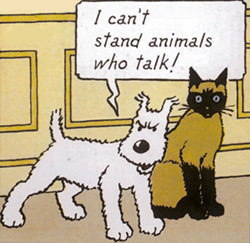
The first image he chose to illustrate his criticism was that of being viewed, nakedly, by an animal, for example, a pet cat. The cat's gaze is a certain kind of gaze to Derrida, a gaze of the Other, a silent reply, that is, one not speaking a logos-language we're used to. Nakedness has a long history in human culture; this might sound like a stupid and self-evident statement, but it goes back to our founding, what with Adam and Eve, and also back to another founding in the enlightenment and even as far back as the Greeks, namely of figuring "truth" as "naked" and "falsity" as "clothed." However, quoting Heidegger near the end of the book: "This deception, this being deceptive that belongs to the essence of the logos—this proffering of something as something it is not—this pretending, with respect to whatever the deception is about, is a concealing." Thus, the same question asked by Nietzsche (in "Truth and Lies in a Nonmoral Sense") and every nominalist before and after Ockham.
It's a bitter irony: that Derrida, far from being some boogeyman against "The West" (or whatever Jordan Peterson calls him), is actually extremely concerned with truth, and with all the values that The West holds dear. Derrida wants to interrogate, to "deconstruct", not to destroy, as many of his critics claim. He wants to take apart to see the constituent parts, not merely tear apart and leave it in a heap. Working in reverse from the end of the book (because why not), Derrida points out three major traumas which have shaken "phallogocentrism" to the core: First, the Copernican (the earth revolves around the sun), Second, the Darwinian (humans are just complex monkeys), Third, the Freudian ("the decentering of consciousness under the gaze of the unconscious"). Derrida thus arrives at the nervous nexus of these three traumas, the venn diagram of all three, ultimately asking "whether what calls itself human has the right rigorously to attribute to man, which means therefore to attribute to himself, what he refuses the animal, and whether he can ever possess the pure, rigorous, indivisible concept, as such, of that attribution."
In other words, what makes us gods over all the animals, to simplify them to non-human, and divinize ourselves as something exceptional? This question is one logical conclusion of his prioritization of the margins over the norms, but I'm not sure what exactly it achieves other than total coverage. He points out early on in the text how "victims of historic catastrophes have in fact felt animals to be victims also, comparable up to a certain point to themselves and their kind." In other words, he shows his hand here; or rather, the hand of all the marginalized he represents. In other words, as I wrote in my journal this morning, "pathology is passion;" in other words, trauma is an engine. In other words, the "catastrophes" or "traumas" that Derrida describes (genocides, factory farming, Copernicus, Darwin, Freud, etc.) are where he finds the most anxiety, and thus the most meaning, the most energy to write, to explore. He's like an over-zealous surgeon digging in the wound looking for the bullet.
On one level, I understand where he is going in this text, and I even appreciate how he finds places of tension and dives right in instead of shying away like many do (who define anxiety away under the guise of "cogito ergo sum" or some other anthropocentrism). But I fear that he creates just as comfortable a hammock in these gaps as those who ignore or cover them up. As I just mentioned in my Entangling Vines review about Zen Buddhist Koans, Derrida, despite all his posturing, still shares many of the same goals as those he criticizes. Whether he intends to or not, he maintains a certain linearity and, in his words, a logo-centrism. Sure, he spirals out, but like a spring spinning in a given direction, one which timidly defends a presupposed political program. He lacks entirely the dynamite of Nietzsche, the one honest man, I fear, who is willing to kill all gods and say what's impossible to say aloud.
Derrida at one point hints toward this fearless exploration, asking "Why could one not speak of an animal philosophy?" As "Metaphors We Live By" points out, so many of our concepts are embodied metaphors, and had our world or biology been different, we might have totally different ways of thinking or representing things. For example, depending on the fish or the bird, many things might be inverted, or so thoroughly subverted that there is no clear up and down, but maybe something more like north and south, shallow and deep, light and dark, warm and cold, etc. It's interesting to imagine, but Derrida doesn't explore that much at all.
To be sure, I'd happily agree with Derrida that Descartes commits a mortal sin when "in one blow, to economize, to save time, he eliminates everything that isn't 'certain and indubitable;'" for in that move he sums up the entirety of the modern worldview, and the heresy thereof. I think that the post-modern, of which Derrida is chronologically if not philosophically a part, and the premodern, of which I am not chronologically but at least in attitude a member, often overlap quite significantly. The more I read and write and think, the more I'm disturbed by the modernization of the Church; not the slight doctrinal or aesthetic changes before or since the Reformation, but the changes that have happened under the hood in terms of emphasis, culminating in an almost gnostic hyper-focus on ascertaining the one correct formulation of belief (justification/salvation), and leaving all the rest to the buzzards. Lately I'm much more interested in orthopraxy than orthodoxy; Descartes, however, completely precludes the former when he focuses exclusively on the latter. In other words, when all we have is the Letter, the Spirit doesn't have a chance to "give life." In other words, Derrida attacks our tradition at its weakest point: its most literal, technical side. This is why his usual tactic is to interrogate specific quotes, sometimes even a specific word, needling at it until the assumptions become more evident, and what originally felt self-evident is now up for debate.
He does this when he points out slight differences in Descartes' text when he translated it out of the original Latin into French, where he adds some additional clarifying remarks. He finds those anxieties about miscommunication and clarity often pooled around the issue of certainty and certain starting assumptions about humans. Similarly, I feel like so much of what people debate these days centers around an unexplored egotism, that traumatized engine which fuels so many ignorant people speaking boldly about that which they don't understand. Everyone "secretly exempts [themselves]" from the need to be self-critical, to stringently vet one's "allies." For in truth, we irresistibly tend to fall back into the comfortable cliche of taking at face value that which props up our "side" (or more accurately, which strokes our ego). Thus, Derrida's text is a healthy thing for us anthropocentric thinkers to consider.
However, a supreme irony exists here: why doesn't Derrida turn this critical gaze back in on himself? Why does he secretly exempt himself? Simply because he has rejected some lazy assumptions? Yet even he, were he honest, has his own fair share of assumptions which he defends like a mama bear, especially later on in Limited Inc. His is often a simple ideological inversion, a privileging of the margin over the norm, as I highlighted at the start. At the start of "The Animal That...", he shifts from what is "certain" (Descartes' 'cogito') to what is "undeniable" (that animals suffer). It isn't self-evident how to interpret this suffering, however. Given how Christianity complicates suffering (i.e., it isn't a straightforward bad thing, good can come from it, it can make you a better person, etc.), the vegan conclusion is far from self-evident. I've met more than my fair share of vegitarians who arrived at their position because of "ew", the same stupid argument that secular people had against homosexuality or transgenderism before 2014. But "ew" is not an argument.
The Christian argument normally has been wrapped up in "confession" (of sins, of faith) as Derrida points out; it is an endless reflection upon who and what we are and what we've done, resulting in an autobiographizing we incessantly indulge in. He ties together the act of "confession" with the "naming" done by Adam in the garden: "the wound without a name: that of having been given a name." I think a way to sum up Derrida's argument is that all these (male) philosophers have "themselves...never been looked at, and especially not naked, by an animal that addressed them." Thus, the 'feminine' gender, the one that dresses and poses for a gaze, is also the Animal, the Other, the recipient of a name, not the giver of the name. The 'masculine,' is thus a human, philosopher, name-giver, poet, priest, king; his worldview is one built upon the act of looking, speaking, acting in the world. He forgets about the Other once he names it and creates a comfortable distance between him and it. As he writes earlier, "They have taken no account of the fact that what they call ‘‘animal’’ could look at them, and address them from down there, from a wholly other origin." As I wrote earlier in my review, thus the fish or bird epistemologies.
The animal-other then becomes a type of the marginalized, a primal and primary example of exclusion and over-looking that is deeply rooted in western philosophy. "In the first place there are texts signed by people who have no doubt seen, observed, analyzed, reflected on the animal, but who have never been seen seen by the animal." As he writes quite poetically: And in these moments of nakedness, as regards the animal, everything can happen to me, I am like a child ready for the apocalypse, I am (following) the apocalypse itself, that is to say, the ultimate and first event of the end, the unveiling and the verdict. I am (following) it, the apocalypse, I identify with it by running behind it, after it, after its whole zoo-logy
Thus putting ourselves, nakedly, vulnerably, in the position of the animal, the other, the observed but not understood, the named but mysterious, the tamed but segregated, we can start to learn about our blind spots. This isn't even the start of understanding an animal epistemology; rather, it's an indictment of the ways we dehumanize humans who don't fit our comfortable cliches. He writes "The animal looks at us, and we are naked before it. Thinking perhaps begins there." The reason this makes sense is that, in the moment we lock eyes with the Animal, the Other, we must grapple with the fact of their independence; we learn in a flash that we are not God. There are things (such as them) which are far outside of our control, likely outside of our comprehension, things that experience the world similarly enough to interact with, but differently enough so as to disturb our usual assumptions. Animals disturb us first because they are comfortably naked, and second because our human masks don't work on them; we spend all our time curating and posing, but that all falls to pieces under the gaze of the animal-other. We experience those two kinds of nudity simultaneously: "Nudity is nothing other than that passivity, the involuntary exhibition of the self."
Clothed as our thoughts and actions are in words, we fear such an absolute exhibition, always preferring a comfortable gap, a couple feet between us and the person we're talking to. But Derrida complicates this discourse we're so used to: "In any case, isn’t Alice’s credulity rather incredible? She seems, at this moment at least, to believe that one can in fact discern and decide between a human yes and no." Animals, by contrast, have a very direct, immediate, relationship with "truth," which to them is a simple life-or-death; in other words, even when they play dead, they don't know how to lie. Humans are so complex so as to have an almost infinite number of layers of meaning between each other, even when we say something so simple as "yes" or "no." Sarcasm? Irony? Bitterness? Contempt? Pretending? Pretension? Who is to tell. That's why I argued in my Master's defense about the centrality of faith, that language requires faith, that the gaps between each other, between us and words, between words themselves, must be bridged by certain idealistic assumptions, unprovable, yes, but distinctly human.