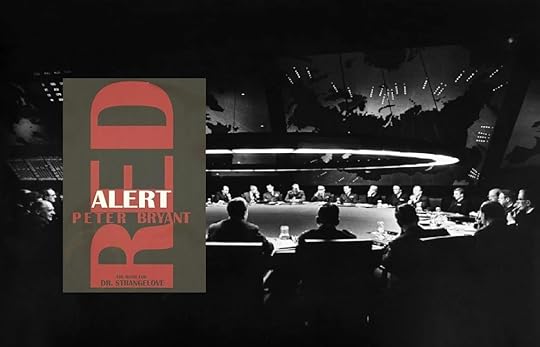
The world hovers on the brink of a nuclear war - and the whole future of mankind rests in the hands of a young bomber pilot...
(Source: back cover)
Red Alert is a 1958 novel by Peter George about nuclear war. The book was the basis for Stanley Kubrick's 1964 film, Dr. Strangelove or: How I Learned to Stop Worrying and Love the Bomb. Kubrick's film differs significantly from the novel in that it is a black comedy.
Originally published in the UK as Two Hours to Doom – with George using the pseudonym "Peter Bryant" (Bryan Peters for the French translation, 120 minutes pour sauver le monde) – the novel deals with the apocalyptic threat of nuclear war and the almost absurd ease with which it can be triggered. A genre of such topical fiction sprang up in the late 1950s – led by Nevil Shute's On the Beach – of which Red Alert was among the earliest examples.
I began Red Alert knowing it would be a straightforward thriller about mutually assured destruction and that the satire present in Dr. Strangelove or: How I Learned to Stop Worrying and Love the Bomb, which is based on the book, would not be present. Essentially, excluding the ending, both the movie and the book are similar in structure and events. The book was simply missing the satire. There was a great deal of military style technicalities and I remember beginning to feel invested when reading about what Quinten did, about the time Howard realized as well. These scenes began to push the book into thriller territory and I felt confident that it would continue to improve.
I became lost when the actions of the people no longer made sense. I have to keep in mind that the book was published in 1958 by someone who experienced the Cold War. I am unable to relate. I found the interactions between the President and the Marshall ridiculous, to the point that I was wondering if maybe the book was supposed to be satirical. I can easily see why Kubrick felt confident in the success of making his version solely a satire.
The President was portrayed as tough, stubborn, and unwilling to give further. My problem with this, and part of why Kubrick was able to create President Merkin Muffley so connvincingly, is that there was nothing further for the President to give after he . I found it ridiculous that the Marshall would even consider such an offer. I guess the saying an eye for an eye was not overly popular at the time. Or it was simply ignored by world leaders. I know the book is possibly more realistic than I am willing to accept. Naive little me still finds it difficult to believe nuclear weapons exist, which is part of why I find the subject fascinating. Sadly, this book failed to fascinate me or connect with me on any level. I am very happy I read it, if only to have a further fleshed out basis for one of my favorite movies.
This may be the last review I write. I am told by a semi-reliable source that this is the eve of the end of the world. Tomorrow, May 22nd, 2011, the earth will be destroyed. I was offered a spiritual ticket on something called the S. S. Rapture. However I doubt that I am destined for sainthood and will remain on planet Earth to watch the rest of us perish. My one and only hope is that the end of the world is not nearly as boring as Red Alert.
A little background may be needed here. Red Alert was just one, albeit one of the earliest, of a number of novels about nuclear holocaust in the 50s and 60s. Of these books, the Trifecta of nuclear holocaust novels include On The Beach, Alas Babylon, and Fail Safe. These three novels dealt with the consequences of nuclear war with different perspectives but they all tend to touch a personal note in most of the readers that wondered if we were going to make it past the Cold War of the 60s. However, Red Alert, published in 1958, didn't make much of a splash except as the basis for Stanley Kubrick's Dr. Strangelove in which the director takes the very serious story and turns it into a dark comedy.
The reason Red Alert is mostly forgotten is quite obvious. It isn't very good. The writing is stiff. The characters are even stiffer and the dialogue borders on the nauseatingly melodramatic. While it is clear the author has expertise in military matters he doesn't have the ability to create scenarios and characters that bring the issue alive.
Four years later comes Fail Safe, a much superior book that treads much of the same ground. Many think that Burdick and Wheeler stole a good portion of their novel from Bryant. In fact, Bryant sued and the case was settled out of court. There is certainly some disturbing parallels but, to be kind to the authors, any book that wishes to deal with Cold War doomsday scenarios have to deal with rather narrow scenarios. Nonetheless, Fail Safe manages to deliver complex emotions and make tough choices more understandable and moving. For instance, one particularly tough choice that is taken in both books is trite and over-calculated in Red Alert while the same tough choice exists in Fail Safe as moving and heart-breaking precisely because the authors allow us to become invested in the emotions of the characters. I would recommend anyone who is interested in this sub-genre to read Fail Safe rather than Red Alert, an interesting failure.
Sorteando la importante cantidad de disgresiones y puntos en común entre libro (drama) y película (comedia), nos encontramos con un par de obras que merecen ser tratadas como un todo, como una única criatura de dos cabezas totalmente distintas. Novela y peli se disfrutan tanto unidas como cada una por separado, presentando una satisfactoria experiencia de sabor agridulce y recomendable para, al menos, una vez en la vida. Reseña completa: http://www.libros-prohibidos.com/pete...
I was introduced to the movie Dr. Strangelove in college, and this is the book the movie was based on. An Air Force general decides the only way to beat the Soviet Union is to strike first, so he initiates a plan designed in case of a nuclear attack on the US that leaves it leaderless, thus the plan doesn’t need a politician’s approval. Thirty-one bombers set out to drop their nukes on the Soviet Union, and no one but the general can stop them or communicate with them.
Bryant created an interesting scenario for the reader—you can’t help sympathizing with the crew of one of the B-52s, the Alabama Angel. They are, after all, just doing their job. They assume that if Plan R has been initiated, their country is in ruins. On the other hand, the Russians have a doomsday device hidden in the Ural mountains, one their leaders will detonate should their country be attacked with nukes, one that will kill the earth off within a few months from the massive radiation it releases. So the reader also wants the Alabama Angel to be shot down before it can complete its mission, because if they succeed, the earth will be destroyed.
How does this differ from the movie? It had a very different tone. The characters, from the Soviet Ambassador to the crew of the Alabama Angel, are more likeable (at least in my mind). No one on the bomber wears a cowboy hat. No fluoridation conspiracy. And the ending is far different from the movie’s ending.
Fast paced and frightening. During the Cold War, it must have been even more so.
„How did Seattle look now? High shattered buildings poking a few ferro-concrete fingers at a sky loaded with strontium dust? Tarmac of roads, stone and wood of houses, bone and sinew of human flesh, fused into a smooth, dead amalgam? Glowing black hair and tall graceful body, brain and voice and generous, loving heart, charred into black nothing?”
„He thought of all the bars he’d never entered, the drinks he’d never tried, the girls he’d never made. [...] The bars, the drinks, the girls, were kid stuff. This was a man’s job, and he was a man doing it.”
„There’s some things right, some wrong, hell I don’t know the difference.”
„Ideological differences are not so sharply defined as the line between life and death.”
Red Alert was the basis for the movie Dr. Strangelove, and apart from it being a serious take rather than a dark comedy, it's incredibly similar in plot and tone. Overall, I really enjoyed the book and the background of the author as an RAF bomber clearly shines through in the technical details and suspense of the story.
Interestingly, George never liked Stanley Kubrick's ironic take on his story - all the more notable considering Stephen King also despised Kubrick's take on The Shining, and both of the films went on to be among the most notable film classics.
Although I love Strangelove, I wouldn't mind a remake that more precisely takes on this novel's serious tone and other elements lacking in the movie (including more brinkmanship between the American president and Soviet premiere, the clearer rationale of the film's antagonist who launches the surprise attack on Russia, and the cat and mouse bomber combat between Soviet air defenses and the advanced aerial countermeasures/pilot skills reminiscent of other military classics like the Hunt for Red October).
Overall very fun and interesting glimpse into Cold War angst and the constant potential for Armageddon.
Everyone's familiar with the bizarre history of 2001: A Space Odyssey, where the novel is by Arthur C. Clarke and Stanley Kubrick based upon the film by Stanley Kubrick and Arthur C. Clarke, which was based upon the novel by Arthur C. Clarke and Stanley Kubrick ... However, this is nothing compared to the convoluted history of Dr. Strangelove.
In 1958, RAF officer Peter George (using the pseudonym Peter Bryant) wrote Red Alert, a straight thriller about a nuclear war started by a deranged USAF officer who thought nuking the Russkies would bring about peace on Earth. A few years later the American team of John Wheeler and Eugene Burdick wrote Fail Safe, a novel so similar that George successfully sued them for plagiarism. Then Stanley Kubrick bought the rights to the Red Alert, fully intending to turn it into a straight thriller.
This was just about the time Kennedy began yapping about the missile gap and Americans were cowering under their beds in fear of Sputnik, and a whole spate of nuclear war films appeared over the course of a few years -- everything from all-star melodramas like On the Beach to AIP drive-in quickies like Panic in Year Zero. Kubrick was a little late to the party, but he still managed to make the one film that truly stands out from the pack due to a simple realization -- as he was developing the script, Kubrick recognized that many of the scenes in the novel were actually blackly comic, and so he brought Terry Southern in to turn the script into a total satire. (Almost all the dialogue in the film is Southern's invention, with one major exception -- General Ripper's lines are lifted straight from the book, to the point that if Kubrick had made a serious film, Sterling Hayden's role would've been unchagned.) Peter George wasn't chuffed about this development, though that didn't stop him from writing a novelization of the film of his own novel. (I told you this was bizarre.)
At the same time Columbia Pictures was filming an adaptation of Fail Safe. When Kubrick learned about this, he was mighty pissed, fearing that if Columbia beat him to theaters, his film would come off as a knock-off or parody. (Compare what happened with Independence Day and Mars Attacks! in '96.) But since George had already proven Fail Safe to be a rip-off of his own novel, Kubrick only needed to threaten a lawsuit to get Columbia to delay their film. Which is good since Fail Safe, despite being lauded today as a classic, is an awful story. While the events of Red Alert/Strangelove are precipitated by an insane commander who overstepped his authority, Fail Safe is triggered by that dumbest of all plot devices, the failsafe failure. In fact, Burdick and Wheeler pretty much invented the trope thanks to their not understanding what a "fail safe" is (you'd think it'd be obvious from the words).
Ironically Dr. Strangelove jettisons the exchange of cities, the most significant element shared by the two novels, and instead elevates the doomsday machine, which was only a minor part of Red Alert.
So anyway, how is the novel? Not very good -- the characters are flatter than Nebraska, to the point that I only remember them by the names of their film counterparts: General Ripper, Colonel Mandrake, President Muffley. The President, General Ripper and the Russian ambassador at least stand out for their role in the plot, but the generals in the War Room and the bomber crew are completely interchangeable cogs who only exist to grind the plot on.
Kubrick definitely made the right choice by turning the story into a satire, because the book is over-earnest in its attempt to sell us on the idea that "nuclear war is bad, mm'kay," while at the same time palming a card -- if not for the doomsday device, the mad general's plan could've succeeded and the US wiped out Russia without getting its hair mussed. The most absurd part comes at the end when the characters conclude that the danger of nuclear war only exists as long as one side or the other has an advantage, and once both sides build up their ICBM arsenals war will become unthinkable -- because as we all learned from the Cuban Missile Crisis and Able Archer both sides were led by completely sane and rational men who act according to the rules of game theory exactly as Milton Friedman said.
Having grown up in the 70s and 80s, this was a haunting reminder of the Cold War fears and MAD (Mutually Assured Destruction) without the softening nature of humorous satire that its movie version, Dr. Strangelove, contained. It is a haunting and compelling portrayal of people on both sides believing they are doing what’s right while risking all of mankind.
Often the danger of the Cold War is mentioned as a relic of our past, but in these difficult times around the world, are we really any better off? Has compassion and love for our fellow person grown? We inhabit, together, such a small, fragile world.
The first question man asks of God, in the biblical tradition, was asked sarcastically by Cain. “Am I my brother’s keeper?” It seems like all of history is the answer given to us. Yes, we belong to each other, and we are our brothers’ keepers. Looking around at society, it seems we are still struggling to learn that. There is no us versus them; there is only us against ourselves.
I chose this book, because I knew that one of my favorite movies - "Dr. Strangelove" by Kubrick was based on this novel. However, this is one of those few occasions when movie is way better than the book. Basically take out all the satire and funny parts, great acting and characters from the movie and leave the core idea of an accidental nuclear war and you will get this novel. You won't lose anything if you don't read the book, however you lost a lot if you haven't seen the movie yet.
Full disclosure, I haven't yet seen Dr. Strangelove. I've seen a lot of reviews panning the book for failing to be the movie (fair, I suppose, since it often happens the other way around). But if you want a quick, tense, riveting read, I'd give this one a strong recommendation.
Used as the basis for Dr. Strangelove, it’s easy to see how Kubrick and Terry Southern expanded the insanity element to their screenplay. The book is a bit more simplistic and straightforward in it’s attempt at proselytizing it’s message of stopping the arms race and moving to a more peaceful co-existence. Something that feels completely out of reach in this day and age.
Cast aside, if you can, all thought of Stanley Kubrick or Peter Sellers. Two Hours to Doom, a.k.a. Red Alert, may be a cynical warning of a novel but it is not a comical one. Peter George's best known work is deadly serious in tone and a Cold War thriller with a difference.
Most books of this kind are predicated on the assumption of devious plots being hatched in the Kremlin, or sometimes the White House. George poses a scenario created by a rogue USAF General that requires both capitals to react and co-operate rather than initiate events.
Some have suggested this is dull, and I can't for the life of me think why. For my taste, this kept me continually gripped. Each chapter rotates through three main perspectives, being the situation room in Washington, the Air Force base in Texas, and onboard the bomber Alabama Angel. All have their own mix of tensions and interactions which engaged me throughout.
George's experience of RAF bomber missions in the second world war lend a sheen of authenticity to proceedings. The internal control procedures within the US hierarchy that allowed the situation at least seem plausible, though one wonders how close it was to reality and how much of that reality George could really have known.
Nonetheless, this is both a psychological study and a thought experiment, making it speculative fiction in its true sense, exemplifying how it extends beyond science fiction alone. One point George makes is that no matter how well a chain of command is designed, someone ultimately has to have the ability to 'press the button' and that person will be a fallible human.
Another is that while the destruction of the entire human race, and maybe all life on Earth, seems like utter madness, it can be arrived at by a series of incremental decisions by individuals lacking all the relevant information, and for whom those individual decisions appear rationally justifiable or even necessary.
Perhaps our avoidance of a nuclear apocalypse seems inevitable with six decades of hindsight, but it was rightly seen as a real threat at the time and a novel like this provides a fascinating insight into the psychology of its era. One wonders how novels about apocalyptic climate change will hold up six decades from now, if civilisation is still in sufficient shape for someone to be reading them. Regardless, this book may be a little niche today but I still recommend it without regard to the film.
So much better than the beloved Strangelove film, and more hopeful than 'Fail Safe'. Bryant gives us a blow-by-blow, with the savvy of one in the know, of the ins and outs of the operation of a Strategic Air Command exercise and the intricacies of an early 1960s nuclear war scenario.
For those familiar with the movie, a number of the elements found in Strangelove were left intact, but without the comedic bits: a SAC base commander feels that the Soviets are getting too close to creating an unbeatable nuclear shield and developing a global annihilation device that could serve as a deterrent if advertised, but instead is kept secret and would be used as a tool for revenge against the planet. As such, the general takes great pains to shut down communications to and from the base (to include confiscation of personal radios) and directs a number of nuclear weapons-laden strategic bombers to transition from conducting a long range strike exercise to conducting an actual strike. Making use of a special strike option that prevents the bombers from being recalled under the usual circumstances, the gears are set in motion to militarily emasculate the USSR before it has a chance to grow to full strength, and in so doing, prevent the Soviets from being able to reciprocate.
A lot of Western Cold War fiction, particularly that written during the era, carries a rather strong pro-West odor, caricaturizing the Soviets as monsters hell-bent on destroying peace, love, liberty, blah blah. There's a touch of that here, but not as much as I would have expected. Bryant is careful in attributing behaviors and actions to the madness of one individual and the response to events as they unfold.
A quick read, tragic and probably frightening to read back in the day. Technology has evolved greatly to keep many of these events in check, but weapon developments have also taken terrible leaps forward. The cautionary tale we're presented with isn't about the deadliness of the weapon systems in place, but those persons we appoint as their caretakers.
I read Peter Bryant's 1958 novel Red Alert, which was the inspiration for the movie Dr. Strangelove. The two diverge in very significant ways that ultimately highlight Stanley Kubrick's creative talents, not to mention Peter Sellers'. The novel is earnest and dead serious. A rogue general (the novel's Quentin becomes Jack D. Ripper in the movie) decides the only way to save the world is to destroy the Soviet Union's nuclear arsenal, even though that means killing millions of people. He uses a top secret plan that tells bombers to attack, then puts his base on lockdown so that no one can recall them.
What Kubrick saw was that the story was so serious, crazy, and yet ultimately rather believable that the narrative deserved to have a mocking tone. Dr. Strangelove is not in the novel, nor are there references to "precious bodily fluids," or George C. Scott's goofy gum chomping general, or the Colonel Bat Guano's constant references to commie "preverts." The novel, in fact, does not have the Doomsday Machine either. Instead, there is the very human drama of a U.S. president agreeing to allow the destruction of a U.S. city (Atlantic City) if a Soviet city were hit first. It shows some optimism about how human beings can work together, whereas the Doomsday Machine is out of any human hands.
The most important difference between the two is that the serious work had a happy ending and the farcical work ended with the destruction of the planet.
Anyway, if you haven't seen Dr. Strangelove, or haven't seen it recently, check it out again, as I did. There's always something new to find in it.
If you're looking at reading this book because the Stanley Kubrick black comedy film Dr. Strangelove was based on it, you might want to put it down and go and try to find the novelization of the actual film. I've read them both, and can tell you that Red Alert had absolutely NONE of the humor of the film.
Red Alert is a straight-forward cold war thriller. In fact, anyone familiar with the book or movie Fail-Safe will find a nearly identical story here. The writers of Fail-Safe actually sued Peter Bryant (nee George) because of the startling, almost plagaristic similarities to their story in this book.
On its own merits as a novel, Red Alert was okay. It did come off as a copy of the earlier work (which I have read and watched many times, being one of my favorite films), but the lack of the humor that was in the Kubrick picture made all the characters seem very one-dimensional. Almost all the characters in the movie are, yes, one-dimensional, but the actors give them a lot of vigor and nuances. That is all lacking in this novel.
If you like cold-war/neo-apocalyptic stories, you might want to give this book a read.
I found both the book the film was based on, and the novelisation of the film, quick reads. Neither of the books is very funny. With Red Alert that is entirely intentional; it is written as an Awful Warning, and even so a couple of the better lines survived to the film in improved form. By contrast, the book-of-the-film leaves out a lot of the good lines and really brings home just how much the film owes to Kubrick's directorial genius.
Less than a month after Black Monday cleared out the stock market, further dunked the economy into the toilet, and erased $1.71 trillion from the financial world, IT'S THE END OF THE WORLD AS We KNOW IT debuted on the US Billboard Hot 100 chart on November 16, 1987. Apparently not connected to the dismal financial crisis or the actual end of the world, the R.E.M. tune climbed to position 69 on said list and the stock market recovered by the time the new decade arrived two years later. True MADness emerges when the real end of the world as we know it is considered, specifically when examining military (and political) strategy regarding two nuclear-armed foes with retaliatory strike capabilities and contingency strike systems. Nash equilibrium and nuclear peace aside, RED ALERT ponders Juvenal's all-important philosophical question 'Quis custodiet ipsos custodes' in matters nuclear strike capacities. Who watches the watchers and what to do when the world is two hours from DOOM?
Famously turned into the 1964 Stanley Kubrick film DR. STRANGELOVE OR HOW I LEARNED TO STOP WORRYING AND LOVE THE BOMB, RED ALERT takes place in a time when the American inter-continental missile, though coming along fast, was not yet operational. The Russkies, however, allegedly possessed such weapons, painting I.C.B.M. bases as primary targets for B-52 strike Wings of Strategic Air Command just north of Sonora, Texas. The mission, of course, is to defend a way of life that gives every man the right to live without fear of attack. The American Way. Totally missing the political satire and the black comedy elements of the film version, RED ALERT is a chaotic, pitiless, and cruel story, as that is the way a battle fought with nukes would unfold. The stark reminder here, naturally, is that it's a story that could very well happen. This honor befalls the crew of the Alabama Angel, usually detailed with flying simulated missions and participating in exercises aimed to illuminate weak points in various defense organization, but now inexplicably within two hours of important Russian targets. Wing attack, Plan R is activated, and their believed mission to guard the peace of the world just got serious. And a solider obeys his commander (un-questioningly).
Flying the most modern, best defended bombers in the Command, Alabama Angel is one of the flying fortresses that has the capacity to destroy the Russian ability to wage global war, as Russian military preparedness was based on the assumption that the US would not launch a thermonuclear war until after massive aggression by the Russkies. Something got lost in translation, as one of the Brigadier Generals of SAC sent out attack orders. Now, the Alabama Angel carries another passenger on the flight; fear. Fear not for themselves, they are the pros from Dover, but fear for the world, as there are two unimaginable bombs hanging in the long bomb bay of their B-52, fifteen megaton yield each, capable of destroying upwards of five million human beings at the press of a button, unleashing a horrifying singeing inferno of metal. Hiroshima and Nagasaki got off easy with twenty kiloton bombs each, looking awfully puny compared to these monsters capable of removing a city the size of New York from the face of the earth.
A daft flight procedural, RED ALERT is fairly close to DR. STRANGELOVE, only missing the hilarious grandstanding of Peter Sellers's multiple characters and the always affable George C. Scott. Regaling the narrative with tertiary terms like X point, general court, 52K and containment policy, RED ALERT proffers that the aggressor's prerogative is to choose the time of attack and that the Pentagon is not so much a building as a city. Issuing a subtle warning that there are world destructive devices buried in the Urals mountains, RED ALERT is too dire to ignore and too jaw-droppingly engrossing not to enjoy. Modern global tensions and purportedly feckless administrations in the White House keep RED ALERT a relevant and shockingly cautionary tale of nuclear oblivion. Although the delivery method may have changed in the intervening sixty years, the threat of total annihilation remains the same. Heed RED ALERT, read it, relish it, for forewarned is forearmed.
I just finished reading Dr. Strangelove or How I Stopped Worrying And Learned To Love The Bomb, so I had to read Peter George's Red Alert, the story that was the basis for the satirical look at nuclear warfare. Both stories were products of the times and written by Mr. George, but their tones are quite different. Red Alert, titled Two Hours to Doom in the UK, was written under George's pseudonym Peter Bryant in 1958 and focused on the failure of the safeguards meant to deter an accidental implementation of a nuclear war, whereas, Dr. Strangelove focused on the idiocy of the leadership after the war began. Both took a serious look at the horrors of nuclear war ... tragically, after it was too late.
An up and coming young movie director and producer, Stanley Kubrick, purchased the movie rights to Red Alert with the intent of making the movie version of George's Cold War thriller, but instead, he decided to make a film highlighting the absurdity of nuclear annihilation, to expose the madness behind it. Dr. Strangelove followed Red Alert five years later in 1964. George wrote the novelization of Red Alert shortly after Kubrick released the movie as he was unhappy with Kubrick's adaptation of his book. However, Kubrick apparently made the right decision as Dr. Strangelove was a box office smash.
Since Red Alert was written first, it set the stage for Dr. Strangelove, so the plots are quite similar, but there are a few differences. I probably should have read Red Alert first, but the shocking comment our warped-minded president made at the beginning of his "war of choice" prompted me to read Dr. Strangelove instead. Red Alert follows the same format as Dr. Strangelove, switching back and forth between three settings, so the story moves along at a rapid clip; it is also one of the most suspenseful books I have read. The author tells us the war would last about two hours ... it will be the shortest war in history, but will also be the most deadliest. And that brings me to the two questions I asked in my recent review of Dr. Strangelove; “how or why did this calamity happen,” and, “do we really need such weapons of mass destruction at our disposal?” It happened because the human element is difficult to predict and control, and the answer to the second question is, “yes, we do need them because the other guys have them.”
When Red Alert was written, it was a mere thirteen years after two nuclear explosions ended World War II; the "Nuclear Club" consisted of three countries, two of which, the United States and the Soviet Union were the dominant members ... today, this unique club membership stands at nine. With all the safeguards built into the system, the one variable ... the human element that is almost impossible to control; it is the rogue general, president or premier whose mind becomes a tangled web of chaotic thinking. In both stories, the weapons are launched; in one story the world's population is annihilated ... in the other, it is spared as fate plays a gigantic role. So, the question remains, are these weapons too dangerous for man to be trusted with them? The answer is, yes, they are, but unfortunately, they are part of the arsenals of nine countries that make up the "Nuclear Club."
Red Alert is the nuclear warfare story to end all nuclear warfare stories, and rightly deserves its five-star rating ... so what else is there to say, except maybe these weapons are too dangerous for man to be trusted with them. Ultimately, Red Alert warns us the system is broken and needs fixing, while Dr. Strangelove warns us the weapons and the system of which they belong is insane and will inevitably destroy us.
Of the two versions of Peter George's nuclear war stories, I like Red Alert one star more than Dr. Strangelove because I can't think of a more serious subject in the 68 years since Red Alert was written than the threat of nuclear war. Peter George's original novel treats this concept of mankind's potential destruction with the seriousness it demands. Ironically, we have a president that continues to remind the Iranian people that he will destroy their civilization ... the only way to accomplish that demonic goal is by the use of nuclear weapons. Perhaps, Mr. Trump should read these two novels authored by Peter George ... they continue to be appropriate 68 years after they were written. *****
This is the book that "Dr. Strangelove" the classic Stanley Kubrik anti-nuclear film was based on. However, the book and Fail-Safe were so similar and that there was a film coming out about Fail-Safe at the same time, Kubrik changed it all, like he would with the screen play of 2001: A Space Odyssey. That said the basics of what is in the film is here. A rogue general using his own authority launches a nuclear attack as the Soviets in attempt to "win" the Cold War by a quick and calculated strike against the Soviets ability to launch missiles. The book was written just a year after Sputnik. The President talks to the Joint Chiefs about hearing from the CIA about the ultimate doomsday device that could kill everyone in the world. The character names are different, some of the action scenes are different and there is no mad nazi scientist in the President's staff. Ultimately the book was boring to me, the writer (who was an RAF Bomber Command pilot) switches between the War room and the bomber. A a few other <3 stars rates have said, the characters blended. There is nothing that makes then stand out in the book. In addition the drama of trying to keep a modern jet bomber together that has been ravaged by a couple of missiles, read more like trying to keep a B-17 or a Lancaster together of Germany than of what "modern combat over Russia", to use a tagline on the cover of my paperback was, would actually look like. I got to the part where the mad general shot himself near the end of a US Army Ranger attack against the base. Which was too short and could have added padding or something of interest besides the bomber and the war room, the whole fight at the base was like three pages. Anyhow, got to the suicide and then skipped to the end. The war stops after the last bomber , the Russians threaten to destroy Atlantic City, but their submarine based missiles are way too inaccurate, so the President is given the choice of going to war again and full on nuclear attack or accept that anything with a 100 mile radius of Atlantic city will be destroyed. The end. Wait...what? We end there? Bah! I have read trashy adventure novels that have ended better than this. Oh well, worth reading if only you are interested in the source material for "Dr. Strangelove" otherwise, skip it.
Apart from having a third world war which comes across as otherwise so fake, this thing is interesting. It instantly reminded me of Dr. Strangelove Or: How I Learned to Stop Worrying and Love the Bomb, which it turns out was made by Stanley Kubrick (you know, the director behind 2001: A Space Odyssey and The Shining), so I guess that makes sense; however, it has a completely different novelization apart from this. It also has bursts of extreme violence that don't quite fit with the rest, which is kinda neat considering it's about a quiet reserved Air Force leader who's prone to fits of extreme violence and another world war. It makes sense. It starts with a great scene, and there are a few great scenes a long the way, but it comes back to the writing for me. Unlike the film, you get this weird contrast and are never sure whether to laugh at it or not. I guess that's the kind of novel this is, it's not going to work for everyone. Either the characters don't even need to try, or maybe they're trying really hard to make it look like they're not trying. I dunno what else to say except that I thought this was great stuff, and I still think it has some great importance, hence my five-star rating, but if it's not quite on your wavelength I could see how you'd be bored stiff. There aren't many big thrills, it's more subtle, dry, silent, creeping stuff that I found it hard to like the rest of it. Average stuff if you ask me. Some will love it, some will hate it. I'm not sure if I have done quite either. Thankfully, it can be finished sooner than expected, and it ends after a nice climax which it's been building too for a while so on that front it is put together well. It does have militaries though, if that helps convince you to give it a chance. It's well worth reading.
This thriller serves one great purpose, and that is to show the reader the difference between talent, of a limited sort, and genius. RED ALERT (Published in Britain as TEN HOURS TO DOOMSDAY), written by ex-RAF officer Peter George under the pseudonym of Peter Bryant, was chosen by Stanley Kubrick to serve as the basis for his film DR.STRANGELOVE: OR, HOW I LEARNED TO STOP WORRYING AND LOVE THE BOMB. Let's look at Bryant's novel, a clarion call for Reason in the nuclear age, versus Kubrick's black comedy masterpiece. In RED ALERT a sane American U.S. Air Force General dying of cancer decides to launch a nuclear sneak attack on the Soviet Union and take the world with him. In DR. STRANGELOVE, an insane American Air Force General, Jack D. Ripper, suffering from impotence blames his sexual dysfunction on the Commies and their "insidious plot to subvert the world through fluoridation by sapping our natural body fluids". Kubrick understood that to a man the lack of an erection is more important than cancer. In RED ALERT, the crew of the B-52 named "The Alabama Angel" carry out their orders because that is what they are trained to do. In Dr. STRANGELOVE the captain of "The Leper Colony" nukes the USSR because he's as crazy as Ripper. In RED ALERT the President of the United States is a rational, dignified man who cannot override the technology of the nuclear age. In DR. STRANGELOVE, President Muffley is a dithering oaf who thinks he can stop a nuclear war with a phone call to the Kremlin: "I see. Just ask for Minsk Information". Now, see what is missing in RED ALERT. There is no Dr.Strangelove, the ex-Nazi addressing the President as "Mein Fuhrer" and getting his rocks off at the thought of a nuclear holocaust. Kubrick invented this character, not found in Bryant. Dr. Strangelove is the culmination of the type of thinking that produced a world held hostage by nuclear weapons. Everyone agrees with his plans for a post-apocalypse world where "ten women would have to service every male to repopulate the earth". Is RED ALERT worth reading? Yes, but FAIL-SAFE has exactly the same plot and advice for the U.S. government for slowing down the nuclear arms race. A sad note: the plagiarism suits between the producers of DR. STRANGELOVE and FAIL-SAFE contributed greatly to Peter George's early demise by suicide.
“In every dictatorship which is tottering, there is an urge towards destruction. Of self, if that only is possible. Of the world, if that is.”
"Have you any doubt Hitler would indeed have brought the world down in flaming ruins if he had had the power to do so when Berlin was under siege? Fortunately, he did not have the power, he could only destroy himself. But notice that he did destroy himself, rather than endure defeat.”
“A man can conquer his fear for himself more easily than his fear for those he loves.”
“The soldier obeys his commander. Yes, so long as he has faith in that commander. Even after he has lost faith, discipline and training will exact his obedience for a while. Superficially, he will remain as good a soldier as before. But only superficially. When the pressure is put on him he will crumple. And when he crumples he is liable to do anything.”
“It was another example of the way the mind will push the unpleasant things into the background. Like the envelope you fail to open because you know it contains a bill you can’t really afford to pay. Like the politicians who manage to convince themselves during face-to-face meetings that the other man is friendly, when they know that yesterday he attacked them bitterly, and will probably do so again tomorrow.”
This 1958 Cold War novel by British author Peter Bryan George is an amazing example of "nuclear war" literature. It served as the basis for the movie Dr. Strangelove (without the dark humor). When the novel Fail Safe came out, it was so strikingly similar to Red Alert, that Peter George sued and was granted an out of court settlement. Forget Fail Safe and Dr. Strangelove,and just read this book about a possible war between the USA and the USSR for the great piece of writing that it is. The story takes place at the Pentagon, at the base where the B-52 bombers are stationed, and aboard a B-52 that is going to deliver a nuclear payload to Russia. We get to know all the character well. We learn about the ideas that both sides of the Cold War had concerning atomic weapons. This really is a well written thriller. It holds up as well today as it did in 1958. I survived the Cold War and the Viet Nam War (in Thailand maintaining the communications links for the B-52's and the U-2 spy planes). I'm one of those vets who prefers not to read about war, but this novel piqued my interest, and I'm glad I read it.
"Nucular combat toe to toe with the Russkies". Red Alert is the book that Dr. Strangelove was based on. The only thing is that the book is not a comedy, not even a black comedy. Red Alert is a book written in the 1950s in the Cold War period about the US/Soviet stand-off. This book is played for real.
It's not a great book, but a good flashback to the mood of the Cold War. It's interesting that Stanley Kubrick took this book as his starting point. He exaggerated the themes of the book to construct his black comedy. It didn't take much. The logic of General Quinten (General Ripper in the movie) is something deeply rooted in the Cold War. A first strike made sense, within the logic of a death match between the US and the Soviet Union. And the movie, and the book, follow that logic to its conclusion. Not good.
There's no "Dr. Strangelove" in the book. He is a brilliant invention of Kubrick. The disturbing thing is that, without Strangelove, and without the exaggerations, the logic proceeds to its disastrous conclusion.
"Gentlemen, you can't fight in here! This is the War Room!"
RED ALERT by Peter Bryant -- There were a number of books written in the 1950s and 60s on the theme of East-West tensions, the Cold War, and how we might fall into circumstances leading to a lethal exchange of atomic and nuclear weapons. As a teenager in the 1960s, I read three of them: RED ALERT, ON THE BEACH, and FAIL SAFE. RED ALERT, written in 1958, became the inspiration and basis for the movie DR STRANGELOVE, a very different kind of movie from those made of FAIL SAFE and ON THE BEACH. In RED ALERT, Air Force General Quinten becomes paranoid and believes he can save the USA, democracy, and the world if he can bring about a full-scale Strategic Air Command nuclear attack on the Soviet Union, and succeeds in launching one without the knowledge of the President, the Joint Chiefs, Congress, or anyone else. The book contains fascinating details of such an attack and how it might actually come about, with interesting insight into how such an event might be experienced by the crew of a B-52 unexpectedly given the task of carrying it out. Thought-provoking and frightening.
The true genius in this book is how Stanley Kubrick came up with Dr. Strangelove out of this story. Red Alert: The Novel that Inspired Dr. Strangelove, or, How I Learned to Stop Worrying and Love the Bomb is a serious Cold War Doomsday novel much like Fail-Safe even with a similar ending. Kubrick follows Peter Bryant’s basic plot line but layers it with insane black humor to provide a bizarro-world take on the whole “duck-and-cover” life in the Sixties. Skip the book and go straight to the film. (5 of 5 Stars for the Film)
A tense 1958 apocalyptic nuclear thriller that inspired the 1964 Stanley Kubrick satirical movie Dr. Strangelove, or How I Stopped Worrying and Learned to Love the Bomb. The premise is that an Air Force general goes haywire and mounts a surprise full-scale nuclear attack on Russia. The Joint Chiefs decide to attack the air base where the general is located in an effort to recall the 32 bombers that have been dispatched and thus prevent doomsday.
It's a realistic, white-knuckle thriller with wonderful technical details about the B-52 inter-continental bombers. Peter Bryant né Peter George was a former R.A.F. pilot, so the aircraft scenes are layered with authentic detail. It's a short book, less than 200 pages, so characterization is necessarily thin. The book seems intended for right-wing, militaristic techno geeks, an audience that later found author Tom Clancy so entertaining, which is at odds with its staunch position on nuclear disarmament. Perhaps that's why Kubrick steered Dr. Strangelove toward satire.
I read the 1962 novel Fail-Safe by Eugene Burdick and Harvey Wheeler as a teenager, and it's now clear to me that that book was a direct ripoff of the earlier Red Alert. Peter George sued the producers of the movie of Fail-Safe, and the lawsuit was settled out of court, presumably for a significant sum. Columbia Pictures ended up purchasing the movie Fail-Safe and releasing it eight months after Dr. Strangelove to ensure that the two movies wouldn't cancel each other out. Sadly, George, who suffered from severe depression and alcoholism, died from a self-inflicted gunshot wound in 1966.