

What do you think?
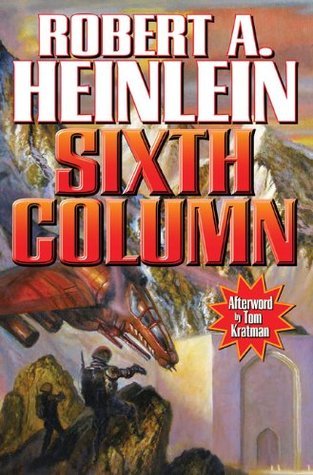
Sixth Column
After the U.S. is conquered, an enclave of brilliant misfits leads a rebellion against near-impossible odds. The totalitarian East has triumphed in a massive invasion and the United States has fallen to a dictatorial superpower bent on total domination. That power is consolidating its grip via concentration camps, police state tactics, and a total monopoly upon the very thoughts of the conquered populace. A tiny enclave of scientists and soldiers survives, unbeknownst to America's new rulers. It's six against six million—but those six happen to include a scientific genius, a master of subterfuge and disguise who learned his trade as a lawyer-turned-hobo, and a tough-minded commander who knows how to get the best out of his rag-tag assortment of American discontents, wily operators, and geniuses. It's going to take technological savvy and a propaganda campaign that would leave Madison Avenue aghast, but the U.S. will rise again. The counterinsurgency for freedom is on, and defeat is not an option.At the publisher's request, this title is sold without DRM (DRM Rights Management).
192 pages, Kindle Edition
First published December 7, 1949
About the author
Robert A. Heinlein
1,082 books10.8k followersRobert Anson Heinlein was an American science fiction author, aeronautical engineer, and naval officer. Sometimes called the "dean of science fiction writers", he was among the first to emphasize scientific accuracy in his fiction, and was thus a pioneer of the subgenre of hard science fiction. His published works, both fiction and non-fiction, express admiration for competence and emphasize the value of critical thinking. His plots often posed provocative situations which challenged conventional social mores. His work continues to have an influence on the science-fiction genre, and on modern culture more generally.
Heinlein became one of the first American science-fiction writers to break into mainstream magazines such as The Saturday Evening Post in the late 1940s. He was one of the best-selling science-fiction novelists for many decades, and he, Isaac Asimov, and Arthur C. Clarke are often considered the "Big Three" of English-language science fiction authors. Notable Heinlein works include Stranger in a Strange Land, Starship Troopers (which helped mold the space marine and mecha archetypes) and The Moon Is a Harsh Mistress. His work sometimes had controversial aspects, such as plural marriage in The Moon Is a Harsh Mistress, militarism in Starship Troopers and technologically competent women characters who were formidable, yet often stereotypically feminine—such as Friday.
Heinlein used his science fiction as a way to explore provocative social and political ideas and to speculate how progress in science and engineering might shape the future of politics, race, religion, and sex. Within the framework of his science-fiction stories, Heinlein repeatedly addressed certain social themes: the importance of individual liberty and self-reliance, the nature of sexual relationships, the obligation individuals owe to their societies, the influence of organized religion on culture and government, and the tendency of society to repress nonconformist thought. He also speculated on the influence of space travel on human cultural practices.
Heinlein was named the first Science Fiction Writers Grand Master in 1974. Four of his novels won Hugo Awards. In addition, fifty years after publication, seven of his works were awarded "Retro Hugos"—awards given retrospectively for works that were published before the Hugo Awards came into existence. In his fiction, Heinlein coined terms that have become part of the English language, including grok, waldo and speculative fiction, as well as popularizing existing terms like "TANSTAAFL", "pay it forward", and "space marine". He also anticipated mechanical computer-aided design with "Drafting Dan" and described a modern version of a waterbed in his novel Beyond This Horizon.
Also wrote under Pen names: Anson McDonald, Lyle Monroe, Caleb Saunders, John Riverside and Simon York.
Heinlein became one of the first American science-fiction writers to break into mainstream magazines such as The Saturday Evening Post in the late 1940s. He was one of the best-selling science-fiction novelists for many decades, and he, Isaac Asimov, and Arthur C. Clarke are often considered the "Big Three" of English-language science fiction authors. Notable Heinlein works include Stranger in a Strange Land, Starship Troopers (which helped mold the space marine and mecha archetypes) and The Moon Is a Harsh Mistress. His work sometimes had controversial aspects, such as plural marriage in The Moon Is a Harsh Mistress, militarism in Starship Troopers and technologically competent women characters who were formidable, yet often stereotypically feminine—such as Friday.
Heinlein used his science fiction as a way to explore provocative social and political ideas and to speculate how progress in science and engineering might shape the future of politics, race, religion, and sex. Within the framework of his science-fiction stories, Heinlein repeatedly addressed certain social themes: the importance of individual liberty and self-reliance, the nature of sexual relationships, the obligation individuals owe to their societies, the influence of organized religion on culture and government, and the tendency of society to repress nonconformist thought. He also speculated on the influence of space travel on human cultural practices.
Heinlein was named the first Science Fiction Writers Grand Master in 1974. Four of his novels won Hugo Awards. In addition, fifty years after publication, seven of his works were awarded "Retro Hugos"—awards given retrospectively for works that were published before the Hugo Awards came into existence. In his fiction, Heinlein coined terms that have become part of the English language, including grok, waldo and speculative fiction, as well as popularizing existing terms like "TANSTAAFL", "pay it forward", and "space marine". He also anticipated mechanical computer-aided design with "Drafting Dan" and described a modern version of a waterbed in his novel Beyond This Horizon.
Also wrote under Pen names: Anson McDonald, Lyle Monroe, Caleb Saunders, John Riverside and Simon York.
Ratings & Reviews
Friends & Following
Create a free account to discover what your friends think of this book!
Community Reviews
Displaying 1 - 30 of 389 reviews

February 2, 2013
Bird Brian's review of Prayers for the Assassin reminded me of this steaming pile of crap, which I read when I was about 12. So the slitty-eyed yellow hordes have invaded the good ol' US and are crushing it under their bamboo heel. But luckily there are six all-American heroes left in this underground mountain research establishment, and they invent this incredible cool weapon based on superior Aryan science, and wow! even though they're up against four hundred million Japanese-Chinese-Vietnamese-whatever Untermenschen they triumph because, well, that's their racial destiny, isn't it?
I may be misremembering some details. Heinlein wrote it in 1940; I would love to know more about his political opinions at the time, and how he thought WW II was going to play out.
I may be misremembering some details. Heinlein wrote it in 1940; I would love to know more about his political opinions at the time, and how he thought WW II was going to play out.

April 7, 2013
It makes me sad to 2-star this Heinlein novel that was one of my very favorites when I was 13 or 14. But it didn't hold up well at all on rereading. First you have to handwave pervasive racial insults and insensitities (American is conquered by an improbable "Oriental" nation that's a mix of Japanese and Chinese), then you have to handwave the magical scientific discovery that does freaking everything: kills people by race, cures cancer, builds huge temples, transmutes other elements into gold... And you also have to handwave the unlikelihood of a group of six intrepid Americans taking on the occupying forces with almost no trouble at all.
My hands just got tired of all that waving.
Full review to come at www.fantasyliterature.com.
My hands just got tired of all that waving.
Full review to come at www.fantasyliterature.com.

October 11, 2009
I just reread this one and I want to update my review a bit. I like the book. Having read it back in the 1970s and rereading it again now I wanted to be sure I'd pointed out some of the things readers from the 21st century should be aware of going in.
You'll need to remember the time frame in which this book was written. The racial attitudes on display are informed by WW2, Korea and America's situation with respect to "Red China". The book is I want to say up front not at all "PC". Please remember this when you read the book.
There are words used in this book that we mostly don't use today. Also for African American or Black readers and Americans of Latin descent you'll probably note that you aren't mentioned at all. The invasion of America seems to be between Asians (usually called "Orientals" in the book a word that has fallen into non-usage) and whites.
Again, just the times. I hope this doesn't offend and you can enjoy the book, but I wanted to give the heads up.
I read this back in the 70s and like most of Heinlein's work I enjoyed it. It is at heart a fast moving story that keeps you interested throughout.
Recommended but be aware it's very much from the era of the "Red menace" and also a time of wariness toward "Asian enemies". The take is not meant to be offensive it's simply meant to be pragmatic. During WW2 Japan had planned to establish an "East Asian Co-Prosperity Sphere". That seems to still be in play here in the plot.
Also let me say that the plot device is an interesting one and not really exactly like one I've seen elsewhere. Heinlein was a talented writer who inculcated his own worldview(s) in his writings in various ways. Most of the time (though not always) they don't overwhelm the story. There are Heinlein books I don't care for and Heinlein books I like greatly...I think this one falls into the latter category. The racial attitudes are of course easy for me to ignore. I do hope that they can be seen through so everyone can enjoy this book. Ironically Heinlein was one of the most open minded writers around if you look at his entire body of work.
You'll need to remember the time frame in which this book was written. The racial attitudes on display are informed by WW2, Korea and America's situation with respect to "Red China". The book is I want to say up front not at all "PC". Please remember this when you read the book.
There are words used in this book that we mostly don't use today. Also for African American or Black readers and Americans of Latin descent you'll probably note that you aren't mentioned at all. The invasion of America seems to be between Asians (usually called "Orientals" in the book a word that has fallen into non-usage) and whites.
Again, just the times. I hope this doesn't offend and you can enjoy the book, but I wanted to give the heads up.
I read this back in the 70s and like most of Heinlein's work I enjoyed it. It is at heart a fast moving story that keeps you interested throughout.
Recommended but be aware it's very much from the era of the "Red menace" and also a time of wariness toward "Asian enemies". The take is not meant to be offensive it's simply meant to be pragmatic. During WW2 Japan had planned to establish an "East Asian Co-Prosperity Sphere". That seems to still be in play here in the plot.
Also let me say that the plot device is an interesting one and not really exactly like one I've seen elsewhere. Heinlein was a talented writer who inculcated his own worldview(s) in his writings in various ways. Most of the time (though not always) they don't overwhelm the story. There are Heinlein books I don't care for and Heinlein books I like greatly...I think this one falls into the latter category. The racial attitudes are of course easy for me to ignore. I do hope that they can be seen through so everyone can enjoy this book. Ironically Heinlein was one of the most open minded writers around if you look at his entire body of work.

June 25, 2023
Sixth Column is one of the early Heinlein novels I collected in high school. It was originally published, pre-WWII in the Astounding Science Fiction magazine as a pulp, multi-part story. Clearly, Heinlein had some foresight into the world events that would culminate in a world war involving many countries including Pan-Asians as they were called in the novel. Unfortunately this novel would contribute to the "Yellow Peril" scares that were rampant in the 1950s.
As for this novel, it begins in a secret underground facility in Colorado where it seems that an experiment has caused the death of all but six men in the facility which will vanguard the entire resistance movement of a conquered future United States. The six survivors organize themselves as a fighting unit made up of scientists, soldiers, and civilians. The scheme involves a great deal of subterfuge and ingenuity developing a weapon that attacks specific racial characteristics, which of course opened Heinlein to criticism. Along with the obvious negative dregs of war, carnage, and trauma that resulted in what we later came to understand as the attempted extinguishing of an entire group of people, an entire generation learned that war was to be avoided at all cost.
Sixth Column is interesting because unlike WWII, the war is fought on American soil which adds a certain level of danger that has never been felt by Americans of the current generation. I hope the depths and breadth of its messages are not lost on us. This book does what great Science Fiction (yes, in caps) should do; it makes us think.
As for this novel, it begins in a secret underground facility in Colorado where it seems that an experiment has caused the death of all but six men in the facility which will vanguard the entire resistance movement of a conquered future United States. The six survivors organize themselves as a fighting unit made up of scientists, soldiers, and civilians. The scheme involves a great deal of subterfuge and ingenuity developing a weapon that attacks specific racial characteristics, which of course opened Heinlein to criticism. Along with the obvious negative dregs of war, carnage, and trauma that resulted in what we later came to understand as the attempted extinguishing of an entire group of people, an entire generation learned that war was to be avoided at all cost.
Sixth Column is interesting because unlike WWII, the war is fought on American soil which adds a certain level of danger that has never been felt by Americans of the current generation. I hope the depths and breadth of its messages are not lost on us. This book does what great Science Fiction (yes, in caps) should do; it makes us think.

April 24, 2023
First published in 1949, when the author was 42, one of his earlier works, this is also lampooned as his most racist.
Yes, this is full of racist and jingoistic terminology but what a passing reader may discount is that there is racism going both ways and the guerrilla war between the invading Asian empire and the beaten but not bowed Americans is also an opportunity for Bob to have some fun with organized religion.
America has been defeated by an Asian power (not Chinese or Japanese) and the survivors fight an underground struggle against their oppressors by using a fake religion and some nifty technology.
RAH fans will note the similarities to many of his later books like Between Planets and Stranger in a Strange Land.
Not one of his better books but also not terrible and a discerning reader will pick up on some later themes explored at an earlier time.
Yes, this is full of racist and jingoistic terminology but what a passing reader may discount is that there is racism going both ways and the guerrilla war between the invading Asian empire and the beaten but not bowed Americans is also an opportunity for Bob to have some fun with organized religion.
America has been defeated by an Asian power (not Chinese or Japanese) and the survivors fight an underground struggle against their oppressors by using a fake religion and some nifty technology.
RAH fans will note the similarities to many of his later books like Between Planets and Stranger in a Strange Land.
Not one of his better books but also not terrible and a discerning reader will pick up on some later themes explored at an earlier time.

August 13, 2007
Heinlein has his faults, I'll admit. Who can forget the ending of Podkayne of Mars where the heroine decides that captaincy of a space ship sounds like too much work, and instead she'll set her sights on marrying a captain?
But until The Day After Tomorrow I have never actually been disgusted by a book of his. An amazon review charitably says it "reflects the fears and concerns of the time period he wrote the book in." Granted, in 1941, paranoia about Japan was probably sane, but he wrote this before Pearl Harbour.
His premise is that America has been invaded and conquered by "panasia," a vast and sprawling empire bent on conquest. Only six men, scientists, who have just made an amazing scientific discovery, stand in its way. They use their amazing, not to say magical, scientific discovery to organize a resistance under the guise of a religion. This plan mostly works.
Specific problems:
* Frank Mitsui in the book is a man whose grandmother was "half-Chinese and half wahini," and his mother is "part Chinese but mostly Caucasian." Somehow he acquired the name Mitsui from this ancestry, and finds himself adrift in a country that reviles him, as do the invaders. He appears early on, is consulted as an expert in "Asian thinking" (it's genetic?) and has few speaking parts.
* American=white is otherwise unchallenged.
* There are no (perhaps one? I don't want to reread to check it out.) speaking parts for women in this book. Only two women are named, and one is dead before the book begins.
* He appears to be an advocate of the "flying monkeys and magic" school of military thought. Sufficiently advanced science will assure that we win! And obviously, our science is more advanced.
* The American spirit and culture raises America above other nations. Granted, in 1941 this must have seemed like an attractive message, but the book often focuses on the ways in which the "Asiatic" culture is deficient.
* The, "OMG my plan is brilliant, really brilliant, would you like to hear about it? Too bad! But it's really brilliant. Okay, I'll tell this guy over here and he'll react in awe and amazement! See how brilliant my plan is?" gambit has never endeared me to anyone.
* The magical weapon has whatever abilities the plot requires. Kill a man? Check. Stun a man? Check. Forcefield? Check. Cure the common cold? Check. Cure Cancer? Check. None of these examples are made up.
But until The Day After Tomorrow I have never actually been disgusted by a book of his. An amazon review charitably says it "reflects the fears and concerns of the time period he wrote the book in." Granted, in 1941, paranoia about Japan was probably sane, but he wrote this before Pearl Harbour.
His premise is that America has been invaded and conquered by "panasia," a vast and sprawling empire bent on conquest. Only six men, scientists, who have just made an amazing scientific discovery, stand in its way. They use their amazing, not to say magical, scientific discovery to organize a resistance under the guise of a religion. This plan mostly works.
Specific problems:
* Frank Mitsui in the book is a man whose grandmother was "half-Chinese and half wahini," and his mother is "part Chinese but mostly Caucasian." Somehow he acquired the name Mitsui from this ancestry, and finds himself adrift in a country that reviles him, as do the invaders. He appears early on, is consulted as an expert in "Asian thinking" (it's genetic?) and has few speaking parts.
* American=white is otherwise unchallenged.
* There are no (perhaps one? I don't want to reread to check it out.) speaking parts for women in this book. Only two women are named, and one is dead before the book begins.
* He appears to be an advocate of the "flying monkeys and magic" school of military thought. Sufficiently advanced science will assure that we win! And obviously, our science is more advanced.
* The American spirit and culture raises America above other nations. Granted, in 1941 this must have seemed like an attractive message, but the book often focuses on the ways in which the "Asiatic" culture is deficient.
* The, "OMG my plan is brilliant, really brilliant, would you like to hear about it? Too bad! But it's really brilliant. Okay, I'll tell this guy over here and he'll react in awe and amazement! See how brilliant my plan is?" gambit has never endeared me to anyone.
* The magical weapon has whatever abilities the plot requires. Kill a man? Check. Stun a man? Check. Forcefield? Check. Cure the common cold? Check. Cure Cancer? Check. None of these examples are made up.

April 9, 2012
Modern-day America tends toward self-loathing. I often wonder if we could survive in the face of a persistent enemy with moral conviction. It is virtually impossible to find an intellectual that doesn't somewhere between apologize for America or just outright regard it as a villain -- inside or outside of the country. The attitude increasingly permeates through the rest of our culture.
It is often one of the underlying things in Heinlein's work that I enjoy that both his personal values and the time in which he wrote were violently opposed to this trend. Perhaps Sixth Column is the best instance of placing that attitude at center stage. In the novel, America has just been taken over by Pan Asians. Their victory is complete and they're strangling the country and running it as a nation of slaves. We open with our hero delivering orders to a small military organization -- one that is exploring applying advanced science to the application of war. The military has essentially ceased to exist. This particular installation is unknown to the invaders. They are to prosecute the war independently in a last ditch effort.
Our hero discovers that a breakthrough has been made, but coupled with a terrible accident. Most of the staff at the installation has died in the accident. Nobody knows exactly the nature of the breakthrough or what killed them all. Every line officer was among those who were killed. Though only a major himself, this leaves it to him to assume command of the couple dozen scientists remaining, fight an occupying major world power and to restore the United States.
There is never a moment's hesitation at whether it is the right thing to do. There is never a question of not doing it. The only question is how. Heinlein highlights bravery, fortitude in the face of insurmountable odds, patriotism and overall spirit sadly missing from most of our culture. He never fails to spin a good story, but this work is inspiring as well.
It is often one of the underlying things in Heinlein's work that I enjoy that both his personal values and the time in which he wrote were violently opposed to this trend. Perhaps Sixth Column is the best instance of placing that attitude at center stage. In the novel, America has just been taken over by Pan Asians. Their victory is complete and they're strangling the country and running it as a nation of slaves. We open with our hero delivering orders to a small military organization -- one that is exploring applying advanced science to the application of war. The military has essentially ceased to exist. This particular installation is unknown to the invaders. They are to prosecute the war independently in a last ditch effort.
Our hero discovers that a breakthrough has been made, but coupled with a terrible accident. Most of the staff at the installation has died in the accident. Nobody knows exactly the nature of the breakthrough or what killed them all. Every line officer was among those who were killed. Though only a major himself, this leaves it to him to assume command of the couple dozen scientists remaining, fight an occupying major world power and to restore the United States.
There is never a moment's hesitation at whether it is the right thing to do. There is never a question of not doing it. The only question is how. Heinlein highlights bravery, fortitude in the face of insurmountable odds, patriotism and overall spirit sadly missing from most of our culture. He never fails to spin a good story, but this work is inspiring as well.

September 24, 2024
Oh! This reminded me of Red Dawn (whether the Australian or American production doens't matter)! Naturally, if anything, this was the template for the movie, not the other way around.
A totalitarian Eastern Empire (think a mix of China and Japan) has invaded and taken over The USA. The regime exerts control via a mix of concentration camps, police state tactics, and monopolizing / controlling people's very thoughts.
However, they missed a few. Six, to be precise.
Not exactly elite anything, but while they could be described as a rag-tag band, they all have a certian je-ne-sais-quoi and thanks to an entrepid "commander", their best comes to the surface and compliments that of the others perfectly.
I like stories of this kind where a country is falling apart and you can't count on anything you've come to take for granted. It usually means that people have to employ intelligence and ingenuity, which I very much like. Here, there was a scientist and the ex-lawyer-turned-hobo was definitely not dim either. I liked how they were from vastly different walks of life and came together by coincidence, then making the best of it while definitely not accepting the new status quo.
How the six fought back was positively genious. *lol*
Some moments betrayed how old this story was in how certain things were phrased, but overall, this story could have been a contemporary one and it's a feature of Heinlein's I have come to appreciate very much (it's usually the case with his stories). I also like how he seems to approve of and hope for self-reliance in people as I happen to agree.
The way the story progressed might not have been perfect and the weapon designed in the end was practically a magic wand (which was a damn shame since this is Heinlein and he was usually not one to use such a "cop-out"), but it was pretty cool overall.
A totalitarian Eastern Empire (think a mix of China and Japan) has invaded and taken over The USA. The regime exerts control via a mix of concentration camps, police state tactics, and monopolizing / controlling people's very thoughts.
However, they missed a few. Six, to be precise.
Not exactly elite anything, but while they could be described as a rag-tag band, they all have a certian je-ne-sais-quoi and thanks to an entrepid "commander", their best comes to the surface and compliments that of the others perfectly.
I like stories of this kind where a country is falling apart and you can't count on anything you've come to take for granted. It usually means that people have to employ intelligence and ingenuity, which I very much like. Here, there was a scientist and the ex-lawyer-turned-hobo was definitely not dim either. I liked how they were from vastly different walks of life and came together by coincidence, then making the best of it while definitely not accepting the new status quo.
How the six fought back was positively genious. *lol*
Some moments betrayed how old this story was in how certain things were phrased, but overall, this story could have been a contemporary one and it's a feature of Heinlein's I have come to appreciate very much (it's usually the case with his stories). I also like how he seems to approve of and hope for self-reliance in people as I happen to agree.
The way the story progressed might not have been perfect and the weapon designed in the end was practically a magic wand (which was a damn shame since this is Heinlein and he was usually not one to use such a "cop-out"), but it was pretty cool overall.

September 18, 2013
It would be easiest to review this like I have the stories I've been reading on Project Gutenberg - with a hefty dose of irreverence, and covering the sometimes astounding racism and sexism with as much humour as headshaking. But this is Heinlein, and it's not as easy to dismiss. With Heinlein, you have to tackle head-on the issues with many of his books, and, if you're me, admit that you still really like reading them anyway.
Note: The rest of this review has been withheld due to the recent changes in Goodreads policy and enforcement. You can read why I came to this decision here.
In the meantime, you can read the entire review at Smorgasbook
Note: The rest of this review has been withheld due to the recent changes in Goodreads policy and enforcement. You can read why I came to this decision here.
In the meantime, you can read the entire review at Smorgasbook
![Profile Image for Ed [Redacted].](https://i.gr-assets.com/images/S/compressed.photo.goodreads.com/users/1429513592i/3968676.jpg)
August 29, 2012
Pretty disappointed with this one. The premise of this book is that the US was taken over by the "Pan Asians". The last remaining vestige of the US military consists of a few scientists and an advertising writer. Rather than give up, the ad guy decides to use the time honored military tactic of making up a fake religion and using the newly invented "Ledbetter Effect*" to beat back the yellow menace once and for all.
The book is just absurd wish fulfillment. Utterly goofy and filled with racial pejoratives that might have been acceptable When this book was written, 1941, but is very jarring to read today.
I am a Heinlein fanboy but I would skip this one unless you are a completist. Two stars including one just because I love Heinlein.
*The Ledbetter Effect is the well known scientific effect of using radiation to do whatever the fuck you want. See also Alchemy or Handwavium.
The book is just absurd wish fulfillment. Utterly goofy and filled with racial pejoratives that might have been acceptable When this book was written, 1941, but is very jarring to read today.
I am a Heinlein fanboy but I would skip this one unless you are a completist. Two stars including one just because I love Heinlein.
*The Ledbetter Effect is the well known scientific effect of using radiation to do whatever the fuck you want. See also Alchemy or Handwavium.

August 30, 2015
2.4 — 2.6 stars.
If Major Ardmore, Robert Heinlein’s protagonist in his first published novel, Sixth Column, were to experience himself, as a reflection in a mirror, would he see and hear this?
“Bark-bark-bark-bark-bark . . . . . . Bark-bark."
"Bark . . . . . . Bark-bark-bark."
". . . I think you have something there . . .”
Yes. A kind of baroque, “terraced dynamic” quality defines Major Admore’s way of speaking—and acting. And, like the protagonist, Heinlein’s novel maintains this “odd” tone throughout.
As Space Cadet, Heinlein’s second novel, is seemingly strange, Sixth Column, his first novel is likewise seemingly strange, though from a different perspective. Whereas Space Cadet surprises the reader with mature ideas within a young adult, (“juvenile”), narrative, Sixth Column strikes a reader as “juvenile-ish” within a mature narrative.
Published in serial form, (which contributes to the uneven tone), approximately four months prior to the Pearl Harbor attack, the novel anticipates such a conflict and “plays out” a futuristic, full-scale invasion of the United States. From the beginning chapter, the United States is devastated. And, the PanAsian Empire, the enemy force, then sets about occupying and enslaving the native population. The “Sixth Column” title, gleaned from a military tactic used during the Spanish Civil War, describes a handful of Americans who then fight the enemy “from within” the occupying force.
With such a premise, the author consequently presents a number of ideas associated with warfare and such an occupation: an autocratic-totalitarian state with widespread surveillance, race, genocide, eugenic prejudice, and terrorism. Additionally, he explores the ideas of freedom / independence, varying facets of religion, as well as individual morality—which he continues to explore in later novels. He also posits one horrible idea that becomes remarkable: that of “killing [the] culture.” The PanAsians maintain the “killing of [the enemy’s] culture” as a strategy to completely subordinate, then enslave, the “lesser” races.
Heinlein succeeds in presenting a potentially horrific vision. He also succeeds in satisfying reader expectation for a science fiction narrative. However, “lucky” and “odd” incidences within the plot as well as a lack of character development push the speculative quality of the novel to an almost cartoonish extreme. And unfortunately, for a science fiction “war” novel, Heinlein creates scene after scene of “talking” or second-hand reporting instead of episodes of action.
Yet, Sixth Column has its strengths, too.
Despite the cartoon quality that ultimately ensues, there are a few scenes that create verisimilitude within the situation: the despair at the beginning of the novel, as well as the severe process for “drafting” military recruits. And, the scene where Thomas discovers a spy within the rebels’ first forward base, (the rebels’ first “church”), becomes quite dramatic and even brutal. The references to labor camps and “pleasure centers” where women are enslaved for sex further support the intended serious tone for the narrative, as well.
By far, Heinlein’s various ideas and critiques become the novel’s greatest strengths. From including linguistic coded messages and chemical warfare, (an incident of a gas attack), through an incisive prediction of world overpopulation, to his critique, through Ardmore, of the political complacency of U.S. leaders, Heinlein, as expected, sets the American ideal of individual liberty in relief against the PanAsian totalitarian and eugenic projection of “superiority.” He also provides cultural commentary regarding the influences and corruptive nature of money, qualities of “the police state,” and the human need for symbol.
Unfortunately, many of these wonderful aspects become thwarted by two particular plot elements: the Americans’ secret weapon, the “Ledbetter effect,” and the choice of using an imagined religious sect as “cover” while building a counter-offensive.
The “Ledbetter effect,” while amazing in its scientific explanation, nevertheless becomes a “miracle” weapon. And, all PanAsian threats to the small rebel group fail to create a sense of risk. This “effect” weapon has a feature so deadly that a reader cannot help but laugh at the “cartoon magic” sense of it—despite its grotesque and horrific implications. Indeed, a riotous skit from Monty Python comes to mind.
The created religious sect of “Mota,” (“atom” scrambled), contributes to the novel’s progressive cartoon quality, as well. Here, agents dress as priests, utter bizarre platitudes to placate their PanAsian oppressors, and bribe local officials as they screen supplicants as potential military recruits. The costumes, like the platitudes, seem silly; and, Heinlein poses a seemingly ignorant assumption about the PanAsian’s view of religion.
One particular illogical and jarring episode involves Ardmore’s frustration toward forming a military staff. This oddity stands out since Heinlein makes the character a Major, a Field Grade Officer—an officer who should know very well the ways in which larger military organizations function.
Further, the progressive episodes involving the haughty Calhoun character as well as Heinlein’s diction, “That’s swell . . . I’ll be a cross-eyed intern . . . Fortnight . . . etc., seem to bring the novel even closer to cartoon territory.
Lastly, while Ardmore’s pronouncement upon the invaders is wonderfully apt and just, his final statement creates an uncomfortable irony. Indeed, he advocates a position seemingly as arrogant as his nemesis. Was Heinlein intentional in this irony? As an author . . . quite possibly. Through the Ardmore character . . . not likely. Consequently, this appears to be another blemish to the conclusion Heinlein perhaps intended.
If, then, the reader were to experience Heinlein’s first novel, Sixth Column, as a reflection in a mirror, s/he would see in that reflection the author’s second novel, Space Cadet, since it stands as a complete reversal to his first. Left becomes right; and, right becomes left—in reflection.
As Space Cadet proposes a positive future anchored in “Peace,” Sixth Column proposes a negative future anchored in war and oppression.
And so, per Major Admore, remember:
"A good PanAsian is a dead PanAsian," and,
"Good Hunting!”
Recommended
for Heinlein & Science Fiction Readers, (2.5 — 2.6 Stars).
Not Recommended
for All Other Readers, (2.4 Stars).
If Major Ardmore, Robert Heinlein’s protagonist in his first published novel, Sixth Column, were to experience himself, as a reflection in a mirror, would he see and hear this?
“Bark-bark-bark-bark-bark . . . . . . Bark-bark."
"Bark . . . . . . Bark-bark-bark."
". . . I think you have something there . . .”
Yes. A kind of baroque, “terraced dynamic” quality defines Major Admore’s way of speaking—and acting. And, like the protagonist, Heinlein’s novel maintains this “odd” tone throughout.
As Space Cadet, Heinlein’s second novel, is seemingly strange, Sixth Column, his first novel is likewise seemingly strange, though from a different perspective. Whereas Space Cadet surprises the reader with mature ideas within a young adult, (“juvenile”), narrative, Sixth Column strikes a reader as “juvenile-ish” within a mature narrative.
Published in serial form, (which contributes to the uneven tone), approximately four months prior to the Pearl Harbor attack, the novel anticipates such a conflict and “plays out” a futuristic, full-scale invasion of the United States. From the beginning chapter, the United States is devastated. And, the PanAsian Empire, the enemy force, then sets about occupying and enslaving the native population. The “Sixth Column” title, gleaned from a military tactic used during the Spanish Civil War, describes a handful of Americans who then fight the enemy “from within” the occupying force.
With such a premise, the author consequently presents a number of ideas associated with warfare and such an occupation: an autocratic-totalitarian state with widespread surveillance, race, genocide, eugenic prejudice, and terrorism. Additionally, he explores the ideas of freedom / independence, varying facets of religion, as well as individual morality—which he continues to explore in later novels. He also posits one horrible idea that becomes remarkable: that of “killing [the] culture.” The PanAsians maintain the “killing of [the enemy’s] culture” as a strategy to completely subordinate, then enslave, the “lesser” races.
Heinlein succeeds in presenting a potentially horrific vision. He also succeeds in satisfying reader expectation for a science fiction narrative. However, “lucky” and “odd” incidences within the plot as well as a lack of character development push the speculative quality of the novel to an almost cartoonish extreme. And unfortunately, for a science fiction “war” novel, Heinlein creates scene after scene of “talking” or second-hand reporting instead of episodes of action.
Yet, Sixth Column has its strengths, too.
Despite the cartoon quality that ultimately ensues, there are a few scenes that create verisimilitude within the situation: the despair at the beginning of the novel, as well as the severe process for “drafting” military recruits. And, the scene where Thomas discovers a spy within the rebels’ first forward base, (the rebels’ first “church”), becomes quite dramatic and even brutal. The references to labor camps and “pleasure centers” where women are enslaved for sex further support the intended serious tone for the narrative, as well.
By far, Heinlein’s various ideas and critiques become the novel’s greatest strengths. From including linguistic coded messages and chemical warfare, (an incident of a gas attack), through an incisive prediction of world overpopulation, to his critique, through Ardmore, of the political complacency of U.S. leaders, Heinlein, as expected, sets the American ideal of individual liberty in relief against the PanAsian totalitarian and eugenic projection of “superiority.” He also provides cultural commentary regarding the influences and corruptive nature of money, qualities of “the police state,” and the human need for symbol.
Unfortunately, many of these wonderful aspects become thwarted by two particular plot elements: the Americans’ secret weapon, the “Ledbetter effect,” and the choice of using an imagined religious sect as “cover” while building a counter-offensive.
The “Ledbetter effect,” while amazing in its scientific explanation, nevertheless becomes a “miracle” weapon. And, all PanAsian threats to the small rebel group fail to create a sense of risk. This “effect” weapon has a feature so deadly that a reader cannot help but laugh at the “cartoon magic” sense of it—despite its grotesque and horrific implications. Indeed, a riotous skit from Monty Python comes to mind.
The created religious sect of “Mota,” (“atom” scrambled), contributes to the novel’s progressive cartoon quality, as well. Here, agents dress as priests, utter bizarre platitudes to placate their PanAsian oppressors, and bribe local officials as they screen supplicants as potential military recruits. The costumes, like the platitudes, seem silly; and, Heinlein poses a seemingly ignorant assumption about the PanAsian’s view of religion.
One particular illogical and jarring episode involves Ardmore’s frustration toward forming a military staff. This oddity stands out since Heinlein makes the character a Major, a Field Grade Officer—an officer who should know very well the ways in which larger military organizations function.
Further, the progressive episodes involving the haughty Calhoun character as well as Heinlein’s diction, “That’s swell . . . I’ll be a cross-eyed intern . . . Fortnight . . . etc., seem to bring the novel even closer to cartoon territory.
Lastly, while Ardmore’s pronouncement upon the invaders is wonderfully apt and just, his final statement creates an uncomfortable irony. Indeed, he advocates a position seemingly as arrogant as his nemesis. Was Heinlein intentional in this irony? As an author . . . quite possibly. Through the Ardmore character . . . not likely. Consequently, this appears to be another blemish to the conclusion Heinlein perhaps intended.
If, then, the reader were to experience Heinlein’s first novel, Sixth Column, as a reflection in a mirror, s/he would see in that reflection the author’s second novel, Space Cadet, since it stands as a complete reversal to his first. Left becomes right; and, right becomes left—in reflection.
As Space Cadet proposes a positive future anchored in “Peace,” Sixth Column proposes a negative future anchored in war and oppression.
And so, per Major Admore, remember:
"A good PanAsian is a dead PanAsian," and,
"Good Hunting!”
Recommended
for Heinlein & Science Fiction Readers, (2.5 — 2.6 Stars).
Not Recommended
for All Other Readers, (2.4 Stars).

April 1, 2009
I'm about a third of the way through this book and I just want to comment about the racism and bigotry presented so far.
Yes, the characters are racist (both the Americans and Pan-Asians) but I think it is important to take this in context. Not just with regard to the time this book was written but with regard to a central premise of the story.
After WWII, the cold war had begun but had continued to freeze well beyond the level it actually did historically. The Pan-Asian countries had maintained a strict isolation from the west and vise versa. This had become enshrined in law preventing any contact between the peoples of these countries for two generations. Knowledge of each other's culture, languages and religion became virtually non-existent and so this explains why the people (on both sides) had strong pre-conceptions and prejudices about the other side.
It comes across quite strongly that the racist sentiments expressed are only that of the characters and not of the author. Indeed, there was one character, an anarchist hobo, who sees the Pan-Asians as just people, induced to hate, kill and conquer by their state just as the Americans were themselves induced by their state. In the eyes of this character, it is the respective governments that were the real criminals, not the people themselves. And I feel that the views of this character are probably closer to the personal views of Heinlein than any of the others.
---
A quick word about the science in this story. It's a bit fanciful to say the least. According to general field theory, there are three types of forces: Electrical, Magnetic and Gravitic. The "Ledbetter" effect, utilised by the protagonists in thist story, involves tapping into the spectra (besides the electro-magnetic) that general field theory predicts should exist: electro-gravitic, gravitic-magnetic and the three-phase electro-magnetic-gravitic. I suppose field theory was quite new when this book was written but still, Heinlein's grip of it seems to be quite weak. Even with my very limited understanding of it.
This isn't really a negative for me at all. I have no problem suspending belief and just running with it but I imagine that for some people it may prove problematic.
---
At 140 pages, the story unfolds at a breakneck speed, never pausing for breath. The advantages of this is that you never get bored, are always on the edge of your seat. The disadvantage is that the author never really had time to develop the characters. They were this way one moment and another way the next. Virtually no time for narrative that didn't develop the plot.
All in all, it is a barmy story with barmy ideas (see above) but it is an engaging read. If you can overlook it's shortcomings, you will enjoy this book immensely. Me, I don't have a problem with barmy.
Yes, the characters are racist (both the Americans and Pan-Asians) but I think it is important to take this in context. Not just with regard to the time this book was written but with regard to a central premise of the story.
After WWII, the cold war had begun but had continued to freeze well beyond the level it actually did historically. The Pan-Asian countries had maintained a strict isolation from the west and vise versa. This had become enshrined in law preventing any contact between the peoples of these countries for two generations. Knowledge of each other's culture, languages and religion became virtually non-existent and so this explains why the people (on both sides) had strong pre-conceptions and prejudices about the other side.
It comes across quite strongly that the racist sentiments expressed are only that of the characters and not of the author. Indeed, there was one character, an anarchist hobo, who sees the Pan-Asians as just people, induced to hate, kill and conquer by their state just as the Americans were themselves induced by their state. In the eyes of this character, it is the respective governments that were the real criminals, not the people themselves. And I feel that the views of this character are probably closer to the personal views of Heinlein than any of the others.
---
A quick word about the science in this story. It's a bit fanciful to say the least. According to general field theory, there are three types of forces: Electrical, Magnetic and Gravitic. The "Ledbetter" effect, utilised by the protagonists in thist story, involves tapping into the spectra (besides the electro-magnetic) that general field theory predicts should exist: electro-gravitic, gravitic-magnetic and the three-phase electro-magnetic-gravitic. I suppose field theory was quite new when this book was written but still, Heinlein's grip of it seems to be quite weak. Even with my very limited understanding of it.
This isn't really a negative for me at all. I have no problem suspending belief and just running with it but I imagine that for some people it may prove problematic.
---
At 140 pages, the story unfolds at a breakneck speed, never pausing for breath. The advantages of this is that you never get bored, are always on the edge of your seat. The disadvantage is that the author never really had time to develop the characters. They were this way one moment and another way the next. Virtually no time for narrative that didn't develop the plot.
All in all, it is a barmy story with barmy ideas (see above) but it is an engaging read. If you can overlook it's shortcomings, you will enjoy this book immensely. Me, I don't have a problem with barmy.

April 22, 2018
Heinlein's first published novel, which also appeared under the title of The Day After Tomorrow, was serialized in John W. Campbell's Astounding Science Fiction Magazine early (pre-Pearl Harbor) in 1941, and was first released as a book by Gnome Press in 1949. Campbell himself reportedly provided much of the concept. I first read it when I was quite young and didn't recognize some of the flaws and weaknesses it contained, though I remember not liking it quite as well as his "juveniles" that I'd previously explored. It's the patriotic story of Yankee can-do spirit and ingenuity prevailing over the overwhelming forces of evil. Like many young fans of the day, Heinlein was my unquestioned hero for years.
I recently checked this audio version out of my local library to revisit the story; it didn't hold up as well. The racist and sexist overtones that didn't bother the juvenile me were impossible to overcome this time around. There was a line about the white men growing beards because it made the Oriental men feel weak and inferior, like women (wince!) , and the conquering Asians are frequently referred to with derogatory and racist phrases. And I was a little more hesitant to accept the idea that a half-dozen guys could invent a magic wand and defeat a whole continent full of experienced soldiers. In historical context I think it's still an entertaining story (I wonder how I missed the fact the first time around that the name of the Great God Mota is atom spelled backwards?), but it's far from Heinlein's best.
I recently checked this audio version out of my local library to revisit the story; it didn't hold up as well. The racist and sexist overtones that didn't bother the juvenile me were impossible to overcome this time around. There was a line about the white men growing beards because it made the Oriental men feel weak and inferior, like women (wince!) , and the conquering Asians are frequently referred to with derogatory and racist phrases. And I was a little more hesitant to accept the idea that a half-dozen guys could invent a magic wand and defeat a whole continent full of experienced soldiers. In historical context I think it's still an entertaining story (I wonder how I missed the fact the first time around that the name of the Great God Mota is atom spelled backwards?), but it's far from Heinlein's best.

February 21, 2012
Fabulous! Bearing in mind the date when it was written, it is still a great yarn with some interesting ideas. I love the way RH will argue both sides of a case - in this book it's fighting a war by advertising. It has to win my prize for the most convincing 'One man can save America' novel, ever.
Jan 2016. Read this again and still managed to enjoy it. This time I noticed how careful he was to make it clear that it was alien ideas his heroes were fighting against, not just alien people. His portrayal of Frank Mitsui, who came from the same stock as the invaders, but was 100% American, was brief, but made the point.
June 2014 yet another reading. This time I was interested in the anarchist who is supremely unconcerned by the invasion. RH is often accused of being a fascist, but I think his political insight is outstanding. The hero was startled when he met someone with a serene acceptance of the situation. Why wasn't the old guy upset by the evil behaviour of the invaders? I remember now what a powerful impact the answer made when I first read this book as a teenager: it's not one I would have reached on my own. The old guy didn't believe in authority, any authority, so the invaders were the same as the old government to him. You get good bosses and bad bosses, but his point was that all bosses are wrong.
Jan 2016. Read this again and still managed to enjoy it. This time I noticed how careful he was to make it clear that it was alien ideas his heroes were fighting against, not just alien people. His portrayal of Frank Mitsui, who came from the same stock as the invaders, but was 100% American, was brief, but made the point.
June 2014 yet another reading. This time I was interested in the anarchist who is supremely unconcerned by the invasion. RH is often accused of being a fascist, but I think his political insight is outstanding. The hero was startled when he met someone with a serene acceptance of the situation. Why wasn't the old guy upset by the evil behaviour of the invaders? I remember now what a powerful impact the answer made when I first read this book as a teenager: it's not one I would have reached on my own. The old guy didn't believe in authority, any authority, so the invaders were the same as the old government to him. You get good bosses and bad bosses, but his point was that all bosses are wrong.

May 18, 2017
En él caso de ‘el día de pasado mañana’ (‘sexta columna’ en su título original , alusión a la permanente ocultación del contraataque al enemigo mientras se estudian sus puntos flacos). Nos enfrentamos a un Heinlein que expone a nivel narrativo una distopia post apocalíptica en EEUU, que ha sido prácticamente destruido y totalmente invadido por los Panasiáticos (algo así como un cruce de los Hindúes con los orientales, los cuales han dominado prácticamente el planeta y los continentes por lo que deja entrever el maestro). Por lo cual, un puñado de supervivientes, entre militares y científicos (los principales son: Admore de inteligencia militar y su mano derecha Thomas, además del antiguo coronel Calhoun del departamento de investigación), resolverán a agruparse y defender su antiguo estado, volviéndolo a recuperar de modo encubierto, mediante la fundación de un nuevo dogma religioso entre el millar existentes en variación; la del Dios Mota. Esto hará que pasen totalmente desapercibidos, propagando una insurgencia social y aparentemente pasiva... no si algún que otro conflicto de por medio, en lo que el nuevo dominio oriental cree en un modo más de actuar de los siervos humanos mundanos.
El panorama que nos presenta el autor es de un continente desolado, forzado por la ‘Ley de no intervención’después de varias guerras (con la dirección de los soviéticos a los Chinos, y después a los Norteamericanos) y sin ‘antifaces’ con pases marcados para todos sus habitantes, que les hacen vivir y gozar del sol por orden del emperador Panasiático, totalmente fascista y totalitarista, pero que no es tan disparatado en según que sitios. El análisis que hace es que la opresión está en todas partes, y la libertad se juzga del modo en la balanza que tú te encuentres, o las cartas que te toquen, según se vea. Algo que es remarcable es el tema de la memoria Racial, que según Heinlein es la causa de la invasión de éstos mestizos en la obra..Una clara alusión al abuso de los blancos contra los demás a lo largo de la historia.
Todo esto previamente explicado es porqué, y siendo escrito en plena post II guerra mundial, al hombre, presumo, se le tildaría de plena resaca emocional de ésta, pero creo que fue bien deliberadamente, ( ya os digo que opto por ésta segunda conjetura, pues he leído mucho sobre el maestro, de la misma época, y es casi toda la demás narrativa es totalmente opuesta en discurso) cómo abordó la trama y desarrollo a nivel propagandístico- folletinesco. Si aquí el estilo Heinleiniano se encrudece, excede en acidez y grosería al nombrar de forma racista a los dominantes ficticios de la obra como monos y otras perlas..cosa bastante excepcional, sino excepcional del todo (como anteriormente lo que comentado, pero quería recalcarlo); y es que él era mucho más elegante, y sobretodo, más intolerante a nivel generalizado...vamos, que no es sólo cuestión de color o credo que Heinlein critique a un sector en concreto. Porqué eso, particularmente, lo hace con sus compatriotas; y aquí en forma de mascarada para complacer al gran público.
La calidad de la obra, pese a resentirse un pelín a nivel equitativo, no es para nada mala, y la destreza Heinleiniana, marca de la casa, es innegable. Haciendo que te leas en dos u tres sentadas dicha novela, debido a su buena dosis de acción dialogada y de ‘avanzadilla’.
En añadidura a esto, tenemos la siempre efectiva y convincente línea paralela al desarrollo del argumento, la filosófica critica Heinleiniana, que disecciona la fe, la política y la sociedad, con especial hincapié en la primera. Un símil del tono de ‘Forastero en tierra extraña’ y’ Tiempo para amar’ pero sin el refinamiento y la sensación de Epopeya de ésas, sino con la mofa como guía, simplemente. Aún así, leer el libro es sentar los precedentes de lo que posteriormente se daría de manera más ambiciosa, y con más solera elaborativa.
En el apartado científico, Heinlein vuelve a ser cuasi profético pues a través del descubrimiento por parte de los insurgentes, el que ellos denominan ‘El efecto Ledbetter’; que exprimido al máximo, divide el átomo a placer, jugando con la invisibilidad, la edificación hasta límites insospechados; los diferentes campos materiales y su no materialización (ocultar estancias o personas asimismo, entre otros menesteres....muy útiles para la guerra, transformar átomos del metal en Nitrógeno para disolverse en el aire, frecuencias perturbadoras de onda hacía determinado sector vivo y hacia las comunicaciones, la explosión Coloidal de las células del cuerpo, y hasta la curación del Ántrax). Estando escrita en los 40, el bueno de Heinlein nos habla de las bombas biológicas raciales, profecía aún en fase de experimentación actualmente. Muy alucinante, pero pausible si se para a pensar detenidamente.
Otra de las cosas que me han sorprendido es que hay alguna escena sanguinaria explicitita en tan temprana etapa de su narrativa. Si bien justificada por el tono, principalmente estratégico, dentro de un marco de rebelión social.
No es el mejor Heinlein, pero se lee y muy bien, por ser hábil en mezclar géneros, conseguir una atmósfera y personajes realistas en plena época Catastrófica, con ésa esencia chulesca e irreverente de lo que sería el ambiente cargado post guerra en los Yankees (con su engreimiento testarudo a la par que sumamente farolero y obcecado por su egocentrismo marisabidillo..así es como lo pinta tal cual. ¿creéis no es una crítica indirecta?), así como sentar precedentes en el género y por él mismo en éste caso, además de profecías en el apartado científico- social. Pues parte de ello está ocurriendo.
Recomendado para los que gusten del viejo Heinlein y los que disfruten, especialmente, con las historias de estrategias militares encubiertas en tono jovial a la par que severo. Una obra liviana, a priori patriótica pero con mofa debajo de su ‘costra dorada’, que, repito, sin ser su mejor contribución narrativa, empero que guarda algunas buenas lecturas y visiones de fondo, además de, profecías.
El panorama que nos presenta el autor es de un continente desolado, forzado por la ‘Ley de no intervención’después de varias guerras (con la dirección de los soviéticos a los Chinos, y después a los Norteamericanos) y sin ‘antifaces’ con pases marcados para todos sus habitantes, que les hacen vivir y gozar del sol por orden del emperador Panasiático, totalmente fascista y totalitarista, pero que no es tan disparatado en según que sitios. El análisis que hace es que la opresión está en todas partes, y la libertad se juzga del modo en la balanza que tú te encuentres, o las cartas que te toquen, según se vea. Algo que es remarcable es el tema de la memoria Racial, que según Heinlein es la causa de la invasión de éstos mestizos en la obra..Una clara alusión al abuso de los blancos contra los demás a lo largo de la historia.
Todo esto previamente explicado es porqué, y siendo escrito en plena post II guerra mundial, al hombre, presumo, se le tildaría de plena resaca emocional de ésta, pero creo que fue bien deliberadamente, ( ya os digo que opto por ésta segunda conjetura, pues he leído mucho sobre el maestro, de la misma época, y es casi toda la demás narrativa es totalmente opuesta en discurso) cómo abordó la trama y desarrollo a nivel propagandístico- folletinesco. Si aquí el estilo Heinleiniano se encrudece, excede en acidez y grosería al nombrar de forma racista a los dominantes ficticios de la obra como monos y otras perlas..cosa bastante excepcional, sino excepcional del todo (como anteriormente lo que comentado, pero quería recalcarlo); y es que él era mucho más elegante, y sobretodo, más intolerante a nivel generalizado...vamos, que no es sólo cuestión de color o credo que Heinlein critique a un sector en concreto. Porqué eso, particularmente, lo hace con sus compatriotas; y aquí en forma de mascarada para complacer al gran público.
La calidad de la obra, pese a resentirse un pelín a nivel equitativo, no es para nada mala, y la destreza Heinleiniana, marca de la casa, es innegable. Haciendo que te leas en dos u tres sentadas dicha novela, debido a su buena dosis de acción dialogada y de ‘avanzadilla’.
En añadidura a esto, tenemos la siempre efectiva y convincente línea paralela al desarrollo del argumento, la filosófica critica Heinleiniana, que disecciona la fe, la política y la sociedad, con especial hincapié en la primera. Un símil del tono de ‘Forastero en tierra extraña’ y’ Tiempo para amar’ pero sin el refinamiento y la sensación de Epopeya de ésas, sino con la mofa como guía, simplemente. Aún así, leer el libro es sentar los precedentes de lo que posteriormente se daría de manera más ambiciosa, y con más solera elaborativa.
En el apartado científico, Heinlein vuelve a ser cuasi profético pues a través del descubrimiento por parte de los insurgentes, el que ellos denominan ‘El efecto Ledbetter’; que exprimido al máximo, divide el átomo a placer, jugando con la invisibilidad, la edificación hasta límites insospechados; los diferentes campos materiales y su no materialización (ocultar estancias o personas asimismo, entre otros menesteres....muy útiles para la guerra, transformar átomos del metal en Nitrógeno para disolverse en el aire, frecuencias perturbadoras de onda hacía determinado sector vivo y hacia las comunicaciones, la explosión Coloidal de las células del cuerpo, y hasta la curación del Ántrax). Estando escrita en los 40, el bueno de Heinlein nos habla de las bombas biológicas raciales, profecía aún en fase de experimentación actualmente. Muy alucinante, pero pausible si se para a pensar detenidamente.
Otra de las cosas que me han sorprendido es que hay alguna escena sanguinaria explicitita en tan temprana etapa de su narrativa. Si bien justificada por el tono, principalmente estratégico, dentro de un marco de rebelión social.
No es el mejor Heinlein, pero se lee y muy bien, por ser hábil en mezclar géneros, conseguir una atmósfera y personajes realistas en plena época Catastrófica, con ésa esencia chulesca e irreverente de lo que sería el ambiente cargado post guerra en los Yankees (con su engreimiento testarudo a la par que sumamente farolero y obcecado por su egocentrismo marisabidillo..así es como lo pinta tal cual. ¿creéis no es una crítica indirecta?), así como sentar precedentes en el género y por él mismo en éste caso, además de profecías en el apartado científico- social. Pues parte de ello está ocurriendo.
Recomendado para los que gusten del viejo Heinlein y los que disfruten, especialmente, con las historias de estrategias militares encubiertas en tono jovial a la par que severo. Una obra liviana, a priori patriótica pero con mofa debajo de su ‘costra dorada’, que, repito, sin ser su mejor contribución narrativa, empero que guarda algunas buenas lecturas y visiones de fondo, además de, profecías.

March 27, 2012
This was written by Heinlein, but the plot was a Campbell Jr. suggestion. This editor often did this with his 'stable' of authors. It seems odd that Heinlein would agree to participate in such a scheme, but this was early in his career and I suppose he took it as an useful exerciser - he was a self-taught author after all.
Though a rather xenophobic story, it has some of RAH's flair and character but overall it is my least favourite of his works.
Though a rather xenophobic story, it has some of RAH's flair and character but overall it is my least favourite of his works.

June 26, 2011
Asians have conquered North American and America's only hope is six survivors in a military research center in the Rocky Mountains. Their task is to organize American resistance after coming uo with a new weapon. Heinlein's Naval Academy training shows through.

February 24, 2011
How can a few scientists defeat an invading horde? By starting a magic religion, of course! Interesting commentary on both religion and race.

July 16, 2017
Also titled "Sixth Column", this is one of Heinlein's most controversial novels due to its racist underpinnings. Sure, he was writing in 1941, but it reads like so much revenge fantasy: PanAsians invade America, so the heroes, hiding behind a fake religion, invent a ray that kills only PanAsians. This, a whole bunch of racial stereotyping, and a friendly PanAsian who, as the trope goes, must die for his white friends, earn the novel my lowest rating. Over thirty years after reading it, I still remember the queasy feeling. Recommended only if you're a Heinlein completionist.

October 9, 2024
It’s tempting to excuse the racism in Sixth Column by saying it was "a product of its time," written in the 1940s when such themes were more common in literature. But just because it reflects the attitudes of that era doesn’t make it any less harmful. The normalization of racist stereotypes in fiction—whether it's from decades ago or today—contributes to reinforcing those biases. Heinlein’s depiction of the "Oriental" enemy as an exaggerated and dehumanizing mix of Asian stereotypes might have been more socially accepted then, but it’s no less problematic now.
Sometimes we justify these outdated themes by saying, “That’s just how people thought back then.” But that doesn’t absolve the work or its creator from criticism. It’s important to acknowledge that even in those times, there were people and writers who challenged racism and stood against such harmful depictions. The idea that it was universally acceptable is not true. Literature has power, and writers have always had a responsibility to use it thoughtfully, whether in the 1940s or today.
The central plot device in Sixth Column—a miraculous scientific discovery—pushes the boundaries of disbelief, even for science fiction. This discovery can do just about anything: it selectively kills people by race, cures cancer, transmutes elements, and even builds massive temples. The result is a narrative that feels less like science fiction and more like a series of convenient plot shortcuts. It becomes even harder to take seriously when a small group of Americans, with little resistance, manage to topple a vastly more powerful occupying force. The lack of real struggle or consequence makes the story feel implausible and undercuts any tension or depth it could have had.
Sometimes we justify these outdated themes by saying, “That’s just how people thought back then.” But that doesn’t absolve the work or its creator from criticism. It’s important to acknowledge that even in those times, there were people and writers who challenged racism and stood against such harmful depictions. The idea that it was universally acceptable is not true. Literature has power, and writers have always had a responsibility to use it thoughtfully, whether in the 1940s or today.
The central plot device in Sixth Column—a miraculous scientific discovery—pushes the boundaries of disbelief, even for science fiction. This discovery can do just about anything: it selectively kills people by race, cures cancer, transmutes elements, and even builds massive temples. The result is a narrative that feels less like science fiction and more like a series of convenient plot shortcuts. It becomes even harder to take seriously when a small group of Americans, with little resistance, manage to topple a vastly more powerful occupying force. The lack of real struggle or consequence makes the story feel implausible and undercuts any tension or depth it could have had.

September 18, 2012
Bit of an old curiosity this one. First published in 1940, it has an odd and outdated attitude to just about every subject it comes across. For those reviewers who whine about bigotry, sexism et cetera all I can say is... get a grip! It's a story (that means made up) and was written over 70 years ago - when we start telling writers what they can and can't write about we may as well give up reading.
Like many older novels, Sixth Column is quite talky and ponderous, especially considering its rather exciting plotline. That it moves along at a reasonable pace is more due to regular narrative jumps than any sense of urgency in the writing. To be fair, the style is fairly typical of the era in which it was written.
Sixth Column starts out with a few scientists and others, less than 10 in total, in a citadel under a mountain. Their group have survived a war that has resulted in the "Pan Asians" taking over the USA, but have been decimated by a weapon testing incident which is (sort of) explained later. This handful of men are on their own against the might of the cruel and evil occupying force that has enslaved the American people. Sounds like they're screwed.
But wait a minute! Between them these few people can do anything! They have unlimited resources and can create/invent anything. Every time a problem strolls in, the solution is rushing in the door behind it so fast that it nearly knocks it over. The religon idea is pretty cool, but it's just achieved with hardly any fuss. And that's the crux of the problem. It's all too easy. Worth reading for its novelty value, but after that there's not much left.
Like many older novels, Sixth Column is quite talky and ponderous, especially considering its rather exciting plotline. That it moves along at a reasonable pace is more due to regular narrative jumps than any sense of urgency in the writing. To be fair, the style is fairly typical of the era in which it was written.
Sixth Column starts out with a few scientists and others, less than 10 in total, in a citadel under a mountain. Their group have survived a war that has resulted in the "Pan Asians" taking over the USA, but have been decimated by a weapon testing incident which is (sort of) explained later. This handful of men are on their own against the might of the cruel and evil occupying force that has enslaved the American people. Sounds like they're screwed.
But wait a minute! Between them these few people can do anything! They have unlimited resources and can create/invent anything. Every time a problem strolls in, the solution is rushing in the door behind it so fast that it nearly knocks it over. The religon idea is pretty cool, but it's just achieved with hardly any fuss. And that's the crux of the problem. It's all too easy. Worth reading for its novelty value, but after that there's not much left.

July 5, 2013
I learned several things about this book. It was the second novel that Heinlein ever wrote and the first that he ever had published. That, alone, makes it interesting. It wasn't a Heinlein original story. The outline was from John Campbell—Heinlein just filled it out. The book gets a lot of grief for its racist elements. Both the foreword and the afterword make good arguments that those elements do not reflect Heinlein's own beliefs. (As if his later novels didn't already bear that out.) He did what he could to tone down the racist elements, but it is true that the story couldn't be changed too much without destroying the central plot point of the entire book.
This book suffers from a heavy dose of pseudo science and a lack of well-developed female characters and secondary characters. Those are all strengths that Heinlein developed later in his career. But it is a rip-roaring good tale of how a native insurgency threw out a conquering force through a strong dose of psychological judo and religious misdirection.
Recommended for fans of Heinlein but a neutral recommendation for everyone else.
This book suffers from a heavy dose of pseudo science and a lack of well-developed female characters and secondary characters. Those are all strengths that Heinlein developed later in his career. But it is a rip-roaring good tale of how a native insurgency threw out a conquering force through a strong dose of psychological judo and religious misdirection.
Recommended for fans of Heinlein but a neutral recommendation for everyone else.

November 24, 2014
1986 grade A-
2004 grade A-
2020 grade A-
aka (original title) Sixth Column
Signet 451-Q5912 ISBN 451-Q5912-095
This 80 year old novel shows some oddities now. The basic society described, at least initially, is early 1940s USA with all of it's prejudices pretty obvious. Younger readers might have never even heard of some of the character types described. That contrasts with the science based technology which still does not exist! The best way to rationalize this is to consider it an alternate reality.
Heinlein had to make a living and sell the story, so he had to write characters for the readers of the time. As a modern reader, if you can suspend your disbelief and adapt to the setting, it is rather good!
Fair warning though, it does not pull the punches in places. It is not gory but it is during war and people die, sometimes rather personally.
Recommended.
2004 grade A-
2020 grade A-
aka (original title) Sixth Column
Signet 451-Q5912 ISBN 451-Q5912-095
This 80 year old novel shows some oddities now. The basic society described, at least initially, is early 1940s USA with all of it's prejudices pretty obvious. Younger readers might have never even heard of some of the character types described. That contrasts with the science based technology which still does not exist! The best way to rationalize this is to consider it an alternate reality.
Heinlein had to make a living and sell the story, so he had to write characters for the readers of the time. As a modern reader, if you can suspend your disbelief and adapt to the setting, it is rather good!
Fair warning though, it does not pull the punches in places. It is not gory but it is during war and people die, sometimes rather personally.
Recommended.

October 11, 2020
6/10 en 2010
Distopía post-apocalíptica con unos USA invadidos por los Panasiáticos.
Pero aquí tenemos a Mr Heinlein que, con su habitual estilo independiente-militarista-"puedocontodo "nos saca a unos rebeldes que tiran de ingenio e inventan una religión para jerarquizar la lucha contra el invasor.
No es el mejor Heinlein, pero se deja leer.
Distopía post-apocalíptica con unos USA invadidos por los Panasiáticos.
Pero aquí tenemos a Mr Heinlein que, con su habitual estilo independiente-militarista-"puedocontodo "nos saca a unos rebeldes que tiran de ingenio e inventan una religión para jerarquizar la lucha contra el invasor.
No es el mejor Heinlein, pero se deja leer.

February 4, 2009
Here’s one of my occasional re-reads of Robert Anson Heinlein’s novels.
This one is what they call ‘a fixup’, originally being in three parts in the January, February and March editions of Astounding Magazine, under the editorial tuition of John W. Campbell. It became a slightly revised novel in 1949, with the author’s real name rather than his pseudonym, and a little tidying up.
Putting it in the context of Heinlein’s other writing, it was published as a novel after his juvenile book Red Planet and before Farmer in the Sky. As written by Anson McDonald, however, it was not written with the intention of being for the juvenile market, but as something more adult.
I found it less satisfying than Red Planet and Farmer in the Sky, its adult voice both uncertain and unreal. It reflects the fact that it was written before Heinlein had had any novels published, and seems a little wobbly both in its concept and its delivery: something which would become much less noticeable as Heinlein becomes more confident in later writing.
This lack of success may also be partly due to the fact that Sixth Column was based upon an idea given to Heinlein from Campbell, the only major work of Heinlein’s career to be plotted by someone else. It exhibits a more adult serious tone than many of his other stories from that time, yet still has that energetic over-exuberance normally associated with much of the pulp fiction of the 1930’s and 1940’s.
Controversially, it centres on the concept of race and has been accused of exhibiting racism. The book was not seen as an artistic success by Heinlein himself, though fairly well received by critics at the time of publication, both in 1941 and 1949.
The story is one of those that deals with the defeat of the American government and her people by the Pan-Asians.
There are a number of survivors at The Citadel, an emergency secret research laboratory in the Rocky Mountains, who are our main characters. ‘Whitey’ Ardmore is the main hero, a person given the responsibility of trying to create order as the last representative officer of the military. Colonel Calhoun is the difficult leader of the remaining scientists. Private Jeff/Jefferson Thomas is our real hero (try reversing that name!) who in the end develops the United States’s intelligence network.
Facing an invading force of four hundred million, the surviving men of The Citadel have a secret weapon: the Ledbetter Effect, a newly-discovered magneto-gravitic or electro-gravitic spectra, which, with development and refinement, seems able to focus on and kill selected people.
Using a newly created religion to cover up their work, the team begin the fight-back necessary to rid the United States of her oppressors. Rather like a secret alliance between the French Resistance and the Roman Catholic Church in World War Two, the men become Priests of Mota and establish churches throughout the nation, whilst simultaneously training and enlisting support from loyal Americans. They are not the mythical ‘fifth-column’ of warfare, but a sixth column of resistance: as Heinlein puts it,
‘this would not be a fifth column of traitors, bent on paralysing a free country; but the antithesis of that, a sixth column of patriots whose privilege it would be to destroy the morale of invaders, make them afraid, unsure of themselves.‘ (page 36)
What works here? Well, it is a short tale, yet one with pace. There are moments where the Heinlein we recognise later appears, albeit briefly, and signs of the Heinlein trademark of lots of little details dropped in throughout, to jolt the reader off-guard.
Some of the comments made about society and religion, of the need for something to bind a fractured society together, are quite astute. The actions of ‘the common people’ in an otherwise paralysed nation are quite touching, although in these cynical times it is quite incredible how quickly people fall into line to help.
It’s hard for me to decide whether this tale is a tribute or a criticism of L. Ron Hubbard, who both Heinlein and Campbell knew well. Campbell was an interested party in Hubbard’s development of Dianetics, and the idea of a religion being created to cover up other activities does sound like a veiled criticism that could be equally applied by its decriers to Scientology. It has been suggested by some critics that Calhoun, the stiff and rather disliked scientist who eventually ends up insane, believing himself to be an incantation of the god Mota, is at least partly based on Campbell himself.
Whilst Campbell’s version emphasised the race aspect, Heinlein’s tried to make it more scientific and using the so-called ‘soft sciences’ such as psychology and sociology to make the tale work. It is no accident that Whitey has a civilian background in advertising.
In the tale’s defence, the worship of science is not particularly original at that time. Atomic power as part of a religion was also used by Heinlein’s friend Isaac Asimov in Foundation (1942-1944) and also by A E van Vogt in his novel Empire of the Atom in 1957. Coincidentally, Van Vogt was a close ally of Hubbard’s and a convert to Scientology in the 1940’s.
Publishing a story about Asian invaders of America that would have been written at least a year before Pearl Harbour is quite prescient. Sadly, it degenerates into a tale that focuses on the fact that the conquering peoples can be defeated as a consequence of being a different race, which is, at best, a generalisation. How would our heroes have coped with the Germans, no doubt of a similar genetic makeup to theirs, working their way across Europe at the time of writing, I wondered?
Also rather unsatisfyingly, the use of a super-weapon created by scientists to defeat the enemy is straight out of the pulp fiction guidebook. The science used to create the weapon also allows them to do amazing things: carve a temple the equivalent of the pyramids (though box-shaped) out of a mountain, create gold for currency, stun people, make Asians disappear in a puff of smoke and so on. It makes you wonder rather why science allowed them to get into the predicament in the first place, though it fits very typically into that 1940’s and 50’s belief that science is unlimited and will solve all problems.
There is a point made in the book that such results are based on research by a Doctor Fox in London in the 1940’s about haemoglobin, which I guess may be the precursor of DNA, yet the abiding impression is that it’s a super-science-invention taken to unrealistic extremes.
So, too, the characterisation, and dialogue. The bad guys are ‘bad’, which seems to be for no other reason than as a consequence of their race. Beatings, torture, harsh treatment: the Masters seem to show no mercy to their slaves. The good guys are flawed but generally morally upstanding and ethically positive.
There is one concession to adulthood more noticeable than in the juveniles: the killing of a PanAsian spy, so that their work remains undiscovered, is brief, though quite shocking. Heinlein doesn’t flinch from making the point that some will have to die if the Americans are to regain their freedom.
This extends to the introduction of Frank Mitsui, a loyal and noble Asian-American character. Heinlein biographer William Patterson has suggested that Mitsui was actually added by Heinlein to Campbell’s idea to try and make the race issue less problematical. Heinlein tries to mollify the race question, yet it still raises issues that sit uneasily today.
The dialogue is proto-Heinlein, veering between lengthy exposition (such as his explanation of the differences between a tramp and a hobo) and Heinlein’s later more overt lecturing, whilst combined with gung-ho phrases of the “Go get ‘em, Whitey!” type. Women have a decidedly low role in the plot, with women priests not allowed and their roles mainly consigned to the office typing and telephony.
The over-enthusiasm of the dialogue extends to the ending, which happens very quickly and is so positive and ‘happy-ever-after’ that to my mind it undermines what has gone before. In a matter of a few pages, the book moves from a troubling warning of what could happen under a demanding overlord to an ending that washes all that concern away in a state of ‘America-wins’ positivism. This seems rather too simple and optimistic, though perhaps no different to the post-WW2 mood after the Nuremberg war trials.
Although in the end this is perhaps rightly seen as one of Heinlein’s less-successful early novels, there are elements here to both enjoy and be annoyed by. Whilst very much a product of its time, there are hints and flashes of the brilliance that Heinlein was later known for. Whilst not an unmitigated disaster, it is, in the end, a rather disappointingly unsuccessful attempt to combine pulp style fiction with more adult ideas.
This one is what they call ‘a fixup’, originally being in three parts in the January, February and March editions of Astounding Magazine, under the editorial tuition of John W. Campbell. It became a slightly revised novel in 1949, with the author’s real name rather than his pseudonym, and a little tidying up.
Putting it in the context of Heinlein’s other writing, it was published as a novel after his juvenile book Red Planet and before Farmer in the Sky. As written by Anson McDonald, however, it was not written with the intention of being for the juvenile market, but as something more adult.
I found it less satisfying than Red Planet and Farmer in the Sky, its adult voice both uncertain and unreal. It reflects the fact that it was written before Heinlein had had any novels published, and seems a little wobbly both in its concept and its delivery: something which would become much less noticeable as Heinlein becomes more confident in later writing.
This lack of success may also be partly due to the fact that Sixth Column was based upon an idea given to Heinlein from Campbell, the only major work of Heinlein’s career to be plotted by someone else. It exhibits a more adult serious tone than many of his other stories from that time, yet still has that energetic over-exuberance normally associated with much of the pulp fiction of the 1930’s and 1940’s.
Controversially, it centres on the concept of race and has been accused of exhibiting racism. The book was not seen as an artistic success by Heinlein himself, though fairly well received by critics at the time of publication, both in 1941 and 1949.
The story is one of those that deals with the defeat of the American government and her people by the Pan-Asians.
There are a number of survivors at The Citadel, an emergency secret research laboratory in the Rocky Mountains, who are our main characters. ‘Whitey’ Ardmore is the main hero, a person given the responsibility of trying to create order as the last representative officer of the military. Colonel Calhoun is the difficult leader of the remaining scientists. Private Jeff/Jefferson Thomas is our real hero (try reversing that name!) who in the end develops the United States’s intelligence network.
Facing an invading force of four hundred million, the surviving men of The Citadel have a secret weapon: the Ledbetter Effect, a newly-discovered magneto-gravitic or electro-gravitic spectra, which, with development and refinement, seems able to focus on and kill selected people.
Using a newly created religion to cover up their work, the team begin the fight-back necessary to rid the United States of her oppressors. Rather like a secret alliance between the French Resistance and the Roman Catholic Church in World War Two, the men become Priests of Mota and establish churches throughout the nation, whilst simultaneously training and enlisting support from loyal Americans. They are not the mythical ‘fifth-column’ of warfare, but a sixth column of resistance: as Heinlein puts it,
‘this would not be a fifth column of traitors, bent on paralysing a free country; but the antithesis of that, a sixth column of patriots whose privilege it would be to destroy the morale of invaders, make them afraid, unsure of themselves.‘ (page 36)
What works here? Well, it is a short tale, yet one with pace. There are moments where the Heinlein we recognise later appears, albeit briefly, and signs of the Heinlein trademark of lots of little details dropped in throughout, to jolt the reader off-guard.
Some of the comments made about society and religion, of the need for something to bind a fractured society together, are quite astute. The actions of ‘the common people’ in an otherwise paralysed nation are quite touching, although in these cynical times it is quite incredible how quickly people fall into line to help.
It’s hard for me to decide whether this tale is a tribute or a criticism of L. Ron Hubbard, who both Heinlein and Campbell knew well. Campbell was an interested party in Hubbard’s development of Dianetics, and the idea of a religion being created to cover up other activities does sound like a veiled criticism that could be equally applied by its decriers to Scientology. It has been suggested by some critics that Calhoun, the stiff and rather disliked scientist who eventually ends up insane, believing himself to be an incantation of the god Mota, is at least partly based on Campbell himself.
Whilst Campbell’s version emphasised the race aspect, Heinlein’s tried to make it more scientific and using the so-called ‘soft sciences’ such as psychology and sociology to make the tale work. It is no accident that Whitey has a civilian background in advertising.
In the tale’s defence, the worship of science is not particularly original at that time. Atomic power as part of a religion was also used by Heinlein’s friend Isaac Asimov in Foundation (1942-1944) and also by A E van Vogt in his novel Empire of the Atom in 1957. Coincidentally, Van Vogt was a close ally of Hubbard’s and a convert to Scientology in the 1940’s.
Publishing a story about Asian invaders of America that would have been written at least a year before Pearl Harbour is quite prescient. Sadly, it degenerates into a tale that focuses on the fact that the conquering peoples can be defeated as a consequence of being a different race, which is, at best, a generalisation. How would our heroes have coped with the Germans, no doubt of a similar genetic makeup to theirs, working their way across Europe at the time of writing, I wondered?
Also rather unsatisfyingly, the use of a super-weapon created by scientists to defeat the enemy is straight out of the pulp fiction guidebook. The science used to create the weapon also allows them to do amazing things: carve a temple the equivalent of the pyramids (though box-shaped) out of a mountain, create gold for currency, stun people, make Asians disappear in a puff of smoke and so on. It makes you wonder rather why science allowed them to get into the predicament in the first place, though it fits very typically into that 1940’s and 50’s belief that science is unlimited and will solve all problems.
There is a point made in the book that such results are based on research by a Doctor Fox in London in the 1940’s about haemoglobin, which I guess may be the precursor of DNA, yet the abiding impression is that it’s a super-science-invention taken to unrealistic extremes.
So, too, the characterisation, and dialogue. The bad guys are ‘bad’, which seems to be for no other reason than as a consequence of their race. Beatings, torture, harsh treatment: the Masters seem to show no mercy to their slaves. The good guys are flawed but generally morally upstanding and ethically positive.
There is one concession to adulthood more noticeable than in the juveniles: the killing of a PanAsian spy, so that their work remains undiscovered, is brief, though quite shocking. Heinlein doesn’t flinch from making the point that some will have to die if the Americans are to regain their freedom.
This extends to the introduction of Frank Mitsui, a loyal and noble Asian-American character. Heinlein biographer William Patterson has suggested that Mitsui was actually added by Heinlein to Campbell’s idea to try and make the race issue less problematical. Heinlein tries to mollify the race question, yet it still raises issues that sit uneasily today.
The dialogue is proto-Heinlein, veering between lengthy exposition (such as his explanation of the differences between a tramp and a hobo) and Heinlein’s later more overt lecturing, whilst combined with gung-ho phrases of the “Go get ‘em, Whitey!” type. Women have a decidedly low role in the plot, with women priests not allowed and their roles mainly consigned to the office typing and telephony.
The over-enthusiasm of the dialogue extends to the ending, which happens very quickly and is so positive and ‘happy-ever-after’ that to my mind it undermines what has gone before. In a matter of a few pages, the book moves from a troubling warning of what could happen under a demanding overlord to an ending that washes all that concern away in a state of ‘America-wins’ positivism. This seems rather too simple and optimistic, though perhaps no different to the post-WW2 mood after the Nuremberg war trials.
Although in the end this is perhaps rightly seen as one of Heinlein’s less-successful early novels, there are elements here to both enjoy and be annoyed by. Whilst very much a product of its time, there are hints and flashes of the brilliance that Heinlein was later known for. Whilst not an unmitigated disaster, it is, in the end, a rather disappointingly unsuccessful attempt to combine pulp style fiction with more adult ideas.
This entire review has been hidden because of spoilers.

July 16, 2017
Heinlein really liked writing about rebellions. This must have been one of his earlier novel length attempts over 15 years before his better known "The Moon is a Harsh Mistress". I suspect "If This Goes On" may have been written earlier than this one. This one is blatantly racist. The bad guys are Pan Asians. Lots of nasty comments about slanty eyes, yellow skin color, other sterotypes about Asians, etc. It was essential to the basic mechanism of the plot that the enemy be a different race from Americans, but not at all comfortable to read in 2017. The plot mechanism was that a new scientific discovery could distinguish between the races and that was the method of attacking the enemy.
This one had more interesting science fiction aspects than many of his other adult novels. For that reason alone it should be of interest to science fiction students. Nonetheless, I cannot recommend the book to most general readers. The characters are stereotypes, rather than well developed people except for two of the main characters. Virtually all the characters are male except for the token female saved to keep her from being shipped off to prison camp and constant rape (never spelled out but heavily indicated). I really enjoyed the science fiction aspects, which he developed in a different direction and reused in "Number of the Beast".
Otherwise there is not much to recommend this one. I recognized the racist elements when I first read it in my twenties (on my honeymoon, actually), but even then also realized parts of it were really well written. Heinlein was an excellent writer, and is justifiably considered one of the "Big Three" science fiction masters (Asimov, Clarke and Heinlein. All three had a good grounding in science that often seems to be missing today).
This one is being tossed in the recycling bin. It gets 3 stars because it held my interest but if it wasn't well written it would deserve only one star for the racist aspect of the story.
This one had more interesting science fiction aspects than many of his other adult novels. For that reason alone it should be of interest to science fiction students. Nonetheless, I cannot recommend the book to most general readers. The characters are stereotypes, rather than well developed people except for two of the main characters. Virtually all the characters are male except for the token female saved to keep her from being shipped off to prison camp and constant rape (never spelled out but heavily indicated). I really enjoyed the science fiction aspects, which he developed in a different direction and reused in "Number of the Beast".
Otherwise there is not much to recommend this one. I recognized the racist elements when I first read it in my twenties (on my honeymoon, actually), but even then also realized parts of it were really well written. Heinlein was an excellent writer, and is justifiably considered one of the "Big Three" science fiction masters (Asimov, Clarke and Heinlein. All three had a good grounding in science that often seems to be missing today).
This one is being tossed in the recycling bin. It gets 3 stars because it held my interest but if it wasn't well written it would deserve only one star for the racist aspect of the story.

August 29, 2025
If you're a big enough Heinlein fan to read this relatively obscure offering, you're most likely well aware of his ways, and can look past them to the story underneath.
However, on the off-chance that you're new to him and are thinking of reading this one, a warning: This book has not aged well. It is chock-full of post-war anti-Asian sentiment (it was published in 1949) and language that would be considered problematic today.
If you can look past that, this is an ok read, but certainly not one of Heinlein's better books.
However, on the off-chance that you're new to him and are thinking of reading this one, a warning: This book has not aged well. It is chock-full of post-war anti-Asian sentiment (it was published in 1949) and language that would be considered problematic today.
If you can look past that, this is an ok read, but certainly not one of Heinlein's better books.

December 5, 2020
I first read this 25 or so years ago and it smacked of racism to me even before I truly understood racism. Now, it's unpalatable and absurd. I did notice the parts Heinlein shoehorned in to make it not quite as bad (like Finny’s statements, or the inclusion of an Asian American character on the “good guy” side), but these did nothing to erase the premise of the book, which rests on white supremacist ideology. The entire plot rests on “science that [Asian] culture can’t match” (next-to-last page) and “the superiority of western culture” (page 16 in my copy).
If one can ignore all that, and the pseudoscience of the superweapons, the writing isn’t bad — the story is tight and fast-paced.
(I published a longer review on my website.)

March 11, 2019
The transparency of Cold War metaphor super-structure, and the cut-out characters, compel the story to crater.

July 9, 2015
Years and years ago Heinlein was my introduction to sci-fi, and I found his work fascinating. Stranger in a Strange Land, Friday, Green Hills of Earth, and the Lazarus Long stories were tremendous, and forced me to take sci-fi seriously. Sixth Column was a book that I did not happen to run across all those years ago, so I picked it up recently, as it had been far too long since I'd read any Heinlein.
In short, it was a disappointment. Aside from some futuristic weaponry, there seemed to be little in the way of imagination in the story, and the characters were not nearly as developed as in his better works.
I'm not going to go into plot too much, as I'm sure other reviewers cover it, but the basic premise is of the U.S. being occupied by the "Pan-Asians"; this was post-WWII, so the racist undertones can be forgiven considering the times. A marketing man and a small group of researchers take up the resistance in an attempt to bring freedom back to the Land of the Free. The marketing man, who's a major in the U.S. Army, is the closest thing to a well developed character in the book, but as a reader I never felt a connection to him, unlike Heinlein's other work.
On the bright side, it's 248 pages, and it's Heinlein, so even with it's faults it was an easy read for me.
In short, it was a disappointment. Aside from some futuristic weaponry, there seemed to be little in the way of imagination in the story, and the characters were not nearly as developed as in his better works.
I'm not going to go into plot too much, as I'm sure other reviewers cover it, but the basic premise is of the U.S. being occupied by the "Pan-Asians"; this was post-WWII, so the racist undertones can be forgiven considering the times. A marketing man and a small group of researchers take up the resistance in an attempt to bring freedom back to the Land of the Free. The marketing man, who's a major in the U.S. Army, is the closest thing to a well developed character in the book, but as a reader I never felt a connection to him, unlike Heinlein's other work.
On the bright side, it's 248 pages, and it's Heinlein, so even with it's faults it was an easy read for me.
Displaying 1 - 30 of 389 reviews