Michael John Moorcock is an English writer primarily of science fiction and fantasy who has also published a number of literary novels.
Moorcock has mentioned The Gods of Mars by Edgar Rice Burroughs, The Apple Cart by George Bernard Shaw and The Constable of St. Nicholas by Edward Lester Arnold as the first three books which captured his imagination. He became editor of Tarzan Adventures in 1956, at the age of sixteen, and later moved on to edit Sexton Blake Library. As editor of the controversial British science fiction magazine New Worlds, from May 1964 until March 1971 and then again from 1976 to 1996, Moorcock fostered the development of the science fiction "New Wave" in the UK and indirectly in the United States. His serialization of Norman Spinrad's Bug Jack Barron was notorious for causing British MPs to condemn in Parliament the Arts Council's funding of the magazine.
During this time, he occasionally wrote under the pseudonym of "James Colvin," a "house pseudonym" used by other critics on New Worlds. A spoof obituary of Colvin appeared in New Worlds #197 (January 1970), written by "William Barclay" (another Moorcock pseudonym). Moorcock, indeed, makes much use of the initials "JC", and not entirely coincidentally these are also the initials of Jesus Christ, the subject of his 1967 Nebula award-winning novella Behold the Man, which tells the story of Karl Glogauer, a time-traveller who takes on the role of Christ. They are also the initials of various "Eternal Champion" Moorcock characters such as Jerry Cornelius, Jerry Cornell and Jherek Carnelian. In more recent years, Moorcock has taken to using "Warwick Colvin, Jr." as yet another pseudonym, particularly in his Second Ether fiction.
This book ends with the words "the end of the long history of the Eternal Champion". I've seen others claim this statement to be "untrue" because other books of the cycle seem to appeared or take place later. (as in for example Elric's presiding over the end of the world or the series "Dancers at the End of Time.)I choose to believe that they are simply placed on the multiverse time line or time lines before this book even though written later. (In other words...time doesn't necessarily flow at the same rate in all the wolds and universes where the history of the Eternal Champion takes place.) Whatever, it is a satisfying culmination to the Hawkmoon saga and if like me you choose to take Moorcock at his word, the Eternal Champion Cycle. It's a slightly different sort of story and ending for the "Eternal Champion Cycle" and ties up both of Hawkmoon's interlocking series in a satisfying manner.
The Quest For Tanelorn brings the Castle Brass Chronicles trilogy to a satisfying conclusion, as well as the Eternal Champion cycle, and, indeed, Moorcock's entire Multiverse tapestry, his life's work that spans many, many, many volumes across infinite variant timelines and dimensions. Many stories and books appeared after this one, of course, but the nature of his universe is non-linear, with events happening parallel to one another or causes following effects and the future preceding the past, so it's safe to believe the final line that reads: "This ends the long story of the Eternal Champion." In this one Hawkmoon has been reunited with his wife, Yisselda, but now must find their children. Naturally, the quest is not an easy one, and their are many obstacles and distractions along the way. He encounters other aspects of the Eternal Champion, which are big events in Moorcock's work, much like when different versions of the title character team up in Doctor Who. There's an aspect of Jerry Cornelius along, as well, which is only fitting. There are fewer fireworks than one might expect in such an important volume, but it's a very fitting and thoughtful wind-up. Hawkmoon was my favorite of all of Moorcock's famous creations, and I enjoyed this capstone of his life and times thoroughly.
In this final volume in the Chronicles of Castle Brass, Dorian and his wife Yisselda have returned to Castle Brass where a month or so has passed. Yisselda's father, Count Brass, is still finding it hard to believe that his two grandchildren really existed, although he has accepted the return of his daughter who was believed killed at the battle of Londra, five years previously. Both Dorian and Yisselda pine for their children and decide to visit Queen Flana in Londra, in case her scientists can help them in their quest to find the children.
They set off, but when they reach the Silver Bridge which joins their version of Calais to the coast of Granbretan, as it is known in this dimension, Dorian is snatched into another existence where he is confronted by a strange and threatening being. He falls into the sea, but is rescued by Jhary-a-Conel, one of the incarnations of the Companion to the Eternal Champion (as he is an incarnation of the Champion himself). Jhary rows him to the shore of a misty, seemingly deserted, land. They are accosted by the menacing being who abducted Dorian, whose ramblings don't make much sense. Afterwards, they find a group of people they recognise, who have been brought from different realities to advise them, and on their directive, return to the shore where a mysterious ship arrives.
On the ship are warriors taken from different realities, and two other incarnations of the Eternal Champion, Erekose and Corum. Soon afterwards, a third is taken onboard: Elric of Melnibone. The mysterious blind Captain tells them their mission: the Conjunction of the Million Spheres is about to take place when the whole multiverse is subject to change, and this has allowed the intrusion of two powerful sorcerors from a different reality who intend to suck all the energy out of the multiverse and kill everything. They must somehow kill them and burn the building in which they reside, in the ruins of Tanelorn the fabled city which both Dorian and Erekose have been seeking: Dorian, because he hopes his lost children are there, and Erekose because his wife whom he has been trying to find for aeons, might be there.
I won't say any more about the plot at this point only than to say that, in effect, the book has two climaxes, as the final third concerns events of even greater momentum for not only the hundreds of incarnations of the Champion, but also the multiverse itself, and provides an explanation for, among other things, the precise nature of the Black Sword which Elric and other heroes have carried, and the Black Jewel which Hawkmoon once had forcibly inserted into his head to control him (in the previous Runestaff books).
In one sense, this book provides a wrapping up of the whole saga of connected stories about Hawkmoon, Erekose, Elric and Corum, though I believe some aspects of it are revisited in other books written later, such as The Sailor on the Seas of Fate in the Elric series which I have yet to re-read.
The aspect which figured more strongly in the previous books in this trilogy, but is lost here, is characterisation. There are a lot of minor characters - the other soldiers aboard the ship who help the four Champions, for a start - and characters who have appeared in other series which I read too long ago to recall, such as Orland Fank, servant of the Runestaff - and none of them are more than ciphers. The important thing in this book is the concept of the multiverse, the nature of gods, whether there should be an imposed balance between order and chaos, and the nature of humanity and whether we create our own gods and can dispense with them as easily, and can create our own paradise. So there is quite a strong philosophical component driving the narrative, rather than straightforward action as in the previous volumes. It was interesting, but also rather mind-boggling at times.
So it comes to an end - not just for Hawkmoon, but for everyone. Elric and Corum put the ball rolling, and here we see the final culmination of the saga and everything going down, perhaps forever. Considering the climax it contains, I might have expected something a bit more, a bit different, from Moorcock's usual fare. Instead if was another short and weird one: I didn't even get just how big it would be until the last few pages.
Still good, just could have benefited from more build-up.
This novel brings a magnificent conclusion to a long, intricate, and deeply rewarding saga. The Eternal Champion must face his final quest: the one that several of his incarnations have pursued for years—the search for Tanelorn.
Once again, Dorian Hawkmoon is cast into a different plane of existence and toward a destiny far removed from the one he had envisioned for himself. He loses Yisselda yet again and is forced to confront the path laid out before him. Meanwhile, the mysterious ship that once accompanied Erekosë returns, its appearance once more shrouded in the same ethereal and enigmatic aura that has always surrounded it.
Hawkmoon, Corum, Elric, and Erekosë. Only four incarnations can exist within the same plane without threatening the balance and stability of the Multiverse itself. Only four are needed to confront the danger looming over Tanelorn. The Four Who Are One must embrace their destiny, even when it stands opposed to their deepest desires, for they remain the Eternal Champion: the warrior bound to serve humanity.
The Runestaff, the Dark Hour, and the Cosmic Balance. Fear, Justice, and Man. Together, they lend both greater mysticism and deeper understanding to a story that serves as the culmination of an adventure spanning the very fabric of the Multiverse.
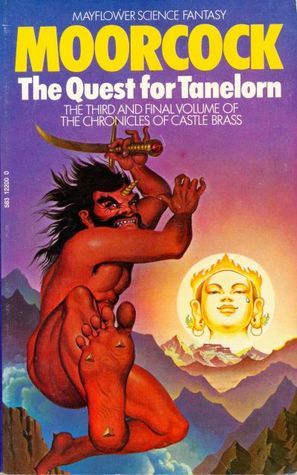
Michael Moorcock, The Quest for Tanelorn (Berkley, 1975)
The Quest for Tanelorn ends with the words "the end of the saga of the eternal champion." A quarter-century later, of course, we know the untruth of that statement; still it's tough to read.
In this last novel of Dorian Hawkmoon and his compatriots, Hawkmoon, united with his wife, goes on the search for his children. He is pulled into a land of limbo suddenly while on a journey to Londra, there to find himself with his old friend Jhary-a-Conel, and the two of them adrift in a boat. They soon work out that they are in limbo, and have been sent there for a particular purpose...
Readers of the Eternal Champion novels will no doubt remember Hawkmoon popping up in various places throughout where he doesn't seem to have ever gone before in the series dedicated to him. Well, here it all is; the battle with Agak and Gagak (and what happens afterwards, when whichever manifestation of the Champion the series in question revolves around leaves Hawkmoon and his coterie in the ruins), the boat on the seas of limbo and its odd, blind crew; the whole mess. (One point, for those who have read the Elric series; how the Runestaff itself ends up in the tower of Voilodion Gaghnasdiak is never explained.)
All in all, the series draws to a satisfying conclusion, with the events coming in the most logical time flow they ever do in the eternal champion novels, and with the final mystery of the deaths of the gods, presented at the end of the first Corum trilogy, solved. Everyone (well almost everyone) who has survived ends up happy, and all is right with the Universe. Or so we think. ****
In 1970, Moorcock began tying together his early writings with a novel called The Eternal Champion (1970). Just five years later, he brought to a close the cycle that would define his career in The Quest for Tanelorn (1975).
As an adventure story, this is well-done and fun, particularly the shipboard travels and battle against Agak and Gagak, which would later form the heart of the very evocative Sailor on the Seas of Fate (1976). However, the true joy of this book is how Moorcock does his best to tie together his almost 20 fantasy books written to that date. Not only do Corum, Elric, Erekosë, and Hawkmoon all feature in this story (despite the fact that two of the four were already dead), but Moorcock does a great job explaining how all their stories led to this point. And he does a great job of making an ending that was meaningful for all their tales (but particularly for Erekosë and Hawkmoon) and that also sort of explains the underlying cosmology behind these tales.
What's surprising is that Moorcock then continued to write about the Eternal Champion for decades thereafter — though never to quite the same extent as seen in his watershed fantasy novels written from 1970-1976.
I just reread “The Quest for Tanelorn” by Michael Moorcock for the first time in nearly 40 years and found it pretty dull, actually. I’d read it once as a teenager, but at that time just didn’t get into the “Chronicles of Castle Brass” trilogy, despite reading and rereading the first Hawkmoon series multiple times.
In each of the two previous books of the Castle Brass trilogy the main character, Hawkmoon, experiences changes in time and space that begin to restore his friends and family that he lost in battle at the end of the first Hawkmoon series. This one continues that process as now his children are missing.
The first third of the book sets things up for him to head out on an adventure. There’s little action there, just talk, planning and preparation, with a little uneventful travel. The characters’ goals are to get to Tanelorn, a city in Moorcock’s mythology where warriors can find peace. But the city changes in different dimensions and different times and sort of moves around, making it a difficult destination.
The second third of the book, where all the action is, is a repeat. For anyone who’s read other Moorcock stories about the Champion Eternal, this adventure will be familiar as he uses it multiple times. The tale is the same, just that he writes it from a different character’s perspective depending which series of books you’re reading. That’s not a bad idea, but when that’s the main action in the book there’s no tension, because we already know how it ends. And honestly, the villains in this adventure aren’t all that interesting.
The final third of the book has little action, just talking and philosophizing. Hawkmoon also gets to witness the endings of the two other Champion Eternal characters, Elric and Corum, copied from the final pages of those respective series.
Overall, it’s not a great book. It’s not terrible. It’s just sort of “meh”. It’s not a bad conclusion for Hawkmoon, just not an exciting way for a reader to arrive there.
Far and away the worst and most ridiculous of Moorcock's sword and sorcery novels, a tale which absolutely did not need to be told steeped in absurdly heavy-handed imagery. For Moorcock to foist this off on his readership shows outright contempt for his fans; rarely outside of C.S. Lewis have I encountered fantasy which talks down to the reader as much as this does. Full review: https://fakegeekboy.wordpress.com/201...
This, in some ways, is the final book in the multiverse, though Moorock penned other adventures after this one. It probably contains more explanation of what is going on behind the scenes of the multiverse than any other, but somehow it has always disappointed somewhat, in never being quite as clear as it might have been.
I find the Castle Brass books fascinating, but hard to review without a skeleton-summary of the plot. So if that scares you - the summary, not the skeleton! - then don’t read further.
I may take a break after this book, things are overlapping a bit, Multiverse Overload! Of course, another Me may be reading the final three Corum books elsewhere/when. Hahahaha!
In the first part of the final book in the “Castle Brass” trilogy, we find Hawkmoon, Yisselda, and Count Brass trying to come to terms with where Dorian’s children are, if they were at all, and where/when they might be, if so. Brass, never the one for understanding or entertaining the Multiverse in conversation, agrees that something must be done. What, we are left to wonder. As they prepare for Londra and Queen Flana, hoping their scientists can aid in their search, Hawkmoon and Brass discuss the vagaries of the Multiverse. Meantimes, a rider approaches, from nowhere (!!), and we meet Orland Fank, Servant of the Runestaff. More info, just as the quest is ready, how opportune! And now we ride, ultimately, for Tanelorn it seems, but first The Silver Bridge. And Jhary again too. Soon they meet a group of seven on horseback, (all from various times, tales, and planes…), surrounding an ethereal light. Seems the battle between Law and Chaos is sundering the balance of the universe, and Hawkmoon is called to set things right. Next we meet - again, here, anyway - Brut of Lashmar and his warriors (and another!), aboard the fabled Dark Ship, seeking Tanelorn themselves, maybe. As things resume in part two, Hawkmoon, Brut and Prince Corum - newly reunited - sail for Tanelorn, each for reasons of his own, but all for the same goal, even so. The Blind Captain tells more of the Eternal Champion, and we are told of the Conjunction of a Million Spheres and what it (might) mean for them all, and everyone, everywhere, everywhen. Soon they complete their unruly group with Elric and Erekose, and now we begin to see what lies ahead is no normal quest for some myth-shrouded place, but more likely the physical ground of a massive battle for even larger stakes than any one individual can understand fully. Wow. Lots of badass warriors here! And so my poor attempts at summarizing end, as the final pages of part two bleed into part three and to a finish all would expect, but is still utterly and uncomprehendingly amazing and fabulous. A fitting dual end (really, end, in the Multiverse?!?) to a fabulous iteration of the Eternal Champion, AND to The Eternal Champion series.
Moorcock has done himself a solid with the Castle Brass books. I started with Elric and loved the first 6 books, the later Elric - not canon! - less so. This trilogy has much in common with Elric’s Saga, and I was thoroughly entertained and excited with each new (or not so new) direction of the lives of the Eternal Champions.
As in my review for the second “Castle Brass” book, Moorcock bends and reimagines some of the best of myth, legend, and history into something totally unique, but still retaining echoes of other tales, other gods and monsters, other myths, other lives. I have said this before, twice over, but surely Moorcock had some enormous tesseract-type object to keep track of the Multiverse? Insanity.
Hawkmoon searches for the lost City of Tanelorn which he is convinced contains his missing wife and two children, which he has only seen in dreams or visions.
Moorcock again incorporates his theme of a ship sailing on the Seas of Fate and a gathering of eternal champions from various times and realities, who are directed by greater forces to fight against a pair of sorcerers who exist in the remnants of Tanelorn.
This is where the story gets even more surreal and ambiguous. Four eternal champions, including Hawkmoon, Erekose, and Elric, meld into a personage with eight arms and legs and combat the twin sorcerers who shift and change shape into cities and personages and bubbling cauldrons of faces and limbs. Each draw upon the power of cleft dimensions to fight each other.
The story comes to a satisfying conclusion in a series of twists and false identities in which Hawkmoon bargains for the lives of his loved ones with the demon that once possessed the blade Stormbringer which was carried by Elric.
The story might have more heft if the reader has read the Elric series (which I have) and the Corum series (which I haven't) because they all tie together.
Je savais déja que ce tome était inférieur, mais j'ignorais à quel point. Donc, dans celui-ci, Hawkmoon part à la recherche de ses enfants perdus dans le multivers. Il va rejoindre d'autres incarnations du champion éternel pour la conjonction du million de sphères, participer au combat contre Agak et Gagak, trouver Tanelorn, et détruire l'épée noire, le baton runique, la balance, bref tout. Et c'est annoncé comme le dernier tome de l'hypercycle du multivers. Et franchement, c'est mauvais. Avant tout parce que je n'ai jamais réussi à me sentir le moins du monde impliqué dans ce voyage dans les limbes. Mais aussi parce qu'Hawkmoon lui-même se désimplique de sa propre vie. Alors je l'ai lu. Mais franchement, c'est surtout par vocation complétiste. Si je devais un jour donner un conseil de lecture concernant Hawkmoon (qui est l'incarnation du champion éternel que j'aime le moins), je rcommanderai de ne lire que les quatre premiers tomes, qui sont assez chouettes, et d'ignorer les trois derniers tomes.
I read the first two Chronicles of Castle Brass books a few years back, so when I came across this one earlier this year, I decided to refresh myself and found this excellent synopsis of the books, and read the first two.
As I had remembered it, there was a bit of time travel / alternate timelines hijinks in the first two books, but overall both felt like fairly straightforward adventure stories.
Then the third book starts and it's just madness - multiversal overlap with famous characters from all over Moorcock's mythos showing up; a strange shadowland that is some sort of netherworld; and all of the worlds being threatened by two goddam evil wizards who take about 10 pages to dispatch.
And then it's over... at least, the ending encourages us to think that this book is the end of Moorcock's Eternal Champion saga. But of course we live in our world... and there are always more books to sell.
I set a goal to re-read all of the eternal champion cycle during the pandemic (Elric, Erekose, Corum, and Hawkmoon.). There are a lot of good books in this series, but more bad ones. It was a slog at times. I have several complaints about this book; like the fact that a third of it is dedicated to re-hashing a sequence from another book. But in the end this book is exactly what in needs to be, simple philosophizing and all. I am glad I read them all, and I hope I remember not to ever do it again .
I have read Micael Moorcock's work since I was 12 , I'm now 63 and still enjoy his tales . During Covid I re read many titles including the History of the Runestaff , then Count Brass and The Champion of Garathorm . I had bought The Quest for Tanelorn when it was first printed in 1975 , read it then shelved it . Last week I picked it out and read it again with the same sense of amazement as when I first bought it . It brings the Eternal Champion to an end , for Hawkmoon , Erekose , Corum and Elric . I thoroughly enjoyed the book .
Probably the most confusing book of Moorcock’s I’d read to date, ack in the day. Now I can see it as a conclusion to everything he had done… even if he did keep adding to the lore as years went by. Mostly to Elric’s, though. This is billed as the conclusion of the Eternal Champion’s story and it does have an air of finality to it. It’s just too dreamlike and metaphysical to have proper impact, while also catering to fan service a little too much. It’s great seeing all the as;eats together though.
Moorcock’s blend of fantasy and sci fi multiverse cosmology comes to an epic finale, his writing economy is something to be admired yet fans of ‘modern’ styles (Sanderson etc) may be put off as Michael doesn’t spend 100 pages on character development per book, however the Eternal Champion(s) certainly gets his character arc over the course of the numerous series that make up this wonderful and imaginative cosmos.
A great ending to the Chronicles Of Castle Brass trilogy, and to the greater story of the Eternal Champion. I feel I may have benefited from reading the Elric, Erekose, Corum, etc. books before I read this story, as there is some crossover between characters, but as their own adventures are stories on their own, there is no real harm done. I will definitely be reading more of Moorcock's material.
La fin de la trilogie conclusive, entre le récit maintes fois repris de Agak et Gagak, les Champions Éternels, la Balance, le Bâton runique et l'Épée noire. Tout y est dans ce récit, toute la mythologie de Moorcock et tous ces écrits et la façon dont il a donné une cohérence philosophique au "million de sphères". Bien agréable à relire !
what a final journey this is, a lot of concepts and ideals being put into this book and in my view it works, however there are some spoilers and I had to skip some, otherwise a great ending.