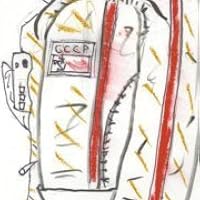
Rawhead it was called because its head was huge and raw like meat. It was the last of a line of kings dating from before civilization, before Christ, when England was forest all over... and the home of unspeakable horror. The most famous and powerful story came from Clive Barker's Books of Blood is here unforgettably illustrated. The incomparable talent of Les Edwards brings ancient evil to life.Also in this volume, the haunting Clive Barker story Twilight At the Towers, Illustrated by the amazing Hector Gomez.
Clive Barker was born in Liverpool, England, the son of Joan Rubie (née Revill), a painter and school welfare officer, and Leonard Barker, a personnel director for an industrial relations firm. Educated at Dovedale Primary School and Quarry Bank High School, he studied English and Philosophy at Liverpool University and his picture now hangs in the entrance hallway to the Philosophy Department. It was in Liverpool in 1975 that he met his first partner, John Gregson, with whom he lived until 1986. Barker's second long-term relationship, with photographer David Armstrong, ended in 2009.
In 2003, Clive Barker received The Davidson/Valentini Award at the 15th GLAAD Media Awards. This award is presented "to an openly lesbian, gay, bisexual or transgender individual who has made a significant difference in promoting equal rights for any of those communities". While Barker is critical of organized religion, he has stated that he is a believer in both God and the afterlife, and that the Bible influences his work.
Fans have noticed of late that Barker's voice has become gravelly and coarse. He says in a December 2008 online interview that this is due to polyps in his throat which were so severe that a doctor told him he was taking in ten percent of the air he was supposed to have been getting. He has had two surgeries to remove them and believes his resultant voice is an improvement over how it was prior to the surgeries. He said he did not have cancer and has given up cigars. On August 27, 2010, Barker underwent surgery yet again to remove new polyp growths from his throat. In early February 2012 Barker fell into a coma after a dentist visit led to blood poisoning. Barker remained in a coma for eleven days but eventually came out of it. Fans were notified on his Twitter page about some of the experience and that Barker was recovering after the ordeal, but left with many strange visions.
Barker is one of the leading authors of contemporary horror/fantasy, writing in the horror genre early in his career, mostly in the form of short stories (collected in Books of Blood 1 – 6), and the Faustian novel The Damnation Game (1985). Later he moved towards modern-day fantasy and urban fantasy with horror elements in Weaveworld (1987), The Great and Secret Show (1989), the world-spanning Imajica (1991) and Sacrament (1996), bringing in the deeper, richer concepts of reality, the nature of the mind and dreams, and the power of words and memories.
Barker has a keen interest in movie production, although his films have received mixed receptions. He wrote the screenplays for Underworld (aka Transmutations – 1985) and Rawhead Rex (1986), both directed by George Pavlou. Displeased by how his material was handled, he moved to directing with Hellraiser (1987), based on his novella The Hellbound Heart. His early movies, the shorts The Forbidden and Salome, are experimental art movies with surrealist elements, which have been re-released together to moderate critical acclaim. After his film Nightbreed (Cabal), which was widely considered to be a flop, Barker returned to write and direct Lord of Illusions. Barker was an executive producer of the film Gods and Monsters, which received major critical acclaim.
Barker is a prolific visual artist working in a variety of media, often illustrating his own books. His paintings have been seen first on the covers of his official fan club magazine, Dread, published by Fantaco in the early Nineties, as well on the covers of the collections of his plays, Incarnations (1995) and Forms of Heaven (1996), as well as on the second printing of the original UK publications of his Books of Blood series.
A longtime comics fan, Barker achieved his dream of publishing his own superhero books when Marvel Comics launched the Razorline imprint in 1993. Based on detailed premises, titles and lead characters he created specifically for this, the four interrelated titles — set outside the Marvel universe — were Ectokid,
Vi o filme, li o conto e agora li os quadrinhos. O conto (que na verdade eu chamaria de novela) é excelente, foi a primeira coisa que li do Clive Barker e ele tem um domínio narrativo sensacional, muito mais do que como diretor de cinema. O filme ficou enfadonho demais, com orçamento baixíssimo que não manteve o verdadeiro horror que é a experiência de ler o conto, embora eu goste muito mais do final do filme que reside na força do sagrado feminino. Os quadrinhos são super fiéis ao original do Barker, coloca uma potência visual provavelmente muito mais próxima do que o próprio Barker visualizou a descrever, mas não possui o espírito de horror do conto, embora excelentemente desenhado.
"Fear was for those who still had a chance of life: ...he had none." (Clive Barker, Books of Blood: Rawhead Rex. 1998)
I have a bias toward Clive Barker. He's a mastermind writer that can do no wrong in my warped opinion (Let us not talk of 'Abarat', for that would be a lengthy discussion...)
Clive Barker has a unique penchant for story telling, and Rawhead Rex highlights his talent beautifully.
( I wanted to see the film for comparison, but the DVD on Amazon it sells for $94.99 used. That's right. $94.99. Used. Needless to say, I didn't pay to see it.)
Still, what an excellent story! I grew up on a farm and so I empathized with the trials and tribulations of the first character, Thomas. This was a man who found rocks, boulders and other soil impediments in the good earth and cleared them away with the (hopeful) goal of planting fruitful seed. As I read, I felt Thomas Garrow's desire to get this huge rock out of the fertile soil bed. His persistence won out over the troublesome boulder. Alas, persistence does not solely reap rewards. Thomas found that out first hand.
The POV switch Barker inserted as Rawhead rose from his prison, was spectacular. I felt as if I WERE Rawhead, smelling the sky...drinking in a world of sensations I'd been deprived of for eons. Then I was Thomas again, bewildered, amazed... then dropped on my head... dead.
Barker does some things in this piece that writers are told never to do in a story (short or long). He switches POV often, and he introduces multiple characters who have little in common except the thread of their existence in the town of Zeal. All of those things, and he uses the word grimace (or a form of it) at least four times in the short story (OMG: What would author Tim Esaias say? There are no gargoyles in this prose. SHU'ers you know what I'm talkin 'bout.) A sin in writing, for those of us taught by those who are great.
Regardless of the grimaces, and Barker doing all of the things we are taught NOT to do as new writers...he is the master of the macabre. His language, his 'page turner' ensemble of words is fantastical. I couldn't help but love each grossly detailed, sickening and twisted moment. Clive Barker is, perhaps, the best (non-personal) writing instructor I've ever had. His is the work I study. His is the prose I most want to capture the idealism behind. He is frank, honest, visual and forthright. He is the mixed martial artist of the writer's arena, practicing with no holds barred. An aberration of the mat, and an opponent never to take for granted. If I were in front of him, I would bow low but I would never, never take my eyes off of him.
Did I find it hard to believe that the 'Venus of Willendorf' was the arch-enemy, the nemesis of Rawhead Rex? It was a bit of a stretch, but the story played on ancient history, and I loved the gender battle. In addition to the story-line, Barker wracked the limits of human endurance in the reader. An innocent young girl dies, and an intellectual boy (writers might feel for because of his introverted self) dies as well. Granted we don't have enough time to fall in love with the boy too much...still...he was only a child), and we get to see the perspective of Rawhead as he revels in his own renewed greatness. He is God once more. We feel the beast's thirst, we hunger for dominance, we understand the confusion of a different world that meets us after centuries of burial in a prison in the ground. The world is strange. It has changed. And even with the last breath (and final urination), we are convinced that Rawhead's reign has not ended. That he will be back. As the female energy is omnipresent, so is the male, and like a male organ gone temporarily flaccid Rawhead Rex will rise again. All he needs is time.
I didn't like the first story, "Rawhead Rex." I found it a bit over the top, and gross to be honest. It was horror for the sake of horror, not for a good story. The second story though, "Twilight At The Towers" that was a delight. J thought it was ingenious to add a cold war, espionagey double-agent type element to a werewolf story. It was cool. Enjoyed that quite a whole lot.
This visual adaptation of Clive Barker's "Rawhead Rex" novelette is noteworthy for two reasons. Steve Niles uses Barker's text for the most part (with truncated paragraphs, some blended sentences, and a few original speech bubbles) and Les Edwards' moody, impressionistic, graphic artistry is striking and quite memorable. The creature's flashback to its original downfall and the blatant giveaway of the tale's finale is handled quite well in two of the panels. For anyone who hasn't read Barker's folk horror story this version should be quite satisfying.
This folktale is unsubtle allegorical gynophobia. It glorifies rape and youth mutilation and fears the fruitful uterus--not unlike many aspects of modern culture. At least it recognizes that this stance is that of the monster.
The creature, Rawhead Rex, is a giant hypermale [9 ft. tall] with a skin-less face making it roughly the embodiment of a monster circumcised erection. It likes to mutilate and debase other males, devour prepubescent kids and rape non-menstruating women in order to procreate. It cringes away from women on their period and runs from pregnant women.
Filled with gore and engorged cocks and a very thin history for the creature, this tale won't be for everyone. A religious element emerges in which penis-worship takes a literal turn when a religious man accepts a baptism by urination from the creature. Unsubtle--check. Not for everyone--check.
OK, 'scary' is a subjective thing. Horrors are kind of tricky—trickier than some people believe. To scare someone through fiction is to play with the way their bodies and psyches process things. And since we're all different, like I said, it's tricky. Therefore, simply saying 'it's not scary' would be stupid. The fact that this horror story didn't 'click' with me doesn't mean that it's bad. What makes it bad in my opinion is the fact that Barker relied too much on the way he tries to scare people.
See, "Rawhead Rex" is a very basic experience. Some dude dug up an ancient monster from its grave by accident. Then the monster began killing people. And yes, technically it is a spoiler, but come on. I officially refuse to accept it as one, just because you can't spoil a story that was told, like, a million times before. Seriously, a monster from a grave is one of the ancient tropes in the genre. Generic developments (like the vicar character, for example) are included. There's literally nothing here for you if you want an interesting and/or at least a little bit fresh story.
Don't get me wrong, though; horror-wise, Barkerdid There's also the movie adaptation of this work. And you know what? I enjoyed it much more than the original story. I mean, in a movie there are many more aspects: the actors, the music, the effects... There's a much bigger chance that something will 'click' with you. Here? You either enjoy the way Barker tells his stories or you hate the hell out of this work. The moral of the story is: you don't put all your eggs in one basket; make sure to add at least a little something to please a broader audience. Dixi.
Le tenía fe a este libro y....meehhh!!!!, no fue 🤷🏻♀️, son dos historias de Clive Barker ilustradas "Rawhead Rex" y "Twilight at the towers", que según averigüe están en el vol1 de los "Libros de sangre", el cuento que le da nombre a este libro es la historia que me gustó más y el ilustrador Les Edwards dibuja muy bien, y fue lo que más disfruté de este libro, el monstruo es feísimo (no puse foto de él, la gracia es verlo en el cómic), pero la historia se desinfla y lo mismo pasa con la segunda historia ilustrada por Hector Gomez, mucho texto y cuando la historia da un giro interesante... fin!
Una historia de terror sobre la pérdida de los relatos, las tradiciones, el olvido, la masculinidad tóxica, la feminidad, la gentrificación y un monstruo gigante con forma de pene. Clive Barker tiene la enorme capacidad de plantear relatos de Cosmicismo interesantes, innovadores, incómodos y atractivos, pero también sus finales tienden a ser deliberadamente abruptos e insatisfactorios.
Rawhead Rex from Clive Barker's 'Books of blood volumes 1 - 3' Is a short, brutal story about an awakened ancient evil. This is a gory, fast-paced horror story that pulls no punches. I thought the writing was excellent and Barker's prose and are a cut above.
So much better than the movie. I'm glad they took the time to illustrate this story! The wonderful art of Les Edwards perfectly paints the true horror and visceral gore of Rawhead Rex. Wonderful!
Savage, unapologetic horror that doesn’t pull a single punch. This story is pure, feral energy—violent, mythic, and deeply unsettling. The creature itself feels ancient and obscene, and the way old folklore collides with modern arrogance makes everything hit harder.
It’s short, brutal, and relentlessly effective, with imagery that sticks in your head whether you want it to or not. No subtlety, no mercy—just raw, primal horror done right.
The graphic novel adaptation of Two of Clive Barker's Book of Blood stories were gorily intriguing. Rawhead Rex is a tale about a monster who eats children, like all monarchy, revolution takes place to dethrone him. Twilight at Tower is a supernatural spy thriller set in Berlin which a twisted ending.
I enjoyed this volume immensely, the gore was really precise to extenuate the terror without being tedious.