

What do you think?
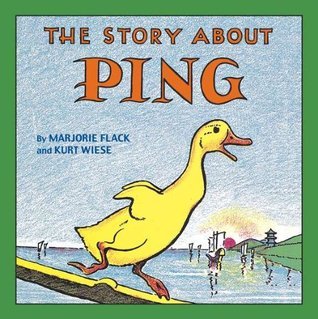
The Story About Ping
Ping was an adventurous duck who lived on a beautiful wise-eyed boat on the Yangtze River. He liked his life on the riverboat just and liked his large family and his kind master. He didn't like to be the last in line to board the boat at night, for that unlucky duck got a loud spank. So what did Ping do when it seemed that he would be the last on line? What else but set out on his own to explore the fascinating world of life on the Yangtze River.
The Story about Ping is one of the best-loved and enduring children's books, both for its spirited and irrepressible hero and for its beautiful evocation of a distant land and way of life. Every child can sympathize with a dawdling duck who wants to avoid a spanking, and share his excitement and wonder as he sails down the river.
The Story about Ping is one of the best-loved and enduring children's books, both for its spirited and irrepressible hero and for its beautiful evocation of a distant land and way of life. Every child can sympathize with a dawdling duck who wants to avoid a spanking, and share his excitement and wonder as he sails down the river.
32 pages, Paperback
First published January 1, 1933
About the author
Marjorie Flack
71 books45 followershttps://en.wikipedia.org/wiki/Marjori...
Marjorie Flack was an American artist and writer of children's picture books. She was best known for The Story about Ping (1933), illustrated by Kurt Wiese, popularized by Captain Kangaroo, and for her stories of an insatiably curious Scottish terrier named Angus, who was actually her dog. Her first marriage was to artist Karl Larsson; she later married poet William Rose Benét.
Her book Angus Lost was featured prominently in the film Ask the Dust (2006), starring Colin Farrell and Salma Hayek, in which Farrell's character teaches Hayek's character, a Mexican, to read English using Flack's book.
Flack's grandson, Tim Barnum, and his wife, Darlene Enix-Barnum, currently sponsor an annual creative writing award at Anne Arundel Community College. The Marjorie Flack Award for Fiction consists of a $250 prize for the best short story or children's storybook written by a current AACC student.
Marjorie Flack was an American artist and writer of children's picture books. She was best known for The Story about Ping (1933), illustrated by Kurt Wiese, popularized by Captain Kangaroo, and for her stories of an insatiably curious Scottish terrier named Angus, who was actually her dog. Her first marriage was to artist Karl Larsson; she later married poet William Rose Benét.
Her book Angus Lost was featured prominently in the film Ask the Dust (2006), starring Colin Farrell and Salma Hayek, in which Farrell's character teaches Hayek's character, a Mexican, to read English using Flack's book.
Flack's grandson, Tim Barnum, and his wife, Darlene Enix-Barnum, currently sponsor an annual creative writing award at Anne Arundel Community College. The Marjorie Flack Award for Fiction consists of a $250 prize for the best short story or children's storybook written by a current AACC student.
Ratings & Reviews
Friends & Following
Create a free account to discover what your friends think of this book!
Community Reviews
Displaying 1 - 30 of 595 reviews

March 26, 2019
I see why the story of Ping is still around. It’s getting to be 100 years now, published in 1933. It was before the Caldecott award started. It’s an old book. It’s a very lovely book.
Ping lives with his large duck family on a boat just for ducks. The owner of the little boat will put up a ramp and let all the ducks out and then they walk up the ramp to get back on the boat. If you are the last duck, the man will give you a spank on the way up. This terrified Ping.
One day, he was late and he saw he would be last, so he hid in the reeds and the boat sails away. The next day, Ping searches the Yellow river for the boat and almost ends up someone’s dinner. He does find his boat and he is glad to get a spank to be with his family.
The art is lovely and the river looks like a place filled with light. There is a warmness to the artwork.
The nephew thought this book was funny. He wanted to spank the duck himself and make it quack. (He is an odd child.) He also liked the little boy in the river with a barrel tied to his back that caught Ping. He gave this 4 stars. The niece thought it was an ok story and she gave this 3 stars. She didn’t say much about it.
Ping lives with his large duck family on a boat just for ducks. The owner of the little boat will put up a ramp and let all the ducks out and then they walk up the ramp to get back on the boat. If you are the last duck, the man will give you a spank on the way up. This terrified Ping.
One day, he was late and he saw he would be last, so he hid in the reeds and the boat sails away. The next day, Ping searches the Yellow river for the boat and almost ends up someone’s dinner. He does find his boat and he is glad to get a spank to be with his family.
The art is lovely and the river looks like a place filled with light. There is a warmness to the artwork.
The nephew thought this book was funny. He wanted to spank the duck himself and make it quack. (He is an odd child.) He also liked the little boy in the river with a barrel tied to his back that caught Ping. He gave this 4 stars. The niece thought it was an ok story and she gave this 3 stars. She didn’t say much about it.

October 22, 2010
Since this is a children's book review, I ought to warn you:

Okay, so this book is FUCKED up. It's about a cute little duck who lives somewhere in China, and he's one of the many ducks that lives on some kinda boat, and every day he's supposed to get back on the boat at the end of his time hanging out in the water. And, every day, the last duck on the boat gets hit on the butt by the human who is in charge of the boat. It's VIOLENT!
So, our protagonist, named PING, loses track of time, and he sees that he's going to be the last duck on the boat, and instead of getting on, he hides. Then, he's LOST in the GREAT BIG WORLD, and it's SCARY. He gets, like, KIDNAPPED and stuff, and eventually gets eaten.
No, he doesn't get eaten. I was checking to see if you were paying attention. He gets picked up by a cute little boy, who then helps him get back to his boat, and he lives kinda-sorta-happily-ever-after on the boat with the evil man who occasionally beats him. LOVELY, huh?
Seriously, Ping is a jacked up little book, and if your goal is to make sure your abused children never get up the courage to run away, this is the book to own. But despite the strange kinda-sorta message of the book, I LOVED it when I was a little kid because my mom read it to me all the time. And, whenever she said the name of the duck, which was Ping, she would poke me on the nose and say "PING!" in this funny high-pitched voice, and every time I would laugh. This is why I liked the book Ping, not because of its bizarre portrayal of reality, and its twisted, sadomasochistic message.
Okay, so this book is FUCKED up. It's about a cute little duck who lives somewhere in China, and he's one of the many ducks that lives on some kinda boat, and every day he's supposed to get back on the boat at the end of his time hanging out in the water. And, every day, the last duck on the boat gets hit on the butt by the human who is in charge of the boat. It's VIOLENT!
So, our protagonist, named PING, loses track of time, and he sees that he's going to be the last duck on the boat, and instead of getting on, he hides. Then, he's LOST in the GREAT BIG WORLD, and it's SCARY. He gets, like, KIDNAPPED and stuff, and eventually gets eaten.
No, he doesn't get eaten. I was checking to see if you were paying attention. He gets picked up by a cute little boy, who then helps him get back to his boat, and he lives kinda-sorta-happily-ever-after on the boat with the evil man who occasionally beats him. LOVELY, huh?
Seriously, Ping is a jacked up little book, and if your goal is to make sure your abused children never get up the courage to run away, this is the book to own. But despite the strange kinda-sorta message of the book, I LOVED it when I was a little kid because my mom read it to me all the time. And, whenever she said the name of the duck, which was Ping, she would poke me on the nose and say "PING!" in this funny high-pitched voice, and every time I would laugh. This is why I liked the book Ping, not because of its bizarre portrayal of reality, and its twisted, sadomasochistic message.

November 3, 2010
Uh, am I the only one that has a problem with this little duck being whacked for no reason? Is it really just me? I'm sorry but we want to ban books that talk about sex and mention a cuss word but we can beat defenseless little ducks? What the fuck is wrong with this picture?
I get this was published in 1933 when spanking was in. Hell, I'm not even against spanking! But in a book? With a little duck? Who did nothing wrong?!
Is it just me (again) or did I read in the description that this duck lives with a "kind master"? Well damn. I'd hate to see dude pissed off. And I'll venture a guess that Ping did not like his life on the boat with his "kind master" all that much because his little feathered butt didn't go back when he knew he was about to get beat.
You know what would have made this a five star book for me? If little Ping would have grabbed the whip dude was holding and beat his ass with it. That would have been awesome.
The poor damn duck.
I get this was published in 1933 when spanking was in. Hell, I'm not even against spanking! But in a book? With a little duck? Who did nothing wrong?!
Is it just me (again) or did I read in the description that this duck lives with a "kind master"? Well damn. I'd hate to see dude pissed off. And I'll venture a guess that Ping did not like his life on the boat with his "kind master" all that much because his little feathered butt didn't go back when he knew he was about to get beat.
You know what would have made this a five star book for me? If little Ping would have grabbed the whip dude was holding and beat his ass with it. That would have been awesome.
The poor damn duck.

December 30, 2023
I don’t normally review children’s books but I just reread this one with my nephew and yikes! I liked it as a kid but I remember it was nothing special. Reading it as an adult was a whole new experience.
The book is teaching kids to be on time, but it’s saying that kids will get physical punishment if they’re not on time. I feel like there’s a ton of better books that teach kids to be on time without resorting to physical punishment which is a form of abuse.
Then there’s the whole issue of the racist portrayal of Chinese people. The Chinese characters all seem to be racist stereotypes, especially in regard to the illustrations.
The book is teaching kids to be on time, but it’s saying that kids will get physical punishment if they’re not on time. I feel like there’s a ton of better books that teach kids to be on time without resorting to physical punishment which is a form of abuse.
Then there’s the whole issue of the racist portrayal of Chinese people. The Chinese characters all seem to be racist stereotypes, especially in regard to the illustrations.

February 2, 2023
This book is a century old and teaches some very valuable lessons. As we read about Ping the duck, we learn empathy, kindness, understanding, and consequences to actions.
Another thing my children learned was that the Sun rises in the East and sets in the West.
Our family read this book because it is part of our living lessons for homeschooling and part of the “Around the World” curriculum we use. This book has been wonderful - the key is to ask your kids questions about what’s going on either as you read, or after. This helps to bring out all those wonderful little lessons I mentioned earlier.
Another thing my children learned was that the Sun rises in the East and sets in the West.
Our family read this book because it is part of our living lessons for homeschooling and part of the “Around the World” curriculum we use. This book has been wonderful - the key is to ask your kids questions about what’s going on either as you read, or after. This helps to bring out all those wonderful little lessons I mentioned earlier.

January 9, 2011

I actually first heard about his story years ago on a Weston Woods video. “The Story of Ping” is a Chinese story by Marjorie Flack and Kurt Wiese about how a young and beautiful duck named Ping gets lost in the Yangtze River after he tries to avoid punishment of being late. “The Story of Ping” is a cute story about showing the consequences of disobedience and the importance of family that children cannot resist!
Once there lived a beautiful young yellow duck named Ping who lived with his mother, his father, his two sisters, his three brothers, his eleven aunts, his seven uncles and his forty-two cousins in the wise-eyed boat on the Yangtze River. Every morning, the duck family would hunt for snails and fishes to eat, but in the evening, the master of the boat calls the duck family back to the boat and the last duck coming to the boat will be spanked. One afternoon however, Ping did not hear the call from his master because he was underwater and when he finally swam towards the boat, the last of his forty-two cousins crossed the bridge and Ping did not want to be spanked, so he hid in the grasses until the next morning and he set out into the Yangtze River to find his family.
This is one of those books that remind me about why I love reading about folktales from different cultures! Marjorie Flack and Kurt Wiese made a great team in both illustrating and writing this book! Marjorie Flack did a great job at pointing out the messages of this book about how being disobedient can get you into trouble and the importance of family as Ping traveled the river by himself to find his family. I also loved the Chinese influence that Marjorie Flack brought to the story as it made the story even more magical to read since it is like placing yourself in a faraway land! I also loved the way that Marjorie Flack made Ping into a brave little duck as he was tried to find his family by himself and faced dangerous obstacles by himself and children will be rooting for him throughout the book. Kurt Wiese’s illustrations are just simply beautiful, especially of the image of Ping himself as he is the only yellow duck in his entire family, which makes him truly stand out from all the other ducks. The images that I really enjoyed in this book were the images of Ping swimming in the river and you can see Ping’s beautiful reflection in the water.

Parents should know that this book focuses on Ping being separated from his family, so smaller children might be upset about Ping going out into the river by himself with danger lurking everywhere. Parents might want to read this book first to see if their children can handle Ping’s situation.
All in all, “The Story about Ping” is a fantastic book about the importance of family that many children will easily enjoy and learn from. I would recommend this book to children ages five and up since the scene of Ping being separated from his family might scare smaller children.
Review is also on: Rabbit Ears Book Blog


April 18, 2021
I remember this book from kindergarten; it was a story that made an impression. . I felt sorry for the ducklings, especially the main duckling, Ping. I knew this was a story, yet I didn't understand why a duckling was punished each evening. In my six year-old eyes, it seemed the ducklings were being punished for no reason, other than bad luck.
Still I liked it enough to reread it, share it with others, and purchase a copy for a school library. I learned the moral of the story was to be on time. Yet I eventually weeded it because of the punishment IMHO
Bottom line - If you are looking for a kid friendlier story with a similar message, check out one of my many Easter favorites, The Easter Bunny That Overslept.
Still I liked it enough to reread it, share it with others, and purchase a copy for a school library. I learned the moral of the story was to be on time. Yet I eventually weeded it because of the punishment IMHO
Bottom line - If you are looking for a kid friendlier story with a similar message, check out one of my many Easter favorites, The Easter Bunny That Overslept.
February 25, 2013
Other than Russell Hoban's "Frances" series, this book is my favorite childhood memory. It foretold a life of distraction, rebellion, waywardness, all nighters, and the last duck home swat. I was fortunate enough to buy a Signed, First Edition this book at auction. It is a treasured possession.

December 21, 2007
I completely forgot about this book until I saw it at Goodreads. But I remember liking it a lot as a kid. It was first read to me and when I learned to read, I read it to myself as well. I was fascinated by the foreign setting. I don’t have a copy now; I assume at this point I’d hate the part about the spanking.

August 20, 2019
Originally published in 1933, this classic picture-book by Marjorie Flack is one I have been meaning to read for some time, as part of my "ducklings in danger" project - does it strike anyone else that there is a superfluity of endangered ducks in children's literature? how did they become the scapegoat of the picture-book world? A recent discussion of The Story About Ping over in the "Popular Children's Books We Hate" thread of the children's books group I moderate, highlighted the divided opinions about it, and reminded me to pick up a copy from the library this past weekend, so I could decide for myself.
The tale of a little Pecking duckling who becomes separated from his family one day, because he is afraid to be the last to board the wise-eyed boat that is his home - the final duckling to board always get a little swat on the behind - The Story About Ping follows its eponymous anatine hero as he survives a night and day by himself on the Yangtze River. Sleeping in the rushes overnight, and then encountering fishing birds, and a swimming boy, while searching for his family and boat, Ping barely escapes being made into dinner by the boy's family. When he finally does find the wise-eyed boat again, he doesn't hesitate to get on board, even though he is last in line...
So... what did I think? Well, I honestly have trouble seeing what all the fuss is about, or how people can interpret the little swat that Ping receives as child abuse. Leaving aside the fact that corporal punishment is not always synonymous with abuse, the behavior in this story struck me less as punishment (of any kind) than as herding. I think Flack successfully communicates the idea that we frequently get ourselves deeper into trouble, when we seek to avoid what is unpleasant and uncomfortable, and she does it with little overt didacticism. The accompanying artwork by Kurt Wiese is charming, with a decided vintage feeling that is very appealing. I don't know that I was as enchanted with this as I would have been, had I encountered it for the first time as a child, but I did find it solidly engaging.
The tale of a little Pecking duckling who becomes separated from his family one day, because he is afraid to be the last to board the wise-eyed boat that is his home - the final duckling to board always get a little swat on the behind - The Story About Ping follows its eponymous anatine hero as he survives a night and day by himself on the Yangtze River. Sleeping in the rushes overnight, and then encountering fishing birds, and a swimming boy, while searching for his family and boat, Ping barely escapes being made into dinner by the boy's family. When he finally does find the wise-eyed boat again, he doesn't hesitate to get on board, even though he is last in line...
So... what did I think? Well, I honestly have trouble seeing what all the fuss is about, or how people can interpret the little swat that Ping receives as child abuse. Leaving aside the fact that corporal punishment is not always synonymous with abuse, the behavior in this story struck me less as punishment (of any kind) than as herding. I think Flack successfully communicates the idea that we frequently get ourselves deeper into trouble, when we seek to avoid what is unpleasant and uncomfortable, and she does it with little overt didacticism. The accompanying artwork by Kurt Wiese is charming, with a decided vintage feeling that is very appealing. I don't know that I was as enchanted with this as I would have been, had I encountered it for the first time as a child, but I did find it solidly engaging.

August 7, 2012
I read this because it's on my daughter's five in a row book list for home schooling. I'm sure it was a great children's book during the time of it's publication but it's pretty dated and insensitive by today's standards. My child found the animal story and the information about China interesting but was to disturbed about the boat owner hitting the duck to get the moral of it at all. He runs away to escape being whacked as the last duck on the boat, then gets in danger, escapes, finds his family again and this time decides to be last and get whacked in order to reunite with his family and his boat. My 6 year old said "He should have kept running away I bet he could have found a better home somewhere else".

August 31, 2025
I first read about Ping and his 42 duckling cousins so long ago that I can’t remember how young I was at the time. No matter, as this wonderful picture book remains as charming as ever — although I don’t agree with thwacking little ducks, whether they are last or not. At a time when American children (or even little Cuban immigrants) saw little of China, The Story of Ping was a glimpse of an amazing land far, far away.
Thanks to my friend Manybooks for the suggestion for a re-read.
Thanks to my friend Manybooks for the suggestion for a re-read.

July 27, 2018
I read this fantastic little book to my 9 year-old daughter, 16 year-old son, and his GF. Written in 1933, it has become a classic of children's literature. It demonstrates varied sentence structure, good vocabulary, a clipping pace, and comedy around every page. A little duck learns the consequences of not paying attention, although he had no malice, and is subsequently exposed to various dangers and little hardships. In the end, he takes his knocks to get back with his group and enjoy the safety, security, and joy of his community. We learn the importance of community, but also the allure of adventure.
I have to make one more point reading the reviews. Most people love this book, but there are a significant but small number of detractors who illustrate for us the complete collapse of common sense that has been with humans for thousands of years. These people are so sensitive that they are "offended" by a duck getting a little thwack on the butt for being late. I think this is a product of completely sheltered city dwellers who have face no hardship in life and have no real understanding of reality. They've never seen extreme poverty, death, disease, or true hardship, and have no perspective on history. Hopefully they realize their hypocrisy and fractured mental duality if they are not all complete vegans. People used to routinely suffer all kinds of injury and abuse, and often the teaching of a parent with a little whack on the butt prevented all sorts of future errancy. Let me use the example of the child I saw recently who was never corrected by a parent. Reaching into the cookie jar, broke the glass, and receive a deep cut on the arm. A spank to teach would have been less harmful to the child, but in the end, life taught the lesson through pain and blood. These "modern" detractors who look for any excuse to shout against any corporal punishment can only be complete wimps who were never hardened by the knocks of life, and probably are destined for either a punch in the face of complete mental breakdown if the society around them ever crumbles the supports of their little world. If you are a complete vegan who never drives a car, has no leather in your life, uses no power from fish churning electric dams, bird wacking windmills, coal or nuclear plants, or puts up windows that kill birds, and in addition fights against abortion as well as corporal discipline, you may respond to this comment.
I have to make one more point reading the reviews. Most people love this book, but there are a significant but small number of detractors who illustrate for us the complete collapse of common sense that has been with humans for thousands of years. These people are so sensitive that they are "offended" by a duck getting a little thwack on the butt for being late. I think this is a product of completely sheltered city dwellers who have face no hardship in life and have no real understanding of reality. They've never seen extreme poverty, death, disease, or true hardship, and have no perspective on history. Hopefully they realize their hypocrisy and fractured mental duality if they are not all complete vegans. People used to routinely suffer all kinds of injury and abuse, and often the teaching of a parent with a little whack on the butt prevented all sorts of future errancy. Let me use the example of the child I saw recently who was never corrected by a parent. Reaching into the cookie jar, broke the glass, and receive a deep cut on the arm. A spank to teach would have been less harmful to the child, but in the end, life taught the lesson through pain and blood. These "modern" detractors who look for any excuse to shout against any corporal punishment can only be complete wimps who were never hardened by the knocks of life, and probably are destined for either a punch in the face of complete mental breakdown if the society around them ever crumbles the supports of their little world. If you are a complete vegan who never drives a car, has no leather in your life, uses no power from fish churning electric dams, bird wacking windmills, coal or nuclear plants, or puts up windows that kill birds, and in addition fights against abortion as well as corporal discipline, you may respond to this comment.

November 19, 2012
The classic book, The Story about Ping, is a page turner, featuring a little yellow duck, who, in fear of receiving punishment, hides from it, only to meet something much more sinister. The theme of the book is a combination of “the grass isn’t always greener on the other side,” “you don’t know what you have until it’s gone,” and “there’s no place like home.” Ping, who is personified with human-like feelings, is late arriving to his family’s boat one afternoon. He knows that the last duck across the bridge receives a spank. Instead of taking the spank, he hides and awakes to a world much different from the one he previously knew. Ping encounters birds with rings around their necks, ensuring that they do not eat the fish they catch for their master; he is also caught by a family who wants to cook him for dinner, only to be set free by the family’s little boy. These scenarios all play in to the theme, as Ping did not encounter anything as dangerous as these in his previous life. The theme is fully enforced at the end of the book when Ping spots his family, is the last duck across the bridge, and happily receives the spank that he so readily avoided earlier. The theme and plot work hand in hand – the multiple themes come across as Ping finds himself in various situations.
The book is written in paragraph form and contains a lot of text; however, the wordiness of the book does not take away from the story, but rather adds to it. The text is essential in building suspense, and also to introducing the reader to the life of a duck in Asia. The illustrations appear to be beautiful colored pencil sketches, and the overlaying of colors makes for an appealing visage. The illustrations are also essential in helping the reader imagine life along an Asian river. The boats, people, and animals of this region have a distinct style that is not entirely known to all.
The work is effective in conveying multiple, yet related themes, and can find use as teaching tool or as an entertaining read. This book is an essential purchase for all libraries, as it is a classic that holds a strong message.
The book is written in paragraph form and contains a lot of text; however, the wordiness of the book does not take away from the story, but rather adds to it. The text is essential in building suspense, and also to introducing the reader to the life of a duck in Asia. The illustrations appear to be beautiful colored pencil sketches, and the overlaying of colors makes for an appealing visage. The illustrations are also essential in helping the reader imagine life along an Asian river. The boats, people, and animals of this region have a distinct style that is not entirely known to all.
The work is effective in conveying multiple, yet related themes, and can find use as teaching tool or as an entertaining read. This book is an essential purchase for all libraries, as it is a classic that holds a strong message.
November 16, 2012
When I was four, my Mom got this book for me for a series we used in homeschooling called "5-in-1". I instantly fell in love with the story of the duckling, the beautiful pencil crayon illustrations and the mystery if an land unknown to me. Well, "5-in-1" taught me a lot of the stuff I wondered, but I still read this book for the fond memories of rainy days curled up with my Mom reading, and of Ping who I still love very much. The writing is beautifully simple, and has enough mystery to keep you reading over and over again.
As an adult, I think what I love BEST about "The Story of Ping" is the five different subjects that you can learn about in one short picture book.
Math: All of Ping's aunts, uncles, cousins, brothers, sisters, Mom and Dad add up quickly! So how many family members does Ping have?
History: What was life like on the Yangtze River when Ping would have been there? What about the birds wearing metal rings around their necks?
Geography: Where is the Yangtze River, anyway? What is China like? What's the weather like? The layout of the land like?
Art: Why did the illustrator use pencil crayons? Then, my mom got out our pencil crayons and we tried to replicate some of the images in the book - the colours in the sunset, the texture of Ping's feathers, and how the water looks.
English - Of course, this is the no brainer! We read the book, but we also looked at how the book was structured and constructed. We talked about the story, about plot, and about word choice.
I see "The Story of Ping" as a timeless book that I will read over and over again, and will pass on to my children.
As an adult, I think what I love BEST about "The Story of Ping" is the five different subjects that you can learn about in one short picture book.
Math: All of Ping's aunts, uncles, cousins, brothers, sisters, Mom and Dad add up quickly! So how many family members does Ping have?
History: What was life like on the Yangtze River when Ping would have been there? What about the birds wearing metal rings around their necks?
Geography: Where is the Yangtze River, anyway? What is China like? What's the weather like? The layout of the land like?
Art: Why did the illustrator use pencil crayons? Then, my mom got out our pencil crayons and we tried to replicate some of the images in the book - the colours in the sunset, the texture of Ping's feathers, and how the water looks.
English - Of course, this is the no brainer! We read the book, but we also looked at how the book was structured and constructed. We talked about the story, about plot, and about word choice.
I see "The Story of Ping" as a timeless book that I will read over and over again, and will pass on to my children.

December 10, 2010
I was surprised to find a humane message hiding in this children’s classic. For those unfamiliar with the story, Ping is a duckling who lives on a boat in Yangtze River along with a flock of his relatives. Every day, the ducks are allowed to leave the boat to go about their business, but every evening they return to the boat and the ducks’ owner “spanks” the last duck aboard with what looks like a long switch. (The man’s reason for keeping the ducks in the first place is not addressed.)
Immediately, many parents and teachers won’t like this element. However, the book makes it clear that Ping fears the spanking and it is the reason he decides not to board the boat one evening when he realizes he will be last in line.
Ping ends up out in the world, and finds it is not a kind place for little birds. He first runs across a group of cormorants forced to fish for their “master.” The cormorants have tight bands around their necks, making it impossible for them to swallow the fish they have caught. Instead, the fisherman collects the catch.
Next, he is captured by a little boy who wishes to keep him as a pet. However, when the boy’s parents see Ping, all they can think about is duck for dinner. The adults trap Ping under an overturned basket, but the boy sneaks out and frees the duckling when his parents aren’t looking. (This is the only show of kindness from humans we encounter in the story.)
Ping decides he’s had enough of the world outside and hightails it back to the boat, where he has to endure his “spanking” before reuniting with his family.
Chances are, the author intended to impart the ideas of not trusting strangers, the necessity of discipline, and that the world can be a scary place for those who are unprepared. (This is probably what caused it to be such a perennial favorite for parents.)
However, I saw something else in The Story About Ping--a study of how birds fare under human control. Ping’s experience of human nature seemed to be one of cruel (his owner’s switch), crueler (the cormorants), and cruelest (his intended slaughter), before experiencing the single act of kindness from a child. Indeed, there seems to be nowhere for Ping to go that will enable him to live out his life in peace (one doubts that a man farming ducks on the Yangtze River regards them as pets). Such is the lot of the farmed animal. When viewed through this lens, Ping takes on a melancholy air. However, there is also an element of hope in the little boy’s rescue of the duckling. Does this represent the young’s innocent compassion that is eventually corrupted, or the promise of a kinder future for small and helpless beings?
Immediately, many parents and teachers won’t like this element. However, the book makes it clear that Ping fears the spanking and it is the reason he decides not to board the boat one evening when he realizes he will be last in line.
Ping ends up out in the world, and finds it is not a kind place for little birds. He first runs across a group of cormorants forced to fish for their “master.” The cormorants have tight bands around their necks, making it impossible for them to swallow the fish they have caught. Instead, the fisherman collects the catch.
Next, he is captured by a little boy who wishes to keep him as a pet. However, when the boy’s parents see Ping, all they can think about is duck for dinner. The adults trap Ping under an overturned basket, but the boy sneaks out and frees the duckling when his parents aren’t looking. (This is the only show of kindness from humans we encounter in the story.)
Ping decides he’s had enough of the world outside and hightails it back to the boat, where he has to endure his “spanking” before reuniting with his family.
Chances are, the author intended to impart the ideas of not trusting strangers, the necessity of discipline, and that the world can be a scary place for those who are unprepared. (This is probably what caused it to be such a perennial favorite for parents.)
However, I saw something else in The Story About Ping--a study of how birds fare under human control. Ping’s experience of human nature seemed to be one of cruel (his owner’s switch), crueler (the cormorants), and cruelest (his intended slaughter), before experiencing the single act of kindness from a child. Indeed, there seems to be nowhere for Ping to go that will enable him to live out his life in peace (one doubts that a man farming ducks on the Yangtze River regards them as pets). Such is the lot of the farmed animal. When viewed through this lens, Ping takes on a melancholy air. However, there is also an element of hope in the little boy’s rescue of the duckling. Does this represent the young’s innocent compassion that is eventually corrupted, or the promise of a kinder future for small and helpless beings?
This entire review has been hidden because of spoilers.

July 24, 2017
I still remember the first time I heard of this book - I was watching Reading Rainbow. :) It was the featured story, which meant that the entire book was read on the show; but that didn't stop me from wanting to get it at the library and read it again. Consequently, it lead to my first encounter with "The Librarian." After mustering enough courage to ask her where I might find the book, she helped me learn what a fourish-year-old needed to know about the library system. I learned she wasn't scary AND that libraries were cooler than I had realized. I share all that to say that that was quite the ordeal for a four-year-old to go through if the book wasn't worth it and I remember it all vividly to this day. *wink
The pictures are great and parents will love the lesson it teaches - it's not worth it to get out of a punishment. The rules are there for a reason and make up a loving and safe home.
Ages 3+
#geography #asia #china #culture
**Like my reviews? I also have hundreds of detailed reports that I offer too. These reports give a complete break-down of everything in the book, so you'll know just how clean it is or isn't. I also have Clean Guides (downloadable PDFs) which enable you to clean up your book before reading it! Visit my website: The Book Radar.
The pictures are great and parents will love the lesson it teaches - it's not worth it to get out of a punishment. The rules are there for a reason and make up a loving and safe home.
Ages 3+
#geography #asia #china #culture
**Like my reviews? I also have hundreds of detailed reports that I offer too. These reports give a complete break-down of everything in the book, so you'll know just how clean it is or isn't. I also have Clean Guides (downloadable PDFs) which enable you to clean up your book before reading it! Visit my website: The Book Radar.

December 18, 2007
This was a favorite of mine as a child and I read this to my own child and we both loved that naughty duck - it is all about getting the little spank and avoiding that consequence! Ping's adventures are infinitely human - we all want to avoid those nasty consequences, but in the end (literally and figuratively) we learn from the school of hard knocks or whacks in this case. The pictures and the story are equally wonderful.

February 20, 2018
I love this book... Another of my childhood collection. It is a very cute story with an important message, conveyed in a way as to teach and entertain. It is a lovely small insight into the Chinese culture, as that is where it is set. My mother always thought it was important that I had diverse reading material when I was a child, and I am grateful for it, as I love this little tale about Ping, the adventurous and cheeky little duck.

February 25, 2014
As a child I was enchanted with this story of the naughty little Ping, the Chinese duck.

March 13, 2008
I have especially fond memories of this book. I just felt like I was there, on the river.
Re-reading it this week brought to mind sadness at how quickly the planet can be changed by people. The Yangtze river way of life is quite different than it was 70 years ago when this book was written. (And perhaps Flack didn't have it exactly right; she's not Chinese, after all.) But certainly things have changed. In the 30 years since I became acquainted with the book, the Yangtze Valley has lost 140 villages, 1,600 factories and over 80,000 acres of growable land, and one species of dolphin to the Three Gorges Dam. That's unfathomable.
Re-reading it this week brought to mind sadness at how quickly the planet can be changed by people. The Yangtze river way of life is quite different than it was 70 years ago when this book was written. (And perhaps Flack didn't have it exactly right; she's not Chinese, after all.) But certainly things have changed. In the 30 years since I became acquainted with the book, the Yangtze Valley has lost 140 villages, 1,600 factories and over 80,000 acres of growable land, and one species of dolphin to the Three Gorges Dam. That's unfathomable.

October 3, 2015
Under a harsh totalitarian system, even corporal punishment is desirable compared to exclusion. This kind of system is why North Koreans who find themselves outside of their country often try to return to the harsh rule.
October 31, 2013
This story is about a duck named ping who dosen't want to be the last duck up on the plank so he doesn't go home . He then gets lost and captured and almost becomes supper but is let go at the last minute. He is finally reunited back with his family.
Ping a young duck with a very large family who gets lost and almost eaten and he is bright yellow.
This story takes place on the Yangtze river in the 1900's on a boat.
I would recommend this book to little children. They will love all the pictures and it is a very nice story about missing your family.
Ping a young duck with a very large family who gets lost and almost eaten and he is bright yellow.
This story takes place on the Yangtze river in the 1900's on a boat.
I would recommend this book to little children. They will love all the pictures and it is a very nice story about missing your family.
November 22, 2008
I think I first heard this read on the Captain Kangaroo television show when I was three or four years old. I utterly identified with Ping as a fellow curious little person exploring the enormous world. I was hugely relieved at his safe return home, but then and every time thereafter that I heard the story, I felt that it was most unfair that the last duck in line every night got a spank!

May 30, 2009
Could this be the best book ever?

August 9, 2014
*We had this in one of our school sets, and it was one of the stories Aunt Mary (and others) read to the girls at GmaKroeschel's often. :)

April 27, 2018
I read this book because it was on my school's pillars of character reading list for responsibility. I would never have picked it on my own and I don't think I'll be reading it to students. The duckling is being irresponsible by not going back to the boat with his family because he didn't want to get smacked. I guess the message is supposed to be not to shirk your duty because you are afraid of consequences, but these don't seem like warranted consequences to me. The guy wanted to smack a duck everyday and there was no way for all the ducks to avoid it. It seems to me like that is a terrible way to run a duck farm. Because seriously, the duck avoids getting eaten by the family in the book, but what did he go back to! I'm certain that one of his aunts, cousins, or brothers disappears occasionally and winds up on a platter. I guess maybe it loses something in the movement from its culture of origin to mine, but I didn't enjoy it at all.

September 16, 2013
This was required reading as an additive for my 5 yr old's history lesson. He enjoyed the story, and it was relatively interesting, I was just hoping for a little more Chinese culture. It takes place on the Yangtze river, which is mentioned over and over again on each page, so it's great for repetitive learning if your child keeps forgetting the name of the river, but other than that, not much info on China. So much more could have been done with this book, and so I was disappointed. It's somewhere between a level 1 and level 2 reading level and it's a cute story about a duck's adventures after not making it on his families boat at dusk and having to spend a night on his own. A somewhat engaging book about a duck that really has no cultural value.

September 2, 2019
I chanced upon this while trying to send a children’s book to my friend. The illustrations drew me in - not often that you find Chinese illustrations in a children’s book! ‘The Story About Ping,’ is simplistic enough - but dig deeper and you can find so many layers of meaning behind it.
Ping is afraid of a spanking and that fear drives him to a series of misadventures. What if we don’t fear at all? That’s what Ping realizes at the end of this little tale.
What I don’t like? Come on - the spanking! Not the best thing to put in a children’s book!
Ping is afraid of a spanking and that fear drives him to a series of misadventures. What if we don’t fear at all? That’s what Ping realizes at the end of this little tale.
What I don’t like? Come on - the spanking! Not the best thing to put in a children’s book!

October 3, 2014
Sometimes children's stories are the best! So innocent, and so magical... and this one so wise! A cute adventure that teaches you so much about rebellion, street smarts, courage, hope, animal rights, veganism... and how the acceptance of a little pain today can be far less than the terror that awaits you in exchange. Bravo!
Displaying 1 - 30 of 595 reviews