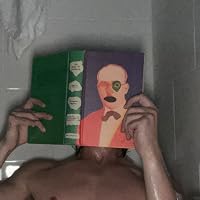
In this important book, acclaimed author Mark Edmundson reconceives the value and promise of reading. He enjoins educators to stop offering up literature as facile entertainment and instead teach students to read in a way that can change their lives for the better. At once controversial and inspiring, this is a groundbreaking book written with the elegance and power to change the way we teach and read. Why Read was a PSLA Young Adult Top 40 non-fiction title 2004
I think that this is an important book, particularly for the constant reader. The author's basic premise is that by reading, a person can change his/her life; making it better. He is critical of many liberal arts universities, saying that they are now more concerned with entertaining and bringing fun to the class. He gives countless quotes from the likes of Blake, Emerson, Freud, Wordsworth, etc. There are some particularly interesting ideas to me personally. He contends that if or when a person comes to a crossroad with their religion/faith, the most likely place to look for meaning is in literature. I wholeheartedly agree with this! I believe that until we come face to face with our belief system versus other views and ideas, our faith is never going to give us the answers we need. I find this to be true personally. I have had, what some might call, a crisis of faith in recent years. I have found myself drawn to the weightier matters in our world... where does my faith fit in with what I see in the world? I see racism, homophobia, sexism, anger, greed, and hate. My faith was not answering that question. I have been reading as much as I can, in an attempt to see where I, and my beliefs, fit in. I highly recommend this book to my fellow readers!
Hmm. I hardly know what to think of this book. I cheered at some parts, groaned at others. The author, a humanities professor, wants us to reassess how (and why) we teach great literature. I was delighted at his well-aimed blows at over-analysis and literary criticism as ends in themselves, of the efforts of so many (including so many of my teachers) to distance the student from the work, telling us that its only value is to be picked apart as an intellectual exercise. This is fun for bright people, but eventually pales for many. Unfortunately, Edmundson insists on seeing the role of literature as a sort of "religion replacement." His vision seems to be something like this--students show up in class with many built-in biases, being used only to being entertained. Teacher takes great book, "interprets" it for his students as a way to live, and lobs this at the students until he ends up challenging and exploding all those preconceived notions they came in with (he calls these things a "life narrative"). Upon seeing that religion really has no answer to life's questions, all the really worthwhile students will take poetry or literature as their religion instead, and go out to promulgate this gospel themselves. What about the students who fail to "convert"? Well, they really weren't good material for a true "literary education" anyway and they can go on to live mostly narrow but slightly enhanced lives. (While Edmundson claims he does not intend to "convert" students, it is obvious that he thinks the really good ones will pretty much come around to seeing things his way in general.) While I appreciate Edmundson's excellent arguments in favor of examining literature as a way to find personal meaning, I cannot puzzle out why he insists that it must become the only way to find personal meaning. Why cannot a student come in with genuine beliefs, and find that literature sometimes supports, sometimes challenges, sometimes helps refine those beliefs, without requiring their rejection? Why does he insist on saying that religion really doesn't offer students a way to live--perhaps it did once, but we desperately need a new way now? This is a worthwhile read, but ends up in some strange places.
I had such high hopes for this book but found myself sorely disappointed. Edmundson has basically one point and, after expressing it clearly, spends the rest of the book being pretentious. His ramblings were intelligent and balanced, but ultimately pretentious and not as illuminating as his vocabulary would have you hope. That is just my opinion, but I admit that I am unlikely his intended audience (as he is also pretentious about his profession).
English departments are under attack in higher education. To be precise, courses that involve reading literature are under attack. Some people still prize being able to express oneself well in writing--maybe what we'll have down the road is simply "Writing Departments."
Not if Mark Edmundson has his way. Why Read? is an extended essay on the value of reading, an expansion of a widely circulated Harpers Magazine article. His answer might be quite surprising to those who have been around English Departments of late. He argues that reading is important for great writers' exploration of the big questions of life--why are we here? what is a life well lived? why should character matter? He believes books can change us and the test of a good book is that we can live its truth.
Against all the critical approaches that deconstruct literature, he argues for reading authors sympathetically--indeed "becoming" the author while retaining one's sense of oneself--so deeply entering into the author's world that we in some way identify with him or her. Likewise, he even suggests identifying with characters in novels. And he teaches at the University of Virginia for goodness sake!
He has a simple test for what he thinks ought to be canonical--it tests and transforms us and has done so for many people over a period of time. He includes writers from beyond the Western world without embracing trendiness.
What was striking for me is that Edmundson speaks of great works of literature as Christians would speak of the Bible. In fact, he acknowledges that in a world that no longer believes in the transcendent (and this is where he thinks we are going, and evidently where he is) these books help us define our truth and shape and expand our lives.
What is fascinating to me is this recognition of the power of words to change us. Edmundson and so many writers dealing with the current crisis of higher education seem "god haunted". They are trying to recover or replace what was lost when we ceased believing that there was a connection between the God who speaks creation into existence and reveals himself in words, and the belief that the study of those words and the world of discourse beyond scripture has a power to change us. People like Edmundson still want to believe the latter while denying the former. I question whether this is ultimately sustainable, much as I share Edmundson's love of these works.
It made me want to vomit. Author is pretentious and incredibly out-of-touch. He assumes a unified notion of "literature" and devalues any works outside the medium of print that might offer the same "transformation" he argues that the reading of literature can supply.
A sane, prophetic voice from the world of literary criticism and academic English literature education--if more teachers were like Mark Edmundson, maybe things wouldn't be so bad. . .
When you invest yourself so thoroughly in an endeavor that it merges with your identity, you can forget or, at least, lose track of the language necessary to explain why that endeavor is so important, why you have poured so much of your life into it. I spend so much time trying to get students to read and write and think outside of themselves and their own limited perspectives that when they ask, “why do we have to read this book or write this paper?”, I am sometimes tongue-tied because the answers seem so obvious and myriad.
So a book like this can be helpful to systematically break down such broad questions and force me back to the beginning, back to where there were no assumptions about the importance of reading, back to a time before I had become intertwined with the dialectic of literature, so that I can remember how reading initially affected me and lead me down a path of no return.
Edmundson’s argument is so simple, it almost seems radical: great literature should make past wisdom available to the present, and teachers should serve as the guides, making the benefits of that literature available to all. He is not opposed to supplemental reasons for reading, such as building empathy, experiencing different perspectives, studying the contextual history of authors and movements, or investigating theory (at least, not in and of itself), but these elements without a core of love and understanding of the wisdom great authors have to offer are still tangential and not enough. They’re certainly not enough to entice students into loving what we, as English teachers, have loved.
Treating education this way–unpacking its authors’ provocations about life and making them palatable for modern audiences–is not easy. At the high school level, I am reminded of just how difficult it is when I see overworked teachers rely on pre-packaged handouts and refuse to change their lesson plans, no matter how stale they’ve become or how poorly they’ve gone. Edmundson talks more explicitly about problems at the university level where professors–who ostensibly once loved literature and found it genuinely transformative–have shifted their focuses to advancing their careers by finding new angles to approach the classics from, no matter how far-fetched. All the incentives are in the wrong place to treat stories and language with the eye-opening, earth-shattering potential they deserve.
I don’t entirely agree with all of Edmundson’s arguments. I’m not quite as anti-theory as he is, nor as hostile to cultural studies. And I would like him to say more about the current connections between the culture of cool he describes, where everyone keeps an ironic distance from anything that might push them beyond mere entertainment, and the maintaining of the political status quo and American empire. But I think he gets something fundamentally right here, which is why I’ve come back again and again to this book over the years and why I will, most likely, return to it again in the future.
This book has a lot of good points regarding the value of reading in the classroom and the overall goal of liberal arts education through a democratic and humanist lens. Edmundson posits that great writing "helps us answer [questions such as 'who am I?' and 'what might I become?' because] it helps us create and re-create ourselves, often against harsh odds" (5). These points were at times helpful as reminders for what most of my colleagues and I often espouse regarding the hope of education and the value of reading. Other times, his points about his classroom and his students made me re-see what I do in my own classroom: especially regarding his focus on having students's own experiences guide course discussions and his points regarding universities selling school and pressure for classes to be viewed as entertainment. Such ideas (about the value of really delving into texts that connect with students' lives, whatever those texts may be, and having conversations about their views and lives in the classroom to help them not only analyze texts but really learn from them) were the best parts of this book.
One such example of this was his framework for his classes putting religion at its foundation--despite how most educators would shy away from the subject. He asserts, "My sort of teaching assumes that a most pressing spiritual and intellectual task of the moment is to create a dialogue between religious and secular visions of the world" (137), while still recognizing "some will object to an open-ended vision of education in which we pursue our own visions, our own truths...they fear chaos, they say. They fear disorder. But perhaps what they fear, most truly, is genuine democracy" (141). I think these are worthy points to make (despite its perhaps haughty tone). I often have fearer disorder in classroom when considering how to give students more agency in material or content of the course, but such an excuse can certainly be a cop out in these ways. Again, when the book tackles such ideas in direct ways, it makes some great points.
Overall though I found the book outdated and often contradictory, particularly regarding some of its ideas on pop culture, cultural studies, and multiculturalism. For example, in his chapter on pop culture he writes, "We can strike to the central issues that confront students and the public at large, rather than relegating ourselves to the edges"--but then the next line seems to directly counter this assumption: "people who have taught themselves how to live--what to be, what to do--from reading great works will not be overly susceptible to the culture industry's latest wares" (135). Such lines and others throughout these sections claim that contemporary music or even the works of Stephen King are distractions and mere entertainment only. This begs the question he is often asking in his book: according to whom? Why can't these works offer relatable and valuable ways to question our place in the world and what we might become? He argues that they can't teach someone how to live and thus doesn't hold up to "great works" he offers---such examples of said works throughout the book are, of course, from the largely white, male literary cannon. In fact, most of this book seemed to be showcasing lines from these "great works" and their views on reading and the value of literature / critical study without really focusing on how to apply these concepts more directly in the classroom. Thus, I wound up skimming a lot of these passages, especially since I am primarily a composition instructor not a literature professor. I wanted him to speak more directly on his students and discuss how teaching reading and framing his class the way he does helps them in direct ways. Instead, I felt I was often reading from a conference panel--the very thing he was chastising along the way.
Approaching 150 books on the year, it doesn't seem that I would need to consult a book entitled "Why Read?". Still, I thought it would be an appropriate subject to ponder in my 200th review.
The basic takeaway points from "Why Read?" were:
1. Literature as a Life Guide: Edmundson believes that classic literature should be treated as suggestions for how we can/should live. When you read a great work of art, you should be asking: Can I live this? How would this work in practice? The author argues that students in University are at a major turning point in their life, and are on the cusp of some major life decisions. Bearing this in mind,the author asks: shouldn't we be teaching them how to glean wisdom from these great works, rather than treating literature as a meaningless intellectual game? It would certainly go along way towards making the arts relevant again.
2. Discipleship: Mark Edmundson states that too much time is spent learning critical theory, which leads to an arrogant, detached way of looking at literature. Instead of smugly dismissing Dostoevsky using Derrida, we'd do better to try and become Dostoevsky's disciples. By this, Edmundson means that it is a teacher's job to merge with the author, so they can make the best possible case for their relevance to their class. Then you can let your students decide whether they can find personal value in the work. Northrop Frye's complete immersion in Blake, is used as the ideal example of this so-called "discipleship".
Along those lines, Edmundson goes so far as to suggest that literature could supplant religion, leading to a golden age of secular wisdom. He tiptoes around it a little bit, but you get the sense that he's just being diplomatic. I wish he hadn't been so polite, I was very interested in pursuing this line of inquiry, even if I wasn't completely sold.
All in all, it is a passionately argued little book, but not exactly earth-shattering to someone who already reads the way he is espousing. Still, it was validating to read a high-profile academic/teacher agree with me. If my professors at University saw things that way, I probably wouldn't have dropped out.
One thing I can say with conviction about this book—
It has pushed me to a greater Kindle-literacy: Never have I spent so much time grappling with the impossible keyboard of my Paperwhite than while reading this book.
Beyond that, where to begin?
Well, I find Edmundson’s take on the effects of this infusion of theory in literary studies to be compelling. When we can simply label, why read? — Borrowing words from disciplines we know not of and packing great work into neatly labeled ziplock bags — Marx. Feminist. Oedipal. Postcolonial. Hegemonic. Categorical imperative. What sort of knowledge are we creating exactly? Edmundson likens such shortcuts to that sort of religious knowledge that can be attained and conveniently packed away. No need to probe or reflect.
So.
If Derrida / Foucault / Frye / Freud / __ are worth studying, well let’s take a serious look at their work. But when we simply borrow their terms to encase aesthetic work which, when it actually has something to say about our lives, is much more worth our attention, we are cheating ourselves. Great works are worth more than that, Edmundson insists. If a work is great, it constitutes a way of being or living. But this is very much out-of-vogue in the university climate. (Harold Bloom et al would labor much to change that.)
Still, the religious fervor of this book strikes me as awkward, jangly. And yet, as a reader, I find this enthusiasm... provocative. This may owe something to the circumstance that I recently read Karen Armstrong, whom Edmundson quotes in the book, and so I am looking for ways to live out the mythos which has been written out of modern life. And yet, while Edmundson attempts to articulate many different humanisms, I find it hard to find myself, as a humanist, anywhere. I guess that is sort of the point.
While reading Why Read?, I am happiest when Edmundson details his reading of great aesthetic work.
Is he here suggesting or applying a system? (Is it systematic? He explicitly rejects the systems of Eliot, others.) I don’t know.
Are the clumsy metaphysics an outgrowth? Are they completely necessary?
Edmundson's argument is that literature should not be taught for obscure or objective critic, but instead, at the end of every book, the reader should see to apply the book's perspective on life to their own, and then come to terms on how that changes the individual reader's own perspective. It's an argument I can agree with as novel study becomes impersonal and theoretical at times instead of the raw experience of self-discovery so many avid readers allude to when questioned on their hobby. However, his argument went on longer than needed and included a lot of theoretical analysis on classics.
Edmundson is not so much defending reading as a broad practice, but a liberal arts literary education specifically. As someone who received one, I certainly don't disagree with him that the central purpose and urgency of a study of literature is to form one's character, in opposition and consensus with one's core values, I just don't share Edmundson's pessimism that this isn't happening, especially at UVA (where I went and he teaches). A classic case of the older generation doubting the younger's commitment to exploring the big ideas, though an excellent defense of why that matters as a project and literary study's role in it.
This book is thought-provoking despite being a bit of a reactionary manifesto against cultural studies as it exists in English departments. The general argument is to teachers, whom the author would like to see adopt the model of Robin Williams' character in the Dead Poets Society when teaching English classes. That is, he argues that literature promotes values for humanity to live by, and that the way to teach this is to inspire reverence for great books. In the process, Edmundson makes some very insightful observations about the reading process itself, especially as it relates to identification and self-development. He deplores the use of literary theory as a mechanical exercise that elevates the critic above the truth and beauty of literary work. There is validity to this critique of contemporary criticism - many people who love literature also rebel against literary critics who seem to reduce inspiring books to mere examples of ideology. Put more sympathetically, the criticism he despises is more democratic than what he advocates. It pulls works of art down to earth, rather than upholding them as idols, showing that they are products of a complex and hierarchical society at specific historical conjunctures, rather than bearers of transcendent human truth. While I agree with a certain argument he makes about both teaching and reading - that readers should think from within texts in order to understand them, and that books can be criticized based on the idea of what kind of model for life they provide, this very way of reading a book can also be understood to be exactly what the best engaged, ideological criticism actually does. The reverential attitude toward literature is often experienced by students as simply a worshipful approach to western civilization and all its inequalities - they do not feel empowered by identifying with works of literature in which characters they might identify with exist only as foils, enemies, and obstacles. Even if some of the critical work that points out these problems in western literature appears tendentious and reductive, they might be described as essentially democratic in their irreverence and iconoclasm. Edmundson's argument that critical approaches to great books are really promoting a snobbish hatred of literature is a bit of a familiar straw-man argument that uses the charge of elitism to deflect criticism of one's favorites, whatever the favorites may be.
This book was a bit of a roller-coaster ride for me: one page I was cheering Edmundson on, agreeing with him wholeheartedly, and the next I was simply writing 'NO' in the margin next to a patently false idea (for example: "We need to face the fact that this life is full of undeserved, unredeemable suffering." [pg. 138] Um, no.)
I need to revisit this book after reading a few other books about reading/literature (like Jason Baxter's "Why Literature Still Matters," and Lewis' "Experiment in Criticism," for example).
Some highlights:
"Before students arrive, universities ply them with luscious ads, guaranteeing them a cross between summer camp and lotusland. When they get to campus, flattery, entertainment, and preprofessional training are theirs, if that's what they want. The world we present them is not a world elsewhere, an ivory tower world, but one that's fully continuous with the American entertainment and consumer culture they've been living in. Is it a surprise then, that this generation of students--steeped in consumer culture before they go off to school; treated as potent customers by the university well before they arrive, then pandered to from day one--are inclined to see the books they read as a string of entertainments to be enjoyed without effort or languidly cast aside?" [pg. 19-20]
At the core of all consequential works of art is the question: "What is life?" [pg. 61]
We will not have real humanistic education in America until professors, and their students, can give up the narcissistic illusion that through something called theory, or criticism, they can stand above Milton, Shakespeare, and Dante. [pg. 50]
One of the most important jobs a teacher has is to allow students to make contact with their ignorance. We need to provide a scene where not-knowing is, at least at the outset, valued more than full, worldly confidence. Thoreau heading to Walden Pond almost empty-handed, or Emily Dickinson going up to her room in Amherst to engage in a solitary dialogue with God, are grand versions of the kind of open and daring endeavor that we can all engage in for ourselves. [pg. 35]
Important book especially today! “What's missing from the current dispensation is a sense of hope when we confront major works, the hope that they will tell us something we do not know about the world or give us an entirely fresh way to apprehend experience. We need to learn not simply to read books, but to allow ourselves to be read by them.”
A few months ago, I read Edmundson's later book, Self and Soul: A Defense of Idealsand was intellectually excited by its ideas, its cogent arguments, and its overall argument. Books that stretch the mind as this one had, make me think and consider things not previously thought of, or immerse me in new or fresh ideas, are treasures that are hard to find and are like gold when I do find them Self and Soul was just such a book. So my hopes and expectations were high when I turned to Edmundson's earlier book, Why Read?. And the book certainly lived up to those expectations. At first, the question, "Why read?" would seem easily answered and indeed the easy, facile answers are good ones. But Edmundson makes a case that reading is more than just casual entertainment and an enjoyable pastime. When the material is right, when the author tries to challenge his readers rather than just entertaining them, reading can take the reader to new vistas, help him examine his own beliefs and values, move him toward his better aspirations, and inform him pointedly about his fellow human beings. Edmundson presents a case for reading the world's finest literature, its best poetry, its most thoughtful non-fiction. The book seems to be an argument aimed at college instructors to challenge their students with only the best in literature, both because it accomplishes all of the goals just mentioned and also because it trains students to recognize the good materials, the deepest thoughts,the best of man's ideals, and separate those from the bad. It is a sad fact that study after study reveals that a little over 40% of Americans will not read a book in any given year and that around 28% will never in their lifetimes read a book at all. No wonder Americans are seen around the world as being uninformed, stupid even. No wonder Americans elect the people they do, believe the myths they do, and are so uncritical in making decisions. Edmundson argues that university professors ought to be placing great books before students and challenging them to personalize the book, to consider how it fits into their own life or values system, and to see the book as a tool for learning about the nature and complexity of human beings. But his argument is not just aimed at his university colleagues, it is aimed at all readers, challenging us all by subtlety asking, "With so much wonderful and enlightening literature available, why not use it to elevate your life?" When Huckleberry Finn decides, "All right, I'll just go to hell;" when Raskolnikov ( Crime and Punishment) faces the fact that he cannot escape his conscience even when he can escape the law; or when the growers in California display their callousness by destroying their "surplus crops" in front of starving refugees in the Grapes of Wrath, don't we learn something, feel something and personalize something much greater than what we will find in the latest murder mystery? Edmundson argues that we do grow from such readings, and that is the answer to "Why Read?"
I found this collection of brief essays to be a quiet classic. Edmundson writes in lucid sentences and is clearly very well read himself and so reading his paragraphs became a pleasure in two ways: The pleasure lies in the reading of his sentences, and in tracking his wisdom.
In particular, I value his reliance on reading using the mind and the heart. He works to debunk the assorted multiculturalisms and critical theories that have abounded in the recent decades in favor of reading for pleasure and for insight. He notes that critical theory has become such a large sport that if extended beyond play, it has the crippling effect of disengaging the reader from caring. That is, if the critical reading disengages too much from the message of the text, the new risk lies in learning how to disengage critical thinking from ethics--it becomes easier to red and do nothing.
I found it beneficial too in its message of why we read the good books. The truism states that Life is too short to read bad books. Edmunds offers solid reading counsel. I would love to take Mr. Edmundson to a corner booth in a classy restaurant, buy us a bottle of wine, and converse.
Although it is, at times, self-righteous, this book makes the compelling case for an adjustment of the teaching (and learning) of the Humanities through books. Mr Edmundson declares that with the current form of analysis through a negotiated lexicon and theoretical lenses, we pass over the intrinsic value of classic books. By failing to ask simple questions such as “Can I live according to this/these character(s)?” or “What is life?”—in the context of the book’s worldview and narrative—we disallow students to find meaning in an increasingly secular society. The consumption of classics and other strong-minded literature, at its best, can reveal inspiration or the limits of life and the people within. Therefore, we must engage with reading in a different manner so as to nullify the lazy malaise of popular culture and hedonistic tendencies of the late-20th and 21st centuries.
I liked the premise of the book and the first few pages, so I purchased it. I thought Edmundson sounded a little old-school in his theory and approach, but her really lost me when he starting reinforcing author's intention as the point of the "art of interpretation" (55). I skipped forward to the last few chapters, where he has unclear messages about the "canon," multiculturalism, pop culture studies ("But we can do better [than pop culture studies] [135]), and he makes a pointed rip at the "cultural studies gang" (121). But then, flipping back through the book, I'm hard-pressed to find mention of female authors or authors of color - Bronte, Shelley, Austen, and Malcom X are mentioned. Indeed, "Gender and Identification" doesn't seem to address gender at all. Definitely a bail for me.
A persuasive articulation of the view that students ought to be fed a diet of great books (books that tackle the most ambitious questions about life) and, instead of being asked merely to interpret them or consider their historical interest, ought to be encouraged to test their philosophies, ought to consider--How can I translate this book's philosophy into action? Can the language/worldview of this author enlarge my own worldview? Reading not as intellectual exercise but as soul crafting.
I liked this book so much I tried two of his other books--Why Teach? and Why Read?--but couldn't get through them. They cover a lot of the same territory as this book, but less well.
This should have been titled "Why Teach?" since that is what the book was about. There were a few interesting points but my general sense when reading this is that it was an example of why people consider readers pompous.
"Reading woke me up. It took me from a world of harsh limits into expanded possibility. Without poetry, without literature and art, I (and I believe many others, too) could well have died miserably. It was this belief in great writing that...made me become a teacher." - Mark Edmundson
I don't need reasons to read and I wanted to love this but it was a slog for me to get through. Very academic writing, on a noble topic. Lost me, tho and I gave up.
A thoughtful, restrained, and reasonable book that makes an argument without overstatement or hyperbole but which nonetheless seems to provoke some reviewers to insist on reading it as an overbearing polemic. Or worse, describing it as 'pretentious,' always a tell that you're dealing with someone preoccupied with looking over the shoulder in fear that someone might witness them taking something more seriously than capitalist culture permits.
Edmundson is making--not for the first time--an old-fashioned argument here, but he's doing it intentionally, and he's not launching a take-no-prisoners broadside against theory in the academy, or even pop culture for that matter. He's arguing that neither theory nor pop culture is really enough for helping the average person lead a worthwhile life, and that there's no shame in looking for something more than what most of us are usually given. This argument always tends to make most Americans instantly clutch for the nearest pearl, and Edmundson is wise to point out that this impulse is something long cultivated by consumer, corporate culture for its own benefit.
Ednundson's point necessarily requires making distinctions between 'high' and 'low,' but he's remarkably calm about it. He may invoke Harold Bloom (more than once) but he keeps well apart from Allan Bloom, and it's a pleasant surprise to find a book like this offering considered and thought-provoking propositions instead of hellfire denunciations.
One could also argue his argument would have been easier to make now, in the age of the earnest Millennial, than it had been back in 2004, still the age of the ironic Gen-Xer. (His critique of the relentlessly all-knowing, Letterman-style, late-night talk show host is dead on.) The problem, then and now, is that the pervading culture in the US has never been good at providing worthwhile material for heartfelt sincerity of any kind. So Edmundson makes a case for turning back to books that, at least for some, once did. And thus the clutching of pearls, even here in Goodreads, where one might have expected sympathy for this kind of thing.
As with his earlier Nightmare on Main Street, Edmundson isn't making an argument easily categorized as Left or Right, which will inevitably confuse the reader who prefers to kneejerk their way to easy categories. This book's argument isn't as original as that one's had been, but Why Read? is an easier go in the 2020s because the references here aren't locked so tightly to the late 1990s.
In fact, Why Read? is rather evergreen. In part because the tradition he's defending has persisted for centuries (how many depends on how you're counting) and has never died out despite its advocates always expecting themselves to be its last generation. But also because the particular assault he describes being made on that tradition within the academy has itself been going on for a couple of generations now, and probably won't go into retreat for quite some time yet, if ever.
And, anyway, it's never been an argument enjoying widespread support, at least not in the measured and forgiving way Edmundson has chosen to make it. But those readers who come to the book willing to be persuaded will find a lot here to interest them and good material for debate with others of their kind.
A book that will change how view reading, will change how you read, and will make you want to read more.
This book came out before the smartphone and social media. If the author is lamenting of the influence of TV and computers, I wonder what he thinks now about smartphones and social media.
A tad repetitive. Edmundson repeats his main points quite a few times.
Though in a book called why read? Edmundson hasn't mentioned one, if not the most important, reason, BECAUSE IT IS ENJOYABLE!! Yes books can improve and change your life but there is no reason why they can't be read simply for pleasure. The bodice ripper romances that Edmundson criticizes at one point (and later Stephen King) serve the purpose of entertainment and enjoyment, which is key part of human life - leisure and play. Especially in this hustle and work and wealth obsessed modern world. Neglecting to mention that books are fun does reading a great disservice. When he says that those types of pop culture books are not good use of your time seem disrespectful. If one is trying to persuade others to read poetry and literature, while it is true that reading those writings will change your life, it would be more persuasive to say that reading poetry and literature is also enjoyable. Reading should not be viewed as just another form of self-help or a chore but a pleasurable activity, especially if one is trying to get back into reading great works of literature instead of watching TV or movies or Instagram or YouTube.
Why Read? seems at first to be less about why one should read and more to be about how one should be going about doing it. On one hand, Edmundson is critical of reading as blind consumption - something to be enjoyed or not enjoyed. On the other, he also doesn't agree with popular modes of literary criticism that seem to over-interpret or overanalyze their subjects. Instead, in Why Read? he proposes viewing literature through identification - asking what you can see of yourself in a work, imagining what it would be like to experience the life portrayed in it, determining how it could be used to guide your own life.
The "Why" part of Why Read? seems to follow naturally from the idea that reading through the lens of identification will ultimately change the reader's life in some way or give them a new viewpoint to consider. Edmundson also seems to indicate that teaching literature in this manner and guiding students through this process could bring about a stronger, more humanist society.
At times the discussion can come across as heavy-handed and difficult to parse. In addition, Edmundson doesn't seem to think much of popular media or its ability to truly be viewed through identification in a real, meaningful way. The distinction there seems blurry at best, but perhaps there is a line at some point. Overall, it seems like a worthwhile experiment, though, and I'm amusing myself greatly applying this (perhaps too literally) to my own reading.
I’d give this 3.5 stars if I could, because there are parts of what Edmundson said that really resonated with me about the role that literature does, can, and should play in the lives of people, particularly in its ability to shape how we live and its potential democratizing effects.
However, there are moments that feel, not exactly pedantic, but very much steeped in a particular privileged worldview. He comes across in places as paternalistic, seems to favor the traditional canon, and poo-poohs pop culture and less canonical works. I think all forms of writing can be transformative, so I had a hard time with his stances on that (Stephen King fans, beware. He calls King a sentimental writer and suggests his understanding of the human condition is a bit facile.).
I don’t happen to agree with him there, and in a few other places, but generally I like his take on the Final Narrative and his advocating for reading and the Humanities in general.
It’s a slim book, but it took me a while to get through, as I was finishing other books on a deadline, and I admit I did get impatient with his tone, so I’d leave it frequently, only to come back because I so valued what he said in the first 80 or so pages.
Overall, it was a worthwhile read. It gave me some things to think about and made me re-examine both my pedagogy and praxis, so though there were issues with the book, I consider it a good use of my time and attention.
Mark Edmundson's Why Read? is both an investigation on the value of the humanities and on its ideal teaching method. The core of his argument is that consumer culture has placed the humanities in the position of entertainment, in which students view it as either something interesting although merely historical or something to be dismissed altogether. In opposition, he defends literature's transformative power: it is a tool in which the student can come in contact with a variety of characters and situations capable of modifying his deepest beliefs, which he calls the "final narrative". It was interesting to see his harsh words directed at literary criticism and over-analysis, alongside his view on entertainment culture. I wonder what he would say on today's society, which is deeply associated with the problems that he already identified in the early 2000s. Furthermore, his over reliance in this "final narrative" was discouraging. His opinion that only "great" literature is capable of changing someone's narrative, alongside his view that literature is a substitute for religion striked me as pretentious. All in all, it is an interesting argument from a self proclaimed democratical humanism perspective, although one that doesn't strike me as particularly democratic, lol. For sure worth the time for a constant reader.