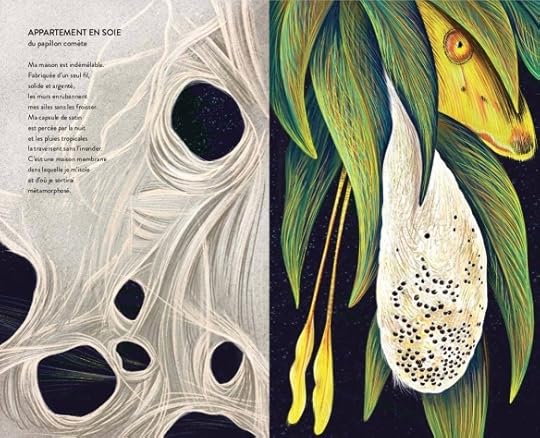
A spectacular tour through the dwellings of twenty-seven different animals, from a hermit crab’s secondhand shell to a beaver’s lakeside dam to a comet moth’s silk cocoon. Acclaimed creator Isabelle Simler presents a poetic journey through amazing animal homes across the world. In Europe, alpine marmots stay safe in underground refuges. In southeast Asia, Sumatran orangutans doze off in treetop bedrooms. In Mexico and the southwestern US, elf owls nest in holes in saguaro cacti. On every continent but Antarctica, honeybees mold wax into palaces for their queens. No matter where you travel, some creature is making an extraordinary place to call home. With connections to life cycles, camouflage, and other biological concepts, Home is a spellbinding showcase of the wonders of the natural world. Enchanting poetry, fascinating back matter, and intricately detailed art invite young readers to be amazed by the creativity and diversity of our animal neighbors.
Isabelle Simler has written and illustrated over twenty picture books for children. Sweet Dreamers, My Wild Cat, Plume, and The Blue Hour were all featured in the Society of Illustrators "The Original Art" annual exhibition. Plume was also named a New York Times Best Illustrated Children's Book. Isabelle lives in France.
Gorgeous scratchboard illustrations jump off the page of this fascinating glimpse into some of the unusual ways animals construct shelters in which to live and raise young. Each animal is identified by name, both common and scientific, before a poem describes the home of that particular animal and how and/or why it was constructed. Each poem is written from the perspective of the animal. A variety of different animals are included: common octopus, European fan worm, weaver ant, foam-nest tree frog, cathedral termite, diving bell spider. Not only does the book provide fascinating information about the animal world but the book is a work of art. The beautiful art complements the poems perfectly, making this a great book for teachers to use in the classroom or for parents to read with their children.
Beautifully detailed illustrations delight the senses and educate the mind to the highly varied dwellings of creatures all over our vast world. From birds to moths, from sea dwellers to tiny ants, the homes of creatures fascinates in this unique book. The presentation is complete with beautifully descriptive language detailing the uniqueness of each home or dwelling.
The strength and beauty, intricacies and uniqueness, use and charm of these homes goes beyond what humans think of as homes - walls, windows, and doorways for protection and defense, but places of beauty creatively and intricately designed and built.
Back pages of additional information about the featured creatures and a glossary are provided as well as resources for those interested.
I received a complimentary copy from the publisher to facilitate a review. Opinions are mine, alone and are freely given.
Particolare, divertente e istruttivo. Non conoscevo il ragno palombaro, né il particolare nido del passero repubblicano o la fantasiosa casa del/della xenophora
The Sociable Weavers of the Kalahari Desert and the Haute Couture Bedchamber of the common tailorbird were my favorite homes! What gorgeous illustrations featuring such talented animals!
From the silky pouch of a comet moth to clay structure of a termite to the shell of a snail, this book looks closely at a variety of homes small creatures build or find to stay safe and rest. The author describes each with a poem and lovely, rich illustration. A interesting look at animals and homes not often discussed with children.
I am a continually big fan of Isabelle Simler's colorful and interesting scratchboard illustrations. They made this book for me. Try as I might, I'm not a huge poetry fan, but this stunning book -- which looks at animal homes around the world -- is lovely and evocative. The short poems are suited to read aloud or be shared in a classroom.
Isabelle Simler's Home describes twenty-seven fantastic creatures in their habitats and homes. Intricate illustrations coupled with beautifully written poems make this book a treasure to behold. Isabelle is both the author and illustrator of 'Home,' which was originally written in French and translated into English by Vineet Lal.
The book starts out...
I've been to some truly amazing homes.
To explore these unique places, I've had
to bend, and shrink, and squeeze, and
let myself be transformed in weird and
wonderful ways.
I've curled up in a hazel leaf,
and disappeared under a stone, and bathed
in a drop of dew...
I've woken up as an ant. And a bird.
Even a sea snail.
And I've imagined life in these homes,
all so very different to my own.
The following animals are featured in this book. The illustrations are amazing and I would love to share them with you. For that, you'll have to purchase the book. Below is one of the author's poems.
Eurasian Penduline Tits
Common Octopuses
Comet Moths
European Fan Worms
Common Tailorbirds
Eurasian Beavers
Common Wasps
Hummingbirds
Weaver Ants
Hermit Crabs
Foam-Nest Tree Frogs
Satin Bowerbirds
Cross Orbweaver Spiders
LACE CITADEL
of the cross orbweaver spider
Araneus diadematus
I live in the vertical plane,
in a complex structure
made from the strongest
and most elastic material there is.
If it gets damaged, I recycle my wheel
by eating my house of silk.
That gives me the energy
to weave a new one.
In this satin-smooth spiral,
mind where you put your feet.
Because at dinner time,
it's better to be the host than the guest.
My description of the illustration.
With a midnight blue background, the illustration is dotted with tiny white dots (maybe stars in the distance). I am merely speculating. About 85% of the page is covered in an intricate web, with the spider working along the perimeter. It's an amazing web. There are some leaves that are reminiscent of peacock feathers. The designs are stunning. Brown and tan shades characterize the spider. Due to its beauty, I'm going to call the spider a she. Its legs are long and fuzzy. On its back, it displays a beautiful pattern that is similar to a turtle's shell.
Cathedral Termites
Case-Making Caddisflies
Golden Eagles
Sociable Weavers
Eurasian Harvest Mice
Elf Owls
Carrier Snails
Diving Bell Spiders
Honeybees
Alpine Marmots
Baya Weavers
Sumatran Orangutans
Red Ovenbirds
Hazel-Leaf Roller Weevils
This is a book that I definitely plan to add to my home library. Adults and children alike will enjoy this book. This book is a must-have.
Home is the perfect example of using various media to make learning come to life. The art is absolutely stunning. Even with no text, only as a book of art, this would be a book worth publishing. Colorful, precise, and detailed, Isabelle Simler’s illustrations don’t just accompany or even complement the text, they are magnificent art in their own right. Each two-page panel vibrantly illustrates the home of some creature—from the stony villa of the common octopus to the cactus cabin of the elf owl.
Alongside each setting is a poem, told in first-person in the voice of the creature being portrayed. They tell the stories of their homes and their lives, adding poetry to the mix of how we learn. The poems are in free verse, not sing-song rhyme, giving it a depth and challenging young readers to learn to read it with a poetic feel.
Each poem is given a title that describes the home in poetic but accurate terms (“Lace Citadel”) and then names the creature (“of the cross orbweaver spider). And then to get really fancy, it follows with the scientific name of the creature (“Araneus diadematus”). It’s a blend of technical language, poetry, and visual art that allows readers to engage with the information in a variety of ways. And this not even to mention that the art of translation is also at work with Vineet Lal translating Home into English from its original French.
Home is a book about creatures and their dwellings, but my primary take away from it was a reminder that we learn through artistic expression. Simler takes readers on a poetic and visually stunning journey through the homes of 27 different creatures and—look, I have no real reason to read this book. It doesn’t matter to my life if I know what an alpine marmot barrow looks like. Even to write this review and do it justice doesn’t necessarily require me to read every word on every page, particularly knowing that I’m not the intended audience. But the poetry and the art enraptured me and captured me and drew me into the lived stories of these animals. And it turns out that knowing what an alpine marmot burrow looks like does enhance my life in some way because it reminds me of the beauty and glory of the natural world.
Home is a beautiful book. I think we could study it as a way of how we can use various mediums to teach. Or we could just appreciate it as art. Or we could learn about the artistry within the natural architecture it shows us. It’s a multi-faceted book that is engaging at many levels. And it’s worth reading.
First published in 2022, this was translated from French to English by Vineet Lal.
This beautiful poetic introduction to animal homes should find a home within books about animals.
Twenty-seven kinds of animals - insects, birds, arachnids, mammals, amphibians, and other invertebrates - share how they build their homes from materials they find in nature. From the Eurasian penduline tit to the Sumatran orangutan, each is given a two-page spread to show the creature with is self-constructed living quarters.
Simler's spare text sings with rich detail about each construction, bringing them alive; the labyrinth created by the cathedral termite, the abandoned seashells claimed by eager hermit crabs, and the paper pulp nest created by the strong jaws of the common wasp, among others. Backmatter includes 2 pages with a sentence or two about each creature expanding on their location/range, their habits, and homes. Also included is a glossary of terms and a list of recommended sources (print, video, and online) for more information.
The text is well matched with glorious digital artwork created by Simler. Using a technique with results that mimic scratchboard, each stroke appears in brilliant color - often times on a dark background making it pop off the page. They flow with movement and grace. The cover is a fine example of what is inside. The endsheets are intriguing, as they look like blueprints of human structures and would be fun to compare animal structures with that of humans.
NOTE: Libraries that catalog this with the DDC recommended number (841.92 - French poetry written in the 2000s) do this book a disservice. It is first and foremost a book of information a book about animal homes with information given in poetic form. It will sit in the 840's and rarely circulate. To be found and used, I strongly suggest it be cataloged in 591.564 with books on animal homes.
This beautiful nonfiction book compares well to those by Joyce Sidman. Use it in units on animals, homes, and nature. This could also be used as an exemplar title to give science reports in poetry form.
The remarkable homes of twenty-seven different animals are described and depicted in this gorgeous picture book from French author/illustrator Isabelle Simler. Each two-page spread highlights a different animal, from the Eurasian penduline tit to the Sumatran orangutan, describing in poetic language how they create their dwelling places. Beautiful full-page artwork, which looks to have been done in a scratchboard style, depicts the animals and their domiciles. The book closes with two pages of further information about each animal included, a glossary, and a list of further resources...
Originally published in France as Maison, this lovely book is the second title I have read from Simler, following upon her earlier Plume, which was selected as a New York Times Best Illustrated Children's Book in 2017. I am immensely glad I sought it out, after being reminded of Simler's work recently, as I found it both an informative read and an aesthetic delight. The artwork and design in this one are outstanding, with gorgeous visuals, and a pleasing layout on each page. Many of the animals profiled were familiar to me, but some were not, and that too was a pleasure. An American book of this nature would probably focus on more North American animals, but as this is a European title, Eurasian species are better represented (i.e., the Eurasian beaver instead of the North American one) as you would expect. I think this is very positive, and an argument for reading a more international selection of animal and ecology-focused books. I'm always a proponent of more children's books being translated, and particularly look for translated children's literature, so I was pleased to see that this was one of this year's Honor Books, for the Mildred L. Batchelder Award, which recognizes the best translated books for young people. Highly recommended to all young animal lovers, as well as to anyone who appreciates beautiful picture book art. At sixty-eight pages it's long for a picture book, but it can be dipped into in sessions, for those not able to read all the way through.
Book Review: "Home (Spectacular STEAM for Curious Readers)" by Isabelle Simler
Rating: 5 Stars
"Home" by Isabelle Simler is a delightful and enchanting exploration of the diverse dwellings of twenty-seven fascinating animals from around the world. From the hermit crab's unique shell to the beaver's intricate dam, this book takes readers on a poetic journey through the remarkable homes created by different creatures.
Simler's lyrical poetry beautifully captures the science behind nesting and homebuilding, making it an engaging read for both young and old nature enthusiasts. The detailed illustrations intricately bring to life the habitats of these creatures, drawing readers into a world of wonder and creativity.
One of the standout features of "Home" is its ability to connect biological concepts such as life cycles and camouflage to the animal homes showcased in the book. This not only educates readers about the natural world but also sparks curiosity and appreciation for the ingenuity of our animal neighbors.
With its captivating storytelling, stunning artwork, and informative back matter, "Home" is more than just a children's book – it is a celebration of the beauty and diversity of nature. I highly recommend this book as a perfect gift for anyone who appreciates the wonders of the animal kingdom. It is a true masterpiece that will inspire readers to marvel at the extraordinary places creatures call home.
⚠️This review was written based on personal opinions and experiences with the book. Individual preferences may vary⚠️
The cover of the book shows an intricately detailed illustration of a bird’s nest. This cover gives you an idea of the amazing illustrations you’ll find inside HOME. Twenty-seven various creatures are illustrated in their habitat. Along with the full-page-spread illustration is a poem about the creature and its home. The scientific name of the creature as well as their region is also given.
The European Fan Worm is a worm-with-a-plume that lives in a tube of mucus. The poem explains that it uses its silky filaments at the slightest sign of danger. Then at the end of the book, you’ll learn that these fan worms live in the Atlantic Ocean and the Mediterranean Sea. They reach out their feathery tentacles to catch food like phytoplankton. The glossary also explains a filament, which is a slender threadlike fiber such as a tentacle.
Some examples of other creatures featured in the book include a hummingbird, a honey bee, a marmot, a weevil, and a harvest mouse. I can’t imagine the research the author did to get every minute detail in the particular creature’s home. Her illustrations are breathtaking. I think my favorite page was of the Sumatran orangutan ready to drift off to sleep in his tree.
Short paragraphs alongside amazing illustrations will engage kids in learning about these specific creatures’ homes. A list of resources including books, websites, and videos are included to continue your child’s learning. The homes built by the creatures in this book are absolutely fascinating and I could look at this book over and over again.
This lovely book highlights the diverse beauty of homes in the animal world. Rich with detailed images that showcase the fantastic architectural design of some very particular animals, it will educate as well as inspire. Each entry is a poem that gives a glimpse into the uniqueness of the homes of twenty-seven animals, be they found in trees, water, underground, or elsewhere. With rich vocabulary and illustrations, Simler describes the construction materials, purposes, techniques, habitats and sustainability of these built environments. Weaving scientific description into the simplicity of poetry, this book is approachable, imaginative and sophisticated all at the same time. Stimulating the reader to wonder and think beyond the text, it can easily flow in the STEM teaching resources realm, or even in a writing or art class, or... just as pure, fun reading! This is a thoughtfully created, beautiful and awe-inspiring book. The author has included additional information about the animals presented, a glossary, and a list of useful resources at the end of the book. Highly recommended.
Breathtakingly gorgeous, splendid illustrations. I thoroughly enjoyed them and they do a skillful job of showing what the animals & their homes look like and are like, though not with photographic type accuracy.
Useful, additional detailed information in the back of the book including a section on More About These Amazing Animals, a Glossary, and a Recommended Resources section that lists four books (that interest me) and a few websites and videos that also are or seem good.
The poems that are the book’s text are sophisticated and good, with what I assume is a good translation, though I can’t say I truly enjoyed them. What kept me from loving this book though is that I had particular interest in only some of the animals featured. Yes, they were all interesting but they weren’t all appealing to me. I think for children and older readers who have a greater curiosity than I do this book might be worthy of 5 stars.
Brief summary: This is a poetry collection of twenty-seven various animals around the world creating unique and amazing homes all beautifully illustrated with great detail. Young readers will learn about camouflage, habitat, life cycles, and interesting animal facts.
Comments: The back sections include More About These Amazing Animals, Glossary, and Recommended Resources(Books, Websites, and Videos).
This lyrical text appears to be flawlessly translated from French(2022) to English(2024).
Rating: 5/5 📗📗📗📗📗
*Home was sent to me as complimentary copy in exchange for an honest review.
Wow! Talk about an amazing STEM nonfiction, picture book! I love how this book reads almost like poetry- and is filled with unique facts about homes from a variety of insects & animals. I really appreciated that it doesn’t shy away from big words- introducing children to a wide range of vocabulary! There’s also a glossary and additional information & resources at the back of the book. The drawings are really detailed and beautiful, and make this nonfiction book appealing to all readers! 10/10 recommend this one.
From cover to cover, Home is simply stunning. Isabelle Simler immediately grabs your attention with her intricate artwork. Her images are full of texture and movement, just begging you to explore. Simler’s words, too, hold your attention. With phrases like:
“I slide into my home like a telescope and fan out my feathery lashes.”
and
“At the blue hour, I shall make my entrance to steal the heart of my beloved.”
you enter different animal domains. The entire experience is enchanting. Excellent backmatter includes more on each animal and a glossary of terms.
Here's your invitation to visit some very unusual homes; homes made of intricately woven fibers, spun silk, and manufactured paper. You'll meet the creators of these marvelous abodes - insects, birds, and mammals. It's a fascinating tour, enhanced by the author's poems and amazing artwork.
This one's a treat for all ages.
Many thanks to NetGalley and Wm. B. Eerdmans Publishing Company for sharing.
A stunningly illustrated book about animal homes built by their own hands or a product of the environment in which it lives. The artistry of each page is what makes this a next-level picture book with the added benefit of instructing and teaching about nature, habitats, and the animals themselves.
Plenty of birds create unique nests and those are on full display. There is the frog that creates froth foam to protect the babies, an octopus, ants and bees, a primate, and the very cool diving bell spider that creates a bubble house.
HOME is absolutely stunning, from the vibrant and mesmerizing illustrations to the lyrical text. The book takes the reader on a wild journey across the globe and features various animals, some lesser known, and their different homes. The STEM content is ever present and connects to concept such as life cycles and camouflage. It helps young readers learn about our beautiful world while being entertained. A masterpiece!
This nonfiction picture book is just so beautiful and full of fascinating information that is shared in an accessible way. Each turn of the page highlights a new animals, a beautiful illustration of that animal's home, and a short, story-like description of that animal's home. There were animals in this book that were new, even to me. My daughter read this several times before returning it to the library. This would be a great addition to night time reading!
The unique homes of varying animals are represented with poetry and detailed artwork.
Each poem is written in 1st person voice, as though the bird or insect or mammal was showing the reader their home. The illustrations are beautiful, I want to look up a photograph of each, but feel I don't need to. The only thing I don't love is the size; narrow and tall, so it doesn't fit nicely on the shelves. Unfortunately that makes it an optional purchase for my school library.
This is a glorious art book that uses poetry to share the science of nesting and homebuilding in all kinds of creatures from bugs to birds and back. It does not stay in one ecosystem, but jumps around the world; I prefer another approach, but this is poetry too! I am a fan of Isabelle Simler – you always, always know it is one of her books by the signature art style. Lovely.
The illustrations are fantastic. Super great nonfiction. I'm not a huge fan of the colloquial titles to the passages. I don't like the first person narration very much, I think 3rd would have worked better. the illustrations are done in a colorful dark scratch style. Some of the text is a little difficult to see easily over the background.
An interesting early non fiction read for young children!
The illustrations are beautiful & the homes the author looks at are homes developed by different sea creatures, insects, birds, etc. The detail of the illustrations are awesome & the author describes how each home is designed, written in a form of prose.
This gorgeous collection of poems about distinctive animal homes/structures includes water and land crates, animals from insects to sea critters to mammals and birds. The book format is narrow and tall, with full spreads that glow with both detail and impressionistic appeal. The poems incorporate accurate terminology yet sing with mood and style. It's no wonder this book has won awards.
This was a really cool book. The illustrations are especially beautiful. The poems are informational but also well written. I learned some really cool facts about some animal habitats.
The back matter is also pretty interesting and gives more details about where (in the world) each animal lives.
Beautifully rendered illustrations in deep colors with what looks like thin strands of hair or fur. Twenty-four different bird, insect, undersea animals from around the world are shown with their diverse homes. We learn a bit about that animal from the poem and a bit more from the 4 pages of back matter.
I think that most people would really enjoy this beautifully illustrated book. The text was written in verse which isn't my thing, but many people would enjoy it. I would have liked an index in the back of the book that would have had photographs of the animals that were illustrated in the book. I looked each one up online because I wanted more information!