

What do you think?

The Boxer Rebellion and the Great Game in China: A History
A concise history of an uprising that took down a three-hundred-year-old dynasty and united the great powers. The year is 1900, and Western empires are locked in entanglements across the globe. The British are losing a bitter war against the Boers while the German kaiser is busy building a vast new navy. The United States is struggling to put down an insurgency in the South Pacific while the upstart imperialist Japan begins to make clear to neighboring Russia its territorial ambition. In China, a perennial pawn in the Great Game, a mysterious group of superstitious peasants is launching attacks on the Western powers they fear are corrupting their country. These ordinary Chinese—called Boxers by the West because of their martial arts showmanship—rise up seemingly out of nowhere. Foreshadowing the insurgencies of our recent past, they lack a centralized leadership and instead tap into latent nationalism and deep economic frustration to build their army. Many scholars brush off the Boxer Rebellion as an ill-conceived and easily defeated revolt, but in The Boxer Rebellion and the Great Game in China, the military historian David J. Silbey shows just how close the Boxers came to beating back the combined might of the imperial powers. Drawing on the diaries and letters of allied soldiers and diplomats, he paints a vivid portrait of the war. Although their cause ended just as quickly as it began, the Boxers would inspire Chinese nationalists—including a young Mao Zedong—for decades to come.
314 pages, Kindle Edition
First published March 13, 2012
About the author
David J. Silbey
3 books7 followersDavid J. Silbey teaches at Cornell University’s Washington, D.C., campus.
Ratings & Reviews
Friends & Following
Create a free account to discover what your friends think of this book!
Community Reviews
Displaying 1 - 30 of 54 reviews

July 11, 2013
3.5 stars
To the Victors Go the Spoils
China, in the 1800's, had suffered two Opium Wars which left her devastated and having to yield to the British, who forced upon her their trade of Opium (the price they were willing to pay for all the tea in China).
c.1900 , many global powers were in conflict - the Germans were fighting a genocidal war against the Hehe in German East Africa; the British were losing a war against the Boers in South Africa; the United States was struggling to suppress a Filipino insurgency; Russia was struggling with a widespread anarchists' movement. These major powers, including France and Japan, all had their covetous eyes on China.
"On the decision of the fate of China may, perhaps, hinge the economic supremacy of the next century."
China, already having seen the insidious growth of Western missionaries threatening their traditional beliefs, was fighting to hold on to her Qing dynastic rule, and to deter the rapid progress of modernization by foreign powers. She had been pushed ever more closely to rebellion against these "foreign devils."
Between 1897-1900, the Boxers, an assortment of religious peasant groups known for their sword twirling, ritualistic prostrations and skilled martial arts, were encouraged by the Empress Dowager Cixi to retaliate against the Allied Forces (Germany, France, United States of America, United Kingdom, Japan, Russia, Austria-Hungary, Italy).

~The Boxers armed with obsolete weapons and farm tools~
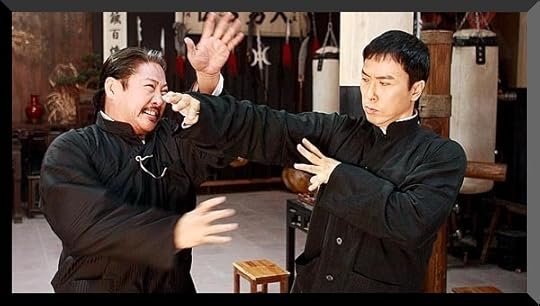
~The Ip Man was there to lend a fist~
Ok, there is no Einstein moment needed to understand what transpired next.
The end result was a country made vulnerable for the most powerful vultures to snack on.

~Slicing up the China-pie~ courtesy wikipedia
The Last Kowtow
The failure of China to defend herself inevitably led to the desire of her people to reform, and strengthen her belief in a China as a nation, not a possession. The Nationalist Party led by Sun Yat-sen and the Communist Party of Mao Zedong managed that patriotic duty, in a manner of speaking.
Although this was a history lesson dry in some parts, I did get a more rounded picture of the Boxers - their origins, beliefs and motives- than would be otherwise gleaned from the popular online searches. Mr. Silbey provided a good description of the motivations behind the superpowers who inserted their greedy hands in another's cookie jar. I was especially interested in the Empress Dowager Cixi - it was insightful that the author paralleled her rule with the indomitable Queen Victoria.
Most of all, I realized more clearly the violence that China endured at the hands of foreigners for a near century; it was tragically, deadly sinful.
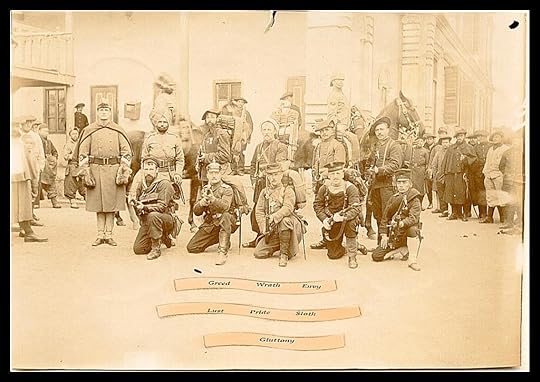
~ Allied Forces~
To the Victors Go the Spoils
China, in the 1800's, had suffered two Opium Wars which left her devastated and having to yield to the British, who forced upon her their trade of Opium (the price they were willing to pay for all the tea in China).
c.1900 , many global powers were in conflict - the Germans were fighting a genocidal war against the Hehe in German East Africa; the British were losing a war against the Boers in South Africa; the United States was struggling to suppress a Filipino insurgency; Russia was struggling with a widespread anarchists' movement. These major powers, including France and Japan, all had their covetous eyes on China.
"On the decision of the fate of China may, perhaps, hinge the economic supremacy of the next century."
China, already having seen the insidious growth of Western missionaries threatening their traditional beliefs, was fighting to hold on to her Qing dynastic rule, and to deter the rapid progress of modernization by foreign powers. She had been pushed ever more closely to rebellion against these "foreign devils."
Between 1897-1900, the Boxers, an assortment of religious peasant groups known for their sword twirling, ritualistic prostrations and skilled martial arts, were encouraged by the Empress Dowager Cixi to retaliate against the Allied Forces (Germany, France, United States of America, United Kingdom, Japan, Russia, Austria-Hungary, Italy).
~The Boxers armed with obsolete weapons and farm tools~
~The Ip Man was there to lend a fist~
Ok, there is no Einstein moment needed to understand what transpired next.
The end result was a country made vulnerable for the most powerful vultures to snack on.
~Slicing up the China-pie~ courtesy wikipedia
The Last Kowtow
The failure of China to defend herself inevitably led to the desire of her people to reform, and strengthen her belief in a China as a nation, not a possession. The Nationalist Party led by Sun Yat-sen and the Communist Party of Mao Zedong managed that patriotic duty, in a manner of speaking.
Although this was a history lesson dry in some parts, I did get a more rounded picture of the Boxers - their origins, beliefs and motives- than would be otherwise gleaned from the popular online searches. Mr. Silbey provided a good description of the motivations behind the superpowers who inserted their greedy hands in another's cookie jar. I was especially interested in the Empress Dowager Cixi - it was insightful that the author paralleled her rule with the indomitable Queen Victoria.
Most of all, I realized more clearly the violence that China endured at the hands of foreigners for a near century; it was tragically, deadly sinful.
~ Allied Forces~

May 6, 2018
I appreciate the research done on the topic, but I felt like there have to be better books out there about this moment in history.
This is a rebellion that takes place in China, but Silbey focuses on the Western powers' (and Japan's) side of the story. However, I found it hard to keep up with at times because of how detailed it goes into nonsense. Maybe it is because the rebellion takes place in a relatively short span of time, but there should not be so much given attention to these silly instances (such as savaging for alcohol) compared to other moments. I just found myself constantly zoning out due to this and the many names being thrown about.
I learnt a lot, but feel like there are books that probably approach the subject much better. Glad I read it, but wished i picked another book.
This is a rebellion that takes place in China, but Silbey focuses on the Western powers' (and Japan's) side of the story. However, I found it hard to keep up with at times because of how detailed it goes into nonsense. Maybe it is because the rebellion takes place in a relatively short span of time, but there should not be so much given attention to these silly instances (such as savaging for alcohol) compared to other moments. I just found myself constantly zoning out due to this and the many names being thrown about.
I learnt a lot, but feel like there are books that probably approach the subject much better. Glad I read it, but wished i picked another book.

July 19, 2025
I wish the conclusion had been as thoroughly pointing-to-the-future as the opening of the book so superbly set up how-we-got here...but in between is a solid, engaging, mostly minutiae-free overview of the Boxer Rebellion. Unless someone writes another volume, I will state that this is the current definitive account as of this moment in time.

January 3, 2017
Over the course of the 19th century, China found itself facing the growing encroachment of their sovereignty by the Western powers. With the government unable to respond effectively to the challenge of economic exploitation and missionary activity, a grassroots movement sprang up in the countryside as the century came to an end. Dubbed the Boxers, they embodied the frustration that many Chinese felt with the privileges enjoyed by Westerners and Chinese converts to Christianity, which they expressed with attacks on both groups. These attacks culminated with assaults on the foreign legations in Beijing in June 1900, which prompted the Western powers to set aside their rivalries to mount a multinational relief effort that captured the imperial capital and forced a humiliating series of concessions from the imperial government.
David SIlbey's book is far from the first work on the subject. Yet it is among the best as an introduction to the event, thanks to Silbey's clear writing and lucid analysis. He does a good job of explaining the underlying issues at play, both between the Chinese and the West and among the Western powers themselves. In doing so, he sets the Rebellion squarely within the context of contemporary events, helping readers better understand the whys and hows of the rising and its outcome. Though Silbey's favoring of English-language and translated sources limits the depth of his coverage, these limitations are understandable, and don't detract from his book's usefulness as a primer to a dramatic episode in the history of both China and Western imperialism.
David SIlbey's book is far from the first work on the subject. Yet it is among the best as an introduction to the event, thanks to Silbey's clear writing and lucid analysis. He does a good job of explaining the underlying issues at play, both between the Chinese and the West and among the Western powers themselves. In doing so, he sets the Rebellion squarely within the context of contemporary events, helping readers better understand the whys and hows of the rising and its outcome. Though Silbey's favoring of English-language and translated sources limits the depth of his coverage, these limitations are understandable, and don't detract from his book's usefulness as a primer to a dramatic episode in the history of both China and Western imperialism.

June 11, 2013
In 1900 European powers dominated China. The country was struggling drought and the loss of jabs. An organization that the Europeans called Boxers came on the scene shouting for the elimination of white control of China. The author explores the the causes and conduct of the Boxer Rebellion and the siege of the European legations. The only problem that I have with with book is sometimes the author treats the Catholic Church as not being Christian such as "the Catholic church and Christians".
July 6, 2025
I thought this book was pretty decent. It is short, but served a pretty good intro to the times and events of the Boxer Rebellion.
The author’s main argument is that the Eurasian imperial powers were closer to being defeated than is commonly believed. The initial expedition by Admiral Seymour to relieve the Beijing legations failed, and at Tianjin and other sites the coalition faced resistance that had the potential to defeat them completely. In the end however, the Chinese lacked the willpower to take a bloody stand against the armies arrayed against them, and fled once the fighting was heavy. The imperial Chinese army broke after losing several battles, and in many ways the Chinese government came out the worst from the Boxer Rebellion. The Boxer movement petered out in the summer of 1900 when the drought in Northern China ended and when they had accomplished their main tasks of driving out the alternate power structure of the Chinese Christians in the peasant countryside. The Boxer movement was an inherently traditionalist, reactionary force, an enlarged lumpenproletariat fighting against what the west called progress.
I am not entirely sure of this main premise. Yes, it appears true that the Chinese weren’t too far behind the Eurasian imperial armies, and the technological edge they had was not overwhelming. Yet even if the Chinese were able to hold off their enemies until winter set in, I imagine that the only result would be that the invading forces would attack with greater vigour and ferocity the next year. This was the Great Game after all, and none of its players would take such an embarrassment so lightly. If one power left the war, the rest would fill their position so as to accrue greater spoils for themselves. But those are just my thoughts.
The author’s main argument is that the Eurasian imperial powers were closer to being defeated than is commonly believed. The initial expedition by Admiral Seymour to relieve the Beijing legations failed, and at Tianjin and other sites the coalition faced resistance that had the potential to defeat them completely. In the end however, the Chinese lacked the willpower to take a bloody stand against the armies arrayed against them, and fled once the fighting was heavy. The imperial Chinese army broke after losing several battles, and in many ways the Chinese government came out the worst from the Boxer Rebellion. The Boxer movement petered out in the summer of 1900 when the drought in Northern China ended and when they had accomplished their main tasks of driving out the alternate power structure of the Chinese Christians in the peasant countryside. The Boxer movement was an inherently traditionalist, reactionary force, an enlarged lumpenproletariat fighting against what the west called progress.
I am not entirely sure of this main premise. Yes, it appears true that the Chinese weren’t too far behind the Eurasian imperial armies, and the technological edge they had was not overwhelming. Yet even if the Chinese were able to hold off their enemies until winter set in, I imagine that the only result would be that the invading forces would attack with greater vigour and ferocity the next year. This was the Great Game after all, and none of its players would take such an embarrassment so lightly. If one power left the war, the rest would fill their position so as to accrue greater spoils for themselves. But those are just my thoughts.

August 22, 2024
An interesting delve into a myserious patch of Chinese and Western history. Silbey doesn't hold back on exposing the horrific past of the Imperial war machines, blazing through a very underprepared China. Whilst it is a very West-centric read (and sometimes quite pro-West, despite the rhetoric about the fears of change from the Chinese and their struggle to maintain the status quo), it's nonetheless a fascinating story that has inspired a few more locations to visit in China in the future.
7.5/10
7.5/10

March 2, 2015
This treatise on the Boxer Rebellion of 1900 in Shantung Province in northern China and in Peking is exceptionally well researched and told. Silbey has written this book with keen understanding and the perceptive knack to engulf the audience deeply into his chronicle. Of what I know of the Boxer Rebellion, I would suggest that this book is the most comprehensive and accurate of all other popular histories. Of note, he engages us in the big pictures and leads us skillfully into minute details of individual exploits and heroism.
I fault Silbey for not providing custom-designed, detailed maps of the various campaigns and a large-scale map of northern China with key geographic features and city names. This is a serious failure and negates a five-star rating. He does suffer us with six maps from that period that are minuscule and worthless—including one of the innards of Peking. The overall map of northern China that he does provide is small and inefficacious. Accordingly, it is extremely difficult to follow the coalition’s campaign up the Dagu River to relieve the besieged legations in Peking. Included in the coalition army were elements of the armed forces from America, Great Britain, Imperial Germany, France, Austria-Hungry Empire, Imperial Russia, and Japanese Empire.
He opens his book with an overview of western imperialism in China over the past fifty years. He details the negative effects this imperialism engendered on and the general populace’s emotions and on the Imperial government; led by the Dowager Empress Tzu-his (“Cixi” in the current Pinyin spelling) and Prince Duan of the fading Qing Dynasty. Compounding the contempts was the Chinese adversarial perception of the special privileges endowed on Chinese Christians by missionaries and the western powers.
The drought in the spring of 1900 in Shantung Province crippled the breadbasket of northern China. The idle and starving farmers and peasants convinced themselves that the imperial westerners caused the drought to further humiliate and dominate them. Without leadership, the Boxer movement evolved and morphed quickly into a ragtag fighting force throughout the province. Some few of the Boxers were students of the ancient Chinese martial arts collectively dubbed “ch’uan fa.” They slaughtered Christian converts, missionaries and their families, and even important westerners; for example, the Baron August F. von Ketteler, the German minister to the Imperial Throne.
The Boxers moved into Peking and laid siege to the foreign legations—ensconced behind the Tartar wall. The Empress Dowager Cixi made the fateful decision to declare war on “the invaders,” and ordered the imperial army to repel the aggressors. The collation forces fought spirited campaigns at the Chinese’s key forts and strong points along the Dagu River in their difficult campaign to relieve the besieged legations in Peking.
The Chinese, army supported by the irregular Boxers, mounted a spirited defense causing serious causalities among the collation forces. Unfortunately, they could not fight as a unified command because of international rivalries (Japan and Russia, for example), petty jalousies, and failure to develop of a comprehensive operations plan. Of note, credit goes to the Japanese whose bravery and innovative tactics forced the fall of the key city of Tientsin (Tianjin) and they led the way to the capitol.
Nonetheless, after fifty-five days collation forces reached Peking and relieved the legation. The peace treaty, the Boxer Protocol, was harsh and unforgiving to the Chinese—imposing a ₤67 million-indemnity and territorial concessions.
I fault Silbey for not providing custom-designed, detailed maps of the various campaigns and a large-scale map of northern China with key geographic features and city names. This is a serious failure and negates a five-star rating. He does suffer us with six maps from that period that are minuscule and worthless—including one of the innards of Peking. The overall map of northern China that he does provide is small and inefficacious. Accordingly, it is extremely difficult to follow the coalition’s campaign up the Dagu River to relieve the besieged legations in Peking. Included in the coalition army were elements of the armed forces from America, Great Britain, Imperial Germany, France, Austria-Hungry Empire, Imperial Russia, and Japanese Empire.
He opens his book with an overview of western imperialism in China over the past fifty years. He details the negative effects this imperialism engendered on and the general populace’s emotions and on the Imperial government; led by the Dowager Empress Tzu-his (“Cixi” in the current Pinyin spelling) and Prince Duan of the fading Qing Dynasty. Compounding the contempts was the Chinese adversarial perception of the special privileges endowed on Chinese Christians by missionaries and the western powers.
The drought in the spring of 1900 in Shantung Province crippled the breadbasket of northern China. The idle and starving farmers and peasants convinced themselves that the imperial westerners caused the drought to further humiliate and dominate them. Without leadership, the Boxer movement evolved and morphed quickly into a ragtag fighting force throughout the province. Some few of the Boxers were students of the ancient Chinese martial arts collectively dubbed “ch’uan fa.” They slaughtered Christian converts, missionaries and their families, and even important westerners; for example, the Baron August F. von Ketteler, the German minister to the Imperial Throne.
The Boxers moved into Peking and laid siege to the foreign legations—ensconced behind the Tartar wall. The Empress Dowager Cixi made the fateful decision to declare war on “the invaders,” and ordered the imperial army to repel the aggressors. The collation forces fought spirited campaigns at the Chinese’s key forts and strong points along the Dagu River in their difficult campaign to relieve the besieged legations in Peking.
The Chinese, army supported by the irregular Boxers, mounted a spirited defense causing serious causalities among the collation forces. Unfortunately, they could not fight as a unified command because of international rivalries (Japan and Russia, for example), petty jalousies, and failure to develop of a comprehensive operations plan. Of note, credit goes to the Japanese whose bravery and innovative tactics forced the fall of the key city of Tientsin (Tianjin) and they led the way to the capitol.
Nonetheless, after fifty-five days collation forces reached Peking and relieved the legation. The peace treaty, the Boxer Protocol, was harsh and unforgiving to the Chinese—imposing a ₤67 million-indemnity and territorial concessions.
April 7, 2013
The Boxer Rebellion was actually short-lived but resulted in changes that the boxers did not want.To me the most interesting aspect of the book was the attitude of the Western powers who felt entitled to ignore the will of the Chinese government and Chinese people and force them to allow businesses to move in, build railroads, set up trading zones.One example was when Britain started shipping opium from India to China. China, concerned about he growing population of addicts, banned the drug. Britain used the ban as an excuse for war. Britain's win ended in China being forced to open 5 cities to trade, and to accept the import of the drug.There's not much here to make a Westerner feel proud, but I felt I learned a lot. I'm grateful to David Silbey and Hill & Wang books for sending me the book through Goodread's giveaway program.
November 25, 2024
Very readable history of the Boxer Rebellion.
History delves into the Political situation with the 8 Great Powers who were equally concerned with dividing up the assets of China and competing with the other Great Powers - to see that no other Great Power gains an advantage. All of this was ongoing while there was a belief of the superiority of the White Race versus the Asian Race......"Take up the White Man's Burden"....deal with these half-savages...half children.
On the Chinese side - the empire was in decline - the Chinese Army could be trusted somewhat; the Boxers couldn't be controlled really (a populist movement); and the Government of the Dowager Empress changed its mind as to whether it would support war against the Great Power's Military.
History delves a little into the Economic situation with China rapidly becoming industrialized; through the influence of the Great Powers (railroads, etc.). This rapid industrialization had economic impacts on the Chinese population - when railroads (and freight haulage displace manual effort to haul freight). This economic displacement - made some Chinese angry at 'foreigners' - so much so the phrase "Support the Qing; Eliminate the Foreigners" - became the motto.
There was plenty for the average Chinese to dislike about Foreigners from the Opium Wars and what began the "Century of Humiliation" which is still being referred to by the Chinese Communist Party.
History also tells the military situation. Contrary to the "vibes" - this telling finds the Great Powers Military lucky to have won, the Great Powers Military having faced some stiff resistance from the combination of the Chinese Army and the Boxers. The Great Powers Military Expeditionary Force numbered some ~ 20,000 troops - opposed by an unknown number of Chinese Army regulars and Boxers. Some of the Chinese Army and Boxer success was due to the disorganization of the Great Powers Military. Some of the Great Powers Military success was due to the Chinese Army and Boxers not having great aim with their weapons; and also that the Chinese Army and Boxers could not defend a position against a coordinated Great Powers Military attack.
Readable - touches the 'main points' - highlights a different truth than the conventional wisdom 'vibe' of an easy Great Power victory; provides a short linkage to the Revolutionary spirit within China and how it was later invoked by Mao.
Should be of interest to those who read History.
Carl Gallozzi
Cgallozzi@comcast.net
History delves into the Political situation with the 8 Great Powers who were equally concerned with dividing up the assets of China and competing with the other Great Powers - to see that no other Great Power gains an advantage. All of this was ongoing while there was a belief of the superiority of the White Race versus the Asian Race......"Take up the White Man's Burden"....deal with these half-savages...half children.
On the Chinese side - the empire was in decline - the Chinese Army could be trusted somewhat; the Boxers couldn't be controlled really (a populist movement); and the Government of the Dowager Empress changed its mind as to whether it would support war against the Great Power's Military.
History delves a little into the Economic situation with China rapidly becoming industrialized; through the influence of the Great Powers (railroads, etc.). This rapid industrialization had economic impacts on the Chinese population - when railroads (and freight haulage displace manual effort to haul freight). This economic displacement - made some Chinese angry at 'foreigners' - so much so the phrase "Support the Qing; Eliminate the Foreigners" - became the motto.
There was plenty for the average Chinese to dislike about Foreigners from the Opium Wars and what began the "Century of Humiliation" which is still being referred to by the Chinese Communist Party.
History also tells the military situation. Contrary to the "vibes" - this telling finds the Great Powers Military lucky to have won, the Great Powers Military having faced some stiff resistance from the combination of the Chinese Army and the Boxers. The Great Powers Military Expeditionary Force numbered some ~ 20,000 troops - opposed by an unknown number of Chinese Army regulars and Boxers. Some of the Chinese Army and Boxer success was due to the disorganization of the Great Powers Military. Some of the Great Powers Military success was due to the Chinese Army and Boxers not having great aim with their weapons; and also that the Chinese Army and Boxers could not defend a position against a coordinated Great Powers Military attack.
Readable - touches the 'main points' - highlights a different truth than the conventional wisdom 'vibe' of an easy Great Power victory; provides a short linkage to the Revolutionary spirit within China and how it was later invoked by Mao.
Should be of interest to those who read History.
Carl Gallozzi
Cgallozzi@comcast.net

February 5, 2024
The imperial powers get together to have an "Olympics" in war, rape and pillage.
This book does an excellent job of setting the atmosphere by describing what's been happening in China the past 100 years or so. Also, the current conditions the common man is going through with the drought, floods, and scarcity of foods. The Christian missionaries brought my foreign powers ct as a quasi part of their foreign governments. The members all get protected status, but this also means that people would commit crimes run to these missionaries and could not be punished by Chinneae authorities. Under these conditions, it's no wonder the common man in China would rise up against foreign intervention in China.
Silbey does a great job in detailing the friction between America, Brittish, Russia, Japan, Germany, Austria-Huntry, and France all interact. A mistrust lingers between rivivarlies while seeds of future issues are planted. Throughout and especially towards the end was a literal race of armies of who could save the legations in Beijing and capture Beijing first. An almost sick and cruel game of Olympics between the armies.
The biggest of these with their major conflict just 4 years away is between Japan and Russia.
The battles and troop movements are written in fine detail here to follow. Sibley does a great job that while vastly out numbered and unorganized, China did have the allied powers on the brink of destruction in Tianjin and the utter destruction of Seymors force. If China had just followed up with their attacks, they could have devastated the allies and pulled one of the all-time underdog stories.
This is one of those tragic events that could have prevented the communist turned China today. Sibley even mentions Mao in the book on how he references the Boxer rebellion on his rise to power. Was the conquer, rape and pillage of China really worth the cost?
Book - 5/5 stars.
Side Note: President McKinley continues to drop after reading this book. D-
This book does an excellent job of setting the atmosphere by describing what's been happening in China the past 100 years or so. Also, the current conditions the common man is going through with the drought, floods, and scarcity of foods. The Christian missionaries brought my foreign powers ct as a quasi part of their foreign governments. The members all get protected status, but this also means that people would commit crimes run to these missionaries and could not be punished by Chinneae authorities. Under these conditions, it's no wonder the common man in China would rise up against foreign intervention in China.
Silbey does a great job in detailing the friction between America, Brittish, Russia, Japan, Germany, Austria-Huntry, and France all interact. A mistrust lingers between rivivarlies while seeds of future issues are planted. Throughout and especially towards the end was a literal race of armies of who could save the legations in Beijing and capture Beijing first. An almost sick and cruel game of Olympics between the armies.
The biggest of these with their major conflict just 4 years away is between Japan and Russia.
The battles and troop movements are written in fine detail here to follow. Sibley does a great job that while vastly out numbered and unorganized, China did have the allied powers on the brink of destruction in Tianjin and the utter destruction of Seymors force. If China had just followed up with their attacks, they could have devastated the allies and pulled one of the all-time underdog stories.
This is one of those tragic events that could have prevented the communist turned China today. Sibley even mentions Mao in the book on how he references the Boxer rebellion on his rise to power. Was the conquer, rape and pillage of China really worth the cost?
Book - 5/5 stars.
Side Note: President McKinley continues to drop after reading this book. D-

February 4, 2024
Pros :: Where do I begin to list all the things I learned from this book about the Boxer Rebellion (which should actually be a war….)? Learned that the Boxers were a group of superstitious martial arts showmanship peasants who launched attacks on the West who they feared that were corrupting their county. The status of the missionaries and Chinese Christian converts became a group for the Boxers to target, as well as foreign railway workers and engineers. There was a drought going on, causing near starvation conditions, there was a large foreign presence, and the guns supplied to the Imperial Army were not as precise as the guns of their opponents, thus loosing battles because their guns shot over the heads of their foes.
Learned this rebellion involved multiple countries, including Britain, France, Austria, US, Germany, Japan, Italy and Russia. That there were rivalries between Russia and Japan, that Britain and the US had other war fronts (Boer War and Philippians) going on at the same time, and, that France’s sphere of influence was southern China while northern China was the British sphere of influence. Also read that earlier, Germany had sold weaponry to China that was used against the allied forces.
A favorite takeaway sentence with the context of the British running the Boxer Rebellion war front out of London and Delhi : “…the British were practiced at this kind of deliberate parsimony and the efficiency. It was, in essence, how they ran most of their wars, and they were skilled at extracting maximum benefits from whatever resources, whether financial or emotional, they could find.” Page 123 And there is this one: “Britain inspired resentment, jealousy as well as respect.” Page 143
Cover art :: 5 out of 5
Learned this rebellion involved multiple countries, including Britain, France, Austria, US, Germany, Japan, Italy and Russia. That there were rivalries between Russia and Japan, that Britain and the US had other war fronts (Boer War and Philippians) going on at the same time, and, that France’s sphere of influence was southern China while northern China was the British sphere of influence. Also read that earlier, Germany had sold weaponry to China that was used against the allied forces.
A favorite takeaway sentence with the context of the British running the Boxer Rebellion war front out of London and Delhi : “…the British were practiced at this kind of deliberate parsimony and the efficiency. It was, in essence, how they ran most of their wars, and they were skilled at extracting maximum benefits from whatever resources, whether financial or emotional, they could find.” Page 123 And there is this one: “Britain inspired resentment, jealousy as well as respect.” Page 143
Cover art :: 5 out of 5

June 12, 2024
Never knew much about the boxer rebellion until reading this. I think the content is generally good, although clearer battle maps could be useful.
Writing style is sometimes choppy and may have grammar mistakes.
Enjoyed some of the context beyond China but sometimes it felt unnecessary. I felt the individual stories and use of the NYT was interesting and insightful.
I would recommend as a fairly digestible but also seemingly expansive coverage of the topic. The “Olympic competition” comparison is fascinating-all these different powers had to work together while still managing rivalries and trying to earn prestige and promotions.
Writing style is sometimes choppy and may have grammar mistakes.
Enjoyed some of the context beyond China but sometimes it felt unnecessary. I felt the individual stories and use of the NYT was interesting and insightful.
I would recommend as a fairly digestible but also seemingly expansive coverage of the topic. The “Olympic competition” comparison is fascinating-all these different powers had to work together while still managing rivalries and trying to earn prestige and promotions.

December 28, 2018
I had to find something to read for my book challenge prompt A Book related to your Ancestry and since I am descended from a Dutch missionary - Bishop Ferdinand Hamer - who was killed in the Boxer Rebellion, I thought this would make an interesting read. I quite enjoyed the final pages which gave more of a political analysis but I generally don't enjoy war books and for the most part this is what the book was. And it was like wading through treacle. Oh well at least I ticked that box on my reading challenge! 2-stars
Read
October 23, 2021Following on from 55 Days in Peking
Having recently watched the film 55 Days in Peking I wanted to find out more of the background to this time in history. The beginnings, the people and cultures involved and the outcomes . For my needs this was very much achieved. I would recommend this book .
Having recently watched the film 55 Days in Peking I wanted to find out more of the background to this time in history. The beginnings, the people and cultures involved and the outcomes . For my needs this was very much achieved. I would recommend this book .
January 21, 2026
Good introduction to the events of the Boxer Rebellion in China. Very much a military campaign history, with heavy reliance on US and British sources. Would have been interesting to see more from the Japanese, French, German, and particularly the Chinese perspectives. That said, I learned plenty about what happened, how it happened, and what the general outcome was.
September 20, 2018
quick interesting read ....giving good detail and perspective on Boxer rebellion.....focusses on military tactics and battles rather than geopolitical issues....becomes a little turgid at times...but short book that allows you to get to the end and understand more about chinese history

May 24, 2019
Wow, what a mess
A very good insight into what bullies the so called great powers were. I am surprised at how the Chinese took it in the shorts for more than a century. Do you think they will put up with it now. I don't think so.
A very good insight into what bullies the so called great powers were. I am surprised at how the Chinese took it in the shorts for more than a century. Do you think they will put up with it now. I don't think so.

August 13, 2017
Not a bad history book if you're interested in the history of different parts of the world.
February 16, 2019
Lesser known part of World History
An interesting and informative history about an event I knew little more than the name. It's well worth a read.
An interesting and informative history about an event I knew little more than the name. It's well worth a read.
September 10, 2019
Very good book for an overview of the Boxer rebellion. The writing style is enjoyable if slightly dry. Good for someone who is trying to gain a better understanding of the world in the pre WWI era.

April 24, 2021
A detailed history and analysis of the Boxer Rebellion. Silbey's work is thoughtful and very insightful, and not at all boring. I really enjoyed reading this.

April 3, 2022
Thoroughly told history of the Boxer Rebellion, with fascinating account of the Allied troops struggling to build a railway to Beijing.
Read
January 30, 2023read this for school. lame.
June 10, 2025
Interesting read, probably not the most historically neutral but gave me some more threads to pull on. Takes me back to IB-20.
July 9, 2025
55 DAYS IN PEKING. Good read overall, just a little too short for my taste but good nevertheless.

March 3, 2019
After the glorious triumph that was Julia Lovell's
The Opium Wars
, I was in the mood to keep reading about this period of Chinese history, and knew that the Boxer Rebellion was the next epochal event, so I went looking for a book that covered that. Silbey's tome here is what seemed to be the most recommended, so I went with it.
It was... fine. I finished it like two months ago and am already struggling to remember it in any great detail, unlike Ms Lovell's masterpiece, which should tell you something.
It covers the details well, even if it focuses too strongly on the Western and Japanese perspectives instead of the Chinese. It also spends too much time in the military weeds and not enough giving a perspective on the greater impact of events.
Starting off with a pretty thin grounding of how the Boxer Rebellion started and its initial path (which, unfortunately, focuses too much on its impact on the Western communities in China rather than, say, its own inherent goals or impact on the Chinese people themselves), it then goes into great, nay, exhaustive detail on the Western military response to the Boxer Rebellion.
EXHAUSTIVE detail.
And that's the problem; this is more a ground-level history of a specific military campaign than it is an exploration of a collision between two major civilizations that has had direct repurcussions into two World Wars and relations between the two biggest powers on Earth to this day. And I feel like the jacket sells it as more of the latter than the former.
If you just want a military history of the Western campaign, such as it was, to rescue the westerners trapped in Beijing, it tells that story very well. But it's quite uninterested in telling the wider story of how it ties into the wider scope of Chinese history, or even the more-specific story of Western Imperialism in China and that impact on current Sino-Western relations. The Lovell book about the immediately preceding Opium Wars discusses all of that quite well, which makes The Boxer Rebellion disappointing.
So maybe it was just a matter of my expectations, but those derived from the back copy and press around the book to begin with, but it didn't quite do the job I wanted it to. Again, if you want a pretty tightly-scoped history of the actual interactions between the Boxers and the Western armies that fought them, this book will be your jam. I, however, am going to continue to look for something that gives this event a more widely-scoped treatment.
It was... fine. I finished it like two months ago and am already struggling to remember it in any great detail, unlike Ms Lovell's masterpiece, which should tell you something.
It covers the details well, even if it focuses too strongly on the Western and Japanese perspectives instead of the Chinese. It also spends too much time in the military weeds and not enough giving a perspective on the greater impact of events.
Starting off with a pretty thin grounding of how the Boxer Rebellion started and its initial path (which, unfortunately, focuses too much on its impact on the Western communities in China rather than, say, its own inherent goals or impact on the Chinese people themselves), it then goes into great, nay, exhaustive detail on the Western military response to the Boxer Rebellion.
EXHAUSTIVE detail.
And that's the problem; this is more a ground-level history of a specific military campaign than it is an exploration of a collision between two major civilizations that has had direct repurcussions into two World Wars and relations between the two biggest powers on Earth to this day. And I feel like the jacket sells it as more of the latter than the former.
If you just want a military history of the Western campaign, such as it was, to rescue the westerners trapped in Beijing, it tells that story very well. But it's quite uninterested in telling the wider story of how it ties into the wider scope of Chinese history, or even the more-specific story of Western Imperialism in China and that impact on current Sino-Western relations. The Lovell book about the immediately preceding Opium Wars discusses all of that quite well, which makes The Boxer Rebellion disappointing.
So maybe it was just a matter of my expectations, but those derived from the back copy and press around the book to begin with, but it didn't quite do the job I wanted it to. Again, if you want a pretty tightly-scoped history of the actual interactions between the Boxers and the Western armies that fought them, this book will be your jam. I, however, am going to continue to look for something that gives this event a more widely-scoped treatment.

September 2, 2012
the Boxer Rebellion and the Great Game in China is a mediocre book about an disappointingly mediocre subject. Which is not to say that David Silbey is an awful writer or historian, he's simply working on a subject that in the long run of world history and more importantly Chinese history was incredibly short lived and it's importance just as ephemeral. The Boxers were a bizarrely amorphous, poorly-organized, Luddite, reactionary movement that aimed to, in their own words, "Support the Qing, exterminate the foreigners!" While seemingly purely political reasons seemed to lie at their seething dissent and materialized into a loose coalition to accomplish these goals, their antagonists were largely provoked by Christian missionaries who operated within their own legal space, who usually provided succor for the seedier rabble rousing sectors of society, therefore obstructing the normal local political process. More importantly, and most essentially, these violent dissidents emerged during a particularly prolonged and oppressive drought.
Predictably, these people rise up and the imperial powers: America, France, Britain, Russia, and Japan step in to put an end to these terrorists and foment their already strong imperial presence. Through a series of pitched- yet ultimately futile battles, the nativist response is crushed and the Western Powers+Japan occupy and extort China for all its worth. That's basically the gist of the entire book since their are no extant Boxer sources, and the vast majority of this particular narrative has been reconstructed through Western sources of various commanders in this turn of the century East Asian Theatre. This, unfortunately, leads to a very one sided story, that could be derided, if your're a toolbag Marxist, as Eurocentric slander.
Needless to say, this isn't the most exciting or interesting book on Chinese history. First of all, Mr. Silbey writes in this odd style which tries to be something of a middle roads between purely pop history and legitimate scholasticism, accomplishing neither and devoid of any prose or wit ending in disappointingly dry style. Secondly, no powerful threads are tied together like would occur in any other solid work of history. Mentions of the Boer War in Africa, French occupation of Indochina, and American imperialism in nearby Phillipenes are nothing more than cursory declarations on the periphery. Instead of some real strong academic inquiry going on where the context of the whole world- which is really what history is all about- there are no thematic connections between forged between the Boxer conflict and the imperial ambitions of the Western world at the time and I find this disappointing
In conclusion, it's worth a read if you've got a few days to kill over a vacation- as dry as the prose is, its a relatively short read.
Predictably, these people rise up and the imperial powers: America, France, Britain, Russia, and Japan step in to put an end to these terrorists and foment their already strong imperial presence. Through a series of pitched- yet ultimately futile battles, the nativist response is crushed and the Western Powers+Japan occupy and extort China for all its worth. That's basically the gist of the entire book since their are no extant Boxer sources, and the vast majority of this particular narrative has been reconstructed through Western sources of various commanders in this turn of the century East Asian Theatre. This, unfortunately, leads to a very one sided story, that could be derided, if your're a toolbag Marxist, as Eurocentric slander.
Needless to say, this isn't the most exciting or interesting book on Chinese history. First of all, Mr. Silbey writes in this odd style which tries to be something of a middle roads between purely pop history and legitimate scholasticism, accomplishing neither and devoid of any prose or wit ending in disappointingly dry style. Secondly, no powerful threads are tied together like would occur in any other solid work of history. Mentions of the Boer War in Africa, French occupation of Indochina, and American imperialism in nearby Phillipenes are nothing more than cursory declarations on the periphery. Instead of some real strong academic inquiry going on where the context of the whole world- which is really what history is all about- there are no thematic connections between forged between the Boxer conflict and the imperial ambitions of the Western world at the time and I find this disappointing
In conclusion, it's worth a read if you've got a few days to kill over a vacation- as dry as the prose is, its a relatively short read.

December 15, 2016
There are parts of this book I really liked.
The initial introductions of the Boxers, players in the Chinese government, and foreign powers looking to carve up China was very interesting.
As were the final 20 or so pages that looked into the historical legacy of what effect the grossly unfair Boxer treaty may have had on later generations (Mao Zedong often cited the Boxers resisting foreign powers as an inspiration for his own revolution).
It made me marvel at how shortsighted governments with imperial aspirations can be (the foreign powers took in excess of 700 million dollars as punishment from China in addition to forcing them to build monuments commemorating the foreigners who died during the battle) in that they seek short term advantage such as with the treaty of Versailles for Germany or the Boxer treaty for China which later manifests itself in the Nazis and the Cultural Revolution.
Yet in between there was a lot of detail on the military campaign to take Tianjin and Beijing which for me, wasn't particularly interesting. I would have preferred less battle detail and more information on who the Boxers were and what motivated them. The author does delve into this, but at the expense of the actual campaign itself. Still an enjoyable if not slightly disappointing read.
The initial introductions of the Boxers, players in the Chinese government, and foreign powers looking to carve up China was very interesting.
As were the final 20 or so pages that looked into the historical legacy of what effect the grossly unfair Boxer treaty may have had on later generations (Mao Zedong often cited the Boxers resisting foreign powers as an inspiration for his own revolution).
It made me marvel at how shortsighted governments with imperial aspirations can be (the foreign powers took in excess of 700 million dollars as punishment from China in addition to forcing them to build monuments commemorating the foreigners who died during the battle) in that they seek short term advantage such as with the treaty of Versailles for Germany or the Boxer treaty for China which later manifests itself in the Nazis and the Cultural Revolution.
Yet in between there was a lot of detail on the military campaign to take Tianjin and Beijing which for me, wasn't particularly interesting. I would have preferred less battle detail and more information on who the Boxers were and what motivated them. The author does delve into this, but at the expense of the actual campaign itself. Still an enjoyable if not slightly disappointing read.
July 25, 2012
The boxers were a sort of luddite-xenophobe combo that rose up against foreign powers in China. 1900 was a rough time for Chinese living in Shandong province. There was a drought going on and coolies were losing their livelyhood to railroads being built throughout the country. The word boxers come from the groups name which included the Chinese word for 'fist.' The boxers were not organized in any way, they did dress in a similar way and did exercises and began to intimidate Chinese Christians and foreign missionaries. The government run by the empress dowagers named Cixi had to decide whether to embrace and buttress the boxers. She through her lot in with them and the Chinese regulars and boxers surrounded the foreign legations intending to kill the occupants. The legations set up barricades and tried to hold out. The French, Russians, Japanese, Americans, Germans,British, Italians, Austrians created a combined force to rescue the legations. They fought several battles and pretty much whipped the Chinese. The Chinese had modern weaponry but were really bad shots as they were always shooting overhead, probably not accounting for the weapons recoil. The foreign powers worked surprisingly well together despite all the mutual suspician. This broke down when they reached Beijing and a lot of random killing and theft. The legations were saved. The book did a great recounting of the campaigns and the reasons behind the boxer movement. His writing style is very readible and for me the first part of the book was a real page turner.
Displaying 1 - 30 of 54 reviews