Jump to ratings and reviews
Rate this book

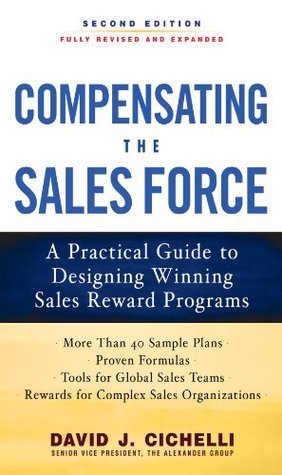
Compensating the Sales Force: A Practical Guide to Designing Winning Sales Reward Programs

Rate this book

The classic guide to raising your bottom line with the perfect

compensation strategy—fully revised and updated!


Sales compensation WORKS!


Nothing motivates a sales force better than a

powerful compensation program. And when

your salespeople are motivated, revenue soars. But

how do you design a program ideally suited for your

business strategy and organizational needs? It’s

a delicate balance that makes all the difference

between profit and loss.


More and more sales leaders have turned to Compensating

the Sales Force
to help them discover

problems in their present system and create a compensation

program that works best for their needs.

Now, in the second edition of this authoritative,

jargon-free handbook, sales compensation guru

David J. Cichelli brings you completely up to date on

setting target pay, selecting the right performance

measures, and establishing quotas. He supplies

clear guidelines for building the right compensation

plan for any type of firm, of any size, in any

industry, and he offers step-by-step procedures for

implementing each approach.


In Compensating the Sales Force, second edition,

Cichelli has substantially expanded the book’s

popular formula section, and he provides brandnew

examples of:


Income producer plans

Sales rep commission plans

Bonus plans

Incentive plans

Base Salary management plans


The book also includes all-new chapters for global,

complex sales organizations and hard-to-compensate

sales jobs.


Using the lessons in Compensating the Sales Force,

you’ll construct and calculate accurate formulas for

payout purposes and establish highly efficient support

programs, such as sales crediting and account

assignment.


Complete with dozens of real-world examples that

illustrate important points and demonstrate specific

techniques and procedures, Compensating

the Sales Force provides all the tools you need to

design and implement a sales compensation plan

that maximizes profits—and keeps them climbing.


With brand-new chapters on GLOBAL SALES TEAMS amd COMPLEX SALES ORGANIZATIONS!


Praise for the first edition of Compensating the Sales Force:


“If your company is refocusing its efforts on sales revenue

enhancement, you must read this book. If you want motivated

salespeople and superior sales results, act on its content.”


Noel Capon, R. C.

347 pages, Kindle Edition

First published August 18, 2003

85 people are currently reading
98 people want to read

About the author

David J. Cichelli

11 books1 follower

Ratings & Reviews

What do you think?
Rate this book

Friends & Following

Create a free account to discover what your friends think of this book!

Community Reviews

5 stars
37 (33%)
4 stars
40 (35%)
3 stars
31 (27%)
2 stars
2 (1%)
1 star
2 (1%)
Displaying 1 - 8 of 8 reviews
Profile Image for Shawn.
3 reviews4 followers
July 5, 2021
This book is useful for ANYONE who is involved in designing incentive plans for sales people—whether you’re a sales manager, head of sales, compensation professional, sales operations, or HR. Compensation the Sales Force is a soup to nuts manual for creating and communicating incentive plans.

In Chapter 2, Cichelli covers important basic concepts, like pay mix, leverage, and quota distribution. One of the key concepts he explains is that sales compensation plans are based on the specific job. If you have 5 different sales jobs at your company, it stands to reason that those 5 jobs are unique—no 2 jobs do exactly the same thing. Each of those jobs needs to be compensated for the unique achievement expected for the job. So, the number of sales compensation plans should equal the number of sales jobs. There are ways to simplify sales compensation design and administration, but reducing the number of plans below the number of jobs is not the way to do it. Reading deeper, he explains why this is so. If you’re in an organization that struggles with proliferation of comp plans, this chapter will help you figure out where to consolidate and where not to.

Chapter 4 is about job content. The most impactful section to me is the Job Design Errors section. Incorrect plan design works at cross-purposes to the definition of the job, and this is often because a job is mis-documented. Here, Cichelli describes the most common errors and exhorts sales management to fix job design errors before the comp plan design process. This is a very useful starting point for compensation professionals to engage stakeholders—start at the very beginning, which is “what is the job?”

Assessing sales compensation programs’ effectiveness is covered in Chapter 16. Great ideas here to formulate goals and hypothesis, which can be measured once a plan has been in force for 6-12 months. If your sales compensation function is not 100% mature yet, but has the basics covered; implementing the ideas in this chapter will get you to the next level, especially with leaders.

I recommend this book for both beginning and seasoned sales comp designers. It makes a great addition to any HR library or business library (your own or your companies).
Profile Image for Harry Harman.
841 reviews19 followers
Read
January 12, 2023
Atypical conversation between the first-line supervisor and his or her sales charges would sound something like this: “Now, ladies and gentlemen, we are on the line here to achieve this month’s sales objectives. I have a commitment from each of you to reach and exceed your monthly quota. It’s important to me, and it should be important to you. At our next sales meeting, we will put the numbers up on the board to see whom we cheer and whom we lovingly sneer! If you are having any trouble closing a deal, I can help you. Call me, and we will schedule joint sales calls. Remember, your success is my success!”

Before concluding that the sales compensation plan is overpaying, you might want to look at the cost of sales. Ahigh cost of sales might be a result of overstaffing and not overpayment to individuals. If actual payouts are too high, then examine the quota system first. Perhaps quotas are too easy.

Follow industry practice only if your company is identical to your competitors and if they have found the ideal sales compensation solution.

salespeople are ideally suited to be at the point where customers have risk and uncertainty—the point of persuasion.

“a culture of winning,” “a culture of sales results at all costs,” or “a culture of beating the competition.”

Sellers who are income producers create business revenue. Their value is not in the products they offer, but the relationships they manage. In many cases, they sell commodities. What is unique is their relationship with their customers; they often have the power to take their customers with them when they change employers.

The average pay mix for business-to-business territory sales representatives in the United States is approximately 65/35.

best performers is defined as the 90th percentile of performance among all job incumbents.

Quota distribution establishes the desired difficulty of quotas. If quotas are too easy, the sales compensation plan might overpay. If quotas are too difficult, the sales compensation program could underpay. Apreferred quota distribution target is to have two-thirds of the salespeople reaching and exceeding quota and one-third not.
4 reviews
February 6, 2021
Excellent! It’s a must read

Precise, great, comprehensive

Precise, great, comprehensive

Precise, great, comprehensive

Precise, great, comprehensive

Precise, great, comprehensive


Precise, great, comprehensive

Precise, great, comprehensive


Hey guys. Allow to introduce short comments!
Profile Image for Lori Grant.
1,349 reviews93 followers
March 30, 2013
A must-read book on sales and selling techniques for knowledge workers, managers, executives, and entrepreneurs.
Displaying 1 - 8 of 8 reviews

Can't find what you're looking for?

Get help and learn more about the design.