

What do you think?

Tinderbox: The Past and Future of Pakistan
“Among many recent books on Pakistan, Mr. Akbar’s stands out….A fine and detailed history of Indian Muslim anger and insecurity.”—The Economist
In Tinderbox, India’s leading journalist delivers a fascinating narrative history of Pakistan, chronicling the conflict between Muslim and Hindu cultures in South Asia and describing the role that their relationship has played in defining both the country and the region. Editorial director of India Today and editor of the Sunday Guardian, M. J. Akbar gives readers an unprecedented look at Pakistan past and present. Panoramic in scope but specific in detail, with rich portraits of the central figures and events that have defined the nation’s history, Ackbar’s Tinderbox tells the Pakistanian story from the Middle Ages to the present, puts the Taliban and its place within modern Islam into a meaningful context, and diagnoses where the country is headed in the 21st century.
In Tinderbox, India’s leading journalist delivers a fascinating narrative history of Pakistan, chronicling the conflict between Muslim and Hindu cultures in South Asia and describing the role that their relationship has played in defining both the country and the region. Editorial director of India Today and editor of the Sunday Guardian, M. J. Akbar gives readers an unprecedented look at Pakistan past and present. Panoramic in scope but specific in detail, with rich portraits of the central figures and events that have defined the nation’s history, Ackbar’s Tinderbox tells the Pakistanian story from the Middle Ages to the present, puts the Taliban and its place within modern Islam into a meaningful context, and diagnoses where the country is headed in the 21st century.
402 pages, Kindle Edition
First published January 1, 2011
About the author
M.J. Akbar
18 books92 followersMobashar Jawed "M.J." Akbar (born 11 January 1951) is a leading Indian journalist and author. He was the Editorial Director of India Today, India's leading weekly English news magazine published by the Living Media group till his resignation in October 2012. He also had an additional responsibility of overseeing the media conglomerate's English news channel, Headlines Today.
He launched "The Sunday Guardian", a weekly newspaper in 2010, and continues to serve as Editor-in-Chief. He is also the founder and former editor-in-chief and managing director of The Asian Age, a daily multi-edition Indian newspaper with a global perspective.
He has written several non-fiction books, including Byline (New Delhi: Chronicle Books, 2003), a biography of Jawaharlal Nehru titled Nehru: The Making of India, a book on Kashmir titled Kashmir: Behind the Vale, Riot After Riot and India: The Siege Within. He also authored The Shade of Swords, a cohesive history of jihad. Akbar's recent published book is Blood Brothers, a skillfully crafted family saga covering three generations and packed with information of events in India and the world, particularly the changing Hindu-Muslim relations.
His book Blood Brothers has been translated into Italian as Fratelli di Sangue. It was released in Rome at the headquarters of Adnkronos on 15 January 2008.
He published his latest book "Tinderbox: The past and future of Pakistan" in January 2012 discussing the themes of identity crisis and class struggles in Pakistan.
Akbar was also the editor-in-chief of The Deccan Chronicle, a Hyderabad-based news daily.
He launched "The Sunday Guardian", a weekly newspaper in 2010, and continues to serve as Editor-in-Chief. He is also the founder and former editor-in-chief and managing director of The Asian Age, a daily multi-edition Indian newspaper with a global perspective.
He has written several non-fiction books, including Byline (New Delhi: Chronicle Books, 2003), a biography of Jawaharlal Nehru titled Nehru: The Making of India, a book on Kashmir titled Kashmir: Behind the Vale, Riot After Riot and India: The Siege Within. He also authored The Shade of Swords, a cohesive history of jihad. Akbar's recent published book is Blood Brothers, a skillfully crafted family saga covering three generations and packed with information of events in India and the world, particularly the changing Hindu-Muslim relations.
His book Blood Brothers has been translated into Italian as Fratelli di Sangue. It was released in Rome at the headquarters of Adnkronos on 15 January 2008.
He published his latest book "Tinderbox: The past and future of Pakistan" in January 2012 discussing the themes of identity crisis and class struggles in Pakistan.
Akbar was also the editor-in-chief of The Deccan Chronicle, a Hyderabad-based news daily.
Ratings & Reviews
Friends & Following
Create a free account to discover what your friends think of this book!
Community Reviews
Displaying 1 - 30 of 82 reviews

May 23, 2020
The title gives away the intention of the author,it is Pakistan bashing. "Nations are not created across the breakfast table",he says.
The author is an Indian Muslim,and to boost his patriotic credentials,takes plenty of digs at Pakistan and its founder.
Off-putting enough,with a clear anti Pakistan agenda,this one is not worth wasting time over.
Abandoned.
The author is an Indian Muslim,and to boost his patriotic credentials,takes plenty of digs at Pakistan and its founder.
Off-putting enough,with a clear anti Pakistan agenda,this one is not worth wasting time over.
Abandoned.

October 12, 2016
I remember my school days' exams, where I used to keep the essay writing exercise towards the end, cause that would take considerable time and thought. I reach the essay question without realizing that there are only few minutes left before the warning bell to ring. I begin in style, elaborating the most un-important thing with "you need to provide the context before you come to the actual gist" rationale. And then suddenly the warning bell rings and then I have to finish the essay in next 10 minutes. I rush through jumping from point to point, sometimes passing through them, skipping them, brushing them and leaving the whole work hugely unsatisfactory.
This book reads like that.
Akbar, a prominent journalist, politician in India, trying to tackle the complex question of Pakistan's past and future, starts off in style, spending more than two third of the book talking about pre-independence time Islamic history in the Indian sub-continent, providing 1000 unimportant names and narrating many irrelevant incidents, and finally skittering through the most important aspects that would define the troubling times of today.
Informative, for sure. But, sadly not as insightful as I expected it to be.
Disappointed.
(This is the 3rd book by MJ Akbar that I read, and although I admit that I like many of his newspaper columns, I think it would take a stronger persuasion for me to take another book by him.)
This book reads like that.
Akbar, a prominent journalist, politician in India, trying to tackle the complex question of Pakistan's past and future, starts off in style, spending more than two third of the book talking about pre-independence time Islamic history in the Indian sub-continent, providing 1000 unimportant names and narrating many irrelevant incidents, and finally skittering through the most important aspects that would define the troubling times of today.
Informative, for sure. But, sadly not as insightful as I expected it to be.
Disappointed.
(This is the 3rd book by MJ Akbar that I read, and although I admit that I like many of his newspaper columns, I think it would take a stronger persuasion for me to take another book by him.)

August 1, 2012
Pakistan is a lost case, sitting on a tinder box, ready to implode. The signs are quite visible and Akbar brings it out in his own inimitable style. A book worth reading and worth keeping as well.

July 9, 2011
I am not a league-y . My mother's family is very congressi so we buy a lot of the reasoning that goes behind Mr. Akbar's thesis of how Pakistan was formed. A lot of this book is well written research until we get to Pakistan's independence. Then the narrative breaks down and the author does not seem to have good sources to draw upon. The period after Pakistan's independence looks like it is patched together from newspaper clippings, mostly.
Nevertheless a good read on how Pakistan has gone a bit haywire in this day and age. The 100 billion dollar question is how do we put it back together again.
Nevertheless a good read on how Pakistan has gone a bit haywire in this day and age. The 100 billion dollar question is how do we put it back together again.

May 29, 2017
Comprehensively commendable!
Its a good contemporary book to read, as from few others native Pakistani writers highlighted, pathetic historical deliberate mistakes of statesmen for Islam and Ideology, Pak thrives on.
Theory of distance offered by Eminent political theologian, Shah Waliullah, as the base of Jihad as well, as at one moment the writer jotted down,
"19th century, Jihad had become 'a source of chronic danger to the British power in India"
is the main theme (mostly discussed time and again) of the thesis.
One remarkable quality of the book is its balanced approach. M.J Akbar's harsh innuendos struck sweetly to every party of involved, directly or indirectly, in the events.
Then a reader peruses about Jinah's struggle of uniting communities; Hindu and Islam
,
"Gokhale Praised him in 1914, saying, 'freedom from all sectarian prejudice will make him the best ambassador of Hindu-Muslim unity."
and Gandhi's Jihad with a group of Ullema's, Ali Brothers, Hakim Ajmal Khan , M.A Ansari's indeed, warned by Jinnah as he thought it would lead to communal violence therefore Gandhi ought no to intermix Religion with Politics.
I adored one passage of 'Attaturk-Gandhi's Comparison' the most.
"Gandhi and Ataturk (Father of the Turks), both anointed fathers of their nations, make a fascinating comparison.
Ataturk eliminated an obsolete caliphate from nationalist space and released politics from the embrace of religion. Gandhi used the caliphate to stir a dormant community by infusing religion into politics. Ataturk defeated the West, but welcomed its script, clothes and lifestyle, serving alcohol in public and dancing in immaculate tie and tails. Gandhi was more prohibitionist than any mullah and his battledress was a Ilomespun cotton loincloth. He used khadias economic weapon and dress code. 'I consider it a sin to wear it is sinful for me to wear the latest finery of foreign cloth . Regent Street, when I know that if I had but worn the things woven by the neighbouring spinners and weavers, that would have clothed me and fed and clothed them,' he wrote in the 13 October 1921 issue of Young India. (In 1930, he was spinning 220 yards of yarn each day.)
Ataturk banned the Islamic veil and Ottoman fez and promoted skirts and suits. Gandhi welcomed the veil and fez, signature apparel of the Khilafat Movement. Having stepped out of trousers
himself, he dragged his most famous disciple and heir, Nehru, a child of privilege and student of Ilarrow and Trinity, away from bespoke suits into tight homespun pyjamas and Ions, loose, knee-length cotton shirt developed during centuries of Turkish—Muslim
rule in Delhi.
Ataturk and Gandhi used the same slogan between 1919 and 1922: 'Victory or Death' cried Ataturk; 'Do or Die!' demanded Gandhi. But while Ataturk's battlefields did not offer a third option, Gandhi believed that a final confrontation could always
be postponed on India's minefields. Gandhi always lived to fight or fast another day, until 1947 broke his country and 1948 took his life."
I could never help myself in making assumptions of lack of preparation on both sides of the political parties; Congress and League, on most of the consequential events.
They couldn't set a plan unless there was Britain involvement. Both parties leaders met many a time but they were unable to satisfy to the masses with a proper plan. Idon't know whether it was as B.R Nanda opined; "Hindu Politicians were incapable of generosity and Muslim politicians were incapable of trust."
One thing more startled me was Rajendra Parsad's 'creativity' , as M.J Akbar noted,
"Congress stalwart Rajendra Prasad, who would become the first president of the Republic of India, reacted to the 1940 resolution by describing Pakistan as 'Dinia', a nation based on faith. It was clever wordplay: Din means faith, and Dinia is an anagram of India, suggesting the reverse of a secular state."
After Partition, with many social issues arose ideological issues which statesmen 'tried' to negotiate with terms like 'Pakistan is in Danger, Islam is in Danger' and Pakistan was meant to be an Islamic state as first constitution of 1956 said about , 'Islamic Republic of Pakistan.' Here one thing is apt to mention and that is the analysis of Azad on Partition, on Pakistan.
"Azad listed eight potential ills that could leave the body politic of pakistan in high fever. 'I feel right from its inception, Pakistan will face some very serious problems:
1. An incompetent political leadership will pave the way for military dictatorship as it has happened in many Muslim
countries.
2. heavy burden of foreign debt.
3. Absence of friendly relationship with neighbours and the possibility of armed conflict.
4. Internal unrest and regional conflicts.
5. Loot of national wealth by the neo-rich and industrialists of Pakistan.
6. Apprehension of class war as a result of exploitation by the neo-rich.
7. The dissatisfaction and alienation of youth from religion and collapse of the theory of Pakistan.
8. The conspiracies of international powers to control Pakistan.' "
For Ayub's era, a passage came to surprise was,
"One great admirer of Ayub Khan was an American academic who became a worldwide name three decades after this paean.
Samuel Huntington thought Ayub Khan "More than any other Political leader in a modernising country after World War II . . . came close to filling the role of a Solon or Lycurgus, or "Great Legislator" bn the Platonic or Rousseauian model. By the time this was published in 1968, even the few Pakistanis who knew of Solon or Rousseau had given up on a man who scented closer to tired dictator than revolutionary philosopher."
Bhutto like others just "maximised the advantage of adversity" and funding resources altered for a time period. This time were Arabian countries.
Zia's pathetic period was tormenting which is still prevailing with more lethal results and Pakistan is facing as it is sole option or fruit of sowing seeds.
"Zia's war objective were significantly different than Reagan's. America wanted the humiliation of the Soviet Union, to revenge Vietnam and Angola and the Horn of Africa. For Zia, the Afghan jihad was also an embryo of a new regional, and perhaps world, order that would emerge out of the Islamic resistance."
M.J.Akbar's ability of discussing issues is brilliant. In the book he discussed Pak's relationship with India, Russia, China and America.
"Very early in his term, President Obama defined Iraq as the war of choice and Afghanistan as the war of necessity"
"In March 2009 a self-professed admirer of the 'Islamic resistance' General Mirza Aslam Beg former Chief of Army Staff, Pakistan, advised in an article distributed by his foundation, Friends Foundation, that America and NATO should quit the region gracefully before they were defeated. It is not necessary to agree with him, but important to know what he says about the power of the Islamic 'Shadow Army': 'The Global Order of the century is being by three major wers: One is led by The United States, supported b the European Union, India and Japan; the second is China and Russia and the third is the Islamic Resistance. The first and the second are not confronting each other. They are, rather, in the cold war frame of mind. It is the Islamic Resistance, which has been confronting.the American power, limiting its role and its global ambitions.' "
And yes There was a brilliant story of Osama Bin Laden. Thank God, it was spicy, or i would have slept in the end. (Kidding, of course)
In ensuing, i share an insight for future suggestion for Pakistanis by Ayaz Amir.
"If Pakistan, wanted to become a modern republic, it would have to revisit the morality tales of that 'prince of hypocrites' General Zia ul Haq. "
Its a good contemporary book to read, as from few others native Pakistani writers highlighted, pathetic historical deliberate mistakes of statesmen for Islam and Ideology, Pak thrives on.
Theory of distance offered by Eminent political theologian, Shah Waliullah, as the base of Jihad as well, as at one moment the writer jotted down,
"19th century, Jihad had become 'a source of chronic danger to the British power in India"
is the main theme (mostly discussed time and again) of the thesis.
One remarkable quality of the book is its balanced approach. M.J Akbar's harsh innuendos struck sweetly to every party of involved, directly or indirectly, in the events.
Then a reader peruses about Jinah's struggle of uniting communities; Hindu and Islam
,
"Gokhale Praised him in 1914, saying, 'freedom from all sectarian prejudice will make him the best ambassador of Hindu-Muslim unity."
and Gandhi's Jihad with a group of Ullema's, Ali Brothers, Hakim Ajmal Khan , M.A Ansari's indeed, warned by Jinnah as he thought it would lead to communal violence therefore Gandhi ought no to intermix Religion with Politics.
I adored one passage of 'Attaturk-Gandhi's Comparison' the most.
"Gandhi and Ataturk (Father of the Turks), both anointed fathers of their nations, make a fascinating comparison.
Ataturk eliminated an obsolete caliphate from nationalist space and released politics from the embrace of religion. Gandhi used the caliphate to stir a dormant community by infusing religion into politics. Ataturk defeated the West, but welcomed its script, clothes and lifestyle, serving alcohol in public and dancing in immaculate tie and tails. Gandhi was more prohibitionist than any mullah and his battledress was a Ilomespun cotton loincloth. He used khadias economic weapon and dress code. 'I consider it a sin to wear it is sinful for me to wear the latest finery of foreign cloth . Regent Street, when I know that if I had but worn the things woven by the neighbouring spinners and weavers, that would have clothed me and fed and clothed them,' he wrote in the 13 October 1921 issue of Young India. (In 1930, he was spinning 220 yards of yarn each day.)
Ataturk banned the Islamic veil and Ottoman fez and promoted skirts and suits. Gandhi welcomed the veil and fez, signature apparel of the Khilafat Movement. Having stepped out of trousers
himself, he dragged his most famous disciple and heir, Nehru, a child of privilege and student of Ilarrow and Trinity, away from bespoke suits into tight homespun pyjamas and Ions, loose, knee-length cotton shirt developed during centuries of Turkish—Muslim
rule in Delhi.
Ataturk and Gandhi used the same slogan between 1919 and 1922: 'Victory or Death' cried Ataturk; 'Do or Die!' demanded Gandhi. But while Ataturk's battlefields did not offer a third option, Gandhi believed that a final confrontation could always
be postponed on India's minefields. Gandhi always lived to fight or fast another day, until 1947 broke his country and 1948 took his life."
I could never help myself in making assumptions of lack of preparation on both sides of the political parties; Congress and League, on most of the consequential events.
They couldn't set a plan unless there was Britain involvement. Both parties leaders met many a time but they were unable to satisfy to the masses with a proper plan. Idon't know whether it was as B.R Nanda opined; "Hindu Politicians were incapable of generosity and Muslim politicians were incapable of trust."
One thing more startled me was Rajendra Parsad's 'creativity' , as M.J Akbar noted,
"Congress stalwart Rajendra Prasad, who would become the first president of the Republic of India, reacted to the 1940 resolution by describing Pakistan as 'Dinia', a nation based on faith. It was clever wordplay: Din means faith, and Dinia is an anagram of India, suggesting the reverse of a secular state."
After Partition, with many social issues arose ideological issues which statesmen 'tried' to negotiate with terms like 'Pakistan is in Danger, Islam is in Danger' and Pakistan was meant to be an Islamic state as first constitution of 1956 said about , 'Islamic Republic of Pakistan.' Here one thing is apt to mention and that is the analysis of Azad on Partition, on Pakistan.
"Azad listed eight potential ills that could leave the body politic of pakistan in high fever. 'I feel right from its inception, Pakistan will face some very serious problems:
1. An incompetent political leadership will pave the way for military dictatorship as it has happened in many Muslim
countries.
2. heavy burden of foreign debt.
3. Absence of friendly relationship with neighbours and the possibility of armed conflict.
4. Internal unrest and regional conflicts.
5. Loot of national wealth by the neo-rich and industrialists of Pakistan.
6. Apprehension of class war as a result of exploitation by the neo-rich.
7. The dissatisfaction and alienation of youth from religion and collapse of the theory of Pakistan.
8. The conspiracies of international powers to control Pakistan.' "
For Ayub's era, a passage came to surprise was,
"One great admirer of Ayub Khan was an American academic who became a worldwide name three decades after this paean.
Samuel Huntington thought Ayub Khan "More than any other Political leader in a modernising country after World War II . . . came close to filling the role of a Solon or Lycurgus, or "Great Legislator" bn the Platonic or Rousseauian model. By the time this was published in 1968, even the few Pakistanis who knew of Solon or Rousseau had given up on a man who scented closer to tired dictator than revolutionary philosopher."
Bhutto like others just "maximised the advantage of adversity" and funding resources altered for a time period. This time were Arabian countries.
Zia's pathetic period was tormenting which is still prevailing with more lethal results and Pakistan is facing as it is sole option or fruit of sowing seeds.
"Zia's war objective were significantly different than Reagan's. America wanted the humiliation of the Soviet Union, to revenge Vietnam and Angola and the Horn of Africa. For Zia, the Afghan jihad was also an embryo of a new regional, and perhaps world, order that would emerge out of the Islamic resistance."
M.J.Akbar's ability of discussing issues is brilliant. In the book he discussed Pak's relationship with India, Russia, China and America.
"Very early in his term, President Obama defined Iraq as the war of choice and Afghanistan as the war of necessity"
"In March 2009 a self-professed admirer of the 'Islamic resistance' General Mirza Aslam Beg former Chief of Army Staff, Pakistan, advised in an article distributed by his foundation, Friends Foundation, that America and NATO should quit the region gracefully before they were defeated. It is not necessary to agree with him, but important to know what he says about the power of the Islamic 'Shadow Army': 'The Global Order of the century is being by three major wers: One is led by The United States, supported b the European Union, India and Japan; the second is China and Russia and the third is the Islamic Resistance. The first and the second are not confronting each other. They are, rather, in the cold war frame of mind. It is the Islamic Resistance, which has been confronting.the American power, limiting its role and its global ambitions.' "
And yes There was a brilliant story of Osama Bin Laden. Thank God, it was spicy, or i would have slept in the end. (Kidding, of course)
In ensuing, i share an insight for future suggestion for Pakistanis by Ayaz Amir.
"If Pakistan, wanted to become a modern republic, it would have to revisit the morality tales of that 'prince of hypocrites' General Zia ul Haq. "
March 31, 2018
In 1947 Muslim of British India opted for a separate homeland because they felt they would be physically safe and their religion secure in a new nation called Pakistan. In Tinderbox, MJ Akbar grapples with the question: why a country which was created in the name of Islam has become one of the most violent nations on earth where Muslims are killing Muslims?
In this book, the author first gives a short history of the Muslim rule in India and tries to show that during this period the majority Hindus which were ruled by minority Muslims lived happily and had the freedom to worship their gods and celebrate their festivals. This narrative of the Muslim rule is quite popular in India. The Muslim rule in India can be divided into two phases (three if you include the Muslim conquest of Arab, but I won't go there because its effects were negligible in the Subcontinent) Delhi Sultanate and Mughal Period. In this book, MJ Akbar tries to project that, in the Sultanate period, the relation between the two communities were not bad. According to Akbar: 'the Muslims and the Hindus respected their difference and lived with it. The Muslim elite considered itself superior to the Hindus, but made no effort to impose its mores n those who wanted to be left alone. He also cherry picks facts from various sources to buttress his arguments. This narrative is also prevalent in our textbook. But this view of the Sultanate period is absolutely false. The same sources which MJ Akbar uses also contain facts which show that the reality was very different. Every temple from the North to the South bears evidence of the assaults which were carried out by Sultanate Rulers of Delhi. This whitewashing of the brutal history of Sultanate period is not needed. Both the communities can live together without manufacturing fake history. Rather than manufacturing fake narratives we should focus on personalities like Akbar and Dara Shikoh which represents the pluralist culture of India.
The history of Pakistan movement or the search for a separate homeland for the Muslims of the Subcontinent, according to Akbar, starts with the downfall of Mughal Empire. Akbar gives a sweeping account of the Freedom struggle and how the idea of a separate homeland became a reality. He also gives a brief history of Pakistan.
This is a good book to know about the history of Pakistan Movement but not for the history of Pakistan.
In this book, the author first gives a short history of the Muslim rule in India and tries to show that during this period the majority Hindus which were ruled by minority Muslims lived happily and had the freedom to worship their gods and celebrate their festivals. This narrative of the Muslim rule is quite popular in India. The Muslim rule in India can be divided into two phases (three if you include the Muslim conquest of Arab, but I won't go there because its effects were negligible in the Subcontinent) Delhi Sultanate and Mughal Period. In this book, MJ Akbar tries to project that, in the Sultanate period, the relation between the two communities were not bad. According to Akbar: 'the Muslims and the Hindus respected their difference and lived with it. The Muslim elite considered itself superior to the Hindus, but made no effort to impose its mores n those who wanted to be left alone. He also cherry picks facts from various sources to buttress his arguments. This narrative is also prevalent in our textbook. But this view of the Sultanate period is absolutely false. The same sources which MJ Akbar uses also contain facts which show that the reality was very different. Every temple from the North to the South bears evidence of the assaults which were carried out by Sultanate Rulers of Delhi. This whitewashing of the brutal history of Sultanate period is not needed. Both the communities can live together without manufacturing fake history. Rather than manufacturing fake narratives we should focus on personalities like Akbar and Dara Shikoh which represents the pluralist culture of India.
The history of Pakistan movement or the search for a separate homeland for the Muslims of the Subcontinent, according to Akbar, starts with the downfall of Mughal Empire. Akbar gives a sweeping account of the Freedom struggle and how the idea of a separate homeland became a reality. He also gives a brief history of Pakistan.
This is a good book to know about the history of Pakistan Movement but not for the history of Pakistan.

August 23, 2018
Founding father Vs God father : Jinnah Vs Maududi
-------------------------------------------------------------------
Pakistan is not going to be a theocratic State - to be ruled by priests with a divine mission. We have many non-Muslims - Hindus, Christians, and Parsis - but they are all Pakistanis. They will enjoy the same rights and privileges as any other citizens and will play their rightful part in the affairs of Pakistan.
-Muhammad Ali Jinnah
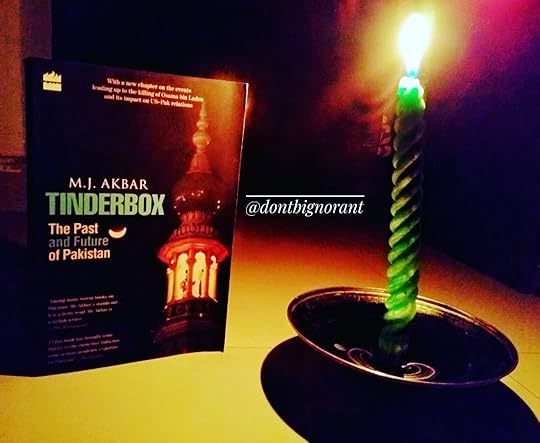
Tinderbox, the past and future of pakistan, talks about the idea that led to the formation of the 'first islamic State' i.e. Pakistan, and the constant struggle between the childrens of Jinnah, founder of pakistan, and the heirs of maulana maududi, founder of jaamat-e-islami, and the God father of pakistan. And the conflict between these two ideologies will define the future of pakistan.
Neither the 'two-nation theory' nor the word 'pakistan' was coined by Jinnah. The former was the idea of sir syed ahmed khan, and the latter was the gift of Chaudhary rahmat Ali. But Jinnah accomplished one thing, that he cunningly mixed religion with politics and he also exploited the popular slogan of mullahs i.e. Islam was in danger, and the result was pakistan.
Before India's partition Jinnah proclaimed that Hindus and Muslims can't live together they are two separate nations but ironically after the creation of Pakistan, Jinnah said that pakistan would be a secular Muslim majority nation not a theocratic state. And he basically underestimated the forces which he used for the creation of pakistan and rightly after his death these forces started the 'talibanization' of pakistan.
Infact with jinnah's death the vision of his secular Pakistan got buried alongside with him. And the man who single handedly destroyed jinnah's dream was the disciple of maududi, general Zia-ul-haq who had changed the slogan of pakistan army to jihad fi sabil allah ( Jihad in the name of allah ).
And the Author rightly said that pakistan displays the characteristics of a ''Jelly state'', neither it will achieve stability, nor disintegrate.
I will recommend this book to those Readers who are interested in reading about pakistan and its conflicting ideology, and the language of the book is not that tough and the author also included some photographs which will make your reading more pleasurable.
My Ratings : ⭐⭐⭐⭐ ( 4/5 )
I hope you like the Review, thanks for reading, Jai Hind.
Table of contents :-
------------------------------
1. The age of defeat
2. A scimitar at somnath
3. A theory of distance
4. An english finesse
5. Grey wolf
6. Gandhi's maulanas
7. The non-violent jihad
8. The Muslim drift from Gandhi
9. Breaking point
10. Faith in Faith
11. The godfather of pakistan
12. God's general
13. The long jihad
14. Pakistan : The siege within
15. Darkside of the moon
-------------------------------------------------------------------
Pakistan is not going to be a theocratic State - to be ruled by priests with a divine mission. We have many non-Muslims - Hindus, Christians, and Parsis - but they are all Pakistanis. They will enjoy the same rights and privileges as any other citizens and will play their rightful part in the affairs of Pakistan.
-Muhammad Ali Jinnah
Tinderbox, the past and future of pakistan, talks about the idea that led to the formation of the 'first islamic State' i.e. Pakistan, and the constant struggle between the childrens of Jinnah, founder of pakistan, and the heirs of maulana maududi, founder of jaamat-e-islami, and the God father of pakistan. And the conflict between these two ideologies will define the future of pakistan.
Neither the 'two-nation theory' nor the word 'pakistan' was coined by Jinnah. The former was the idea of sir syed ahmed khan, and the latter was the gift of Chaudhary rahmat Ali. But Jinnah accomplished one thing, that he cunningly mixed religion with politics and he also exploited the popular slogan of mullahs i.e. Islam was in danger, and the result was pakistan.
Before India's partition Jinnah proclaimed that Hindus and Muslims can't live together they are two separate nations but ironically after the creation of Pakistan, Jinnah said that pakistan would be a secular Muslim majority nation not a theocratic state. And he basically underestimated the forces which he used for the creation of pakistan and rightly after his death these forces started the 'talibanization' of pakistan.
Infact with jinnah's death the vision of his secular Pakistan got buried alongside with him. And the man who single handedly destroyed jinnah's dream was the disciple of maududi, general Zia-ul-haq who had changed the slogan of pakistan army to jihad fi sabil allah ( Jihad in the name of allah ).
And the Author rightly said that pakistan displays the characteristics of a ''Jelly state'', neither it will achieve stability, nor disintegrate.
I will recommend this book to those Readers who are interested in reading about pakistan and its conflicting ideology, and the language of the book is not that tough and the author also included some photographs which will make your reading more pleasurable.
My Ratings : ⭐⭐⭐⭐ ( 4/5 )
I hope you like the Review, thanks for reading, Jai Hind.
Table of contents :-
------------------------------
1. The age of defeat
2. A scimitar at somnath
3. A theory of distance
4. An english finesse
5. Grey wolf
6. Gandhi's maulanas
7. The non-violent jihad
8. The Muslim drift from Gandhi
9. Breaking point
10. Faith in Faith
11. The godfather of pakistan
12. God's general
13. The long jihad
14. Pakistan : The siege within
15. Darkside of the moon

October 11, 2015
MJ Akbar begins off in style. The early Islamic contacts through trade and violence, the dynasties, their decline and the British policies that impoverished them were pretty well narrated. The highlight of the book was the elaboration of Gandhi’s shrewd manipulation of the Khilafat issue and his success in winning over the Muslim support- only to squander it all in the end and lose their trust for good. Hailing from Malabar, I was not aware that the Moplah rebellion also had its links to the Khilafat movement. Akbar also managed to portray Jinnah without much of a bias and my curiosity to understand him better has been roused.
Post 1947, Akbar loses the plot and the last quarter of the book brings forth characters like Maulana Maudidi, the military dictators, Bhutto and ends up in a bit of incoherence. Can’t be recommended to understand Pakistan.
Post 1947, Akbar loses the plot and the last quarter of the book brings forth characters like Maulana Maudidi, the military dictators, Bhutto and ends up in a bit of incoherence. Can’t be recommended to understand Pakistan.

July 25, 2014
An insightful and captivating account of South-Asian History.
May 29, 2017
Comprehensively commendable!
Its a good contemporary book to read, as from few others native Pakistani writers highlighted, pathetic historical deliberate mistakes of statesmen for Islam and Ideology, Pak thrives on.
Theory of distance offered by Eminent political theologian, Shah Waliullah, as the base of Jihad as well, as at one moment the writer jotted down,
"19th century, Jihad had become 'a source of chronic danger to the British power in India"
is the main theme (mostly discussed time and again) of the thesis.
One remarkable quality of the book is its balanced approach. M.J Akbar's harsh innuendos struck sweetly to every party of involved, directly or indirectly, in the events.
Then a reader peruses about Jinah's struggle of uniting communities; Hindu and Islam
,
"Gokhale Praised him in 1914, saying, 'freedom from all sectarian prejudice will make him the best ambassador of Hindu-Muslim unity."
and Gandhi's Jihad with a group of Ullema's, Ali Brothers, Hakim Ajmal Khan , M.A Ansari's indeed, warned by Jinnah as he thought it would lead to communal violence therefore Gandhi ought no to intermix Religion with Politics.
I adored one passage of 'Attaturk-Gandhi's Comparison' the most.
"Gandhi and Ataturk (Father of the Turks), both anointed fathers of their nations, make a fascinating comparison.
Ataturk eliminated an obsolete caliphate from nationalist space and released politics from the embrace of religion. Gandhi used the caliphate to stir a dormant community by infusing religion into politics. Ataturk defeated the West, but welcomed its script, clothes and lifestyle, serving alcohol in public and dancing in immaculate tie and tails. Gandhi was more prohibitionist than any mullah and his battledress was a Ilomespun cotton loincloth. He used khadias economic weapon and dress code. 'I consider it a sin to wear it is sinful for me to wear the latest finery of foreign cloth . Regent Street, when I know that if I had but worn the things woven by the neighbouring spinners and weavers, that would have clothed me and fed and clothed them,' he wrote in the 13 October 1921 issue of Young India. (In 1930, he was spinning 220 yards of yarn each day.)
Ataturk banned the Islamic veil and Ottoman fez and promoted skirts and suits. Gandhi welcomed the veil and fez, signature apparel of the Khilafat Movement. Having stepped out of trousers
himself, he dragged his most famous disciple and heir, Nehru, a child of privilege and student of Ilarrow and Trinity, away from bespoke suits into tight homespun pyjamas and Ions, loose, knee-length cotton shirt developed during centuries of Turkish—Muslim
rule in Delhi.
Ataturk and Gandhi used the same slogan between 1919 and 1922: 'Victory or Death' cried Ataturk; 'Do or Die!' demanded Gandhi. But while Ataturk's battlefields did not offer a third option, Gandhi believed that a final confrontation could always
be postponed on India's minefields. Gandhi always lived to fight or fast another day, until 1947 broke his country and 1948 took his life."
I could never help myself in making assumptions of lack of preparation on both sides of the political parties; Congress and League, on most of the consequential events.
They couldn't set a plan unless there was Britain involvement. Both parties leaders met many a time but they were unable to satisfy to the masses with a proper plan. Idon't know whether it was as B.R Nanda opined; "Hindu Politicians were incapable of generosity and Muslim politicians were incapable of trust."
One thing more startled me was Rajendra Parsad's 'creativity' , as M.J Akbar noted,
"Congress stalwart Rajendra Prasad, who would become the first president of the Republic of India, reacted to the 1940 resolution by describing Pakistan as 'Dinia', a nation based on faith. It was clever wordplay: Din means faith, and Dinia is an anagram of India, suggesting the reverse of a secular state."
After Partition, with many social issues arose ideological issues which statesmen 'tried' to negotiate with terms like 'Pakistan is in Danger, Islam is in Danger' and Pakistan was meant to be an Islamic state as first constitution of 1956 said about , 'Islamic Republic of Pakistan.' Here one thing is apt to mention and that is the analysis of Azad on Partition, on Pakistan.
"Azad listed eight potential ills that could leave the body politic of pakistan in high fever. 'I feel right from its inception, Pakistan will face some very serious problems:
1. An incompetent political leadership will pave the way for military dictatorship as it has happened in many Muslim
countries.
2. heavy burden of foreign debt.
3. Absence of friendly relationship with neighbours and the possibility of armed conflict.
4. Internal unrest and regional conflicts.
5. Loot of national wealth by the neo-rich and industrialists of Pakistan.
6. Apprehension of class war as a result of exploitation by the neo-rich.
7. The dissatisfaction and alienation of youth from religion and collapse of the theory of Pakistan.
8. The conspiracies of international powers to control Pakistan.' "
For Ayub's era, a passage came to my surprise was,
"One great admirer of Ayub Khan was an American academic who became a worldwide name three decades after this paean.
Samuel Huntington thought Ayub Khan "More than any other Political leader in a modernising country after World War II . . . came close to filling the role of a Solon or Lycurgus, or "Great Legislator" bn the Platonic or Rousseauian model. By the time this was published in 1968, even the few Pakistanis who knew of Solon or Rousseau had given up on a man who scented closer to tired dictator than revolutionary philosopher."
Bhutto like others just "maximised the advantage of adversity" and funding resources altered for a time period. This time were Arabian countries.
Zia's pathetic period was tormenting which is still prevailing with more lethal results and Pakistan is facing as it is sole option or fruit of sowing seeds.
"Zia's war objective were significantly different than Reagan's. America wanted the humiliation of the Soviet Union, to revenge Vietnam and Angola and the Horn of Africa. For Zia, the Afghan jihad was also an embryo of a new regional, and perhaps world, order that would emerge out of the Islamic resistance."
M.J.Akbar's ability of discussing issues is brilliant. In the book he discussed Pak's relationship with India, Russia, China and America.
"Very early in his term, President Obama defined Iraq as the war of choice and Afghanistan as the war of necessity"
"In March 2009 a self-professed admirer of the 'Islamic resistance' General Mirza Aslam Beg former Chief of Army Staff, Pakistan, advised in an article distributed by his foundation, Friends Foundation, that America and NATO should quit the region gracefully before they were defeated. It is not necessary to agree with him, but important to know what he says about the power of the Islamic 'Shadow Army': 'The Global Order of the century is being by three major wers: One is led by The United States, supported b the European Union, India and Japan; the second is China and Russia and the third is the Islamic Resistance. The first and the second are not confronting each other. They are, rather, in the cold war frame of mind. It is the Islamic Resistance, which has been confronting.the American power, limiting its role and its global ambitions.' "
And yes There was a brilliant story of Osama Bin Laden. Thank God, it was spicy, or i would have slept in the end. (Kidding, of course)
In ensuing, i share an insight for future suggestion for Pakistanis by Ayaz Amir.
"If Pakistan, wanted to become a modern republic, it would have to revisit the morality tales of that 'prince of hypocrites' General Zia ul Haq. "
Its a good contemporary book to read, as from few others native Pakistani writers highlighted, pathetic historical deliberate mistakes of statesmen for Islam and Ideology, Pak thrives on.
Theory of distance offered by Eminent political theologian, Shah Waliullah, as the base of Jihad as well, as at one moment the writer jotted down,
"19th century, Jihad had become 'a source of chronic danger to the British power in India"
is the main theme (mostly discussed time and again) of the thesis.
One remarkable quality of the book is its balanced approach. M.J Akbar's harsh innuendos struck sweetly to every party of involved, directly or indirectly, in the events.
Then a reader peruses about Jinah's struggle of uniting communities; Hindu and Islam
,
"Gokhale Praised him in 1914, saying, 'freedom from all sectarian prejudice will make him the best ambassador of Hindu-Muslim unity."
and Gandhi's Jihad with a group of Ullema's, Ali Brothers, Hakim Ajmal Khan , M.A Ansari's indeed, warned by Jinnah as he thought it would lead to communal violence therefore Gandhi ought no to intermix Religion with Politics.
I adored one passage of 'Attaturk-Gandhi's Comparison' the most.
"Gandhi and Ataturk (Father of the Turks), both anointed fathers of their nations, make a fascinating comparison.
Ataturk eliminated an obsolete caliphate from nationalist space and released politics from the embrace of religion. Gandhi used the caliphate to stir a dormant community by infusing religion into politics. Ataturk defeated the West, but welcomed its script, clothes and lifestyle, serving alcohol in public and dancing in immaculate tie and tails. Gandhi was more prohibitionist than any mullah and his battledress was a Ilomespun cotton loincloth. He used khadias economic weapon and dress code. 'I consider it a sin to wear it is sinful for me to wear the latest finery of foreign cloth . Regent Street, when I know that if I had but worn the things woven by the neighbouring spinners and weavers, that would have clothed me and fed and clothed them,' he wrote in the 13 October 1921 issue of Young India. (In 1930, he was spinning 220 yards of yarn each day.)
Ataturk banned the Islamic veil and Ottoman fez and promoted skirts and suits. Gandhi welcomed the veil and fez, signature apparel of the Khilafat Movement. Having stepped out of trousers
himself, he dragged his most famous disciple and heir, Nehru, a child of privilege and student of Ilarrow and Trinity, away from bespoke suits into tight homespun pyjamas and Ions, loose, knee-length cotton shirt developed during centuries of Turkish—Muslim
rule in Delhi.
Ataturk and Gandhi used the same slogan between 1919 and 1922: 'Victory or Death' cried Ataturk; 'Do or Die!' demanded Gandhi. But while Ataturk's battlefields did not offer a third option, Gandhi believed that a final confrontation could always
be postponed on India's minefields. Gandhi always lived to fight or fast another day, until 1947 broke his country and 1948 took his life."
I could never help myself in making assumptions of lack of preparation on both sides of the political parties; Congress and League, on most of the consequential events.
They couldn't set a plan unless there was Britain involvement. Both parties leaders met many a time but they were unable to satisfy to the masses with a proper plan. Idon't know whether it was as B.R Nanda opined; "Hindu Politicians were incapable of generosity and Muslim politicians were incapable of trust."
One thing more startled me was Rajendra Parsad's 'creativity' , as M.J Akbar noted,
"Congress stalwart Rajendra Prasad, who would become the first president of the Republic of India, reacted to the 1940 resolution by describing Pakistan as 'Dinia', a nation based on faith. It was clever wordplay: Din means faith, and Dinia is an anagram of India, suggesting the reverse of a secular state."
After Partition, with many social issues arose ideological issues which statesmen 'tried' to negotiate with terms like 'Pakistan is in Danger, Islam is in Danger' and Pakistan was meant to be an Islamic state as first constitution of 1956 said about , 'Islamic Republic of Pakistan.' Here one thing is apt to mention and that is the analysis of Azad on Partition, on Pakistan.
"Azad listed eight potential ills that could leave the body politic of pakistan in high fever. 'I feel right from its inception, Pakistan will face some very serious problems:
1. An incompetent political leadership will pave the way for military dictatorship as it has happened in many Muslim
countries.
2. heavy burden of foreign debt.
3. Absence of friendly relationship with neighbours and the possibility of armed conflict.
4. Internal unrest and regional conflicts.
5. Loot of national wealth by the neo-rich and industrialists of Pakistan.
6. Apprehension of class war as a result of exploitation by the neo-rich.
7. The dissatisfaction and alienation of youth from religion and collapse of the theory of Pakistan.
8. The conspiracies of international powers to control Pakistan.' "
For Ayub's era, a passage came to my surprise was,
"One great admirer of Ayub Khan was an American academic who became a worldwide name three decades after this paean.
Samuel Huntington thought Ayub Khan "More than any other Political leader in a modernising country after World War II . . . came close to filling the role of a Solon or Lycurgus, or "Great Legislator" bn the Platonic or Rousseauian model. By the time this was published in 1968, even the few Pakistanis who knew of Solon or Rousseau had given up on a man who scented closer to tired dictator than revolutionary philosopher."
Bhutto like others just "maximised the advantage of adversity" and funding resources altered for a time period. This time were Arabian countries.
Zia's pathetic period was tormenting which is still prevailing with more lethal results and Pakistan is facing as it is sole option or fruit of sowing seeds.
"Zia's war objective were significantly different than Reagan's. America wanted the humiliation of the Soviet Union, to revenge Vietnam and Angola and the Horn of Africa. For Zia, the Afghan jihad was also an embryo of a new regional, and perhaps world, order that would emerge out of the Islamic resistance."
M.J.Akbar's ability of discussing issues is brilliant. In the book he discussed Pak's relationship with India, Russia, China and America.
"Very early in his term, President Obama defined Iraq as the war of choice and Afghanistan as the war of necessity"
"In March 2009 a self-professed admirer of the 'Islamic resistance' General Mirza Aslam Beg former Chief of Army Staff, Pakistan, advised in an article distributed by his foundation, Friends Foundation, that America and NATO should quit the region gracefully before they were defeated. It is not necessary to agree with him, but important to know what he says about the power of the Islamic 'Shadow Army': 'The Global Order of the century is being by three major wers: One is led by The United States, supported b the European Union, India and Japan; the second is China and Russia and the third is the Islamic Resistance. The first and the second are not confronting each other. They are, rather, in the cold war frame of mind. It is the Islamic Resistance, which has been confronting.the American power, limiting its role and its global ambitions.' "
And yes There was a brilliant story of Osama Bin Laden. Thank God, it was spicy, or i would have slept in the end. (Kidding, of course)
In ensuing, i share an insight for future suggestion for Pakistanis by Ayaz Amir.
"If Pakistan, wanted to become a modern republic, it would have to revisit the morality tales of that 'prince of hypocrites' General Zia ul Haq. "

August 29, 2022
What ties the demand of muslim female students in Karnataka to don the Hijab with what Shah Walliullah said nearly 200 years ago. It’s the ‘theory of distance’ as per which Walliullah urged muslims to stress the difference with hindus by giving importance to action over intellect and promoting the visible over the invisible attributes of Islam. The demand for wearing hijab in classrooms is to this effect only.
The ‘theory of distance’ was revelatory to me. M.J Akbar explains that said theory was propounded by Shah Walliullah, a sunni muslim, in the aftermath of the waning power of mughal empire, and a highly destructive invasion of delhi by the shia muslim, Nadir Shah which decimated the city - both of which together produced a ground for muslim anxieties.
Back then, Akhand Bharat, or undivided India (today’s India, Pakistan, Bangladesh, and Myanmar) was also a hindu majority region, albeit ruled by a muslim minority. The Islamic rulers and invaders (comprising Turks, Afghans, Persians) were known for deviating from the systems and norms established by previous hindu rulers, particularly on the rates of taxation, hatred against indigenous ethnicities and scriptures, enforcing religious taxes, viz., jizya, and destruction of hindu temples. The muslim lay class, especially its religious leaders enjoyed comfortable existence during the heydays of muslim rulers. However, during Aurganzeb’s rule, when it became apparent that muslim rulership is now in terminal decline, perhaps the muslim lay class started anticipating popular revolt by hindu majority, against their inhuman and barbaric rule, which caused anxieties regarding their future.
Akbar pithily comments that muslims’ memory of a glorious past mixed with anxieties of the future came together in the form of ‘theory of distance’ propounded by Walliullah - who feared that without influence of muslim rulers, the lay muslim might get diluted out of their Islamic identity amidst an overwhelming hindu majority population.
As per the said ‘theory’ propounded in Waliullah’s Hujjat Allah al-Baligah (Allah’s conclusive argument) - ‘Faith had to be pure , and separation was the antidote to pollution’ (from so called ‘kaafirs)(Akbar, 2011, p.51). Emphasis added in bracket is mine. Akbar explains it further that, ‘the difference between believer and infidel had been blurred in India, and could be corrected only through forms of alienation. Waliullah had told muslims to live at such a distance from hindus that they would not be able to see the light of the fires in hindu homes’ (Ibid).
The ‘theory of distance’ is capable of explaining a lot of the actions of Islamist leaders and muslims generally as practiced in the Indian sub-continent, leading upto the vivisection of India into two countries divided along religious lines. The very name of the new country that emerged from said vivisection, viz., Pakistan, is a salient give away as the literal meaning is, ‘Land of the Pure’ - i.e., a land free from pollution - an important aspect of the same idea of maintaining distance, that was propounded by Waliullah.
Akbar takes us through a journey of two centuries, starting from the decline of the muslim rule by the weakening of the last of the Great Mughals, viz Aurangzeb, until today’s Pakistan. Akbar gives us a ring-side view of the narrative development of the ‘two nation theory’, starting from the idea of ‘theory of distance’ which ultimately engulfed the Indian sub-continent in communal violence and bloody riots, after that idea acquired a more global scale in the form of ‘two-nation theory’. Akbar peppered the story with some side-stories that give new perspectives into the narratives of the role of INC and the Britishers during the British era and until independence, which I am not dwelling upon.
The reasons why muslim clergy became anxious in the post-Mughal decades is because they otherwise enjoyed a free run during Islamic rule. While it’s true that the bigness of the Indian civilization forced the muslim kingship to split from the clergy, which resulted in two different strains, viz., one practical Islam followed by rulers and the other clergical Islam followed by the clergy. However the Islam followed by rulers never waned the influence of the clergy otherwise, who continued to command a stronghold over muslim mindsets.
There is an incident of Jalaluddin Akbar being hit once by Shaikh Nabi, an Islamic scholar mystic who desperately tried to entrance Jalaluddin Akbar to Islam. Shaikh Sirhindi - the most respected Islamic scholar even described Jalaluddin Akbar as a traitor to Islam. In their friday papers, instead of taking name of Akbar, being the ruler, they took the name of Akbar’s brother Mirza Hakim, governor of Kabul, thus denying Akbar due recognition for his deviations. However, with the decline of Mughal era, the clergy saw potential for loosening of their hold over the lay muslim. In a remarkable observation, M J Akbar states that “Akbar’s rule was an aberration in march of Islam than its high note.”
While ruler’s Islam underwent change in practices owing to the pressures of pragmatism, the clergical Islam continued to remain enveloped in hard boiled fundamentalism with the clergy deriving inspiration from scriptural doctrines without any answerability to the rulers of the day. This parallel strain reached its epitome during the rule of Jalaluddin Akbar who professed deviation from Islamist practices, in the interest of acquiring legitimacy for his minority led muslim rule over the majority hindu population. However, Jalaluddin Akbar’s actions were not free from inviting the Islamist clergy’s opprobium on himself.
The anxieties of the muslim clergy that emerged in the waning phase of Aurangzeb’s era were intensified at the successive military defeats handed out by the Britishers in India. What was once propounded as an idea, in the form of ‘theory of distance’ soon started manifesting itself in the attitudes and aspirations of the muslim elites and religious scholars as they doubled down on the efforts in the post-Mugha era, to create a ‘muslim space’ to conserve the practices and behaviour of the hindus who had converted into Islam. This helps provide an explanation of Pakistan - as a successor of the Mughal empire in India. It is pertinent to note that Akbar claims that Deoband rooted in local history, which also sought muslim space, but within a shared hindu-muslim India (Ibid, p.76).
The idea of ‘theory of distance’ and growing muslim anxieties soon gave way to calls for military jihad, whose leadership was acquired by Sayyid Ahmed Barelvi, a talib (student) of the madarsa started by Waliullah’s father, Shah Abdur Rahim.
Barelvi established the Indian Wahhabi Movement of the 1820, then went on to establish Balakot, which has now become a training centre for modern day Talibanis, and also the same place which was bombed by the Indian Air Force in 2019 after a terror attack carried out by Pakistan at an Indian army camp. Akbar reports Mullah Mahmud, a Talibani leader, who said in an interview to the Chinese daily, “Global Times” that ‘...We were not born today. We were born in the days of colonisation of India by Britain (Ibid, p.48).
The Islamists were thus developing their doctrines for military jihad in India so as to throw out the Britishers, not with the objective of achieving ‘azaadi’, but for capturing India to create their ‘muslim space’ (Ibid, p.150). The Indian Wahhabi movement gained increasing control over the muslim mindspace as they were bent on acquiring the steering wheel of muslim anxieties. After the failure of the 1857 mutiny of British soldiers, Jama Tafseer, a newspaper printed in Delhi in 1867 insisted that Indian muslims had only 2 options - it is incumbent on mussalmans to join together and wage war upon the infidels. Those who are unable to take part in the fight should emigrate to a country of the true faith. This laid the foundation for a diplomatic route to get their own muslim space.
Muslim anxieties were growing especially because the muslim communities’ fortunes started going down as they kept away from learning English or acquiring education as they felt that the Britishers were the ones who dispossessed their position of royalty. On the other hand, the hindus who were hitherto deprived of opportunities in the muslim administrative setup, were eager to learn English and acquire a colonial education so that they could find kinship with the britishers in order to get jobs in the administration - which further increased muslim anxieties. This continues to this day in the anti-western attitudes of the average muslim who is expected to be familiar more with urdu and arabic than with English. Perhaps this explains an anti-west and an anti-colonial sentiment amongst the muslims (which explains why they are good friends with the leftists who are anti-west because of capitalism).
The Britishers wanted to wrest control of the muslim mind from the Indian wahhabist puritans because of their open espousal of violence and doctrinal view of islam - which posed a military and ideological opposition to sustenance of British rule. Therefore, the Britishers channelized the anxieties for a muslim space through ‘Sir Syed Ahmed Khan’.
Shah Waliullah’s theory of distance reached what might be described as an intermediate stage under the leadership of Sir Syed. He was not hostile to hindus but did not believe that it was his responsibility to worry about their welfare (Ibid, p.91). He wanted a muslim deal with the British and while he recognized an intimacy between Islamic and hindu cultures - he could not bother himself with the upliftment of all in a secular fashion. At Siddons club - he likened Indians to monkeys (p.91). In 1885 - he condemned the Indian National Congress and made all attempts to keep muslims away from joining the INC through political scaremongering, and firmly believed that hindus and muslims were separate as two nations. He dwelt on the concept of “one country, two nations” at a speech he delivered on 16th March, 1888, at the invitation of the mussalmans of meerut. In fact, in a petition submitted by Aligarh alumni in 1906, to Viceroy Lord Minto referred to muslims exclusively as a nation (pg. 98).
Later on, the idea of two nations was made part, as an underlying theme, in the demand for separate electorates by Mohammad Ali Jinnah. Muslim separatism was sought to be protected through the demand for ‘separate electorates’ as it was said that hindu muslim union was possible only through commitment on constitutional practicalities (Ibid, p. 115). Jinnah’s demand for ‘separate electorates’ as part of such ‘constitutional practicalities’ was not a united national goal that was being prepared by the INC, rather his demand was projected as a common goal for all of Indians. However said idea, with its underlying theme of ‘theory of distance’ was itself broken to start with.
Even through the khilafat bonhomie, the subtext was quite clear. If the muslims did not protect their right to live by the Qur’an, Islam would be in danger in India (Ibid, p.150). Gandhi courted the khilafat movement and tied it with the non co-operation movement to ensure mass mobilisation. After the chauri chaura incident, when Gandhi called the movement off, the muslims were quick to lose faith in the non-violent movement of Gandhi, and perhaps as a way to signal coming out of the grey of non-violence, Islamists planned and executed the Moplah rebellion (Ibid, p.152). It was an invocation of the doctrine of military jihad amidst the perceived threat of dilution of Islamic identity in hindu presence and Gandhian calls for non-violence. Although a section of muslims felt otherwise and argued that it would be sinful to turn against hindus who had stood by the khilafat cause, and that they should now work for an honourable place for muslims in a free India. Nirad Chaudhuri writes that muslims had completely abandoned Gandhi. In East Bengal, they had even sacked and looted hindu homes in towns and villages. In Gandhi’s agitation for abolition of salt tax - only 2 muslims had joined his band of 78 trekkers (Ibid, p. 186).
These are clear evidences that pre-Independence, a section of muslims sought unity with hindus more as an instrument to be used against the Britishers than as a belief in the value and the spirit of the idea of unity, while seeking to maintain distance in order to conserve and avoid reversion.
Post-1947, Akbar outlines Pakistan’s revisionism and descent into Islamism, anti-hindu bigotry and hindumisia. In Pakistan, hindus were recast as cowards and devious people who burnt their idols, were backward, superstitious and given the chance would deprive muslims and lower castes of education. That revisionism also included eulogising past Islamic invaders like Qasim, Ghazni, Ghori and Aurangzeb. The value of a muslim icon was seen in direct proportion to the anger they aroused among hindus. Therefore, Jalaluddin Akbar is made as an apostate while Aurangzeb whose cycle had started beginning of the end of muslim rule in the country, is still eulogized simply because he introduced jizya tax on hindus.
The value of the book lies in building a coherent narrative that traces a common theme running through muslim rule, through Jalaluddin Akbar’s reign, through Aurangzeb’s decline, through rise of Barelvi and the Indian Wahhabi movement, the British’ need to prop up Sir Syed, the rise of the INC, Sir Syed’s hatred for the INC, establishment of the Aligarh muslim University, Jinnah’s demand for separate electorates, Moplah rebellion, and creation of Pakistan and modern day Taliban. The culprit is and has always been, ‘the theory of distance’.
The ‘theory of distance’ was revelatory to me. M.J Akbar explains that said theory was propounded by Shah Walliullah, a sunni muslim, in the aftermath of the waning power of mughal empire, and a highly destructive invasion of delhi by the shia muslim, Nadir Shah which decimated the city - both of which together produced a ground for muslim anxieties.
Back then, Akhand Bharat, or undivided India (today’s India, Pakistan, Bangladesh, and Myanmar) was also a hindu majority region, albeit ruled by a muslim minority. The Islamic rulers and invaders (comprising Turks, Afghans, Persians) were known for deviating from the systems and norms established by previous hindu rulers, particularly on the rates of taxation, hatred against indigenous ethnicities and scriptures, enforcing religious taxes, viz., jizya, and destruction of hindu temples. The muslim lay class, especially its religious leaders enjoyed comfortable existence during the heydays of muslim rulers. However, during Aurganzeb’s rule, when it became apparent that muslim rulership is now in terminal decline, perhaps the muslim lay class started anticipating popular revolt by hindu majority, against their inhuman and barbaric rule, which caused anxieties regarding their future.
Akbar pithily comments that muslims’ memory of a glorious past mixed with anxieties of the future came together in the form of ‘theory of distance’ propounded by Walliullah - who feared that without influence of muslim rulers, the lay muslim might get diluted out of their Islamic identity amidst an overwhelming hindu majority population.
As per the said ‘theory’ propounded in Waliullah’s Hujjat Allah al-Baligah (Allah’s conclusive argument) - ‘Faith had to be pure , and separation was the antidote to pollution’ (from so called ‘kaafirs)(Akbar, 2011, p.51). Emphasis added in bracket is mine. Akbar explains it further that, ‘the difference between believer and infidel had been blurred in India, and could be corrected only through forms of alienation. Waliullah had told muslims to live at such a distance from hindus that they would not be able to see the light of the fires in hindu homes’ (Ibid).
The ‘theory of distance’ is capable of explaining a lot of the actions of Islamist leaders and muslims generally as practiced in the Indian sub-continent, leading upto the vivisection of India into two countries divided along religious lines. The very name of the new country that emerged from said vivisection, viz., Pakistan, is a salient give away as the literal meaning is, ‘Land of the Pure’ - i.e., a land free from pollution - an important aspect of the same idea of maintaining distance, that was propounded by Waliullah.
Akbar takes us through a journey of two centuries, starting from the decline of the muslim rule by the weakening of the last of the Great Mughals, viz Aurangzeb, until today’s Pakistan. Akbar gives us a ring-side view of the narrative development of the ‘two nation theory’, starting from the idea of ‘theory of distance’ which ultimately engulfed the Indian sub-continent in communal violence and bloody riots, after that idea acquired a more global scale in the form of ‘two-nation theory’. Akbar peppered the story with some side-stories that give new perspectives into the narratives of the role of INC and the Britishers during the British era and until independence, which I am not dwelling upon.
The reasons why muslim clergy became anxious in the post-Mughal decades is because they otherwise enjoyed a free run during Islamic rule. While it’s true that the bigness of the Indian civilization forced the muslim kingship to split from the clergy, which resulted in two different strains, viz., one practical Islam followed by rulers and the other clergical Islam followed by the clergy. However the Islam followed by rulers never waned the influence of the clergy otherwise, who continued to command a stronghold over muslim mindsets.
There is an incident of Jalaluddin Akbar being hit once by Shaikh Nabi, an Islamic scholar mystic who desperately tried to entrance Jalaluddin Akbar to Islam. Shaikh Sirhindi - the most respected Islamic scholar even described Jalaluddin Akbar as a traitor to Islam. In their friday papers, instead of taking name of Akbar, being the ruler, they took the name of Akbar’s brother Mirza Hakim, governor of Kabul, thus denying Akbar due recognition for his deviations. However, with the decline of Mughal era, the clergy saw potential for loosening of their hold over the lay muslim. In a remarkable observation, M J Akbar states that “Akbar’s rule was an aberration in march of Islam than its high note.”
While ruler’s Islam underwent change in practices owing to the pressures of pragmatism, the clergical Islam continued to remain enveloped in hard boiled fundamentalism with the clergy deriving inspiration from scriptural doctrines without any answerability to the rulers of the day. This parallel strain reached its epitome during the rule of Jalaluddin Akbar who professed deviation from Islamist practices, in the interest of acquiring legitimacy for his minority led muslim rule over the majority hindu population. However, Jalaluddin Akbar’s actions were not free from inviting the Islamist clergy’s opprobium on himself.
The anxieties of the muslim clergy that emerged in the waning phase of Aurangzeb’s era were intensified at the successive military defeats handed out by the Britishers in India. What was once propounded as an idea, in the form of ‘theory of distance’ soon started manifesting itself in the attitudes and aspirations of the muslim elites and religious scholars as they doubled down on the efforts in the post-Mugha era, to create a ‘muslim space’ to conserve the practices and behaviour of the hindus who had converted into Islam. This helps provide an explanation of Pakistan - as a successor of the Mughal empire in India. It is pertinent to note that Akbar claims that Deoband rooted in local history, which also sought muslim space, but within a shared hindu-muslim India (Ibid, p.76).
The idea of ‘theory of distance’ and growing muslim anxieties soon gave way to calls for military jihad, whose leadership was acquired by Sayyid Ahmed Barelvi, a talib (student) of the madarsa started by Waliullah’s father, Shah Abdur Rahim.
Barelvi established the Indian Wahhabi Movement of the 1820, then went on to establish Balakot, which has now become a training centre for modern day Talibanis, and also the same place which was bombed by the Indian Air Force in 2019 after a terror attack carried out by Pakistan at an Indian army camp. Akbar reports Mullah Mahmud, a Talibani leader, who said in an interview to the Chinese daily, “Global Times” that ‘...We were not born today. We were born in the days of colonisation of India by Britain (Ibid, p.48).
The Islamists were thus developing their doctrines for military jihad in India so as to throw out the Britishers, not with the objective of achieving ‘azaadi’, but for capturing India to create their ‘muslim space’ (Ibid, p.150). The Indian Wahhabi movement gained increasing control over the muslim mindspace as they were bent on acquiring the steering wheel of muslim anxieties. After the failure of the 1857 mutiny of British soldiers, Jama Tafseer, a newspaper printed in Delhi in 1867 insisted that Indian muslims had only 2 options - it is incumbent on mussalmans to join together and wage war upon the infidels. Those who are unable to take part in the fight should emigrate to a country of the true faith. This laid the foundation for a diplomatic route to get their own muslim space.
Muslim anxieties were growing especially because the muslim communities’ fortunes started going down as they kept away from learning English or acquiring education as they felt that the Britishers were the ones who dispossessed their position of royalty. On the other hand, the hindus who were hitherto deprived of opportunities in the muslim administrative setup, were eager to learn English and acquire a colonial education so that they could find kinship with the britishers in order to get jobs in the administration - which further increased muslim anxieties. This continues to this day in the anti-western attitudes of the average muslim who is expected to be familiar more with urdu and arabic than with English. Perhaps this explains an anti-west and an anti-colonial sentiment amongst the muslims (which explains why they are good friends with the leftists who are anti-west because of capitalism).
The Britishers wanted to wrest control of the muslim mind from the Indian wahhabist puritans because of their open espousal of violence and doctrinal view of islam - which posed a military and ideological opposition to sustenance of British rule. Therefore, the Britishers channelized the anxieties for a muslim space through ‘Sir Syed Ahmed Khan’.
Shah Waliullah’s theory of distance reached what might be described as an intermediate stage under the leadership of Sir Syed. He was not hostile to hindus but did not believe that it was his responsibility to worry about their welfare (Ibid, p.91). He wanted a muslim deal with the British and while he recognized an intimacy between Islamic and hindu cultures - he could not bother himself with the upliftment of all in a secular fashion. At Siddons club - he likened Indians to monkeys (p.91). In 1885 - he condemned the Indian National Congress and made all attempts to keep muslims away from joining the INC through political scaremongering, and firmly believed that hindus and muslims were separate as two nations. He dwelt on the concept of “one country, two nations” at a speech he delivered on 16th March, 1888, at the invitation of the mussalmans of meerut. In fact, in a petition submitted by Aligarh alumni in 1906, to Viceroy Lord Minto referred to muslims exclusively as a nation (pg. 98).
Later on, the idea of two nations was made part, as an underlying theme, in the demand for separate electorates by Mohammad Ali Jinnah. Muslim separatism was sought to be protected through the demand for ‘separate electorates’ as it was said that hindu muslim union was possible only through commitment on constitutional practicalities (Ibid, p. 115). Jinnah’s demand for ‘separate electorates’ as part of such ‘constitutional practicalities’ was not a united national goal that was being prepared by the INC, rather his demand was projected as a common goal for all of Indians. However said idea, with its underlying theme of ‘theory of distance’ was itself broken to start with.
Even through the khilafat bonhomie, the subtext was quite clear. If the muslims did not protect their right to live by the Qur’an, Islam would be in danger in India (Ibid, p.150). Gandhi courted the khilafat movement and tied it with the non co-operation movement to ensure mass mobilisation. After the chauri chaura incident, when Gandhi called the movement off, the muslims were quick to lose faith in the non-violent movement of Gandhi, and perhaps as a way to signal coming out of the grey of non-violence, Islamists planned and executed the Moplah rebellion (Ibid, p.152). It was an invocation of the doctrine of military jihad amidst the perceived threat of dilution of Islamic identity in hindu presence and Gandhian calls for non-violence. Although a section of muslims felt otherwise and argued that it would be sinful to turn against hindus who had stood by the khilafat cause, and that they should now work for an honourable place for muslims in a free India. Nirad Chaudhuri writes that muslims had completely abandoned Gandhi. In East Bengal, they had even sacked and looted hindu homes in towns and villages. In Gandhi’s agitation for abolition of salt tax - only 2 muslims had joined his band of 78 trekkers (Ibid, p. 186).
These are clear evidences that pre-Independence, a section of muslims sought unity with hindus more as an instrument to be used against the Britishers than as a belief in the value and the spirit of the idea of unity, while seeking to maintain distance in order to conserve and avoid reversion.
Post-1947, Akbar outlines Pakistan’s revisionism and descent into Islamism, anti-hindu bigotry and hindumisia. In Pakistan, hindus were recast as cowards and devious people who burnt their idols, were backward, superstitious and given the chance would deprive muslims and lower castes of education. That revisionism also included eulogising past Islamic invaders like Qasim, Ghazni, Ghori and Aurangzeb. The value of a muslim icon was seen in direct proportion to the anger they aroused among hindus. Therefore, Jalaluddin Akbar is made as an apostate while Aurangzeb whose cycle had started beginning of the end of muslim rule in the country, is still eulogized simply because he introduced jizya tax on hindus.
The value of the book lies in building a coherent narrative that traces a common theme running through muslim rule, through Jalaluddin Akbar’s reign, through Aurangzeb’s decline, through rise of Barelvi and the Indian Wahhabi movement, the British’ need to prop up Sir Syed, the rise of the INC, Sir Syed’s hatred for the INC, establishment of the Aligarh muslim University, Jinnah’s demand for separate electorates, Moplah rebellion, and creation of Pakistan and modern day Taliban. The culprit is and has always been, ‘the theory of distance’.
September 4, 2023
Alice in the book “
Alice in wonderland
” asks the cat, ‘Would you tell me, please, which way I ought to go from here?’ ‘That depends a good deal on where you want to get to,’ said the Cat. ‘I don’t much care where’ said Alice. ‘Then it doesn’t matter which way you go,’ said the Cat. Thus to know where Pakistan would end-up, it does matter to know where it has come from and where it wants to go. This book “Tinderbox: The Past And Future Of Pakistan “, by M.J. Akbar tries to understand the path taken by Muslim leaders for the creation of Pakistan to show that the trajectory after creation of Pakistan (according to him future) could not be different from what it is today.
As I read it, I feel that M.J. Akbar also grapples with the same issue that many Indian Muslims face. He defends Muslim sultan's & leaders, trying to portray that initially, they had a favorable attitude towards Hindus, but due to issues created by Hindus/congress (which the author considers as a 'Tinderbox'), they deviated and opted for the formation of Pakistan. Below are some extracts from the book that illustrate this perspective.
a) “Iqtidar Hussain Siddiqui quotes Barani to affirm that Alauddin Khilji ‘The repair of mosques is placed eighth, and there is no mention that Khilji earned any earthly or heavenly merit by destroying idols or spreading the faith. He did loot temples and reward converts, but neither was considered worthy of mention. ‘They (Turkish Sultans) appear to have realized the need for cooperation between the Sultan and hereditary land chiefs, Hindu and Muslim alike,’” ( 535-543)
b) “Barelvi was pragmatic enough to seek good relations with Hindu nobles who had fought the British. He sent a letter through a confidante, Haji Bahadur Shah, to Raja Hindu Rao, brother-in-law of Maharaja Daulat Rao Scindia. This remarkable missive promised that once India was cleared of the British, their territories would be restored to traditional hierarchs, including Hindus.” (Loc: 1068-1073)
c) “His (Sir Syed Ahmad Khan) speech in Patna on 27 January 1883 is often quoted: ‘India is the home of both of us (Hindus and Muslims). We both breathe the air of India and take the water of the holy Ganges and the Jamuna. We both consume the products of the Indian soil. We are living and dying together…My friends, I have repeatedly said and say it again that India is like a bride which has got two lustrous eyes – Hindus and Mussulmans. If they quarrel against each other that beautiful bride will become ugly and if one destroys the other, she will lose one eye.’” (Loc: 1505-1509) with the tinderbox being "birth of the Indian National Congress. From the very beginning he condemned the Congress as a Hindu organization that would make the ‘Muslim nation’ subjects of Hindus rather than Christians, who were at least people of the Book" ( Loc: 1523-1525)
d) "Muhammad Ali’s first editorial in Comrade, in January 1911, recognized the value of Hindu–Muslim cooperation."( Loc: 2016-2017) but the tinderbox effect being as “Mushirul Hasan points out, ‘his enthusiasm for [Congress] was not dampened until the publication of the Nehru report in August 1928’.14 Muhammad Ali accused Gandhi of being a front for Hindu communalism” (Loc: 2944-2948)
e) “Iqbal sought a rational Muslim province, rather than a separate country.” (Loc: 3013-3013)
f) “Jinnah sharply condemned Bengali Muslim excesses in a letter, dated 24 May 1907, to William Wedderburn, an Englishman who had served as Congress president. Jinnah castigated the ‘ignorant and fanatical section of the [Bengali] Mahomedans’ who had indulged in violence against Hindus. ‘A number of Mahomedan rowdies,’ he continued, ‘have been preaching for some time a holy war against the Hindus…on religious grounds.” (Loc: 1764-1771) also he notes that “In his speech to the Muslim League on 12 December 1917, Jinnah ‘I take it that the Hindus and Mohammedans as one nation will make that demand and there will be no going back from it.”” ( 2181-2190)
g) “Kashmiri nationalists could be, and often were, secular, with an equal place for Kashmiri Hindus in their construct. Moreover, most of them sought independence, not merger with Pakistan.” (Loc: 4453-4454)
My take is that Muslim leaders did not wanted Pakistan (a small piece of land from India) rather they wanted to rule full India with Hindus as its subjects if not Dhimmis. As Hindus did not agree for the Muslim rule, Muslim leaders inevitably settled for Pakistan.
The other argument that pops out from the book is Jinnah did not wanted to create Pakistan but used it as a bargaining chip unfortunately, “In trying to protect India from a ‘virtual’ Pakistan, Nehru had inadvertently provided the Muslim League with the opportunity to seek a real Pakistan.” (Loc: 3355-3356) This is evident from the below extract.
“There were five ‘swivel’ moments in Congress–Muslim relations before the formation of Pakistan. The pact negotiated by Jinnah in 1916, in which the Congress accepted separate electorates, was widely described as the basis on which Hindus and Muslims could unite against the British. The second moment, Gandhi’s Khilafat struggle, promised liberation but ended in despair. Jinnah crafted the third opportunity, in 1927 and 1928, when an all-party effort was made to create a Constitution for India by Indians; he failed to bridge the League–Congress gap. In 1937, the two parties could have cemented an electoral understanding with a post-election coalition in the United Provinces, but an ascendant Congress underestimated the potential of a depressed Muslim League. The fifth, and most tantalizing, chance appeared at the very last minute, in 1946, when the Congress and the League accepted the British Cabinet Mission Plan to retain a united India, but the Congress, fearful of Balkanization, reversed its decision. After this, their separate paths became irreversible.” ( Loc: 3026-3034)
Putting blame of creation of Pakistan on Hindus and congress. Using the same logic that Akbar uses (understating the past to justify the future) if India was not divided and Muslim had upper hand in ruling un-divided India undoubtedly Hindus would have no better position than the Pakistani hinds of today. Thus, formation of Pakistan was best thing that can happen to Hindus. Thus his statement “When India became free in 1947, its leaders were committed to a clear objective: a great leap forward into the industrial and modern age.” (Loc: 819-821) is just imaginary un-realistic justification of Muslim rule.
As I read it, I feel that M.J. Akbar also grapples with the same issue that many Indian Muslims face. He defends Muslim sultan's & leaders, trying to portray that initially, they had a favorable attitude towards Hindus, but due to issues created by Hindus/congress (which the author considers as a 'Tinderbox'), they deviated and opted for the formation of Pakistan. Below are some extracts from the book that illustrate this perspective.
a) “Iqtidar Hussain Siddiqui quotes Barani to affirm that Alauddin Khilji ‘The repair of mosques is placed eighth, and there is no mention that Khilji earned any earthly or heavenly merit by destroying idols or spreading the faith. He did loot temples and reward converts, but neither was considered worthy of mention. ‘They (Turkish Sultans) appear to have realized the need for cooperation between the Sultan and hereditary land chiefs, Hindu and Muslim alike,’” ( 535-543)
b) “Barelvi was pragmatic enough to seek good relations with Hindu nobles who had fought the British. He sent a letter through a confidante, Haji Bahadur Shah, to Raja Hindu Rao, brother-in-law of Maharaja Daulat Rao Scindia. This remarkable missive promised that once India was cleared of the British, their territories would be restored to traditional hierarchs, including Hindus.” (Loc: 1068-1073)
c) “His (Sir Syed Ahmad Khan) speech in Patna on 27 January 1883 is often quoted: ‘India is the home of both of us (Hindus and Muslims). We both breathe the air of India and take the water of the holy Ganges and the Jamuna. We both consume the products of the Indian soil. We are living and dying together…My friends, I have repeatedly said and say it again that India is like a bride which has got two lustrous eyes – Hindus and Mussulmans. If they quarrel against each other that beautiful bride will become ugly and if one destroys the other, she will lose one eye.’” (Loc: 1505-1509) with the tinderbox being "birth of the Indian National Congress. From the very beginning he condemned the Congress as a Hindu organization that would make the ‘Muslim nation’ subjects of Hindus rather than Christians, who were at least people of the Book" ( Loc: 1523-1525)
d) "Muhammad Ali’s first editorial in Comrade, in January 1911, recognized the value of Hindu–Muslim cooperation."( Loc: 2016-2017) but the tinderbox effect being as “Mushirul Hasan points out, ‘his enthusiasm for [Congress] was not dampened until the publication of the Nehru report in August 1928’.14 Muhammad Ali accused Gandhi of being a front for Hindu communalism” (Loc: 2944-2948)
e) “Iqbal sought a rational Muslim province, rather than a separate country.” (Loc: 3013-3013)
f) “Jinnah sharply condemned Bengali Muslim excesses in a letter, dated 24 May 1907, to William Wedderburn, an Englishman who had served as Congress president. Jinnah castigated the ‘ignorant and fanatical section of the [Bengali] Mahomedans’ who had indulged in violence against Hindus. ‘A number of Mahomedan rowdies,’ he continued, ‘have been preaching for some time a holy war against the Hindus…on religious grounds.” (Loc: 1764-1771) also he notes that “In his speech to the Muslim League on 12 December 1917, Jinnah ‘I take it that the Hindus and Mohammedans as one nation will make that demand and there will be no going back from it.”” ( 2181-2190)
g) “Kashmiri nationalists could be, and often were, secular, with an equal place for Kashmiri Hindus in their construct. Moreover, most of them sought independence, not merger with Pakistan.” (Loc: 4453-4454)
My take is that Muslim leaders did not wanted Pakistan (a small piece of land from India) rather they wanted to rule full India with Hindus as its subjects if not Dhimmis. As Hindus did not agree for the Muslim rule, Muslim leaders inevitably settled for Pakistan.
The other argument that pops out from the book is Jinnah did not wanted to create Pakistan but used it as a bargaining chip unfortunately, “In trying to protect India from a ‘virtual’ Pakistan, Nehru had inadvertently provided the Muslim League with the opportunity to seek a real Pakistan.” (Loc: 3355-3356) This is evident from the below extract.
“There were five ‘swivel’ moments in Congress–Muslim relations before the formation of Pakistan. The pact negotiated by Jinnah in 1916, in which the Congress accepted separate electorates, was widely described as the basis on which Hindus and Muslims could unite against the British. The second moment, Gandhi’s Khilafat struggle, promised liberation but ended in despair. Jinnah crafted the third opportunity, in 1927 and 1928, when an all-party effort was made to create a Constitution for India by Indians; he failed to bridge the League–Congress gap. In 1937, the two parties could have cemented an electoral understanding with a post-election coalition in the United Provinces, but an ascendant Congress underestimated the potential of a depressed Muslim League. The fifth, and most tantalizing, chance appeared at the very last minute, in 1946, when the Congress and the League accepted the British Cabinet Mission Plan to retain a united India, but the Congress, fearful of Balkanization, reversed its decision. After this, their separate paths became irreversible.” ( Loc: 3026-3034)
Putting blame of creation of Pakistan on Hindus and congress. Using the same logic that Akbar uses (understating the past to justify the future) if India was not divided and Muslim had upper hand in ruling un-divided India undoubtedly Hindus would have no better position than the Pakistani hinds of today. Thus, formation of Pakistan was best thing that can happen to Hindus. Thus his statement “When India became free in 1947, its leaders were committed to a clear objective: a great leap forward into the industrial and modern age.” (Loc: 819-821) is just imaginary un-realistic justification of Muslim rule.
February 5, 2013
Any book, that traces the idea of Pakistan, from its most nebulous beginnings to the present day, from Aurangzeb to Zardari and Kayani, cannot be this short. MJ Akbar's intent is noble, but the chapters of Pakistan's troubled history require more detailed and nuanced treatment. The book gathers pace as it progresses and soon the year changes with each page. This speed is fatiguing and does not do any justice to the complexity of the region.
Pakistan, to me has always been a nebulous entity. Having been conditioned from an early age to look at the partition as a calamity, I was intrigued by the run up to partition described by Akbar. It does seem that partition was the culmination of a series of events stretching back to the era of Aurangzeb. Its seeds lay in the concept of "Muslim otherness". Akbar does a fine job a tracing the evolution of this idea. After partition though, his narrative falters, the scene becomes more complex, new players emerge in the South Asian calculus and one volume can never capture all this tumult.
A decent read, not detailed enough, but there are enough characters in this story to keep you interested.
Pakistan, to me has always been a nebulous entity. Having been conditioned from an early age to look at the partition as a calamity, I was intrigued by the run up to partition described by Akbar. It does seem that partition was the culmination of a series of events stretching back to the era of Aurangzeb. Its seeds lay in the concept of "Muslim otherness". Akbar does a fine job a tracing the evolution of this idea. After partition though, his narrative falters, the scene becomes more complex, new players emerge in the South Asian calculus and one volume can never capture all this tumult.
A decent read, not detailed enough, but there are enough characters in this story to keep you interested.

July 14, 2014
One of the best books that I've read so far. M. J. Akbar provides a very deep analysis of the ideological ethos that lead to the creation of Pakistan. The book can be divided into 3 broad points - the origins of Pakistan, the current state (and the way this has been attained), and the future.
The historical origins of Pakistan are traced back to the decline of the Mughal empire. This analysis has provided an useful understanding into what "minority"-ism is all about. The way the political requirements of a puritanical Islamic state sought to express itself created the foundation for the demand of Pakistan. The analysis of contemporary Pakistan that has been provided provides a template for understanding larger geo-political happenings across the globe. The fanaticism that was fanned by Zia and Maulana Maududi is an important learning point for today. Incidentally, this book made my perception of Jinnah slightly more charitable than before - Jinnah was a fool, not a bigot. The author's reading of Pakistan's present and future is linked to movements across central Asia.
Truly, a stimulating read. Highly recommend.
The historical origins of Pakistan are traced back to the decline of the Mughal empire. This analysis has provided an useful understanding into what "minority"-ism is all about. The way the political requirements of a puritanical Islamic state sought to express itself created the foundation for the demand of Pakistan. The analysis of contemporary Pakistan that has been provided provides a template for understanding larger geo-political happenings across the globe. The fanaticism that was fanned by Zia and Maulana Maududi is an important learning point for today. Incidentally, this book made my perception of Jinnah slightly more charitable than before - Jinnah was a fool, not a bigot. The author's reading of Pakistan's present and future is linked to movements across central Asia.
Truly, a stimulating read. Highly recommend.

July 22, 2011
Excellent history of Pakistan written by an Indian Muslim. One by his own admission 'chose' not to migrate to the land of the pure. Very current, must read. Talks about the idea of Pakistan and the Pakistani of today. Which one does the average Pakistani subscribe to, one of the father Jinnah or the godfather Maudaudi? Inclusive or exclusive? A Pakistan of Rahet Fateh Ali Khan and Aisam ul-Haq Qureshi or the one of Ajmal Kasab and Qadri? Liberal or conservative? It's a question every Pakistani needs to address himself with, do we want Pakistan to be a secular modern state or an Islamic theocratic state? If secular can we envisage living like a second rate India?

January 17, 2014
Though it is tough to capture an entire history in a few pages, the author, through his lucid narration, has done well in exploring a country which has always been an enigma of sorts. Credit must be given to the author for not wavering from the underlying theme of identity crisis, its genesis and nurturance with seamless past and present connectivity though the detailing reduces considerably as we progress towards the end of the book, particularly the post-independence years. But then there is only so much an Indian can dig up about our next door neighbour.
August 24, 2015
Written by well known Indian journalist M.J. Akbar, this is a scholarly book about Indian history, India's freedom struggle, role of Muslim community in it and the partition of India and Pakistan.
This book focuses more on the past and a bit of present. There is actually nothing about future. It is a great commentary on how Pakistan formed, trying to trace the problems of today through the events of past.
These are the views on Pakistan from what is seen from India (though the author is Indian Muslim). I am sure someone from Pakistan may not agree with these views.
This book focuses more on the past and a bit of present. There is actually nothing about future. It is a great commentary on how Pakistan formed, trying to trace the problems of today through the events of past.
These are the views on Pakistan from what is seen from India (though the author is Indian Muslim). I am sure someone from Pakistan may not agree with these views.

August 2, 2012
My copy of this copy is heavily annotated and post-it(ed). I LOVED it. Akbar has a way with words that makes him unlike any other political writer. And he is really really funny - something I appreciate over anything else. Everybody should read this book; apart from being well-informed, the entertainment value is excellent. The critique of the military and the Jamaat-i-Islami are especially giggle-inducing.

October 25, 2014
Traces the idea of Pakistan. Starts with the fall of Mughal empire, and covers the contemporary history of Pakistan - which happens to be one of deceit, fraud and conspiracies at a humongous scale - in some detail. A fascinating account of a toxic jelly state, founded on a weak idea whose foundation was the artificial, whipped up fear of 'Islam in Danger'. Amusing account, would have been funny were it not so tragic as we'll at the same time.
February 24, 2023
MJ Akbar's Tinderbox: The Past and Future of Pakistan has been lying in my bookshelf for the last few years. But somehow I could not get round to start it.
Then, last week I stumbled upon the cover story in Open magazine by MJ Akbar. Provocatively titled, The Doctrine of Indifference, the essay postulates that present stand of the Narendra Modi-led Government of India is just to ignore Pakistan and allow it to bleed itself dry.
Shri Akbar probably speaks for many of us when he says, "What precisely did [Manmohan] Singh and [Atal Behari] Vajpayee get from Pakistan in return for their warm 'partnership'? During the 16 years of their combined tenure, there was a continuous deadly toll of innocent lives across India. If this is what Islamabad means by partnership, then it is time for disengagement."
And I decided to pick up Tinderbox.
Published in 2011, is it little dated? Well, a little.
When the book was written, 26/11 was just three years old. Narendra Modi and his Pakistan policy was nowhere in sight. America was still bogged down in Afganistan. And this fast-changing world was a different place.
Twelve years later Pakistan is in the headlines again. And, as is its wont, for all the wrong reasons. Economy is in tatters. 75 years on, democracy in still wobbling. Foreign exchange reserve is at a historic low. Food shortages have started hurting the common man. Baluchistan is in ferment. One terrorist group has declared formation of its own cabinet. The world has generally accepted, even if privately, that it is looking at a failing state. And, 50 years after the creation of Bangladesh, the talk of implosion of Pakistan is again in the air.
Writing in 2011, Shri Akbar believed that, "Fears of Pakistan disintegration are highly exaggerated."
And be had some very sage advice for it. "The best-case scenario for Pakistan is that the 'Islamic-subaltern' revolt in impoverished areas is brought under control by the military, and elected governments appreciate that the real solution demands social and economic reform: land redistribution; high economic growth which can facilitate rapid redistribution of national wealth; Keynesian investments in low-skill jobs and artisan products; secular, gender-equal education; health care and infrastructure, with democracy as a non-negotiable necessity, which in turn means that the 'doctrine of necessity', the judicial cover for coups, has to be eliminated." (p. 307).
Is Pakistan likely to heed the advice?
Given the hatred that birthed the nation and the hatred that has sustained it for over seven decades, the answer is, no.
We, at this side of the Wagah border, will watch with curiosity - and with concern.
Much water has flown down the Indus in the decade since the book came out. But for keenness of observation - and, yes, elegance of language - Tinderbox is worth reading.
MJ Akbar's two books, Nehru: The Making of India and The Shade of Swords: Jihad and the Conflict Between Islam and Christianity, have rapidly made their way up to the top of my 2023 To Be Read list.
Then, last week I stumbled upon the cover story in Open magazine by MJ Akbar. Provocatively titled, The Doctrine of Indifference, the essay postulates that present stand of the Narendra Modi-led Government of India is just to ignore Pakistan and allow it to bleed itself dry.
Shri Akbar probably speaks for many of us when he says, "What precisely did [Manmohan] Singh and [Atal Behari] Vajpayee get from Pakistan in return for their warm 'partnership'? During the 16 years of their combined tenure, there was a continuous deadly toll of innocent lives across India. If this is what Islamabad means by partnership, then it is time for disengagement."
And I decided to pick up Tinderbox.
Published in 2011, is it little dated? Well, a little.
When the book was written, 26/11 was just three years old. Narendra Modi and his Pakistan policy was nowhere in sight. America was still bogged down in Afganistan. And this fast-changing world was a different place.
Twelve years later Pakistan is in the headlines again. And, as is its wont, for all the wrong reasons. Economy is in tatters. 75 years on, democracy in still wobbling. Foreign exchange reserve is at a historic low. Food shortages have started hurting the common man. Baluchistan is in ferment. One terrorist group has declared formation of its own cabinet. The world has generally accepted, even if privately, that it is looking at a failing state. And, 50 years after the creation of Bangladesh, the talk of implosion of Pakistan is again in the air.
Writing in 2011, Shri Akbar believed that, "Fears of Pakistan disintegration are highly exaggerated."
And be had some very sage advice for it. "The best-case scenario for Pakistan is that the 'Islamic-subaltern' revolt in impoverished areas is brought under control by the military, and elected governments appreciate that the real solution demands social and economic reform: land redistribution; high economic growth which can facilitate rapid redistribution of national wealth; Keynesian investments in low-skill jobs and artisan products; secular, gender-equal education; health care and infrastructure, with democracy as a non-negotiable necessity, which in turn means that the 'doctrine of necessity', the judicial cover for coups, has to be eliminated." (p. 307).
Is Pakistan likely to heed the advice?
Given the hatred that birthed the nation and the hatred that has sustained it for over seven decades, the answer is, no.
We, at this side of the Wagah border, will watch with curiosity - and with concern.
Much water has flown down the Indus in the decade since the book came out. But for keenness of observation - and, yes, elegance of language - Tinderbox is worth reading.
MJ Akbar's two books, Nehru: The Making of India and The Shade of Swords: Jihad and the Conflict Between Islam and Christianity, have rapidly made their way up to the top of my 2023 To Be Read list.

January 29, 2017
This guy can really write. And he can think. He's an Indian journalist who wrote this book well before he found himself in the position of being an assistant Foreign Minister. His is an excellent effort at explaining why Pakistan behaves the way it does, and why India finds it so difficult to engage with it. The philosophical underpinnings of the creation of Pakistan, according to Akbar, are a "theory of distance", propagated by a series of Muslim scholars who concluded that the only way to protect Muslim minorities in a large Hindu nation was to live separately from them. This evolved into an idea of a separate state. I must say that I finished it despairing whether the two countries could ever find a way to reconcile, given how essential this idea seems to be to Pakistani identity.
This is a touchy topic in South Asia, but whether you agree with his thesis or not, you can't fault Akbar for putting it forward so cogently. My only complaint, and it is a gentle one, is that the book - like so much journalism in India - relies on assumed knowledge about the background to certain events and people. If you have grown up steeped in Indian or Pakistani history and politics, I suspect it is a far easier read. I found myself reaching for other sources (thank you, wikipedia) to fill in the blanks at times.

October 31, 2018
I find that there is nothing like the writing of a Indian Muslim on the topic of Pakistan to bring out my patriotism.
I appreciated the historical look at how Pakistan was formed and felt there was some details to history that are not often covered or discussed. Just as Akbar's anti Pakistan bias came out loud and true - reading this book also helped to reveal to me some of the ingrained biases and misinformation that I hold true in relation to this topic. I did like that this book has made me think more about these issues. The part of the book that covered post partition to present I felt was limited and felt very much like outsider information. From the premise it felt obvious that Akbar disagrees with the very premise of Pakistan as a nation. I am more interested in other questions such as can an Islamic state succeed and be a just and safe nation for it's citizens? Is Pakistan an Islamic nation or a fundamentalist one and is there a difference? In the areas that Pakistan has not succeeded is this due to islam or the factors? It appears that Akbar only looks at Islamic fundamentalism as the reason for the failures of Pakistan.
And Akbar does nothing to look at the future for Pakistan.
I appreciated the historical look at how Pakistan was formed and felt there was some details to history that are not often covered or discussed. Just as Akbar's anti Pakistan bias came out loud and true - reading this book also helped to reveal to me some of the ingrained biases and misinformation that I hold true in relation to this topic. I did like that this book has made me think more about these issues. The part of the book that covered post partition to present I felt was limited and felt very much like outsider information. From the premise it felt obvious that Akbar disagrees with the very premise of Pakistan as a nation. I am more interested in other questions such as can an Islamic state succeed and be a just and safe nation for it's citizens? Is Pakistan an Islamic nation or a fundamentalist one and is there a difference? In the areas that Pakistan has not succeeded is this due to islam or the factors? It appears that Akbar only looks at Islamic fundamentalism as the reason for the failures of Pakistan.
And Akbar does nothing to look at the future for Pakistan.

February 20, 2019
A good Book for beginners who wish to understand Pakistan, more aptly the political Pakistan. And it's coming from a muslim author, who is not just a seasoned journalist with decades of experience in journalism, but also is in a suitable position to talk about the ideology of Pakistan, since understanding Pakistan without understanding properly about Political Islam is almost impossible.
Akbar delves into Islamic history, especially the history of Islam in Indian sub-continent, which is completely necessary to understand the formation of Pakistan and the subsequent ideological path it took post independence on 1947. (This is also the reason that some might feel boring while reading this book, especially if they aren't fond of History as a subject.)
Almost 3/4th of the Book deals with Pakistan's Past and Present, whereas only 1/4th is dedicated to its future and rightly so, since future is a matter of speculations whereas past and present are in front of us like an open book.
A good Book that is a beginner's guide to understand Political Pakistan. Hopefully it will widen the understanding of Pakistan for general Indians, especially for non-muslims.
Akbar delves into Islamic history, especially the history of Islam in Indian sub-continent, which is completely necessary to understand the formation of Pakistan and the subsequent ideological path it took post independence on 1947. (This is also the reason that some might feel boring while reading this book, especially if they aren't fond of History as a subject.)
Almost 3/4th of the Book deals with Pakistan's Past and Present, whereas only 1/4th is dedicated to its future and rightly so, since future is a matter of speculations whereas past and present are in front of us like an open book.
A good Book that is a beginner's guide to understand Political Pakistan. Hopefully it will widen the understanding of Pakistan for general Indians, especially for non-muslims.

December 4, 2017
To start with, 'Tinderbox' is probably not the book to choose if you do not live on the Indian Subcontinent unless you are deeply steeped in Pakistan/Indian politics and history. The author assumes the reader knows numerous political figures, places, and non-major events (historical and current). I consider myself worldly knowledgeable, but I was way out of my depth with this book.
Secondly, M.J. Akbar is an Indian journalist turned politician, so his views about Pakistan should not be taken at face value.
Finally, the writing leaves a lot to be desired. This surprised me, given that he is a longtime, well-respected journalist. I agree completely with the opinion on reviewer S.Ach in his review dated Oct. 11, 2016. I won't repeat his views. Cannot recommend this book.
Secondly, M.J. Akbar is an Indian journalist turned politician, so his views about Pakistan should not be taken at face value.
Finally, the writing leaves a lot to be desired. This surprised me, given that he is a longtime, well-respected journalist. I agree completely with the opinion on reviewer S.Ach in his review dated Oct. 11, 2016. I won't repeat his views. Cannot recommend this book.

July 13, 2019
The book turned out to be drastically different from what I was expecting, but nevertheless it was a fascinating read. The title 'Past and Future' of Pakistan is slightly misleading as there is just a hint of present along with a copious dose of past and a couple of large helpings of ancient. Almost 75% of the book concentrates on the events that occurred pre 1947 and explains in great detail the idea of Islam/Pakistan.
I would recommend this book to everyone who's interested in the Enigma that is Islam/Pakistan. Wonder why I'm not separating the two words (Islam & Pakistan). Well, you need to read the book to find that out!
I would recommend this book to everyone who's interested in the Enigma that is Islam/Pakistan. Wonder why I'm not separating the two words (Islam & Pakistan). Well, you need to read the book to find that out!

April 14, 2021
The book is extremely well researched and well written.
It does a great job of explaining the genesis of the 2 nation theory that culminated in the formation of Pakistan.
But it is more than just about the past and future of Pakistan.
The book is essentially about the journey of Islam and the journey of the Muslim League throughout the Indian independence movement.
The book does a great service to Islam by presenting all its Indian ambassadors in an unfiltered form.
The antithesis of Maulana Azad Versus Jinnah is brought out beautifully in this book.
This is a must read for all those interested in Jinnah, the Muslim League and the politics that shaped them both.
It does a great job of explaining the genesis of the 2 nation theory that culminated in the formation of Pakistan.
But it is more than just about the past and future of Pakistan.
The book is essentially about the journey of Islam and the journey of the Muslim League throughout the Indian independence movement.
The book does a great service to Islam by presenting all its Indian ambassadors in an unfiltered form.
The antithesis of Maulana Azad Versus Jinnah is brought out beautifully in this book.
This is a must read for all those interested in Jinnah, the Muslim League and the politics that shaped them both.
July 19, 2025
Pakistan is our only demand!
History justifies it;
Numbers confirm it;
Justice claims it;
Destiny demands it;
Posterity awaits it;
AND By God, we will have it!
Muslims unite!
You have a world to gain.
Muslims unite!
You have nothing to lose but your chains!
Very well researched documentation of Pakistan's forces of genesis: Islam, Mughal rule, Aligarh
Muslim University, Barelvi, Maududi and Jinnah-
The books spends a long time dwelling on United India that it does on the subject of the book: Pakistan; taking into account the beginnings of Islam in India in 792 in Sindh, and even before that in Malabar, the Ghaznavid attacks and the Turco-Afghan run-ins and eventual Empire formations.
A sizable amount of time is spent on the freedom struggle but solely from an interesting religious POV.
Lastly, in a matter of a few pages, it deals with the upheavals of Pakistan and the erratic, strange ways of its helmsmen and ideologues- basically what the book was supposed to be as per the anticipation. All in all, informative, even though a touch biased and somewhat propagandistic, and too much anticipation for no substantial crescendo.
History justifies it;
Numbers confirm it;
Justice claims it;
Destiny demands it;
Posterity awaits it;
AND By God, we will have it!
Muslims unite!
You have a world to gain.
Muslims unite!
You have nothing to lose but your chains!
Very well researched documentation of Pakistan's forces of genesis: Islam, Mughal rule, Aligarh
Muslim University, Barelvi, Maududi and Jinnah-
The books spends a long time dwelling on United India that it does on the subject of the book: Pakistan; taking into account the beginnings of Islam in India in 792 in Sindh, and even before that in Malabar, the Ghaznavid attacks and the Turco-Afghan run-ins and eventual Empire formations.
A sizable amount of time is spent on the freedom struggle but solely from an interesting religious POV.
Lastly, in a matter of a few pages, it deals with the upheavals of Pakistan and the erratic, strange ways of its helmsmen and ideologues- basically what the book was supposed to be as per the anticipation. All in all, informative, even though a touch biased and somewhat propagandistic, and too much anticipation for no substantial crescendo.

March 28, 2018
The research is detailed and gives a comprehensive view of the history that shaped the continent. Quite an impartial view considering there was not one spoiler but many wrong decisions and motivation. I did not like the timeline mix where the author moved back and forth in decades. Would have preferred it to be chronological.

April 15, 2018
An engaging account of Pakistan's history, starting from the Mughals to its present. Akbar is knowledgeable, and presents the book in a very interesting manner. At the beginning, it seemed a little like a rambling of factoids with no order to them, but then everything comes together in the end - to the tinderbox Pakistan has become.

May 10, 2018
A very interesting read, but only if you are already somewhat familiar with the history of Indian subcontinent. I think that without any background knowledge this book seems to give too much information at a really fast pace in some chapters. The topic of the partition of India is a really sensitive topic for all the countries involved in this and hence the history taught in the schools in these countries are skewed for a different narrative. Therefore it was a very refreshing read with a relatively new point of view for me.
This one quote from the book describes the essence of a very large portion of this book very accurately - "For those who wanted a united India, Jinnah's death came too late. For those who sought a secular Pakistan, Jinnah's death came too early."
This one quote from the book describes the essence of a very large portion of this book very accurately - "For those who wanted a united India, Jinnah's death came too late. For those who sought a secular Pakistan, Jinnah's death came too early."
Displaying 1 - 30 of 82 reviews