“From one of the brightest of the new generation of Mormon-studies scholars comes a crisp, engaging account of the religion’s history.”—The Wall Street Journal With Mormonism on the nation’s radar as never before, religious historian Matthew Bowman has written an essential book thatpulls back the curtain on more than 180 years of Mormon history and doctrine. He recounts the church’s origins and explains how the Mormon vision has evolved—and with it the esteem in which Mormons have been held in the eyes of their countrymen. Admired on the one hand as hardworking paragons of family values, Mormons have also been derided as oddballs and persecuted as polygamists, heretics, and zealots. The place of Mormonism in public life continues to generate heated debate, yet the faith has never been more popular. One of the fastest-growing religions in the world, it retains an uneasy sense of its relationship with the main line of American culture.
Mormons will surely play an even greater role in American civic life in the years ahead. The Mormon People comes as a vital addition to the corpus of American religious history—a frank and balanced demystification of a faith that remains a mystery for many.
With a new afterword by the author.
“Fascinating and fair-minded . . . a sweeping soup-to-nuts primer on Mormonism.”—The Boston Globe “A cogent, judicious, and important account of a faith that has been an important element in American history but remained surprisingly misunderstood.”—Michael Beschloss “A thorough, stimulating rendering of the Mormon past and present.”—Kirkus Reviews
Matthew Bowman teaches American religious history at Hampden-Sydney College, and serves as associate editor of Dialogue: A Journal of Mormon thought. He’s interested in evangelicalism, fundamentalism, religion and American culture and occasionally dabbles in Mormon history, noir, and the movies. He’s published in Religion and American Culture: a Journal of Interpretation, The Journal of Mormon History, the John Whitmer Journal, and the Journal of the Early Republic.
In the preface to The Mormon People Matthew Bowman states that his book is a work of synthesis: over the past 40 years Mormon history has seen a sort of a renaissance, with a remarkable amount of scholarship published both by Mormon and non-Mormon academics, and he aims to weave their findings into a coherent narrative which would present a concise history of the Church of the Latter Day Saints, from its inception to the present day. Bowman compares organizing the material to "finding in this astonishing amount of timber something like the unity of a forest". His effort is commendable - the book includes an extensive bibliographic essays, which lists over a hundred titles used in its creation. The author is a professor of religion at the Hampden-Sydney College in Virginia - his work is not an apologetic tract aiming but an attempt to provide an objective and unbiased history of the church and insight into its organization and structure. Bowman dedicated his work to Richard Bushman - himself author of Mormonism: A Very Short Introduction and the biography Joseph Smith: Rough Stone Rolling.
The roots of Mormonism can be traced to an event which occurred almost two centuries ago in a small village in Western New York, where a young man claimed to have been visited by an angel. The man in question was Joseph Smith, who claimed that the angel - whose name was Moroni - disclosed to him the location of golden plates, on which the history of an ancient American civilization was written. Joseph then dug up the plates - which have been written in what he called "reformed Egyptian" - and translated them into English, eventually publishing them as The Book of Mormon: Another Testament of Jesus Christ, which became the basic scripture of the Church of Christ which he subsequently organized, and which later expanded into the Church of Latter Day Saints.
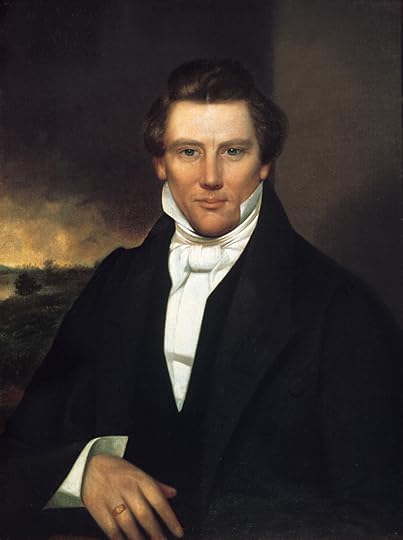
Probably the best known portrait of Joseph Smith, c. 1842.
Joseph Smith's experience was hardly unique. Jacksonian America was a vastly unexplored frontier, which attracted thousands of settlers with an eye for business, but along with them came people seeking spiritual fulfillment. At the time of Joseph Smith's vision America was experiencing the Second Great Awakening, and millions of new members joined already existing Church denominations and formed new ones. Many believed that the period was a new millennial age - the golden age of Paradise on Earth where Christ would reign, which would last for a thousand years before his final judgment and ascend of saved souls to the Heavens. Western New York in particular was the burned-over district where many of the religious revivals occurred: the place populated with seers, prophets and self-proclaimed messiahs. Lured by the promise of almost unlimited land readily available as a potential site for their spiritual fulfillment, antebellum America was populated by people who possessed an Enlightenment skepticism and instinctively doubted the authority of a minister, but at the same time were more than ready to accept the supernatural and as Bowman eloquently puts it "heard the voices of angels outside their windows late at night".
Joseph Smith was an ambitious and restless man, for whom organizing a church was just the beginning. He sent missionaries to preach to Native Americans, whom he believed to be direct descendants of the Nephites and Lamanites - two tribes whose history is described in the Book of Mormon. He believed that with their help he would be able to build nothing else but the city of Zion itself, a New Jerusalem of the western American frontier, which would herald Christ's second coming. Joseph Smith dreamed of a holy city where people would come to to honor God, and together built a new civilization based on peace and religious unity. The charismatic leader convinced his flock to follow him in his quest; people abandoned their homes, jobs and ordinary lives to pursue this dream of a new world. Together they moved west - to Kirkland, Ohio, where the Mormons built their first temple. When Joseph journeyed with his missionaries to a small town of Independence in Missouri, he proclaimed the area to be the site of the Garden of Eden, along with the valley where Adam fled after his exile - and the place to which he would return in the End Times, as described in the Book of Daniel. As Bowman writes, "In a stroke Joseph sacralized the American continent, finding in its vistas not only the Christianized past of the Garden and the Book of Mormon but also the apocalyptic future of the End Times. To many Americans, the Mormons among them, America offered the promise of new birth and a glorious inheritance. To Joseph Smith, it was the land of Christianity’s past and future."
The story of early Mormonism is rich with romantic sense of purpose, and American frontier proved to be a very fertile ground for the new religion expanded rapidly, with thousands of converts coming from as far as Canada. Despite the early success, dark clouds have gathered over Joseph Smith's head. First came the failure of the Kirkland Safe Society - a joint stock company established by Ohio Mormons, which operated as a quasi-bank to serve their financial needs. The Mormons began to exchange its notes as currency and all was well for about three weeks, until a few customers demanded to exchange it for other forms of capital, the bank's meager supplies simply ran out, leaving investors broke and people with worthless notes. This event put a dark mark on Joseph Smith, who was just starting to enjoy being considered a prophet - he was accused of establishing the bank with the intention of enriching himself and Mormon leaders. This event also marks the first schism in the religion, as many bitter and bankrupted Mormons left the church and established their own branch of Mormonism - a restoration of the restoration. Things weren't sunny in Missouri as well, where the Mormon settlement was growing in dissent to Joseph's economic wisdom, and the non-Mormon Missourians grew more and more fearful of the increasing Mormon power in the state. On election day, a group of Missourians tried to stop a Mormon from voting - an event which turned into a full blown armed conflict between Mormons and the Missouri State Guard. Governor of Missouri, Lilburn Boggs, was so outraged by this that he issued the Missouri Executive Order 44 - accusing the Mormons of "attitude of an open and avowed defiance of the laws, and of having made war upon the people of this state", issuing a directive to the state militia: "he Mormons must be treated as enemies, and must be exterminated or driven from the state if necessary for the public peace--their outrages are beyond all description. If you can increase your force, you are authorized to do so to any extent you may consider necessary." After a group of vigilantes executed 17 Mormons, the Mormon leaders surrendered to the authorities, and Joseph Smith willingly went to prison. The Mormons were forced to leave the state and fled to Illinois under the direction of Brigham Young, who would soon became the most important Mormon leader.
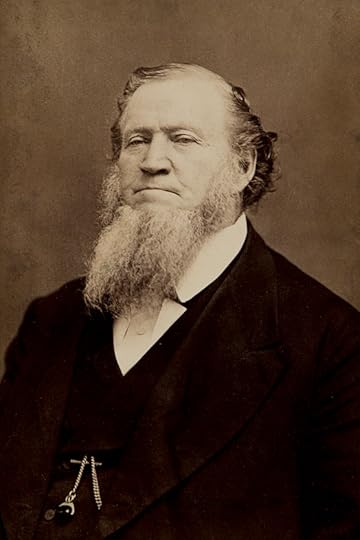
Brigham Young late in life, c. 1870.
Illinois did not bring peace to Joseph Smith - although he managed to escape from Missouri and cross to Illinois, he was accused of being a false prophet and of forcing women into polygamy in a bitter expose. Even though he served as a mayor of the town of Nauvoo and was a candidate for the U.S. presidency, Joseph Smith faced growing tensions in the town: the dissidents criticizing his theological developments were growing in number, and his decision to destroy the printing press which published the expose threatened with an uprising. Missouri was repeating itself: after initially declaring martial law, Smith surrendered himself and went to prison once again - this time with his brother, Hyrum, both charged with treason against the state. There he met his bloody end, as the angry mob stormed the jail. Joseph Smith was shot multiple times as he was trying to escape through the window, and his last words were "Oh Lord my God!". After the murder of their prophet the faithful Mormons decided to leave the U.S. for good - and venture west, into the wild territories.
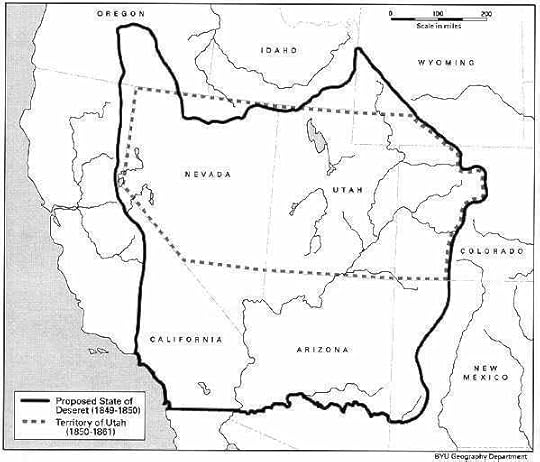
Brigham Young is the closest person to be called an American Moses -as Bowman notes,"if the Mormons saw themselves as a new Israel, the trek west was inevitably their Exodus". Joseph smith did not rise again - he stayed very much dead, but Brigham Young proved to be more than a capable leader. Young continued the initial quest for Zion envisioned by Joseph Smith by settling mainly around the Great Salt Lake and neighboring areas, which he wanted to turn into a de facto theocracy - but when some of the Mormon colonies were annexed to the U.S. through the Mexican Cession, Young petitioned the U.S. government for a creation of the State of Deseret (name coming from the word of "Honeybee", which can be found in the Book of Mormon".). Young's request was denied and Utah Territory was created instead, of which he was appointed governor: as a leader he encouraged self-reliance and sought distance from the U.S., seeing its capitalistic tendencies as poison for the faithful. Much of cities in today's Utah and its neighboring states have been founded under Young's direction, but his leadership was obstructive for the U.S. federal officials - federal marshals viewed young as an autocrat, and president James Buchanan decided to install a non-Mormon governor. Young initially engaged in negotiations with the U.S. government, threatening to burn Salt Lake City down and take his followers to Mexico, but finally stepped down. Still, his influence and Mormon dominance of the area continued to slow down the U.S. annexation of the territory - Utah was admitted into the Union as a state 46 years after Utah Territory has been created, much later than its neighbors (Nevada too only three years). Creation of the state of Utah and imposition of federal authority over the region finally ended the Mormon dream of Zion and New Jerusalem: the Latter Day Saints had to settle with life among other Americans. Still, the Mormon presence in contemporary Utah makes up for two thirds of the population. The state is also home to the Salt Lake Temple - designated by Brigham Young, who also presided over its groundbreaking. Brigham Young University is also located in Utah, and is the largest religious university and third-largest private university in the U.S.
The State of Deseret, as proposed by Brigham Young in 1849. Contemporary state boundaries underlain for reference. Boundaries of historical Utah Territory marked in a dotted line.
Bowman does a quite good job at documenting a change in the church - how from an enclave in Utah the Mormons mingled into the mainstream American population, with convenient revelations changing the approach of the church towards polygamy and black people (who have been banned from being ordained to the Church's lay priesthood and participate in procedures considered necessary for salvation). The Latter Day Saints shifted from isolationism and separatism from the U.S. to appealing to the American public by stressing the importance of family unit and religious belief, and spreading their faith overseas by sending missionaries to various countries. Although by its nature the book does not dive deep into Mormon theology and its sometimes truly extraordinary claims - the word "Kolob" never appears in the text - it does a wonderful job at examining how the Church fits into contemporary American life. The Mormons came a long way - from being perceived as heretics and outcast to having a presidential candidate who represented the Republican party in the last elections and gained a fair amount of support. As the book is meant to be a general introduction to the Latter Day Saints, their history, theology and society it obviously does not cover all aspects of Mormon history, and some elements of it are just brushed upon - such as the fact that ordinance of the Temples is mentioned, but the information that after a temple is ordained it becomes closed to the general public (as opposed to most other religions) is not given - the extensive bibliographic essay contains more than enough material for those wishing to study the religion in depth. One would be hard pressed to find a more concise, approachable and up to date introductory volume to what is essentially a quintessentially American story of self-realization and creation of something unique out of familiar elements, which began when once upon a time a young man in New York was visited by an angel.
Fantastic introduction to the history of the LDS Church that should be read by every Mormon (even though, ostensibly, the book is written primarily with a non-Mormon audience in mind). When Mormons think of "Church History," we usually conjure up images of scripture translation, Kirtland visions, Nauvoo city-building, prophetic martydom, and plains crossing. This book, as any introduction to Mormon history must, rehearses all that—and with remarkable objectivity, I might add. But what was perhaps most useful about this book for me was its presentation of early to mid-twentieth century Mormon history. It became apparent to me that the roots of most 21st century Mormon controversies can be traced to decisions made in the transition from B.H. Roberts/James Talmage era Mormonism to Joseph Fielding Smith/Bruce R. McConkie era Mormonism. From progressive theology to markedly conservative, the angst felt by many liberal or academically-inclined Mormons is more clearly discerned when the pedagogical and liturgical developments of the mid-twentieth century church are laid bare. I found it illuminating and wildly helpful. And it left me with a provocative thought: how might the LDS Church be different today if President Joseph Fielding Smith had not so dramatically shifted course from the Joseph F. Smith, Heber J. Grant, David O. McKay presidencies? Without giving an opinion as to whether the shifted course was good or bad, I cannot escape the conclusion that today's church would be decidedly different.
Wholeheartedly recommend to anyone interested in Mormon History.
If you're looking for a good, readable synthesis of current scholarship on the Church of Jesus Christ of Latter-day Saints, this is your book. Bowman covers 180 years of Mormon history, culture, and theology, from its beginnings with Joseph Smith right up to Mitt Romney's presidential bid and the current "Mormon moment." I especially enjoyed the way Bowman contextualized Mormon history within the broader framework of religious movements within the United States. Subtitled "The Making of an American Faith," this book is really the story of how Mormons went from being a small, marginalized, and persecuted group to a well-established and rapidly growing faith that sees itself as the epitome of traditional American moral and patriotic values.
Bowman dedicates The Mormon People to Richard Bushman, the author of the 2005 biography, Joseph Smith: Rough Stone Rolling. The two books read very similarly, although one is a 300-page, two century overview and the other a 700-page biography. Bowman also includes a useful annotated bibliography for those who'd like to dig deeper.
Whether you're Mormon and want an introduction to more in-depth history than the Sunday School manual provides, or non-Mormon and curious for a peek at the origins and growth of this extraordinary faith, I highly recommend this book.
This was between 3 and 4 stars. In the beginning, I couldn't figure out if it was about church history or the doctrine. As it turns out, it was both but mostly the history. This was a somewhat pragmatic look into this faith. I've studied many religions over the years and by study, I mean talking to actual members of a particular faith....I've never wasted time reading negative publications written about them by others. Those type of materials are usually overly slanted because the author had an ax to grind. To me, it said more about who wrote it than on who they were writing about.
This covered the evolution of Church of Jesus Christ of Latter Day Saints (ie: the Mormons) from their upstart to very recently. It contained a lot of the controversy without being overly slanted or even hateful. It didn't cover the doctrine step by step, but rather used the doctrine to explain its history. I liked this approach for the most part. I don't know if I should round up or down....3 stars doesn't seem like enough....4 seems like too many.
This is a great introductory overview to Mormon history whether readers be members of the faith or not. It’s a bit dated and a lot has happened since it was written. There’s been a lot of scholarship that has come out since it was written including comprehensive history is written by the church itself.
In particular, it was interesting to be reminded of the tensions between between a more expensive, theological approach captured by B.H, Roberts, Talmage, and Widstoe compared to the more pragmatic conservative and dogmatic approach of Joseph Fielding Smith, and Bruce R Mcconkie. While the more conservative approach one out from 1980 to 2010, it appears that the more expensive theological approach is making a come back.
I was interested to get some outside perspective on the history of the church my family has been in for generations. Bowman gives a thorough, yet not overly drawn-out history that does not shy away from flaws or controversy, but doesn’t dwell on them either. He seems almost anxious to defend the people he’s talking about. (I actually had to double-check to make sure he wasn’t a Mormon himself.)
I was somewhat surprised at how positive his analysis of polygamy was. It left the impression of “maybe that wasn’t such a bad idea after all” (or in the case of us believers, “maybe that really was a commandment from God”).
I admit that I was just a little embarrassed at the amount of space dedicated to the discussion of Saturday’s Warrior. That’s one of those Mormon culture things that I’ve always done my best to distance myself from. And yet, there it is. (Now I’ve talked about it too much myself).
It’s a book I think would be well worth the time of current and former Mormons alike, as well as anyone who has any interest in knowing what the Church of Jesus Christ of Latter-day Saints is all about.
Just for the record: I am still a faithful Mormon. While I recognize and acknowledge the missteps that have been taken by church leaders from time to time, the overarching story from 1820 to today gives me the impression of God’s subtle means of nudging His children in the right direction.
Matthew Bowman, a religion professor at Hampden-Sydney College in rural Virginia, has written a matter-of-fact history of the Church of Jesus Christ of Latter-day Saints. Bowman tries to show all sides of issues that faced the Mormon church in an unbiased way.
As I was preparing to write this review, I did a little research myself. I found out Bowman was a member of the LDS Church, which does not disqualify him from writing this book, but he is hardly impartial.
The audiobook was still very interesting and worth a listen. Bowman did cover various controversial subjects such as polygamy, Mountain Meadows, gays, and intellectualism/feminism.
At the end of the book, Bowman referenced the church's outreach video program, "and...I'm a Mormon" and mentioned one of the participants as an urban African American school teacher. I know he had to be talking about Sheryl Garner from Richmond; she now lives in DC, but still visits here. Such a warm, fun, and wonderful person: http://www.youtube.com/watch?v=S-DIbm...
Several times Bowman mentioned Richmond author Terryl Givens and used some of his research. I thought that might be interesting to Nathaniel and Ro.
Bowman’s work holds up and provides an excellent overview of the large historical arc of the LDS Church, though it’s interesting to re-read now and notice how the contemporary LDS Church has continued to make institutional and policy changes since the time of publication. The bibliographic essay at the end remains particularly useful, though again I was surprised by the number of recent works I would add in there. There’s been a lot of excellent recent work in Mormon Studies, and Bowman’s contributions to that growth are significant.
One of the best Mormon History books I’ve ever read. If you’ve ever thought, “wow, my people are odd.” This books explains the development of why we do what we do culturally.
I'm not a Mormon, but as a Christian I wanted to get a little more background on Mormonism. I found this book to be a well written modern history of the Mormon faith written by a Mormon. While the author clearly was sympathetic to Mormonism, I found him to be surprisingly even handed; especially when dealing with the many controversies within the history.
The history of Joseph Smith is very well done and pretty comprehensive. However the subsequent history of the Mormon people is fairly thin, and brushed through quickly (which was fine with me since what I wanted was a history of the church's origin).
I found Smith's history fascinating. And while I respect Mormons for their deep commitment to church and family, I was troubled by much that I saw in their founder. In regard to Smith, several things stood out as red flags in light of what Christian scripture teaches, and several more were just scandalous by any standard.
A few findings:
• Joseph was a treasure hunter before his revelations ~ Instead of working hard at a career, he sought to strike it big and not have to work. Questionable character for someone who allegedly began hearing from God.
• Joseph eloped with his neighbors daughter and moved away, instead of asking her father for his blessing on their marriage ~ This was scandalous in this period and even today the running away is often viewed as something of poor moral character.
• Joseph was a finder of lost things for others for a fee, which he would find with the help of a magic stone he had ~ this strikes me as incredibly creepy, and not the a practice of someone whom you wish to stake your spiritual life on.
• The linguist whom Joseph asked to view the tablets he found, denied that Joseph's tablets said what Joseph told the Mormon church they said ~ the author was silent (as far as I can remember anyway) as to if the tablets still exist or can be viewed by linguists today.
• Joseph was accused and tried in the Mormon church for adultery by an eyewitness, before he received his alleged revelations that polygamy was ok (but was acquitted and the accuser was excommunicated).
• Joseph hid his first polygamous relationships from his wife ~ Not the actions of someone who was convinced of a revelation from God.
• Joseph was a pedophile, in that some of his polygamous wives were 14 years old (If I remember right another was 11). ~ this is incredibly evil, notwithstanding that times have changed regarding the accepted age of consent, - especially considering that Joseph was believed to be a prophet from God. How could any of these girls fathom saying no? A man of good moral character would not do something so incredibly coercive and evil to these young innocent girls who knew no better.
• Joseph ended his life with 30 or more wives, and even married women who were already married to other men in his church ~ The misuse of power is downright disturbing. To all appearances, Joseph simply took for himself the young girls and the already married women he desired.
• Throughout the book, very many of those closest to Joseph left Mormonism entirely. In fact even his original wife married a non-Mormon after Joseph's death ~ This doesn't really argue for the greatest moral character in the man, or the truthfulness of the Mormon faith.
Many of these things are extremely unsettling, but perhaps the biggest issue I have with the Mormon faith is that it relies on its people's works as the guarantor of salvation instead of the work of Jesus Christ on our behalf.
The vivid picture in this book of the Mormon pilgrims, slowly trodding across entire territories, many dying, making the deadly journey west pulling heavily loaded hand carts (by hand, without horses because of the expense) in order to obey the call of their leaders to homestead in Utah, is a horrifying parable of the works based religion itself.
In stark contrast to this picture, is Christianity, which teaches that God became the God-man Jesus to both earn our way to heaven for us by being perfectly righteous for us, and to pay the penalty for sin that we deserve. The great exchange. He gives his perfect righteousness to us as a gift and there is no earning our own salvation, but rather trust and delight in the one who bought this for us at such great a cost. And he also takes all of our sin onto himself, carrying that weight to the cross, and facing the terror of it for us in his brutal murder. He then grants us the Spirit, who changes our deepest desires and directs them toward him, so that growth in holiness is borne from delight, not grueling joyless work.
Instead of requiring us to pull our own burden, Jesus carries the burden of the cross on his back for us, and then dies himself from that load so that we don't have to be crushed by it. God became man and took our burden for us!
Like historian Matthew Bowman, I am an active participant in The Church of Jesus Christ of Latter-day Saints, commonly referred to as the Mormon Church. Bowman’s recent overview of the history and people of the Church, The Mormon People: The Making of an American Faith (published January 2012 by Random House), provides a different perspective on the history of the Church in America. He shares the history by discussing the people that joined the Church as believers and those that interacted with the Church from the early 1800s until today.
I consider myself fairly well read about the history of the Church in the United States, so I was pleasantly surprised by how Bowman’s perspective gave me a new view of Church history. The different personalities of the Church leaders throughout the eras of the Church’s history certainly had an impact on how the Church was administered, how doctrines were taught, how believers were encouraged to live, and how believers and nonbelievers interacted with one another.
The Mormon People does not dumb down controversy. It does not hesitate to examine the disagreements among leaders throughout the 180 years of history since the Church was founded. It also does not discuss the doctrines of the Church in detail, nor provide a comprehensive look at the leaders and key players of the Church throughout that history. From my perspective, though, The Mormon People does what it set out to do: it provides a historic context for the Mormons we see in the public sphere today.
This was a really well done history of the Mormon faith. It fairly considers both sides of major issues and doesn't hesitate to point the mistakes of the church along with its successes. It's really enjoyable over all and I definitely recommend it if you're curious about the church, its history, and its current practices.
This book is a helpful history from the founding days of the church through 2010/2011.
The evolution of the church and its core tenets are on full display as the book explores various early thought leaders in the church and the influence they have had on church leadership and doctrine from the beginning.
Curiously, in the beginning the church was a highly progressive entity (setting aside polygamy which today one might regard as extreme or perverse conservatism).
But the church in the early days had a vision of consecration and shared properties, progressive inclusion of African Americans, gladly delegated meaningful leadership and responsibility to women, and various intellectuals sought to reconcile scientific developments (i.e., evolution) with the church’s theological construct.
Interestingly, that progressive/intellectual bend took a dramatic turn toward conservatism beginning with Joseph F Smith, and saw its peak in the late 20th and early 21st century with leaders such as joseph fielding smith, Bruce r mconkie, and Boyd k packer.
Understandably, the church experienced radical growth during the 20th century, and could not afford anything but to establish core fundamental doctrines, and through correlation, ensure those doctrines were taught with consistency throughout the world. Some may wonder, however, if all extremely conservative positions were necessary, and how the church might be different today had the church not departed from its early inclusive mindset.
That said, since the book was published, and particularly since President Nelson’s call as prophet, the church seems to be softly returning again to allow for more intellectual and progressive influence.
I also noted in the book an interesting pattern associated with the church’s lay clergy. As church ecclesiastical leaders are not formally trained in church doctrine, key focus has been on discipleship rather than doctrinal scholarship. (Whom the Lord calls, the Lord qualifies). As a result, I wonder if the church doesn’t have a challenge of leadership that doesn’t fully know/agree upon some key theological positions of the church.
Overall, this book provides insight for LDS and non-LDS alike, into the growth and development of the church.
My takeaway from this book and others is that revelation is messy. And our spiritual development collectively and individually is a wrestle. And often, men get things wrong. But that doesn’t necessarily imply that men aren’t inspired, it simply means that inspiration takes time, and often requires failed attempts before a broad group of people can settle on final core truth.
On a personal note, I’ve learned from experience, that unless one has developed a pattern of seeking revelation, through immersive scripture study, participation in gospel ordinances, obedience, and communion with God, he/she is not in a position to critique the revelatory process of another.
I could have sworn I uploaded a review for this a long time ago... Oh well. Here are my notes:
It's like a full history of the US since Joseph's parents' time, but with a special focus on the interaction between the US and the church and the development of the church itself. He explains major spiritual cultural movements and what parts of our church culture formed at what time in response to what crisis. It's absolutely fascinating.
There were only a couple of small parts that I took exception to. I would say that if you want to know about Mormons, then you should also read "Our Heritage," which is published by the church and is very short and fun to read. If you're Mormon then you should read that first!
He discusses at length how Mormons are very community-centric. We are what we are collectively. We help each other in hard times, raise our kids together, and do tons of social activities. Our view of heaven is a very social one. We believe in the literal restoration of Zion in the last days.
One comment that really annoyed me: he says that Mormons have no doctrine at all. This is silly; we have tons of doctrine. But we use a different vocabulary to explain it, which makes it difficult to explain it to other Christians. We also have a very different view of canon; we have living prophets and apostles, and believe that it's okay for our understanding of truth to grow over time.
I think I get what he was trying to say, though. Mormons don't like Bible bashing (or are at least told to avoid it). To me, when someone says "it's dumb to believe Satan is going to hell; he should be destroyed altogether at the last day", or when I go on Wikipedia and read that a church's central belief is that Jesus' essence is only one thing or is two separate things combined, etc., all I can give is a blank stare. It feels like splitting hairs to me. What really matters is the restoration of the priesthood and the organization of the church, eternal marriage, etc.
Overall, even though the book is written from a secular point of view, I felt like reading it taught me about myself and where a big part of me comes from. It made me prouder to be a Mormon.
This was the best holistic history of the Church of Jesus Christ of Latter-day Saints I have ever read. I’m a lifelong member of the Church, and I learned many new things about how the Church’s focus and structure have evolved alongside American culture. I wish I had read it ten years ago when it was first published!
The book was neither apologetic nor critical; it provided an objective historical overview that improved my understanding of the trends that have shaped the Church I’ve always known and continue to impact its culture and day-to-day focus. Particularly, I enjoyed the observations of the 20th century periods from Grant through Hinckley that are rarely covered in CES or official Church publications. This insight into how the Church has evolved over time from Joseph and Brigham’s radical sect to a worldwide church that seems modeled after conservative corporate America is what I was hoping to learn from the Saints volumes these past few years.
Bowman’s style was easily accessible, and would be easy to understand for those unfamiliar with Mormonism. I really hope Bowman can publish a new edition that adds a new chapter covering the past decade following Mitt’s loss and the Monson/Nelson administrations. I will get a physical copy of this book because I intend to read it again.
Great, quick review of church history. I appreciated the way that Bowman doesn't shy away from an honest portrait of church leaders, including their biases and mistakes. It's also interesting to see how much has changed in just the last few years since this was published.
This was a really well done, comprehensive synthesis of Mormon history from its inception to 2011. It gave me a lot to think about and also gave me a lot more context into the current Mormon culture.
I've read several books of this sort now, the story is familiar and almost comforting, but it always reads as white men making shit up to make things the last guy said make sense.
That being said, believers would benefit from reading this account of their history because it's not going to break your faith unless you're already PIMO.
I need to see if he has written anything about the church's changes since 2012 though, I'm not sure the Hinckley era was well received by all.
Fantastic story of the history of the Church of Jesus Christ of Latter Day Saints and its beliefs, teachings, etc. Highly recommended to those who aren't familiar with the Church and want to learn more.
The Mormon People provides an overarching narrative arc of this religious movement with "profoundly optimistic theology" starting with Joseph Smith, Jr.'s early childhood and family life and moving up through the modern-day church. While there are definitely books that give a more in-depth view of the various aspects of Mormon history, or the many fascinating characters involved in its growth, The Mormon People is valuable for the "big picture" it draws, linking the history into a single flowing narrative.
I especially appreciate the chapters covering more recent church history - by which I mean everything after the manifesto ending polygamy. There seems to be a pretty significant blind spot in my - and I think most Mormons' - knowledge about how the church has progressed over the past hundred years or so. For example, having been born in 1978, I've never known anything but post-correlation church. Learning about the context of correlation and how broadly it affected just about every aspect of how the church functioned was very informative. Also, the financial troubles of the early church were fascinating, especially in contrast to the stability and relative wealth of today.
A few stories that have taken on "urban legend" status were also addressed, like the story of Symonds Ryder, who supposedly left the church because the Prophet Joseph spelled his name wrong in a revelation. Actually, Mr. Ryder had issues with the principle of consecration, and worried that it was a con to deprive members of their property.
Polygamy was addressed, naturally, as it was a defining feature, particularly during Brigham Young's time as prophet, not only of how Mormons saw themselves, but also how the rest of the world saw them. Interestingly, as defenders of "the principle" many members of the Church came to see monogamy as the source of many of the world's evils. "Mormons drew upon common mid-nineteenth-century American fears of urban decay, poverty, and corruption. The only difference was that the Mormons blamed these problems on the curse of monogamy from which American society suffered." Dr. Bowman explains that "though the numbers vary from place to place and over the forty-year life of official plural marriage in territorial Utah, in general some 20 to 30 percent of Mormons belonged to a family that practiced the principle."
Another fascinating tidbit: I'd always wondered when the church started ordaining 12-year-old boys to priesthood offices. Turns out it was Brigham Young's innovation in the 1870s, shortly before his death, as part of the Mormon Reformation. Prior to this change, men generally served "in only one or two priesthood offices over the course of their entire lives." The Primary, Young Men and Young Women programs also saw their genesis during this time period, prompted by concerns about youth falling away from the faith. "Brigham Young and other leaders hoped that entrusting this responsibility [the preparation and administration of the sacrament] to the young men would encourage their faithfulness and dedication." I couldn't help but think of the parallels when the lower minimum age for both men and women serving church missions was announced this past weekend.
Good section on Elder Bruce R. McConkie and his prolific writings. His "particular fondness for absolute language" distinguished his works and "embodied a particular worldview, a comprehensive theology, and a way of being Mormon." This "retrenchment Mormonism" championed by Elder McConkie incorporated a "suspicion of American culture" and a focus on warning against the "moral decline of the world" and was widely disseminated through the Church Educational System. Ripples are definitely still felt today.
I was particularly interested in the final chapter which covers from 1978 to 2011, as that encompasses the whole of my life and the only church I've ever known personally. Issues raised include low retention rates for new converts (for example, in the 2000 census, 205,000 Mexicans self-identified as Mormon, while church records showed 850,000), the "further integration of Mormons into the texture of American life" (including, for example, the Osmond Family, Mitt Romney, and pop culture like the Twilight series and the Book of Mormon musical), Mormon feminism, the lack of "theological dispute" and difficulty in "pin[ning] down what precisely orthodox Mormon belief is," the priesthood ban on members of African descent, and California's Proposition 8. Whew! It's been a busy and exciting three decades!
I picked this up wanting to learn more about the Mormon faith and while I did learn a little about the faith, I learned a great deal about the history of the people that created and sustained the church. The history was fascinating and went into detail on the key people and the events surrounding them. The book did go into the faith a little covering the beliefs, the practices, and the interesting lack of interest in theology. I can now better appreciate the Mormon emphasis on devotion and intentionality on family, community, and missions. It was a good read, but more focused on history than I thought it would be. Definitely recommend it for readers of church/religious history.
Great history of the Mormon Church and people from its founding to (nearly) the present day. The book is tactful and fair in its treatment of sensitive topics.
In The Mormon People, Bowman faced the difficult task of condensing nearly 200 years of Church of Jesus Christ of Latter-day Saints history into almost as many pages. And writing it for a popular audience. And writing the entire project over the course of about four months. In the end, he pulled this off brilliantly.
The Mormon People is the best introduction to the culture, history, and basic beliefs of my faith that I've seen outside of the Church’s Deseret printing label. In fact, this book has a distinct advantage over many of those other writings as it benefits from having Bowman’s neutralizing historian’s perspective. Some critics of the book accuse Bowman of being overly sympathetic because he is himself an observant Mormon. This could not be farther from the truth. His treatment of Church history is comprehensive—he does not ignore or even lightly pass over some of the more controversial aspects of LDS history. His analysis is thorough and thoughtful.
I argue that a Mormon scholar was the best choice of author for a book of this sort. Who better to introduce the most important aspects of the identity of a people than someone who knows firsthand how that group identifies itself? Adding the skeptical and analytical eye of an academic to that qualification allows the author to take a step back and acknowledge history as a whole, not ignoring anything for the sake of saving face.
Bowman should also be lauded—especially considering the extremely limited time frame he was given to write the book—for its readability and flow. Bowman is a historical scholar. Historians are not known for their creative nonfiction writing savvy. The majority of the academic history texts I encountered in my graduate studies are dry bricks of wordy pages. Some scholars even seem to strive to avoid being readable because textual density gives them an odd academic street cred. The Mormon People, in contrast, is clear and concise in its prose. I found an occasional sentence here and there that required a second pass, but these were the exception.
Some individuals have found fault with the book because it did not go into greater depth on various respective topics that the readers wanted to know more about—the practice of plural marriage, the Mountain Meadows Massacre, and the current struggle of feminist Mormons are some of the more common topics. Unfortunately for these readers, The Mormon People was not written to be a treatise on the major controversies and critiques of LDS practices. It clearly defines itself as an introduction and overview of Mormon history. Not delving deeper into the darker corners of the LDS past is not a deficiency in the text—the despondent reviewers who find it lacking have simply read the wrong book. Bowman gives those readers a great help in his thorough bibliographic essay in the appendix. If anyone wishes to know more about any topic he addresses (and he does address all three that I listed above), it is easy to find several works that will help them do so.
I recommend The Mormon People to anyone who wants to understand who the Mormons are and what defines us. I also recommend it to members of the LDS church—it offers a fresh perspective on our history and reminds us of our roots—whether your ancestors were pioneers or whether you joined the Church last year.
So at first I thought this book's framing was a little too narrow: how can a Mormon, Mitt Romney, be a serious contender for the Presidency in America? With the election over, I thought, wow this may not be a very relevant work in just a few years. But as I read it, it actually is a nicely packaged chronology of Mormon history and culture that demonstrates how "the Mormon people" have transformed from a radical religious group that sought to escape American political neglect and persecution to an exemplary, conservative community of patriots embracing the most successful "American-born religion." In this sense, I think this work will be relevant for many years to come.
I thought the organization was well-composed; many Mormon chronologies give a weighted portion of their time to the early 19th century history (Joseph Smith through the exodus to Utah), but this book gives a fair amount of time to the 20th century developments and even a sliver of 21st century developments. Although the overall thesis statement (which follows this) is not explicitly referred to throughout the book, Bowman does a thorough job of chronicling Mormon historiography such that when he does reach his conclusion it is compelling and believable.
"It is too easy, however, to mark off the history of Mormons in binary: now and then, polygamous visionaries and monogamous Puritans, social revolutionaries and dour Republicans, 1840s Nauvoo and present-day Provo, Utah. ... At the heart of the faith a radical and transformative vision still lurks, and the Mormons made America their own as much as they made themselves Americans" (250-251).
"While the story of Mormonism in America is in many ways the story of the Americanization of a radical religious movement, it is also the story of the preservation of a dream and the still-beating heart of Joseph Smith's vision of Zion" (253).
Thus, despite fundamental transformations of the Mormon people and their religion, Bowman warns against simply reading the transformation as a complete process leaving the present state entirely indistinguishable from its origins. But rather, the evolution of Mormonism has not extinguished the optimistic hope of preparing a people for Christ's Second Coming and His millennial reign. The Mormon culture is paradoxically malleable but resilient.
For the first time in American history, a Mormon has gained the nomination for president from one of the major political parties. Thus, this book is timely. It is not a difficult read, though it is thorough. Bowman does not just tell us about the beginnings of Mormonism and Joseph Smith, but he takes us on a complete Mormon history in the United States up to the present day. The greatest value in the book lay in all of the story from the death of Joseph Smith on. Mormonism did not stay unchanged. Much of what Mormons believe and practice today grew from decisions made by leadership after Smith (and after Brigham Young).
What I found most interesting about this book is the assertion that Mormons are not interested in theological speculation the way (other) Christians traditionally have been. Don't misread that - there is Mormon theology that seeks to answer the same questions all religions and denominations answer. But Mormons in general are more interested in living out their faith on a practical level. Perhaps this is where most debates about "are Mormon Christians" go awry. The average Mormon talks and lives like any other Christian. Do they hold to the Council of Nicea or to the Trinity as historically understood? Not technically. Of course, if that is the standard for how Mormons are judged, then a lot of traditional Christians are in trouble for most probably don't understand the Trinity too well either.
The best thing about this book is that Bowman writes with respect. I found myself feeling sympathy for the various figures. There is no mockery or anything of that nature. At the same time, Bowman shows the does not write as a Mormon apologist. He writes a solid history of the Mormon faith which would be an enriching read for anyone interested in the topic.
Knowing Mormon history, but from within, I have always had a rather fragmented understanding. For once all the pieces have fallen into chronological/contextual order! For that alone, this was an invaluable read, but it also is very interesting and well-written, despite the superfluous use of the word "some". I highly recommend it to anyone curious about Mormons, and to Mormons themselves.
After a few days of thinking I have come to the following clarifying conclusion: This book is not about faith, it is about religion, to use Reza Aslan's distinction.* It is about that religion's interaction with America, and subsequently its growth into internationality. It isn't even really a deep look at people within the religion. It is a broad, sweeping history of the religion. For those interested in simply quantifying the beliefs of Mormons around you in the world today, you could get away with reading the last chapter. For those interested in why you have any opinion at all of Mormons and/or how that opinion is shaped by history, you should read the whole book. For those interested in specific people, read biographies of those specific people.
As an aside, between this book and "No god but God" I am now thoroughly intrigued by religious histories on the grand scale that cover the beginnings to the modern day. Anyone know of good histories of other religious groups?
*"Religion, it must be understood, is not faith. Religion is the story of faith. It is an institutionalized system of symbols and metaphors (read rituals and myths) that provides a common language with which a community of faith can share with each other their numinous encounter with the Divine Presence." - No god but God, xxv
A very engaging, but not sensational, read. Bowman provides a concise narrative of how Mormons became the way they are today: theologically, politically, and socially, focusing on Mormons's engagement with American society. He offers no opinions.
Especially riveting was the evolution dispute between Widtsoe/Talmage/Roberts and Joseph Fielding Smith. Apostles Widtsoe (mathematician), Talmage (geologist) and the council of 70 member Roberts argued there were "pre-Adamites" that existed, while JF Smith (who reads fundamentalist Protestant literature) thought that was heretical. The President of the Church, Heber J. Grant (businessman), did not care about evolution so he issued a First Presidency Statement calling for a non-overlapping mageiteria, stating that the scientific disciplines are irrelevant to salvation.
I would have liked more from the book:
-Illustrations of how united Mormons are today. He starts the story (Joseph Smith's communitarian vision), proceeds to polygamy creating a less-fragmented society, but doesn't depict the current cohesiveness of Mormons today. -More content about Mormonism as a global faith in the chapter "Towards a global faith."
I’m upset because I wasted twenty-five years of my life in the Mormon Church, yet knew almost nothing of the Church’s history outside of the approved, sanitized stories from Church history that I was taught growing up. News flash: the current Mormon Church is fundamentally different from the church Joseph Smith established and Brigham Young refined. The early Church was more about existing within the Church community and fulfilling one’s communal role than today’s practice of adhering to a strict moral code.
I’m also upset because I feel like I am finally able to understand my ancestors without the taboo the Church places on polygamy and constant pressure to romanticize ancestors’ paradoxical “moral superiority”. Yes, my ancestors practiced polygamy, and, yes, I still believe polygamy is wrong because of its rejection of consent and equality in relationships, but at least I can now understand what life was like for them, and why they made the choices they did. Truth is superior to justification any day.
I love The Mormon People as it gives me a brief yet revealing overview of the religion that has consumed most of my life. I genuinely want to buy this book.