

What do you think?

Thoughts out of Season Part I
This book was converted from its physical edition to the digital format by a community of volunteers. You may find it for free on the web. Purchase of the Kindle edition includes wireless delivery.
154 pages, Kindle Edition
First published January 1, 1874
About the author
Friedrich Nietzsche
4,011 books26.9k followersFriedrich Wilhelm Nietzsche was a German classical scholar, philosopher, and critic of culture, who became one of the most influential of all modern thinkers. He began his career as a classical philologist before turning to philosophy. He became the youngest person to hold the Chair of Classical Philology at the University of Basel in 1869 at the age of 24, but resigned in 1879 due to health problems that plagued him most of his life; he completed much of his core writing in the following decade. In 1889, at age 44, he suffered a collapse and afterward a complete loss of his mental faculties, with paralysis and probably vascular dementia. He lived his remaining years in the care of his mother until her death in 1897 and then with his sister Elisabeth Förster-Nietzsche. Nietzsche died in 1900, after experiencing pneumonia and multiple strokes.
Nietzsche's work spans philosophical polemics, poetry, cultural criticism, and fiction while displaying a fondness for aphorism and irony. Prominent elements of his philosophy include his radical critique of truth in favour of perspectivism; a genealogical critique of religion and Christian morality and a related theory of master–slave morality; the aesthetic affirmation of life in response to both the "death of God" and the profound crisis of nihilism; the notion of Apollonian and Dionysian forces; and a characterisation of the human subject as the expression of competing wills, collectively understood as the will to power. He also developed influential concepts such as the Übermensch and his doctrine of eternal return. In his later work, he became increasingly preoccupied with the creative powers of the individual to overcome cultural and moral mores in pursuit of new values and aesthetic health. His body of work touched a wide range of topics, including art, philology, history, music, religion, tragedy, culture, and science, and drew inspiration from Greek tragedy as well as figures such as Zoroaster, Arthur Schopenhauer, Ralph Waldo Emerson, Richard Wagner, Fyodor Dostoevsky, and Johann Wolfgang von Goethe.
After his death, Nietzsche's sister Elisabeth became the curator and editor of his manuscripts. She edited his unpublished writings to fit her German ultranationalist ideology, often contradicting or obfuscating Nietzsche's stated opinions, which were explicitly opposed to antisemitism and nationalism. Through her published editions, Nietzsche's work became associated with fascism and Nazism. 20th-century scholars such as Walter Kaufmann, R.J. Hollingdale, and Georges Bataille defended Nietzsche against this interpretation, and corrected editions of his writings were soon made available. Nietzsche's thought enjoyed renewed popularity in the 1960s and his ideas have since had a profound impact on 20th- and early 21st-century thinkers across philosophy—especially in schools of continental philosophy such as existentialism, postmodernism, and post-structuralism—as well as art, literature, music, poetry, politics, and popular culture.
Nietzsche's work spans philosophical polemics, poetry, cultural criticism, and fiction while displaying a fondness for aphorism and irony. Prominent elements of his philosophy include his radical critique of truth in favour of perspectivism; a genealogical critique of religion and Christian morality and a related theory of master–slave morality; the aesthetic affirmation of life in response to both the "death of God" and the profound crisis of nihilism; the notion of Apollonian and Dionysian forces; and a characterisation of the human subject as the expression of competing wills, collectively understood as the will to power. He also developed influential concepts such as the Übermensch and his doctrine of eternal return. In his later work, he became increasingly preoccupied with the creative powers of the individual to overcome cultural and moral mores in pursuit of new values and aesthetic health. His body of work touched a wide range of topics, including art, philology, history, music, religion, tragedy, culture, and science, and drew inspiration from Greek tragedy as well as figures such as Zoroaster, Arthur Schopenhauer, Ralph Waldo Emerson, Richard Wagner, Fyodor Dostoevsky, and Johann Wolfgang von Goethe.
After his death, Nietzsche's sister Elisabeth became the curator and editor of his manuscripts. She edited his unpublished writings to fit her German ultranationalist ideology, often contradicting or obfuscating Nietzsche's stated opinions, which were explicitly opposed to antisemitism and nationalism. Through her published editions, Nietzsche's work became associated with fascism and Nazism. 20th-century scholars such as Walter Kaufmann, R.J. Hollingdale, and Georges Bataille defended Nietzsche against this interpretation, and corrected editions of his writings were soon made available. Nietzsche's thought enjoyed renewed popularity in the 1960s and his ideas have since had a profound impact on 20th- and early 21st-century thinkers across philosophy—especially in schools of continental philosophy such as existentialism, postmodernism, and post-structuralism—as well as art, literature, music, poetry, politics, and popular culture.
Ratings & Reviews
Friends & Following
Create a free account to discover what your friends think of this book!
Community Reviews
Displaying 1 - 8 of 8 reviews

May 28, 2020
The essay on Wagner here in Thoughts Out of Season (Untimely Meditations, vol.1) hits all the notes you'd expect from the Romantic Era: nature and the sublime, the tortured genius struggling to bring forth his originality, rebellion against the constraints of artificially-imposed neoclassical artforms, the virtuoso artist developing out of the German Sturm und Drang movement, culminating in the 'grand opera' genre as the Gesamtkunkswerk. In this period of Nietzche's hero-worship of Wagner, conceived as a Byronic figure, he glosses over Wagner's campaign against Meyerbeer, because, well, Nietzsche was part of that campaign, as evidenced here--despite the fact that Wagner's ressentiment against Meyerbeer is the sort of thing Nietzsche would otherwise condemn (see Beyond Good and Evil). A word of caution to the reader: Nietzsche assumes a thorough familiarity with Wagner's music, to appreciate his masterful summary of his hero's oeuvre. And to get the full effect, and to put this early essay into its proper context as just one stage in Nietzsche's assessment of Wagner, you'll want to follow up with The Case Against Wagner (1888) and Nietzsche Contra Wagner (1888-9). In the latter, one of the last lucid things he wrote before succumbing to illness, he repents against the earlier views he published about Wagner's music, herein. He is particularly ashamed about his earlier claim here that Wagner represented some sort of wave for the future, rather than a retrograde reflection of things past.
As far as I know, he never did pull back from the character assassination he indulged in against David Strauss, in the first essay of Thoughts Out of Season.
There's nothing particularly out of season or "unfashionable" with these two essays, unless one wants to construe 'out of season' as being products of the author's youth (age 30-32 when he published them), perhaps writings that should be understood as precocious. Otherwise he seems very much a product of his age, heavily influenced by the Zeitgeist.
As far as I know, he never did pull back from the character assassination he indulged in against David Strauss, in the first essay of Thoughts Out of Season.
There's nothing particularly out of season or "unfashionable" with these two essays, unless one wants to construe 'out of season' as being products of the author's youth (age 30-32 when he published them), perhaps writings that should be understood as precocious. Otherwise he seems very much a product of his age, heavily influenced by the Zeitgeist.
November 15, 2025
Recomendable sólo si quieres leer todo Nietzsche porque eres un apasionado de su pensamiento. Es preocupante ver ya, a finales del siglo XIX, como hay una denuncia del declive del lenguaje provocada por una cultura floja, satisfecha de sí misma y alimentada únicamente de periódicos. Interesante ver cómo aparece en el libro la figura del filisteo y cultifilisteo.

January 3, 2012
One half of Untimely Meditations and two long essays on history, culture and Schopenhauer from a young Nietzsche. Like Birth of Tragedy, these early meditations outline concepts that would become fully realized in his later works. Required reading for anyone interested in Nietzsche.

March 15, 2012
Essays from a younger Nietzsche. In the public domain, with a free electronic copy here.
November 6, 2018
Did not finish and I do not intend to. The first half isn’t even Nietzsche; and it’s boring and pedantic.

December 27, 2023
For meg har det å lese Nietzsche blitt noe jeg tenker jeg skal igjennom. Lesingen av denne boka får meg til å spørre meg hvorfor. Vil jeg meg selv virkelig så vondt. Jeg opplevde store deler av boka som tungrodd og smertefull å komme meg gjennom.
Hvordan i all verden skal dette tjene meg som far, spesialpedagog eller alkoholiker i tilfriskning? Etter å ha grunnet på dette, er jeg kommet frem til at jeg kanskje må lese den anderledes. Jeg må være aktivt søkende for å finne mening for meg, og også akseptere at denne ikke finnes hver dag. Hvis jeg leser for å finne svar, vil jeg finne noe. Med dette utgangspunktet gikk resten av boka så mye lettere.
Hvordan i all verden skal dette tjene meg som far, spesialpedagog eller alkoholiker i tilfriskning? Etter å ha grunnet på dette, er jeg kommet frem til at jeg kanskje må lese den anderledes. Jeg må være aktivt søkende for å finne mening for meg, og også akseptere at denne ikke finnes hver dag. Hvis jeg leser for å finne svar, vil jeg finne noe. Med dette utgangspunktet gikk resten av boka så mye lettere.

April 16, 2016
 "Women can form a friendship with a man very well; but to preserve it - to that end a slight physical antipathy must probably help." - Nietzsche Family Circus
Description: "Human, All-Too-Human (1878) is often considered the start of Friedrich Nietzsche's mature period. This complex work, composed of hundreds of aphorisms of varying length, explores many themes to which Nietzsche later returned and marks a significant departure from his previous thinking. Here Nietzsche breaks with his early allegiance in Arthur Schopenhauer and Richard Wagner, and establishes the overall framework of his later philosophy. In contrast to his previous disdain for science, now Nietzsche views science as key to undercutting traditional metaphysics. This he sees as a crucial step in the emergence of free spirits who will be the avant-garde of culture." This is an essential work for anyone who wishes to understand Nietzsche's incisive critique of such diverse aspects of Western culture and values as the idea of good and evil, the roles of women and children in society, and the concept of power and the state.
Kicking off is: DAVID STRAUSS, THE CONFESSOR AND THE WRITER: I. : Public opinion in Germany seems strictly to forbid any allusion to the evil and dangerous consequences of a war, more particularly when the war in question has been a victorious one. Those writers, therefore, command a more ready attention who, regarding this public opinion as final, proceed to vie with each other in their jubilant praise of the war, and of the powerful influences it has brought to bear upon morality, culture, and art. Yet it must be confessed that a great victory is a great danger. Human nature bears a triumph less easily than a defeat; indeed, it might even be urged that it is simpler to gain a victory of this sort than to turn it to such account that it may not ultimately prove a serious rout.
 "We Germans are of yesterday," Goethe once said to Eckermann. "True, for the last hundred years we have diligently cultivated ourselves, but a few centuries may yet have to run their course before our fellow-countrymen become permeated with sufficient intellectuality and higher culture to have it said of them, it is a long time since they were barbarians."
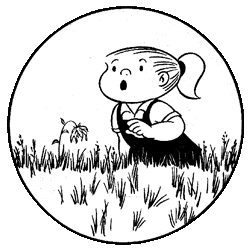 Is not life a hundred times too short to bore ourselves? - Nietzsche Family CircusA corpse is a pleasant thought for a worm, and a worm is a dreadful thought for every living creature. Worms fancy their kingdom of heaven in a fat body; professors of philosophy seek theirs in rummaging among Schopenhauer's entrails, and as long as rodents exist, there will exist a heaven for rodents. In this, we have the answer to our first question: How does the believer in the new faith picture his heaven? The Straussian Philistine harbours in the works of our great poets and musicians like a parasitic worm whose life is destruction, whose admiration is devouring, and whose worship is digesting.
 It has been many moons since I read any FN, however this one has just been completed over on Gutenberg and Brazilliant alerted me (hattip). Maybe you would care to re-visit too, here is the link.
 NB I found three spelling mistakes in the grramazon blurb, so be careful when copying and pasting. (headsup)
PS The new default typeset at Project Gutenberg is easy on the eyes, a vast improvement.

Want to Read
April 16, 2016Free download available at Project Gutenberg.
David Strauss, the Confessor and the Writer - Richard Wagner in Bayreuth.
David Strauss, the Confessor and the Writer - Richard Wagner in Bayreuth.
Displaying 1 - 8 of 8 reviews