Beginning in the year 711 and continuing for nearly a thousand years, the Islamic presence survived in Spain, at times flourishing, and at other times dwindling into warring fiefdoms. But the culture and science thereby brought to Spain, including long-buried knowledge from Greece, largely forgotten during Europe's Dark Ages, was to have an enduring impact on the country as it emerged into the modern era. In this gracefully written history, Richard Fletcher reveals the Moorish culture in all its fascinating disparity and gives us history at its here is vivid storytelling by a renowned scholar.
Richard Alexander Fletcher was a historian who specialized in the medieval period. He was Professor of History at the University of York and one of the outstanding talents in English and Spanish medieval scholarship.
Since I have friends visiting from abroad and we will be travelling to Andalusia, it was time to revise the history of the Muslims in Spain. After the disappointing read of Menocal, eyeing my library I saw this book, which I had read years ago, and pulled it out again and sat with it. What a delight to read a commonsensical account of this difficult period.
Fletcher is very clear in his narrative. He follows a chronological order, differentiating very well the various phases: the arrival and fast conquest; the Ummayad settlement; the independent Caliphate with Cordoba as its major centre; the degeneration of the latter and the formation of the various Taifa kingdoms – in Zaragoza, Toledo, Valencia, etc…; the invasion from the fundamentalist Almoravids; the subsequent invasion from the Almohads, greater zealots than the precedent and who chose Seville as their town; their eventual defeat by the now more organised Christian forces; the undefined second Taifa period; and the final vassal kingdom of the Nasrids in Granada.
But Fletcher’s account explains very well the links, or the causes behind this chronological succession. For a start, his explanation of how come the Muslims managed to conquer in just a few years what it had taken the Romans a couple of centuries, is highly plausible. The Muslims were taking over a country that was both unified in its structures after the four centuries of Romanization, and it was no longer militarily prepared. He also throws a different light onto why would Abd-al-Rahman III declare himself Caliph. The usual reason given is his desire to become independent from Bagdad, but as Cordoba had already been so for a couple of centuries, Fletcher sees more that it was the rivalry with the North African Fatimids as the immediate concern for such a forthright act.
In general, Fletcher places the various stages in a wider scenario that goes beyond the peninsula. So, we see the Vikings prowling around the coasts during the years of the Caliphate ; or the French and German mercenaries and settlers coming to fight with their crusading spirit in a closer scenario, and with a greater expectation of success, than in the Middle East. Out of the international connections the one that fascinated me the most was the association with the Cluny monastery. During the Taifas period, the various Muslim kingdoms entered into varied partnerships with the also fragmented and antagonistic Christian kingdoms, but these included the payment of vassalage money or parias. These flows were large, and since the Christian kings were often guilty of some fratricide or other, they had to buy their way to salvation and the Cluniac order offered the way. One such king was Alfonso VI . Fletcher estimates that the huge Cluny monastery was built largely with gold from Muslim Spain particularly during the times of this Alfonso (who married his daughter to one of the French mercenaries--a Burgundian).
And the payment of these parias was indeed one of the reasons, as well as the disgust with the hedonistic and sophisticated palatial life that both the Umayyads and the Taifa kingdoms had led in Al-Andalus, that had horrified the fundamentalist sects from north Africa. They felt they had the moral and religious grounds to invade the peninsula and put both the Christians and the deviated Muslims in their place. Paying tribute to non-Muslims was explicitly forbidden in Sharia law. So, even if the Almoravids first and then the Almohads later, were appealed by the Taifas to help them against the Christians, the invasion from Africa turned also against them.
As always, the financial and economic aspects have many facets, and Fletcher duly pays attention to several of these. The Muslims were responsible for a ‘green revolution’, as they brought, around the 9thC from Syria, both new crops as well as a highly efficient and complex irrigation system (still in use in the area where the ‘paella’ is the main local dish). The improvement in agriculture accounts for the growth in population that took place in the heyday of the Muslim times, the 10thC. And yet, in other aspects some inefficiencies prevailed, such as the absence of wheeled modes of transport.
Fletcher also sees a financial reason that forewarned that the kingdom of Granada was doomed to fall eventually. As the Nasrid kingdom had been born as a vassal state to the kingdom of Castile, they had to pay considerable taxes to the Christians. When other parts of Spain, such as the Valencia region, began producing the fruit, ceramics, and silk for which Granada was famous, then the revenues for Granada began to dwindle. But the payment of their dues maintained their high levels until one of their last Emirs refused further payment. War by attrition ensued.
During those embattled centuries frontier lines shifted continually and resettlements of populations ensued. And this was a time when population density was about--let’s say-- a seventh of what it is today, so in spite of the recurrence of violence, human life retained some value. Slaves were needed. And this need for workforce and resettlement explains why there was not more bloodshed during this period. Slavery was practiced on both sides, but more so amongst the Muslims. Their galleys required a considerable stock of men . And maybe it was the need for keeping the land and the cities inhabited, rather than benevolence, that explains the existence of both Mozarabic (Christians in Islamic areas) and Mudéjar (the opposite) communities. But both of these were second-class citizens in their respective habitats.
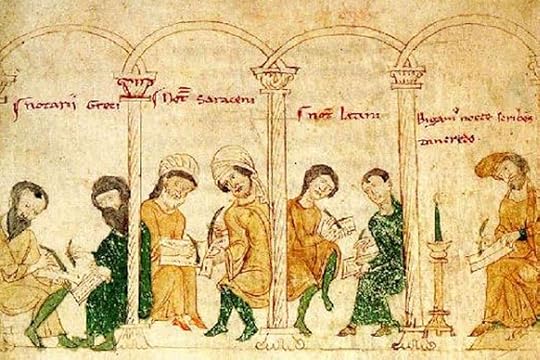
And it is towards the conclusion that Fletcher addresses what must have been on his mind all along in his book, that of the mythical tolerance, given a great push by the 19C romantics and later by a badly digested liberal conscience. After the various chapters we get a good idea of how dislocated and complex were the times, so yes, there are examples of fruitful cultural exchange. He sees that the Iberian Peninsula was the door for the entrance in Europe of an Islamic train of thought that had a deep impact in later European culture at large. This Islamic corpus of thinking was partly autochthonous and partly transmitted (since in Bagdad an effort had been conducted to preserve and translate the Hellenistic culture that had been buried in the West). But the peninsula was not the only door. Sicily, and to a lesser extent the Middle East offered other entrances. Fletcher also points out that the door opened in one direction only. The Muslims showed no interest in learning from the Christian culture. And the Christians, not just Iberia but the rest of Europe, although keen on adapting or adopting aspects of the Islamic traditions, did this in a cherry-picking mode. At the core, Fletcher sees no interest on either side, to understand the other.
Fletcher then is no nostalgic historian. And precisely for this I enjoyed his account and recommend it.
Nostalgia is the enemy of historical understanding.
After reading and being disappointed with Menocal’s famous book on Moorish Spain, The Ornament of the World, I decided to take another crack with this book. And I am happy to report that Fletcher’s book is much better.
While Menocal is wistful and romantic, Fletcher is more detached and occasionally wry. While Menocal hardly acknowledges her sources, Fletcher is usually careful to note where he is getting his information from, even if this book lacks a scholarly bibliography. I found this a great relief, as I have been discovering that Moorish Spain is one of the most persistently mythologized periods in history. Washington Irving set the tone for this in his Tales of the Alhambra, but other writers have been following in his romantic footsteps ever since. Thus Fletcher’s dispassionate treatment was refreshing.
The main drawbacks of this book is that it is too short, and too scholarly. Fletcher was explicitly aiming for a popular audience, but the book he wrote would be better suited for an undergraduate class than a tourist. You cannot, for example, find many good vacation ideas in these pages; indeed, if this was your introduction to Moorish Spain, you might not even want to travel there at all.
Instead of focusing on intellectual and cultural history, the majority of this text deals with political and military history—the invasions, battles, territorial expansions, and so on. Admittedly, Fletcher also quotes poems, autobiographies, and includes pictures of famous buildings; he even has a whole chapter on the relations between Christians and Muslims during this time. But this information jostles for space among dozens of unfamiliar names of rulers who I do not much care to remember. Probably, if he wanted a better-selling book, he could have bot expanded it and included more of a personal touch. He is a fine writer and rather opinionated, so it would have served him well, I think, to have written something less formal.
In any case, I doubt there are any better books on the market for the history hungry tourist visiting Andalusia. This book will give you an overview of the period, and in the process inoculate you against much of the nonsense that gets thrown around about al-Andalus. It was not a paradise of tolerance, nor was it a perpetual war of faith against faith. As Fletcher said: “The past, like the present, is for most of the time rather flavourless.”
A brisk canter through the history of the Moorish regimes in Spain. The north African invasion of Iberia in 711 led to almost 800 years of Muslim rule in what is now Spain and Portugal. Fletcher manages to incorporate a huge amount of information in what is a slim volume, yet in a way that is accessible and enjoyable. He writes in a fluid, almost chatty, style and wears his obvious erudition lightly - referring to more involved themes which are then summarised with admirable brevity.
I liked the way that he is honest about what we know and cannot know, and his demolition of the simple myths about the reconquista. In truth it was a complex and messy affair, with dynastic politics often pitting all against all rather than a case of good Christians taking back their land from bad Muslims.
I enjoyed Fletchers evident delight and warmth towards the unique cultural fusion of the Moorish regimes, and his explanation of the intellectual debt the West owes to Moorish Spain for its role in the transmission of the glories of Greek learning.
In preparing for a vacation in Spain, in particular in Córdoba, Sevilla, and Granada, I wanted to read more about the history of Andalucía, in particular of the time between 711 and 1492, when there was a strong Moorish influence. I had read the book by Maria Rosa Menocal, “The Ornament of the World ..” (see my review). In looking for a different perspective I read some of the reviews in Amazon, and this book was mentioned as providing both a concise history and an interesting counterpoint to Menocal’s.
This book focuses more on the “Moorish” activities (while Menocal’s also includes contemporaneous activities in Spain of the Christian and Jewish community). In addition, the feel of Fletcher’s book is more of look at history than the snapshots given by Menocal. In particular Fletcher draws upon work of others about the conversion, in Spain, of the previous population to becoming Muslim. Menocal’s book includes more discussion about philosophy and literature. However, this does not mean Fletcher is devoid of poetry from the region.
Overall, his perspective of how the Muslim, Jewish and Christian communities lived together is certainly less romantic that what one might glean from Menocal’s book, and is a reasonable counterpoint.
I believe that this is a very good book to read before going to Spain, especially southern Spain. Having just returned, I wish I could have done more in preparing for the trip, in particular understanding of the various players and their history. When I go again, I will do exactly that.
And I agree with the Amazon reviewer who said that the two books (Fletcher’s and Menocal’s) make for a good pair of readings. Perhaps the reader of these two reviews can decide what is best for them to read if there is time for only one book.
041016: thanks to kalliope i have read this: this is exactly the sort of history of the Iberian peninsula i wanted. not simply kings and battles, this covers more the extent, nature, history of an entire cultural integration and conflict. not simply a paean to lost glories, nor nostalgic memory of what might not have been there. i do not know much ancient history of Europe let alone Spain, but for certain fiction works and this works as a nonfiction novel. doubtless an abrieviated portrayal of the centuries of rise and fall of moorish Spain- this seems an excellent introductory work. quick, concise, compelling, capacious. this covers centuries, covers battles, covers what must be inferred from incomplete sources, from sources such as birth names as much as jostling politics... rec this book highly...
Brilliant summary of a truly exotic, elegant, learned and tolerant civilisation that existed for 900 years in the peninsula and made Spain what it is today to a very great extent. You need the music as well of course, and I link to a classic whether NGE cares for that sort of thing or not.
The very interesting time of the Muslim Moors in Spain is detailed in a quite non-romantic way. His emphasis is on the Moors and the Christians. Whereas my interest is in the Jews and how they survived or didn't under the rule , often intolerant of both religious groups. Nonetheless it is an interesting complex picture that he paints. In all cases intolerance ended up ruling the day because both sides refused to learn about the other in any serious way. So the strict constructionists ( read fundamentalists) ended up dominating from both sides. In between there was mush cultural cross fertilization.
An excellent book outlining the history of Moorish Spain! In 711 a relatively small army crossed over from Africa to establish a presence on the Iberian peninsula which was to last for almost a thousand years. Richard Fletcher describes the development of Moorish civilization from its beginnings, its relationship with Christian Europe and the rest of the Islamic world through to its final collapse in 1492. The book also shows how Islamic learning introduced science, agricultural practices and ancient philosophical studies which benefited the then emerging cultures of Christian Europe.
This book gives an insight into a fascinating period of history. Recommended reading!
Too many writers have fallen for the romantic myth of a peaceful Moorish Spain in which Christians, Jews, and Moslems lived in harmony. Richard Fletcher debunks this thoroughly. Life for most people was poor, nasty, brutish, and short, just like everywhere else at the time (711 to 1492 AD). The book includes 5 maps, and 28 black-and-white photographs which don't begin to do justice to the wonderful art that can still be seen.
A great survey of the Islamic presence in Spain from 711 to 1492. I came in knowing almost nothing about this period and now feel familiar with the main regimes, battles, cities, and geography of Spain! Also, it yields many great examples of the tension between centralized empires and decentralized city states.
Started to read Moorish Spain by Fletcher that I bought from Amazon. Literary style is not great, but quite readable. Some interesting points so far: -- Conquest of Spain by Arabs was so quick and easy, because: a) Spain has been already a country accustomed to central government, first by Romans then by Visigoths. Therefore victory in a single battle over Visigoths and death of Visigoth king Roderick were enough to remove organized resistance. b) Local lords always had great power, and Arab conquerors generally preferred to make a deal with them rather then fight. Under such deal local lord pledged loyalty and provided tax payment, but retained full power in administering local affairs.In such way Arabs could quickly claim the whole peninsula, without actually fighting for each piece of land.
-- From the beginning the invaders included both Arabs and Berbers. When land was distributed, the Arabs got better parts, and Berbers didn't like it. Eventually it led to a lot of local wars between various factions for the second part of 8th century.
-- Roland was one of Charlemagne's nobles, who led expedition of Franks into Spain in order to take advantage of local infighting. The expedition was unsuccessful, and when the force retreated back into France via Basque Country, they were defeated by Basques in Roncesvalle pass in Pyrenees.
-- Around 750 Abbasids replaced Umayyads as caliphs, subsequently transferring capital from Damascus to Baghdad. The only surviving Umayyad escaped to Spain, where he established himself as amir of Cordoba
Continue to read the book, now about 70%. Again, the style is not fluent, and sometimes there is an impression of superficiality in narrative. I think my main complaint is that analysis of the events part lacks depth. There is some attempt to explain background and reasons for certain major events (such as collapse of Caliphate, rise of Christian kingdoms, the conquest by Almoravids and Almohads), but I don't find it sufficient. Main outline of the events: Cordoba khalifate has flourished, but at some point they started to use Berber soldiers from Maghreb to fight the Christians in the North. These were employed not as individuals, but as entire tribes, with their own chiefs as military commanders. These local commanders gained power, and in the beginning of 11th century the khalifate disintegrated into several small statelets (taifas), that constantly fought one another and were unstable politically at home. In some taifas power was at the hands of Berber military commanders, at others in the hands of local lords. The strongest taifa state was Seville, and it controlled large territory at the height of its power. During this period, Christian kingdoms constantly intervened into internal politics of Muslim taifas, supporting one or other candidate in internal power struggle. Also, the Christians started to collect money tribute from the taifas (Castilian king received tribute even from Granada!). Almoravids were an Islamist fundamental movement, which took power in Morocco. The Almoravid troops were initially invited into Spain to help fight Christians, but they ended up establishing their own authority over Spain. They were rather successful in their military campaigns against Christians, re-taking some cities (although they failed to capture Toledo). However, gradually their religious zeal declined, and they got spoiled with good life in Andalusia.
This entire review has been hidden because of spoilers.
-Damascus, Cairo and Baghdad were the centres of Islam, al-Andalus was on the periphery and considered quite provincial in regards to these cosmopolitan centres of enlightenment -Spain and Portugal are more mountaneous than any other European country, except Norway and Switzerland. -The Berbers, who had originally invaded Spain in the ninth century, were hardly 'Islamicised' themselves. Moreover, Islamic law guarantees toleration for Christians and Jews, as 'Peoples of the book'. -Non-Muslim subjects under Islam paid poll and land taxes and thus, this would have been a definite disincentive to convert all non-Muslims to Islam. -"The calpih himself reclined on a most richly ornate couch. They do not use thrones or chairs [but] recline on divans or couches when conversing or eating. Their legs crossed one over the other." -"It is convenient to think of the Iberian peninsula from the eighth century onwards [...] as being broadly divided into three bands: a Muslim zone in the south, a Christian zone in the north and the tierras despobladas, the unsettled lands of the frontier zone." -"The payment of tribute from Islamic rulers tp non-Islamic ones is forbidden by the Shari'ah, the revealed law of Islam: a Muslim cannot be a subject to a non-Muslim." -A mudejar, was a Muslim who continued to live under Christian Spain; a Mozarab was a Christian who lived under Islam -"Sexual relations across the religious or cultural divide were punished savagely. Death by stoning was the normal penalty for a Muslim man who had sexual intercourse with a Christian woman-unless she were a prostitue, in which case he would be publically whipped for a first offence and only executed for a second." -"Granada was not self-supporting in food stuffs; cereal and olive oil had to be imported from the Mahgrib, in return for specialised crops such as sugar, raisins, figs and almonds. Much of this trade was in the hands of the Genoese."
A succinct but highly interesting overview of Spain from the time of the first Berber conquest in 711 until the fall of Nasrid Granada in 1492.
I turned to this book after my third read of Guy Gavriel Kay’s excellent historical fiction / fantasy “The Lions of Al-Rassan”, which unfolds in a world heavily influenced by the Iberian peninsula during Moorish rule. As a history lover, I was excited to learn about the period which inspired one of my favourite novels. Fletcher’s work did not let me down, providing a great introduction to Al-Andalus which was both insightful and engaging. Despite the book’s short length, Fletcher covers a broad and often complex period in good detail whilst also managing to challenge stereotypes and elucidate the difficulty in chronicling this period (in particular Al Andalus’ infancy).
The book’s key takeaway is the recognition of Moorish Spain as a conduit for knowledge into Europe. Ancient learning which had been lost from the western world was reintroduced through Spain via Morocco, providing at least some of the Renaissance’s foundations. As Fletcher notes, “Like it or not, European hegemony is the most prominent feature of the history of the world between 1300-1900”, and anything which helps to explain this rise to dominance is useful to understand. While other historians have depicted Al-Andalus as a tolerant, colourful, enlightened period in Europe’s past, Fletcher challenges these claims (although does not completely dismiss them) and instead gives primacy to the Moors’ role in European growth. He does, however, manage to do this without totally dissuading the reader from viewing medieval Spain as devoid of beauty and charm - his is a “realistic” history which nevertheless inspires an urge to visit the beautiful places described.
On a personal note, I thoroughly enjoyed picking up on points which had clearly influenced Kay when researching for and writing “Lions”. I gained a greater appreciation of the novel from understanding the real-world cities reflected in Al-Rassan’s kingdoms, the individuals who inspired characters and the events which Kay echoed. It takes fearsome skill to weave this into a novel as intensely captivating as “Lions”.
This is an awesome book, but first, let's get the annoying stuff out of the way: The author is a bit obsessed with dates which, typographically speaking, gives the body text a sort of algebraic flavor. Did I need to note the exact year in which Alfonso X farted? Not really. Do all those numbers disrupt the narrative flow? You betcha. Another problem is the complex language that he often uses to describe pretty mundane ideas. It's cringeworthy, and along with the numbers, makes my brain hiccup.
“The witness of those who lived through the horrors of the Berber conquest, of the Andalusian fitnah in the early eleventh century, of the Almoravid invasion – to mention only a few disruptive episodes – must give it the lie.”
Those two faults aside, the book is an absolute masterpiece. The narrative is well structured and concise. The author does his best to look at the history objectively and not succumb to idealization, which is quite common in studies on that period. Yet, despite omitting the usual poetic nonsense about a lost paradise, the book is anything but boring. On a few occasions I felt the urge to clap. Here's an example:
“Those who are too idle to prepare decent food can buy pungent sauces in supermarkets to disguise the absence of flavour in the meat or fish they smother with them. The past, like the present, is for most of the time rather flavourless. ‘Nothing, like something, happens anywhere.’ Larkin’s line should be the historian’s motto. But in the cultural conditions that prevail in the west today the past has to be marketed, and to be successfully marketed it has to be attractively packaged. Medieval Spain in a state of nature lacks wide appeal. Self-indulgent fantasies of glamour or guilt do wonders for sharpening up its image.”
Amen!
P.S. Highly recommended to anyone interested in Iberian history, especially for those who look for a detailed straight-to-the point introduction.
A really nice and balanced overview (without bias) of the history of the Moorish Spain. It is more about the history, as the title says, than the culture. I guess it might be intentional, since the Moorish culture has quite a lot of other books dedicated to it and those represent more of the romantic idea of Moorish Spain, which Fletcher shows, is a kind of a misrepresentation since life in Moorish Spain was as dangerous and brutal as in other parts of Europe at that time. I like how he shows that ideas flowed from the Arabic world through Spain to Europe, but that it does not mean that it was a society of without discrimination or that either side really cared to look beyond the stereotypes in general. I guess this happened on personal level, it always does, but not in a wider sense. Basically both sides thought that the grass was less green on the other side, while Europeans were open to taking knowledge from the Arab side. The book also gives you an idea about the development of the Christian Spanish kingdoms after the invasion of the Moors, so that was an added plus.
There was just a tiny mistake that I noticed, having watched the Spanish drama series about Isabel of Castile lately - Isabel was not the niece, but half-sister of Enrique the IVth.
Many forget when speaking of the Middle Ages that Europe was not purely Christian. Al-Andalus, Moorish Spain, Islamic Iberia. However you want to call it. The point is that a mostly Islamic power existed on the Iberian peninsula and its' significance for the developement of Europe was remarkable. This book gives you a good look into the history of Al-Andalus. How Al-Andalus was formed, who was in power, how it interacted with Europe and the nearby Christian powers, how was the society in Al-Andalus. All of this is answered to some extent in this book.
Sometimes the book strays into Al-Andalusian poetry and details of rulers, writers and such who were from Al-Andalus. I found those parts to be a little tiring. I was purely interested in the political history of the state of Al-Andalus, not so much in the cultural side even though parts covering architecture were really interesting.
I would say that this book is a great first step into the history of Al-Andalus. I learned a lot.
Excellent book written by an enthusiastic and knowledgeable author, showing deep knowledge and research about the history of Islamic Iberia: from the invasion of the Berbers in 711, the Umayyad conquest of Hispania, to the Caliphate of Al-Andalus, the Taifas period, the Almohads and the "Reconquista". The author is successful in explaining the complexity of the historical period, in terms of struggle for power and land and the differences between the tribes within the Muslim world and the Catholic Kindgoms (and the Jews) and the complex economic and social interactions that brought the opposing forces to live more or less peacefully for long periods of time and to come to arms during others. It was also very interesting to understand how the cohabitation of people from different faiths in the territory now known as Iberia for so many centuries influenced arts and culture, pre and post fall of Granada in 1492. Great book, truly enjoyed it.
I picked this up as part of some reading ahead of a holiday in Andalusia, and despite its somewhat old fashioned style, I thoroughly enjoyed it. Fletcher provides both a generalised picture of Moorish Spain as well as some more detailed and vivid examples, characters and places. He quite successfully dispels the myth surrounding a tolerant and enlightened society by showing that life in Moorish Spain was more often than not, short and brutal. Now looking forward to seeing these places in the flesh!
I read this last year during a month-long stint in Granada, Spain. It really enhanced the experience, especially on our visits to the famous monuments such as the Alhambra or Mezquita in Córdoba. While being a little bit tedious at times, this was expected due to the nature of the book and the fact that I am not studying the subject. I would recommend to anyone visiting the region, though bear in mind that there is a huge amount of information in here and it may be a little too much for some (as it was for me).
I thought a good antidote to the romantic view idealized view of Spain during the middle ages, often spread by anglophile scholars in attempts to diss Spaniards.
The more nuanced understanding makes it clear the catholic kings were indeed responsible for virulence of their conquest of the new world. It wasn't merely a carryover of the reconquista.
Slavery existed much later in Spain than elsewhere in Europe. This may explain the new world.
I found the introduction and conclusion great - drawing together the impact of Islamic learning on wider Europe etc - however the main chapters were too dense and academic. The incredible amount of detail would be great for a student writing about the era but for the casual reader it becomes just too hard to follow at times. I appreciate what Fletcher has endeavoured to undertake but a lighter touch would have made it more enjoyable.
i enjoyed that book as I was traveling in Andalusia. I liked the rhythm, stories and angle the author took to describe the period.
Note that this book is an history book that will be best enjoyed by persons used and fond of history books. It’s too detailed and lengthy to be a quick read before a trip to Spain.
I particularly like the author vision of History, demystified and rather chaotic.
This is one of an excellent generation of contemporary history books that re-examines the assumptions of Romantic history and takes a sharp look at the documentary and archaeological evidence. The air is clearer once you blow Washington Irving off and settle down for a clearly argued consideration of Moorish Spain. Well worth it!
Tema: -harmonisk convivencia en myt. Historiebruk -moriska Spanien traderade den klassiska vetenskapen till det barbariska väst -däremot lite intresse att lära av varandra när det gäller religion -reconquista definierar spansk nationalism -administrationen av erövrade områden en modell för erövringen av latin Amerika.
What a great, concise and well-balanced book on the history of al-Andalus. I browsed similar ones and they seemed either partisan or saccharine - thankfully, this one describes the complex nature of the society, without bias. The author has clearly done a lot of research, has good mastery of the subject and knows how to take the reader on a journey.
Interesting overview, but I found it dragged a bit, maybe too many place names and people names? Making sense of this book also needed a reasonably thorough understanding of Spanish geography that I did not have at the beginning lol. I don’t think any of that is necessarily a problem though, just made it harder for me to get invested.
I am sure Mr Fletcher put tones of work into it and gathered lots of valuable information in this book which may be useful for academics. However, from the narration point of view, this book is nothing but a very long Wikipedia page.