

What do you think?
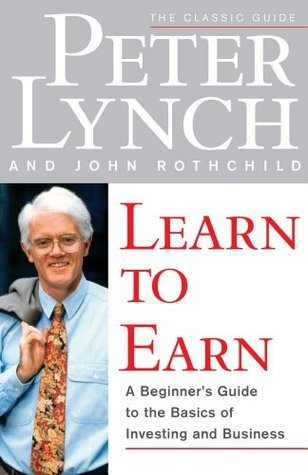
Learn to Earn: A Beginner's Guide to the Basics of Investing and
Mutual-fund superstar Peter Lynch and author John Rothchild explain the basic principles of investing and business in a primer that will enlighten and entertain anyone who is high-school age or older.
Many investors, including some with substantial portfolios, have only the sketchiest idea of how the stock market works. The reason, say Lynch and Rothchild, is that the basics of investing -- the fundamentals of our economic system and what they have to do with the stock market -- aren't taught in school. At a time when individuals have to make important decisions about saving for college and 401(k) retirement funds, this failure to provide a basic education in investing can have tragic consequences.
For those who know what to look for, investment opportunities are everywhere. The average high-school student is familiar with Nike, Reebok, McDonald's, the Gap, and the Body Shop. Nearly every teenager in America drinks Coke or Pepsi, but only a very few own shares in either company or even understand how to buy them. Every student studies American history, but few realize that our country was settled by European colonists financed by public companies in England and Holland -- and the basic principles behind public companies haven't changed in more than 300 years.
In Learn to Earn, Lynch and Rothchild explain in a style accessible to anyone who is high-school age or older how to read a stock table in the daily newspaper, how to understand a company annual report, and why everyone should pay attention to the stock market. They explain not only how to invest, but also how to think like an investor.
Many investors, including some with substantial portfolios, have only the sketchiest idea of how the stock market works. The reason, say Lynch and Rothchild, is that the basics of investing -- the fundamentals of our economic system and what they have to do with the stock market -- aren't taught in school. At a time when individuals have to make important decisions about saving for college and 401(k) retirement funds, this failure to provide a basic education in investing can have tragic consequences.
For those who know what to look for, investment opportunities are everywhere. The average high-school student is familiar with Nike, Reebok, McDonald's, the Gap, and the Body Shop. Nearly every teenager in America drinks Coke or Pepsi, but only a very few own shares in either company or even understand how to buy them. Every student studies American history, but few realize that our country was settled by European colonists financed by public companies in England and Holland -- and the basic principles behind public companies haven't changed in more than 300 years.
In Learn to Earn, Lynch and Rothchild explain in a style accessible to anyone who is high-school age or older how to read a stock table in the daily newspaper, how to understand a company annual report, and why everyone should pay attention to the stock market. They explain not only how to invest, but also how to think like an investor.
274 pages, Kindle Edition
Published November 27, 2012
About the author
Peter Lynch
54 books1,048 followersPeter Lynch is an American businessman and stock investor. Lynch graduated from Boston College in 1965 and earned a Master of Business Administration from the Wharton School of the University of Pennsylvania in 1968.
Lynch worked at Fidelity Investments where named head of the then obscure Magellan Fund which had $18 million in assets. By the time Lynch resigned as a fund manager in 1990, the fund had grown to more than $14 billion in assets with more than 1,000 individual stock positions. From 1977 until 1990, the Magellan fund averaged a 29.2% return and as of 2003 had the best 20-year return of any mutual fund ever.
Though he continues to work part-time as vice chairman of Fidelity Management & Research Co., the investment adviser arm of Fidelity Investments, spending most of his time mentoring young analysts, Peter Lynch focuses a great deal of time on philanthropy. He said he views philanthropy as a form of investment. He said he prefers to give money to support ideas that he thinks can spread.
Lynch worked at Fidelity Investments where named head of the then obscure Magellan Fund which had $18 million in assets. By the time Lynch resigned as a fund manager in 1990, the fund had grown to more than $14 billion in assets with more than 1,000 individual stock positions. From 1977 until 1990, the Magellan fund averaged a 29.2% return and as of 2003 had the best 20-year return of any mutual fund ever.
Though he continues to work part-time as vice chairman of Fidelity Management & Research Co., the investment adviser arm of Fidelity Investments, spending most of his time mentoring young analysts, Peter Lynch focuses a great deal of time on philanthropy. He said he views philanthropy as a form of investment. He said he prefers to give money to support ideas that he thinks can spread.
Ratings & Reviews
Friends & Following
Create a free account to discover what your friends think of this book!
Community Reviews
Displaying 1 - 30 of 439 reviews

July 12, 2008
This book holds sentimental value to me, for it introduced me to the world of investment. A world which, later, not only becomes a personal interest but also a professional one. I started my first investment in stocks and mutual funds shortly after I finished the book. Fast forward, I started my career five years later in an Indonesian state-owned investment bank in the equity research department.
In this book, Peter Lynch starts with a brief history of what would become Corporate America and later, describes how it can change and have changed the fortune of ordinary Americans who participate by owning the shares of those companies. It pays to start early, and only invest in what you know, as often as possible, compounding works.
In this book, Peter Lynch starts with a brief history of what would become Corporate America and later, describes how it can change and have changed the fortune of ordinary Americans who participate by owning the shares of those companies. It pays to start early, and only invest in what you know, as often as possible, compounding works.

July 5, 2021
Concepts have been explained in a simple manner, written in easy-to-understand language. The book covers a short history of capitalism, the basics of investing, how companies work, the Invisible Hand and free markets, and how to read a balance sheet. I marked a lot of things in the book (wherever I encountered something new). I think I'll have to re-read this to absorb it fully.
This was the second book in the journey of my financial education, the first being Rich Dad Poor Dad. Perhaps that's something that enhanced my understanding. However, even if this had been my first book, it would have taught me a lot.
This was the second book in the journey of my financial education, the first being Rich Dad Poor Dad. Perhaps that's something that enhanced my understanding. However, even if this had been my first book, it would have taught me a lot.

June 7, 2015
This book is a great for kids to read and understand the concept of investing. In this book, the author is Peter Lynch, who is an investing mastermind. Lynch graduated from Boston College in 1965 with a degree in finance. He served two years in the military before attending and graduating from the Wharton School at the University of Pennsylvania with a Master of Business Administration in 1968. As you can probably guess, yes, he is one of the richest people in this planet. Everything the book mentions can be easily understandable because of how easy he makes it and how entertaining it can be. When my parents usually told me about the stock market, I nodded my head, not knowing why I was nodding my head. After reading this book that my dad gave me, I now know how this really "complicated" concept work. My favorite line of this book is on page 19 where it says "... it's always a thrill to walk into a McDonald's a Toys R Us, ,or a Circuit City and watch the customers lining up to buy the merchandise, knowing that you've got a piece of the action and that some smidgeon of the profits will end up in your pocket." And this is my favorite line because it just makes everything much easier to understand. What it is basically saying is how a stockholder would be really happy to walk into a place in which he has a stock because he knows that all that money earned will be split and one part of that share will end up in his wallet. Overall, I enjoyed reading this book and look forward to reading other investing books.
April 9, 2015
While this book was not perfect, I'm giving it 4 stars because I think everyone should read it, or at least a book like it. It does a great job as a primer on capitalism, businesses, and the basics of investing.
The two authors are both unabashed capitalists, wholly in favor of the system. This makes sense, as Peter Lynch made countless millions in the stock market, and John Rothschild wrote about the financial system for years. Some of their pro-capitalism passages were a little tough for me to swallow, but overall I thought they made a compelling argument for why people should be getting involved in investing.
Written in 1995, this book is of course a little outdated. The internet was barely a thing, the epic meltdown of 2008 had not yet happened, and the companies who are big in business have changed a bit since then. But the core principles do still seem to remain the same. This book will teach you how to read the stock ticker tape, how to interpret balance sheets and understand what separates a strong business with potential from a business on the brink of failure. The authors are adamant about investing in only stocks, which I think makes sense if you don't mind not touching the money for decades.
Overall, I thought the writing was strong (though perhaps a bit too much time was spent in the beginning on the history of capitalism, which was interesting to some extent but perhaps not as essential). I find the topic fascinating. And the authors did a great job making the whole world of investing accessible. Definitely worth becoming more familiar with the topic.
The two authors are both unabashed capitalists, wholly in favor of the system. This makes sense, as Peter Lynch made countless millions in the stock market, and John Rothschild wrote about the financial system for years. Some of their pro-capitalism passages were a little tough for me to swallow, but overall I thought they made a compelling argument for why people should be getting involved in investing.
Written in 1995, this book is of course a little outdated. The internet was barely a thing, the epic meltdown of 2008 had not yet happened, and the companies who are big in business have changed a bit since then. But the core principles do still seem to remain the same. This book will teach you how to read the stock ticker tape, how to interpret balance sheets and understand what separates a strong business with potential from a business on the brink of failure. The authors are adamant about investing in only stocks, which I think makes sense if you don't mind not touching the money for decades.
Overall, I thought the writing was strong (though perhaps a bit too much time was spent in the beginning on the history of capitalism, which was interesting to some extent but perhaps not as essential). I find the topic fascinating. And the authors did a great job making the whole world of investing accessible. Definitely worth becoming more familiar with the topic.

July 12, 2015
Lots of good stuff in this book, particularly the chapter, "A Short History of Captalism". But since the book came out in 1995, parts of it are now quite outdated (the primary reason I gave it four stars instead of five), and will only become more so in the years to come. Hoping that the authors consider a second edition, because today's young people are in serious need of an education on this book's subject.

April 14, 2015
Great intro book for beginners. Written in layman's terms with some practical items included. Presents a compelling case for capitalism. It would be interesting to see an analysis on how the arguments for going long on stocks holds up after the 1999 and 2008 crises, due to the great volatility history has shown.
March 3, 2016
This is a great book. It introduced me to the world of investing. It was the first book that I read on investing. Since, the book was written in the early 90s, the examples taken by Mr. Lynch would sound somewhat old to you but they will still give you a fair idea of what he is trying to teach
you. The principles taught by him in the book are still valid today. he has explained everything in such an easy way that you would be able to relate to everything easily although the book is written from the perspective of an American investor.
The book is completely divided into 4 chapters :
1. A short History of Capitalism
2. the basics of investing
3. the lives of a company
4. the invisible hands
overall, it was a good book for beginners who want to know about investing and stock market trading. Looking forward to reading some more books on investing.
you. The principles taught by him in the book are still valid today. he has explained everything in such an easy way that you would be able to relate to everything easily although the book is written from the perspective of an American investor.
The book is completely divided into 4 chapters :
1. A short History of Capitalism
2. the basics of investing
3. the lives of a company
4. the invisible hands
overall, it was a good book for beginners who want to know about investing and stock market trading. Looking forward to reading some more books on investing.

March 22, 2016
Great book for a high schooler who has no idea how the markets work or their historical significance to our nation.
As a means of basic info, it works well. Unfortunately for me, it was a little too basic. Very light reading, but enjoyable anyways.
As a means of basic info, it works well. Unfortunately for me, it was a little too basic. Very light reading, but enjoyable anyways.

February 17, 2026
im smart now and gonna make a bajillion dollars

January 23, 2015
I read this book twice, at the age of 9 and 13 (as it was recommended to me by my father, of course). English is not my mother tongue and despite the lack of fluency at that age I was still able to understand absolutely everything in that book and take away the most important message. It is, in my humble opinion, one of the best books out there for people with no particular knowledge of finance/investing to understand the fundamental basics of investing with equities. In addition to that, the book contained a lot of thought-provoking stories about how particular companies were founded and became one of the biggest corporations in the world.
A great read!
A great read!

March 2, 2020
More like an introduction to the capitalist system and a defence to it, also how to get a share of the fun, but this book was mostly an explanation of economic and social dynamics of the wealth distribution through the creation of companies. This book appears to have been written by the second author John Rothchild, because when referring to Peter’s activities those are in third person. Not quite useful but I’m looking forward for “Beating the Street”.

October 15, 2017
Severely outdated, at least the audiobook version from the library I listened to. The basic principles are of course reasonable, but I already knew those things. I suppose I’m not a beginner. The other info is so horribly outdated it sounds absolutely ridiculous. Perhaps a new updated edition is due.

June 19, 2020
This is should be the first book for any new investor out there. The book set a stage for investment. It provides fundamental and background that is useful for your further studies. I took out one star because the information in the book is kind of dated.
January 13, 2022
Way too basic for most readers. If it's the first book in the subject - go ahead!

February 1, 2025
Read the abridged version. Some of the advice/processes are out of date, but full of wisdom.
April 30, 2023
3/5: Liked It
Learn to Earn is a beginner's book that introduces you to the world of stock market, how they function, what are stocks and IPOs, how companies work, how they affect our lives in general and are affected by us. It begins with the most common products used and their parent companies and how they are integral part of everyone's life. It goes on to introduce Capitalism and covers where Communism fails for the society. There are two dedicated pages for Karl Marx which is entertaining to read. It covers the basics of investing, depression, investor's mindset and the two appendices are extremely useful if you are completely new to investing. I liked the way this book progressed and the overall presentation. The language is simple and easy to understand.
This book is a beginner's guide (as suggested in the title) and I already knew most of it.
One thing I found most interesting: This book is written for Americans. Not only it gives examples from American market, but constantly you will find praise and appreciation for how great America is. Many a times I found this exaggerated.
Overall a good read if you are completely new to investing and an American. For an Indian, Coffee Can Investing: The Low Risk Road to Stupendous Wealth by Saurabh Mukherjea can be a better read.
Learn to Earn is a beginner's book that introduces you to the world of stock market, how they function, what are stocks and IPOs, how companies work, how they affect our lives in general and are affected by us. It begins with the most common products used and their parent companies and how they are integral part of everyone's life. It goes on to introduce Capitalism and covers where Communism fails for the society. There are two dedicated pages for Karl Marx which is entertaining to read. It covers the basics of investing, depression, investor's mindset and the two appendices are extremely useful if you are completely new to investing. I liked the way this book progressed and the overall presentation. The language is simple and easy to understand.
This book is a beginner's guide (as suggested in the title) and I already knew most of it.
One thing I found most interesting: This book is written for Americans. Not only it gives examples from American market, but constantly you will find praise and appreciation for how great America is. Many a times I found this exaggerated.
Overall a good read if you are completely new to investing and an American. For an Indian, Coffee Can Investing: The Low Risk Road to Stupendous Wealth by Saurabh Mukherjea can be a better read.

January 17, 2026
Very Basic book explains investing in a very simple way by first teaching readers to understand what a company does and how it started. The book stresses knowing a company’s basic business and history before investing. It shows that common sense and basic understanding equally more important than complex financial knowledge.

May 17, 2021
The book provides history and basics on how the markets work. All in all, an interesting read. However, a lot of content is outdated by now. Also, the author has a bit much hype for capitalism and corporations.

Read
June 16, 2022Solid book. Explains the who, what, when, where and why of the stock market through a macro view perspective. Could probably be turned into a college course where students are charged upwards of $5k to study and be graded on at a fancy Ivy League or B-School setting, quite honestly.

January 16, 2022
Great for beginners. I recommend it for beginners. I did not get much from the book. Not for fund managers

April 21, 2023
Extensive coverage with a simple language for an advanced beginner.

Read
July 13, 2024Great book. Highly recommended.

May 31, 2023
This or an equivalent should be taught in high school. Financial education is sorely lacking in America.

October 7, 2018
It's great book for beginners like me. It gave insights into the mechanics of capitalism, consumerism, industries and environment, banks. Lays foundation for one to continue to reading other books like The Intelligent Investor.

July 13, 2025
This one by Peter Lynch is a spectacular book on basics of investing and business. What makes this book spectacular is that it is written in such a lucid and simple language which can be understood even by high schoolers. Every adolescent should be made to read this book and the idea discussed in this book should be taught in schools which will pave the way for a great economy in the future.

June 9, 2015
A real classic book, written more than 20 years ago, in 1995!
As the book title suggests, "A Beginner's Guide to the Basics of Investing and Business", this book was written, assuming that the reader has absolutely no prior knowledge of Investing and Business. It is mainly targeted at teenagers to young working adults, who are beginning to explore the financial world.
Despite it being an extremely novice book, I had chosen to give it 4/5 stars for the sheer simplicity that the book has in conveying its contents of business, stock investing, and the connection between the two, in an engaging manner.
The list of contents are as follows:
1) A Short History of Capitalism
2) The Basics of Investing
3) The Lives of a Company
4) The Invisible Hands
In the Appendix 2, Peter Lynch goes through the basics of understanding a balance sheet, which is my main take-away from the book. Elsewhere, it also gives me a better perspective of (American) history, in the context of the economical world, as well as a nice recap of the 5 basic different investment instruments.
I would recommend this book as a starting book for having a basic understanding of investments and its impact on the world around us.
As the book title suggests, "A Beginner's Guide to the Basics of Investing and Business", this book was written, assuming that the reader has absolutely no prior knowledge of Investing and Business. It is mainly targeted at teenagers to young working adults, who are beginning to explore the financial world.
Despite it being an extremely novice book, I had chosen to give it 4/5 stars for the sheer simplicity that the book has in conveying its contents of business, stock investing, and the connection between the two, in an engaging manner.
The list of contents are as follows:
1) A Short History of Capitalism
2) The Basics of Investing
3) The Lives of a Company
4) The Invisible Hands
In the Appendix 2, Peter Lynch goes through the basics of understanding a balance sheet, which is my main take-away from the book. Elsewhere, it also gives me a better perspective of (American) history, in the context of the economical world, as well as a nice recap of the 5 basic different investment instruments.
I would recommend this book as a starting book for having a basic understanding of investments and its impact on the world around us.
December 12, 2020
While it provides some useful insights, these could have been boiled down to a quarter the length of the book (or less). The examples are really old and many times seem irrelevant to 2020, especially in regards to technology. Lynch often poo-poos computer stocks because they are too complex to understand. However, todays leading companies in all industries are leveraging digital technology that creates their success. In fact, those that are late in this respect are the ones that are failing financially. In addition, how technology and the cloud are also adopting new business models that didn't really exist when this book was written.
The other annoyance, is that the book comes across as him talking about his greatest hits. I would have preferred he expanded on the useful stuff. Finally, he also doesn't care for futures or options, that he admits he doesn't understand. Bonds gets minimal discussion that he writes off as well since they won't provide the 10-baggers he is hunting for. There's got to be a better introduction to the stock market than this. Finally, title is misleading since the book only discusses traditional stock market investing, while title suggests you'll learn about other types of investing and business in general.
The other annoyance, is that the book comes across as him talking about his greatest hits. I would have preferred he expanded on the useful stuff. Finally, he also doesn't care for futures or options, that he admits he doesn't understand. Bonds gets minimal discussion that he writes off as well since they won't provide the 10-baggers he is hunting for. There's got to be a better introduction to the stock market than this. Finally, title is misleading since the book only discusses traditional stock market investing, while title suggests you'll learn about other types of investing and business in general.
January 6, 2025
Learn to Earn by Peter Lynch is generally considered one of the core starting points for new investors in the market. Foundational is a keyword here, since this book will introduce readers to some very key concepts underpinning stock market investing: how businesses work, how capitalism evolves, and how the individual investor can learn to participate in wealth creation. In this sense, Learn to Earn is foundational in teaching fundamental finance knowledge. Foundational indeed, it gives broad strokes on the basics of investing and the historical context of capitalism. Foundational to the approach, foundational in tone, foundational in presenting the market to novices, and foundational in reminding us that investment opportunities show up even in everyday life.
This is Peter Lynch's blueprint, the highly successful former manager of Fidelity's Magellan Fund, to a younger and/or beginning audience on why the stock market matters and how the average person can benefit from taking ownership in strong, reliable companies. What makes Learn to Earn truly foundational is that it is not as dense as other works of finance; it tries to be a starting point-a single volume that provides an accessible, almost "101-level" overview of how markets function. The message is clear: meaningful wealth can be built via an informed and level-headed approach to investing, and Learn to Earn is the foundational stepping-stone that helps readers cultivate the confidence to begin.
By calling it foundational, we should emphasize that the book covers a number of core principles: how capitalism molded the modern economy; how companies list their shares to attract investors; and why stocks as an asset class have outperformed many classes. What has made this text foundational for so many is the demystification of these concepts. Peter Lynch presents them in plain words with anecdotes that place the stock market in our everyday experiences. Whether one has been to a grocery store, used a computer, visited a fast-food chain, or worn certain brands of clothing, one has witnessed the power of consumer-driven demand. That is part of Lynch's foundational lesson: you can invest in what you know, using your common sense to guide you to profitable enterprises.
Equally important, well over a thousand reviewers have steadily mentioned over the years how Learn to Earn takes something as intimidatingly broad in scope as finance and makes the basics simple. A lot of prospective readers were afraid of 'big words' and too many confusing charts; Lynch works hard to keep it free of obstacles. True to its foundational spirit, the book includes definitions of major financial terms, explanations of basic market structures, and gentle reminders that reading a company's annual report and following its trajectory is neither too difficult nor too time-consuming for an everyday investor. In that sense, the book is an empowering tract. Foundational, again, is the operative descriptor: the authors build a solid bedrock of knowledge before delving into deeper waters.
With its foundational attributes, Learn to Earn often appears on the list of recommended reading for teens and young adults. Educators appreciate how it blends history, economics, and finance within one text, showing how investing is not just a matter of profit but also part of the greater system of growth and innovation. Lynch and co-author John Rothchild wrote in an extremely conversational style, which further underlines the accessibility of this book. A foundation in the very basics of capitalism and the stock market would, in my opinion, provide any interested mind-even if a complete beginner-a great basis on which to start, meaning that the book will yield useful information only a few chapters in. While the content itself covers the fundamentals in a basic manner, it does not try to be anything more than what one investor might need. Indeed, investing is a vast subject, and there are a lot of strategies, theories, and advanced analyses that go well beyond the scope of one volume.
But for the audience who want an introduction to major ideas, a wish to get some feeling of confidence in picking stocks, and want to understand how the market came to occupy such a prominent place in the modern economy, Learn to Earn is that critical starting point-foundational for broadening one's financial literacy. New readers of Learn to Earn should realize that the text was published some years ago, so a few examples are a bit dated. Yet the fundamental lessons about capitalism and investing remain. The principles of spotting consumer trends, investigating companies' financial health, diversifying intelligently, and thinking long term remain as true today as they were at the time of the book's publication. It therefore retains its status as a foundational text. Through Lynch's experiences, students, novices, or just about anyone can learn and draw lessons from his conviction that, although turbulent at times, the stock market is in fact knowable just like any other feature of life by observation, doing homework, and keeping one's eyes open for opportunity. Because Learn to Earn is so frequently described as foundational, it occupies a special place in the realm of beginner-friendly finance books. It does not overload readers with esoteric details but instead provides them with a vantage point from which they can later investigate more advanced topics. This is a completely foundational vantage point in that it colors how a new investor might interpret market news, how they might read about earnings reports, or how they might approach conversations about personal finance.
Thereby, Peter Lynch's voice is imaginative, encouraging, and optimistic; he instills in readers the essential belief that investments are not professionals' domain but ordinary folk can learn, earn, and share in the prosperity created by successful companies. Which brings us back, in any case, at the level of summation and precis, if Learn to Earn had to be captured with a single word, then quite appropriately the word would indeed be foundational. The whole text underlines the bedrock of knowledge necessary for starting participation in the stock market. Though concise, it is an approach detailed enough to really leave the readers with a feeling of capability. Or, in other words, as a foundational and all-approach book, Learn to Earn by Peter Lynch will come in handy for brand-new investors willing to develop their knowledge regarding stocks, capitalism, and, generally, further perspectives on managing money.
This is Peter Lynch's blueprint, the highly successful former manager of Fidelity's Magellan Fund, to a younger and/or beginning audience on why the stock market matters and how the average person can benefit from taking ownership in strong, reliable companies. What makes Learn to Earn truly foundational is that it is not as dense as other works of finance; it tries to be a starting point-a single volume that provides an accessible, almost "101-level" overview of how markets function. The message is clear: meaningful wealth can be built via an informed and level-headed approach to investing, and Learn to Earn is the foundational stepping-stone that helps readers cultivate the confidence to begin.
By calling it foundational, we should emphasize that the book covers a number of core principles: how capitalism molded the modern economy; how companies list their shares to attract investors; and why stocks as an asset class have outperformed many classes. What has made this text foundational for so many is the demystification of these concepts. Peter Lynch presents them in plain words with anecdotes that place the stock market in our everyday experiences. Whether one has been to a grocery store, used a computer, visited a fast-food chain, or worn certain brands of clothing, one has witnessed the power of consumer-driven demand. That is part of Lynch's foundational lesson: you can invest in what you know, using your common sense to guide you to profitable enterprises.
Equally important, well over a thousand reviewers have steadily mentioned over the years how Learn to Earn takes something as intimidatingly broad in scope as finance and makes the basics simple. A lot of prospective readers were afraid of 'big words' and too many confusing charts; Lynch works hard to keep it free of obstacles. True to its foundational spirit, the book includes definitions of major financial terms, explanations of basic market structures, and gentle reminders that reading a company's annual report and following its trajectory is neither too difficult nor too time-consuming for an everyday investor. In that sense, the book is an empowering tract. Foundational, again, is the operative descriptor: the authors build a solid bedrock of knowledge before delving into deeper waters.
With its foundational attributes, Learn to Earn often appears on the list of recommended reading for teens and young adults. Educators appreciate how it blends history, economics, and finance within one text, showing how investing is not just a matter of profit but also part of the greater system of growth and innovation. Lynch and co-author John Rothchild wrote in an extremely conversational style, which further underlines the accessibility of this book. A foundation in the very basics of capitalism and the stock market would, in my opinion, provide any interested mind-even if a complete beginner-a great basis on which to start, meaning that the book will yield useful information only a few chapters in. While the content itself covers the fundamentals in a basic manner, it does not try to be anything more than what one investor might need. Indeed, investing is a vast subject, and there are a lot of strategies, theories, and advanced analyses that go well beyond the scope of one volume.
But for the audience who want an introduction to major ideas, a wish to get some feeling of confidence in picking stocks, and want to understand how the market came to occupy such a prominent place in the modern economy, Learn to Earn is that critical starting point-foundational for broadening one's financial literacy. New readers of Learn to Earn should realize that the text was published some years ago, so a few examples are a bit dated. Yet the fundamental lessons about capitalism and investing remain. The principles of spotting consumer trends, investigating companies' financial health, diversifying intelligently, and thinking long term remain as true today as they were at the time of the book's publication. It therefore retains its status as a foundational text. Through Lynch's experiences, students, novices, or just about anyone can learn and draw lessons from his conviction that, although turbulent at times, the stock market is in fact knowable just like any other feature of life by observation, doing homework, and keeping one's eyes open for opportunity. Because Learn to Earn is so frequently described as foundational, it occupies a special place in the realm of beginner-friendly finance books. It does not overload readers with esoteric details but instead provides them with a vantage point from which they can later investigate more advanced topics. This is a completely foundational vantage point in that it colors how a new investor might interpret market news, how they might read about earnings reports, or how they might approach conversations about personal finance.
Thereby, Peter Lynch's voice is imaginative, encouraging, and optimistic; he instills in readers the essential belief that investments are not professionals' domain but ordinary folk can learn, earn, and share in the prosperity created by successful companies. Which brings us back, in any case, at the level of summation and precis, if Learn to Earn had to be captured with a single word, then quite appropriately the word would indeed be foundational. The whole text underlines the bedrock of knowledge necessary for starting participation in the stock market. Though concise, it is an approach detailed enough to really leave the readers with a feeling of capability. Or, in other words, as a foundational and all-approach book, Learn to Earn by Peter Lynch will come in handy for brand-new investors willing to develop their knowledge regarding stocks, capitalism, and, generally, further perspectives on managing money.

November 11, 2018
I got the idea to read Peter Lynch’s books from R. T Kiyosaki on Rich Dad Poor Dad. Kiyosaki, himself, learnt from Peter Lynch about investing especially how to pick successful stocks on the market. Not what I expected at the beginning, but it turned out to be the right decision I made before reading the other books of Peter Lynch’ on my ‘To Read’ shelf, which are older on published year than this book. Another one to put on the foundation before continuing to other books of investing.
I absolutely would recommend it, especially for beginners on investing. It introduced about short history of capitalism (including the story of early entrepreneurs, father of financial system, modern economics, the beginning of stocks), and why it’s better than communism. It also elaborated reasonable explanations why we should choose real estate & stocks over other basic investments. Lastly, his advice is "Invest Now! What are you waiting for? Lebih cepat lebih baik" 😄
I absolutely would recommend it, especially for beginners on investing. It introduced about short history of capitalism (including the story of early entrepreneurs, father of financial system, modern economics, the beginning of stocks), and why it’s better than communism. It also elaborated reasonable explanations why we should choose real estate & stocks over other basic investments. Lastly, his advice is "Invest Now! What are you waiting for? Lebih cepat lebih baik" 😄
Displaying 1 - 30 of 439 reviews