

What do you think?

Russian Fairy Tales (Illustrated)
Several famous Russian fairy tales with color illustrations by Ivan Bilibin. The tales were recorded by folklorist Alexander Afanasyev, who collected and published more than 600 Russian folk tales in the middle 19th century.
*** Fairy eBooks series ***
This ebook features a colorful, full screen design optimized for Kindle Fire HD. It can be viewed also on Kindle eInk devices except old models: Kindle 1, 2, DX; Kindle 3 needs a firmware update to ver. 3.4.
*** Fairy eBooks series ***
This ebook features a colorful, full screen design optimized for Kindle Fire HD. It can be viewed also on Kindle eInk devices except old models: Kindle 1, 2, DX; Kindle 3 needs a firmware update to ver. 3.4.
90 pages, Kindle Edition
First published January 1, 1855
About the author
Alexander Afanasyev
284 books115 followersAlexander Nikolayevich Afanasyev (Russian: Александр Николаевич Афанасьев) was a Russian folklorist who recorded and published over 600 Russian folktales and fairytales, by far the largest folktale collection by any one man in the world. His first collection was published in eight volumes from 1855-67, earning him the reputation of a Russian counterpart to the Brothers Grimm.
Born in 1826 in Boguchar, in Voronezh Governate, he grew up in Bobrov, becoming an early reader thanks to the library of his grandfather, a member of the Russian Bible Society. He was educated at the Voronezh gymnasium and from 1844-48 he studied law at the University of Moscow. Despite being a promising student, he did not become a professor, due largely to attacks upon his work by the conservative Minister of National Enlightenment, Count Sergey Uvarov.
Afanasyev worked for thirteen years at the Moscow's Main Archive Directorate under the Ministry of Foreign Affairs of the Russian Empire, during which time he also amassed a huge library and published numerous articles and reviews. In 1862 he was fired from his position, because of his association with philosopher Alexander Herzen. Jobless for a number of years thereafter, he sold his library in order to support his family, eventually finding work as a secretary at the Moscow City Duma and at the Moscow Congress of Justices of the Peace.
Afanasyev wrote a large theoretical work (three volumes of 700 pages each) – "The Poetic Outlook of Slavs about Nature" (Поэтические воззрения славян на природу) – which came out between 1865 and 1869. In 1870 his Русские детские сказки (Russian Children's Fairy Tales) were published. He died in poverty in 1871, at the age of forty-five.
(source: Wikipedia)
Born in 1826 in Boguchar, in Voronezh Governate, he grew up in Bobrov, becoming an early reader thanks to the library of his grandfather, a member of the Russian Bible Society. He was educated at the Voronezh gymnasium and from 1844-48 he studied law at the University of Moscow. Despite being a promising student, he did not become a professor, due largely to attacks upon his work by the conservative Minister of National Enlightenment, Count Sergey Uvarov.
Afanasyev worked for thirteen years at the Moscow's Main Archive Directorate under the Ministry of Foreign Affairs of the Russian Empire, during which time he also amassed a huge library and published numerous articles and reviews. In 1862 he was fired from his position, because of his association with philosopher Alexander Herzen. Jobless for a number of years thereafter, he sold his library in order to support his family, eventually finding work as a secretary at the Moscow City Duma and at the Moscow Congress of Justices of the Peace.
Afanasyev wrote a large theoretical work (three volumes of 700 pages each) – "The Poetic Outlook of Slavs about Nature" (Поэтические воззрения славян на природу) – which came out between 1865 and 1869. In 1870 his Русские детские сказки (Russian Children's Fairy Tales) were published. He died in poverty in 1871, at the age of forty-five.
(source: Wikipedia)
Ratings & Reviews
Friends & Following
Create a free account to discover what your friends think of this book!
Community Reviews
Displaying 1 - 30 of 226 reviews

September 5, 2008
seriously there is nothing more weird and bewildering and beautiful than russian fairy tales. first of all the titles are incredible. "if you don't like it, don't listen" is a classic example. the way they end is my favorite part. often the story is clipped short by: "i was there, i drank mead with the king and it got in my beard but did not spill into my mouth." or other such brilliance. and baba yaga and her chicken-leg hut? don't even get me started.

August 10, 2019
Here's a good list of things that will happen in a Russian fairy tale:
- Ivan is an idiot and will probably end up dying because of it. If he doesn't die, his two older brothers will.
- someone's limbs will be ripped off. probably multiple someones.
- Baba Yaga loves to chase people and have them do chores for her and then let them go
- there are multiple Baba Yagas
- at the end of any given story the teller will remind you pointedly that he hasn't had anything to drink
- the people who die are just like, welp! guess i'm dead! unless they're coming back to life and getting revenge.
- random foreign princes will not be able to enter russia. instead of an explanation the story will just say "for some reason he could not enter russia"
- ICONIC.
- 80% of them are re-telling another story you already read but with an added twist; i.e., this time it's Baba Yaga as the antagonist instead of Kochchei the Deathless (or once, a vampire).
- I would die for Kochchei the Deathless. Just out here trying to save these women from their terrible fiance/husbands and what does he get for it? His heart eaten. Absolutely NO gratitude.
- Ivan is an idiot and will probably end up dying because of it. If he doesn't die, his two older brothers will.
- someone's limbs will be ripped off. probably multiple someones.
- Baba Yaga loves to chase people and have them do chores for her and then let them go
- there are multiple Baba Yagas
- at the end of any given story the teller will remind you pointedly that he hasn't had anything to drink
- the people who die are just like, welp! guess i'm dead! unless they're coming back to life and getting revenge.
- random foreign princes will not be able to enter russia. instead of an explanation the story will just say "for some reason he could not enter russia"
- ICONIC.
- 80% of them are re-telling another story you already read but with an added twist; i.e., this time it's Baba Yaga as the antagonist instead of Kochchei the Deathless (or once, a vampire).
- I would die for Kochchei the Deathless. Just out here trying to save these women from their terrible fiance/husbands and what does he get for it? His heart eaten. Absolutely NO gratitude.

February 16, 2023
carefully translated and crafted, this is a delightful collection. my babushka often referenced a few of these fairy tales; reading this made me feel like a little child once more.

April 14, 2017
Hmm. Well. I liked half of the stories? But they got very samey after a while. And boy oh boy, are the names Ivan and Vasilisa ever popular.
All the Baba Yagas and creepy wooden dolls were the best. Also that gray wolf was a chill guy~ and why aren't women freaking out about falcons flying into their rooms and turning into beautiful men, or is this just something that happens in Russia?
All the Baba Yagas and creepy wooden dolls were the best. Also that gray wolf was a chill guy~ and why aren't women freaking out about falcons flying into their rooms and turning into beautiful men, or is this just something that happens in Russia?

May 22, 2018
Here is a fine bundle of Russian folk tales, finely illustrated by Ivan Bilibin, whose drawings call to mind Akseli Gallen-Kallela's paintings about the Kalevala, the Finnish collection of legends celebrated on a national day!
To put a long story short, it is an engaging introduction to cultural specificities and similarities of Russian folk tales with other collections of national legends dating back to the 19th century.
Matching Soundtrack :
Вечерний звон / Evening Bell - Ivan Rebroff
To put a long story short, it is an engaging introduction to cultural specificities and similarities of Russian folk tales with other collections of national legends dating back to the 19th century.
Matching Soundtrack :
Вечерний звон / Evening Bell - Ivan Rebroff

July 29, 2020
I felt like I was reading an illustration of Propp or another Russian formalist. Almost the perfect hero`s journey, with a fascination for the number three and Baba-Yaga.

April 17, 2026
Review of Russian Fairy Tales by Alexander Afanasyev
Rooted in folklore and oral tradition, Russian Fairy Tales gathers a wide range of traditional Russian stories filled with magic, tricksters, and moral lessons. The collection includes tales featuring figures like Baba Yaga, talking animals, enchanted objects, and brave or sometimes foolish heroes who must navigate strange and dangerous worlds.
Each story varies in tone, from humorous to dark, reflecting the richness of Russian storytelling traditions. There isn’t a single narrative or central character, but rather a tapestry of myths and legends passed down through generations.
Some tales are more engaging than others, especially for modern readers unfamiliar with the cultural context, but the variety keeps it interesting. It’s a fascinating glimpse into folklore, though uneven in pacing and style.
RATING: Four out of Five stars ⭐⭐⭐⭐.
Rooted in folklore and oral tradition, Russian Fairy Tales gathers a wide range of traditional Russian stories filled with magic, tricksters, and moral lessons. The collection includes tales featuring figures like Baba Yaga, talking animals, enchanted objects, and brave or sometimes foolish heroes who must navigate strange and dangerous worlds.
Each story varies in tone, from humorous to dark, reflecting the richness of Russian storytelling traditions. There isn’t a single narrative or central character, but rather a tapestry of myths and legends passed down through generations.
Some tales are more engaging than others, especially for modern readers unfamiliar with the cultural context, but the variety keeps it interesting. It’s a fascinating glimpse into folklore, though uneven in pacing and style.
RATING: Four out of Five stars ⭐⭐⭐⭐.

January 30, 2008
i am a sucker for fairy tales in general, but this collection gives me insight into gogol's imaginative workings... absurdities, odd, cruel, dry humor... and excellent illustrations to boot...
May 19, 2023
This wonderful hardcover Russian Fairy Tales book is worth owning. The illustrations are lovely and drawn by Ivan Bilibin, a distinguished Russian illustrator and stage designer in the 19th and 20th centuries. The tales presented in this book were collected by Alexander Afanasyev, an ethnographer who collected Russian folk tales in the 19th century.
The book is quite light since the tales chosen were the most popular such as Vasilisa the Beautiful; Maria Morevna; The Feather of Finist the Falcon; The Frog-Tsarevna; Tsarevich Ivan, The Firebird and the Grey Wolf. Each tale has a common theme and pattern where the main protagonist—because of his/her foolishness—must set out on a journey to recover what’s important to them. The protagonist will always meet some sort of old witches or magical beings who would help them on their journey and face the many obstacles.
Upon reading this book I now realized that there are a lot of baba yagas in the Russian fairy tales world and they are all related. The third child of a Tsar (whether a son or daughter) is always innocent, kind-hearted, trustful, and eventually favoured by the Tsar. Perhaps, this is a reference to the preferred ultimogeniture inheritance right practiced by the scattered principalities in Russia during the 9th century.
Overall, this is a beautiful book that contains wonderful tales and illustrations.

Portrait of Alexander Nikolayevich Afanasyev by unknown

Portrait of Ivan Yakovlevich Bilibin by Boris Mikhaylovich Kustodiev
The book is quite light since the tales chosen were the most popular such as Vasilisa the Beautiful; Maria Morevna; The Feather of Finist the Falcon; The Frog-Tsarevna; Tsarevich Ivan, The Firebird and the Grey Wolf. Each tale has a common theme and pattern where the main protagonist—because of his/her foolishness—must set out on a journey to recover what’s important to them. The protagonist will always meet some sort of old witches or magical beings who would help them on their journey and face the many obstacles.
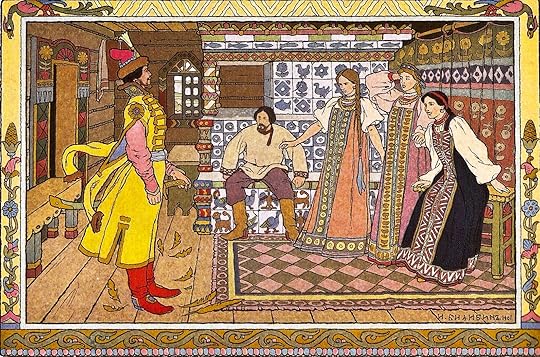
One of the illustrations in this book, drawn by Bilibin, depicts the “Hawk Prince” who came flying to ask the hand of Tsarevich Ivan’s oldest sister. This part of the story is from the Maria Morevna tales.
Upon reading this book I now realized that there are a lot of baba yagas in the Russian fairy tales world and they are all related. The third child of a Tsar (whether a son or daughter) is always innocent, kind-hearted, trustful, and eventually favoured by the Tsar. Perhaps, this is a reference to the preferred ultimogeniture inheritance right practiced by the scattered principalities in Russia during the 9th century.
Overall, this is a beautiful book that contains wonderful tales and illustrations.

January 3, 2010
This is a vast compendium of folk tales (no fairies, really, in Russian folklore)... but they seem often to be the same story with various character configurations, having a hard time 'feeling' the subject matter. Think this is going to be more of a reference book than a 'read'. Think I'd enjoy a more realized version of the stories--like in individual picture books.
*************
As I go along, I find it's more engaging. I've found a better tempo, slower rather than faster.
**************
Russian folk tales are complex and their impact unfolds gradually--there's no way to summarize these stories, hardly a way to keep them separate in my head. I've tried to tell them to people in a sentence or two. Impossible. There's not only three princes, three suitors, the sorcerer figure, the lover-queen, princess, old people in the forest with an only daughter, woodcutters and firebirds and talking fish and magical horses, and all of the animals in the forest, each with their legendary personalities-- but one on top of the other--plus, of course, the terrible Baba Yaga in her hut on chicken legs. I WANT THIS IN AN ILLUSTRATED EDITION!!! I'll never be done with it, want to see all the operas and ballets based on these stories. What a treasure, such a different feel than Grimm. The 'morals' to the stories are very different, often the very opposite of the German. Fascinating on the narrative end, and as a look into the culture and mind-set of the preliterate, oral culture of Russia. Such cultures don't die when the more sophisticated, modern ones come in, they live one inside the other inside the other, like nesting dolls.
*************
As I go along, I find it's more engaging. I've found a better tempo, slower rather than faster.
**************
Russian folk tales are complex and their impact unfolds gradually--there's no way to summarize these stories, hardly a way to keep them separate in my head. I've tried to tell them to people in a sentence or two. Impossible. There's not only three princes, three suitors, the sorcerer figure, the lover-queen, princess, old people in the forest with an only daughter, woodcutters and firebirds and talking fish and magical horses, and all of the animals in the forest, each with their legendary personalities-- but one on top of the other--plus, of course, the terrible Baba Yaga in her hut on chicken legs. I WANT THIS IN AN ILLUSTRATED EDITION!!! I'll never be done with it, want to see all the operas and ballets based on these stories. What a treasure, such a different feel than Grimm. The 'morals' to the stories are very different, often the very opposite of the German. Fascinating on the narrative end, and as a look into the culture and mind-set of the preliterate, oral culture of Russia. Such cultures don't die when the more sophisticated, modern ones come in, they live one inside the other inside the other, like nesting dolls.
July 14, 2019
I could read a whole book of Baba Yaga tales, alone, so to get one with a few about the infamous witch; along with other familiars is a treat. Most of the stories are new to me. More than a handful are the ones that I've heard about before, but this book is more accurate than anything that have passed through my ears, I'm sure. The more a tale passes through someone's mouth, the more elaborate they become. This was a refreshing course on classic Russian fairy tales that anyone can appreciate. I will be moving on to Native American tales next time, so hopefully it will be a faster read. Overall, this is a very good collection.

March 3, 2019
This is an illustrated collection of five Russian folk tales: Vasilisa the Beautiful, Maria Morevna, The Feather of Finist the Falcon, The Frog-Tsareva and Tsarevich Ivan, the Firebird and the Grey Wolf. The tales were collected by Alexander Afanasyev, who collected and published a large number of Russian folk tales in the 19th century. The illustrations are by Ivan Bilibin, who was a well known Russian illustrator and stage designer around 1900. I'm not entirely sure why this is listed as an alternate edition to the one that has many more tales in it but it's a good introduction to Russian fairy tales.
The great strength of this collection is the illustrations. The stories are interesting but carry many of the same elements so that reading it in one sitting, you really notice the themes. It might have been better to have included some fairy tales that didn't feel quite so similar. However, the illustrations more than make up for it. There are several of Bilibin's prints throughout and each page has a lovely decorative border. I'd buy this just to keep on my shelf just for the love of the art.
As someone who was completely unfamiliar with Russian fairy tales until reading the Winternight Trilogy by Katherine Arden, this was a good introduction to the subject and the art had me drooling.
The great strength of this collection is the illustrations. The stories are interesting but carry many of the same elements so that reading it in one sitting, you really notice the themes. It might have been better to have included some fairy tales that didn't feel quite so similar. However, the illustrations more than make up for it. There are several of Bilibin's prints throughout and each page has a lovely decorative border. I'd buy this just to keep on my shelf just for the love of the art.
As someone who was completely unfamiliar with Russian fairy tales until reading the Winternight Trilogy by Katherine Arden, this was a good introduction to the subject and the art had me drooling.
August 21, 2019
Bilibin is among my ten favorite artists through history - so delicate, mysterious, delvingly emotionally mythic in movement in his illustrations, like a swirling flame.
He did so much work for Afanasyev - who is the chief repository if you wish to find Russian Folktale before it evaporated. Afanasyev was among those circles of elite, like Gogol, Turgenev, Dostoyevsky - and this included Bilibin.
Was there to be found even higher mind, spirit and esoteric culture in that era and in that region of the earth other than these folk? Perhaps a small bit more, but it can fairly successfully be shown their direct connections to such where so.
Ouspensky said there were some more illusive among the early German Romanticists in Bavaria, friends with Goethe and the like, who were members of some “archaic inner school of refined consciousness” - however you want to understand that if you are open to such - that went on to be among Morris, MacDonald and the Pre-Raphaelite’s.
This group of Russians Bilibin was in were friends with these early German Romanticists.
This would all sound like a bunch of new age nonsense if one weren’t familiar with how very unusually intelligent Ouspensky is by comparison to near any other writer in any field one may perhaps come across in all “known” writings through all the centuries of man. Then, at least some may see there might be some truth to all such and all this becomes very interesting. See my review of “Place of the Lion” for more on this.
In any case, Bilibin is a vivid, colorful and great artist and brings one to certain important emotional states.
He did so much work for Afanasyev - who is the chief repository if you wish to find Russian Folktale before it evaporated. Afanasyev was among those circles of elite, like Gogol, Turgenev, Dostoyevsky - and this included Bilibin.
Was there to be found even higher mind, spirit and esoteric culture in that era and in that region of the earth other than these folk? Perhaps a small bit more, but it can fairly successfully be shown their direct connections to such where so.
Ouspensky said there were some more illusive among the early German Romanticists in Bavaria, friends with Goethe and the like, who were members of some “archaic inner school of refined consciousness” - however you want to understand that if you are open to such - that went on to be among Morris, MacDonald and the Pre-Raphaelite’s.
This group of Russians Bilibin was in were friends with these early German Romanticists.
This would all sound like a bunch of new age nonsense if one weren’t familiar with how very unusually intelligent Ouspensky is by comparison to near any other writer in any field one may perhaps come across in all “known” writings through all the centuries of man. Then, at least some may see there might be some truth to all such and all this becomes very interesting. See my review of “Place of the Lion” for more on this.
In any case, Bilibin is a vivid, colorful and great artist and brings one to certain important emotional states.

July 19, 2022
Read this for research on a short story I’m writing. Brutal and symbolic and strangely lovely. In the same scandi-germanic vein of frightful magic as Hans Christen Anderson and the Brother’s Grimm. I remember being haunted by a picture book of one of the Baba Yaga stories as a youth.
April 19, 2015
This collection is a bit of a mixed bag. The illustrations alone - full page, full color - make this book worth owning (although I wish I'd gotten the hardcover) and it's fascinating to see the Russian versions of some classic folk tales. Plus there's an intriguing underlayer in some of the stories, where the women have full control over when and whom they choose to marry ("consent" is a sadly unusual word for fairy tales), and where a woman is the one to ride off to battle, leaving her husband behind to tend the castle. "Maria Morevna" is my favorite of the bunch, with clever narrative choices that made it a highly enjoyable read. Unfortunately, this all goes astray in the last two tales. In "The Frog-Tsarevna," the boy gets the fairy-girl by literally catching her about the throat, holding onto her as she transforms into various creatures, then breaking her in half. This is an explicit portrait of domination and ownership that isn't surprising in fairy tale traditions but was a disappointment after the female agency shown in the previous tales. The final tale, "Tsarevich Ivan, the Firebird, and the Grey Wolf," was a retelling of a story I've seen in a variety of forms. It was fairly dull, since Ivan did nothing of value to show his worth, and the wolf did all the work and received none of the glory. I did like the wolf, though. It's enough to make me consider yet another fairy tale retelling with the wolf in the hero's role.

September 15, 2018
This book is one volume of the collection by Afanasyev and contains 5 of Russian Folk/fairy tales narrated in a storytelling manner, i.e in a manner in which the stories used to be told orally, accompanies by nice illustrations. The premise of the stories is very similar to other famous European folk tales; I could see traces of Cinderella, The Frog Prince, Grimm's Fairy Tales etc. in them. But my greatest surprise was the story, 'The Feather of Finist The Falcon' in which I found a striking resemblance to an Indian fairy tale that I had read long back. This and the other tales hint that a multitude of such tales with a similar set of attributes and themes exist all over the world. There could be two theories regarding this:
1. The tales originated separately and the points of similarity are just coincidences.
2. The tales have a common origin and have been slightly altered and customized to suit the region as it spread to different parts of the world
The 2nd explanation seems more plausible. This could be a fascinating subject of research for a PHD scholar pursuing comparative literature.
1. The tales originated separately and the points of similarity are just coincidences.
2. The tales have a common origin and have been slightly altered and customized to suit the region as it spread to different parts of the world
The 2nd explanation seems more plausible. This could be a fascinating subject of research for a PHD scholar pursuing comparative literature.

August 26, 2018
Fun collection of five tales, gathered and translated by Afanasyev (whose work was further adapted by Lang for the colored Fairy Tale books) in the nineteenth century. These are readable adventures with a good mix of heroes and heroines, and a great rhythm. By the end, you recognize patterns in the Russian storytelling style: three times nine kingdoms, journeys are short in the telling but long in the doing, etc.
You can find Afanasyev's full collection, and no doubt many of those stories are fun, too... but this edition really shines thanks to Ivan Bilbin's gorgeous artwork. Link below for a sample.
http://allart.biz/up/photos/album/B-C...
Also, surprise!! The book is good in hard copy but looks AMAZING on a Kindle app for iPad. Like stained glass windows. 😍 That's a first.
You can find Afanasyev's full collection, and no doubt many of those stories are fun, too... but this edition really shines thanks to Ivan Bilbin's gorgeous artwork. Link below for a sample.
http://allart.biz/up/photos/album/B-C...
Also, surprise!! The book is good in hard copy but looks AMAZING on a Kindle app for iPad. Like stained glass windows. 😍 That's a first.

May 8, 2020
Birkaç gündür büyük Rus yazar ve etnograf Aleksandr Afanasyev'in (1826-71) derlediği şu güzelim Rus masallarını okuyordum. Masallar, her toplumda olduğu gibi, "Rus ruhu"nu çok iyi yansıtıyor. Masallarda en sık geçen kelimeler: Çar, çareviç, çarevna, orman, yaşlı kadın, güzel kız, yol, köylü, emir, ölüm, itaat..
2019'da İranlı yazar Samed Behrengi'den birkaç masal çevirmiştim Türkçeye. Afanasyev'in Rus masallarıyla kıyaslayınca; Behrengi'nin masal kahramanları daha canlı, halktan, zulme baş kaldıran, değiştirmeye çalışan... Halbuki, Rus masallarının kahramanları daha itaatkar ve çar kontrolünde, emir-itaat formunda ilerliyor.
Bu arada, Afanasyev'in masalları yakında Türkçede...
2019'da İranlı yazar Samed Behrengi'den birkaç masal çevirmiştim Türkçeye. Afanasyev'in Rus masallarıyla kıyaslayınca; Behrengi'nin masal kahramanları daha canlı, halktan, zulme baş kaldıran, değiştirmeye çalışan... Halbuki, Rus masallarının kahramanları daha itaatkar ve çar kontrolünde, emir-itaat formunda ilerliyor.
Bu arada, Afanasyev'in masalları yakında Türkçede...

February 23, 2014
This is a collection Russian Fairy Tales. There is love, death, and betrayal, as with all good tales.
The narrative is detailed, vivid, often emotional, and evocative.
Characters are sometimes emotional, caring, and humorous.
Overall, a fun read.
The narrative is detailed, vivid, often emotional, and evocative.
Characters are sometimes emotional, caring, and humorous.
Overall, a fun read.

June 22, 2014
man the Russians are depressing!

December 28, 2018
Loved the illustrations. Would like it if the collection were longer.

March 7, 2019
3,5 stars
Le fiabe sono belle. E' l'edizione che non è curata al meglio e, in molti punti, fa cadere le braccia.
Le fiabe sono belle. E' l'edizione che non è curata al meglio e, in molti punti, fa cadere le braccia.

February 15, 2025
These stories are nuts but all folktales are nuts. I appreciate the author who dedicated a portion of his life to collecting over 600 Russian folktales before they were lost to modern times. This book only contains 4 or 5 of the stories but they give you an extremely clear insight into Russian folktales. Many things are repeated in each of the stories, which was both delightful and strange. The illustrations!!! The illustrations are TO DIE FOR. I want to frame every illustration in the book and create a little faux Tsardom in my home. The art is worth purchasing or borrowing a paper copy, as you’ll want to pore over every detail.
As a devotee of Baba Yaga, I read a couple of these stories out loud at my altar and was tickled at how she was portrayed. There’s no way I would have come out of her hut alive! She’s a task master on the page and in my real life 🤗, but she’s stretching me into the woman I have the potential to be. No matter if the process is….uh…excruciating, haha. I REALLY enjoyed the Baba Yaga portions of the book. I plan to get the full book of 600 tales at some point just to see if there’s any deviation from the repetition or if every MC has to cross three times nine tsardoms in order to fail at three tasks even with help from Baba Yagas and the amazing magical animals, only to be helped a final time, undeserving as all hell, leading to a happily ever after that “cannot be told in words or in a tale”. My favorite repeating line is “Get some sleep. The morning is wiser than the night.” Indeed.
As a devotee of Baba Yaga, I read a couple of these stories out loud at my altar and was tickled at how she was portrayed. There’s no way I would have come out of her hut alive! She’s a task master on the page and in my real life 🤗, but she’s stretching me into the woman I have the potential to be. No matter if the process is….uh…excruciating, haha. I REALLY enjoyed the Baba Yaga portions of the book. I plan to get the full book of 600 tales at some point just to see if there’s any deviation from the repetition or if every MC has to cross three times nine tsardoms in order to fail at three tasks even with help from Baba Yagas and the amazing magical animals, only to be helped a final time, undeserving as all hell, leading to a happily ever after that “cannot be told in words or in a tale”. My favorite repeating line is “Get some sleep. The morning is wiser than the night.” Indeed.
May 24, 2026
Read this cover to cover, after being inspired by the movie Donkeyskin.
Incredible, strange, illuminating collection of stories. Also a great foundation if you want to get further into Russian literature.
Incredible, strange, illuminating collection of stories. Also a great foundation if you want to get further into Russian literature.
April 12, 2025
Geweldige illustraties <3
January 12, 2020
The thing I love about Russian literature, including all of these precious stories, is how dark and intelligent they are. Russians know how tough life can be, and they're not afraid to show it. This wisdom is portrayed in this beautiful collection by short and longer tales. Speaking through animals, kings and peasants. Each as smart and important as the other.
It amazes me that these tales are all ever so interesting to read. Whether they talk about a tsar's or a princess' fate, about a quarrel between animals or about an agreement made by two rivers; they are one by one delightful and will leave you with a lesson you will ponder over.
These tales speak of deep love and hurt at the same time. They speak of fear (I love all the Baba Yaga stories!) and trust. And, bottom line of a whole bunch of these tales: nothing is as it seems to be.
Some stories, I recognize from when I was a child myself (for example, The Wolf and the Goat) and other tales are completely new to me. I like how the stories capture society, in a way, which is still relevant even today.
There's evil stepmothers and wealthy kings, witches and talking animals. Reading these tales is a true feast for your eyes. Not to forget the beautiful illustrations that go with them!
After reading these tales, I can surely say that not only the stories' plots are poetic and magical, but the language with which they're written is as well. A must-read for lovers of fairy tales, young and old.
It amazes me that these tales are all ever so interesting to read. Whether they talk about a tsar's or a princess' fate, about a quarrel between animals or about an agreement made by two rivers; they are one by one delightful and will leave you with a lesson you will ponder over.
These tales speak of deep love and hurt at the same time. They speak of fear (I love all the Baba Yaga stories!) and trust. And, bottom line of a whole bunch of these tales: nothing is as it seems to be.
Some stories, I recognize from when I was a child myself (for example, The Wolf and the Goat) and other tales are completely new to me. I like how the stories capture society, in a way, which is still relevant even today.
There's evil stepmothers and wealthy kings, witches and talking animals. Reading these tales is a true feast for your eyes. Not to forget the beautiful illustrations that go with them!
After reading these tales, I can surely say that not only the stories' plots are poetic and magical, but the language with which they're written is as well. A must-read for lovers of fairy tales, young and old.

June 15, 2022
2.5 rounded up to 3
This is a big book and many of its tales are fun. I once narrated one of the tales to my English Teacher back in school and it had our class rolling with laughter.
So, when I decided to go through the whole of it this time without skipping any tales, it was harder to do than I had thought.
I am usually fine reading a book of this size or bigger but here the stories tend to repeat the essence and some of them come off as more rambling.
If the book was shorter or with more variety of tales and with better editing then this would have been a precious piece to hold.
This is a big book and many of its tales are fun. I once narrated one of the tales to my English Teacher back in school and it had our class rolling with laughter.
So, when I decided to go through the whole of it this time without skipping any tales, it was harder to do than I had thought.
I am usually fine reading a book of this size or bigger but here the stories tend to repeat the essence and some of them come off as more rambling.
If the book was shorter or with more variety of tales and with better editing then this would have been a precious piece to hold.

September 16, 2011
These fairy tales are so good that I enjoy reading them as an adult. You just can't go wrong with these Russian tales. My mom enjoyed them a lot when she was young and she got me to like them too. Our favorite tale is obviously the one with Baba Yaga.

May 20, 2018
Recently read these stories, and they're such a break from our usual Grimm's fairytales. The stories have a lot of similarities in their themes, but the magical realism, at times scary storylines and strong heroines make this enjoyable for everyone. Furthermore, the illustrations are divine!

February 1, 2016
Dnf 102/189 stories.
Displaying 1 - 30 of 226 reviews