Jump to ratings and reviews
Rate this book

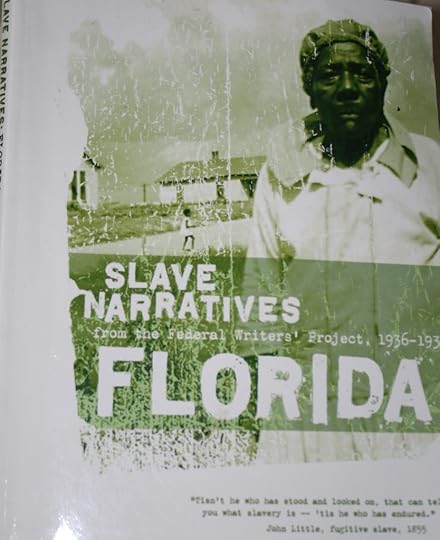
Slave Narratives: a Folk History of Slavery in the United States From Interviews with Former Slaves Florida Narratives

Rate this book
This book was converted from its physical edition to the digital format by a community of volunteers. You may find it for free on the web. Purchase of the Kindle edition includes wireless delivery.

295 pages, Kindle Edition

First published March 5, 2005

Loading...
Loading...

About the author

Work Projects Administration

749 books18 followers

Ratings & Reviews

What do you think?
Rate this book

Friends & Following

Create a free account to discover what your friends think of this book!

Community Reviews

5 stars
22 (62%)
4 stars
12 (34%)
3 stars
1 (2%)
2 stars
0 (0%)
1 star
0 (0%)
Displaying 1 - 5 of 5 reviews
Profile Image for Rebecca.
997 reviews
April 9, 2018
I found out about these books after a tour of the Whitney Plantation in Wallace, LA, about an hour outside of New Orleans on the historic River Road. The Whitney Plantation is a plantation museum that focuses on the lives of enslaved people. It has restored buildings - slave cabins, a freedmen's church, detached kitchen, and outbuildings, as well as memorials built to honor the people who were enslaved.

I bought two books - the slave narratives volume for Florida and the one for Maryland.

The Foreward by the Director, The American Folklife Center, Library of Congress, points out the importance of these narratives as "our first national exploration of the idea of oral history, and the first time that ordinary Americans were made part of the historical record." Note how the text reveals something of the point of view of the interviewer.

Some notes:

page 28: "It was during the war between the Indians and settlers that Berry's grandmother, serving as a nurse at Tampa Bay was captured by the Indians and carried away to become the squaw of their chief; she was later re-captured by her owners. This was a common procedure, according to Berry's statements. Indians often captured slaves, particularly the women, or aided in their escape and almost always intermarried with them. The red men were credited with inciting many uprisings and whole-sale escapes among the slaves."

page 29: "Berry recalls the old days of black aristocracy when Negroes held high political offices in the state of Florida, when Negro tradesmen and professionals competed successfully and unmolested with the whites. Many fortunes were made by men who are now little more than beggars. To this group belongs the man who inspire of reduced circumstances manages still to make one think of top hats and state affairs. Although small of stature and almost disabled by rheumatism, he has the fiery dignity and straight back that we associate with men who have ruled others. . . . "

pages 39-40: "I never learned to read until I was 26 years old. That was after I left the plantation. I was staying at a place washing dishes for Goodyear's at Sapville, Georgia, six miles from Waycross. I found a Webster's spelling book that had been thrown away, and I learned to read from that. I wasn't converted until I went to work in a turpentine still and five years later I was called to preach. I am one of thirteen children and none of us has ever been arrested. We were taught right. I kept on preaching until I came to Miami. I have been assistant pastor at Bethel African Methodist Church for the past ten years. I belong to a class of Negroes called Geechees. My grandfather was brought directly from Africa to Port Royal, South Carolina. My grandmother used to hold up her hand and look at it and sing out of her hand. She'd make them up as she would look at her hand. She sang in Geechee and also made rhymes and songs in English."
392 reviews2 followers
September 10, 2017
I loved this book. It should be required reading for all high school students in the US. What a perspective it gives on slavery and emancipation and reconstruction. The narratives are brutally honest. About their former owners, the life then and the changes in life in the 1920's and 30's. Their challenges with old age are just the beginning.
Reading this book makes me interested to read the Narratives of former slaves from other states.
Were their experiences very similar, or different from those given by elders in South Carolina.
One interesting fact I noticed, was how near to the original plantations the elderly former slaves still lived. There was so much more.
Profile Image for Carlton Phelps.
570 reviews10 followers
January 25, 2018
Very interesting read. You can get a feel of what is was like to be an early American who was forced into slavery and sent from their own country to a new land with no freedoms. Some of the older Americans interviewed were born into slavery so they knew nothing else until the end of the Civil War.

All of the Americans knew what the Civil War was about, Slavery, no question. And that they as humans would be free.
Profile Image for Cathy DuPont.
456 reviews177 followers
July 8, 2013
After reading two books about Zora Neale Hurston I discovered that she was a member of the Works Projects Administration or earlier, the Works Progress Adminstrtion renamed in 1939 the Works Projects Administration.

(From Wiki: the Work Projects Administration, WPA was the largest and most ambitious New Deal agency, employing millions of unemployed people (mostly unskilled men) to carry out public works projects,[1] including the construction of public buildings and roads. In much smaller but more famous projects the WPA employed musicians, artists, writers, actors and directors in large arts, drama, media, and literacy projects.)

Curious about the project and slavery in especially Florida, I found this book and was happily surprised when the pages were actually typewritten verbal accounts from the writers who interviewed men and women at the time who previously were slaves.

There were so many surprises for me and reading through the accounts of 23 previous slaves, it occurred to me that many of the events about slavery which was found in Gone With the Wind, were fairly accurate.

Many of the old slaves, some of who were in their 90's and some even more than 100 years old, had similar remembrances in what they ate, how they cooked, what they wore, and how they were treated with regard to family ties, and particularly how they were punished.

The names were of interest to me also since as we know in all probability, the family, first or last names, were not known. (Reading a bit about black genealogy, it's called "hitting the wall" when research comes up with nothing, up to the time their ancestors landed on the shores of America in slave trading boats. The names that intrigued me were Florida Clayton, Norfork Virginia and Mama Duck who were all interviewed. Norfork, she said, changed her name when she became an adult.

My favorite interview was with Arnold Gragston who visited a relative who was affiliated with Robert Hugerford College, Eatonville, FL.
Slave Narratives from the Federal Writers' Project, 1936-1938 Florida photo IMG_0970_zps9eec6e28.jpg "Cover of the book Slave Narratives

Here are some interesting excerpts from Gragston. He was in the minority knowing when he was born which was Christmas morning and said he was a grown man "when I finally got my freedom." "Before I got it, though, I helped a lot of others get theirs. Lawd only knows how many; might have been as much as two-three hundred."

He was born into slavery and belonged, he said to "Mr. Jack Tabb in Mason County, just across the river in Kentucky." Without looking on a map the Ohio River separates Kentucky and Ohio with Ohio being a free-state at the time therefore freedom by crossing a river.

What Gragston did as a slave himself, was to be a connection in the underground railroad. When the first slave was brought to him (although he was "owned by Tabb") he took just one pretty young woman over at night to a light set up on the other side of the shore. Then as time went on, he made more trips in just one night with up to 12 slaves seeking freedom.

Spoken in his own words as dictated to that WPA writer, Gragston's story is fascinating.

"What did my passengers look like? I can't tell you any more about it than you can, and you wasn't there." He went on to say..."the only way I knew who they were was to ask them; "What you say?" and they would answer, "Menare." I don't know what that word meant---it came from the Bible. I only know that that was the password I used, and all of them that I took over told it to me before I took them."

According to Gragston's story, Tabb seemed to have an inkling of what he did at night but looked the other way because apparently he did not feel strongly about slavery and in fact, let his neighbors know his feelings. In return they would not speak to Tabb for days and weeks at a time.

Another neighbor of Tabb, John Fee, made his anti-slavery feelings be known. Gragston said that Fee stated "...that God didn't intend for some men to be free and some men be in slavery." And "mostly they (Fee's neighbors) hated the sight of John Fee."

Fascinating stories about slavery coming directly from the mouths of the men and women who lived through the period and remembered (most of them) when the Emancipation Proclamation was issued.

I haven't enjoyed reading a book this much in a long time. It was like reading a diary and was so moving to me. My only regret is that there weren't any Hurston's interviews. Oh, my, guess I'll have to get the same book for Georgia, the reason I got Florida is quite obvious, being a native. Fascinating, just fascinating; even amazing, therefore the five stars.

Please Note: The names of places and excerpts taken from the book were written exactly as they came from the book.
Profile Image for Susan Molloy.
Author 153 books91 followers
November 20, 2023
🖋️ The United States government ran a Depression-era program under the WPA wherein workers interviewed former servants (slaves) either by note-taking or tape recording. In this book, these remembrance stories of life in antebellum United States were conducted between 1936-38. They are fascinating. Some of the remembrances are written in the vernacular, some are written in standard English, and some are written by the interviewer in the third person. Nevertheless, I greatly enjoyed reading these historical stories. It is interesting to read the former servants' recollections and events they experienced or overhead.
📙Published in 1938.
🟢The e-book version can be found on Project Gutenberg.
🟣 Kindle.
🔲 Excerpts of note:
🔹Josephine Anderson: "My weddin dress was blue—blue for true. I thought it was de prettiest dress I ever see. We was married in de court-house, an dat be a mighty happy day for me. . . . “

🔸Samuel Simeon Andrews (affectionately called "Parson"): "Parson" came to Umatilla, Florida, in 1882 from Georgia with a Mr. Rogers brought him and six other men, their wives and children, to work on the railroad; he was made the section "boss" which job he held until a white man threatened to "dock" him because he was wearing a stiff shirt and "setting over a white man" when he should have a shovel.

🔹Banana Williams: 1740 N.W. 5th Court, Miami, Florida was born in Grady County, Georgia, near Cairo in the 16th District. "The man what I belonged to was name Mr. Sacks. My mother and father lived there. I was only about three years old when peace came, but I remember when the paddle rollers came there and whipped a man and woman. . . . “

●▬●🔷●🔷●▬●
Displaying 1 - 5 of 5 reviews