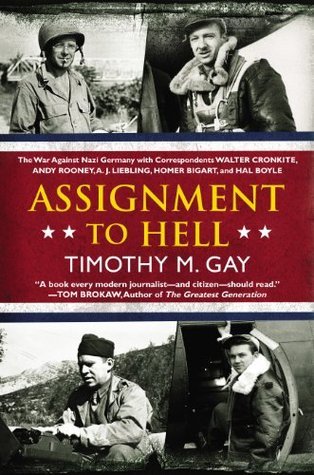
THEIR WORK ON THE FRONT LINES MADE HEADLINES In February 1943, a group of journalists--including a young wire service correspondent named Walter Cronkite and cub reporter Andy Rooney--clamored to fly along on a bombing raid over Nazi Germany. Seven of the sixty-four bombers that attacked a U-boat base that day never made it back to England. A fellow survivor, Homer Bigart of the "New York Herald" "Tribune," asked Cronkite if he'd thought through a lede. "I think I'm going to say," mused Cronkite, "that I've just returned from an assignment to hell." During his esteemed career Walter Cronkite issued millions of words for public consumption, but he never wrote or uttered a truer phrase. "Assignment to Hell" tells the powerful and poignant story of the war against Hitler through the eyes of five intrepid reporters. Crisscrossing battlefields, they formed a journalistic band of brothers, repeatedly placing themselves in harm's way to bring the war home for anxious American readers. Cronkite crashed into Holland on a glider with U.S. paratroopers. Rooney dodged mortar shells as he raced across the Rhine at Remagen. Behind enemy lines in Sicily, Bigart jumped into an amphibious commando raid that nearly ended in disaster. "The New Yorker"'s A. J. Liebling ducked sniper fire as Allied troops liberated his beloved Paris. The Associated Press's Hal Boyle barely escaped SS storm troopers as he uncovered the massacre of U.S. soldiers during the Battle of the Bulge. "Assignment to Hell" is a stirring tribute to five of World War II's greatest correspondents and to the brave men and women who fought on the front lines against fascism--their generation's "assignment to hell."
This was a very tough book to get through. It seemed more like a bad copy and paste job from other books that were written about this subject. I hope someone who has more knowledge and takes the time to properly research, write a book of a similar subject to do the men justice.
I think I, like a lot of people, have taken World War II journalism for granted. The history of the war, the words and sights and images, are so much a part of our common cultural background that it is all too easy to forget that those images were shaped by men. Those stories were written by reporters who were there, who were embedded with the troops: reporters who landed in Normandy on D-Day hot on the heels of the soldiers, who flew on the bombing runs over Germany, parachuted into Holland on airborne assaults, reporters who were never very far from the action and quite often right in amongst it. Fifty-one American reporters were killed in WWII, pursuing what they felt was their duty, to report honestly and accurately on events as they occurred, both for the soldiers and the folks back home.
One of the strengths of this book is how much Gay covers what the reporters themselves and their readers were interested in - the stories of the grunts, the men on the ground. The small snapshots of American GIs peppered throughout this book are of just as much interest now as they were back then, and there are some incredible stories in here. Few of these reporters ever lost sight of those soldiers, their importance, their bravery and resilience, and this comes through on every page.
We are used to seeing reporters covering war zones in today's news, but today's wars often seem very short and very far away in comparison to such a titanic clash as WWII. It was fascinating to read about how the reporters approached their stories, how they finagled their way into missions, hitch-hiked to front lines, dove for cover from bombs and artillery and occasionally even had to pick up a gun themselves. Of the reporters covered in this book, I had only heard of Walter Cronkite, and it was more in his later role as avuncular host on CBS Evening News than as a young war reporter. But even though the five men chronicled here were unknowns to me, I got utterly swept up in this book. It is such a unique approach to WWII history and, as I said, an angle I had never even thought of before.
The kind of book a teacher loves, full of anecdotes that are both interesting and informative. I'm the kind of person who always tries to imagine what elderly folk were like when they were teenagers (and what teenagers will be like as elderly folk), so this book definitely piqued my interest as it shows young and reckless Andy Rooney and Walter Cronkite. Makes me want to look up some of their old war articles.
Since I am always interested in W War II, and I have a great respect for war journalists in particular, I found this book to be quite interesting. I was only familiar with the work of Cronkite, Rooney, and Ernie Pyle before this work, which concentrates on the W War II reporting of Cronkite, Rooney, A. J. Liebling, Homer Bigart, and Hal Boyle. Each of these men were competitive yet friendly, looked death in the face as they attempted to get a good story on numerous occasions, and, according to the compiler, Timothy Gay, demonstrated the highest of journalistic standards. Having just read My War by Rooney, I found that this editor/compiler took much of the material on Rooney verbatim from that book. I now look forward to reading the works left by several of the others. I have some quibbles about this work. Organizing it was a challenge, and there are places where the chronology was a little baffling, but the reader needs to remember that this is a story of war correspondents and not the war itself. I so wish there had been more reporting from the Battle of Hurtgen Forest, for example, but these five weren't too involved with that one, and it's a shame, because more people need to know about it. But they were involved in countless other encounters from North Africa, through Italy, in the Netherlands, etc. and left us records of those. Having read this, now I understand how Cronkite came to be the television titan that he was, how CBS television news was able to use the great print journalists of W War II to establish prominence in TV news reporting, and how indebted we are as citizens to the brave efforts of journalists to get the news straight and out to people.
Timothy Gray's, Assignment to Hell: The War Against Nazi Germany With Correspondents Walter Cronkite, Andy Rooney. A.J. Liebling, Homer Bigart, and Hal Boyle is a profoundly interesting book not just on the war but on some of the leading journalists who covered it.
Going in, I've already read 2 books on Edward R. Murrow and an extremely well written biography on Walter Cronkite and aware of Andy Rooney having watched him on 60 minutes my whole life but must admit to being unaware of his service as an enlisted correspondent for Stars and Stripes in World War II as well as all the other journalists mentioned.
To see another side of World War Ii was fascinating to hear of the trials and tribulations of but a small group of were responsible for bringing the news of the war to the home front. The preponderance of the book is spent on the European theater briefly touching on the Pacific and following up with a brief description of their post-war career.
I rate this as a solid 4-star book and encourage those interested in World War II to look at a non typical coverage of the war.
Good until the end of the war. The rest of it, the competition among news organizations, petty personality conflicts, was boring. I stopped reading at that point.
A great book awaiting a greater movie. We see the youngsters Andy Rooney and Walter Cronkite and the daring feats they accomplished in covering the Second World War. But we get even better when the stuttering Bigart, Boyle, and especially A.J. Liebling become a part of the coverage. [Bigart used his stuttering to great effect to get his stories. Boyle came close to being one of the victims of the Malmedy Massacre. Liebling's own life is worthy of a separate book alone. He was cultured, intelligent, a connoisseur of fine alcohol, women, and Parisian cuisine. He was a party animal.] Author Tim M. Gay has done meticulous researching of these great correspondents and their stories, and it becomes such an engrossing read that it is hard to put down for any length of time. One of the best reads in the past year. It shows us the insanity, inhumanity up close and personal, and also sheds light on the many correspondents who were killed by the Nazis in the war. Also not lost are the constant reports of friendly fire killing so many of our Allied soldiers. I had no idea there were so many. All of them covered up. These brave men risked their lives in support of our armed forces. They helped sell the war, putting human faces to it. After the concentration camps were discovered in 1945, like many of those Allied soldiers, I have always thought there were not enough dead Nazis in WW2, this book rather solidifies that opinion.
Assignment to Hell: the War Against Nazi Germany with Correspondents Walter Cronkite, Andy Rooney, A. J. Liebling, and Homer Bigart, by Timothy M. Gay, Narrated by Walter Dixon, Produced by Gildan Media LLC, downloaded from audible.com.
Their work on the front lines made headlines. In February 1943, a group of journalists - including a young wire-service correspondent named Walter Cronkite and cub reporter Andy Rooney - clamored to fly along on a bombing raid over Nazi Germany. Seven of the 64 bombers that attacked a U-boat base that day never made it back to England. A fellow survivor, Homer Bigart of the New York Herald Tribune, asked Cronkite if he'd thought through a lede. "I think I'm going to say," mused Cronkite, "that I've just returned from an assignment to hell." During his esteemed career, Walter Cronkite issued millions of words for public consumption, but he never wrote or uttered a truer phrase. Assignment to Hell tells the powerful and poignant story of the war against Hitler through the eyes of five intrepid reporters. Crisscrossing battlefields, they formed a journalistic band of brothers, repeatedly placing themselves in harm's way to bring the war home for anxious American readers. Cronkite crashed into Holland on a glider with U.S. paratroopers. Rooney dodged mortar shells as he raced across the Rhine at Remagen. Behind enemy lines in Sicily, Bigart jumped into an amphibious commando raid that nearly ended in disaster. The New Yorker's A. J. Liebling ducked sniper fire as Allied troops liberated his beloved Paris. The Associated Press's Hal Boyle barely escaped SS storm troopers as he uncovered the massacre of U.S. soldiers during the Battle of the Bulge. Assignment to Hell is a stirring tribute to five of World War II's greatest correspondents and to the brave men and women who fought on the front lines against fascism - their generation's "assignment to hell".
The Women Who Wrote the War kind of spoiled me I think ... this is probably an interesting book but right now I can't bring myself to read a book that (based on a quick skim of the index) is only about dudes. (Caldwell's book included the male lovers, husbands and colleagues of the women who were its focus.)
If you don't know where Walter Cronkite or Andy Rooney came from; If you are interested in the history of World War II; or if you want an engaging and interesting book about the practice of journalism; you will love this book. It is full of facts and while not portraying all WWII correspondents as heroes, it portrays the danger that was a constant part of their lives.
slightly biased, as this was one of my work titles, but a really great read for anyone who enjoys biographies of journalists and reading about some of the more harrowing experiences as a reporter in the midst of crisis.
11-03-12, 7:45 a.m.- Review to follow, damn it; I stayed up all night again to finish this book & am unfortunately in no condition to write anything before I get a couple of hours worth of sleep, my usual mason jar full of strong coffee, and a square or two...
Couldn't finish it because I couldn't get into it. My grandmother recommended it, and I'm sure it's an enlightening read, but I've read so many serious books this year that I wasn't motivated to get into this one.
Not only does this book show the amazing lengths that these journalists went to to cover WWII, it also provides an excellent overview of the main events of the war.