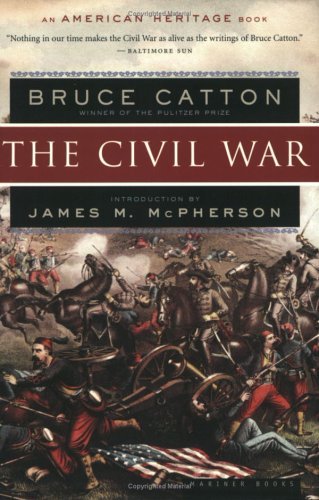
Infinitely readable and absorbing, Bruce Catton’s The Civil War is one of the most widely read general histories of the war available in a single volume.
Introduced by the critically acclaimed Civil War historian James M. McPherson, The Civil War vividly traces one of the most moving chapters in American history, from the early division between the North and the South to the final surrender of Confederate troops. Catton's account of battles is a must-read for anyone interested in the war that divided America, carefully weaving details about the political activities of the Union and Confederate armies and diplomatic efforts overseas.
Bruce Catton was a distinguished American historian and journalist, best known for his influential writings on the American Civil War. Renowned for his narrative style, Catton brought history to life through richly drawn characters, vivid battlefield descriptions, and a deep understanding of the political and emotional forces that shaped the era. His accessible yet meticulously researched books made him one of the most popular historians of the twentieth century. Born in Petoskey, Michigan, and raised in the small town of Benzonia, Catton grew up surrounded by Civil War veterans whose personal stories sparked a lifelong fascination with the conflict. Though he briefly attended Oberlin College, Catton left during World War I and served in the U.S. Navy. He later began a career in journalism, working as a reporter, editor, and Washington correspondent. His experience in government service during World War II inspired his first book, The War Lords of Washington (1948). Catton achieved national acclaim with his Army of the Potomac trilogy—Mr. Lincoln’s Army (1951), Glory Road (1952), and A Stillness at Appomattox (1953)—the last of which earned him the Pulitzer Prize for History and the National Book Award. He went on to publish a second trilogy, The Centennial History of the Civil War, and contributed two volumes to a biography of Ulysses S. Grant, begun by Lloyd Lewis. His other notable works include This Hallowed Ground, The American Heritage Picture History of the Civil War, and Waiting for the Morning Train, a memoir of his Michigan boyhood. In 1954, Catton became the founding editor of American Heritage magazine, further shaping the public’s understanding of U.S. history. In 1977, he was awarded the Presidential Medal of Freedom. Catton’s legacy endures through his vivid portrayals of America’s most defining conflict and his enduring influence on historical writing.
Preeminent Civil War historian Bruce Catton's The Civil War is an excellent and highly readable general history of the Civil War, which gives a balanced treatment of both sides. Catton not only covers the causes and the fighting but also the Northern and Southern economies and politics, and also slavery.
Just a few interesting highlights:
According to Catton, the vast majority of Northern soldiers enlisted to preserve the Union. The vast majority of Southern soldiers enlisted for many reasons, including to defend their newly founded country; to take part in a momentous event, which was bigger than themselves, that happened maybe every generation or two; and to protect their women. Few were motivated by defending slavery.
By 1862, the Confederates were triumphant and civilians in the North had become tired of and disillusioned by the war and—much to President Abraham Lincoln’s dismay—and wanted the fighting to stop. To prevent that from happening, Lincoln issued the Emancipation Proclamation on September 22, 1862, which freed all slaves in the states under rebellion—but not in the border slave states because he feared those people would join the war on the side of the Confederacy. But Lincoln also had another reason for issuing the proclamation. Both England and France appeared ready to recognize the Confederacy as a sovereign country, and Lincoln didn’t want that that to happen. If he freed the slaves, England and France would be reluctant to intervene in what had suddenly morphed into a domestic quarrel over slavery. The majority of Union soldiers, though, could care less about freeing the slaves because they were fighting to preserve the Union. “They were either in sympathy with slavery or willing to tolerate it.” (p. 174). A few regiments actually came to the point of mutinying over the proclamation.
After the Emancipation Proclamation, Blacks were allowed to join the Army. Most of the White soldiers opposed having Blacks in their ranks, even if they were in segregated regiments. But those men quickly changed their minds when they realized that “a colored soldier could stop a Rebel bullet just as well as a white soldier could,” (p. 176) which meant fewer White soldiers would be killed or wounded.
Catton also explains how Lincoln’s death changed the course of Reconstruction. Lincoln intended to reunite North and South “without bitterness and in a spirit of mutual understanding and goodwill.” (p. 273) But Lincoln’s death, along with the long train ride with his body through many states to the burial ground, angered the general public in the North and put the Radical Republicans in control of the government. The Radical Republicans, who sought revenge instead of reconciliation, and with the support of angry civilians, chose to punish the Southern states instead of reconciling both sides. And we’re still feeling the effects of their policy of revenge today.
Bruce Catton is one of my favorite Civil War historians. If you want to read a readable and interesting general history of the Civil War, The Civil War, this is the book for you.
A superbly written text from a master historian. Great flow. Easy to read. Covers all aspects of the Civil War from pre-war to post-war. A great learning experience.
Bruce Catton's The Civil War would make for a great entry into the realm of U.S. Civil War history for any reader. Covering all the major battles and campaigns that proved pivotal, Catton brings his usual, eminently readable narrative style to the table. This is a beautifully written book. Of course, if one is looking for an account of the war in which the personalities of the major players come to the fore, you won't find it here. In a book where actions and events take precedence, the only man whose personality really shines through is General Sherman -- and even then it's because his methods were relatively novel. This being Catton, there is some element of romance to the coverage that at times has unfortunate echoes of the Lost Cause works his books are otherwise a great antidote to (unlike Catton, I can imagine someone doing a better job than Jefferson Davis). Overall, this book remains an excellent, evocative resource.
When I was a kid, my grandparents thought they would do something that every grandparent should do - share what they love with the next generation. They bought me a subscription to the Time-Life series on The Civil War. Now for those of you too young to remember, Time-Life used to publish these monthly book series on various topics. The idea was that you would receive the books once a month, each book on a different topic in the series. My father had the Science Series, which I absolutely adored, and my grandparents thought that I would fall similarly in love with the Civil War series.
After all, they both were interested in this most unfortunate periods in U.S. history. It spanned five years, cost hundreds of thousands of lives, and permanently altered the face of our nation. What's not to love?
Predictably, I found them kind of boring.
The pictures were all in black and white, static in composition and full of dead guys with beards. There were lots of dates that I couldn't comprehend, talking about places I'd never been and full of names I'd never heard of. I got them, flipped through them and was just not interested.
Looking back, I know that I was a bad grandson and I feel bad that I can't tell my grandparents that.
Now that I'm older, and I know some things about my country and its history, I can really appreciate the enormous change that the Civil War brought upon the United States. As horrible as it was - and it was horrible - without that war our nation would be a pale shadow of what it is today. If it were a nation at all....
We all know the facts: in 1860, following the election of Abraham Lincoln and years of arguing about slavery and its place in a modern nation, eleven states seceded from the United States and formed their own Confederate States of America. In response, Lincoln raised an army from the remaining states in the Union and launched it out the Rebels. After five years of relentless fighting, the war was won in favor of the Union. The rebel states were accepted back into the Union, and the nation has been putting itself back together ever since then.
That's the big picture, and that's basically what this book does. In less than 300 pages, Catton gives an interesting and dynamic overview of the War, from its origins in such decisions as Dred Scott and the Missouri Compromise up through the assassination of Lincoln and the failures of the Reconstruction. It follows the major battles of the war, listing the strikes and feints of each army and introducing all the major players. Between these, he talks about the political and social effects of the war - how the economies of the two states fared, how the international community viewed the conflict, and what the ultimate fate of the slaves was.
The pace of the book is very good, even if the blow-by-blow descriptions of the battles get a little soft in the middle. Catton acts as a narrator for the war, telling it as one might tell a story. He works up to climactic moments, then leaves us there to consider for a while before moving on to the next event. What's more, he's fair. It's very easy for people to be unfair to the South - they were rebels, after all. Traitors, some might say. But Catton wants us to understand that the South was doing what it thought was in its best interests, as with the North. What's more, he wants us to know that the South fought harder than any army has since, sacrificing countless men and an entire culture to a war that they really could not win. He does not demonize the South, nor does he praise the North. He is simply a storyteller, who knows from the beginning the tragic tale that he has in store for us.
So yes, I think this book is an excellent read, especially if you're just getting into the Civil War. My one real complaint about it is that the book lacks adequate maps which would otherwise help a reader visualize what kind of maneuvers the armies of the North and the South are making. There are maps at the back of the book, but I wouldn't call them "adequate." They're black and white where they really should be color - having both the Union and the Confederate advances marked with black arrows isn't really helpful. Given the intricate interactions between armies, some kind of clear visual aid might have been useful.
If you have access to the internet, of course, you can get a slightly clearer view of what happened, where and when. Mind you, even the better maps that you can find on line still take some interpretation. Still, it would have been nice to have the book more accessible to those of us who don't carry the maps in our heads.
The reason why this is important is that even though this book is kind of an index tour of the Civil War, it still gets into a lot of detail - which general moved which army across which river is vital to understanding how the war progressed. The reason the book can go into such detail is that this is one of the most extensively studied conflicts in our history. Every battle, the movement of every army has been studied and documented over the last century and a half, and there's no sign of it slowing down. The Civil War is fundamental to how our nation became what it is, and as such it is an obsession for the United States.
That's what this book really tries to understand - why, of all the wars that we have fought, are we so obsessed with this one? You never see people doing World War 2 re-enactments or dressing up to fight mock battles of our cute little war with Spain. I'm pretty sure there won't be any kind of Afghan War Re-enactment Society a hundred and fifty years from now.
It was a horrible war. It took more lives in a single battle than we've seen in our current Middle East conflict so far. It was fought by untrained, inexperienced men who had no idea what they were in for when they signed up. It was a war fought not only for territory but for ideals - for the South's ability to maintain its agrarian slave culture and for the North's ability to keep the Union whole. It was a war that could have gone a thousand different ways, each more horrible than the last, and the fact that it ended as well as it did is completely due to the strength of character possessed by all the men involved in sealing that bloody peace. It was a war that was, perhaps, inevitable.
That was something I took away from this book. The Civil War had to happen. In order for our country to progress, it had to do away with the things that was holding it back, slavery being one of those things. It was a test to see if the union could balance its ideals of liberty and order, and to see if it was worthy of forging ahead. It was a war that settled who we are as a nation, at least for a little while, and put paid to the question of whether we were a bunch of congenial states or a true nation, ready to take its place in the world.
The Civil War is one of those topics that people spend their lives studying, and rightly so. Its effects can be felt even today, and the echoes from the shots fired at Fort Sumpter and Gettysburg and Shiloh won't fade as long as this nation survives. For Americans, to know the Civil War is to know how grateful we should be that we have the country we do. It is often said that soldiers die to keep us free, but I would say than no army of the United States since then has done so more literally than the army of this conflict.
For those of you who aren't American, this might give you a little insight into our character. Most nations wouldn't survive such a conflict, with such immense losses of life and the utter destruction of an economy. But we did, somehow. The wounds from that war aren't entirely healed - there are still scars. But we have stayed together since then, and I reckon that nothing is going to tear us apart again.
So Grandmom, Grandpop, I'm sorry. I really should have appreciated what you tried to teach me. But now I do, and I can pass it on to others....
Bruce Catton was a highly distinguished and respected Civil War historian, writing numerous books about the period. This book is a condensed version of the War (weighing in at slightly over 300 pages after including three appendices), yet seemingly nothing was left out. Catton covers all of the major battles, personalities, and factors that led to this horrible conflict. He concludes with a short yet penetrating chapter on the immediate and long-term effects of Abraham Lincoln's assassination: how Secretary of War Edwin Stanton took over temporarily and permanently damaged any hope of a true reconciliation between North and South by placing the blame for the assassination squarely on the Confederate Government, when in fact that soon-to-be disbanded body had nothing whatsoever to do with it.
What makes this book so easily readable yet appealing to serious readers is that Catton provides appropriate amounts of detail and background about virtually everything. Yet, at the same time, he does not delve deeply into intricate battle maneuvers except where necessary, thus he does not spend seemingly endless pages reviewing battle after battle. Can one get more detail elsewhere? Sure. See James McPherson's Battle Cry of Freedom, which is an excellent book in its own right. If a reader is looking for a relatively short yet compact depiction of the Civil War, choose Catton. If one has the time for a much more in-depth review, choose McPherson. You will not go wrong with either choice.
This was a good overview on the Civil War. but one book isn't enough to cover the whole Civil War, most campaigns, or battles, or generals get their own book with lots of more detail. I'll read more of Catton's and McPherson’s Civil War books. Good stuff.
Excellent overview of The Civil War. Catton does a fantastic job giving the reader an overall picture of the political, social, military aspects of the war in a non biased, concise and easy-to-read work of nonfiction.
I chose to listen to the audio version via Hoopla. For me personally, the narrator’s voice became a little too dry and monotonous as the book went on, but aside from that this is a great read for history lovers or anyone wanting to know more about the Civil War.
Bruce Catton is one of the giants of Civil War non-fiction, with in-depth treatments of various battles, generals, and phases of the war, I decided to start with his survey book, titled simply The Civil War. It was outstanding. At 400 pages, it is less than half as long as McPherson's 867-page tome. They cover the same ground and with much the same analyses regarding the causes, the resources, and the impacts of various decisions along the way. I must say, though, that Catton's final chapters in which he talks about how the effects of the conflict are still being played out today (i.e., 1960 was when this was first published) and today (2024) are chilling and sobering, but his writing is beautiful and memorable.
If there is only one book you read on the Civil War, I would recommend this one. Truly a classic.
"The Civil War" is a good surface exploration of a topic that has inspired countless volumes of books, and will continue to do so for many years to come. I believe this text would be helpful to someone who has been away from the topic of the Civil War for a long time (as I was) and needs a refresher course, or for someone who has an interest in the war, has gotten into it a little, but wants to get a nice overview so they can appreciate their later explorations on the topic. It serves as a great foundation of information for a topic that is as deep as it is wide. Bruce Catton was a lyrical writer, not a usual quality of historians, and his prose at times is wonderfully, and simply, beautiful. That is a strength of the text. I can see some readers being irritated at his obvious infatuation with the Confederacy, and its doomed cause, but I think that is just his natural sympathy for the "loser" in the conflict. Mr. Catton makes it very obvious that the right side won, and that the real tragedy of the Civil War was that the whole thing could have been avoided. The book is arranged chronologically and explores the eastern and western theaters of the war, as well as the political and home front aspects. He weaves them together into a nice tapestry that clearly demonstrates the importance to our nation's history of this most monumental of events. This edition of the text also has period photographs and maps dispersed throughout the chapters and it includes a nice (and thorough) index as well as two vastly informative chronologies. This book is worth adding to your History shelf.
A wonderful short book that is a survey of the Civil War. Catton does an amazing job of including every part of the War and every personality involved in the War without getting lost in the details. I have read quite a bit about the Civil War in my years and there was nothing new here, but it was a nice review and I completely understand why it is considered a classic.
The American Civil War is one of the most written about conflicts in history. Aside from reading Doris Kearns Goodwin’s Team of Rivals (which is wonderful, by the way) and working through an EdX class taught by Eric Foner, I have merely collected books on the subject in anticipation of delving deeply into the conflict, politics, characters and period of the Civil War. With so much material to consume I wanted to find a relatively short primer on the war. Something that covers the larger conflicts, movements–both political and militarily, yet more well-written than your standard U.S. History textbook. The late Bruce Catton won the 1954 Pulitzer Prize for his Civil War book A Stillness at Appomattox and I was very pleased to find in this book all that you could want in a Civil War primer/summary. Catton is blunt about the shortcomings of political leaders and generals alike, yet cautious to abuse 100 years of hindsight (The Civil War was originally published in 1960).
Lessons Learned:
The Civil War was too complex to categorize as merely attrition warfare. Sieges on cities (Petersburg, most prominently) and large entrenchments were certainly elements of strategy for both Union and Confederate generals, as was the concept of frontal assaults which lead to absurdly high casualties; and yet, there were instances of insurgent behavior exhibited. Most notably was during the Battle of the Wilderness in 1864, which pitted Grant’s Army of the Potomac against Lee’s Army of Northern Virginia southwest of Washington, D.C. Lee chose to face Grant here because he knew his force was undermanned and felt the dense woods and thick underbrush would neutralize the Federal troop (and artillery) advantage. Also, the nature of Lee’s forces played a role in his decision. As Catton states, “because a much higher percentage of its men came from the country and were used to the woods, the Confederate army was probably less handicapped by all of this than the Army of the Potomac.” (P. 195). Lee was absolutely correct and after a two day battle the Federal losses were great with nothing to show for them. Notwithstanding the subsequent (and successful) maneuvers of Grant to move past Lee’s forces and disrupt his supply lines, Lee’s ability to continually neutralize the Union’s asymmetric advantages is indicative of insurgent behavior. Other examples of insurgent and counterinsurgent behavior and thoughts (I categorize insurgency two ways: 1) bringing symmetry to a lopsided conflict; 2) leverage the opposition’s populace to influence military and political maneuver) include:
- Confederate General Johnston’s view of Sherman’s stalled advance in Atlanta. Johnston knew that Lincoln’s reelection was, in part, dependent on Sherman’s success in the South. Had he remained outside Atlanta and harried Sherman with small-scaled attacks he could have swung the election and the eventual outcome; however, Confederate President Jefferson Davis felt a traditional victory was paramount and replaced Johnston with Hood.
- Grant’s call for total devastation of the Shenandoah Valley to prevent sustenance of the Confederate forces. The Valley was an avenue for Confederate troops to harass the North (as Jubal Early has shown). In this venture Union General Sheridan’s forces dealt with a fair number of Confederate guerrillas which has little effect on the North, but likely drew capable troops from the Southern forces.
- Sherman’s march to the sea saw him shift focus away from addressing Confederate forces and towards civilian population centers (think Warden’s rings). This effort in effect broke the Confederate will to fight, as their army was shown as ineffectual at defending the Southern populace and sped the end of the Civil War. Though it calls into question the longer term impact on reconstruction.
Lincoln’s death was gravely impactful on reconciliation and reconstruction. Lincoln’s guidance to Grant and Sherman had permitted a relatively bloodless end to the war. After his assassination, now President Johnson didn’t have the savvy to pursue reconciliation with the ability Lincoln would have and largely deferred to Secretary of War Stanton (with the influence of other Bitter-Enders) that belabored reconciliation efforts.
Effectively going 60 years without a standing army had an impact on early Civil War battles. The gray beards of the Revolution War were mostly dead by the time Fort Sumter was taken by the Confederates and the early generals charged in this conflict show rust and outright inability. Winfield Scott’s anaconda plan (build forces, block naval ports and attack with the army) would have taken too long to play out and the blockage was only effective because of equal blunders by the Confederates (including restricting cotton trade with Britain and France). At lower ranks, the ineffective officer corps was likely exacerbated by the appointment of men by politicians and election of officers (in some cases) by their own men. In either case this bred a protectionist mentality amongst officers where the best military decision was weighed against political expediency. In some cases good order and discipline barely existed as the younger generation of soldiers were unacquainted with war and strife.
The criticality of battles along the Mississippi. The well-known battles largely occurred in Virginia and Sherman’s raising of the South is known to most, but the battles for control of the Mississippi (in both MS and Tennessee) were crucial in several regards. First, this was where Grant got his start and showed his abilities that eventually brought him to control all Federal forces. Two, Union success permitted Grant and Sherman to eventually focus on Lee and Johnston.
Quotes:
On Strategy: “git thar fust with the most men” Nathan Bedford Forrest, Confederate Calvary
On Sherman’s march to the sea: “it was…the nineteenth century equivalent of the modern bombing raid, a blow at the civilian underpinning of the military machine.”
Awesome words:
Chattel - A personal possession; an item of property other than real estate Superannuated - obsolete through age or new technological or intellectual developments (antiquated) Anachronism - a thing belonging or appropriate to a period other than that in which it exists, especially a thing that is conspicuously old-fashioned Spavine - A disease of horses characterized by a bony swelling as the result of inflammation of the bones Abnegation - the act of renouncing or rejecting something Fifth Column - a group of people who undermine a larger group (city or nation) from within, usually in favor of an enemy group or nation; can be overt or clandestine Jocosely - given to or characterized by joking; jesting; humorous Attenuate - reduce the force, effect, or value of Victuals - food or provisions; typically prepared for consumption
A fine general overview or introduction to the Civil War for people like me who know next to nothing about it, I guess. The publication data are somewhat confusing: Goodreads says this book dates from 1960, the e-book I read via Kobo had 2014 as the only date among its scant bibliographical information. It's rather worrying that publishers are so lackadaisical about that.
1960 would seem to be the more plausible first publication date for this as regards some aspects of the text, since to me it sometimes unnecessarily glorifies the heroism of the South. (In one particular sentence for instance, it is said the South keeps defending something 'valiantly' against overwhelming odds, where I think the adjective 'stupidly' might have been just as, if not more appropriate). And whereas the authors don't shy away from moral and character judgements (about Jefferson Davis, for instance), a heinous atrocity like slavery is rather glossed over and often simply characterized as an 'archaic' or 'peculiar' practice. I'm not exactly a fan of the excesses of group think that current wokeness can sometimes lead to, but I would like to think that a modern day concise history of the Civil War would be a little more sensitive in its approach towards that particular aspect of the whole sordid business.
Having said that, I did learn a lot and gained a clearer insight into the course of the war as well as its social, economic and political ramifications; and it was well written, a lot more palatable than just gleaning Wikipedia articles about the subject.
Excellent and succinct overview of the entire Civil War by one of America's leading historians on the subject. Recommended for anyone looking for a good general overview of the causes and lead-up to the War, the significant battles and individuals involved, War life, and aftermath.
Interesting fact: During the Civil War years, more than 40% of the wheat and flour in Great Britain came from the (northern) United States. The country's wheat exports tripled during the War and it was northern wheat rather than southern cotton that was king during that time.
The Civil War, by Bruce Catton, has helped one understand the political motivations as well as the military plans and actions during the U.S. civil war. The civil war, following the election of Abraham Lincoln, and the arguing of slavery, has occurred due to the eleven states creating confederate states, angering Lincoln, and leading to war. The split between the southern and northern side of the U.S. was very well illustrated through the causes and different opinions regarding slavery in the civil war. This novel has introduced the topics of abolition, John Brown, and train of refugee slaves who followed Sherman’s army. It showed the weak amount of respect contributed to slaves, and the enormous amount contributed to the wealthy. Yet it shows the economic, political, and individual actions, thoughts, and destructions, this novel also shares the military side of the war. This novel has been able to produce a vivid image of the entire civil war, helping the important details appear. Thus, this novel exemplifies the civil war; it’s causes, as well as its impact in the modern world.
Bruce Catton has introduced Abraham Lincoln, a character who proved to have a significant role in the civil war. Abraham Lincoln has done several things, such as improving the civil war, and even bringing it to an end. He acted as a leader by preserving the union during the civil war. Abraham Lincoln has successfully started the process of emancipation proclamation, which has brought an end to slavery in the U.S., and later to the war. Because of his achievements, Abraham was respected and later considered as a leader and hero. Today, Abraham is considered as the greatest American president in history. Lincoln is remembered and is a symbol for inspiration, hope, and determination. Abraham’s face and name is represented and shown in several different parts of the U.S., keeping his presence and the memory of him alive. Furthermore, Lincoln has been influenced by his culture, religion, and family in order to achieve what he has. Additionally, Lincoln’s life experience made him understands and knows better. Lincoln grew in poverty, which made his chances lower and his determination higher. Lincoln understood life and the difficulties other faced, this kind of knowledge is what helped him fight for the servants. Thus, Abraham Lincoln has had a huge impact on the civil war due to his achievements and influences, leaving a great legacy behind.
The civil war is a novel that shares several historical and significant events in a very clear and precise manner. This novel is mainly for people from ages 15 and above, since it requires a higher lexile level. This novel introduces historical events relating to the U.S. civil war, which makes this novel interesting for those who are intrigued by history. Scholars interested in the civil war or its victims ,such as Abraham Lincoln, should read this enlightening novel.This novel has the capacity to imply other events into the one being presented. In order for one to read this novel, an individual requires a minimum of history knowledge only obtained at the age of 15. This novel is recommended for all genders. This novel teaches one about the civil war in a very detailed manner. Mostly all events occurring during that time period are mentioned, and the political as well as economic level is presented.Thus, this novel is highly recommended for people interested in history, from ages 15 and above.
It won't be news to anyone who knows anything about the Civil War that the late Bruce Catton was the Grand Poobah of Civil War historians. He has held that distinction for well over half a century now.
Sheepishly, I admit -- and with great envy for all those who've long ago put Catton and Foote and McPherson and the legions of other Civil War master storytellers behind them in their Civil War life reading lists -- this is my virginal experience with a canonical Civil War overview tome. And yes, I realize this is Catton's "Reader's Digest" reduction of his own massive multi-volume work on the subject, but it's just what I wanted right now: a quick, pithy, clear, and well-reasoned survey of the main political, economic and technological issues, the battles and the personages of the war. This is very much that, and for that I am very much satisfied. It's a highly recommendable template or jump-off point for subsequent immersion into the vast panorama of this event via more fulsome and detailed books.
While many authors today require pages and pages of minutiae to establish context, Catton does the same, clearly, in one sentence. The presentation is textbook penny plain, yet breezier, and because Catton was not an academic this does not feel academic. The narrative follows an uncluttered linear path, and that, too, was something I wanted.
It's a much easier thing to expound on and on in minute detail for 1,000 pages about a very lengthy and complex subject; it's a much more impressive thing to do the same with the brevity shown here, for that requires complete mastery of the material. Just when it seems there's a point or a question missing from the narrative, Catton sweeps in with the answer. Catton explains in one masterly paragraph the genius of Lincoln's "team of rivals," something that took Doris Kearns Goodwin a thousand pages to do.
It's always interesting to be reminded just how dramatically the Civil War changed the technological nature of warfare, and also how it profoundly changed the nation forever. There's a passage where Catton explains how the people of the North and South just wanted the country they had before the war, were fighting for that, yet were never going to get that back. It's a sad and poignant observation, beautifully reasoned and stated.
There are levels of dryness in the writing, but also moments of inspired poetic feeling. Catton's prose is better when talking about the ordinary soldier and slavery than when he rattles off various epic battles in highly compressed (yet in this context, necessary) form, but even at that there are flourishes of flavor.
Having heard about Catton for years, I can now see that the hype is real, and just from reading this, I love the guy. I will be reading more.
This is a highly recommended primer on the subject.
Concise yet comprehensive history of the events leading to and including the entire Civil War. Catton's writing is clear and easy to follow and the book is so interesting that before you know it, you are almost finished! Included within the entire text are sketches and photographs of key people, places and battles that enhance the written word greatly. Although not the most comprehensive book on the subject, Catton is perfect for war buffs and the curious in equal measure. If you are looking for a good overview of the war and the key persons involved that is fast-paced and enjoyable to read, this is it!
This book provides a bird's-eye view of the war, with emphasis on broad-stroke explanations instead of minute details. (I will read Shelby Foote's trilogy for the full account.) With this approach the author is able to narrate the war as a comprehensible story, elucidating how one event leads to another and how they progress in a historical arch. The writing is superb making the book a pleasure to read.
I enjoyed this book. It had the usual Generals and dates and locations. but it also had the deeper story. Such as the north was undergoing an industrial revolution, while the south was stuck in aristocracy and agriculture. This helped the north win the war.
An introductory text on the Civil War, good for the casual reader who will just read one book on this subject, or a good big-picture survey of the war for anyone who will be diving in more deeply on the various battles, issues, and personalities.
The union wins. And everything in between in this easy to read history of the Civil War. Detailed without the bogged down feeling. This was a Mothers Day gift a quick and awesomely fun read!
And again what is most fascinating in these civil war accounts are how many Southern soldiers did not have slaves. And how many Northern soldiers did not want to fight along side African Americans. This is important because I know some who STILL think The enormous amount of Northern Union soldiers who died to free slaves was,and is, a price paid in FULL to the debt of slavery. An enormous amount of union soldiers did in fact die in the civil war! However, WE are putting the cause of that death into their mouths, so to speak! Some Union soldiers deserted when Lincoln made the war “officially” about freeing slaves with the Emancipation Proclamation. Not only have we put the cause for fighting into Northern soldiers mouths we have done so for many Southern ones as well.
It is all so much more complex I have come to learn and it really starts with 1776 (and before). We have decided to make it a very neat tidy story. The south all owned slaves the North hated slavery. The south fought to keep them the North fought to free them. Not so tidy is the truth! Many Union soldiers could care a less about slavery. They lived in more industrial cities that had nothing to do with slavery and it was a nonissue to them. On the other end are the northerners who themselves were racist and as stated deserted when the cause was switched beneath them. So why did these union soldiers fight then? Well that’s when 1776 comes in! July 4th 1776 (or 2nd as Adams was adamant about), 13 colonies that were each VERY different from one another, that each had their own laws, politicians and even currency decided together to form a union and cleave from Britain. And it was NO easy decision!!! Basically imagine 13 presidents of 13 different little countries deciding that 12 of them will have to give up power to 1. ALL SORTS of issues spewed forth. How would all 13 be guaranteed their little countries would uphold their individual needs. I.e. farming needs for the south and banking industry needs of the north. These “countries” didn’t and couldn’t have a one size fits all government. A significant amount of compromise had to be laid out to join in union against Britain. One horrific compromise was allowing slavery into the union in the first place. Another compromise was States rights. It was vehemently important that to accept convergence that each ‘state’ still withheld its rights and laws.
I often forget that the civil war was actually fought not that long after the very war that united us as civilians in the first place! I’m forgetting who said so but, it was said, that the Union was so young that some who were alive at its foundations were now also alive for its potential fall. That’s important context! That means that fever and that spirit of 1776 was very much still alive and palatable! Lighthouse Henry Lee of the Revolutionary War was the father of the commander in chief of the Confederate Army! General Scoot of the Union side fought in the Revolutionary war HIMSELF! This means that fervency to maintain states rights WAS still felt and even more so as industry continued to loom as a threat to Southern ways. When Lee was offered the command of the Union army he declined because he decided to stick with “his country” his words, of Virginia. State rights were very deeply felt.
And as you traveled up the coast sons of Continental Congress hero’s were also just as impassioned about what their fathers had struggled and sacrificed to pull together. This union this new way of leading a country was such a radical idea. Could it work? Many actual separate countries were also waiting for it to fall apart. It wasn’t solid ice that was sure to hold your weight. America was new, it had new forms of governments and new currency it was very much a baby and there was no guarantee as someone said it would last further than one or two generations that saw its birth. A lot of pride was still felt and immigrants fled here early to live in this new country that ruled in contrast to the ones they left. The investment was high. And the British were still watching. We practically started the whole war for independence based on feeling inferior to Britain. We still felt their eyes watching. So it is not actually that far fetched to believe that we would even fight our own selves to try to maintain it, in order to once again not be made laughingstocks in Britains eyes!
So no, the majority of Union soldiers would not say they fought to free slaves. Most would say we fought to preserve the union. Especially early in the civil war it was the minority, and here is when the Christian’s got it right: They despised slavery and would freely risk their lives to end it. They were the fringe and many political Christian’s probably saw them as such. Within ‘Christian’ families children who grew to see slavery for the hypocrisy it was in this more perfect union were ostracized. The union just as it was in the continental congress not long before was not worth upsetting the fragile union over. The north being less reliant on slaves was ready to enter free, the south was so intertwined in every way to slavery it would not form the union without it. The north knew it could not likely take on Britain without all the states fighting together. The south knew the north knew that. And there was significant gridlock. Ultimately we chose. We chose the Union over freedom for all.
Interestingly enough it is always said that this new union was facing insurmountable odds. That is even as all 13 colonies combined faced Britain. So what if the congressmen who felt tugs at their consciousness did NOT concede to slavery? The odds were already insurmountable. I often thought there was NO way around the slave issue our union as I read over and over in tidy history book accounts: would have collapsed before it even began if it didn’t compromise with the south on slavery and put it off for another time when it was a stronger nation, no less one without the worlds best navy breathing down on it!
And if we are honest isn’t that exactly how many Christian’s feel today? Without congressmen who represent us in positions of power our ‘nation of faith’ can’t survive! So we compromise. We vote in people who are morally bankrupt to preserve our idea of this union. We want our Union we want it our way and we are willing to compromise to get it! I mean really sometimes you HAVE to right?!?!? Well yes. If you are an atheist. But truly Ben Franklin George Washington these guys knew God! So do we!!!!! God MADE the earth with ZERO help from a political party! As much as I LOVE Washington and I do, he could have chosen not to bow down to slavery. He could have pushed along with other northern delegates to say fine if you insist on slavery then we will trust God and go in this without you. The issue being a bit more complex with Washington who himself owned slaves but did in fact have very conflicting artifices actions and ideas about slavery. Still, we could have feeling those moral tugs chosen to believe God. Didn’t David beat Goliath with only one stone?!? But they didn’t. In many ways I see how we have that same weak faith. We can write in The Lord Jesus Christ in 2024 and believe. But don’t we HAVE to take an active part in this or that to protect ourselves? It all sounds to me like the same lack of faith that compromised at Independence Hall.
Now I’m not saying if I were in George’s wooden dentures I would choose otherwise! What do I know of that kind of pressure? But I can say I see countless ways government is failing and atrocious! Corrupt and even at war with Christianity. But I believe Christianity belongs to Christ and apparently this makes me naïve, but I don’t think God is calling us to have to compromise on his moral law to maintain it.
EVERY American is still paying the price for the compromise we made on Gods moral law to form this union. I wonder if He is asking us if we will you compromise again or will we believe HE can do it without our pet politicians?
So who knows maybe if that 1st Continental Congress decided to stand firm against compromising Gods morals and left half the colonies out to do their own thing what would have happened? Maybe they would have faced Britain down on Dorchester Hieghts and the storm and utter lack of ammunition and weapons would not have been enough. Perhaps the British soldiers in Boston wouldn’t have fled but stomped out the union right there. No United States of America. Would that mean Christ lost? Would that mean God was less powerful? Would that mean Gods word was not still living and active? Didn’t Israel fall? Weren’t Gods people taken captive? Didn’t God use even this to advance His kingdom?
As for me and my house… I pray we have the strength to continue to serve the Lord.
This entire review has been hidden because of spoilers.
Bruce Catton is a superb summarizer of events. I don't need to list the risks one takes when they boil a 4 year-long, nation-defining war to 300 pages, but Catton really nails it.
The newcomer will find a breezy, readable account of the war to start out with.
Civil War buffs will appreciate Catton's 10,000 foot view vision of things. I walked away thinking of certain battles and events in different ways because of his perspective.
It should be a requirement to read this book before engaging in a Civil War spat on Twitter.
This is a wonderful, succinct volume covering the whole war in under 300 pages. Catton has a very readable style. Context matters, and I love how he shows you what the country, the world, the people, and the situations were like at the time. It offers some added insight into actions and reactions that get missed or misrepresented when only looking at the bullet points of historical events.
My favorite comprehensive volume is still "Battle Cry of Freedom" by McPherson, but if you are looking for something shorter this is well worth your time.
Bruce Catton did a very good job of covering the American civil war at a high level, but my rating for this book was lowered because of his constant habit of glorifying the southern soldiers and officers and attributing any northern success to luck or inevitability. This was a strange habit for an author from Michigan.
One of my great friends recommended this book after I mentioned I sought to get smarter on the subject without getting too deep into the military analysis and it is so far the best book I’ve read all year. The writing is exquisite, the pacing is smooth and the research is fantastic. Can’t recommend this book enough.
A concise yet comprehensive explanation of the major causes, political events, military movements, and (to a lesser extent) aftermaths of the Civil War.
It’s a great introduction to the topic and I will return to Catton’s more detailed works in the future.
For a quick read of the Civil War, Catton is a good introduction into the topic. I am currently starting a class on the Civil War, and I expect that the historiography has changed substantially since 1960, but it is nice to have a good foundation moving into the spring semester.
My second great grandfather fought in many of the battles catalogued here - which is the motivation for my interest. I found this author much more readable than others I've read.