

What do you think?

Red or Dead
In 1959, Liverpool Football Club were in the Second Division. Liverpool Football Club had never won the FA Cup. Fifteen seasons later, Liverpool Football Club had won three League titles, two FA Cups and the UEFA Cup. Liverpool Football Club had become the most consistently successful team in England. And the most passionately supported club. Their manager was revered as a god.Destined for immortality. Their manager was Bill Shankly. His job was his life. His life was football. His football a form of socialism. Bill Shankly inspired people. Bill Shankly transformed people. The players and the supporters.His legacy would reveberate through the ages.
In 1974, Liverpool Football Club and Bill Shankly stood on the verge of even greater success. In England and in Europe. But in 1974, Bill Shankly shocked Liverpool and football. Bill Shankly resigned. Bill Shankly retired.
Red or Dead is the story of the rise of Liverpool Football Club and Bill Shankly. And the story of the retirement of Bill Shankly. Of one man and his work. And of the man after that work. A man in two halves. Home and away. Red or dead.
In 1974, Liverpool Football Club and Bill Shankly stood on the verge of even greater success. In England and in Europe. But in 1974, Bill Shankly shocked Liverpool and football. Bill Shankly resigned. Bill Shankly retired.
Red or Dead is the story of the rise of Liverpool Football Club and Bill Shankly. And the story of the retirement of Bill Shankly. Of one man and his work. And of the man after that work. A man in two halves. Home and away. Red or dead.
738 pages, Kindle Edition
First published July 30, 2013
About the author
David Peace
41 books561 followersDavid Peace was born in 1967 and grew up in Ossett, near Wakefield. He left Manchester Polytechnic in 1991, and went to Istanbul to teach English. In 1994 he took up a teaching post in Tokyo and now lives there with his family.
His formative years were shadowed by the activities of the Yorkshire Ripper, and this had a profound influence on him which led to a strong interest in crime. His quartet of Red Riding books grew from this obsession with the dark side of Yorkshire. These are powerful novels of crime and police corruption, using the Yorkshire Ripper as their basis and inspiration. They are entitled Nineteen Seventy-Four, (1999), Nineteen Seventy-Seven (2000), Nineteen Eighty (2001), and Nineteen Eighty-Three (2002), and have been translated into French, Italian, German and Japanese.
In 2003 David Peace was named by Granta magazine as one of twenty "Best Young British Novelists." His novel GB84, set during the 1984 miners' strike, was published in 2005.
from contemporarywriters.com
His formative years were shadowed by the activities of the Yorkshire Ripper, and this had a profound influence on him which led to a strong interest in crime. His quartet of Red Riding books grew from this obsession with the dark side of Yorkshire. These are powerful novels of crime and police corruption, using the Yorkshire Ripper as their basis and inspiration. They are entitled Nineteen Seventy-Four, (1999), Nineteen Seventy-Seven (2000), Nineteen Eighty (2001), and Nineteen Eighty-Three (2002), and have been translated into French, Italian, German and Japanese.
In 2003 David Peace was named by Granta magazine as one of twenty "Best Young British Novelists." His novel GB84, set during the 1984 miners' strike, was published in 2005.
from contemporarywriters.com
Ratings & Reviews
Friends & Following
Create a free account to discover what your friends think of this book!
Community Reviews
Displaying 1 - 30 of 219 reviews
August 12, 2013
Red or Dead is a novel. Red or Dead is a novel about Bill Shankly. Bill Shankly of Liverpool Football Club. Bill Shankly the manager of Liverpool Football Club. The manager of Liverpool Football Club in the 1960s and 1970s.
Red or Dead has an unusual style. A style based on repetition. Repetition of simple phrases. Simple phrases that advance the plot. Simple phrases that advance the story of Bill Shankly. Bill Shankly of Liverpool Football. Bill Shankly the manager of Liverpool Football Club. Simple phrases that tell the story of Bill Shankly the manager of Liverpool Football Club. The repetition of simple phrases tell the story of Bill Shankly. The repetition of simple phrases that mirror the training methods of Bill Shankly. Bill Shankly the manager of Liverpool Football Club. Training based on the repetition of simple routines.
You get the idea. I think this approach works for this story, but you do have to attack passages at speed. You need to get a rhythm. For the first third a knowledge of football, especially English football of that era, is an advantage.
The heart of the novel is the final third, where a post retirement Shankly looks for a role. What comes out is that this is essentially a love story of the Shankly's love of the city of Liverpool and it's love of him. It's clear Peace admires Shankly, and frankly Shankly is a man of such dedication, and good will that he deserves this admiration.
Red or Dead is a good novel. A good novel about a great man.u
Red or Dead has an unusual style. A style based on repetition. Repetition of simple phrases. Simple phrases that advance the plot. Simple phrases that advance the story of Bill Shankly. Bill Shankly of Liverpool Football. Bill Shankly the manager of Liverpool Football Club. Simple phrases that tell the story of Bill Shankly the manager of Liverpool Football Club. The repetition of simple phrases tell the story of Bill Shankly. The repetition of simple phrases that mirror the training methods of Bill Shankly. Bill Shankly the manager of Liverpool Football Club. Training based on the repetition of simple routines.
You get the idea. I think this approach works for this story, but you do have to attack passages at speed. You need to get a rhythm. For the first third a knowledge of football, especially English football of that era, is an advantage.
The heart of the novel is the final third, where a post retirement Shankly looks for a role. What comes out is that this is essentially a love story of the Shankly's love of the city of Liverpool and it's love of him. It's clear Peace admires Shankly, and frankly Shankly is a man of such dedication, and good will that he deserves this admiration.
Red or Dead is a good novel. A good novel about a great man.u

August 27, 2014
Big fan of David Peace but I think, stylistically, he’s now beginning to write himself into a cul-de-sac. It’s been argued that his repetitive incantatory prose style suits the groundhog day nature of football, its dependence on statistics and religious fervour, and perhaps if I had not read any of his other novels I might have admired this more, but for me Peace’s prose in this novel was lacking its usual depth charges poetry. The day Bill Shankly finally accepts retirement is brilliant. We get him washing his car in real time. Every mundane obsessive action described in all its bald poverty which poignantly evokes the bleak denouement of retirement but these moments are few and far between. The carbon copy text of the pre-season training rituals means you just end up skipping the copy and pasted passages that come up before every new season. And this was the case for many of the obsessively repeated paragraphs. In his earlier novels his choice of what motifs to repeat was inspired. In this novel it seems lazy and often gratuitous.
I reckon he’s now exhausted this style. His next novel will either be a masterpiece or a kind of pastiche of his former self.
I reckon he’s now exhausted this style. His next novel will either be a masterpiece or a kind of pastiche of his former self.

February 28, 2017
Repetition, Repetition, repetition.
The opening words of David Peace’s 720 page Red or Dead do give the reader fair warning of what to expect.
Red or Dead was shortlisted for the inaugural Goldsmiths Prize in 2013, and, for me, completes the set of the 24 shortlisted novels to date. I have certainly saved the longest till last; and although not the best, it was a far more enjoyable and interesting read than I had feared.
Peace’s better known football novel, The Damned United focused on Brian Clough’s ill-fated and brief reign at Leeds. Red or Dead takes as it’s subject another legendary manager, Bill Shankly at Liverpool. The timescale is much longer – Shankly managed the club for almost 15 years rather than 44 days and somewhat more lightly fictionalised. Few of the real-life characters came out of The Damned United well, and indeed the book found its way to the libel courts, whereas this story is much more generous and respectful to almost all concerned.
In this crucial early scene, perhaps my favourite in the book, we are in December 1959, witnessing Shankly’s first visit as manager to his new team’s ground. He and we encounter the famous boot room, a fictional recreation of the real-life event documented in Stephen Kelly’s Bill Shankly: It's Much More Important Than That: The Biography.
Into Liverpool, into Anfield.
In the ground, in the office, Bill shook hands with Jimmy McInnes, the club secretary. Bill knows Jimmy McInnes. Bill knew Jimmy came from Ayr. Bill knew Jimmy had played for Third Lanark and Liverpool Football Club. Jimmy introduced Bill to the receptionist, the ticket administrators, the cleaners and the groundsman, Arthur Riley. Bill knew Arthur Riley. Bill had worked for Liverpool Football Club for over thirty years. Arthur took Bill to meet the coaching staff. Under the stands, down a corridor. Among the boots, the dirty boots -
This is Bob Paisley, said Arthur Riley. Bob is the first-team trainer. This is Joe Fagan. Joe is in charge of the reserves. This is Reuben Bennett. Reuben takes most of the training. And this is Albert Shelley. Albert used to be first-team trainer. He’s supposed to be retired. But Albert still comes in every day. Albert does whatever needs doing. Albert does everything and anything.
Bill nodded. And Bill said, I know Bob. Me and Bob played against each other on many occasions. We had many a good scrap. And I know Joe. I tried to sign Joe when I was at Grimsby and he was at Manchester City. I know Reuben. Reuben used to work with my brother Bob at Dundee. And I know Albert. I know he lives and breathes Liverpool Football Club. I know you all do. And so I know you men are all good men. True football men. But I also know you fellows have been here a long time. And so I know you’ll all be worrying about me coming in. A new feller with new ways. Different ways. Maybe wanting to bring in new trainers with him. His mates. Well, I’m not going to do that. But I do have my ways. My methods and my systems. And they will be different ways. But I am here to work with you. Not against you. I am here to work in cooperation with you as a team. And so gradually I will lay down my plans and then gradually we will all be on the same wavelength. And in return I want one thing. Loyalty, I want loyalty. So I don’t want anyone to carry stories about anyone else. The man who brings the story to me will be the one that gets the sack. I don’t care if he’s been here fifty years. He’ll be the one who goes. Because I want everyone to be loyal to each other. To the team. And to the club. So everything we do will be for Liverpool Football Club. Not for ourselves. Not as individuals. But for the team. For Liverpool Football Club. Total loyalty. That is all I ask. Because that loyalty makes strength. And that strength will bring success. I promise you.
Shankly’s biggest achievement wasn't so much the trophies he won but his legacy. Three league titles, two FA cups and the UEFA cup in 15 seasons, starting from the 2nd division is impressive, but in the same period Busby and Stein won the European Cup (which eluded Shankly), Robson and Clough also took teams from the 2nd division to winning the 1st, Revie built his own formidable team, and Nicholson and Mee won the league/cup Double. Indeed this picture of adoring fans is actually taken after Liverpool had lost the 1971 FA Cup final to Arsenal's double winners.
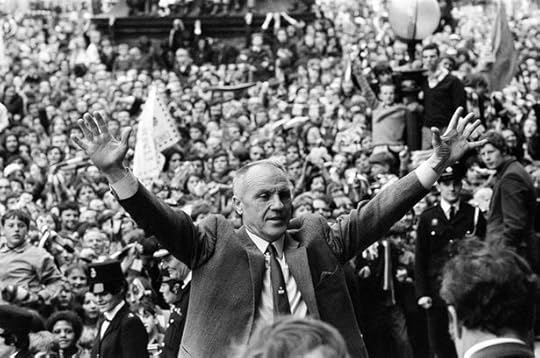
But none transformed their club in the same way Shankly did, creating a template for sustained success.
That legacy included handing over to the boot-room team: after Shankly retired in July 1974, he was succeeded by Bob Paisley (to July 1983 - winner of 3 European Cups and 6 league titles in 9 years) who was in turn briefly succeeded by Joe Fagan (to May 1985, his last game being the Heysel Stadium disaster).
Key to Shankly’s popularity was his relationship with, and dedication to, the fans, rooted in his socialist beliefs.
At his first Board meeting he complains about the toilets:
The ones the spectators use?
Yes, said Bill Shankly. The ones in the stands. The ones the people who pay to watch Liverpool Football Club have to use. Those people almost my wages. Those people, those toilets.
As discussed at outset, the key to Peace's style in this novel is repetition, the same methodical repetition that was key to Shankly's training method and approach. Almost every game in his time at the club is described in similar style to the following passage, taken from the start of what would prove to be Liverpool's promotion season into division 1:
On Saturday 19 August, 1961, on the first Saturday of the new season, Liverpool Football Club travelled to the Eastville Stadium, Bristol.
And before the whistle, the first whistle of the new season. In the dressing room, the away dressing room. The players of Liverpool Football Club looked up at Bill Shankly. Bill Shankly in the centre of the dressing room, the away dressing room. Bill Shankly looking around the dressing room, the away dressing room. From player to player, Liverpool player to Liverpool player. From Slater to White, White to Byrne, Byrne to Milne, Milne to Yeats, Yeats to Leishman, Leishman to Lewis, Lewis to Hunt, Hunt to St John, St John to Melia, Melia to A'Court. And Bill Shankly rubbed his hands together—
This is it, said Bill Shankly. This is it, boys! Everything we've been doing. Everything we've been working for, boys. It was all for this moment, all for this game. This first game of the season, boys. This season that will be our season. Our season, boys…
In the seventh minute of this first game of this new season, Kevin Lewis scored. And in the fifty-fifth minute, Hills scored an own goal. And Liverpool Football Club beat Bristol Rovers two–nil. Away from home, away from Anfield. In the first game of the new season.
On Wednesday 23 August, 1961, Sunderland Football Club came to Anfield, Liverpool. That night, forty-eight thousand, nine hundred folk came, too. On a Wednesday night, for the first home game of the season. In the forty-eighth minute of the first home game of the season, Roger Hunt scored. In the seventy-eighth minute, Kevin Lewis scored. And in the eighty-third minute, Hunt scored again. And Liverpool Football Club beat Sunderland Football Club three–nil. At home, at Anfield. In the first home game of the season.
The listing of the results, cumulative point totals and team lists also help create a sense of how the season evolved (although little actual drama), and it is fascinating to see how the teams evolved to the ones that became famous, and how he had to rebuild as players aged and opponents tactics evolved.
This need to rebuild and replace was something Shankly was, by necessity, relatively ruthless at pursuing, while compassionate in terms of handling the people concerned (Bob Paisley had a reputation for being even more successfully ruthless, but handling players impacted less well). To Ian St John, when he is dropped, Shankly tells him:
It comes to us all son. And so you have to be prepared. You have to be ready son. Because you have to decide how to deal with it. Will it be with grace and with dignity. Or will it be with anger and bitterness.
And inevitably it comes to Shankly as well, albeit he retired by his own choice.
Nothing but the sound of chains rattling, knives sharpening and spades digging. At your back, in your shadow. Rattling, sharpening, digging. And ticking. The clock ticking.
Bill knew it was always easier to give up. To throw in the towel. And surrender. To the chains, the knives, to the spades. To take your comfort in past glories, to dine out on past victories. To abandon the present to other men, to leave the future to younger men.
The last third of the novel describes Shankly's retirement. The methodical repetition carries over in his retirement to his daily life - or at least's Peace's description of it. The following passage constitutes about 1/15th of a description of him washing his car:
And Bill walked back round to the bucket. Bill crouched down back beside the bucket. Bill put the cloth back into the water in the bucket. Bill soaked the cloth in the water again. Bill wrang out the cloth again. Bill stood back up with the cloth in his hand. Bill walked round to the far side of the car. And Bill washed the windows on the far side of the car. Back and forth, back and forth. Bill washed the windows on the far side. And Bill walked back round to the bucket.
One that gave him some cause for frustration: the Liverpool Board had to discourage him from returning to the training ground, so as to give the new manager a chance to establish himself, and for a period Shankly found himself more welcome in the Boardroom at Goodison or Old Trafford, than at Anfield.
But he was - and still is - adored in the streets and on the terraces.
Ultimately a moving portrayal of a true great. The literary technique used is effective, and the book a more enjoyable read than my review might suggest, albeit lyrical prose this isn't. 3.5 stars and certainly worthy of his Goldsmith's nomination.
The opening words of David Peace’s 720 page Red or Dead do give the reader fair warning of what to expect.
Red or Dead was shortlisted for the inaugural Goldsmiths Prize in 2013, and, for me, completes the set of the 24 shortlisted novels to date. I have certainly saved the longest till last; and although not the best, it was a far more enjoyable and interesting read than I had feared.
Peace’s better known football novel, The Damned United focused on Brian Clough’s ill-fated and brief reign at Leeds. Red or Dead takes as it’s subject another legendary manager, Bill Shankly at Liverpool. The timescale is much longer – Shankly managed the club for almost 15 years rather than 44 days and somewhat more lightly fictionalised. Few of the real-life characters came out of The Damned United well, and indeed the book found its way to the libel courts, whereas this story is much more generous and respectful to almost all concerned.
In this crucial early scene, perhaps my favourite in the book, we are in December 1959, witnessing Shankly’s first visit as manager to his new team’s ground. He and we encounter the famous boot room, a fictional recreation of the real-life event documented in Stephen Kelly’s Bill Shankly: It's Much More Important Than That: The Biography.
Into Liverpool, into Anfield.
In the ground, in the office, Bill shook hands with Jimmy McInnes, the club secretary. Bill knows Jimmy McInnes. Bill knew Jimmy came from Ayr. Bill knew Jimmy had played for Third Lanark and Liverpool Football Club. Jimmy introduced Bill to the receptionist, the ticket administrators, the cleaners and the groundsman, Arthur Riley. Bill knew Arthur Riley. Bill had worked for Liverpool Football Club for over thirty years. Arthur took Bill to meet the coaching staff. Under the stands, down a corridor. Among the boots, the dirty boots -
This is Bob Paisley, said Arthur Riley. Bob is the first-team trainer. This is Joe Fagan. Joe is in charge of the reserves. This is Reuben Bennett. Reuben takes most of the training. And this is Albert Shelley. Albert used to be first-team trainer. He’s supposed to be retired. But Albert still comes in every day. Albert does whatever needs doing. Albert does everything and anything.
Bill nodded. And Bill said, I know Bob. Me and Bob played against each other on many occasions. We had many a good scrap. And I know Joe. I tried to sign Joe when I was at Grimsby and he was at Manchester City. I know Reuben. Reuben used to work with my brother Bob at Dundee. And I know Albert. I know he lives and breathes Liverpool Football Club. I know you all do. And so I know you men are all good men. True football men. But I also know you fellows have been here a long time. And so I know you’ll all be worrying about me coming in. A new feller with new ways. Different ways. Maybe wanting to bring in new trainers with him. His mates. Well, I’m not going to do that. But I do have my ways. My methods and my systems. And they will be different ways. But I am here to work with you. Not against you. I am here to work in cooperation with you as a team. And so gradually I will lay down my plans and then gradually we will all be on the same wavelength. And in return I want one thing. Loyalty, I want loyalty. So I don’t want anyone to carry stories about anyone else. The man who brings the story to me will be the one that gets the sack. I don’t care if he’s been here fifty years. He’ll be the one who goes. Because I want everyone to be loyal to each other. To the team. And to the club. So everything we do will be for Liverpool Football Club. Not for ourselves. Not as individuals. But for the team. For Liverpool Football Club. Total loyalty. That is all I ask. Because that loyalty makes strength. And that strength will bring success. I promise you.
Shankly’s biggest achievement wasn't so much the trophies he won but his legacy. Three league titles, two FA cups and the UEFA cup in 15 seasons, starting from the 2nd division is impressive, but in the same period Busby and Stein won the European Cup (which eluded Shankly), Robson and Clough also took teams from the 2nd division to winning the 1st, Revie built his own formidable team, and Nicholson and Mee won the league/cup Double. Indeed this picture of adoring fans is actually taken after Liverpool had lost the 1971 FA Cup final to Arsenal's double winners.
But none transformed their club in the same way Shankly did, creating a template for sustained success.
That legacy included handing over to the boot-room team: after Shankly retired in July 1974, he was succeeded by Bob Paisley (to July 1983 - winner of 3 European Cups and 6 league titles in 9 years) who was in turn briefly succeeded by Joe Fagan (to May 1985, his last game being the Heysel Stadium disaster).
Key to Shankly’s popularity was his relationship with, and dedication to, the fans, rooted in his socialist beliefs.
At his first Board meeting he complains about the toilets:
The ones the spectators use?
Yes, said Bill Shankly. The ones in the stands. The ones the people who pay to watch Liverpool Football Club have to use. Those people almost my wages. Those people, those toilets.
As discussed at outset, the key to Peace's style in this novel is repetition, the same methodical repetition that was key to Shankly's training method and approach. Almost every game in his time at the club is described in similar style to the following passage, taken from the start of what would prove to be Liverpool's promotion season into division 1:
On Saturday 19 August, 1961, on the first Saturday of the new season, Liverpool Football Club travelled to the Eastville Stadium, Bristol.
And before the whistle, the first whistle of the new season. In the dressing room, the away dressing room. The players of Liverpool Football Club looked up at Bill Shankly. Bill Shankly in the centre of the dressing room, the away dressing room. Bill Shankly looking around the dressing room, the away dressing room. From player to player, Liverpool player to Liverpool player. From Slater to White, White to Byrne, Byrne to Milne, Milne to Yeats, Yeats to Leishman, Leishman to Lewis, Lewis to Hunt, Hunt to St John, St John to Melia, Melia to A'Court. And Bill Shankly rubbed his hands together—
This is it, said Bill Shankly. This is it, boys! Everything we've been doing. Everything we've been working for, boys. It was all for this moment, all for this game. This first game of the season, boys. This season that will be our season. Our season, boys…
In the seventh minute of this first game of this new season, Kevin Lewis scored. And in the fifty-fifth minute, Hills scored an own goal. And Liverpool Football Club beat Bristol Rovers two–nil. Away from home, away from Anfield. In the first game of the new season.
On Wednesday 23 August, 1961, Sunderland Football Club came to Anfield, Liverpool. That night, forty-eight thousand, nine hundred folk came, too. On a Wednesday night, for the first home game of the season. In the forty-eighth minute of the first home game of the season, Roger Hunt scored. In the seventy-eighth minute, Kevin Lewis scored. And in the eighty-third minute, Hunt scored again. And Liverpool Football Club beat Sunderland Football Club three–nil. At home, at Anfield. In the first home game of the season.
The listing of the results, cumulative point totals and team lists also help create a sense of how the season evolved (although little actual drama), and it is fascinating to see how the teams evolved to the ones that became famous, and how he had to rebuild as players aged and opponents tactics evolved.
This need to rebuild and replace was something Shankly was, by necessity, relatively ruthless at pursuing, while compassionate in terms of handling the people concerned (Bob Paisley had a reputation for being even more successfully ruthless, but handling players impacted less well). To Ian St John, when he is dropped, Shankly tells him:
It comes to us all son. And so you have to be prepared. You have to be ready son. Because you have to decide how to deal with it. Will it be with grace and with dignity. Or will it be with anger and bitterness.
And inevitably it comes to Shankly as well, albeit he retired by his own choice.
Nothing but the sound of chains rattling, knives sharpening and spades digging. At your back, in your shadow. Rattling, sharpening, digging. And ticking. The clock ticking.
Bill knew it was always easier to give up. To throw in the towel. And surrender. To the chains, the knives, to the spades. To take your comfort in past glories, to dine out on past victories. To abandon the present to other men, to leave the future to younger men.
The last third of the novel describes Shankly's retirement. The methodical repetition carries over in his retirement to his daily life - or at least's Peace's description of it. The following passage constitutes about 1/15th of a description of him washing his car:
And Bill walked back round to the bucket. Bill crouched down back beside the bucket. Bill put the cloth back into the water in the bucket. Bill soaked the cloth in the water again. Bill wrang out the cloth again. Bill stood back up with the cloth in his hand. Bill walked round to the far side of the car. And Bill washed the windows on the far side of the car. Back and forth, back and forth. Bill washed the windows on the far side. And Bill walked back round to the bucket.
One that gave him some cause for frustration: the Liverpool Board had to discourage him from returning to the training ground, so as to give the new manager a chance to establish himself, and for a period Shankly found himself more welcome in the Boardroom at Goodison or Old Trafford, than at Anfield.
But he was - and still is - adored in the streets and on the terraces.
Ultimately a moving portrayal of a true great. The literary technique used is effective, and the book a more enjoyable read than my review might suggest, albeit lyrical prose this isn't. 3.5 stars and certainly worthy of his Goldsmith's nomination.

August 1, 2013
Beautiful. Moving. Inspiring. A modern day hagiography worthy of its subject. One of the finest books I have ever read. I never thought a 700 page novel could fly by. And it has. It was like drinking water.

January 22, 2014
Red or Dead is a novel. Red or Dead is a novel by David Peace. Red or Dead is a novel by David Peace about the Liverpool manager Bill Shankley. Red or Dead is a novel by David Peace about the Liverpool manager Bill Shankley which eschews adjectives. Red or Dead is a novel by David Peace about the Liverpool manager Bill Shankley which eschews adjectives and uses repetition a lot.
If the repetitive style of the above paragraph irritates you, then I'd advise you give this book a wide berth. Over 717 pages, it becomes very heavy going indeed and I'm not sure that I would have finished the book, but for the fact that I had a very wet weekend in Northumberland with a lot of time to kill and nothing else to read with me. And by the time I'd come home, I'd got two thirds of the way through the book and, you know, sunk costs and whatnot... Such a style might work fine over the course of a short story, although even there, I am a bit ambivalent, it does have a bit of a 'creative writing exercise' feel to it, but over quarter of a million words...really...
I'm not sure whether the repetitive, incantatory voice of the novel is aimed at getting across the repetitive, grinding nature of club football: just one damned game after another; the ritualistic, perhaps even quasi-religious nature of following a football team or the way that Shankley saw the world. And that might be a part of my problem with this book. I picked it up because I had read and enjoyed his account of Brian Clough's time at Leeds Utd in 'The Damned United' but truth be told, if football is a religion, then I am Richard Dawkins. Except less childishly peevish. I hope. And perhaps that was my problem. Maybe this book works a lot better if the endless games that it reports on mean something to you. But as it was, large parts of it read like a very, very long shopping list. And unlike 'The Damned United', I'm not sure that this is a book that really works if, like me, you don't really care about football.
That's not to say that the book was entirely without redeeming qualities. While, for much of it, I found it didn't really get under the skin of Shankley, I didn't feel I understood him, the last quarter, which covers the period of his life from his retirement to his death, was a touchingly sad evocation of what it must be like to go from being at the centre of your world to being yesterday's man, on the sidelines, with no clear role. On the face of it, the idea of including a more or less verbatim transcript of a radio interview he gave with then-Prime Minister Harold Wilson sounds like a terrible bit of self-indulgence, but in the context of the book, I thought it actually worked quite well in giving a sense of what the man was really like.
In the end though, this book reminded me of one of those atonal, 'experimental' modern pieces of classical music. In that it might be interesting to aficionados in a chin-strokey way, but I can't imagine many people getting much pleasure from listening to, or as the case may be, reading, it.
If the repetitive style of the above paragraph irritates you, then I'd advise you give this book a wide berth. Over 717 pages, it becomes very heavy going indeed and I'm not sure that I would have finished the book, but for the fact that I had a very wet weekend in Northumberland with a lot of time to kill and nothing else to read with me. And by the time I'd come home, I'd got two thirds of the way through the book and, you know, sunk costs and whatnot... Such a style might work fine over the course of a short story, although even there, I am a bit ambivalent, it does have a bit of a 'creative writing exercise' feel to it, but over quarter of a million words...really...
I'm not sure whether the repetitive, incantatory voice of the novel is aimed at getting across the repetitive, grinding nature of club football: just one damned game after another; the ritualistic, perhaps even quasi-religious nature of following a football team or the way that Shankley saw the world. And that might be a part of my problem with this book. I picked it up because I had read and enjoyed his account of Brian Clough's time at Leeds Utd in 'The Damned United' but truth be told, if football is a religion, then I am Richard Dawkins. Except less childishly peevish. I hope. And perhaps that was my problem. Maybe this book works a lot better if the endless games that it reports on mean something to you. But as it was, large parts of it read like a very, very long shopping list. And unlike 'The Damned United', I'm not sure that this is a book that really works if, like me, you don't really care about football.
That's not to say that the book was entirely without redeeming qualities. While, for much of it, I found it didn't really get under the skin of Shankley, I didn't feel I understood him, the last quarter, which covers the period of his life from his retirement to his death, was a touchingly sad evocation of what it must be like to go from being at the centre of your world to being yesterday's man, on the sidelines, with no clear role. On the face of it, the idea of including a more or less verbatim transcript of a radio interview he gave with then-Prime Minister Harold Wilson sounds like a terrible bit of self-indulgence, but in the context of the book, I thought it actually worked quite well in giving a sense of what the man was really like.
In the end though, this book reminded me of one of those atonal, 'experimental' modern pieces of classical music. In that it might be interesting to aficionados in a chin-strokey way, but I can't imagine many people getting much pleasure from listening to, or as the case may be, reading, it.

i-want-money
August 3, 2014It doesn't matter, but here's a Steven Moore review ::
"Review of ‘Red or Dead’: Liverpool’s Bill Shankly, the Odysseus of Anfield: The football club’s legendary manager gets the epic treatment"
"Peace’s style often transcends modernist aesthetics to evoke ancient epics and medieval ballads, their repetitive formulas and lilting refrains, their stylized actions and heroic gravitas. Each time Liverpool trains for a new season, it is as though they are preparing to besiege the walls of Troy. Shankly is as cunning as Odysseus, as civic-minded as Aeneas, as relentless as Beowulf. He confesses in the final third that “football is my religion,” and the style appropriately resembles liturgical chanting, mystical incantation. For readers who simply want the straight story, there are a couple dozen books about Shankly to choose from (Peace lists them in his concluding “Sources and Acknowledgments”). But “with artistry and craft, with bravery and with strength,” Peace set out to ennoble Shankly’s career into a postmodern epic. Goal!"
http://www.washingtonpost.com/enterta...
"Review of ‘Red or Dead’: Liverpool’s Bill Shankly, the Odysseus of Anfield: The football club’s legendary manager gets the epic treatment"
"Peace’s style often transcends modernist aesthetics to evoke ancient epics and medieval ballads, their repetitive formulas and lilting refrains, their stylized actions and heroic gravitas. Each time Liverpool trains for a new season, it is as though they are preparing to besiege the walls of Troy. Shankly is as cunning as Odysseus, as civic-minded as Aeneas, as relentless as Beowulf. He confesses in the final third that “football is my religion,” and the style appropriately resembles liturgical chanting, mystical incantation. For readers who simply want the straight story, there are a couple dozen books about Shankly to choose from (Peace lists them in his concluding “Sources and Acknowledgments”). But “with artistry and craft, with bravery and with strength,” Peace set out to ennoble Shankly’s career into a postmodern epic. Goal!"
http://www.washingtonpost.com/enterta...
July 13, 2013
"Utterly hypnotic", I said a couple days ago on Twitter and I'm sticking to it.
Red or Dead is in the first instance a novel but it is so many things after that, so much more. It reminded me of songs and tales, things that used to be history and now are only legend, kept alive by strangers in pubs and shared over a fire. Peace's droning rhythm and repetition begs and even evokes a voice like chocolate, like syrup informing scores and passes and attendance figures as if he were describing an historic battle.
However behind the style and the tricks lies a heart which may have been, not lacking, but well-hidden in previous novels.
Peace makes you live each win and each loss, yet rather than his strongest sections being the downbeat ones I found tears in my eyes at the most glorious moments, the most heartfelt moments. For someone as apathetic to football as I am and someone who finds a lot of similar heart string plucking clumsy and kitch I am touched and amazed by Peace and his cohort Bill Shankly.
Red or Dead is in the first instance a novel but it is so many things after that, so much more. It reminded me of songs and tales, things that used to be history and now are only legend, kept alive by strangers in pubs and shared over a fire. Peace's droning rhythm and repetition begs and even evokes a voice like chocolate, like syrup informing scores and passes and attendance figures as if he were describing an historic battle.
However behind the style and the tricks lies a heart which may have been, not lacking, but well-hidden in previous novels.
Peace makes you live each win and each loss, yet rather than his strongest sections being the downbeat ones I found tears in my eyes at the most glorious moments, the most heartfelt moments. For someone as apathetic to football as I am and someone who finds a lot of similar heart string plucking clumsy and kitch I am touched and amazed by Peace and his cohort Bill Shankly.

October 9, 2013
Well, we can't say he didn't warn us. 'Repetition. Repetition. Repetition.' Those are the first three words of David's Peace's novel on Bill Shankly's years as manager of Liverpool FC (or 'Liverpool Football Club' as Peace reiterates throughout) and repetition is what we are given on every one of the 700-odd pages that follow. Relentless. Relentless. Relentless. It's a style that has divided critics, and has divided this critic. Even while I'm writing this review I'm still trying to work out what I feel about the experience, and what I should say about it.
I could say the novel is powerful and brilliant. It drills into us, injects into our mainstream the Shankly obsession with the team and the unbearable tension that inevitably accompanies it. The unadorned accounts of match after match, entirely stripped of verbiage and sporting cliché, are insistent drumbeats on the brain. The repeated step-by-step descriptions of Shankly's domestic chores - laying the kitchen table, washing the car - are written and read at the nerve ends. Ness, the placidly inscrutable wife in the background, and the daughters - never present, always somewhere else - underscore Bill's constant isolation. Other characters - the board of directors, fellow managers, players, specific fans - exist chiefly to show what Bill is not (guileful, worldly) or to emphasise his difference even where he is at his most influential - somehow standing outside even when he seems at his happiest and most absorbed in the first half of the book when he is working; an ambiguous state, a strangely parallel existence which is both a stark contrast and a prefiguration of his more obvious isolation in the second half, standing alone in corridors outside dressing rooms after his ill-judged retirement. The diction throughout is near-biblical, lifting and sanctifying, with a distant roll of morality like coming thunder.
I could say the reading experience in detail is tedious and wearing. I could say that the second half of the book - which uses entire transcripts of long radio and television interviews including a broadcast conversation between Bill Shankly and then-Prime Minister Harold Wilson - represents lazy editing, merely the author importing his research material wholesale into the novel. I want to argue myself out of those propositions, insist that the gestalt is the potent brew and no ingredient can be changed or modified. But I have no way of knowing whether that is true: the book is what it is.
Would I recommend it? Absolutely yes. But don't say I didn't warn you.
I could say the novel is powerful and brilliant. It drills into us, injects into our mainstream the Shankly obsession with the team and the unbearable tension that inevitably accompanies it. The unadorned accounts of match after match, entirely stripped of verbiage and sporting cliché, are insistent drumbeats on the brain. The repeated step-by-step descriptions of Shankly's domestic chores - laying the kitchen table, washing the car - are written and read at the nerve ends. Ness, the placidly inscrutable wife in the background, and the daughters - never present, always somewhere else - underscore Bill's constant isolation. Other characters - the board of directors, fellow managers, players, specific fans - exist chiefly to show what Bill is not (guileful, worldly) or to emphasise his difference even where he is at his most influential - somehow standing outside even when he seems at his happiest and most absorbed in the first half of the book when he is working; an ambiguous state, a strangely parallel existence which is both a stark contrast and a prefiguration of his more obvious isolation in the second half, standing alone in corridors outside dressing rooms after his ill-judged retirement. The diction throughout is near-biblical, lifting and sanctifying, with a distant roll of morality like coming thunder.
I could say the reading experience in detail is tedious and wearing. I could say that the second half of the book - which uses entire transcripts of long radio and television interviews including a broadcast conversation between Bill Shankly and then-Prime Minister Harold Wilson - represents lazy editing, merely the author importing his research material wholesale into the novel. I want to argue myself out of those propositions, insist that the gestalt is the potent brew and no ingredient can be changed or modified. But I have no way of knowing whether that is true: the book is what it is.
Would I recommend it? Absolutely yes. But don't say I didn't warn you.

December 23, 2015
Red Or Dead was my first David Peace book, and of course I had been told, or warned, about the style. Mantric. Incantatory. Epic, in the oldest sense. A version of the Iliad where you have a hundred lists of ships and then Odysseus retires. A 700 page prose poem told in a pared-down vocabulary, phrases repeated like training drills or tactical formations. It was all true. What I wasn’t expecting was that, once I caught the book’s rhythms, Red Or Dead would rattle along so quickly.
It’s about Bill Shankly, and Liverpool (the club and the city). But it doesn’t have particular insights into them. On the surface, Shankly is a god, the club his heaven, the city paradise on earth. Read more closely and there are cracks in them all, areas where Shankly protests too much, moments when the club and fans’ behaviour is far from perfect… but this isn’t a portrait of a man or a life so much as an attempt to catch a mentality, obsession in a bottle.
It’s avowedly a novel about work and retirement, but again it doesn’t always have a great deal to specifically say, beyond being a tribute to a kind of socialist work ethic which, Red Or Dead suggests, began to run out of use and regard with Bill Shankly’s generation. A man works hard, and then finds himself frustrated when he stops. There’s the story. There is drama in the work – amidst a lot of frustration and repetition – but the retirement drains it away, and after the book’s audacious emotional climax, a five-page sequence of Bill washing his car, Red Or Dead is content to run the clock down, its rigidity of style relaxing at times, its momentum devolving into anecdote. There’s a reason for this – even at my age, I recognise that the book is realistic, and often moving, about the gradual loss of letting your involvement in a thing go. But I enjoyed the first half more. As, of course, did Bill.
So we’re left with the style, a tractor beam carrying you along. Does Peace overdo it? I don’t know. It worked for me, the way the pacing of each season – the little things he mentions or doesn’t – was slightly different. The way tiny changes in the stock phrasing, or breaks in paragraphing, can seem ominous or significant. It built up to an experience quite unlike any other I’ve had reading a novel, even if it was sometimes an absurd one.
It’s about Bill Shankly, and Liverpool (the club and the city). But it doesn’t have particular insights into them. On the surface, Shankly is a god, the club his heaven, the city paradise on earth. Read more closely and there are cracks in them all, areas where Shankly protests too much, moments when the club and fans’ behaviour is far from perfect… but this isn’t a portrait of a man or a life so much as an attempt to catch a mentality, obsession in a bottle.
It’s avowedly a novel about work and retirement, but again it doesn’t always have a great deal to specifically say, beyond being a tribute to a kind of socialist work ethic which, Red Or Dead suggests, began to run out of use and regard with Bill Shankly’s generation. A man works hard, and then finds himself frustrated when he stops. There’s the story. There is drama in the work – amidst a lot of frustration and repetition – but the retirement drains it away, and after the book’s audacious emotional climax, a five-page sequence of Bill washing his car, Red Or Dead is content to run the clock down, its rigidity of style relaxing at times, its momentum devolving into anecdote. There’s a reason for this – even at my age, I recognise that the book is realistic, and often moving, about the gradual loss of letting your involvement in a thing go. But I enjoyed the first half more. As, of course, did Bill.
So we’re left with the style, a tractor beam carrying you along. Does Peace overdo it? I don’t know. It worked for me, the way the pacing of each season – the little things he mentions or doesn’t – was slightly different. The way tiny changes in the stock phrasing, or breaks in paragraphing, can seem ominous or significant. It built up to an experience quite unlike any other I’ve had reading a novel, even if it was sometimes an absurd one.

November 23, 2013
David Peace's 'Red or Dead' is a 700+ page fictional account of legendary Liverpool manager Bill Shankly's time at Anfield, and his subsequent life after retirement. Shankly was and indeed still is, seen as an almost mythical figure by many Liverpool and indeed football fans, and being a fan of the team, I was always going to enjoy the content of the novel.
First things first-the book is without doubt about 200 pages too long. Peace writes in a repetitive style while describing Shankly's time at Anfield, with regard to training routine, pre match team talks, game reports and indeed post match life at home. Apparently this is indicative of Peace's writing style-I've only read one of his previous novels-but is also used to show how obsessive a character Shankly was in all that he did. Up until about page 500 this was a little grating at times, but there was plenty of anecdotal tales of Shankly's interactions with others to keep me engaged. However it was the last 200 pages, after his decision to retire that really blew me away.
Shankly's retirement at 60 came as a massive shock when it happened in 1974 to all in football, and Peace does a superb job in getting inside the man's head post announcement. From his turning up at training 'to help out' the day after his official departure from the club, it's obvious that Shankly never realised the magnitude of his decision when he took it, and when he is told to stay away to let his former assistant make his own mark on the club, Peace does an amazing job in showing the hurt this causes. The repetition continues to a certain extent, while Bill completes menial household tasks, but what emanates from this last quarter of the book is the obvious love Shankly had for not only the team, but also the people of the city. His honesty, integrity and socialism all shine through. At times, his treatment by Liverpool is shoddy, and Shankly's disillusionment with changing aspects of the game are apparent, but ultimately, Peace does nothing but enhance the reader's opinions of one of the greatest managers in football history.
This book, particularly the last 200 pages, will stay with me for a long time. I'd definitely recommend the book as a great read!
First things first-the book is without doubt about 200 pages too long. Peace writes in a repetitive style while describing Shankly's time at Anfield, with regard to training routine, pre match team talks, game reports and indeed post match life at home. Apparently this is indicative of Peace's writing style-I've only read one of his previous novels-but is also used to show how obsessive a character Shankly was in all that he did. Up until about page 500 this was a little grating at times, but there was plenty of anecdotal tales of Shankly's interactions with others to keep me engaged. However it was the last 200 pages, after his decision to retire that really blew me away.
Shankly's retirement at 60 came as a massive shock when it happened in 1974 to all in football, and Peace does a superb job in getting inside the man's head post announcement. From his turning up at training 'to help out' the day after his official departure from the club, it's obvious that Shankly never realised the magnitude of his decision when he took it, and when he is told to stay away to let his former assistant make his own mark on the club, Peace does an amazing job in showing the hurt this causes. The repetition continues to a certain extent, while Bill completes menial household tasks, but what emanates from this last quarter of the book is the obvious love Shankly had for not only the team, but also the people of the city. His honesty, integrity and socialism all shine through. At times, his treatment by Liverpool is shoddy, and Shankly's disillusionment with changing aspects of the game are apparent, but ultimately, Peace does nothing but enhance the reader's opinions of one of the greatest managers in football history.
This book, particularly the last 200 pages, will stay with me for a long time. I'd definitely recommend the book as a great read!

July 4, 2023
Ultimately disappointing. Too long, and though there were elements of real quality, and I felt the book did succeed in providing an insight into the life of Bill Shankly and the history of English football in the 1950s-1970s, it wasn't enjoyable overall and the bits I liked were few and far between.
I understand that David Peace made a decision to prioritise style and utilise repetition for impact in how the subject operated as a man and manager, but this became utterly tedious and bloated a very good 400-500 page book into a 700+ page book.
When I was at primary school, the captain of the football team used to have to read a match report in assembly after each game. The ten year old boy would stand up and say something like "We played St John's School. We kicked off and St John's scored. Then Paul scored. Then David scored. Then St John's scored. Then St John's scored again. Then Simon had a penalty but missed. We lost 3-2. But we all played well and enjoyed the game". The same sort of thing each week. This book reminded me of this. Ad nauseam in places.
I understand that David Peace made a decision to prioritise style and utilise repetition for impact in how the subject operated as a man and manager, but this became utterly tedious and bloated a very good 400-500 page book into a 700+ page book.
When I was at primary school, the captain of the football team used to have to read a match report in assembly after each game. The ten year old boy would stand up and say something like "We played St John's School. We kicked off and St John's scored. Then Paul scored. Then David scored. Then St John's scored. Then St John's scored again. Then Simon had a penalty but missed. We lost 3-2. But we all played well and enjoyed the game". The same sort of thing each week. This book reminded me of this. Ad nauseam in places.

May 27, 2017
YNWA What does that mean? If you're not a supporter of Liverpool FC, even an enthusiast of Rock and Roll, or maybe you like musicals and have seen Carousel, then you might know what those letters stand for. I'm a Yank that's been rooting for LFC for almost twenty years and I never felt more connected to the team, history, and now more than ever appreciate Mr Shankly, or as those that love him simply, Bill.
For many this will be a tough read if you don't know Peace's style, or his insistence on repetition. It's used in is novel as a way to show Bill's philosophy for the game, make a routine, stick to it as much as you can, and stay loyal to the Reds.
Though a novel, this book is well researched and places you on the pitch along the Merseyside and into the times. A great read for any football fan but especially for a Scouser, YNWA and though not in the book remember the 96.
For many this will be a tough read if you don't know Peace's style, or his insistence on repetition. It's used in is novel as a way to show Bill's philosophy for the game, make a routine, stick to it as much as you can, and stay loyal to the Reds.
Though a novel, this book is well researched and places you on the pitch along the Merseyside and into the times. A great read for any football fan but especially for a Scouser, YNWA and though not in the book remember the 96.

December 21, 2014
Ce livre est une vraie leçon de football. On se retrouve plongé dans la vie de Bill Shankly, un manager hors du commun pour qui le football est toute sa vie. J'ai adoré me retrouver à cette époque, aux débuts du Liverpool Football Club et à ses premiers trophées.
Le livre est écrit de façon à ce que le lecteur soit en permanence aux côtés de Bill, un homme d'une grande sagesse et d'une humanité incroyable. Ça m'a donné encore plus envie de lire sa biographie, chose qu'en tant que fan du LFC, j'aurais dû le faire il y'a longtemps déjà.
Le seul point négatif à mon goût est que le livre est long par moment, les répétitions sont frustrantes mais on s'y fait assez rapidement. Cela gâche un peu la lecture qui aurait pu être plus fluide. C'est pour ça, que j'enlève une étoile à ma note.
Le livre est écrit de façon à ce que le lecteur soit en permanence aux côtés de Bill, un homme d'une grande sagesse et d'une humanité incroyable. Ça m'a donné encore plus envie de lire sa biographie, chose qu'en tant que fan du LFC, j'aurais dû le faire il y'a longtemps déjà.
Le seul point négatif à mon goût est que le livre est long par moment, les répétitions sont frustrantes mais on s'y fait assez rapidement. Cela gâche un peu la lecture qui aurait pu être plus fluide. C'est pour ça, que j'enlève une étoile à ma note.

February 4, 2016
Many reviewers have noted the repetition. Some have felt bold enough (ill-advisedly) to try to parody it in their write-ups. It is rather beautiful in itself, in its rhythm. You don't have to remember the majestic way Bill Shankly used words to find poetry in the way David Peace uses them. If, however, you are lucky enough to have been brought up under the spell of Shankly's unique speech patterns then you will know that Mr Peace has achieved something quite remarkable with this book. A coming together of form and content that, I think, is unmatched in English novel writing this century. Certainly unmatched in English sportswriting. I feel like turning back to page one and starting all over again.

February 20, 2018
There is no way I can write a useful review of this book, there is simply too much to say and I am far to emotionally invested, for many reasons, to be objective. Here a few thoughts right after finishing it.
It's probably up there with the best novels I have ever read. Reading it is an astonishing and personal experience and I can understand completely why some feel that it's not for them and that it's too stylistic. Personally I think that every word is there for a reason and that the repetition is making sense of the life of a man who put thousands of hours of hard work into his achievements. The repetitions are there to remind us that to keep going in the face of adversity is difficult, that to achieve anything takes time and patience but most of all that the way Shankly approached his work was the way he approached life. I loved it and thought it Perecesque in both its originality and structure at times. There is also a poetic quality to Peace's writing that mirrors Shankly's own way of talking; it ends up making the book read like a distant legend.
It does help if you have some knowledge of or interest in football but really this book is about much more than that; at its heart it's about a normal and decent man who worked extremely hard and wanted to care for those around him. That he was a socialist was no surprise to me, he cared deeply about everyone, to the exclusion of himself at times, but the fact that he actually lived out his personal philosophy in a genuine and honest way and with an obvious effect on those who's lives he touched makes him a hero of mine. David Peace captures all of that and the more complex sides of Shankly's emotional life in this amazing book.
When people tell you, as they inevitably do these days, that football hasn't changed much over the years you can point at the example of people like Bill Shankly, Bob Paisley, Brian Clough and Matt Busby and disagree; there were, at one time, honourable men in this sport, I'm just glad that I am old enough to have seen some of their impact directly and to have had a dad who was able to light a fire in me about their stories. It made reading this, as Bill Shankly and Harold Wilson compare football to in the book, akin to a religious experience.
It's probably up there with the best novels I have ever read. Reading it is an astonishing and personal experience and I can understand completely why some feel that it's not for them and that it's too stylistic. Personally I think that every word is there for a reason and that the repetition is making sense of the life of a man who put thousands of hours of hard work into his achievements. The repetitions are there to remind us that to keep going in the face of adversity is difficult, that to achieve anything takes time and patience but most of all that the way Shankly approached his work was the way he approached life. I loved it and thought it Perecesque in both its originality and structure at times. There is also a poetic quality to Peace's writing that mirrors Shankly's own way of talking; it ends up making the book read like a distant legend.
It does help if you have some knowledge of or interest in football but really this book is about much more than that; at its heart it's about a normal and decent man who worked extremely hard and wanted to care for those around him. That he was a socialist was no surprise to me, he cared deeply about everyone, to the exclusion of himself at times, but the fact that he actually lived out his personal philosophy in a genuine and honest way and with an obvious effect on those who's lives he touched makes him a hero of mine. David Peace captures all of that and the more complex sides of Shankly's emotional life in this amazing book.
When people tell you, as they inevitably do these days, that football hasn't changed much over the years you can point at the example of people like Bill Shankly, Bob Paisley, Brian Clough and Matt Busby and disagree; there were, at one time, honourable men in this sport, I'm just glad that I am old enough to have seen some of their impact directly and to have had a dad who was able to light a fire in me about their stories. It made reading this, as Bill Shankly and Harold Wilson compare football to in the book, akin to a religious experience.
June 26, 2019
Amo il calcio e seguo il LFC da piccolo. Avevo appena terminato "Il maledetto United" quando ho saputo che David Peace avrebbe pubblicato "Red or Dead". Praticamente la combo perfetta. Ho acquistato il libro all'uscita, ma come sempre la vita di tutti i giorni è un ostacolo insormontabile rispetto a un libro di quasi 700 pagine. L'anno scorso però sono stato a Liverpool per la prima volta nella mia vita. E ovviamente ad Anfield Road. Ormai non potevo più aspettare, dovevo leggere questo libro.
L'impatto è stato straniante. Non ho mai letto un libro così. Una forma ripetitiva, ossessiva, che scandisce ogni singolo istante nella vita di Bill Shankly e del LFC dal 1959 al 1974. Bill fa questo. Bill fa quello. Bill fa questo e Bill fa quello. Questo giocatore passa a questo, e questo passa a quello e quello passa a questo. E il LFC vince. IL LFC vince in casa. E il LFC è primo in classifica. E il LFC è primo in classifica nella Prima Divisione. La storia avvince, a maggior ragione se il calcio è una fissa anche per chi legge. Ma ho interrotto la lettura dopo circa 170 pagine. Non avevo trovato il ritmo. Andavo lento e mi avvilivo al pensiero di dover affrontare ancora tre quarti di libro. Poi quest'anno il LFC ha vinto la sua sesta Coppa dei Campioni e automaticamente ho ripreso il libro tra le mani. Piano piano, con costanza ho ricominciato a leggere. E a leggere. E a leggere. Sempre di più, sempre più velocemente. Le ripetizioni erano la norma e non mi pesavano più. Sono entrato nella testa di Bill Shankly, ho vissuto con lui una esperienza totalizzante. Una piena immersione nel suo mondo, nel mondo del LFC dal 1959 al 1974, nel calcio inglese dei tempi d'oro, nel tessuto sociale, politico ed economico dell'Inghilterra di metà anni sessanta.
Le ultime 200 pagine circa, che rappresentano la seconda parte, quella del ritiro di Bill Shankly è ancora più faticosa. Non ci sono più allenamenti, partite, trasferte all'estero, trattative di mercato. C'è un uomo solo con la sua ossessione, con i suoi rimpianti, con i suoi ricordi. La fatica di leggere aumenta ulteriormente nelle ultime pagine, ma lì c'è l'essenza del libro. Un libro che ti ammalia e ti appaga fino all'ultima riga, fino all'ultima parola, fino all'ultima ripetizione.
L'impatto è stato straniante. Non ho mai letto un libro così. Una forma ripetitiva, ossessiva, che scandisce ogni singolo istante nella vita di Bill Shankly e del LFC dal 1959 al 1974. Bill fa questo. Bill fa quello. Bill fa questo e Bill fa quello. Questo giocatore passa a questo, e questo passa a quello e quello passa a questo. E il LFC vince. IL LFC vince in casa. E il LFC è primo in classifica. E il LFC è primo in classifica nella Prima Divisione. La storia avvince, a maggior ragione se il calcio è una fissa anche per chi legge. Ma ho interrotto la lettura dopo circa 170 pagine. Non avevo trovato il ritmo. Andavo lento e mi avvilivo al pensiero di dover affrontare ancora tre quarti di libro. Poi quest'anno il LFC ha vinto la sua sesta Coppa dei Campioni e automaticamente ho ripreso il libro tra le mani. Piano piano, con costanza ho ricominciato a leggere. E a leggere. E a leggere. Sempre di più, sempre più velocemente. Le ripetizioni erano la norma e non mi pesavano più. Sono entrato nella testa di Bill Shankly, ho vissuto con lui una esperienza totalizzante. Una piena immersione nel suo mondo, nel mondo del LFC dal 1959 al 1974, nel calcio inglese dei tempi d'oro, nel tessuto sociale, politico ed economico dell'Inghilterra di metà anni sessanta.
Le ultime 200 pagine circa, che rappresentano la seconda parte, quella del ritiro di Bill Shankly è ancora più faticosa. Non ci sono più allenamenti, partite, trasferte all'estero, trattative di mercato. C'è un uomo solo con la sua ossessione, con i suoi rimpianti, con i suoi ricordi. La fatica di leggere aumenta ulteriormente nelle ultime pagine, ma lì c'è l'essenza del libro. Un libro che ti ammalia e ti appaga fino all'ultima riga, fino all'ultima parola, fino all'ultima ripetizione.
May 21, 2024
A great story, told in an interesting way. However it was also a bit of a (deliberate) slog at times. Needed a half time break to read something else for a bit.
Not your standard football biography and possibly one that would work better as audio / spoken word
Not your standard football biography and possibly one that would work better as audio / spoken word

April 29, 2019
Admittedly, David P‘s writing style is an acquired taste ,but once you get used to it there are some passages that can seem like high poetry,eventually though, the repetitiveness will wear down even his biggest fans… Always four stars for Bill Shankly and the rest of the boot room boys though.
October 27, 2024
I love David Peace - has anyone ever written so well about the mental side of sport as him? His ability to get inside a character’s head is amazing.

June 1, 2018
As a lifelong LFC fan, a Scouser and of an age where my teenage heroes were Shanks, Crazy Horse and (post Kenny the too often overlooked) Kevin Keegan, most of the stories, the urban myths. the teamsheets and many of the games that David Peace brought together here, were very familiar from my teenage standpoint in the Annie Road End and then from the middle of the Kop.
Should have loved it, but I had to read this in two go's over 4 years, it was that dull. It was just way, way too repetitive. It felt like I was being hammered on the head as David Peace ran through each season like a very slow away day special bereft of liquid refreshment, scarves and song. It failed utterly to capture my love and affection for Shanks. I finished it, because in a way I had to - see 2 stars - and it was part of setting me up for the CL Final last week. Went to Paris in '81 and then Rome part 2 '84 and the tales from Kiev have sounded great. Footy is not just about the result. Wonder if Shanks like me was thinking of singing Careless Hands at halftime. That Leeds game in 67?? was my first ever. Poor old Gary Sprake, poor young Lorus Karius. History repeating but still YNWA.
Should have loved it, but I had to read this in two go's over 4 years, it was that dull. It was just way, way too repetitive. It felt like I was being hammered on the head as David Peace ran through each season like a very slow away day special bereft of liquid refreshment, scarves and song. It failed utterly to capture my love and affection for Shanks. I finished it, because in a way I had to - see 2 stars - and it was part of setting me up for the CL Final last week. Went to Paris in '81 and then Rome part 2 '84 and the tales from Kiev have sounded great. Footy is not just about the result. Wonder if Shanks like me was thinking of singing Careless Hands at halftime. That Leeds game in 67?? was my first ever. Poor old Gary Sprake, poor young Lorus Karius. History repeating but still YNWA.
January 7, 2015
I had to quit this book. I had to quit this book because I did not like the writing style. I had to quit this book because I did not like the writing style that was forced and over-stylized. Seriously, how did anyone get through 720 pages of this song-songy garbage?
April 8, 2020
یه کتاب فوقالعاده در مورد خالق لیورپول امروزی، بیل شنکلی کبیر

April 6, 2021
what a treat. i was given this distinctive, fascinating, and surprisingly epic tome as a christmas gift on suggestion that id "enjoyed finnegans wake", and im glad i recieved it, because otherwise i wouldnt have given this novel a second thought at the store based on synopsis alone - i am not a fan of football, or sports in general. my friend even told me "its a biography about a british football coach." oh? oh... dreading the read, i opened the book, and saw the truth. i even remember the page i flipped to (331), because my eyes practically popped out of my skull at the prose.
"And in the fiftieth minute, Cooper belted down the wing. Cooper crossed. Madely made the cross. And Madely scored. But the supporters of Liverpool Football Club did not surrender. They kept cheering and they kept singing. And so the players of Liverpool Football Club did not surrender. They kept struggling and they kept trying. Harder. Clemence struggled and Clemence tried. Harder. Lawler struggled and Lawler tried. Harder. Lindsay struggled and Lindsay tried. Harder." and so on, the whole team, alphabetically, struggle and try. harder. for the rest of the page. in one long paragraph.
holy shit! what the hell?! i thought this was going to be boring sports stuff! i may not be a fan of sports, but i AM a fan of experimental and otherwise weird literature. so i was so on board for the read, when it came. but what i DIDNT realize at the time is that this consistently choppy, repetitive prose serves a distinct purpose, reflecting the ceaseless cycle of sports seasons, games, training, playing, the grind of it all, essentially. it also reflects the homedown, unpretentious nature of the protagonist, Bill Shankly, who by all accounts here seemed to be an absolutely swell guy.
the choice of simple diction and simple sentences is absolutely perfect for what the author is trying to get across here - i think it succeeds completely at what it is intending to do. like, COMPLETELY succeeds. i cant help but imagining the author finishing a particularly long segment of writing and then having to make a concious effort to stop talking in caveman sentences. return to normal thought patterns. normal length. it takes a huge risk with a style that will turn off probably 75% of readers instantly, but i think artistically Red or Dead just fucking nails it. and when a work fully realizes its artistic intentions, its impossible to give it anything but a perfect score. a masterclass book, maybe one of my all-time favorites.
ive shared a few of the more distinctive pages in this unique novel on social media, and the reactions my friends have to it are much the same as i - "what the hell is this?" eyes jump 3 feet out of their skulls like a looney tunes character, etc. which leads me to think this book is distinctly underappreciated on top of all that. the reaction it gets out of people! i really do think that i serve as a perfect example for why this hasnt connected (or been memed on) by a larger audience. you hear the synopsis, "a biography of a soccer coach from the 70s" and your eyes instantly glaze over. what a shame! heres another reaction by a friend: "I thought this was just a book about some Liverpool FC manager what the fuck" yeah man! really, Red or Dead drives home that cliche "dont judge a book by its cover(synopsis)".
so while i cant really recommend it to a casual reader, i wish more people KNEW about Red or Dead. just, like, open a copy and take a look in there. holy god. its well worth wider consideration than what the plot synopsis alone suggests.
"And in the fiftieth minute, Cooper belted down the wing. Cooper crossed. Madely made the cross. And Madely scored. But the supporters of Liverpool Football Club did not surrender. They kept cheering and they kept singing. And so the players of Liverpool Football Club did not surrender. They kept struggling and they kept trying. Harder. Clemence struggled and Clemence tried. Harder. Lawler struggled and Lawler tried. Harder. Lindsay struggled and Lindsay tried. Harder." and so on, the whole team, alphabetically, struggle and try. harder. for the rest of the page. in one long paragraph.
holy shit! what the hell?! i thought this was going to be boring sports stuff! i may not be a fan of sports, but i AM a fan of experimental and otherwise weird literature. so i was so on board for the read, when it came. but what i DIDNT realize at the time is that this consistently choppy, repetitive prose serves a distinct purpose, reflecting the ceaseless cycle of sports seasons, games, training, playing, the grind of it all, essentially. it also reflects the homedown, unpretentious nature of the protagonist, Bill Shankly, who by all accounts here seemed to be an absolutely swell guy.
the choice of simple diction and simple sentences is absolutely perfect for what the author is trying to get across here - i think it succeeds completely at what it is intending to do. like, COMPLETELY succeeds. i cant help but imagining the author finishing a particularly long segment of writing and then having to make a concious effort to stop talking in caveman sentences. return to normal thought patterns. normal length. it takes a huge risk with a style that will turn off probably 75% of readers instantly, but i think artistically Red or Dead just fucking nails it. and when a work fully realizes its artistic intentions, its impossible to give it anything but a perfect score. a masterclass book, maybe one of my all-time favorites.
ive shared a few of the more distinctive pages in this unique novel on social media, and the reactions my friends have to it are much the same as i - "what the hell is this?" eyes jump 3 feet out of their skulls like a looney tunes character, etc. which leads me to think this book is distinctly underappreciated on top of all that. the reaction it gets out of people! i really do think that i serve as a perfect example for why this hasnt connected (or been memed on) by a larger audience. you hear the synopsis, "a biography of a soccer coach from the 70s" and your eyes instantly glaze over. what a shame! heres another reaction by a friend: "I thought this was just a book about some Liverpool FC manager what the fuck" yeah man! really, Red or Dead drives home that cliche "dont judge a book by its cover(synopsis)".
so while i cant really recommend it to a casual reader, i wish more people KNEW about Red or Dead. just, like, open a copy and take a look in there. holy god. its well worth wider consideration than what the plot synopsis alone suggests.
March 13, 2026
I read this book. I read this book on the train. I read this book at home. I read this book in the evening. I read this book when no-one was around. When everyone was somewhere else. Somewhere where I wasn't reading this book.
I read this book because I had read the other book. The book about Brian Clough. Brian Clough at Leeds. Inside Brian Clough's head. At Leeds. And it was a good book.
So I read this book. This book about Bill Shankly. Bill Shankly at Liverpool.
And I read this book because I thought about a Venn disgram. A venn diagram with Liverpool fans in one circle and admirers of post-modernist, flow of consciousness novels in the other. And I thought I might be the only person in the overlap. The overlap in the venn diagram. The venn diagram about this book.
I learned to enjoy this book. This book about Bill Shankly. About Bill Shankly at Liverpool. This book that had 720 pages. I learned to read this book when my brain needed some rhythm. Stimulation from rhythm. Rhythm with weekly gaps between. Or with longer gaps between.
Between the shots of rhythm.
This book took a long time to read. I enjoyed this book. This book that took me a long time to read.
I read this book because I had read the other book. The book about Brian Clough. Brian Clough at Leeds. Inside Brian Clough's head. At Leeds. And it was a good book.
So I read this book. This book about Bill Shankly. Bill Shankly at Liverpool.
And I read this book because I thought about a Venn disgram. A venn diagram with Liverpool fans in one circle and admirers of post-modernist, flow of consciousness novels in the other. And I thought I might be the only person in the overlap. The overlap in the venn diagram. The venn diagram about this book.
I learned to enjoy this book. This book about Bill Shankly. About Bill Shankly at Liverpool. This book that had 720 pages. I learned to read this book when my brain needed some rhythm. Stimulation from rhythm. Rhythm with weekly gaps between. Or with longer gaps between.
Between the shots of rhythm.
This book took a long time to read. I enjoyed this book. This book that took me a long time to read.

March 8, 2019
This book, David Peace points out, is a work of fiction. It is a novel about Bill Shankly and not a biographical study of the man and his work.
In 1959,Liverpool FC were in Englands second division. Fifteen seasons later they were the most consistently successful team in England due to the work of their manager, Bill Shankly. His job was his life, an ardent socialist who had no time for socialist politicians, he was ahead of his time,pretty much inventing the modern game in a time when the Premier League did not exist. Everything was for the club, and the supporters and people of Liverpool.
Shankly shocked Liverpool and the footballing world in 1974,when, on the verge of even greater success both domestically and in Europe, he retired. The novel charts all of his ups and downs in painstaking detail, and paints a vivid picture of one man and his work, both home and away.
In 1959,Liverpool FC were in Englands second division. Fifteen seasons later they were the most consistently successful team in England due to the work of their manager, Bill Shankly. His job was his life, an ardent socialist who had no time for socialist politicians, he was ahead of his time,pretty much inventing the modern game in a time when the Premier League did not exist. Everything was for the club, and the supporters and people of Liverpool.
Shankly shocked Liverpool and the footballing world in 1974,when, on the verge of even greater success both domestically and in Europe, he retired. The novel charts all of his ups and downs in painstaking detail, and paints a vivid picture of one man and his work, both home and away.

March 4, 2025
A beautifully intricate account of the legend of Bill Shankly and his Liverpool Football Club teams of the 60s and 70s. The style is unlike anything else I've ever read: its repetitive poetry echo from the pages as the years pass by. Football fans will enjoy Red or Dead, but its about so much more than the beautiful game: Shankly's socialist politics, marriage, family and friends all combine to create a story about perseverance, anxiety, and identity.
The constant repetition of phrases does a great job of capturing the neurotic obsession with football of a man who is often (mis)quoted as saying: "Somebody said that football's a matter of life and death, I said 'listen, it's much more important than that.'" It takes a little practice to get into the rhythm and flow of the long passages, and my eyes started to glide over the pages at points. If this style is your thing, then you will devour this book, but for me it dragged at points. At about 200 pages from the end I was almost ready to quit, but I'm very glad I didn't. This final section, describing Shankly's attempting to find his place in a changing world post-retirement, is extremely touching and contains some of the best passages of the entire book. This is an impressive achievement from David Peace and it is surely one of the best sports books ever.
The constant repetition of phrases does a great job of capturing the neurotic obsession with football of a man who is often (mis)quoted as saying: "Somebody said that football's a matter of life and death, I said 'listen, it's much more important than that.'" It takes a little practice to get into the rhythm and flow of the long passages, and my eyes started to glide over the pages at points. If this style is your thing, then you will devour this book, but for me it dragged at points. At about 200 pages from the end I was almost ready to quit, but I'm very glad I didn't. This final section, describing Shankly's attempting to find his place in a changing world post-retirement, is extremely touching and contains some of the best passages of the entire book. This is an impressive achievement from David Peace and it is surely one of the best sports books ever.

July 30, 2021
Surprisingly poetic. There is of course poetry in football XIs, as in many lists of names. But who knew that football fixtures could be turned into poetry? That is a schlovskyan achievement. And for a football book, there is surprisingly little on tactics or even positions. Often you have to google the names to find out what they did. It is no hagiography, since Shankly's faults are also presented (for example, an element of calloussness), yet by the end, there are overtones of King Lear too.
All in all, a very good read. But maybe it does get too repetitive at times
All in all, a very good read. But maybe it does get too repetitive at times
February 9, 2018
It took me a while to get through this book. I started reading it and was amazed by the easy reading writing ! I read it in several times but always loved the moments I spent with Bill !
It’s a great book for football lovers that gave me some tips for my own life and football approach.
It could have been shorter but clearly loved it.
It’s a great book for football lovers that gave me some tips for my own life and football approach.
It could have been shorter but clearly loved it.
January 24, 2022
This book's style can be a difficult read because of its constant repetition. But I guess the point that David Peace is making is that football and life are repetitive. This book's style can be a difficult read because of its constant repetition. At several points during 'the first half' I almost took the unheard of step of giving up and starting on something else. I'm glad that I persevered though as 'the second half' is a beautiful, poignant account of a man trying to find meaning in a life after retirement.
March 14, 2025
Formally challenging, with its relentlessly repetitive sentences, but if you make it to the final section, the style opens up into a testimonial to human decency. By the end I was ready to canonize Shankly. YNWA
Displaying 1 - 30 of 219 reviews