Gourmet restaurateur and vegan food expert Miyoko Schinner shares her secrets for making homemade nondairy cheeses that retain all the complexity and sharpness of their dairy counterparts while incorporating nutritious nuts and plant-based milks. Miyoko shows how to tease artisan flavors out of unique combinations of ingredients, such as rejuvelac and nondairy yogurt, with minimal effort. The process of culturing and aging the ingredients produces delectable vegan cheeses with a range of consistencies from soft and creamy to firm.
For readers who want to whip up something quick, Miyoko provides recipes for almost-instant ricotta and sliceable cheeses, in addition to a variety of tangy dairy substitutes, such as vegan sour cream, creme fraiche, and yogurt. For suggestions on how to incorporate vegan artisan cheeses into favorite recipes, Miyoko offers up delectable appetizers, entrees, and desserts, from caprese salad and classic mac and cheese to eggplant parmesan and her own San Francisco cheesecake.
So, I got my cookbook and took it home, and started to make the rejuvelac that night. The steps were very simple and each thing only takes a few minutes to do, but the whole process takes several days to complete. No matter. I got the fermented rejuvelac, and at first I was scared because it smelled like something rotten, even though it looked exactly like what the author described. My husband said it smelled exactly like something you would use to make cheese, but I was frightened I had gotten an invasive bacteria in my rejuvelac and it was ruined. But despite my doubt I decided to make the cheese and just...see. I forgot to soak the cashews and I had to add some of the drinkable variety of coconut milk (it's what I had on hand) to make the mixture blend, and I also forgot salt. first-time jitters. It smelled horrible when I poured it into the bowl, and I had mostly decided I wasn't going to try it, but I left it in the fridge for a couple days cause it was such a tragedy to waste the cashews. Maybe my husband would eat it. He good-naturedly picked up some wheat crackers to eat with our cheese, and when he took the cheese out of the fridge and I smelled it, it smelled exactly like cheese! I was astonished. It smelled just like I would expect cheese to smell. I was still reluctant to try it, but my husband got me a cracker with cheese -- the cheese mixture was a spreadable consistency like cream cheese -- and handed it to me. I sprinkled on some salt and put it in my mouth, still feeling positive that I probably ruined everything and now we would both die. It was so much like chevre. In fact, I think it makes a very satisfying substitute for chevre, and I can totally imagine baking up a loaf of french bread and sitting down with this cheese and sharing it with someone wonderful. So, I left out a couple of ingredients but it still came out tasting tart, a little lemony, with a creamy, creamy texture from the cashews.
The yogurt was much easier to make, but I filled up the jar almost to the top and screwed the lid on when I set it on the counter, and the mixture pressurized the jar. I noticed that there was yogurt dripping down the side of the jar and I opened it over the sink, and the yogurt came burbling out. I think I lost about a fourth cup, so be smart and use two of the one quart size jars, and don't fill them up all the way.
This is one of the hardest ratings I’ve ever assigned. I could have rated this from 5 to 2 stars. For me, for using it, I suspect 2 or 3 stars, for most people who have even the remotest interest in vegan cheese, I’d say 5 stars. Vegan cheeses are definitely improving, at least according to most palates. The cheeses created by this author, after a tremendous amount of work and experimentation, and passion and love, are probably amazing. I’ve never tasted any. I doubt that I’ll make many, though I’d love to try some. The author is local and does sometimes have events. I’d like to try some, though not all, of these cheeses. I like this author, a lot, as a person and as a chef. Her old vegan restaurant in my city, Now and Zen, was one of my very favorite restaurants, and I still mourn its loss, as do many of my friends, some of them omnivores.
Anyway, this is an amazing book; it’s just not one that personally thrills me. I had to try for 6 ½ years to go fully vegan, and my difficulty was mostly because of craving cheese, most specifically sharp cheddar, and to a lesser extent, guyere, etc. cheeses. But after many years, I finally got over my need for any cheese. I’ve found a couple vegan cheeses I like, and occasionally eat, and I suspect the ones in this book are superior in every way to those. But, I’m not THAT interested anymore. I was intrigued by this book though, especially because of its author, and I can heartily recommend it to those interested.
To see some photos of readers’ versions of these recipes, and to read some mini reviews and experiences with them, you can go to this thread http://www.goodreads.com/topic/show/1... in the Goodreads group Vegan Cooking & Cookbooks group. I’ve gotten hungry for some of these cheeses just by reading and viewing the thread and its links.
The author is very personable and I love her little stories about her children and life and her year of experimenting with vegan cheeses. She really, really worked at it, and from all reports I’ve heard, she succeeded.
There is a short text blurb about the recipe on the top of every recipe page. Each of the full recipes (vs. just the ones for the basic cheeses) have nutritional information showing the numbers for calories, protein, fat, saturated fat, carbohydrate, sodium, calcium. Most of the recipes do look delicious, and I know this author is a fabulous cook; I’ve eaten many of her pre-vegan cheese recipes.
There are some mouthwatering photos of some of the recipes and of the cheeses themselves.
Some of the ingredients I find unappealing. I’m talking vegan yogurt and coconut oil, etc. ingredients that most will probably enjoy. I’m a picky eater and have a fairly long list of vegan foods I don’t like. That includes one in the cheddar cheese, the cheese I’d be most interested in trying. Ditto the guyere.
One huge positive of this book is that while making many of these cheeses takes some time, most of them seem reasonably easy to make, a few really easy to make. I was surprised that most of the cheese recipes seemed doable. The full recipes, most it would help to have some experience in the kitchen.
I can recommend this book to anyone who loves cheeses, especially vegans, anyone allergic to dairy, those who are lactose intolerant, and anyone avoiding animal based cheeses for any reason, and cookbook readers, especially those interested in making their own cheese.
Contents:
Foreword by Dixy Mahy Preface: My Year of Vegan Cheeses Acknowledgements Introduction
Chapter 1: Artisan and Aged Cheeses Chapter 2: Air-Dried Cheeses Chapter 3: Meltable Cheeses Chapter 4: Almost-Instant Cheeses Chapter 5: Other Dairy Alternatives Chapter 6: Cheese Sauces and Fondue Chapter 7: First Courses and Small Plates Chapter 8: Entrées and Accompaniments Chapter 9: Sweet Cheese Dishes and Desserts
Glossary Suppliers Index About the Author
I feel really, really guilty giving this book only 3 stars, even though I could have also given it 2, instead of 5 or at least 4 stars. Just FYI.
I'm tempted to give this book five stars just from my first quick read through but will wait and try a few recipes first. I think this book is an excellent resource for those who want to try their hand at non-dairy recipes for cheese.
Most of the recipes in the first part of the book, featuring artisan cheeses, will take a few days to make because of the culturing process. And as the author states in her introduction, "If you like instant gratification, you've picked up the wrong book." That being said, the amount of actual work involved is not a lot, perhaps a few minutes per recipe. Most of the time appears to be waiting time.
It's obvious from reading that the author put a lot of time and work into developing these recipes. I would not consider myself to be a former cheese addict, (okay maybe I was), but I do appreciate the opportunity to be able to create, or re-create the pleasure of eating cheese and knowing that no-one had to suffer for my enjoyment.
I wasn't really looking for a way to make better vegan cheeses, as I'm very used to cooking without cheese and I find the smell of dairy cheese revolting, despite the fact that in the past I loved it. Still, just because I don't really want any cheese, I like creamy things. I keep a giant bag of raw cashews on hand. I'm for anything plant-based that's tasty.
When this book started taking vegan blogs by storm, I had to have it. Even though I have agar on hand, I haven't yet made any of the meltable cheese, or any of the harder, air-dried cheeses. So far, I made cream cheese, Gruyere, and brie. Each were soft and spreadable and delicious. These recipes are not difficult, but they are a little different from what most people are used to. I mean, OK, I certainly never made rejuvalac before I got this book. It never occurred to me to soak grains in water until they sprout, then rinse and add more water and let it get cloudy, then use this friendly bacteria-filled cloudy water to culture cashews and give it sharpness. Novel! And brilliant, in my opinion.
Although those are the only ones I've made, I ate a lot more of them at an event I went to in San Francisco with the author. So, ummm, check this out:
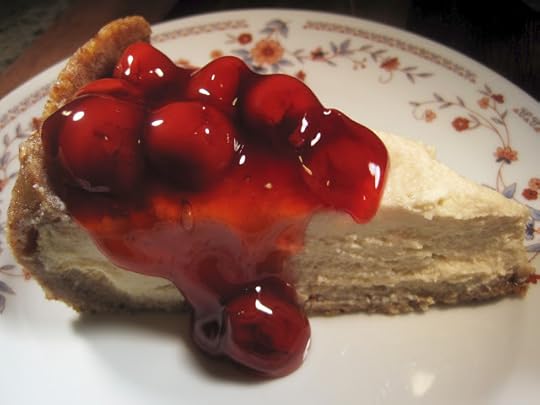
That picture shows just a small portion of the cheeses she'd made for the event. She also served recipes using the cheeses, which were all so great that I just knew I had to try some of her full recipes toward the end of the book for stuff that uses the cheese. That's how I ended up making this outrageously amazing Fluffy No-Bake Cheesecake. Shut UP! Did you ever see anything that looked so great? It tastes just as great as it looks.
So, why not 5 stars? I guess just because I'm usually too lazy to make the cheeses. Not that it's hard to do, just that you have to start it in advance and go through a bunch of various steps over time for it. I don't hate that, it's really OK, and it makes me feel super-accomplished. But as a person who just is not sitting around wanting cheese, I kind of have to go out of my way to find uses for the stuff. Nevertheless, if you want to impress people, cook from Artisan Vegan Cheese.
Artisan Vegan Cheese takes a really revolutionary approach to vegan cheeses. Most of the recipes start with a culture and you actually ferment your cashew/ soy yogurt to produce a cheese. 4 stars for the idea of the book and interesting reading. 3 stars for how my cheeses came out.
I made 4 different cheeses from the book using quinoa rejuvelac (easy!), a normal blender and agar powder:
-Basic Cashew Cheese Not impressed. A fine spread but not worth the effort.
-Smoked Provolone This had a wonderful taste while it was hot. It never firmed up for me, but I still like the taste as a spread. It doesn't taste like cheese to me, but yummy.
-Brie Great texture, firmer than regular brie. I didn't use refined coconut oil (I had Trader Joe's coconut oil on hand), so it tastes like coconut but a nice smooth texture. A winner if I make it with refined coconut oil next time. Very rich.
-Air-Dried Camembert Mine tastes like a tart version of the above brie but with a less smooth and firm texture but still sliceable. Doesn't taste like cheese to me but a good, savory flavor.
Well, I made a few of the recipes. Being gluten free, I made rejuvelac from rice. It never got "lemony" (tried it twice). I used it anyway to make a few cheese recipes. I had high hopes after reading reviews. Yeah, no. The sour cream from cashews, however, works well to make veggie dip.
What an incredible adventure this book has been. For those who don't know, Miyoko is creator of Miyoko's Creamy - which is pretty much the gold standard in vegan cheese. That should be reason alone to check this out - and there's a lot to be learned here.
Prior to diving into this cookbook, I'd never sprouted anything, never cultured anything, and definitely never made cheese - vegan or otherwise. It really opened my eyes to so many new culinary techniques and possibilities. If you do some google searching, you'll see there are plenty of recipes out there that seek to approximate cheese using a variety of thickeners, binders, flavorings, etc. And then there is another category that are actually cultured much like traditional cheese would be. Miyoko offers a little of both in her cookbook, but in my opinion - the real standouts are of the cultured variety.
She's a big proponent of using something called Rejuvelac as the primary culturing agent. It's a liquid that you make from sprouted grains - which was a new experience from me. She says that you can use any grain to make the Rejuvelac, but I'd highly recommend wheat berries. I tried it with rice the first time and it didn't go so well. I'd also recommend a sprouting lid for a mason jar.
My favorite cheeses from this book were the softer, spreadable ones - such as her Sharp Cheddar (pg 14). They're similar to the amazing Miyokos cheeses you might find at Whole Foods. I found the hard cheese recipes just weren't setting all that well for me. But as part of my vegan cheese exploration - I came across the incredible resources they have available at Cashewbert. And I did actually make some vegan Camembert - following a process very similar to traditional cheese making. It produces a vegan cheese with a true rind, and tastes very reminiscent of Brie or Camembert. Admittedly, I had some cheese connoisseur friends from Wisconsin try it, and it wasn't enough to make them converts. So maybe it's not fair to compare apples to apples, but as a vegan, I feel like this is about as close as you can get to the flavor complexity of traditional cheese. The Cashewbert is amazing with some jam and sourdough crackers.
Bottom line - this book definitely requires an open mind and a sense of adventure. But if you have that, you'll amazed at all you can discover. And next thing you know, you have a whole new set of tricks in the kitchen. You won't just be making cheese - you'll be sprouting greens, making your own sauerkraut and culturing your own yogurt!
Many vegan cheese recipes I've made in the past have involved soaking and pureeing nuts which have resulted in a ricotta-like taste and consistency but the recipes in this book involve fermentation and aging which result in more complex flavors and textures. Upon eating the one-month aged gruyere, sps said, "Whoa, I haven't had that flavor in 8 years!" because it really did have the slightly sharp/sour taste of animal milk cheese.
Though the whole process takes a few days, the instructions are easy to follow and the ingredients are fairly basic (except maybe for xantham gum). The cheddar wasn't very exciting and it tasted strongly of nutritional yeast but the gruyere was good enough to make me want to try more. It was creamy, tangy, and nutty.
I learned making rejuvelac does not make me a hippie.
Quick work but in multiple steps spread out over several days: sprouting grains, making rejuvelac, soaking nuts, culturing and aging cheese. The sharp cheddar tasted of nooch, not cheddar, though it was nice enough. The soft gruyere at first tasted weirdly sour but after several weeks in the fridge had a flavor remarkably like those mild Bonnebell cheeses. (And made me think of Ivy and Bean No News is Good News!) Good with pears and crackers.
More to try: air-dried gouda, smoked provolone, brie.
I've made a couple recipes now. The rejuvelac that some of the recipes was difficult to get going, but was super easy once I caved and kept the heat a bit higher than I normally would in winter, will probably be real easy to make in the summer. The biggest downside is the cost of ingredients. Most of the cheeses are cashew based, which is expensive per pound, and to improve mouth feel, coconut oil is used, and that is pricey too. I think in the future I will attempt to order some of the more expensive items through my work.
Have yet to find a store bought vegan cheese I liked, so after listening to a Myoko's interview with Nil Zacharias—onegreenplanet.org/eatfortheplanet, I tried several recipes, with varying success. Most are good if not great. The stuffed shells are wonderful and the fresh mozz is delicious when sprinkled with onion powder and in a Caprese salad. Inspired to continue 'til I get through them all. Thank you Myoko!
It has some good ideas, but also some ingredients that I would not want to make a staple in my diet. I'd rather go with raw food cheese substitutes for vegan options. Over all, it is definitely worth the read.
I was excited to discover this book since my daughter is gluten- and dairy-free, and I am always looking for food that replaces what she can't eat - but is also tasty, not full of chemicals, and that we will all enjoy. Many of the recipes in this book look easy enough to actually make, and as the subtitle says "From everyday to gourmet" so there are plenty of options and ideas. The book's recipes are divided by the types of cheeses (artisan and aged, air-dried, meltable, etc.) and the author figuratively holds your hand as she explains the process, tips, how long the cheeses will last in both the fridge and freezer, as well as nutritional facts. Miyoko also includes three chapters of recipes for using the non-dairy cheeses you make - so you can create appetizers, entrees, and desserts.
A disclaimer, I haven't made any of the recipes yet, but can't wait to try several.
Honestly one of the most creative cookbooks I've read. Especially among vegan cookbooks. You can tell that the author truly spent time curating her recipes. I appreciated that there was variety, including nut-free options and dishes/desserts in which to use the cheeses. I haven't tried any of the recipes yet but I can already tell they are well thought-out. Also, I didn't get bored reading it, which happens easily reading a cookbook from cover to cover, especially in this food blogger age. So, I do appreciate that :)
This is a great book with thorough information and good recipes. However the design choice to make the text this baby-poop-yellow-brown made it difficult for me to use the book.
I realize this aesthetic particularity I have won't bother others but it stopped me from buying the book. Therefore I photocopied a few pages that I felt I'd need to develop recipes on my own because then they were in black and white.
Lots of different ways to make cheese. It's definitely not an easy process compared to other recipes online, but it might be a lot better. I'm not a cheese fanatic, but miss pizza a lot. I might give the mozzarella a go if I can get the dough right first. Surprisingly there aren't photos and the layout is a little dated.
A wonderful vegan cheese cookbook with recipes for many different types of vegan cheese as well as related things like cream cheese and sour cream. It also has recipes to use the vegan cheeses in, although I think the star of the book is the recipes for cheese. It even has some options that are suitable for people on MAOI diets, which is wonderful and not something I was expecting!
I am lactose intolerant, and I've been buying miyokos cheese for awhile now. I rated this book 3 stars because, although it is helpful and easy to understand and prepare, the ingredients are very costly. I'd rather buy the cheese already made and save money.
I'm not sure how to rate this book. I will not be making any of the recipes. They are just too difficult for someone that can no longer spend hours in the kitchen, but sound like they would probably turn out to be great non dairy cheese substitutes if you can put in the time and effort.
Pretty good book, has some cheeses I haven’t seen before
I have used other books, and this one added nicely to my library of cheeses. I do wish she were clearer about the different kinds of carrageen (kappa being the proper type) so I ding 1 star for that.
Indispensable book if you want to DIY for cheese. There are some amazing artisan (v) cheeses on the market, but why not make them at home at a fraction of the price? This guide covers a slew of techniques and styles using simple ingredients. It's one of those things like breadmaking: so simple you just need to make a point to make it happen -- and a habit.
After trying a few recipes in this book, I decided I'm just not into these cheeses. I didn't go in expecting them to taste like dairy cheese, but every recipe I've tried has basically tasted like tangy cashew cream. The flavor profile just isn't that developed and the effort having to make the rejuvelac and wait for it to ferment wasn't worth it for me :(
I haven't made the aged cheeses yet, so maybe I will like those better.
Great stuff, more attention than I'm inclined to give. Fermenting cheese is not a hobby I'm inclined to. I don't understand the obsession with cheeses. I can think of dozens of things I'd rather eat. It's great there are fantastic vegan cheeses around these days, cholesterol-free, suffering-free, better tasting in a lot of cases now, too. But eh. Pass on the salt and fat, would rather stuff sugar and carbs in my face and feel fantastic.
Vegan cheese-making based on "real" cheese-making using culturing and aging techniques. Some require time (up to months). I personally find this fun and challenging in a good way. Includes recipes such as cheddar, mozzarella, cream cheese, yogurt and Chèvre. There are also some easy and quick cheeses and many cheese dishes (cheesecake, dips, salads...). I definitely recommend it.