Jump to ratings and reviews
Rate this book

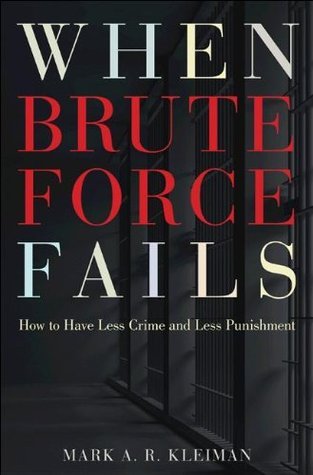
When Brute Force Fails: How to Have Less Crime and Less Punishment

Rate this book

Since the crime explosion of the 1960s, the prison population in the United States has multiplied fivefold, to one prisoner for every hundred adults--a rate unprecedented in American history and unmatched anywhere in the world. Even as the prisoner head count continues to rise, crime has stopped falling, and poor people and minorities still bear the brunt of both crime and punishment. When Brute Force Fails explains how we got into the current trap and how we can get out of it: to cut both crime and the prison population in half within a decade.

Mark Kleiman demonstrates that simply locking up more people for lengthier terms is no longer a workable crime-control strategy. But, says Kleiman, there has been a revolution--largely unnoticed by the press--in controlling crime by means other than brute-force incarceration: substituting swiftness and certainty of punishment for randomized severity, concentrating enforcement resources rather than dispersing them, communicating specific threats of punishment to specific offenders, and enforcing probation and parole conditions to make community corrections a genuine alternative to incarceration. As Kleiman shows, "zero tolerance" is nonsense: there are always more offenses than there is punishment capacity. But, it is possible--and essential--to create focused zero tolerance, by clearly specifying the rules and then delivering the promised sanctions every time the rules are broken.

Brute-force crime control has been a costly mistake, both socially and financially. Now that we know how to do better, it would be immoral not to put that knowledge to work.

257 pages, Kindle Edition

First published March 31, 2005

23 people are currently reading
586 people want to read

About the author

Mark A.R. Kleiman

10 books7 followers

Ratings & Reviews

What do you think?
Rate this book

Friends & Following

Create a free account to discover what your friends think of this book!

Community Reviews

5 stars
57 (36%)
4 stars
66 (42%)
3 stars
22 (14%)
2 stars
10 (6%)
1 star
1 (<1%)
Displaying 1 - 25 of 25 reviews
Profile Image for Aaron Gertler.
231 reviews73 followers
June 18, 2015
Patrick's review says most of what I'd like to say, but in more detail.

My own short review:

Recommended to anyone with an interest in the subject matter, or U.S. politics at large, or experimental science at large.

This book seeks to apply our knowledge of economics and psychology to criminal justice policy in the U.S. By relying on commonsense principles and well-executed case studies, Kleiman leaves very little room for disagreement. Of course it's absurd that we think "30 years in prison" is twice as scary as "15 years in prison", or that criminals are calculating the expected value of their crimes before they rob stores or sell drugs. Of course it's better to focus our energy on small punishments for small crimes, rather than a few enormous punishments for moderate crimes. And so on, for a few hundred clear and readable pages of polite suggestions.

I won't ignore the possibility that I, as a total non-expert, might be missing some key flaw in Kleiman's research. But even if he isn't telling the whole story of criminal-justice policy, he's telling an important part of that story, thoughtfully and with admirable modesty. Despite the subject matter, I couldn't help but smile as I read "When Brute Force Fails" -- it's a masterful example of how to write about controversial issues without overshooting the evidence.
Profile Image for Patrick.
Author 36 books36 followers
March 6, 2013
How economists think about crime

JDN 2456358 EDT 16:00.

A review of When Brute Force Fails by Mark Kleiman.

Kleiman is one of the few self-identified centrists who actually seems really centrist to me. Unlike someone like Shermer, he isn't ideologically committed to the idea that liberals and conservatives are equally right and equally wrong. Instead, Kleiman has few ideological commitments, and seeks pragmatic solutions to problems. He agrees with liberal views when the data supports them, and conservative views when the data supports them instead. It's a refreshingly nuanced approach. I'm also thrilled to see science applied to moral questions; I want to see more of this.
Kleiman is a professor of public policy, but he's also really a criminologist and a behavioral economist. He analyzes the problem of crime and incarceration in the United States in behavioral economic terms, asking how much harm crime does and how much it would cost to fix it by various means. His basic methodology is "let's look at the data and see what is most cost-effective, and then do that"; it's pretty hard to disagree with frankly. Ironically, it's also vastly different from the standard approaches, which are bound up in ideological assumptions.
The pragmatic approach does have some flaws, though, as it fails to create a unified vision to follow and risks being reduced to a series of unrelated bullet points. Indeed, the last chapter is literally a list of bullet points, without much to connect them. The closest Kleiman gets to unifying principles are "treat arrests and punishments as costs, not benefits" and "shift the mix of correctional budgets away from prisons to community corrections". Beyond that, he gives a long list of ideas to implement, most of which sound pretty good; but the whole thing doesn't feel like a cohesive vision.
He also has a tendency to qualify his own statements, never making them as forceful as they should be. "Yes, if the jails delivered more infectious-disease control and the health-care system more anti-violence efforts, we might end up both healthier and safer. But we might also wind up with worse-managed jails and hospitals as a result of divided managerial attention." (p.170) This sort of "it might work, it might not" hedging is a good way to never be proven wrong, but it's not a good way to make policy. Are we reorganizing hospitals or not? Doing it halfway could well be worse than not doing it at all. (My favorite joke about false compromise is becoming perilously close to reality: The Republicans want to build a pipeline, the Democrats don't, so we'll compromise and build half a pipeline.)
Most of his suggestions just seem like common sense, which is alas not so common in our political system: "Add police to areas that are under-policed", "Prosecute felonies committed by parolees as new crimes, rather than allowing them to be treated as mere parole violations", "Stop tolerating inmate-on-inmate violence", "reward good behavior as well as punishing bad behavior"; who could possibly disagree with those?
A few of his suggestions are notable for being bold in our political climate, yet well supported by the scientific data: "The movement toward for-profit prisons has not been noticeably successful", "Some of the features which make prison most horrible--especially inmate-on-inmate violence--may not make them more aversive to offenders", "Assertive Community Therapy can improve the lives of probationers and parolees with serious mental-health problems", "raise alcohol taxes and abolish age restrictions", and "permit the private production and use of cannabis, but not its commercialization" are all backed by sound research and could make a lot of people's lives better.
In general, I'd like to see some policymakers read this book and apply its suggestions. As Kleiman himself admits, they might not work; but they might work, and they could offer us the chance to have less crime with fewer people imprisoned and less spent on incarceration. Who could disagree with that?
Profile Image for Hweston.
16 reviews
April 27, 2025
Had to read for work but I predict I will read this over and over throughout my career. A well researched back bone to less crime but also less punishment. Changed the entire way I think about criminal Justice “reform.”
444 reviews14 followers
June 7, 2016
Wonderful, easy-to-read, thought-provoking book about the American criminal justice system, how it has changed during the last 40 years, its current failings, and what to do to fix them. Even-handed, non-partisan analysis of which tactics works and which don't, based on several pilot programs and lots of independent research. Should be required reading for any sociology student. Very sobering on the social justice aspect: 1% of American adults are currently incarcerated. Many of his findings would not be expensive to implement, and the research surrounding effective punishment--immediate, but not severe--was both intuitive but something I'd never really thought about. Much to be hopeful about in terms of the effectiveness of probation relative to incarceration.
Profile Image for Ari.
782 reviews91 followers
October 5, 2012
An economist's take. Perspective is center-left. I thought it was well argued and appealingly written.

The author's two biggest suggestions: reduce neurotoxic pollution (such as lead.) Make punishments milder, but more immediate and more certain. In particular, police should make it a high priority to serve arrest warrants on people who break their probation.
576 reviews10 followers
December 28, 2018
"An observer from Mars would find the treatment of alcohol in the American drug-policy debate hard to understand. The heavy burden of alcohol-related crime is used by opponents of the current drug laws to argue that prohibiting other drugs while allowing alcohol to be marketed agressively is irrational. They have some facts to back them up: according to surveys of jail and state prison inmates, more crimes, and especially violent crimes, are committed under the influence of alcohol than under the influence of all illicit drugs combined.

Logically, though, observing that the one legal addictive intoxicant does more damage than all the illegal addictive intoxicants makes it more difficult, not easier, to believe that legalization tends to minimize aggregate harm.

Drug-war 'hawks' and drug-war 'doves' tend to tacitly agree that no change should be made in current policies toward alcohol. Since those policies seem to be producing miserable results - there are four persons meeting clinical criteria for alcohol abuse or dependency for every one person meeting those criteria for any other drug - this agreement seems, on reflection, very strange, especially since there are clear opportunities to change alcohol policies in ways that would unambiguously reduce crime and other alcohol-related harms.

Alcohol consumption, and especially consumption by heavy drinkers, who spend a large proportion of their personal budgets on drinking, is responsive to price. At present, the federal and state tax burden on the average drink is only about 10 cents, roughly one-tenth of the total price. The effect on alcohol-related crime (including domestic violence and child abuse) of raising that tax to a dollar a drink would likely be substantial, even allowing for the risk of developing illicit markets in untaxed alcohol: the safety and convenience of legal alcohol, and drinkers' loyalty to legal brands, would tend to keep such markets small. Even a doubling of the tax would probably reduce the homicide rate by several percent, while imposing no substantial tax burden on any but problem drinkers; someone who averages two drinks a day year-round would pay additional taxes of less than $4 per month.

A more radical step would be to make alcohol less available to those likely to commit crimes under its influence, as evidenced by prior convictions. Like the current age limit, a ban on drinking by those previously convicted of alcohol-related offenses - in effect, a selective, rather than a blanket, prohibition - would have to be enforced primarily by regulations on sellers rather than by legal threats aimed at buyers. The crime-control benefits might be substantial. That such a relatively modest step remains well outside the bounds of political discussion, let alone political feasibility, reflects the extent to which practical efficacy continues to bow to the symbolic politics of the culture wars in framing policy toward alcohol and other drugs."
Profile Image for Lance Cahill.
250 reviews10 followers
August 5, 2021
If you ever wondered what if a liberal had written James Q Wilson’s magnificent “Thinking About Crime”, this would be it. Great exploration of various issues and summary of existing social science research with key organizing principle being that of harm minimization (including harm to offenders in the form of time in prison) to society.

Certain, known, and timely are critical components to punishment for effective crime deterrence as opposed to severity of punishment.

Level-headed discussion of crime, drug and gun policy deserves much commendation today, especially as recent reform efforts have sought to reduce the burdens of the criminal justice system, such as eliminating pre-trial jail stays (eliminating so-called cash bail).

Combining this book with James Q Wilson’s and John Pfaff’s book exploring causal factors of increase in incarceration rates (“Locked In”) would be highly recommended.
Profile Image for Steven Michael.
23 reviews
September 20, 2023
This should be required reading for anyone working in, or interested in, the justice system. It dispels some pernicious leftwing (defund the police!) and rightwing (lock em up and throw away the key) popular myths about justice policy, while at the same time developing a model for crime control that works (emphasizing certainty and swiftness of punishment over severity).
8 reviews
September 18, 2024
This book is way ahead of its time; it is a credit to the author and a disgrace to our society that it is just as relevant and timely today as it was 10+ years ago.

Curiously, even in 2009, it was possible to anticipate the unwanted effects of a variety of policy reforms from banning the box to drug legalization. But I guess you can’t know until you try it, can you?
Profile Image for Eva Forslund.
206 reviews8 followers
November 1, 2021
Was pretty tired when I read this but it's well written and insightful. Tragic that there was people with good suggestions on policy reform over 10 years ago but so little has happened in the US.
Profile Image for Dheraj Ganjikunta.
40 reviews1 follower
May 4, 2021
Interesting economic analysis of criminal behavior, but ultimately unconvincing. Provides some pretty smart policy reccomendations though.
880 reviews2 followers
September 19, 2012
"One approach to finding those resources might be called 'dynamic concentration.' Start somewhere: with a geographic location, a set of offenses, a set of offenders. Borrow existing capacity from other areas, offenses, or offenders to concentrate on the chosen target. Once offenders have gotten the message, in the words of the old music-hall song, 'You can't do that there here,' and reduced their level of activity accordingly -- once that original target has been 'tipped' from high offending to low offending -- the temporary increase in enforcement directed at that sector can be relaxed without letting the target 'tip' back." (4)

"[T]he examples of H.O.P.E. probation, the squeegee crackdown, and the low-arrest crackdown that broke up High Point's open drug market, together point to three central ideas about how to maximize control effects of any given stock of enforcement resources: concentration, substitution of certainty and swiftness for severity, and the direct communication of deterrent threats. ... They all rest on the notion that the actions taken by criminal-justice agencies -- arrest, prosecution, and incarceration -- should be thought of as costs, not benefits." (86-7)

"Compared to other advanced democracies, the United States does not have an especially high level of crime, or even of violent crime. It does have a startlingly high level -- about five times the Western European/Canadian/Australian average -- of homicide. It also has an astoundingly high level of private gun -- especially handgun -- ownership, and the difference in gun homicide rates, linked to differences in the lethality of robbery, residential burglary, and aggravated assault, accounts for much of the difference in overall homicide rates." (140-1)
Profile Image for Gary Braham.
107 reviews1 follower
October 25, 2012
Wasn't really much of a fan of this book. It read like a college textbook. The type that the professor wrote himself, and makes all his students buy. Some parts of the book were interesting. And even though the book wasn't very long, he kept refering over and over again to two different case studies that he really liked. As far as his ideas, some seemed good, others not so much. Some of them weren't so consistant with each other, but in fairness, he said they needed to be tested on a small scale first to see if they actually work.

A lot of the theories the author gives might work in a world without politics or emotion. They are dependant on the criminals making decisions on a purely rational basis. And people reacting to crime also without emotion. One of the case studies the author loves involves the police building a case against a cities drug dealers. And once they complete the investigation, they warn the dealers, and tell them they had better stop. And most of them did stop, so you would have to consider the program a success. However, if even one of those dealers ends up getting in a shootout with a rival, and takes down an innocent victim instead, there's going to be political hell to pay.

Edit: "Don't Shoot" by David Kennedy explains a lot of what is in this book a lot better. http://www.goodreads.com/book/show/11... It's more of a narritive rather than the same boring statistics over and over again, and it actually explains why the statistics work.
Profile Image for Abby Jean.
986 reviews
August 10, 2010
absolutely fascinating. i thought i knew a fair amount about crime policy, but was used to approaching it either from the ACLU view (all criminals are products of poverty or discrimination and we need to address root causes rather than punishing them) or the DA view (throw them all in jail forever!!). this is an utterly refreshing third view, thinking about how to have the most reduction in crime while still maximizing liberty and minimizing costs. some absolutely fascinating views and proposals in here - it's certainly significantly changed the way i approach crime issues.
1,326 reviews15 followers
November 13, 2012
I am glad I read the book. I don’t agree with the author about everything but he makes a thoughtful, well reasoned argument that should be wrestled with seriously. He takes a careful look at all sides of the issues around crime and the high percentage of people we have behind bars in this country and he brings light to bear on solutions that work, solutions that don’t, and how to try to get all the different pieces of the system and our communities to work together to solve these issues. Very interesting.
Profile Image for Kelly.
416 reviews21 followers
January 25, 2011
This is a clear, informative and realistic assessment of the public policy challenges posed by the American criminal justice system. The jewel at the center of Kleiman's book is the premise that the goal of crime reduction is compatible with a diminution of suffering at all organizational levels, including enforcement and punishment. It's the kind of book that one dearly hopes that our political class might actually read.
Profile Image for Scott Harris.
583 reviews9 followers
January 9, 2012
This research report provides an academic review of crime control policy, particularly in the United States. It emphasizes the need for balancing interventions and deterrence so as to demonstrate real reductions in recidivism as opposed to argumentation. It is based on an economic theory of crime control and examines aspects such as demand, incentives and rational decision making. Moreover, it dispels an artificial assumption that offenders are perfectly rational in their choices.
436 reviews16 followers
February 8, 2011
This book came highly recommended, but I almost gave up on it early on. The opening chapters are just too dry and directionless. Fortunately, Kleiman regroups and eventually walks through a very engaging argument about what we get wrong in how we deal with crime. B+.
Profile Image for Kerrie.
491 reviews11 followers
April 8, 2015
Solid perspective, a little too forgiving of the roles of racism and classism in the shaping of our criminal justice system. Overall an interesting, if incomplete, approach.
Profile Image for Daniel Kasbohm.
31 reviews2 followers
August 12, 2010
Fascinating! A nuanced analysis that does not fall into the same old recommendations or ideologies.
Profile Image for Rebecca.
1,004 reviews6 followers
March 11, 2015
Well, this is not a sexy book. There is math. But it's a reasonable and dispassionate discussion of the various issues surrounding crime control. (Including, quelle surprise, guns.)
Profile Image for Steven.
82 reviews1 follower
April 14, 2015
What popular social science writing should be.
Displaying 1 - 25 of 25 reviews

Can't find what you're looking for?

Get help and learn more about the design.