Jump to ratings and reviews
Rate this book

A Matter of Life

Rate this book
After the acclaimed indie film Save the Date and the bestselling all-ages humor book Darth Vader and Son, graphic novelist Jeffrey Brown (Clumsy, Unlikely) returns to the autobiographical work that first made his reputation. In A Matter of Life, Jeffrey Brown draws upon memories of three generations of Brown himself, his minister father, and his preschooler son Oscar. Weaving through time, passing through the quiet suburbs and colorful cities of the midwest, their stories slowly assemble into a kaleidoscopic answer to the big matters of life and death, family and faith, and the search for something beyond oneself.

97 pages, Kindle Edition

First published January 1, 2013

9 people are currently reading
505 people want to read

About the author

Jeffrey Brown

189 books1,386 followers
Jeffrey Brown was born in 1975 in Grand Rapids, Michigan and grew up reading comic books with dreams of someday drawing them, only to abandon them and focus on becoming a 'fine artist.' While earning his MFA from the School of the Art Institute of Chicago, Brown abandoned painting and began drawing comics with his first autobiographical book 'Clumsy' in 2001. Since then he's drawn a dozen books for publishers including TopShelf, Fantagraphics, Drawn & Quarterly, McSweeney's and Chronicle Books. Simon & Schuster published his latest graphic memoir 'Funny Misshapen Body.' In addition to directing an animated video for the band Death Cab For Cutie, Brown has had his work featured on NPR's 'This American Life' His art has been shown at galleries in New York, San Francisco, San Diego, Los Angeles and Paris. Jeffrey's work has also appeared in the Best American Comics series and received the Ignatz Award in 2003 for 'Outstanding Minicomic.'
He currently lives in Chicago with his wife Jennifer and their son Oscar.

Ratings & Reviews

What do you think?
Rate this book

Friends & Following

Create a free account to discover what your friends think of this book!

Community Reviews

5 stars
180 (16%)
4 stars
342 (31%)
3 stars
401 (37%)
2 stars
131 (12%)
1 star
23 (2%)
Displaying 1 - 30 of 165 reviews
Profile Image for karen.
4,012 reviews172k followers
July 28, 2021
i got an email the other day:

A young child, upon spotting the new Jeffrey Brown book, screams with wide-eyed delight: "OH! Is THIS one of the STAR WARS books???"

even kid-phobic me thinks that is adorable.however, this is most certainly not one of the star wars books, and would probably baffle a young child expecting to see light sabers and muppet-baby versions of their beloved characters.

this is a more mature jeffrey brown than in any of his previous autobiographical graphical novels. no longer is he wearing a little barnes and noble name tag, pining over unattainable girls and getting himself into embarrassing situations. this one is a more contemplative series of pieces about fatherhood and faith.

he has found love! he has babies! and now he can relax, breathe a little easier and ruminate on his past, his family, and take stock of the decisions he has made along the way.

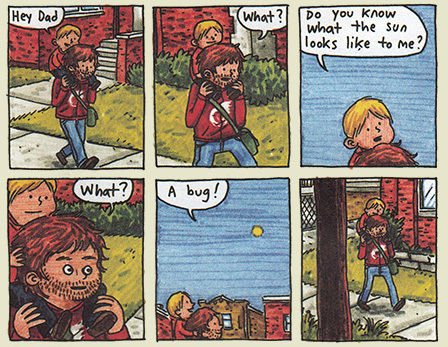
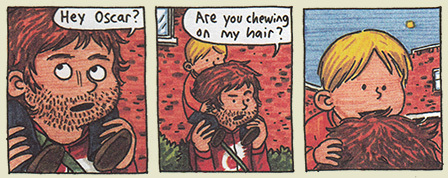
some of it is just cute "look at my kid stuff:"


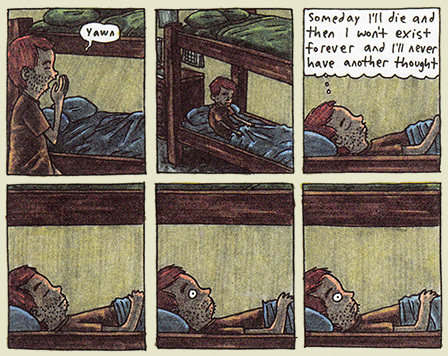
and some of it is about how his early childhood acceptance of the faith of his minister father was slowly stripped away over time, through reading about physics in college, being exposed to other religions, and realizing that you don't have to be a part of any organized religion to be a good person and perform good deeds.

it's also about killing a cricket that had a tapeworm on a mission trip one time in his youth and the frustration of passports and travel in general, neither of which really fit into the themes of the book as a whole, but jeffrey brown was never really about continuity.

i was super disappointed with Little Things: A Memoir in Slices, and i feel bad for writing such a mean review of it (i love you jeffrey brown - don't be sad!!!) but this one is right back on track. there is a different energy behind it, definitely, but there are some really beautiful, tender moments in here, and if you have been following his life story-through pictures as i have, you really have to feel a swelling in your heart for him and his happiness. you turned out all right, jeffrey brown!! i always knew you would.

come to my blog!
Profile Image for Jan Philipzig.
Author 1 book310 followers
December 18, 2015
Well, that was underwhelming. As a "meditation on fatherhood and faith," which is what the back cover promises, A Matter of Life does not really have all that much to say, and as an autobiography it feels a bit shallow and trivial in places. Or does Brown want to tell us that that's just life - no grand answers, no non-stop thrill rides? Maybe, but that point has been made many times before, and more effectively. Still, there are a few nice touches here and there, and towards the end I thought the kid perspective on church and death and smurfs wrapped things up nicely.
Profile Image for Sam Quixote.
4,801 reviews13.4k followers
June 29, 2015
Though he does a lot of Darth Vader and Change Bot comics these days, Jeffrey Brown started his comics career doing autobiographical, introspective stories, a genre which he returns to in A Matter of Life.

That said, the Jeffrey Brown of books like Clumsy and Unlikely, about being an awkward single guy muddling through relationships is gone. He’s now married and has a little boy, Oscar, and the perspective of being a father makes him revisit memories of his now-deceased father.

While the book is a hodge-podge of stories featuring Brown as a kid, his dad, and becoming a dad with a toddler, it’s also about faith, spirituality, science and mortality. Brown was raised Christian but as he grew up, he began moving away from the religion.

As a teen, he started reading physics books by Carl Sagan and Stephen Hawking, began thinking about the wider universe and how small humanity is in the face of everything, and the limitations and contradictions within Christianity. However if you’ve read one book about someone struggling with their faith, you’ve read them all, and Brown’s story is no different from most. Also while he is no longer a Christian, he treats the religion and other Christians with enormous respect in this book. This isn’t someone mocking the faith for yuks or looking down at anyone in the church (though he does gently needle some folk!).

The memories of his father are sweet but not saccharine and have the ruggedness of reality to them. Through them we see glimpses of Brown’s own development from an art student to a cartoonist and the man he is today, still having awkward moments, and determined to be as good a father to his son as his father was to him. It’s a good mix of light and heavy.

Unlike a lot of Brown’s work, the art is much more confident with stronger lines, ambitious splash pages, and lots and lots of colour. The landscape panels are especially pretty as are the cosmic shots.

A Matter of Life is a very soft read in that Brown’s adopted a loose approach to talk about personal stories and also touch on larger issues that affect us all. It doesn’t leave a deep impression, nor does it say anything particularly fresh or profound, but some of the memories are touching.

Brown’s adulthood stories are more interesting than his kidulthood ones and because there’s a balance between the two, I liked half the book better than the other. It’s a pleasant read though not one of Brown’s best (also describing itself as a “meditation” makes me want to punch its cover!).
Profile Image for Ross Blocher.
544 reviews1,450 followers
March 26, 2021
I recognized Jeffrey Brown's art style immediately from his Star Wars-themed graphic novelettes like Darth Vader and Son: the big heads, the simple expressions, the dark ink outlines with colored marker fill. In A Matter of Life, Brown shares stories about his relationship with his own [minister] father, about growing up in the church, and him being a father in turn to his son Oscar. Most pages are a 12-panel spread, depicting a story from his childhood. We read the basic dialog and narrator scene-setting, but so much of the heavy lifting is done by the illustrations. With childlike simplicity and coloring, we are invited to take a child's perspective and revisit our foundational first interactions with ideas of injury, aging, death, war, faith, ritual, and eroticism: the misunderstandings and exaggerated literalism that color our perceptions for the rest of life. It's often laugh-out-loud funny, but also tender and sweet and vulnerable. It's something to savor, but will still only take you half a day to read. Highly recommended. Handing it off to my son to read...
Profile Image for Seth T..
Author 2 books959 followers
November 9, 2015
A Matter of Life by Jeffrey Brown

Jeffrey Brown’s A Matter of Life is collapsed between the terrifying vast expansiveness of the cosmos. Here the reader is recommended to the laughable insignificance of the human endeavor in the face of such grand celestial emptiness. Between these bookends, Brown recounts several dozen autobiographical moments, beautiful in their mundane simplicity. Each of these remembrances strains against both prologue and epilogue, threatening to undo our sense of how little we really are. We are shown, visually and rather powerfully, that we are little more than germs in the universal scope; but then Brown tells us trivial, page-long stories about how things were for him growing up and in his young adulthood. As if, after being shown the lie of human importance, we should care at all.

A Matter of Life by Jeffrey Brown

And the thing I most appreciated about A Matter of Life is that this tension seems to be Brown’s point and purpose. The book is overlaid with a sense of cosmic horror that has nothing to do with Lovecraft or his successors. Because of his choice of universal scope at the bookends, there is always a sense of secular numinous haunting even episodes so innocuous as Brown’s toddler son riding atop his shoulders. A Matter of Life is explicitly concerned with the mystery that subsumes the essential experientiality of the human creature in the face of the bright darkness of the extra-terrestrial expanse. Who is man that the universe should be mindful of him? Are we the Nothing that cold reason demands or the Everything that our hearts propose so forcefully through every minute of our lives? And then, what of the immortal, invisible, in light inaccessible? What about God?

In many ways, Brown’s episodic memoir is an older man’s version of Craig Thompson’s seminal work. A Matter of Life is kind of like Blankets if you sucked out the vitriol, melodrama, self-importance, prodigy-level artwork, and narrative direction. In place of those gaping holes, let’s inject warmth, a bit of circumspection, a slice of compassion for his religious parents, colour, and a touch of humility.

A Matter of Life by Jeffrey Brown
[My son did this to me tonight. It hurt a lot]

There are a number of similarities between Brown’s and Thompson’s autobiographical avatars in these two books. Both have been alienated from the mainstream, conservative Christian faith of their parents. Both remember some dumb or mean things their parents did or said. Both have left their faith communities and maintain an awkward identity in proximity to those spaces. Both are still concerned with existential mystery and the absence of easy answers. But while Thompson’s is a more majestic and memorable work (and one that will regularly grace Best of Comics lists for foreseeable decades), Brown’s is a warmer, more pleasant experience. Save for a few moments, A Matter of Life will almost certainly prove to be a forgettable work—but that’s okay because it’s enjoyable while it lasts.

Part of the trouble (and I use trouble here mostly facetiously) is that where Blankets has a grand story to tell, full of pathos and symbology, Brown’s story isn’t concerned with that. He hops from one dis- or barely-connected story to another. Taken together they weave a tapestry that gives a sense to the tenor of his formative years, but—realistically enough—there is no plot, no climax, no central conflict, and no denouement. Life doesn’t present itself in those structures and so Brown’s story feels honest and forthright.

The part of A Matter of Life that struck me most notably when compared to the similarly themed Blankets was the absence of vitriol. I was going to say the markèd absence of vitriol, but then I remembered that there’s no real reason we should expect so much frustrated rage from those who move out of dogmatic ideology into something else—even if that something else is another dogmatic ideology (as often happens[1]). In a world of cool blue reason, we would simply accommodate new information and ideological shifts and go about our business living in new and better (maybe?) ways. But we’re not usually like that. Our beliefs are attached to parts and pieces of our lives, relationships, and histories. Extricating ourselves from the communities that shared our former thought-governing paradigms can be a violent experience. We feel betrayed by those who shaped our former thoughts. They feel betrayed by our dismissal of what they tended so well. Outsiders feel judged by our conclusion that they are mistaken. We feel judged for our conviction that we were wrong. A lot of pain and passion circle these decisions, threatening constantly to devour our goodwill.

A Matter of Life by Jeffrey Brown
[Do you have jesus in your heart? Like, literally?]

I think time may be the best buffer to those hurts. At twenty-five, Craig Thompson was essentially just a kid when he wrote Blankets. For all its wonder and beauty, it reads as a book written by someone fresh from the college years, still on the edge of adulthood. Add a little more than a decade of life and family experience and you’ll arrive at the tone of A Matter of Life. Brown and Thompson were both born in 1975 but Brown’s book was written around 2012 while Thompson’s was conceived beginning in 1999. Brown’s wounds had a full decade of healing while Thompson’s were fresh. Obviously, they are different people with different experiences and different temperaments, but I wonder what Blankets would have looked like had it been written today. It’s possible that it wouldn’t have been as good, that its strength comes from its passion and naïveté.

The greatest weakness of Blankets is in its epilogue, when Thompson kind of peters out his narrative into a helpless shrug against the beauty and mystery of the world. He doesn’t know what to make of it and his new life apart from faith doesn’t yet have the vocabulary to articulate his place in the cosmos. Brown, however, isn’t a fresh apostate. He’s worn the identity of the man apart for years now and he’s (mostly[2]) comfortable in that skin. And so, when it comes to the unanswerable question about how he as an insignificant cosmic triviality fits in to a universal machine so grand and powerful and empty as his own, he with humility simply fades his anecdotes to black, allowing them to absorb back into the dark starfield of our ever-expanding universe.

A Matter of Life by Jeffrey Brown

A fade to black. A fade to lights. From mundane to mystery, from life to everything else. It’s a good conclusion to a solidly conceived work. It doesn’t satisfy as much as the neatly woven narrative of Blankets, but it isn’t meant to. Thompson’s is a story of anguish where Brown’s is a story of love. Both treat faith and familihood. Both are some measure of autobiography. Both are good uses of the comics form and would be sustained perhaps by no other medium. I partly write this not because I will remember A Matter of Life, but so that I will remember to reread A Matter of Life.
_______

[Review courtesy of Good Ok Bad.]
_______

Footnotes
1) People are preposterously pendulous!

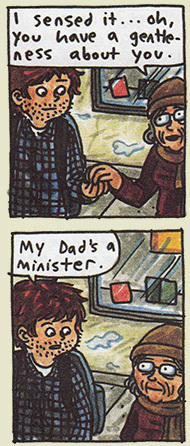
2) One of the more remarkable moments in A Matter of Life for me was when an elderly woman asks the adult Brown if he isn’t a Christian. He hasn’t been associated with his father’s faith in years and generally he depicts himself with a sour face in response to efforts to draw him back into the fold. In this instance, however, Brown looks down at this woman and, with a certain spark of kindness, agrees that he is a faithful Christian and endures her Christianese and wishes her well after helping her cross the street. He wanted her to feel comfortable despite his own discomfort.
A Matter of Life by Jeffrey Brown
It shouldn’t be striking to have read that—but since I had Blankets in mind while reading (it is a giant of the medium), I couldn’t help but think how out of place such a scene would have been in Blankets' idiom.
Profile Image for sj.
404 reviews81 followers
July 8, 2013
If the name Jeffrey Brown rings tiny little bells of recognition, it's likely because you've at least HEARD of his Darth Vader and Son comic series.

A Matter of Life is not anything like, that, though.  It's an incredibly reflective sort of Graphic Memoir (can I just take a moment to acknowledge that I'm so in love with the fact that GRAPHIC MEMOIRS are actually a THING?), featuring Brown's ruminations on his early life in the Church (Proper Noun, yes), and what his life has been like since then.

I didn't expect to find myself as thoroughly touched throughout (not a euphemism) as I was the entire time I was reading.

Brown's experience is a sort of Fun House Mirror of my own, so there were times when I was on the verge of tears while reading.  It opens with several full page panels of the following:
When I was little, I believed in God.

At least, I think I did.

At some point I realized I didn't believe

And that I hadn't in a long time

If ever.

It doesn't mean I don't believe in something bigger than myself.

Heh, geddit? Heh, geddit?
Brown's memories dart back and forth in time, from the present day to earliest childhood.  I loved the non-linear flow, because that's what memories are like, right?

mea culpa

Which all fits rather nicely with something from The Big Reap that I've been chewing on lately:
We all have thoughts, even the stupidest of us. Reams of them, all day long, from sunup to sundown. And yet most folks have no idea how those thoughts are structured, or what makes them tick. They’re not some kind of mental home movie, a series of vignettes that traipse from A to B to C with a handy-dandy voiceover narration making sense of the whole thing. They’re more like water droplets scattered across a spider web after a spring rain; little pockets of experience, caught at random it seems, each a lens through which distorted images of the world as we see it can be viewed, but never, ever as it truly is.

My point being that it's nice to see a memoir that acknowledges "Hey, maybe I made some of this shit up, but I'm not even sure anymore."  My husband and I do that to each other all the time.

Me:  blahblahblah AND THEN THIS HAPPENED!

Him:  Wait, really?

Me:  Yes!  Or...I don't know.  I could be making it up?

And then we laugh.  But while I'm telling it, I believe it to be true, so that's kind of what counts, right?

So, anyway - the book.  I kind of loved this book.  As I mentioned earlier, I had a lot of similar experiences growing up.  My dad wasn't a pastor, but my grandmother was heavily involved in the Church.  Brown and I were around the same age when we came to a realization that maybe the Church wasn't for us.  His parents still loved him, even if he had become a godless heathen.

I...my grandmother told me that as long as I always knew she loved me, it didn't matter what I believed.  I wish the rest of my family had been as understanding (much like most of Brown's family seems to have reacted):

jesus in your heart


Jesus in your heart 2
I can totally empathize with this.

I have family that is STILL disappointed we haven't had our children baptized, and even MORE family (and friends) that are convinced we're atheists (um, we're not, but we believe that our relationship with our/any higher power is none of your damn business), but we want our children to develop their relationship with god/God/gods on their own, once they're old enough to make an informed decision.

I'm totally veering off onto my own personal tangents, so I'll stop now.  I'll just say that this book happened to push a number of my own personal buttons and really worked for me.  If you're someone who also grew up heavily involved in the Church that dropped out for whatever reason (and there are a lot of us), this may work for you as well.

 Thanks so much to Top Shelf for the review copy.

Originally posted here.
Profile Image for Raina.
1,718 reviews163 followers
November 7, 2013
What happens when the son of a minister doesn’t believe in God? How does he relate to his father? How does he parent his son?

Jeffrey Brown is a well-known graphic novelist, but until I read this book, I'd never felt the need to pick up his work. I mean, I think I picked up one of his zines once, and I'd definitely flipped through Darth Vader and Son and been mildly amused, but I'd generally come away from his work unimpressed.

I'm so glad I was forced to pick this up.

Here, he takes on faith, family, and fatherhood.

At first glance, Brown’s illustration aesthetic looks relatively simple, and maybe that's one reason I'd shyed away in the past. His lines are never quite straight, his human figures are slightly lumpy, and his panel arrangement – though not completely uniform – stays relatively close to a 12-panel-per-page formula. His lettering is less polished than most, and his characters’ facial expressions seem -- at first -- to show little nuance.

I think for me, a higher production value - color, specifically - helps a LOT.

I was enthralled.
Brown is still figuring out what it means to be a father, but the stories he tells of his journey up to this point are heart-breaking and heart-swelling slices of life. Brown talks about his childhood experiences, what it was like to “come out” as someone who’d rejected his Christian upbringing, and anecdotes about the challenges of raising children. The stories are arranged roughly in chronological order, and - but for a few exceptions - the narrative flows smoothly.

This was a timely work for me to read, and I'm really glad he put this out there.
Profile Image for Drew Canole.
3,168 reviews43 followers
August 13, 2017
It terrifies me to think that it would be difficult to break away from your parent's beliefs. My parents were not religious, so it was easy for me to define my own religious/spiritual beliefs (still ongoing). My parents are also very nonrestrictive concerning my sexual beliefs, so I think it would be easy to tell them I'm gay (if I was, or felt the need to tell them). At one point in the book Brown is listening to a religious tape, "You want gay rights? You have the right to stand before God and be judged" (which is a confusion of the topic, political rights and divine rights shouldn't be conflated). I typically find all religious talk to be complete nonsense - I suppose they are since religion doesn't appeal to the senses in a strict interpretation of that word.

My parents were far from perfect, and looking back I can tell they overwhelmed themselves with 3 boys at too young an age, but they tried hard and allowed each of us to grow in our own ways. I never felt the need to run-away from home, and I lived at home all through college - I'm writing this from the bedroom I maintain at my parent's home; even though I have my own home now.

So many of these 'breaking away from my parents' stories fall flat for me, although I do enjoy reading about an existence that could have been my reality.

I'm getting tired of autiobiographies by boring people who appeal to their audience by being modest. But their so damn inviting, and they make me feel good about my own dull life. The unfortunate part is this book doesn't even have much of a story to hold it's pieces together. It runs more like a chronological overview of some minor events that were important to the development of Jeffrey Brown being Jefferey Brown (how he developed a conception of his self).
Profile Image for Dave Schaafsma.
Author 6 books32.1k followers
September 25, 2013
So just read the sort of pieced together, roughly chronological autobiographical collection Undeleted Scenes and liked it a lot. Here, Brown is older, his art seems more "mature," more carefully (is this right? I think it's wrong to call anything he does immature or less than thoughtful, it's part of the intended effect to draw us in, capture us as readers...) rendered, with the full color of the Vader books, too.. This is at times entertaining, which is generally what he goes for, but to call this "An Autobiographical Meditation on Fatherhood and Faith," I don't know, what's the takeaway from those lofty goals? He leaves (as I did) the Faith of His Father, manages (without ever speaking about it with him, really) to keep loving connections with his Dad, but how? Why? What do we learn about it? We can intuit that his Dad is forgiving, but based on this, what does the kid Jeffery or even the adult Jeffery have to tell us of substance about how that happens, or why it should? Brown is best for me when he is funny, self-deprecating, the clumsy, bumbling, bad at girls guy that draws us in... but this older, more serious, resistant son becoming father... It appears to intend to effect an extended narrative in ways Undeleted Scenes did not, a longer, interwoven narrative, but it feels to me as Andrew said, (ironically) disjointed, not really coming together in the way you expect an "autobiographical meditation" really ought to. Maybe I'm like the guy in Stardust Memories who comes up to Allen and says, "I liked your early, funny films best." Maybe I'm THAT guy. But I promise I will keep reading his work; he's so interesting and often funny and his humanity and honesty and self-reflection and warmth still come through here, as almost always.
Profile Image for João Teixeira.
2,306 reviews44 followers
August 15, 2025
Lido em Inglês.
Este livro pretende ser "fofinho" e não deixa de ser em determinadas alturas... No entanto, fiquei com a sensação de que lhe falta uma linha narrativa coesa. Mistura demasiada coisa e, enquanto leitor, deixou-me um pouco confuso... O autor queria mostrar aspectos biográficos da sua infância ou queria mostrar o que é ser pai? Ao querer misturar estes dois aspectos díspares da sua vida, as pequenas histórias parecem estar desligadas umas das outras, o que a meu ver acabou por ser como uma espécie de desvantagem que não ajudou a que eu avaliasse o livro "melhor". A título de exemplo, temos a história do passaporte, a qual confesso, não se me mostrou muito relevante. Quando alguém decide contar uma história, criamos uma certa expectativa que ela seja relevante e que nos ensine alguma coisa... essa do passaporte para mim não teve grande interesse.
No entanto, também não deixa de ser verdade que o livro contém outras histórias mais interessantes que fazem valer a pena lê-lo.
Profile Image for Sarah.
348 reviews6 followers
March 11, 2014
I have only read snippets of Jeffrey Brown's work here and there, so I was unfamiliar with his scenic style until picking up A Matter of Life. The short slices of life he depicts between the book's covers resonate together in an intriguing way. They clue the reader in to both the smallness and grandeur of the universe, and how we learn the most about ourselves, our relationships, and our cosmos by putting the picture together one piece at a time. There's a lot of funny material here, along with tense family moments, and one gross image with a tapeworm I will never forget. And while I may always prefer deeper dives into faith and impermanence, such as Blankets, A Matter of Life lays out some of the same material, more gently -- and in some ways, more elegantly.
Profile Image for Elizabeth A.
2,151 reviews119 followers
December 28, 2015
What drew me to this graphic novel was this on the back cover: "An Autobiographical Meditation on Fatherhood and Faith." I guess I expected a more in-depth exploration of those themes, but alas, that is not what I found. Yes, there are faith and fatherhood and growing up memories, told in short story form, and while not everyone has huge epiphanies, I expected a little more than a fortune cookie style memoir. No depth, and I did not like the art either. This will probably be a wonderful treasure for the author's son, but not a book I'd recommend to anyone else.
Profile Image for Joshua.
Author 2 books38 followers
June 13, 2017
The largest complaint about this book, as far as I can tell, is that it is scatterbrained in terms of narrative, but I would argue this is simply part of Brown's aesthetic. Jeffrey Brown is an "indie" comics artists, which means that his work has often appeared in print in magazines and periodicals and small publication that receive little attention. Still the man has built his own craft and style as a comics artist, and having read him before I knew going into this book that Brown is an artist who is constantly moving around in terms of his writing.

This book is an autobiography, but it's also a reflection about morality, virtue, and the complicated nature of the father-son relationship. Brown shows the reader his life, several events that have occurred during his lifetime, and offers his idea about faith and religion and how he ultimately turned to aa different path in life.

The best line in the book, and also one that sums up the entire narrative is:

You don't need god to be good.

As an atheist this line really clicked with me, but even if the reader is religious they can probably find something to like about this book. Jeffrey Brown's work is funny, light-hearted, and constantly self-depreciating. It's an enjoyable book that, while it does zig0zag everywhere in terms of narrative, it does have a central core idea which is that life is complicated and we're all figuring it out as we go along.


If the reader would like to read the review I have published on my site White Tower Musings, they can do so by following the link below:

https://jsjammersmith.wordpress.com/2...
Profile Image for Derek.
1,076 reviews79 followers
January 18, 2019
This is a quaint and lovable autobiographical comic. First of Jeffrey Brown's comics I've read. Must say, I'm impressed with his artwork and writing. Definitely need to read more of his stuff.
Profile Image for Deirdre K.
862 reviews69 followers
October 15, 2014
Aidan checked this out of the library. He is too prolific a reader for me to keep up with, and it was by one of his favorite authors, so I didn't think twice about it. Then he asked me what _____ meant, and I realized this book is not intended for his age audience.

So I read it that night, so I would know what Aidan had read and be able to discuss it with him. Overall, I liked it, though it was a bit disjointed. It led to some great conversations about religion (Aidan thought it was funny that JB was so angry about the story of Abraham being asked to sacrifice his son, the very story A and I had just discussed the week before, and my usual example when sharing my view that the Old Testament is more about humanity's evolution toward an understanding of God than it is about God), and some awkward ones about sex.

It's a memoir/graphic novel. I would have liked a bit more cohesion and resolution (there were a lot of panels where I assumed they would be relevant later, but no---they never came back up so maybe they were just there because they amused the author?). I like Jeffrey Brown's drawings and his sense of humor; I just wished there was a way to make it more obvious that this book (and presumably others of his) are not intended for his new audience of fans under age 16.
215 reviews3 followers
September 12, 2013
I really like Jeffrey Brown's style and subject matter (religion, fatherhood) but this material came across to me as somewhat disjointed. So it doesn't compare to a really powerful meditation like Bechdel's Fun Home, where her confidence in shaping her material gives it narrative force even when it's fairly nonlinear. However, what Brown has on his side is a welcoming quality to the art (like Watterson's Calvin and Hobbes) and a gift for capturing amusing or poignant moments. So it's very accessible. My nine-year -old daughter got hold of this in a bookstore, sat on the floor reading it for ten or fifteen minutes, and was reluctant to put it back on the bookshelf when it was time to go. It make a great catalyst for conversation with some kids.
Profile Image for Abbey.
522 reviews23 followers
July 19, 2013
Jeffrey Brown's comics always seem to tug at my heart strings in the most perfect ways. It's about parenting which includes having a parent and about god and space and time and it's so powerful and wonderful. I didn't want it to end.
Profile Image for Amanda [Novel Addiction].
3,511 reviews97 followers
January 21, 2014
This was... very disjointed. I love Jeffrey Brown's work, and the art was still fantastic in this. But the constantly switching of ages and story left me a little confused.
Profile Image for Dov Zeller.
Author 2 books124 followers
February 16, 2017
In the last week, I've read two graphic memoirs, "A Matter of Life" and "Why I Killed Peter", both to some degree concerned with religion. Jeffrey Brown grew up with a minister father and as a kid went to church and on 'mission trips.' And then, at some point, he stopped going.

To quote Sam Q's gr review https://www.goodreads.com/review/show...

"While the book is a hodge-podge of stories featuring Brown as a kid, his dad, and becoming a dad with a toddler, it’s also about faith, spirituality, science and mortality. Brown was raised Christian but as he grew up, he began moving away from the religion.

"As a teen, he started reading physics books by Carl Sagan and Stephen Hawking, began thinking about the wider universe and how small humanity is in the face of everything, and the limitations and contradictions within Christianity..."

Brown chooses a different kind of life than his parents, a more secular lifestyle, focusing on art and music and relationships not as mediated by the structure of the church. Most of his memoir-ish works in some way explore his relationship to music, illness, graphic art, and romantic relationships and friendships and this book adds some layers and changes things up a bit. No longer is he writing about dating mishaps with a steady infusion of physical comedy and self-deprecating humor (thought there's still a touch of comedy). Now he's married and his exploration of fatherhood and life-after-dating has a quiet feel to it (or, as Sam puts it, "soft".) I like the loose narrative, low-key meditative mode and the evasion of firm narrative structure.

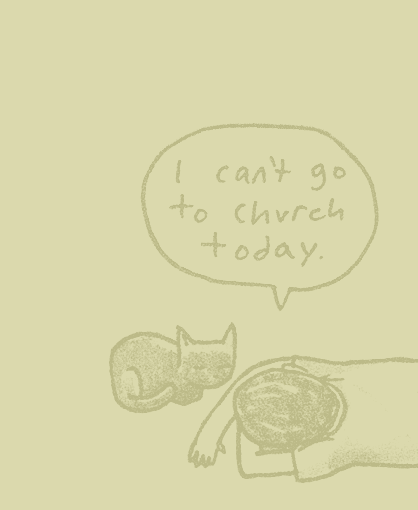
There are Brown's signature small panels (often 12 per page), and lots of color (which he doesn' always do). Also some nice one-panel pages (splash pages? Seems strange to say that given the style, and because quite a few of these pages are all black or mostly black interpretations of cosmic space). There are a few variations in paneling, but these variations are still consistent in terms of boxiness and structure. As far as sections, there are a few distinct ones, but there is not a lot of fanfare about them. The book begins with Brown going to church and, soon enough, moving away from it, and ends with his young son telling him he doesn't want to go to church (I'll not go into details, but it is a kind of loose full-circle thing happening...)

"Why I Killed Peter" is much more dramatic and dramatically structured. It's a memoir about a guy who grew up with Christian grandparents and parents who moved away from the church and became sort of polyamorous hippies? Basically they tried to go in an "opposite" directionthan the culture of their families, but perhaps went a bit to extremes. Oliver is a witness to a lot of behavior that he doesn't understand/have context for. Meanwhile, while he's trying to make sense of the relationships of the adults around him and his own growing awareness of his physicality and sexuality, his grandparents and a priest they sort of bring into the lives of Oliver and his parents, try to influence Oliver in the direction of the church. Oliver's parents are pretty hands-off about it all. In general, they don't seem to offer a lot of guidance. And the priest is charismatic and dynamic but in the end, unsafe.

This book is broken up into chapters that all have 'splash pages' (I am not sure I'm using that term correctly. Whole-page panel. They all start "I Killed Peter Because..." of an age. ("Because I was seven years old." "Because I was ten years old"...) and they all have portraits of Oliver with some contextualizing information in boxes. The book is about the same size as Browns but has a lot more variation in terms of page structure and color scheme. There is a soulfulness to Oliver's character, the way he is illustrated, that really drew me into the story, but all in all the story, well, I am trying to make sense of my relative dislike of it. There is something about memoirs I often dislike. This naming of moments that are "important" "life-changing". It can feel formulaic and frustrating to me if there isn't the kind of reflection that makes it feel like more than the sum of its parts. And this can be especially true in books about abuse. I don't know why, and how I'm meant to interact with a book in which abuse plays a key part. I'm not meant to "enjoy" it per se. But feel connected to it? Changed by it? I'm not sure.

Sometimes I read two books in a similar space of time and the reading of each enriches or sheds light on my experience of the other. This is one of those times. I'm sure I'll continue to consider what drew me to the Brown and left me feeling less connected to "Why I Killed Peter" and wondering about their similarities as well as their differences. (Both are very male-focused and centered and deal with religion, coming-of-age, family cultures, existential considerations...)
3 reviews
February 3, 2023
My daughter and I are big fans of Jeffrey Brown's Neanderthal series. So when I got this book for my daughter, with the expectation that this book was related to science (with the dino pic, I thought it was about ancient animals and life on earth). Well, it's not.

I read it after my daughter told me it's really good. I found it not really a kid's book with some of his thoughts on science and religion. But I've got a chance to relate it to my life. I introduced my daughter to the three-story apartment where her mom and I lived before having her, the moments that I lost my temper due to pressure, and how I became interested in science.

In general, I like it. It makes people want to write such a book of themselves. Good work.
Profile Image for Sarah.
1,845 reviews52 followers
October 12, 2019
My sister bought this for my daughter's library because she recognized the artist. I read it before I put it up there, as I do almost all those books, and I'm glad. This was an adult memoir.
The topic was interesting and I enjoyed segments of it but it was put together in such a way that made it feel like a puzzle with the pieces jammed in the wrong places. I could see what he was trying to do, but the construction was jarring and not what I'd call great.
Like I said. I liked the story and his snapshots of life - I just wish he'd had a better editor maybe, to help him sew them together.
Profile Image for Jennifer.
495 reviews
February 28, 2020
This is one of the most moving books I've read in a while. I think Brown has matured into a really great graphic memoirist from his cartoons of being an awkward young man into a a self-reflective writer commenting on life. I encouraged my partner to read this book and it brought him to tears with its quiet beauty. Thank you, Jeffrey Brown, for sharing your reflections on religion, your father, your son, and the meaningfulness of life.
Profile Image for Amanda Cox.
1,129 reviews4 followers
October 11, 2025
A semi-auto-biographical graphic novel about 3 generations of a family. It specifically focuses on the idea of struggling with your faith (and whether you're still religious as an adult after growing up in a religious household).

I liked the graphics and the short style. I didn't like the choppy nature of the story and how they'd jump between scenes, generations, or topics without much notice. A decent book but not my favourite.

Read as a hardcover. Very quick read (about an hour).
Profile Image for Vittorio Rainone.
2,082 reviews33 followers
August 18, 2017
Una storia molto raccontata, poco montata e poco interpretata. Nessun estro grafico, nessuna trovata degna di nota. Solo il ricorso a un voluto afflato indie che indispone. Non orribile, ma nemmeno tutto questo gran che, considerando soprattutto l'obiettivo di costruire una sorta di romanzo autobiografico di formazione.
Profile Image for Ashley.
1,689 reviews148 followers
September 9, 2018
Apparently I don't like disjointed and out of order stories with no transitions... It's autobiographical, and it sort of felt like this dude wrote/drew his stories in whatever order they popped into his head without any organization.
Also... Why make it a graphic novel if there's that many words? IDK... :/ This one was not for me
Displaying 1 - 30 of 165 reviews

Can't find what you're looking for?

Get help and learn more about the design.