Jump to ratings and reviews
Rate this book

The American Presidents #21

Chester Alan Arthur: The American Presidents Series: The 21st President, 1881-1885

Rate this book

The Gilded Age bon vivant who became America's unlikeliest chief executive-and who presided over a sweeping reform of the system that nurtured him

Chester Alan Arthur never dreamed that one day he would be president of the United States. A successful lawyer, Arthur had been forced out as the head of the Custom House of the Port of New York in 1877 in a power struggle between the two wings of the Republican Party. He became such a celebrity that he was nominated for vice president in 1880-despite his never having run for office before.

Elected alongside James A. Garfield, Arthur found his life transformed just four months into his term, when an assassin shot and killed Garfield, catapulting Arthur into the presidency. The assassin was a deranged man who thought he deserved a federal job through the increasingly corrupt "spoils system." To the surprise of many, Arthur, a longtime beneficiary of that system, saw that the time had come for reform. His opportunity came in the winter of 1882-83, when he pushed through the Pendleton Act, which created a professional civil service and set America on a course toward greater reforms in the decades to come.

Chester Arthur may be largely forgotten today, but Zachary Karabell eloquently shows how this unexpected president-of whom so little was expected-rose to the occasion when fate placed him in the White House.

189 pages, Kindle Edition

First published June 21, 2004

49 people are currently reading
886 people want to read

About the author

Zachary Karabell

25 books38 followers
Zachary Karabell is a New York-born author, columnist and investor who previously served as Head of Global Strategies at Envestnet, a publicly traded financial services firm. He currently hosts the podcast “What Could Go Right?” and analyzes economic and political trends as president of River Twice Research.

Ratings & Reviews

What do you think?
Rate this book

Friends & Following

Create a free account to discover what your friends think of this book!

Community Reviews

5 stars
337 (28%)
4 stars
382 (32%)
3 stars
389 (32%)
2 stars
70 (5%)
1 star
10 (<1%)
Displaying 1 - 30 of 126 reviews
Profile Image for Bill Kerwin.
Author 2 books84.3k followers
March 24, 2020

I believe Chester A. Arthur to be our second most forgotten president (with Benjamin Harrison running ahead by a length and a half). Arthur was a Republican hack who had already achieved his dream job: the lucrative position of Collector of the Port of New York. He enjoyed living in Manhattan, dining at Delmonico’s, and socializing in prominent gentleman’s clubs, chatting over brandy and cigars. A modest man, he only agreed to run as Garfield’s vice president as a favor to his patron, Senator “Lord Roscoe” Conkling. Certainly, he never wished to be president: when Garfield died as a result of an assassin’s bullet, President Arthur’s tears were shed for the Garfield family, of course, but I’m sure he also shed a few for himself.

Still, all things considered, he wasn’t a bad president. The American public expected little of him, and he gave more than expected. The most important thing he did was sign the Pendleton Civil Service Reform Act, which mandated that most Federal workers be hired according to their grades on exams. (He was the ideal man to end the spoils system, for he was known to be the rare scrupulously honest member of a notorious big city machine.) In addition, he helped simplify the tariff structure, vetoed the Rivers and Harbors Act (over-stuffed with pork) and also vetoed the original Chinese Exclusion Act which banned Chinese immigrants for twenty years (although he did sign a later version that reduced the years to ten), pushed for increased funding for the education of Native Americans, and supported an ambitious ship building program that eventually gave birth to the modern American navy.

All in all, a pretty good record for an almost universally forgotten man.
Profile Image for Jim.
1,452 reviews95 followers
August 24, 2024
A concise (148 page) bio of President Chester Alan Arthur (1881-1885). I read it on Presidents' Day 2022--because I like to read about our presidents and I have read many bios of presidents- Lincoln, first of all, then Jefferson, Theodore Roosevelt ( the superb trilogy written by Edmund Morris), Kennedy, of course, and Nixon... and many of the others. This bio of Arthur, like a number of other presidential bios, is part of the excellent "The American Presidents" series which unfortunately does not cover all the presidents--but does cover most of them. I've read the bios of Wilson, Harding, John Adams, and Rutherford B. Hayes--and several others--in this series. I like how they cover the lives of the presidents and the main points of their administrations, bringing in the historical background of the time period, with a chronology at the end. The authors give their opinions in these bios--and I have found them to be worthwhile to consider.
Briefly, about "Chet" Arthur, he was the "Gentleman Boss," the elegant New Yorker who liked nothing better than tucking into a sumptuous dinner at a posh restaurant, and a spoilsman, specifically, a political hack in the Roscoe Conkling Republican machine in New York. By becoming collector of the New York Customhouse he enriched himself--legally, that is, under the laws of the time. The gentlemanly Chet was personally not corrupt but he was part and parcel of a deeply corrupt system. For the election of 1880, the Republicans nominated a "dark horse," Governor James Garfield of Ohio and to appease the pro-Grant "Stalwarts" they made Arthur their candidate for vice-president. It was a close election, but Garfield-Arthur squeaked by to victory in the popular vote and by a wider margin in the electoral vote. And then, the inconceivable happened--Garfield was assassinated and the political creature of Conkling became president.
Amazingly, Arthur was determined to be his own man and defied Conkling. President Arthur should be remembered for signing into law the Pendleton Civil Service Act, bringing to a gradual end the "spoils system" that Arthur himself had benefited from in his own career. The federal civil service was to be a system based on merit and not on who-you-know. That was definitely on the plus side for Arthur but, on the negative side, Arthur signed the Chinese Exclusion Act barring Chinese immigration into America. It should be noted that Arthur vetoed the first version of the bill as it barred Chinese immigration for twenty years. He then signed the version that barred the Chinese for a ten-year-period. The author notes that Arthur signed it because he knew it could be passed over his veto. As the author states, "...Arthur would not fight a fight he knew he would lose. Rather than be a martyr to principle, he submitted to the will of the political majority and pragmatically signed the ten-year exclusion act." I believe the Chinese Exclusion Act was renewed ten years after it was signed in 1882 and it was finally repealed only during World War II, in 1943.
Arthur, like Hayes before him--and Andrew Johnson, as well--was unable to get the nomination of his party to run for president. Democrat Grover Cleveland smashed the GOP in the 1884 election, anyway. Arthur died in 1886 at the age of fifty-seven. I like what the author states about the 21st president in the epilogue: " In everything he did, Chester Arthur was a gentleman...It reminds us that adversaries can be treated with respect, that democracy can survive differences....Arthur managed to be a decent man and a decent president in an era when decency was in short supply." That sounds like our era.
Profile Image for Doreen Petersen.
779 reviews142 followers
January 26, 2017
A delightful biography of the 21st US president. Arthur was known as a Gentleman Boss but as a president he was lukewarm. Taking into account his preference to remain in the world of business politics was not his strong point. It is however a very interesting read that I would suggest to all.
Profile Image for robin friedman.
1,948 reviews415 followers
July 29, 2024
An Accidental President In The American Presidents Series

Chester Arthur (1829 --- 1886) served from 1881 -- 1885 as the 21st president. He became the president upon the assassination of President James Garfield by a deranged individual, Charles Guiteau. Upon his death, Arthur and his presidency were all but forgotten. In his short biography, Chester Alan Arthur" (2004), Zachary Karabell offers an assessment of Arthur's presidency. Karabell is a widely published author on American history with books on the 1948 presidential campaign and the Suez Canal, among other subjects. His book on Chester Arthur is part of the "American Presidents" series edited by Arthur Schlesinger Jr. and by Sean Willenz, following Schlesinger's death.

The series aims to offer readers brief introductions to all the American presidents beyond the handful of famous names. The books can be read quickly. The series may indeed be more effective for obscure presidents such as Chester Arthur than for more familiar leaders. Besides introducing the presidents and offering overviews of their history, the series has another goal: to study the qualities of leadership in its various forms. It is valuable to read this books and to think about the qualities that may make for effective leadership at a particular time.

Karabell's book on Chester Arthur fulfills admirably the aim of the series. It is a biography and a history that can be read easily. More importantly Karabell offers his own perspective on his subject. Rather than seeing Arthur as a nonentity, Karabell finds much to admire in his administration. Arthur became president at a difficult time following an assassination and held the country together in a crisis situation. Instead of proving the political hack both his friends and detractors anticipated, Arthur quietly rose to the office. In an era known for corruption, Arthur served honestly and worked to reduce the power or cronyism. He vetoed the first Chinese Exclusion Act (although he yielded and reluctantly signed a more modest second version) as well as pork-barrel appropriations legislation. He signed the Pendleton Act which still provides the fundamentals for the Federal Civil Service. taking Federal employment out of the spoils system. He approved the prosecution for corruption of close political associates, approved funding for the revitalization of the Navy, and spoke out against the Supreme Court's 1883 decision ruling unconstitutional Reconstruction-era civil rights legislation.

Karabell shows that Arthur was an unlikely source for these accomplishments. Before he became Vice-president, Arthur had never held political office. He owed his place on the ticket to convention-floor brokering. Arthur had become a wealthy lawyer and customs-house official who loved to eat and to live opulently and in style. He was affable and sociable and owed much of his success to his ability to get along with people in addition to his boss, Roscoe Conkling. Conkling was the leader of one of the factions of the Republican Party of the day and a rival to the other faction leader James Blaine. Although he was a full product of the system, Arthur proved able to rise above it when he needed to do so. Besides offering a portrayal of Arthur, Karabell's book is effective in presenting the state of American politics during the Gilded Age of the 1870's and 1880's.

Karabell makes no exaggerated effort to inflate Arthur's reputation. Rather, he shows Arthur as a fundamentally decent if passive president who did more than might have been expected under trying circumstances. In assessing Arthur, Karabell writes:

"Physically stretched and emotionally drained, he strove to do what was right for the country. Given his close association with faction, spoils, and party, that itself was a surprise. The office of the presidency ... seems to alter the way its primary inhabitant views the world. The president may make wise decisions or dumb decisions, but to a man, presidents have confessed to a sense that suddenly partisan pettiness is inappropriate to the office. Some have been able to transcend partisan politics more than others, and on that score Arthur is certainly among the most honorable chief executives the country has seen. He tried to serve the general good rather than the interests of his faction."

"Arthur managed to be a decent man and a decent president in an era in which decency was in short supply."

There are no shortcuts to learning history and no substitutes for wide reading and the development of judgment. Karabell's book is a good summary and perhaps an invitation to read and think further. The book offers a good overview of a neglected president and his era. It is also a thoughtful meditation on the varied forms of leadership.

Robin Friedman
Profile Image for Greg.
561 reviews143 followers
April 12, 2025
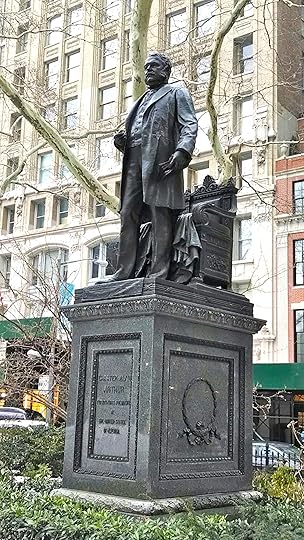
Tens of thousands of people walk through New York’s Madison Square Park every day—well, they used to and hopefully will again soon. I wonder how many notice a statue near the corner of Madison Avenue and East 26th Street, which is even harder to notice from spring to early fall when the trees are leafy. It’s easy to miss or ignore. And it’s the only monument of Chester Alan Arthur of which I am aware.

description

Forty-eight men have been Vice President of the United States. Virtually all of them are forgotten today except by the most anally retentive of American historians. Arthur is one of four who became president after an assassination. He was no Theodore Roosevelt or Lyndon Johnson. However, after reading this delightful short biography, History might have to reassess its verdict of him.

He emerged from a contentious Republican convention as James Garfield’s running mate in the election of 1880 because “few people felt strongly enough about him to hate him.” He had never held an elected position. No one thought him too much a risk because Garfield was relative young and in robust health. But after being shot by a mentally deranged man, followed by four months of primitive medical care, Garfield died. The political magazine “Harper’s commented that in the future, nominating conventions would take the choice of vice president more seriously.” Arthur probably would have agreed because he “may have been the most reluctant president to ever occupy the White House. At no point in his life did he want to be president…because he simply didn’t want the job.” Why, then, did he agree to be the vice presidential nominee of his party?

After all, he had a good life. He was a successful attorney in his beloved Manhattan universe between Madison Square Park and Union Square. He was a member of exclusive private clubs where he hobnobbed with society’s elite including financier J.P. Morgan and artists like John Singer Sargent and Albert Bierstadt. He was a loyal Republican, arguably the most important operative of Sen. Roscoe Conkling, one of the most powerful men in the Senate who dreamed of being president himself. Conking and Sen. James G. Blaine were the two most powerful Washington politicians of the 1870s into the 1880s. Although both were Republicans, Blaine led the Half-Breeds, a faction that generally favored reform of governmental institutions. The imperious “Lord Roscoe,” as he was known to both his admirers and detractors, led the Stalwarts, which basically liked things the way they were. Both fed their power through the spoils system—from the aphorism “to the winner go the spoils”—which rewarded political allies with government jobs, big and small, when their man won. In turn, the office holders were expected to pay assessments or more precisely, kickbacks that funded the parties and campaigns. Ultimately, the differences were not about policy, but about personalities and rivalries, petty or not.

Through his connection to Conkling, Arthur became counsel to the New York Tax Commission, a plum job with a salary twenty times higher than the average income of $500 a year. He increased his income by at least five times to become the highest paid federal employee in the nation—making more than even the president—when he became the collector of the New York Customhouse, which accounted for the majority of all federal income. But although he was near the top of the pyramid of the most powerful political machine in the nation, he was by all accounts fair, honest, got richer by following the rules, and didn’t complain when the rules changed to deny the extra income. He played the game like an expert, yet his “genteel, easygoing presence,” and, more significantly, sense of honesty and duty was very much out of place in the post-Civil War political quagmire that created the spoils system. He was a schmoozer par excellence; in another age, he might have been a rich, connected K Street lobbyist.

Going into the 1880 Republican convention to nominate a presidential candidate, Arthur’s job was to secure support for Conkling by raising money, glad handing and parceling out promises for Stalwart for jobs in the new administration. Blaine’s people did the same. The result was a contentious convention from which neither emerged as a winner. Instead, James Garfield, an unassuming congressman from Ohio, emerged as the compromise candidate. In a sharply divided nation, Indiana and New York were the only states in play for the November election. Conkling maneuvered to have Arthur chosen as the vice presidential candidate in order to lock in the support of the state’s Stalwarts. Arthur “neither received nor threw much mud” and no one expected he’d do more than keep a seat warm.

Garfield went on to win, but the Senate was evenly divided between Democrats and Republicans, 37-37, which meant that the vice president, who theoretically presides over the Seante, would break ties. Conkling saw this as his way to increase power; he expected continued fealty from Arthur. But he miscalculated. His rival Blaine was named secretary of state and his Stalwart choices for other cabinet posts were rebuffed, and more importantly, Garfield did not nominate his choice to replace Arthur at the New York Customhouse. In a huff, Conkling resigned is office. He was secure in the knowledge, in the days when senators were not directly elected but instead appointed by their state legislatures, that he would would be reappointed. He had gravely miscalculated and was in for the rude awakening of powerlessness that comes with being a political has-been. Most felt that what little stature Arthur had went out the door with Conkling. It all changed on July 2, 1881. Blaine was seeing Garfield off at the B&O train station in Washington, DC (the current site of the National Gallery of Art on the mall) when a mentally deranged Charles Guiteau, who was misleadingly described as a disgruntled office seeker, walked up to Garfield and fired a bullet in him. After his arrest he said, “I did it and will go to jail for it. I am a Stalwart and Arthur will be President.” As Garfield slowly succumbed to death in the next four months, due mostly to the primitive medicine of the times, when theories about germs and hygiene were dismissed as quackery. It didn’t help that the best doctors of the day continuously poked the wound with their unwashed fingers. Nor that the bullet could not be found after it ricocheted off Garfield’s bones.

Arthur was “devastated.” It was noticed that his “eyes were bloodshot and frequently welled with tears.” As Garfield languished, the New York Times wrote of Vice President Arthur that “no holder of that office has ever made it so plainly subordinate to his self-interest as a politician and narrowness as a partisan.” When he took office, it was taken for granted he would be ineffective at best and a Conkling marionette at worst. But two things were soon to be clear. First, Arthur knew who he was, he was comfortable in his skin. And “many members of Congress has assumed that Arthur would simply be a place keeper, and they were annoyed to find out the he actually intended to exercise his constitutional authority.” The duties of the Presidency, writ large, imposed upon him a humble respect for the job.

True to form, however, his work schedule was light. Much like the president of a century later, Ronald Reagan, rising early and working overtime or into the night was not part of his routine. But Arthur was not lazy. As a very wealthy New Yorker used to comfort and luxury, he was surprised to see the shabby condition of the White House once he moved in. It did not correspond to the grandeur he associated with the presidency. For transportation, he had the finest carriage built to transport the president, a Rolls-Royce of his day. He brought in a young, relatively unknown designer from New York, Louis Comfort Tiffany, to create themed-rooms—which still exist today. “In the Gilded Age, Chester Arthur was the closest thing to Jacqueline Kennedy that Washington would see until Jaqueline Kennedy.” In a nod to his abolitionist roots, he replaced the all white White House usher staff with black men in smart uniforms. As part of his conviction that a president should know the country he was serving, he was the first to travel to as far west as San Francisco, visiting national parks and other places under federal jurisdiction.

His most significant act as president surprised virtually everyone. Guiteau’s declaration after shooting Garfield turned out not be the noose around Arthur’s presidency as many assumed it would be. It crystallized the notion that something was deeply wrong with the spoils system. Taken together with self-published book by a little known writer Henry George called Poverty and Progress that “quickly sold hundreds of thousands of copies”, the national mood began to change at the height of the Gilded Age. According to Karabell, George “was reminded of the yawning gap between the most wealthy and privileged Americans [because] the rewards of the new industrialism were distributed to very few and the costs borne by very many.” Sound familiar? In that era, however, the federal government had little impact on people’s daily lives; the one area where it could make significant changes were in its own employment system, in which “a professional political class…treated elections as contests of patronage.”

A rather obscure congressman from Ohio, George Pendleton, had introduced a bill to reform the federal civil service in 1881, but the bill had no chance of passing. The crushing defeats of numerous Republican candidates in the midterm election of 1882 changed everything, the people wanted reform. Not surprisingly, Democrats who supported reform became less enthusiastic after gaining seats as Republicans changed their tune of prior opposition. The tide of public opinion placed the “supporters” of reform who suddenly realized it could actually pass in a bind, which was reflected in the Senate vote that passed the Pendleton bill 38 to 5 with 33 (!) abstentions. The House had 88 (!) abstentions when it voted for passage. As the master of the system, “Arthur himself understood that assessments lay at the heart of the spoils system…and he candidly admitted…it went ‘without saying that such contributions are not voluntary.’” For him to say the quiet part out loud was astounding to all but those who understood how seriously Arthur took his oath of office to represent all the people. He signed the Pendleton Civil Service act to create a mostly non-political civil service that largely divorced federal employment from political patronage. What might Arthur have thought of Republicans and a president who are doing all they can to re-politicize the federal bureaucracy and renaming it “the deep state” or as one of the most sinister advisors to them calls it, “the administrative state?” Might be, as Karabell concludes, because “[c]ivil service reform was an early expression of the impulses that would coalesce in the early twentieth century to create the progressive movement”?

Arthur also stood out because of three other issues that dominate American politics today: immigration, tariffs, and pork barrel spending. Congress passed a bill to bar the immigration of Chinese people for twenty years; Chinese laborers who were brought to the U.S. to build the western route of the, transcontinental railway because “[t]hey were, in short, too good at what they did.” Xenophobic Californians were instrumental in passing a bill repugnant to Arthur’s Lincolnian roots which he vetoed. He would later sign into law a new bill that lessened the exclusion to ten years, but only did so because his veto would be overridden. His Customhouse experience gave Arthur a unique insight to understand the domestic impact of tariffs. Tariffs funded most of the federal government, leading to surpluses that fed pork barrel spending. The idea of free trade was anathema to protectionists who dominated policy since the nation’s founding, and was “aided by a government that shielded (U.S. industry) at every turn from real or perceived threats from foreign competitors.” Arthur understood better than most that high tariffs hurt workers and farmers, the people his presidency sought to represent. It would take another century to take hold. He realized the real threats to national security were irresponsible fiscal policies and lack of a national defense. Vetoing spending bills and building up the decrepit U.S. Navy into a reputable force became two of his most lasting ideas. Karabell goes so far as writing that McKinley’s and Roosevelt’s success in doing so did as much as anything to contribute to the American victory in the Spanish American war of 1898. But in taking these positions, he made “himself a man without a party” largely because “[h]e had no pressing vision for the country that consumed his ambition.” He was never seriously considered as a candidate for the 1884 election, which did pique his vanity a bit, but going back to his beloved New York was a pretty good consolation prize for him. Plus, he likely knew that he was slowly dying from a condition in which his digestive system which was slowly poisoning him. He passed away in 1886.

On the opposite side of Madison Square Park from Arthur’s statue, near the corner of Madison and East 23rd, is a statue of Conkling. That seems a bit unfair; few understood how far away Arthur moved from Conkling’s shadow. Karabell concludes “throughout his public life, Arthur conducted himself with honor at a time when politics was venal and petty” which produced “certainly one of the most honorable chief executives the country has seen.” It’s a pity that Washington, DC, which has monument and statue overload, does not have one for Arthur. He must make do with the one so many ignore in Madison Square Park. Knowing what I know now, I think the monument he deserves—the one he would have most appreciated—is for U.S. history teachers throughout the nation to give greater depth and importance to the learning not of his accomplishments and life, but an understanding of the constitutional duty of the person who temporarily fills the office of the presidency. Especially since the current occupant of the White House is the most serious threat to this obligation. In learning about him, we would be reminded of an unassuming man who understood what it meant to put country and honor before self-idolatry. Wouldn’t that be a refreshing break in these testing times?
Profile Image for EmilyP.
93 reviews5 followers
August 21, 2007
If I were a president, I would be Chester A. Arthur. He is hands down my favorite, and here's why:
1) He had 82 pairs of pants.
2) He worked from 10 a.m. to 3 p.m. --that's all!
3) He snubbed the political machine that brought him notoriety and proved that he had a moral backbone.

It's a short book, and a good little read on a president you probably know nothing about.
Profile Image for Frank Theising.
395 reviews37 followers
April 14, 2019
I’m roughly half way through my trek of reading one biography of each president (starting at the present and working backwards). And thus far, I can confidently say that Chester A. Arthur has got to be the most forgettable of presidents. A largely anonymous political crony thrust into the Vice Presidency in the most bizarre of circumstances. Devoid of vision or passion, yet promoted to the presidency by the assassination of President Garfield. Amidst the lowest of expectations, he proved a fairly competent president with some good qualities (uncommon honesty and disdain for slavery). But he never inspired anyone and the largest accomplishments of his time in office happened largely without him. He was one of the rare presidents who didn’t control his own party and therefore was not nominated for reelection in his own right. Overall, the author paints a fairly even portrait of a largely unremarkable president, with a good emphasis on the limitations imposed by his place and time in history. 3 Stars.

What follows are my notes on the book:

Arthur never aspired to President let alone VP but he had said yes and never imagined his acceptance would inadvertently set in motion a series of events that would culminate with the assassination of President Garfield and his own elevation to the presidency (1). Arthur belongs to two select and not proud clubs: presidents who came to office because of the sudden death of their predecessor, and presidents whose historical reputation is neither great, nor terrible, nor remarkable. This time period, when the White House had shed much of the power it had acquired during the Civil War, was not one that was conducive to executive action. Congress had reasserted its traditional preeminence with the near impeachment of Andrew Johnson for the sin of removing his own cabinet members without the say-so of the Senate (3).

Arthur was not well known prior to 1880. He had been the collector of the customshouse of the Port of New York (at the time a position of greater influence than all but a handful of federal appointments). In the era before income tax, it accounted for 3/4s of all customs duties and more than a third of government revenue. In that un-ideological era, careers did not depend on bold legislation, stunning oratory, or fighting for ideals. Politicians of the Gilded Age had followed the public in a turn away from freedom, democracy, or equality in favor of stability, order, and prosperity. America’s cities were growing rapidly as immigrants flowed in New York and then the West. The dual pressure of burgeoning demographics and industrialization meant chaotic growth. In the face of such flux, big ideas took a back seat to daily needs: food, water, shelter, order (5).

Politics was beholden to a self-perpetuating cycle. Win an election, appoint bureaucrats and then use their contributions to pay for the next election. That’s why party organizations were so powerful and why even the presidency, with curtailed powers, remained such a plum position because of the vast swath of patronage it wielded (such as the postmaster general and customs houses in major port cities). Each national election was a patronage contest between leaders who could most effectively mobilize their networks and raise money. Yet at that time, politics was simply too local so no single faction was able to consolidate power nationally. Arthur was the consummate insider and as such he was an unlikely candidate to reform the patronage system that he had handsomely profited from (9). Yet by the time he left office, he had reformed the bureaucracy (or had reform just happened while he was in the seat?). Whatever the answer, Arthur holds the distinction of being the president who derived the least pleasure from being president, and that is saying a lot, because in his five decades of life before, he took as much pleasure from life as any of us ever do (10).

Arthur was born Oct 5, 1829 in North Fairfield, VT. He was the 5th child of Malvina and Baptist minister William Arthur. They moved frequently until his father found a permanent church in Union Village, NY when “Chet” was 10. He was an average student. The only issue in life to which he was dedicated was slavery. His father was a staunch abolitionist who railed against human bondage from the pulpit. In 1854, Chester became a law clerk at an abolitionist firm in New York City. Chester considered himself pragmatic and fell in with the “free-soiler” wing of the abolitionist movement (that sought a more achievable goal of halting the spread of slavery into new Western states rather than attempt to overturn the whole system so entrenched in the South). He was so committed to this cause, he moved to Kansas in 1856 to support the movement. Kansas was divided and violent however and Chester didn’t last long there. The brutal thuggery on both sides shocked his Eastern sensibilities and he returned to NYC. He did however join the newly formed Republican Party, created to champion the cause he supported (13).

In NY, he married Ellen “Nell” Herndon in 1859. His marriage and his law practice flourished and he was well regarded in Republican circles. Then war broke out. He flirted with a direct commission but his wife was from Virginia and most her family naturally supported the Confederacy. Instead, he used his connections with powerful men to be appointed chief engineer and then quartermaster general for the state of New York with the rank of brigadier general. He was responsible for feeding, housing, and supplying several hundred thousand troops. He proved an able manager for this complicated task. In this role he worked closely with the governor, allowing him to solidify his position in the patronage network of the Republican Party. Despite his daily interactions with businesses and access to a cornucopia of goods (that stoked materialism in him and his wife), he was a surprising honest man who did not enrich himself directly by skimming off the top (15).

When the Democrats won New York in 1862, he was out of a job however. Rather than enlist in combat, he resumed his law practice. He did not suffer during the war but lived lavishly in Manhattan. With a cheerful temperament, he liked people and people liked him. He moved easily in NY social circles and was something of a peacemaker in contentious times. He and his wife were grief stricken over the death of their 2 and half year old son William around the same time as the Battle of Gettysburg. Rather than celebrate the victory with their friends, they were in mourning for months. The victory was a boon to the Republican Party and meant new opportunities for a young Republican like himself. The GOP was somewhat divided however between the “Stalwarts” (who followed Grant wholeheartedly) and the “Half-Breeds” (who were half faithful to Grant, half to reform, and wholly faithful to no one). Senator Blaine from Maine led the Half-breed faction and Senator Conkling of NY led the stalwart faction.

Arthur hitched his star to Conkling and was rewarded with the position as collector of the New York Customhouse. His dramatic rise owed more to his executive ability and knowledge of men than it did to any genius. He regularly arrived late, left early, and did not administer with a heavy hand. Nor did he try to change the way things were done. While the average US salary was $500, his salary was $12K a year, though his actual income was closer to $50K thanks to the moiety system (where officials received a percentage of seized illegal goods). Grant beat inept reformer Horace Greely and was reelected in 1872. However, popular sentiment favored reform, especially after the financial Panic of 1873 hit and unemployment rose (25).

Congress passed the Anti-Moiety Act in 1874 and Arthur’s income plummeted 80% (he was still very rich). With neither Conkling nor Blaine able to secure the nomination, Rutherford B. Hayes of Ohio was nominated on the 7th ballot (26). Hayes was a good choice, untainted by Grant and the spoils system. 1876 would be the most controversial election until 2000. Three southern states elected two sets of electors. When Congress seated the Republican electors, Hayes won but would retain the sobriquet of “His Fraudulency”. When Hayes started a commission to look at corrupt customhouses, low-profile Arthur became the center of a national crisis (28).

Arthur was accused of corruption, kickbacks, lax accounting, etc. The commission report didn’t really target Arthur (though it did provide a damning, though self-evident report on the spoils system). Hayes broke with Conkling and the Stalwarts and ordered Treasury Secretary Sherman to remove Arthur from his post despite there being no charges against him. An enraged Conkling declared war in response. Arthur wisely let others fight for him. The Senate rejected several of Hayes nominees to replace Arthur, humiliating President Hayes. Hayes bided his time and when Congress went into summer recess he removed and replaced Arthur for good. The New York Times came to Arthur’s defense, insinuating that the real reason for the dismissal was Hayes desire to reward his own with patronage.

Rather than ruining Arthur’s career, Hayes’ vendetta catapulted him onto the national stage. He became a darling of the Stalwarts and other opponents of Hayes (33). Democrats recaptured both houses in the 1878 midterms. As an organizer for Stalwart Republicans, he loved wining and dining with like-minded men. Fifth Avenue Hotel and Delmonico’s were practically his office. His wife died suddenly of pneumonia in 1880. Arthur threw himself into the Republican National Convention to occupy his mind. The convention was deadlocked between Grant and Blaine for 35 ballots. Hayes was out, having alienated too many factions. The result was a dark horse candidate, neutral James Garfield elected on the 36th ballot (40). Arthur was selected (over Conkling) as VP as a token nod to keep the Stalwarts on board.

The 1880 election was a contest of organization and will, not a battle over the future direction of the country. Before radio or TV, the candidates relied on others to speak for them across the country at organized events. Arthur proved a persuasive manager and fundraiser that helped tip the scales in the general election. Garfield won IN and NY (the 2 crucial swing states) by less than 1/10 of a percent. Garfield and Arthur celebrated separately (not knowing each other). The party was still deeply divided and Arthur worked to get Stalwarts into the cabinet. When Senator Conking (Arthur’s former patron) resigned (thinking he would be re-elected) Arthur’s stock in the administration plummeted. But on July 2, 1881, Garfield was shot in the back at the railroad station in DC. The gunman, Charles Guiteau was a vocal Stalwart and wanted Arthur to be president. Arthur was suddenly implicated in an assassination that would put him in the White House (59).

Garfield died from infection in September. Because it took months for him to die, there was not the same shock as when Lincoln, McKinley, or Kennedy were killed. Investigation showed Guiteau had acted alone and many previous critics gave Arthur the benefit of the doubt as he entered office. No one knew which direction his administration would take, least of all himself. With Garfield in office only 4 months, there were no unfavorable comparisons with his predecessor and he could really steer any course he chose unlike others who inherited a presidency.

Arthur remodeled the White House and brought in his preferred chefs, turning the White House into a social destination in a capital not known for social destinations (much of this work would be erased by Teddy Roosevelt’s remodeling during his administration). He kept short work hours (rarely longer than 9-5).

Arthur was a skilled organizer and competent politico but he lacked the x-factor associated with great leadership. In their initial meeting, Arthur shot down Conkling’s demands to staff his administration with Stalwart cronies (69). He did not want to tank his credibility and refused to be seen as anyone’s errand boy. He went further than most had supposed possible in distancing himself from the Stalwarts, something that would have handicapped him as a lame duck for the 3 years of his term. Raised in an anti-slavery, religious household, he vetoed a popular Anti-Chinese Immigration Bill. He did sign a shorter 10-year exclusion, after it was clear Congress had the will and votes to overturn another veto (84). He also vetoed a rivers and harbors bill that allotted $19M to Mississippi levies and coastal harbors. Congress expected Arthur to be a place-holder, and were annoyed when he exercised his Constitutional authority.

While Arthur could afford to alienate Democrats, he was now beginning to lose support of his own party. Distancing himself from his faction (the Stalwarts), he was at risk of committing the fatal mistake of losing his base. He suffered from Bright’s Disease, a kidney disorder that hinders the expulsion of toxins from the body.

Republicans, used to victory, grew complacent. Democrats were just as divided internally (both north/south and between reformers and Bourbons who favored limited government with an expectation of patronage). Bourbon Democrat Grover Cleveland’s run for Governor was a key bellwether. Republicans misread the public mood and clamor for reform and were absolutely crushed in the midterms, losing 77 seats (even in solid Republican states). In response, they used the remainder of the current lame duck session to heed the message of the electorate and seize the mantle of reform by passing reform measures while Congress was still under Republican control (101). The Democrats basking in victory, suddenly became ambivalent to reform of the spoils system. They had suffered from the spoils system for so long, they now saw their chance to reward the party faithful with patronage and didn’t want to see that curtailed (103). The two parties essentially traded places, with Republicans tripping over themselves to support the reform bill and Democrats lining up against it. It passed and Arthur signed it into law in January 1883.

The Pendleton Civil Service Reform Act is the most memorable piece of legislation to emerge from Arthur’s presidency. Symbolically, it marked a before-and-after moment in American politics, replacing the spoils system with a professional civil service appointed based on aptitude (107). Immediately, the bill was more symbol than substance, only being applicable to large cities. Yet, 20 years later, the nature of government changed giving rise to the modern bureaucratic state. Presidential leadership was not central to the passage of the Pendleton Act, the extent of Arthur’s involvement was him signing it.

Arthur had hopes of securing his party’s nomination in 1884. He was proving a surprisingly competent president among all the low expectations. However, he hardly controlled his own party, and the last two years of his lame duck administration offered no crisis demanding action. He had no pressing vision for the country. Tariff reform was the issue de jure but any change was likely to create new winners and losers, alienating key constituencies. Rather than jump into the fray, Arthur settled into the role of moderate who suggested courses of action. His reputation suffered because of the perception that he was a passive bystander.

Western territories (MT, WY, NE, ND, SD, etc) were filling with settlers. Arthur hoped to avoid conflict with Indian tribes, desiring their assimilation into the dominant culture but he was detached from the reality on the ground. He presided over the opening of the Brooklyn Bridge. With nothing to keep him in Washington, he took a tour of Florida (then nothing more than a swamp) and the West (Yellowstone). Nobody seemed to notice his two month absence as politics carried on without him (125). His return was barely noticed as the party moved into nomination mode. The party remained fractured, the newest splinter group being the Mugwumps (precursors to the progressives). Arthur was too weak politically to challenge Blaine, who captured the nomination. But Blaine proved every bit as polarizing and the Mugwumps ultimately supported Cleveland. The 1884 campaign was an ugly affair with accusations of scandals and bastard children. Cleveland would defeat Blaine.

Before leaving office, Arthur signed a special bill giving the ailing Grant a pension for his service to the Union. Grant died in July 1885. His Blaine’s disease became worse and he died in November 1886 (138). His reputation didn’t rise or fall after his death, it disappeared. He generated almost no public passion. He was neither loved nor feared, but he wasn’t hated either. He was an unexpected president in an age when nobody expected much from the presidency…and in an age of low expectations he was more than satisfactory.
Profile Image for Steve.
340 reviews1,184 followers
December 1, 2014
http://bestpresidentialbios.com/2014/...

“Chester Alan Arthur” is Zachary Karabell’s 2004 biography of the twenty-first president. Karabell is a historian, asset manager and economist. He is also the author of several books including “The Last Campaign: How Harry Truman Won the 1948 Election” and “Parting the Desert: The Creation of the Suez Canal.”

As a member of The American Presidents Series, Karabell’s biography is concise and fast-paced. With just 143 pages, this book can be read in a single sitting and is both articulate and straightforward. And, typical for books in this series, key themes are clearly presented and unnecessary details are kept to a minimum.

Many readers believe that a crisp, economical biography is perfect for an obscure president like Chester Arthur. But while the concept is appealing, Arthur’s personality is too multifaceted to really merit such a concise study. A lengthier and more penetrating review of his life would reveal layers of color and complexity that a relatively rushed biography simply cannot capture.

But Chester Arthur’s personality is not boundless and Karabell successfully captures much of what makes this former president unique. He finds time, for instance, to reveal traits such as Arthur’s affinity for fashion and food, his fondness for late evenings “out with the boys” (much to the chagrin of Mrs. Arthur) and even his decorating taste…revealed during a renovation of the White House.

What is less thoroughly explored in the rush through his life is the full dichotomy between Arthur the “spoilsman” of New York politics and Arthur the “reform president.” But while Karabell takes care to investigate this dramatic evolution in Arthur’s approach to public policy, he is unable to fully examine its nuances because the book’s pace begs for a binary, not shaded, answer.

And I cannot recall any mention of Julia Sand, the bedridden but intellectually spirited woman who offered a stream of unsolicited advice to the new president through the mail – and eventually received a surprise visit from him.

Most readers, however, are likely to find Karabell’s efficient style quite appealing. While a slower pace would reveal more of Arthur’s character, this biography provides significant payback for a very modest investment of time. And there is no need for readers to carefully decode hidden messages in the text – key themes pertaining to Arthur’s personality and politics are well-revealed.

Overall, “Chester Alan Arthur” is a successful, if brief, biography of the twenty-first president. Although this study uncovers little that is new of Arthur’s life or legacy, it proves comprehensive and extremely efficient. While not the definitive biography of Chester Arthur, Karabell’s book is successful in its mission to provide much about this lesser-known president in a potent, punchy format.

Overall rating: 3¾ stars
Profile Image for Emily.
349 reviews5 followers
February 25, 2024
A great little biography. Smartly written and provides an accessible portrait of Arthur’s life and career, as well as the American landscape that shaped him.
Profile Image for Joe.
1,209 reviews27 followers
June 22, 2015
Book Forty of my Presidential Challenge.

"For those who want presidents to be heroes, and, failing that, villains, for those who expect them to be larger-than-life figures, Arthur's tenure in office isn't satisfying. The nature of our expectations would have to change dramatically for Arthur to be reevaluated as one of this country's best presidents. An yet, in spite of what Shakespeare wrote, some men are neither great, nor achieve greatness, nor have it thrust upon them. Some people just do the best they can in a difficult situation, and sometimes that turns out just fine."

What did I know about Chester A. Arthur going into this book?
1. He was President Garfield's Vice-President and took over after the assassination.
2. He had some bitchin' Stachburns.
3. He was the answer to one of Simon's riddles in "Die Hard with a Vengeance."

After reading this book, I kind of like ol' Chet Arthur. Undoubtedly, no one ever wanted to be President less and enjoyed it less after he got there. Arthur's forte was working behind the scenes. He was a glad hander, a fundraiser. He wasn't a leader. He wasn't a policy wonk. He simply enjoyed being in powerful positions because of the spoils that accompanied it.

We shouldn't look down on him for this. Most people don't want to be President, I think wanting to be President (especially in this day and age) is practically a sign of mental illness.

Once in office, he didn't do much. He'd never made waves in his life and he wasn't going to start doing so just because he was President now. However, he can be credited with a few things.

1. Most important, he signed into law the Pendleton Act. This Act was the first (admittedly small) step towards reforming the spoils system which had been plaguing politics for over 100 years. Without this reform, each time an elected official took office, every single employee under them would be fired, no matter how small the job. That lack of continuity is bad for government and the country. Especially with how complicated some of these jobs were becoming. We needed people doing government work with a bare minimum of professionalism.
2. He didn't appoint only his faction of the Republican party to power. This was before the Pendleton Act and shows that he was a fair guy (or was just really good at understanding public perception). Probably both.

Arthur wasn't corrupt but he did tolerate some corruption. He knew that Stephen Dorsey committed electoral fraud to help Garfield get elected and (during at least one drunken night) thought that fact was hilarious. But hey, Arthur was always a go along to get along kind of guy.

Ultimately, he didn't mess anything up, and the country was slightly better off in the long run after his four years in office. I doubt that 50% of Presidents can say that.
Profile Image for Steven Peterson.
Author 19 books324 followers
August 22, 2009
Chester Alan Arthur was a surprise president. He was selected to run for VEEP from pure political reasons. However, he fell into the presidency and, against many fears, did not mess up in that office. As the author states (Page 143): ". . .some men are neither born great, nor achieve greatness, nor have it thrust upon them. Some people just do the best they can in a difficult situation, and sometimes that turns out just fine."

Chester Arthur was one of the United States' "accidental presidents," thrust into office because of the assassination of James Garfield. This book, as others in the series, provides a thumbnail sketch of Arthur (text is 143 pages long). Born in Vermont, his family moved to New York when he was ten years old. He began his political work as a bureaucrat and patronage administrator. While he was enmeshed in the "spoils system," he was not corrupt and was generally pretty well liked. In 1871, he received a coveted position--collector of the New York customhouse. He earned plenty in that role.

Comes the 1880 presidential race. Garfield, a "dark horse," won the nomination and Arthur was selected as his V-P partner, as a result of torturous Republican politics. And he had never been elected to any office prior to that!

The Republicans won, Garfield was assassinated, and Arthur became president. One comment says a great deal, when someone said (Page 61): "Chet Arthur? President of the United States? Good God!" Against the expectations of many, he served without any great errors, and with some positive contributions. (1) While he did not take an active role, he did sign the Pendleton Law, providing Civil Service reform. (2) He did take steps to modernize the embarrassing United States Navy. (3) He was involved with reducing the tariff. (4) Etc. Perhaps more important, he made no major blunders (as many had expected).

He was diagnosed with a dreadful disease, Bright's Disease, which made the last part of his stint as President miserable. While he would have liked another term, such was not to be. He left the presidency with dignity, but with a disease that doomed him.

All in all, a nice biography of a little known and not very great president--but one who did not make things worse than when he entered office.
Profile Image for Shawn Thrasher.
2,025 reviews50 followers
January 13, 2012
A mostly milquetoast presidency is made far more interesting by the sometimes witty and urbane and interestingly historical stylings of Zachary Karabell. Arthur was doomed to serve (if doomed is indeed the right word) in not-so-interesting times, but Karabell concludes that Athur was still a decent, honorable gentleman. Regardless of how much you actually learn about Arthur, you'll be entertained by this light, short biography.
Profile Image for Michael Austin.
Author 138 books301 followers
May 21, 2018
This is both the first biography of Chester A Arthur I have ever read and the first volume in Henry Holt's "The American Presidents" series that I have read. I intend to read more of both.

This was a short book--about 150 pages--and could be read in a single evening. It is not a heavily footnoted doorstop like, say, Ron Chernow's recent biography of Grant. It gives a brief overview of Arthur and his times and then gets out of the way. That is what the books in this series were designed to do, and this one, at least, does it very well. It does not convey the information of the standard 900 page presidential biography, but also, it does not require the investment of time. I have already downloaded Robert Remini's volume on John Quincy Adams and Gary Hart's (yes THAT Gary Hart) volume on James Monroe.

Karabell's writing in this volume is clear and lively. He has a good grasp of the important threads that were winding through American culture at the time. And he genuinely seems to like Chester Arthur, perhaps the least qualified human being to actually become president until, well, now.

And he does a good job of explaining Arthur's signature accomplishment: the Pendleton Civil Service Reform Act. This is one of the most consequential pieces of legislation in American history. It deprived a corrupt political system of it's driving power--patronage appointments. Between the Jackson and Arthur administrations, pretty much all government employment was political: postal workers, customs officials, BIA agents--the works. Whoever controlled the presidency (and often a seat in the Senate) could direct thousands of jobs to supporters, who were then required to contribute a portion of their salary to the political party/political official/political party that controlled the patronage. This was all perfectly legal, and most politicians wanted to keep it because it kept them in power.

Patronage was then what Congressional Redistricting and unlimited campaign contributions are today--the way that incumbents stacked the deck in their favor. This made it a bipartisan issue, because both parties had incumbents who wanted to use patronage to hold on to their jobs. And the poster child of patronage was New York Republican Senator Roscoe Conkling, who controlled patronage in the New York Port Custom House, which controlled about one-third of the entire US Government's revenue by collecting tariffs on foreign goods.

This means that the head collector for the New York Port was the richest and most powerful patronage position in the country, and for much of the 1870s, this position belonged to Chester A. Arthur, Conkling's protege. Arthur never held any other political position when he was selected to be James Garfield's running mate. He was chosen to placate Conkling and other pro-patronage Republicans--to put the main symbol and top beneficiary of patronage in the White House.

He wasn't just pro-patronage or anti-reform. If Patronage was Dr. Frankenstein, Chester A. Arthur was the dang Monster.

Four months later, Garfield who had begun to make some moves towards civil service reform was killed by a man who fancied himself an officer seeker. Arthur was president, and that meant that patronage was safe.

Except that it wasn't. In one of the most dramatic examples we have of a president rising to the stature required by the office, Arthur did not exactly become a champion of civil service reform, but he did shepherd it through when it became politically feasible. And he didn't stand in its way. As Karabell assesses it, "Arthur did for civil service reform what he had done for most things in his life: he added a note of grace and honor, and the result was a balanced piece of legislation at a time when that was rare."

Arthur is a fascinating study. Not a great president, perhaps, but one who came into office with extremely low expectations and exceeded them by every measure. Karabell's parting assessment of Arthur captures something, not just about the man, but about the world.

For those who want presidents to be heroes, and, failing that, villains, for those who expect them to be larger-than-life figures, Arthur's tenure in office isn't satisfying. The nature of our expectations would have to change dramatically for Arthur to be reevaluated as one of this country's best presidents. And yet, in spite of what Shakespeare wrote, some men are neither great, nor achieve greatness, nor have it thrust upon them. Some people just do the best they can in a difficult situation, and sometimes that turns out just fine.



I hope that some day someone will say the same about me.
Profile Image for Jacob Hodges.
120 reviews
February 13, 2024
The book was good. Well written. I learned stuff about a guy nobody cares about. If it wasn’t $2 at a thrift store I would not have read it and my life would be no different.
Profile Image for Sean Chick.
Author 9 books1,107 followers
August 17, 2025
As an account of his time and presidency this book is weak. As an account of the man it works well.
Profile Image for Regina Lindsey.
441 reviews25 followers
January 17, 2016
Chester Alan Arthur by Zachary Karabell
3 Stars

An era when elections were deeply divided by geographic lines with two swing states, accusations that a nominee was born outside of the U.S., deep resentment over immigration policy, proposals for redistribution of wealth by heavily taxing the 99% in favor of the 1%, scandals requiring the attention of the attorney general, and a Republican party deeply divided by factions from within. 2013? Nope. 1880’s. This was the era in which Chester Arthur’s administration presided.

Even though Arthur never sought nor desired the office of president, he had never even held elected office, he was catapulted to the nation’s highest office after the assassination of President Garfield. Prior to his nomination of vice-president, Arthur was collector of the controversial customhouse of the port of New York where he drew a sizable salary. Even though the spoils system was coming under attack he developed a reputation as a man of integrity in an environment fraught with corruption. It was because he did not draw the ire of critics nor the extreme admiration of the Stalwarts that he was a palatable candidate. However, while he was more effective as a president than most feared (who wants their presidency labeled as, “not half bad”?) he was, as Karabell noted, “more reactive than proactive. That is not to say there are not things to appreciate about Arthur. While not actively managing the bill, he did sign into law the Pendleton Bill of 1883, the first major step towards civil service reform. More importantly, in my opinion, was his direction to the attorney general to pursue charges against Dorsey, a man of his own party and who Arthur owed much, in the Star Route fraud. Perspective that is greatly needed in today’s political climate. Unfortunately, Arthur didn’t take the high road when it came to the Chinese immigration policy or the Supreme Court’s decision on the Civil Rights Act of 1875.

This is a short book and is easy to read. However, it lacks in-depth analysis
Profile Image for Rory.
Author 1 book27 followers
May 7, 2011
Zachary Karabell starts his examination of the life and sudden presidency of Chester Alan Arthur from the perspective of an author who seems like he still hasn't grasped his subject, like he's mulling over everything he's read just to make sure he's got it right. But then, once that frustration wears off as to Karabell's method (and it disappears quickly), it becomes clear that Karabell is not only exactly the right person to write about Arthur, but he loves the subject and he loves the time and all that was contained within. He gives context to every movement of Congress in that time, explaining clearly tariffs and the spoils system and patronage. His bio says that he taught at Harvard and Dartmouth. It feels like this book is hopefully what it feels like to attend one of his lectures.

I especially treasure the final paragraph in his epilogue, which is generally rare among presidential biographies:

"For those who want presidents to be heroes, and, failing that, villains, for those who expect them to be larger-than-life figures, Arthur's tenure in office isn't satisfying. The nature of our expectations would have to change dramatically for Arthur to be reevaluated as one of this country's best presidents. And yet, in spite of what Shakespeare wrote, some men are neither born great, nor achieve greatness, nor have it thrust upon them. Some people just do the best they can in a difficult situation and sometimes that turns out just fine."
48 reviews
November 15, 2008
This quick read is an excellent way to learn the essentials of Chester A. Arthur's Presidency. The early part of the book describes the political culture that enabled a person, well respected, who had never held an elected office to become the Vice Presidential nominee. He distinguished himself by his cabinet selection and by operating a responsible office of the Presidency when the country was in a period of calm. During his presidency notable legislation that was passed included Tariff legislation and the creation of the Federal Civil Service Act. He also began the revitalization of the depleted Navy by constructing iron clad ships. To his credit President Arthur vetoed a Rivers and Harbors Bill (too much pork barrel) and an anti-Chinese immigration act. During his administration the effort to build the Panama Canal was started.

He did not seek the Presidency and rose to the occasion as was necessary when placed in the position.
Profile Image for Jim.
169 reviews6 followers
September 17, 2009
A very good short biography of a mostly forgotten but actually pretty decent US President. Just as interesting to me as Arthur himself were the stories of what big city party politics were like in the late 19th century, before the formation of the modern civil service (which was one of the major initiatives of Arthur's presidency). If we think today's politicians are corrupt, they look like saints compared to some of their predecessors!
Profile Image for Jc.
1,063 reviews
May 23, 2009
Chet was not the most memorable of Presidents. And, I don't know if one needs to have much more in depth a study of him than this 150 pager affords. However, Mr.Karabell does squeeze a lot of information into this short book. One does come away with an appreciation for Pres. Arthur as a good man for his time, if not altogether that exciting a one.
Profile Image for David R..
958 reviews1 follower
November 11, 2009
One of the better entries in the series. Like the others, it is a fairly sympathetic portrait. Karabell successfully creates a cogent and deep picture of the subject from a paucity of documentary evidence.
Profile Image for Matt.
28 reviews1 follower
February 16, 2009
Karabell illuminates his subject with an unembellished history. A wonderful portrait.
5,870 reviews146 followers
July 14, 2019
Chester Alan Arthur is the twenty-first book in The American Presidents series – a biographical series chronicling the Presidents of the United States. Zachary Karabell wrote this particular installment and edited by Arthur M. Schlesinger, Jr.

Chester Alan Arthur was an American attorney and politician who served as the twenty-first President of the United States from 1881–1885. He previously was the twentieth Vice-President of the United States, and he succeeded to the presidency upon the death of President James A. Garfield in September 1881, two months after Garfield was shot by an assassin.

Charting a career that catapulted Arthur to the presidency after James Garfield's assassination, Karabell investigates whether Arthur was an active reformer or a mere placeholder. To frame this challenge, he explores the post-Civil War era's simmering politics, which hinged on the spoils system, a long-entrenched formula whereby victorious politicians distributed federal and state jobs to supporters and cronies, later mining their appointees' pockets for future campaign contributions.

When calls for reform peaked, Arthur spurned the system that spawned him and signed the landmark Pendleton Civil Service Act, which launched the professionalization of the federal bureaucracy, replacing patronage with merit-based examinations. However, Arthur was not a true reformist. In the end, he simply conducted himself with honor when politics was venal and petty.

Karabell freely admits his mission impossible: to rescue his subject from the dustbin of history occupied by obscure late nineteenth century presidents, more famous for their facial hair than their tenures in office. Despite limited archival materials as Arthur's papers were destroyed after his death, Karabell tackles this task with considerable literary aplomb.

All in all, Chester Alan Arthur is a wonderful, albeit brief biography of the twenty-first president and it is a good continuation to what would hopefully be a wonderful series of presidential biographies, which I plan to read in the very near future.
Profile Image for Michael Lewyn.
961 reviews29 followers
December 11, 2020
A short but adequate history of President Arthur's political career; unlike Scott Greenberger's Arthur biography, this book focuses very little on his personal life. Nevertheless, it paints a vivid picture of Arthur: a decent, affable man who enjoyed being the 19th century equivalent of a Beltway insider, but who never expected to be a leader and did not enjoy the Presidency.

What I liked the most: the author's explanation of how the Pendleton Civil Service Act (Arthur's greatest achievement) came to be. He writes that before the 1882 midterms this bill had little chance of passage. But after Republicans suffered devastating losses in the midterms, they decided to rehabilitate their image by passing civil service reform in the lame duck session. Doing so both ensured that Democrats would not be able to claim credit for it a few months later and allowed outgoing Republicans to cram the bureaucracy full of loyalists.

What I liked least: an inadequate discussion of Arthur's biggest mistake, his willingness to sign the Chinese Exclusion Act. At first, Arthur vetoed this bill. After Congress made it slightly less onerous (by excluding Chinese for ten years instead of twenty) he signed it. Why? The author says that Congress would have overriden a Presidential veto and made Arthur "a martyr to principle"- but if this is the case, Arthur still suffered nothing from a veto other than the embarassment of being overriden.
Profile Image for Laura McGee.
406 reviews11 followers
February 16, 2020
Presidential biographies can be a little dry, but I really enjoyed this. I had developed an interest in Arthur after reading ‘Destiny of the Republic’ Which was about James Garfield but featured Arthur and a few others pretty heavily and I was anxious to learn more. This was a man who NEVER expected to be Vice President, let alone the President, and the country was a little nervous at the thought of an Arthur administration. He stepped up to the job though. Anyway, I enjoyed this, learned a lot, and I think it’s worth noting, we are literally still having the same political arguments today that we were having in 1880.
Profile Image for Emily.
879 reviews32 followers
July 6, 2022
I used to know this much about Chester A. Arthur: https://www.getyarn.io/yarn-clip/b350.... Now I know everything there is to know about Chester A. Arthur. (His papers were destroyed after his death, so there's even less about him than you would think.)

Chester A. Arthur never planned to be president, never wanted to be president, and no one else wanted him to be president, but he was president and he did a pretty darn good job of it. He grew up respectably in the East, moved to Bleeding Kansas, didn't do so well, spent the Civil War moving supplies around in New York, excelled at that, became a customs house official after the war, amassed an extremely pleasant middle class income, did behind-the-scenes work for the Republican Party, and became Garfield's pick for vice-president on the ten millionth ballot of an extremely long convention. As vice-president, Arthur was supposed to sit quietly in the wings for four years. But Garfield was shot and his doctors kept sticking their grubby little fingers in his wounds, so Arthur was slowly drawn toward Washington and eventually assumed the presidency. Arthur distinguished himself as president by softening the Chinese Exclusion Act and fighting party corruption, but by the end of his presidency, he went on a months-long camping trip to Yellowstone before the park was connected to the railroads and nobody noticed or cared particularly. Arthur was not renominated and he went on to live comfortably and quietly under his fancy mustache. One gets the sense that he was incredibly charming. Probably one of the more fun presidents to be around, especially for women. https://www.youtube.com/watch?v=TLpnF...
Profile Image for Alissa.
2,547 reviews53 followers
January 30, 2020
I have more respect for Arthur after reading this. He was a gentleman-a party operator who did not desire to be president. I also find it interesting in the 1870s/1880s they tore down stuff and redid the White House - getting rid of furniture with no eye to historical value or preservation. Much like in the 1970s.
818 reviews9 followers
January 8, 2021
Isn't this the right week to read about past Presidents? I finished this very well-written bio that I had started to read last year. I got a clear sense of the man and I liked him!
513 reviews7 followers
May 27, 2022
Interesting book

I didn't know anything about President Arthur so I learned a lot reading this book. This book was good and concise
Displaying 1 - 30 of 126 reviews

Can't find what you're looking for?

Get help and learn more about the design.