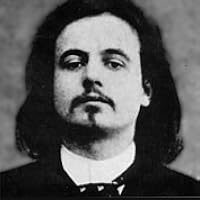
Known American writer Conrad Potter Aiken won a Pulitzer Prize of 1930 for Selected Poems.
Most of work of this short story critic and novelist reflects his intense interest in psychoanalysis and the development of identity. As editor of Selected Poems of Emily Elizabeth Dickinson in 1924, he largely responsibly established her posthumous literary reputation. From the 1920s, Aiken divided his life between England and the United States and played a significant role in introducing American poets to the British audience.
If you enjoy the inner ramblings of a mad alcoholic with paragraphs that go on for pages with no punctuation, then this book is for you. The non-linear timeline details the protagonist Andy's current situation finding out his wife is having an affair with his closest friend. The middle of the book describes Andy at the age of 12 when his mother is having an affair. Female characters in the book are misogynistically characterized as virgin or whore. The author's devotion to Sigmund Freud is clear. This is the first and last book I will read by Conrad Aiken.
I learned that nobody seems to give a damn about Conrad Aiken and a PhD on Conrad Aiken sounds like a rousing good time. Now if only I can get off my ass and do something about it...
I'm becoming familiar with Aiken's approach to writing. He doesn't so much write a narrative (although it is there), but rather episodic chunks, often in a stream of consciousness, which build into a whole (and which narrative emerges). Sometimes it works really well (brilliant as he captures childhood episodes/experiences from a summer holiday in Cape Cod); and sometimes not quite, when his characters start expounding about their love interest and their "madnesses". But I'm drawn into all of it, so perhaps I'm resisting liking it whole heartedly, because sometimes its a little close to the bone of some of my experiences. Yes, probably so.
------
Finished Aiken’s Great Circle last night, and on the whole I enjoyed it. I think the second chapter (of four) of a childhood holiday to the beach in the Cape Cod area was brilliant. As I said before, very episodic, but layering down something more coherent - he captures “insignificant” moments, which are shown to be formative in the "adult" chapters (which cover a few picked days following the discovery of his wife's infidelity with his hairy, athletic, best friend). The childhood the chapter ends with a tragic and absurd death, and that death’s circumstances seems to be repeated by the narrator time and time again (the Great Circles) in his relationships, and his marriage. I guess the question is will he escape it? Perhaps, as the end is left open.
All the above echoes Aiken's life, in a transformed way. Having read Ushant, his autobiography (of sorts), he draws heavily on a lot of his own experiences.
In form, there’s a lot of experimental stream of conscious, capturing dreams, waking, drunkenness, panic, and so on, told with gusto, and often with a fluidity that impressed me. Much talking to himself, in sort of battle between Freud and an anti-Freud forces, trying to understand or ignore. Some of this probably goes on too long, as the narrator ("One Eyed" Cather) wallows in his pain and grief, while wondering just what is suffering, and why we experience it: do we seek it: and why sometimes we feel a certain falsity in expressing it, as if we are acting out a melodrama to some external expectations – or perhaps with a certain degree of disassociation.
I took a break from reading the complete collection of Conrad Aiken's short stories to read this, his second novel, and discovered that the first two chapters (of four total) would have made much better short stories than half of his actual short stories. But Aiken's short stories are truly short (usually around ten pages, sometimes less)--a length dictated, no doubt, by the magazines to which he sold them--whereas the first two chapters in Great Circle are quite long. But even so, they are perfectly contained stories in their own right.
The first chapter introduces us to Andrew Cather, who is returning to Boston from New York ahead of schedule because he suspects that Bertha, his wife, is having an affair with Tom, his best friend. The suspense leading up to the confrontation is well-paced, and when Andy finally arrives home to discover Berty and Tom together, the resulting conversation is painfully real. Andy self-righteously needles them with boisterous wisecracks, obviously in shock and, I'd guess, trying to avoid a complete emotional breakdown. Berty, on the other hand, is at first ashamed but quickly becomes irritated by Andy's theatrical bravado, resulting in a flurry of accusations and pain on both sides.
In the second chapter, we go back in time to a summer Andy spent as a young boy with his mother and siblings in Duxbury, on the South Shore of Massachusetts. They're staying with Andy's Uncle Tom and Aunt Norah, while his Uncle David, whom Andy does not like, lives on his boat and spends a lot of time with Andy's mother while Andy's father stays at home, working in Boston. Here, Aiken gives us a feel for what it was like to vacation on the coast of Massachusetts at the turn of the (previous) century: digging for clams, repairing windmill-driven water pumps, falling in love with the girl a few doors down the beach, flying box kites, playing croquet, learning to sail, making playhouses out of seashells, and so on. It's a vivid evocation of a simple childhood--except for the fact that the reason this particular summer is being relived is because of the rising marital tension between Andy's parents, which parallels the crisis in Andy's adult life.
The third chapter is a long Socratic (and Freudian) dialogue between the adult Andy and his friend Bill, who discuss Berty's infidelity and also, surprise surprise!, Andy's infidelity as well. It turns out he's slept with a few other women in his married life, yet he still feels like the victim. (Gotta love the privileged white male's double standard, which was hard at work in the early twentieth century.) Despite this somewhat irritating revelation (I suppose I shouldn't have been surprised), this is another excellent chapter, though not one that I could see standing alone as a short story. Aiken's use of dialogue with no description, except from what can be gleaned from the two characters' short asides (e.g., their mention of the restless, drunk Andy knocking over the standing ashtray a few times, pouring too much water on the fire, opening the window to feel the falling snow on his fingers), is well done, and Bill's Freudian analysis of Andy's state of mind is interesting.
The fourth and final chapter finds Andy going to the symphony, where he meets up with Berty and they discuss things in a calmer state of mind. In the end, Andy decides to take a trip to Duxbury.
I enjoyed Great Circle a lot more than Blue Voyage. Aiken's sophomore effort is more substantial, and less experimental, in a Modern way, than his first. This is one I wouldn't mind reading again. Particularly the second chapter.
Up next, King Coffin.
This entire review has been hidden because of spoilers.