Wainewright the Poisoner The Memoir of Thomas Griffiths Wainewrigh - Regency author, painter, swindler, and probable murderer - brilliantly woven from historical fragments
In a time rich in unlikely characters, Thomas Griffiths Wainewright (1794-1847) was one of the strangest of all. A painter, writer, well-known London dandy and friend of most of the major figures of the Romantic era (from Blake to Byron, from John Clare to John Keats, Lamb, De Quincey and Hazlitt), he was also almost certainly a murderer, possibly several times over. Arrested and convicted of forgery--evidence was lacking to prove the murders--he was transported for life to the barbarous penal colony of Tasmania, where, years later, he died in obscurity. Behind him he left only rumors and fragments of documents, and a legend of evil that fascinated such writers as Charles Dickens and Oscar Wilde.
With a brilliant blend of creative imagination and scholarly sleuthing, Andrew Motion evokes Wainewright's double life in a tour de force of the biographer's art. Cast in the form of a partly fictional "confession" written by the subject himself, buttressed (and sometimes contradicted) by the notes, background essays and other commentary setting out the known facts, it reveals the man as no straightforward history could do--his distinctive voice, his wit and charm, his callousness and unreliability, his pathos and, perhaps, his capacity for murder.
As a distinguished biographer (of Philip Larkin and John Keats, among others), Andrew Motion has been notably successful in pinning down the often-elusive details of Wainewright's life. As a first-rate poet (he succeeded Ted Hughes as Britain's Poet Laureate), he shows himself equally skilled in the imaginative investigation of Wainewright's bizarre psyche. The result is a richly memorable exploration of the darker side of human nature, of the roots of crime, of the nature of biography itself.
Sir Andrew Motion, FRSL is an English poet, novelist and biographer, who presided as Poet Laureate of the United Kingdom from 1999 to 2009.
Motion was appointed Poet Laureate on 1 May 1999, following the death of Ted Hughes, the previous incumbent. The Nobel Prize-winning Northern Irish poet and translator Seamus Heaney had ruled himself out for the post. Breaking with the tradition of the laureate retaining the post for life, Motion stipulated that he would stay for only ten years. The yearly stipend of £200 was increased to £5,000 and he received the customary butt of sack.
He wanted to write "poems about things in the news, and commissions from people or organisations involved with ordinary life," rather than be seen a 'courtier'. So, he wrote "for the TUC about liberty, about homelessness for the Salvation Army, about bullying for ChildLine, about the foot and mouth outbreak for the Today programme, about the Paddington rail disaster, the 11 September attacks and Harry Patch for the BBC, and more recently about shell shock for the charity Combat Stress, and climate change for the song cycle I've finished for Cambridge University with Peter Maxwell Davies." In 2003, Motion wrote Regime change, a poem in protest at Invasion of Iraq from the point of view of Death walking the streets during the conflict, and in 2005, Spring Wedding in honour of the wedding of the Prince of Wales to Camilla Parker Bowles. Commissioned to write in the honour of 109 year old Harry Patch, the last surviving 'Tommy' to have fought in World War I, Motion composed a five part poem, read and received by Patch at the Bishop's Palace in Wells in 2008. As laureate, he also founded the Poetry Archive an on-line library of historic and contemporary recordings of poets reciting their own work.
Motion remarked that he found some of the duties attendant to the post of poet laureate difficult and onerous and that the appointment had been "very, very damaging to [his] work". The appointment of Motion met with criticism from some quarters. As he prepared to stand down from the job, Motion published an article in The Guardian which concluded, "To have had 10 years working as laureate has been remarkable. Sometimes it's been remarkably difficult, the laureate has to take a lot of flak, one way or another. More often it has been remarkably fulfilling. I'm glad I did it, and I'm glad I'm giving it up – especially since I mean to continue working for poetry." Motion spent his last day as Poet Laureate holding a creative writing class at his alma mater, Radley College, before giving a poetry reading and thanking Peter Way, the man who taught him English at Radley, for making him who he was. Carol Ann Duffy succeeded him as Poet Laureate on 1 May 2009.
Andrew Motion nació en 1952. Estudió en el University College de Oxford y empezó su carrera enseñando inglés en la Universidad de Hull. También ha sido director de Poetry Review, director editorial de Chatto & Windus, y Poeta Laureado; asimismo, fue cofundador del Poetry Archive, y en 2009 se le concedió el título de Sir por su obra literaria. En la actualidad es profesor de escritura creativa en el Royal Holloway, de la Universidad de Londres. Es miembro de la Royal Society of Literature y vive en Londres. Con un elenco de nobles marineros y crueles piratas, y llena de historias de amor y de valentía, Regreso a la isla del tesoro es una trepidante continuación de La isla del tesoro, escrita con extraordinaria autenticidad y fuerza imaginativa por uno de los grandes escritores ingleses actuales.
‘Truth, like a strip of beaten gold, may be worked into a shape and remain the truth.’
Thomas Griffiths Wainewright (1794-1847) lived the first half of his life near the centre of the Romantic revolution, and the second half in exile and disgrace. Wainewright’s grandfather and guardian founded the ‘Monthly Review’; he was educated by Charles Burney, studied art under John Linnell and Thomas Phillips. Wainewright painted a portrait of Byron, and counted Henry Fuseli, William Blake and Charles Lamb amongst his good friends.
Wainewright was also an amoral and ingenious criminal. Suspected of three murders, found guilty of forgery, Wainewright was transported for life to Van Diemen’s Land (Tasmania).
In this book, which Andrew Motion calls ‘an experimental biography’, he recreates Wainewright’s life by using a purported confession written by Wainewright in 1847, and drawing on factual information where possible. The result is two stories within the one book. The first, written from Wainewright’s perspective, is a memoir in which Wainewright is the victim. Each chapter is followed by a chapter of notes which adds in facts which Wainewright ignores or downplays. Although initially I was distracted by the way in which the notes were presented, I quickly came to appreciate their balancing role in the narrative.
Does Mr Motion’s experiment work? For me it did because it is possible, largely, to separate the criminal from the artist. Thomas Wainewright, criminal is neither likeable nor trustworthy. Thomas Wainewright, artist, left an entirely different mark on the world. My interest in Wainewright arose from his life in Hobart, Tasmania after 1840. Wainewright was amongst Tasmania’s earliest European artists, and his known art consists of mainly small portraits in pencil, watercolour, chalk and Chinese white.
Poet Andrew Motion has written a strangely elegant biography of a loathsome cheater, murderer, and con man -- but one who traveled for much of his life in quite elevated circles. Thomas Griffiths Wainewright numbered among his friends and acquaintances William Blake, Thomas Lamb, William Hazlitt, and many other notable literary and artistic figures of his day. It's clear that Wainewright aspired to be as well regarded as these luminaries, and perhaps this formed the warped rationale for his crimes.
Motion blends a fictional confession by Wainewright with the actual historical documents of his life. This is an unorthodox approach to get to the heart of the man and no doubt why Motion styles this book an 'experimental biography.' Given the fragmentary records that have been passed down, this is a bold way to reanimate an enigmatic man. Wainewright, it seems, thought very highly of himself (even though he was apparently a second-rate painter and writer), and by presenting both Wainewright's "voice" and the external facts of the case, a vivid psychological portrait emerges.
Since nothing in life is certain (that is the only certain thing) I shall begin this confession by insisting on what a more sceptical age would accept without question.
Motion turns an interesting true-crime into a yawnfest.
This entire review has been hidden because of spoilers.
Nonfiction adjacent, since the subject of the book left a very light trail of autobiographical information. I thought this was an interesting and well-written take on the life of someone who was certainly a criminal, almost certainly the murderer of multiple family members, possibly more, as well as someone who inhabited the twilight world of “being of good birth” while being artistic and economically marginal. The author walks a fine line on making him relatable, but not particularly sympathetic, and creates a very different take on Regency-era history than most biographies of prominent figures of the time period.
An interesting mix of history, speculation and fiction, with the voice of the character coming through strongly. The problem was, there wasn't enough to make a story of it, just a recitation of the facts.




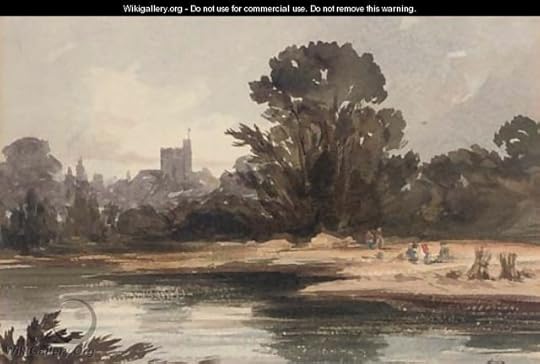 "Egham Church" oil on Canvas


