This is an abridged version of two books, The National Dream and The Last Spike. This version deals mainly with the main story of building the railroad across Canada. It was produced as a CBC multi-million dollar television production. Most of the photos in the book were taken from production Location. Book is about 5 1/4 by 8 1/4 inches and 1 1/8 inches thick. Has a few maps.
Pierre Francis de Marigny Berton, CC, O.Ont. (July 12, 1920 – November 30, 2004) was a Canadian historian, writer, journalist and broadcaster.
From narrative histories and popular culture, to picture and coffee table books to anthologies, to stories for children to readable, historical works for youth, many of his books are now Canadian classics.
Born in 1920 and raised in the Yukon, Pierre Berton worked in Klondike mining camps during his university years. He spent four years in the army, rising from private to captain/instructor at the Royal Military College in Kingston. He spent his early newspaper career in Vancouver, where at 21 he was the youngest city editor on any Canadian daily. He wrote columns for and was editor of Maclean's magazine, appeared on CBC's public affairs program "Close-Up" and was a permanent fixture on "Front Page Challenge" for 39 years. He was a columnist and editor for the Toronto Star, and a writer and host of a series of CBC programs.
Pierre Berton has received over 30 literary awards including the Governor-General's Award for Creative Non-Fiction (three times), the Stephen Leacock Medal of Humour, and the Gabrielle Leger National Heritage Award. He received two Nellies for his work in broadcasting, two National Newspaper awards, and the National History Society's first award for "distinguished achievement in popularizing Canadian history." For his immense contribution to Canadian literature and history, he has been awarded more than a dozen honourary degrees, is a member of the Newsman's Hall of Fame and a Companion of the Order of Canada.
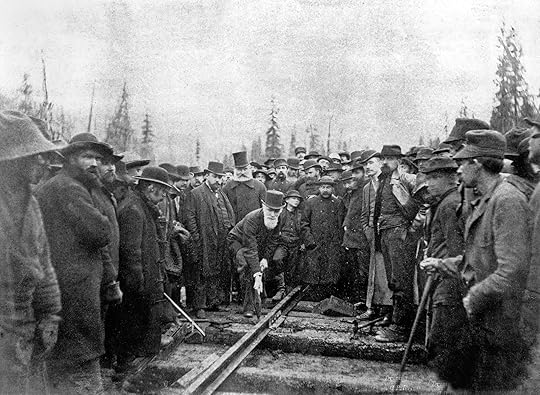
Above is a picture taken at Craigellachie in British Columbia on November 7, 1885 of the last and connecting spike that made the Canadian Pacific Railway truly transcontinental. The child in the centre, behind the white bearded gentlemen doing the last spike, is seventeen year old Edward Mallandaine. He came there on his own from Victoria, B.C. He settled in Kootenay in the middle of British Columbia.
The pictures in this book – and they are all from the era – make it well worthwhile. The text is a summary of Pierre Burton’s two books on the building of the Canadian transcontinental railway: The National Dream: The Great Railway, 1871-1881 and The Last Spike: The Great Railway, 1881-1885. At times I did find the text overly dedicated to political and financial matters (i.e. somewhat dry). When about the actual conditions of those building the railway, its’ fascinating and thrilling. Many Canadian cities sprung up directly as a result of the railway - Vancouver, Calgary, Regina, Sudbury… Lake Louise rapidly became a major tourist attraction when railway surveyors were told about it by local Indian guides.
<
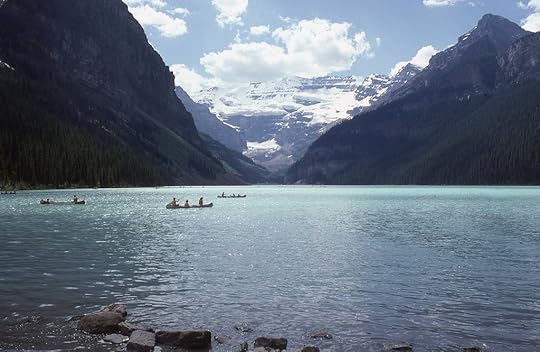
Lake Louise, Alberta - taken in 1984 It's a few miles up from the railway.
Below is an excerpt which shows how the author Pierre Berton is great patriot for promoting Canadian achievements.
Page 16 (my book)
Here was a country of only three and a half million people, not yet four years old, pledged to construct the greatest of all railways. It would be longer than any line yet built – almost one thousand miles longer than the first American road to the Pacific, which the United States, with a population of almost forty million, had only just managed to complete.
The only settlement of account [Victoria]) on the Canadian Pacific coast was on an island [Vancouver Island]; the indentations in the mainland [British Columbia, Alberta] were unchartered, the valleys were unexplored, and the passes were unsurveyed.
For another thing, the United States was not faced with any barrier as implacable as the Precambrian Shield [above the Great Lakes]. If the builders followed an all-Canadian route [which they did], they would have to blast their way across seven hundred miles of this granite wasteland. There were ridges there that would consume three tons of dynamite a day for months on end; and where the ridges ended, there was three hundred miles of muskegs, which could (and would) swallow a locomotive at a single gulp.
This is really 2 books, even though both are abridged. I finished reading The National Dream - it is full of bribery and corruption even at the highest level, brave explorers trying to find the ‘best’ way west, stupidity (e.g. trying to fill in hundreds of acres of muskeg with rock, soil, etc only to see the materials sink below the surface) and determination to establish a company to build a railway across Canada, ‘from sea to sea’ that is truly Canadian - at least they didn’t accept the easy way and just go south and use the American routes. Many politicians look incompetent and others work until they get sick. Note that during this time period, very little if any railway actually gets built. What a time in Canadian history!
I look forward to reading the second book, ‘The Last Spike’ which is about the actual building of the Canadian Pacific Railway - what an achievement!