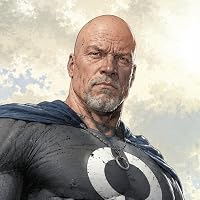
This magnus opus of comic book storytelling brings to life a sombre, dark, world… and an even darker man. Frank Miller completely reinvents the legend of Batman in his saga of a near-future Gotham City gone to rot, ten years after the Dark Knight’s retirement.
An undisputed classic and one of the most influential stories ever told in comics, this book is explicitly cited by the filmmakers as an inspiration for the most recent Batman movies.
Product of the unique and sometimes twisted mind of Frank Miller (1957–), a well known American writer, artist & film director. He is infamous and best known for his film noir-style comic book stories. Besides being one of the most widely-recognized and popular creators in comics, he is also one of the most influential comics creators of his generation. His most notable works include 'Sin City' (1991), 'The Dark Knight Returns' (1986), 'Batman Year One' (1987) and '300' (1999).
Frank Miller is an American writer, artist and film director best known for his film noir-style comic book stories. He is one of the most widely-recognized and popular creators in comics, and is one of the most influential comics creators of his generation. His most notable works include Sin City, The Dark Knight Returns, Batman Year One and 300.
Librarian Note: There is more than one author in the Goodreads database with this name.
It would be hard for me to explain the impact this book had on comics at the time (if you were not there) - the sheer audacity of the book (contextually) compared to the drivel of bad art/writing that almost destroyed the industry. Tracing the arc of Batman (BM) over twenty years you could see a character lost: from the clownish character in the 60's TV series to the gritty Adams/O'Neil reimagining - BM seemed doomed to 'peaks and valleys' - and most of us were tired of the inconsistency. Then this book hit the shelves...word spread that 'the guy who did DD' was working his magic on BM. I passed on the first issue; my disappointment was so deep - in what had become of one of my favorite characters. Picked up issue #1 and #2 after a friend made me promise to 'just check it out' - still blown away to this day. The rebirth of BM - the BM we all know today.
I first read it as the original series of prestige-format comic books, and thought it was a brilliant satire commenting on society in the late 1980s.
What has changed is my understanding of Frank Miller's intent. In blog posts (now deleted) and interviews 20+ years after first publication, Miller revealed himself to be a bigoted neo-fascist.
This made one thing clear: The world and attitudes he depicts in the Dark Knight Returns are not a satire or a cautionary tale at all. It is his prescription for how to solve what he sees as the world's problems.
And that changes The Dark Knight from a being a brilliant work of art into being a puerile but terrifying adolescent male power fantasy.
I'm still in the beginnings of my Batman reading, and I picked this piece by Frank Miller because it was the source behind the movies, it is a standalone story of 4 parts, showing Gotham city 10 years after the bat has retired from the scene yet the presuure keeps building, both in the streets and inside Bruce wayne, until the Batman returns again to set things straight, coincides with this is the return of the joker as well.
The story shows a split scene between those with and those against the batman, and the opposition reaches up to the President, who calls on superman to put an end to the Batman's vigilantism and put some 'sense' into him It is a Dark tale, telling that no one is perfect, and psychologically imbalanced people are not always the villains, sometimes they are the super heroes...
Can't say it's the best Batman story I read because I haven't read much Bat stories, but it definitely deserves a 4 star rating MiM
It's interesting that Batman's villains are almost always similar to himself. It's also interesting to see how much this hurts him. I wonder if that's why he's so reluctant to kill...? He thinks that saving them can save his own soul? Hm. I feel a blog post coming on. =)
For me, this is the etched mark in the timeline of comics that divides all that came before, and those after forever informed by Frank Miller's alchemy
I've read this countless times in the trade paperback that but this is the first time I've read it as an individual comic book, and on digital. Wildstorm did a great job remastering this issue.
What is there more to say? This is the first part of Frank Miller's seminal miniseries on Batman. He aged Bruce Wayne to the edge of crankiness, removing it as far from the smiling corporate pitchman he had become and returning him to his roots as a dark knight.
I love reading it on digital, a new experience to say the least. I could easily zoom in on the panels and enjoy Lynn Varley's lush coloring. This is one of the two best Batman stories ever. The other one is also written by Miller. A must read for any fan of the comic book medium.
It's an unsettling feeling when you read something revered as a classic and just don't connect with it. You wonder if you just haven't understood it properly. You doubt your self. Then I realised nah...it's just not written that well. The general story idea is very good, but it's written in a snapshot way that isn't just a function of the medium. Feels like the draft storyboard version, rather than the finished whole. I read Batman Year One straight afterward and that was significantly better, with a clean storytelling rhythm.
Didn't like the overuse of news station comic panels . Seems like a rather lazy way of providing exposition . Overall I understand the significance of this graphic novel but I don't not feel like it stands the test of time . Millers use of dialogue can occasionally be hard to follow and the pacing just seem awkward to me personally .
The gold standard for Batman storytelling. Ten years have passed since the last sighting of the Batman. In the interim, the Mutants, a gang of disaffected youths who kill for sport, have begun to wreak havoc on Gotham. Unwilling to stand by, an alcoholic and depressed Bruce Wayne dons the cape and cowl once more to prevent his city from spiraling out of control. The strongest, and maybe the most disturbing, aspect of The Dark Knight Returns is its biting political commentary. The system—the incompetent officials, the disconnected experts, the media personalities—are of no help. They are either incapable or unwilling to confront the situation honestly and take action. Only the Batman, who operates outside the system, can do so. As cliché as it might be to call it dark and gritty, that's exactly what it is. And virtually all of the best Batman stories of the last thirty years, be it in comics, film, or television, owe their existence to this graphic novel.
Whew this was good. Really involved story. Batman’s age made this very fresh. Only downside was that I sometimes struggled to figure out what was happening in a square. But in general, I loved this.
Batman’s back! And he’s… ruthlessly murdering people, forming street militias, and blasting away groups of people with a tank! And employing 13 year old girls in tights to fight mutants! What in the world is this book?? Now I’ll be honest, I’m no Batman veteran by any means, I’ve seen all the movies as most have, and not too much else. Previous to this book I also read The Killing Joke, which I enjoyed as an interesting origin story for the Joker, as well as a look into him and Batman’s compelling relationship. No such nuance is found in The Dark Knight Returns, but instead a cruel and ruthless protagonist, constantly being proven right in his hardcore belief that ALL criminals are irredeemable filth that need to be cleansed outside the jurisdiction of any kind of government interference. How do we know he’s right? Well, all of these KOOKY liberals on the news oppose him! What nonsense these talking heads spew, speaking of fascism, criminal rehabilitation and social programs?? Insanity. Obviously the only people who oppose Batman are loser junkies and criminals, for who else would deny his righteous crusade?
Honestly, this book reads like a satire. And, if it was, I think I would find myself laughing WITH the author rather than AT them, for example, the new, “bad” commissioner is a woman, which the story seems to want the reader to implicitly interpret as a ridiculous notion. In addition, Selina Kyle’s Catwoman has been reduced to the manager of a whorehouse, which is just an extremely unsatisfying conclusion for her character.
I guess the only other thing to mention about the story itself is the total lack of development in the characters and the plot. Each conflict plays out essentially the exact same way. Somebody does something bad, whether it’s Joker, Two-Face, or the weird Nazi lady. Batman fights them and they kill more people in the process, Batman deems them scum unworthy of life, and then he either kills them or cripples them for life. He even sticks to his no guns rule, unless you count the weird cop-out sniper rifle grappling hook he uses on Two-Face.
I do have a single nice thing to say about this book, which is I don’t understand some peoples’ hate for the art. I admittedly enjoy the big buff monster Batman look, hence the two star review, and even though the content of the news station panels is usually such an extreme political strawman device, I don’t mind the use of it for exposition. These are the reasons I gave it two stars rather than one, and I’m assuming why people like Miller’s comics in the first place.
To summarize, I truly don’t understand why this is regarded as one of the best Batman comics, let alone one of the best comics in general. No matter what type of “best graphic novels” list you find, this will most likely be at the top, and that baffles me.
So many aspects of the movies and other Batman comics I have read make much more sense now after reading this. The fact that this is 30 years old is astonishing, it still feels so fresh. The story is great, the asides told through television interviews and bulletins are genius, and the illustrations are out of this world. The comic picks up with the mutants causing more and more trouble in Gotham, Batman has been in retirement for a decade but feels he must put on his cape and save Gotham from itself. Understandably not everyone is happy to see him back and many are quick to lay Gotham's problems at Batman's feet. He has to battle evil, save face, and try to stay healthy and fit (which is hard because he's legit old now). Throw in the fact that Harvey Dent is let out (they fixed his face, no more two sided evil nature!) and there are rumors that the Joker is sane enough to do interviews on television, and that a young girl has started tagging along as Robin and you've got one hell of a great graphic novel. Solid from start to finish.
I just recently purchased the hardcover collectors edition of The Dark Knight Returns which collects each issue as a separate hardcover book all in a really nice box set. I think this was the comic that sort of started my Batman obsession.
The first issue of the Dark Knight Returns is a personal story about an aging Bruce Wayne and him trying to move on from being Batman after retiring ten years earlier due to the death of Jason Todd. Frank Millers artwork is definitely dated, and could be deemed ugly by today’s standards but for the time it was groundbreaking. The real reason The Dark Knight Returns remains such a classic though is because of the writing. Frank Miller has very organic and realistic dialogue, and some of the real highlights are in this first issue with Bruce Wayne’s monologues. Miller also reminds us that Gotham is in fact a city, with news reporters, politicians, and people for and against the idea of vigilantism. Much of this book is from the viewpoint of Gotham’s citizens, and is thus made a very intriguing sociopolitical satire.
I liked how the news playing on TV was used consistently throughout the book as a device of storytelling and to present contrasting opinions. In addition to the fact that Bats makes a comeback to crime-fighting 10 years into retirement.
Batman comes back after 10 years to fight a gang that calls itself The Mutants. That might be a good way to describe the start of this quadrology. But I think it'd be more honest to say that he came back because he needed to. Batman came back because the society forgot and surrendered to its demise, and he needed to remind them one more time.
Serie är skapad av Frank Miller och kom ut 1987. Många anser att det är ett av det viktigaste bidragen till superhjältegenren och serien har blivit en stilbildare för superhjälteserier och lämnat avtryck i både film och spel.
När den släpptes 1987 kom den även ut på svenska. Då hette hjälten fortfarande Läderlappen och tidningen fick en censurstämpel på sig som förklarade att den inte var lämplig för personer under tolv år, vilket satte käppar i hjulet för undertecknad som vid nio års ålder helt enkelt fick be en äldre kamrat om ett "litterärt utköp".
I Frank Millers vuxna version av Batman möter vi en åldrande och alkoholiserad Bruce Wayne, som fortfarande kämpar med den demon eller mystiska varelse han funnit i grottan under Wayne Manor. Han har lagt kappan på hyllan, men runt omkring honom faller samhället sönder.
Ungdomsgänget som kallar sig mutanterna tar sakta men säkert över i Gotham och forna hjältar är förbjudna att involvera sig. Sakta men säkert växer vreden inom honom och snart är han tillbaka på gatan igen och sprider skräck hos brottslingarna.
Serien drar paralleller till den amerikanska frihetstanken, som Batman personifierar, och är fylld av symbolik. Superman får här representera staten som förespråkar kontroll. Förr eller senare så kommer dessa ideal att kollidera.
När serien kom fanns det inget liknade och, trots att den har åldrats lite, sticker den fortfarande ut som ett unikt verk och jag rekommenderar den till alla serieintresserade. Ungdomar som läser den ny kan uppleva den lite rörig och med ganska många 80-tals referenser. Men det är lite svårt att sätta något annat betyg på den här serien.
Eventuell censur slipper man förstås på biblioteket och det är en viktig bok i hyllan. Tillsammans med Watchmen räknas den som en av de riktigt stora amerikanska serieklassikerna.
Heard a lot of good things in this little mini series and it didn’t start off as good as I was hoping for. Idk why some comics just don’t try and stay cohesive, it really seems like at least a few that I’ve read recently really try and be complex when it comes to the reading part of it all because this was all over the place and wasn’t lining up all that well. Trying to hard to be clever. Also the art style wasnt something I was into here for the most part.
A very interesting detail about some kids thinking Batman is a myth was really intriguing. One page where one of the members of Mutants was talking very graphically and it was insane the way he was describing how he would kill Batman. Didn’t like the part where one of the news anchors is homophobic.
I’ll say the stuff with Bruce I wasn’t into but when Batman himself shows up was awesome.
Little bit disappointing of a first chapter but still had some high highs in there.
This entire review has been hidden because of spoilers.
As someone who thoroughly disliked Man of Steel and didn't finish the Dark Knight movie, I have to say that this graphic novel series was surprisingly fantastic and showed me something about DC that the movies just didn't communicate to me.
First of all, this was my first graphic novel, so I may just be reeling from this new style I've been exposed to. But I cannot deny how much the style, art, and story absorbed me from the very beginning.
For people like me who have never read a graphic novel or superhero comic before, I'll lay out the main things about this read that surprised me that I liked:
1) The style was like watching a really old cartoon– in each panel, you can tell that there is almost a shocking amount of thought going into the components and layout of each panel. It's more poignant than a movie because every single panel/frame tells a miniature story of it's own. I didn't know that the position and dialogue of the characters mattered so much– I'm used to funny comics, so I didn't consider the careful design of the story through the panels in Dark Knight Returns. It was super cool because it was like a game where the goal is to find all the information/symbolism in a picture (speech bubbles, posters in the background, color, lighting, etc). It was like a powerful storyboard to a movie– I could almost hear a soundtrack!
2) Satisfying characters. Although the backstories of the characters are not fleshed out as much as in a book or movie, the character art, dialogue, and storyline is so masterfully designed/plotted out that it makes up for the lack of words (as in a book) or screentime (as in a movie). I particularly thought the speech choices for Clark Kent and Commissioner Gordon said a lot about their characters in a way that was to the point and almost better than reading a book or watching a movie. I hate every DC movie I've seen (with the exception of Wonder Woman :)), and this book does a much better job of handling the characters than the movies, in my opinion. I've always been uncomfortable with Batman because I didn't understand his motivation or how we were supposed to think of him– but, reading this, I get now that he's troubled and you're supposed to go-"heyyy...maybe, wait....are you...?" etc, every once in a while. From the movies, I got that he had issues, but I wasn't sure whether I was supposed to forgive them or not. This Batman made a lot more sense to me. I also really liked...Yindel? Is that her name? The art style made each character sharp and unique, which I loved. I loved the art for Yindel and Robin!
3) Variety. It wasn't just one type of panel. I really liked how some panels had rounded edges to show that we were watching TV, and how other panels were huge for cityscapes or falling-off-building shots... the art wasn't just good and perfect for the story– it was also creative and varied in its design, and that went for the speech bubbles as well– I was surprised that I could easily figure out if a character was thinking, talking, on TV, in a recording, etc. Certain styles were used when people were talking in different ways, which I suspect is common in graphic novels, but I had never considered it before, and I liked that that was an aspect of this type of book. The fact that the panel styles changed strategically, modeling quick movie scenes and with interested transitions/cut-off points between each– that was neat. Also, the repetition of different styles of panels (like with the TV broadcasts) made the story more impactful and exciting.
4) For people who don't like dark or intense stuff– hey, there's violence but it isn't that bad! I'm not even kidding! There's bright red blood and punching and people planning how to destroy each other and these creepy mutant guys that maybe want to eat people? I didn't really understand them besides the fact they were mean and had crazy teeth... point is, I was expected huge, distasteful amounts of blood and gore and guns and explosions– but, like the panels, the conflicts were varied, and it wasn't a giant punch-fest! There was more psychological stuff going on, really. And there was hardly any swearing (which I wasn't worried about but was expecting). A huge part of the reason I hate most DC movies I've seen is how dark they are– not scary, but just the whole hopeless ambience really gets me down, and the knowledge that people are making the Joker as awful as possible just to freak you out and make you doubt yourself– that gets under my skin. But the Joker here was actually a really interesting character who didn't make me uncomfortable– you got a sense of...if not his depth, than of the depth and uniqueness of his evil.
I thought Batman v. Superman was just "pretty good" until the end– but I really, really liked Dark Knight Returns 4. I may even call it epic– iconic, of course! And I'm saying this as someone who knows of comic superheroes only what I've heard from A) my nerd friends B) pop culture and C) Big Bang Theory.
Complaints? Couldn't stand the bold/italicizing of every third word. Made for some interesting dialogue, but it was mainly distracting.
In general, a surprisingly good read in a style I found awesome– with less violence and more variation in design than I expected! I recommend it to teens– I don't think tweens would understand some political themes and darker ideas presented in the book... and you want the readers to understand. It makes a bigger impact that way.
A very different take on the regular Batman story. Bruce Wayne, now old (only 40!! Like me!!) comes out of retirement as crime is rampant. At the same time, Harvey Dent is released from Arkham Asylum.
The art work reminds me of Miller’s work on Daredevil at times. It’s very wordy, but that is not a bad thing.
Underlying the story is the doubt that Batman had what it takes to make a comeback, and the aura or reputation that he created before, and it’s ability to strike fear into potential criminals.
Birthday present! I can see this being a landmark graphic novel, but man is Batman’s character grim (and a bit one-dimensional). Nolan’s movie series definitely borrowed from this, and went further, adding nuance to the title character.
I had to read this as a course reading for one of my classes. And most of the time, I don’t like the books I have to analyze but this one was great. I love Batman and the darker vibes and mystery and atmosphere of the hero. It was a fun time reading.
The story was really good but this is my first comic and just found it a little overwhelming. Not sure if this how all comics are but I was imagining less images per page, but this was pretty intense. But I did enjoy the story telling and the plot; moving on to book 2!