"This book is an essential tool in the effort to construct teaching on a foundation of thought and care. Rejecting the simple, connect-the-dots view of teaching so prevalent today, Nancy Dana and Diane Yendol-Silva invite us into a world of teaching that is deeply intellectual and fundamentally ethical. They show us how to achieve this, offering practical, concrete steps any teacher or group of teachers can decide to take as they work to transform what they already do informally and privately into something intentional, systematic, and public." William Ayers, Senior University Scholar, Distinguished Professor of Education University of Illinois at Chicago
"This thoughtful and well crafted guide to classroom research is, quite simply, the best book on the topic I have encountered. It is clearly written and jargon-free; it de-mystifies the process of discipline inquiry without sacrificing its complexity and power. I will use this volume in my graduate classes and recommend it to others." Lynne Miller, Professor of Educational Leadership University of Southern Maine
"This book is both scholarly and practical, offering university and school-based researchers a comprehensive, theoretical, and practical foundation for teacher inquiry. Dana and Yendol-Silva have written a book that is a ′must have′ for all those who are interested in bridging the gap between theory and practice." Frances Kochan, Interim Dean, College of Education Auburn University
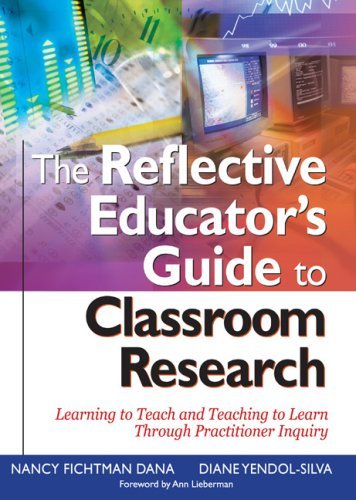
The how-to guide to educator research, from "Where Do I Begin?" to your published results!
Educator research and classroom inquiry are the gold standard for how the most highly qualified, committed, and passionate educators construct their own knowledge about teaching, learning, content, curriculum, classroom practice, professional growth, and social justice. This how-to guide to classroom inquiry takes educators through the process step by step, from beginning to end, answering critical questions on developing the research plan, collecting the data, analyzing the data, writing the results, and publishing the results. This is sure to be an essential guide for teachers, teacher trainers, teacher educators, and professional development schools. The Reflective Educator′s Guide to Classroom Research leads prospective and veteran educators alike on a journey that
Questioning teaching, learning, and school reform Sharing your questions, insights, and processes with other educators Researching through interviews, journals, and surveys Analyzing data and developing a write-up of your results Communicating your findings to the educational community
This book was assigned reading for my university diploma program. It is an excellent resource for teachers wanting to do complete classroom research / inquiry projects / improve their teaching.
"By participating in teacher inquiry, the teacher develops a sense of ownership in the knowledge constructed, and this sense of ownership heavily contributes to the possibilities for real change to take place in the classroom." p. 7
Many references to other texts and a good index.
It's a very easy read if taken chapter by chapter.
"One of the most wonderful aspects of inquiry-oriented PLC work is that it is a form of professional development that honors all the great complexity that is inherent in teaching."
It is so important that teachers have a model, mentor who is willing to accompany them on their learning journey. With the support of admin teams," they can identify organizational structures that can naturally support the work, making it 'a part of' rather than 'a part from' what is expected of teachers in today's classroom." Knowing that we have a team who is willing to work on creating a culture of learning in our schools in essence promotes, guides, nurtures, and sustains the essential qualities of life long learning.
Notes to self: -Action Research and PLC the most effective professional development -Types of PD -Knowledge for Practice -Knowledge in Practice -Knowledge of Practice
4As to structure text discussion: 1. What assumtions does the author of the text hold? 2. What do you agree with in the text? 3. What do you want to argue within the text? 4. To what parts of the text do you want to aspire?
NSRF group protocol to go through student work: 1. Step 1 is to read the work without saying anything. 2. Dsecribe the work. 3. Ask questions about the work. 4. Speculate 5. The original contributor (the one who brought the student work to the group) comment.
This quote struck me as an essential understanding that we as educators need to have: " A little ingenuity can go a long way when making data collection a part of, not apart from, your teaching." Assessment for learning is a necessity when it comes to providing meaningful experiences and opportunities for all learners.
This book catered more toward K-12 education than it did the college level. It focused more on action research (also known as SOTL in higher education) professional learning communities than the more general professional development label in the title. I found several nuggets that could be applied to higher education, but it wouldn't be a top recommendation for college faculty development.
This text is very readable and speaks to the heart and mind of an educator. Excellent text for those engaging in action research for formal reasons or for one's own informal classroom research.
The first 4 chapters of this book were very helpful to plan my research. I thought the second part was not helpful. I liked the stories throughout because they gave you ideas. I also thought the first 4 chapters exercises really helped my understand what action research is.