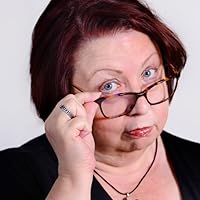
Born in 1953, John Sadler has law degrees from Northumbria University and the University of Westminster. A part-time lecturer in military history at Sunderland University Centre for Lifelong Learning, he is currently studying toward a PhD in history and is soon to begin an Imperial War Museum Fellowship in Holocaust Studies. He is the author of over 20 books, including Scottish Battles, published by Birlinn in April 2010. He is married with two children and lives in Newcastle.
This was such a difficult read to get into. The writing style is very stream-of-consciousness -- flipping around in the timeline, using a multitude of names for each person, lacking proper grammar and sometimes even spelling -- all of which made it quite hard to follow, particularly in the first 2-3 chapters. I can almost understand the multiple names used for each person -- they have so many to go by -- given name, clan name, location name. But it would be much easier on a reader if some consideration was given to being constant throughout.
The timeline jumping also complicated the narrative because it was usually not indicated clearly. But, the closer the book got to the actual massacre, the tighter the timeline and writing became.
This was my first read about the massacre. I think it does a decent job hitting all of the key issues, but it would probably be a much easier read for someone already acquainted with the place and people names than it was for a newbie.
This book is in dire need of a copy edit, which is unfortunate because it contains a great deal of well-sourced information on the 1692 Massacre at Glen Coe.
I read this book as part of my research for a novel of my own. While not as in-depth on the politics and military missions as Glencoe and the End of the Highland War, it does give more of an insight into what the everyday people living in the glen experienced as a result of what amounted to a terrorist act intended by King William to keep the other clans in line.
Sadler provides a detailed look at the history and events which culminated in the devastating massacre at Glencoe. He explains how Highland clans operated and the prejudices held against them by Lowlanders and the English. They lived in a world apart, often considered savage and uncivilized. The clans had many enemies and the MacDonalds ended up bearing the brunt of the anti-Highlander assault. Several military leaders were involved in the issuing of the orders, which were distorted and exaggerated by lower rank men who wanted to get back at the MacDonalds, notably men of clan Campbell.
I enjoyed learning about clan politics and a broad understanding of Scott/English antagonisms during the reign of William and Mary. Many Highlanders were strong Jacobites, they joined Stuart rebellion attempts for years after William's reign was established. The worst part about the Glencoe massacre was the fact that the royal troops had been stationed and quartered in Glencoe for weeks before the definitive orders were given. The men ate and lived out the bitter winter days, and huddled around fires and drank spirits with the families they were later ordered to kill in cold blood. A few of the soldiers refused to follow the orders and deserted, but most went through with it. In total around 1/4 of the Glencoe MacDonald's were killed by a combination of soldier's guns and the bitter cold they faced when they attempted to flee.
Sadler's book was well researched and very readable. One critique is that the book did not contain a map. Reading about all the clans and their glens would have been easier had there been a map or even a sketch of their family strongholds. The photographs of Glencoe are helpful for picturing the events of the massacre, but they don't provide a bigger picture of Scotland. There were several spelling and punctuation errors throughout the book, enough of them to have been noted. Perhaps another read-through before publication would have caught them. Sadler also used wikipedia as a source in his first chapter, not something an academic historian should do. In the intro he did note his lack of Gaelic, and the wikipedia citation is for a translation. Still, he could have found an academic source. Other than these personal critiques I think the book was overall quite good. The narrative flowed well, the events were well explained, and many quotes and eyewitness accounts were given to support Sadler's interpretations. He did include a timeline and a list of the dramatic persons in order to aid the reader in keeping everyone straight. The index is also helpful to find a particular person or place. I enjoyed the book and I learned a lot from it.
As promised, John Sadler's account of Glencoe is packed full of information. It covers some history of the clan system in general, a recount of the civil war, and the more detailed events surrounding the massacre itself.
However, I would suggest there is simply *too much* information, and/or the book has been very poorly edited. Many technical terms (some bordering on jargon) are used with little or no explanation, and this reader was frequently left wondering what was going on. The unnecessarily archaic language of the narrative adds to the confusion: necessary words, such as "tanistry", "primogeniture", and "recusant", needed greater explanation (as offered by Alastair Moffat in "The Highland Clans"), but the use of words such as "inexpugnable" "sanguinary" and "excoriation" is just silly. A myriad of typos (including three different spellings of the word "internecine") were annoying, and suggest poor proof-reading too. The author's means of identifying relevant people was incredibly confusing: any given character might variously be referred to by any one of a wide range of names: his title, his heritage, his hometown, his political/religious persuasion, his nickname, his birth name, or simply as "the old man". I rarely had any idea who anyone was (often they were the same person), particularly in the section on the civil war.
Given that this is a complex subject, it's a shame has not been more effectively edited. If the reader perseveres, s/he will find sections of much great clarity (the descriptions of weaponry and armour, for example) making some passages a joy to read - and Sadler's descriptions of some of the key players are wonderful.
On the whole, I don't recommend this book; but it's possible someone with an existing knowledge of 17thC Scottish history might find it a more useful and enjoyable read.
The story behind this book was really interesting, and parts of it were very informative, but I did find myself skimming and skipping over some parts that seemed to drone on forever. There was very little talk about the actual massacre itself, and a crap load of history before it.