

What do you think?

Titus Crow #1
The Burrowers Beneath
The Titus Crow novels are adventure horror, full of acts of nobility and heroism, featuring travel to exotic locations and alternate planes of existence as Titus Crow and his faithful companion and record-keeper fight the gathering forces of darkness wherever they arise. The menaces are the infamous and deadly Elder Gods of the work of H.P. Lovecraft. Chthulu and his dark minions are bent on ruling the earth--or destroying it. A few puny humans cannot possibly stand against these otherworldly evil gods, yet time after time, Titus Crow defeats the monsters and drives them back into the dark from whence they came. The Burrowers Beneath is the first book in the Titus Crow series.
195 pages, Kindle Edition
First published February 19, 1974
About the author
Brian Lumley
466 books1,397 followersBrian Lumley was born near Newcastle. In 22 years as a Military Policeman he served in many of the Cold War hotspots, including Berlin, as well as Cyprus in partition days. He reached the rank of Sergeant-Major before retiring to Devon to write full-time, and his work was first published in 1970. The vampire series, 'Necroscope', has been translated into ten languages and sold over a million copies worldwide.
He was awarded the World Fantasy Life Achievement Award in 2010.
He was awarded the World Fantasy Life Achievement Award in 2010.
Ratings & Reviews
Friends & Following
Create a free account to discover what your friends think of this book!
Community Reviews
Displaying 1 - 30 of 105 reviews

May 11, 2021
"Aquello que está vivo ha conocido la muerte, y aquello que está muerto jamás podrá morir, porque, en el Círculo del Espíritu, la vida y la muerte no son nada. Sí, todas las cosas viven para siempre, aunque a veces duermen y son olvidadas."
"Sé que hay acontecimientos extramundanos, y yo mismo he probado unas cuantas experiencias que únicamente pueden ser explicadas como «sobrenaturales», pero siempre han sido la excepción. Lo que me pide que crea es que el mito del Ciclo de Cthulhu es nada menos que un hecho prehistórico… , ¡lo que significa que las mismas bases de nuestra esfera de existencia están construidas sobre una magia alienígena! Si ése fuera el caso, entonces lo «oculto» es normal, y el Bien salió del Mal, ¡en oposición a la mitología cristiana!"
3.5*
Una completa inmersión y repaso a gran escala por los mitos y gran parte del circulo. fingiendo su veracidad y enlazando a modo de pastiche.
Como tributo y "Fan Service" se disfruta mucho. Pero como historia en si no tiene demasiado ingenio, ni peso propio. Recurre a un camino bastante fácil y evidente.
Recomendable para los que estén empapados. Caso contrario no hay de donde agarrarlo.
"Sé que hay acontecimientos extramundanos, y yo mismo he probado unas cuantas experiencias que únicamente pueden ser explicadas como «sobrenaturales», pero siempre han sido la excepción. Lo que me pide que crea es que el mito del Ciclo de Cthulhu es nada menos que un hecho prehistórico… , ¡lo que significa que las mismas bases de nuestra esfera de existencia están construidas sobre una magia alienígena! Si ése fuera el caso, entonces lo «oculto» es normal, y el Bien salió del Mal, ¡en oposición a la mitología cristiana!"
3.5*
Una completa inmersión y repaso a gran escala por los mitos y gran parte del circulo. fingiendo su veracidad y enlazando a modo de pastiche.
Como tributo y "Fan Service" se disfruta mucho. Pero como historia en si no tiene demasiado ingenio, ni peso propio. Recurre a un camino bastante fácil y evidente.
Recomendable para los que estén empapados. Caso contrario no hay de donde agarrarlo.

June 14, 2020
DAW Collectors #91
Cover Artist: Tim Kirk
Name: Lumley, Brian, Birthplace: Horden, County Durham, England, UK, 2 December 1937
"The Burrowers Beneath" is also known as "Titus Crow, Volume 1"
This novel introduces Titus Crow, Henri de Marginy, the Chthonian race, the Wilmarth Foundation, and more or less recaps the entirety of H.P. Lovecraft's works so newcomers will understand all the references being made. It's a chaotic, but in a good way, novel which deals with big issues.
Like a tabletop Call of Cthulhu mega-module, The Burrowers Beneath starts with minor threats before introducing the monsters then becomes a globe-trotting war against evil that culminates with a Great Old One being confronted.
The Chthonians are great villains and manage to be simultaneously alien horrors as well as monsters which can interact with our heroes. By their introduction, you really think they're the kind of monster which would fit perfectly into Lovecraft's universe.
However the novel is sometimes a little too overwhelming in its referencing of H.P. Lovecraft's work and goes in odd directions. Brian Lumley attempts to replicate Lovecraft's flourishes and, as a result, the text can get a little purple.
Cover Artist: Tim Kirk
Name: Lumley, Brian, Birthplace: Horden, County Durham, England, UK, 2 December 1937
"The Burrowers Beneath" is also known as "Titus Crow, Volume 1"
This novel introduces Titus Crow, Henri de Marginy, the Chthonian race, the Wilmarth Foundation, and more or less recaps the entirety of H.P. Lovecraft's works so newcomers will understand all the references being made. It's a chaotic, but in a good way, novel which deals with big issues.
Like a tabletop Call of Cthulhu mega-module, The Burrowers Beneath starts with minor threats before introducing the monsters then becomes a globe-trotting war against evil that culminates with a Great Old One being confronted.
The Chthonians are great villains and manage to be simultaneously alien horrors as well as monsters which can interact with our heroes. By their introduction, you really think they're the kind of monster which would fit perfectly into Lovecraft's universe.
However the novel is sometimes a little too overwhelming in its referencing of H.P. Lovecraft's work and goes in odd directions. Brian Lumley attempts to replicate Lovecraft's flourishes and, as a result, the text can get a little purple.

June 21, 2017
Titus Crow, famoso ocultista, junto a su amigo Henri de Marigny, deberán hacer frente a un peligro que amenaza a la Tierra. Un gran mal proveniente de África está haciendo acto de presencia en Gran Bretaña en forma de temblores de tierra. La investigación de Crow le llevará hasta una raza de seres subterráneos relacionados con las Deidades del Ciclo de Cthulhu.
‘Los que acechan en el abismo’ (The Burrowers Beneath, 1974), del británico Brian Lumley, es un estupendo pastiche lovecraftiano, escrito a la manera de August Derleth, autor que me gusta bastante. Lumley dosifica muy bien el misterio, revelando pistas paulatinamente, lo que hace que nunca te aburras.
‘Los que acechan en el abismo’ (The Burrowers Beneath, 1974), del británico Brian Lumley, es un estupendo pastiche lovecraftiano, escrito a la manera de August Derleth, autor que me gusta bastante. Lumley dosifica muy bien el misterio, revelando pistas paulatinamente, lo que hace que nunca te aburras.

March 5, 2016
At first I was like . . .

. . . But then I was like . . .

I had always wanted to read this novel since I was a Cthulhu-obsessed kid. After all, this was the book with the Cthonians in it! The very creatures who got me into Lovecraft!
I was a young D & D player, scouring Dragon Magazines in my local library, when I ran across ads for RAFM's Cthulhu miniatures line.
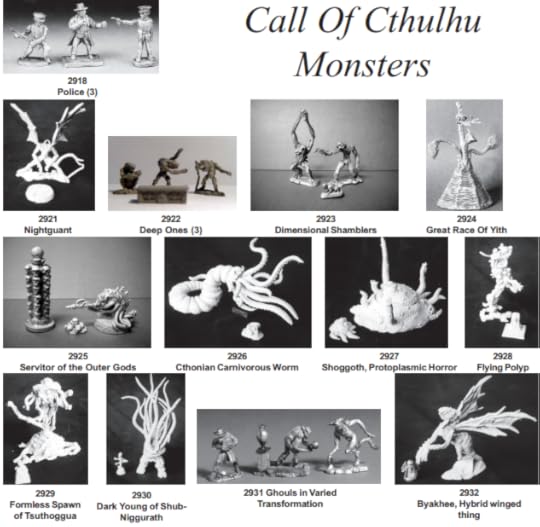
Behold! An array of bizarre creatures, only described (in the original ad) by two words each. I was hooked, and the Cthonian was the badass of my collection.
Of course, I wouldn't figure out what Cthulhu WAS until I hunted down Terrors, Terrors, Terrors, but that didn't matter. The Call of Cthulhu rulebook only confirmed what I suspected: intelligent, spell-casting, blood-drinking tentacle worms were AWESOME.
Only, this book showed me that, they were . . .

We start with a series of letters. Someone named Titus Crow is piercing together clues involving cave-ins, deaths, and madness around the globe, always dropping the hints that he knows the dark secret behind it all. Not a bad start.
Then our narrator, Henri, arrives on scene, and this becomes the Cthulhu Mythos version of the Pink Panther.
Titus Crow, occultist master, explains to Henri that the whole field of the occult is the leftover science of the Elder Gods, who imprisoned the Cthulhu aliens on Earth. He describes this in such detail that we are eighty pages in by the time he's done. Lumley is a huge fan of Lovecraft, AND HE WANTS YOU TO KNOW AND ACCEPT HIS HEADCANNON, DAMMIT.
In-between, there's a very traditional Lovecraft short story as an aside. This sets the tone for the book: awesomeness in the middle of silliness.
By the way, Titus relies heavily on splashing holy water around for the rest of the goddamn book while singing the praises of alien science.

Finally, the tension hits. The world is infested with gigantic, telepathic worm aliens, and Titus has four of their eggs! Their breeding rate is so low that they will surely come for them. What to do?
Well, first he mails them away. Them he and Henri have some chicken sandwiches on a very nice picnic.
I started to realize that Brian Lumley understands precisely what creates the tension in a tale of cosmic horror, and he will shoot it in the face until it is dead.
Worried about the earth-dwelling Cthonians, Titus and Henri decide to escape interference by living on a houseboat and hitting the pub everyday. In the meantime, the telepathic intrusions start to get worse! Titus's mind fills with the words of the Cthonians . . .
. . . who beg him to leave them alone, and they promise they'll forget all about him. Really.

They send a protoplasmic zombie to sneak on board, who reiterates that the Cthonians aren't looking for any trouble, really, let's call the whole thing off.
You'd think that the suspense would be totally dead by this point, but a Miskatonic University professor comes to the house boat and reveals the existence of a badass, monster-fighting conspiracy that has been kicking SO MUCH ASS for decades that:
a) The Cthonians have NO IDEA they exist despite the fact that
b) They have captive Cthonian females in a stable breeding program for worm-killing experiments.
The good professor actually refers to the killing of alien gods as pest control. I begin to realize that these guys are the protagonists of the novel I actually want to read.
The cthonians haven;t even shown up yet, by the way.
Before the end, there's alien dynamitin', a GREAT chapter featuring a letter from a oil rig worker, and some competence on the way of the Cthonians. I gotta give it to them; they're playing with the rules stack against them. Lumley's universe is tweaked to gimp the monsters at every opportunity, and I started laughing at how easily a shoggoth and even mighty Cthulhu himself were told to bugger off.
The great weakness of the Cthonians themselves? Water. A fire-hose can take care of one.

Also, the secret conspiracy telepathically discovers a breeding population of Loch Ness Monsters and has no idea what to do with the information.
In the end, you can clearly see that Lumley has a love of Lovecraft and a clear view of a Mythos universe. The problem is that this view turns the alien entities into mustache/tentacle-twirling bad guys who aren't as effective as Batman '66 villains. There's two great and one good Lovecraftian chapters with what seems like campaign notes from an 11-year-old's all of Cthulhu campaign.
If you love Lovecraft, this can be fun in an MST3K way. I smirked all the way through it.
Also, in the end, a TARDIS is involved. Just so you know.

. . . But then I was like . . .

I had always wanted to read this novel since I was a Cthulhu-obsessed kid. After all, this was the book with the Cthonians in it! The very creatures who got me into Lovecraft!
I was a young D & D player, scouring Dragon Magazines in my local library, when I ran across ads for RAFM's Cthulhu miniatures line.

Behold! An array of bizarre creatures, only described (in the original ad) by two words each. I was hooked, and the Cthonian was the badass of my collection.
Of course, I wouldn't figure out what Cthulhu WAS until I hunted down Terrors, Terrors, Terrors, but that didn't matter. The Call of Cthulhu rulebook only confirmed what I suspected: intelligent, spell-casting, blood-drinking tentacle worms were AWESOME.
Only, this book showed me that, they were . . .

We start with a series of letters. Someone named Titus Crow is piercing together clues involving cave-ins, deaths, and madness around the globe, always dropping the hints that he knows the dark secret behind it all. Not a bad start.
Then our narrator, Henri, arrives on scene, and this becomes the Cthulhu Mythos version of the Pink Panther.
Titus Crow, occultist master, explains to Henri that the whole field of the occult is the leftover science of the Elder Gods, who imprisoned the Cthulhu aliens on Earth. He describes this in such detail that we are eighty pages in by the time he's done. Lumley is a huge fan of Lovecraft, AND HE WANTS YOU TO KNOW AND ACCEPT HIS HEADCANNON, DAMMIT.
In-between, there's a very traditional Lovecraft short story as an aside. This sets the tone for the book: awesomeness in the middle of silliness.
By the way, Titus relies heavily on splashing holy water around for the rest of the goddamn book while singing the praises of alien science.

Finally, the tension hits. The world is infested with gigantic, telepathic worm aliens, and Titus has four of their eggs! Their breeding rate is so low that they will surely come for them. What to do?
Well, first he mails them away. Them he and Henri have some chicken sandwiches on a very nice picnic.
I started to realize that Brian Lumley understands precisely what creates the tension in a tale of cosmic horror, and he will shoot it in the face until it is dead.
Worried about the earth-dwelling Cthonians, Titus and Henri decide to escape interference by living on a houseboat and hitting the pub everyday. In the meantime, the telepathic intrusions start to get worse! Titus's mind fills with the words of the Cthonians . . .
. . . who beg him to leave them alone, and they promise they'll forget all about him. Really.

They send a protoplasmic zombie to sneak on board, who reiterates that the Cthonians aren't looking for any trouble, really, let's call the whole thing off.
You'd think that the suspense would be totally dead by this point, but a Miskatonic University professor comes to the house boat and reveals the existence of a badass, monster-fighting conspiracy that has been kicking SO MUCH ASS for decades that:
a) The Cthonians have NO IDEA they exist despite the fact that
b) They have captive Cthonian females in a stable breeding program for worm-killing experiments.
The good professor actually refers to the killing of alien gods as pest control. I begin to realize that these guys are the protagonists of the novel I actually want to read.
The cthonians haven;t even shown up yet, by the way.
Before the end, there's alien dynamitin', a GREAT chapter featuring a letter from a oil rig worker, and some competence on the way of the Cthonians. I gotta give it to them; they're playing with the rules stack against them. Lumley's universe is tweaked to gimp the monsters at every opportunity, and I started laughing at how easily a shoggoth and even mighty Cthulhu himself were told to bugger off.
The great weakness of the Cthonians themselves? Water. A fire-hose can take care of one.

Also, the secret conspiracy telepathically discovers a breeding population of Loch Ness Monsters and has no idea what to do with the information.
In the end, you can clearly see that Lumley has a love of Lovecraft and a clear view of a Mythos universe. The problem is that this view turns the alien entities into mustache/tentacle-twirling bad guys who aren't as effective as Batman '66 villains. There's two great and one good Lovecraftian chapters with what seems like campaign notes from an 11-year-old's all of Cthulhu campaign.
If you love Lovecraft, this can be fun in an MST3K way. I smirked all the way through it.
Also, in the end, a TARDIS is involved. Just so you know.

February 28, 2024
Un pastiche Lovecraftiano entretenido y con buenas ideas, pero el autor pareciera haber perdido el rumbo a la mitad.
Conocemos a Titus Crow que por una serie de temblores sospecha que algo terrible va a suceder en Inglaterra. Por lo que se embarca en una investigación junto a su amigo Henry que los lleva a ser parte de la fundación Wilmarth, una institución que lucha contra los mitos de Cthulhu.
Un libro que podría dividirse en dos partes, una primera mitad bastante detallada con varios personajes y referencias al trabajo de Lovecraft y una segunda mitad donde el autor narra todo de manera expedita y con múltiples saltos de tiempo como si se hubiera aburrido de redactar el libro y lo hubiera completado de manera rápida y con hechos "Random" que, aunque algunos resultan interesantes, apenas se relacionan con lo que venía desarrollando previamente. Ya para el final pareciera recordar la trama que había planteado al inicio, pero aún así cierra todo de manera expedita y con una perspectiva general que al contrastarlo con la primera mitad de la novela llena de detalles resulta algo extraño.
En fin, pese a mis quejas me ha entretenido. Hay muchas referencias a personajes de las historias de Lovecraft y las explicaciones acerca de los símbolos Arcanos me parece formidable. Lástima que el autor no mantuvo el interesante estilo narrativo de la primera mitad sino la novela sería mucho más.
Si te gusta todo lo relacionado a Lovecraft es una buena lectura, si no es mejor que pases de ella.
Conocemos a Titus Crow que por una serie de temblores sospecha que algo terrible va a suceder en Inglaterra. Por lo que se embarca en una investigación junto a su amigo Henry que los lleva a ser parte de la fundación Wilmarth, una institución que lucha contra los mitos de Cthulhu.
Un libro que podría dividirse en dos partes, una primera mitad bastante detallada con varios personajes y referencias al trabajo de Lovecraft y una segunda mitad donde el autor narra todo de manera expedita y con múltiples saltos de tiempo como si se hubiera aburrido de redactar el libro y lo hubiera completado de manera rápida y con hechos "Random" que, aunque algunos resultan interesantes, apenas se relacionan con lo que venía desarrollando previamente. Ya para el final pareciera recordar la trama que había planteado al inicio, pero aún así cierra todo de manera expedita y con una perspectiva general que al contrastarlo con la primera mitad de la novela llena de detalles resulta algo extraño.
En fin, pese a mis quejas me ha entretenido. Hay muchas referencias a personajes de las historias de Lovecraft y las explicaciones acerca de los símbolos Arcanos me parece formidable. Lástima que el autor no mantuvo el interesante estilo narrativo de la primera mitad sino la novela sería mucho más.
Si te gusta todo lo relacionado a Lovecraft es una buena lectura, si no es mejor que pases de ella.

June 11, 2014
Brian Lumley's Titus Crow is a series I owe an immense debt to. While Call of Cathulhu was the first Mythos-related fiction I was ever exposed to at the tender age of seven, it was Titus Crow I picked up in my college town's library which created my love of Lovecraft's mythology. Thanks to Brian Lumley, I picked up the original works by H.P. Lovecraft and devoured them. He's also the guy I owe my desire to write my own Cthulhu Mythos fiction to.
In short, this will be, by no means, an unbiased review.
These are by no means "new" works of Cthulhu Mythos fiction but I think they qualify as one of the more definitive works on the subject. Despite this, Brian Lumley's version of H.P. Lovecraft's world is distinctly his own and manifestly not cosmic horror. It's still horror fiction but I'd argue they owe more to the lighter-softer fair of The Dunwich Horror and The Strange Case of Charles Dexter Ward than The Unnameable. The influences of Robert Howard and Clark Ashton Smith can also be seen.
As Brian Lumley, himself, wrote: "I have trouble relating to people who faint at the hint of a bad smell. A meep or glibber doesn't cut it with me. (I love meeps and glibbers, don't get me wrong, but I go looking for what made them!) That's the main difference between my stories...and HPL's. My guys fight back. Also, they like to have a laugh along the way."
And why not?
In a very real way, Brian Lumley's take on the Cthulhu Mythos is a fundamentally humanist one. The Great Old Ones are powerful, immortal, and dangerous but our heroes are courageous and clever. Sadly, the humanist element of the story gets downgraded in favor of introducing benevolent Elder Gods to counter the Great Old Ones but even this is somewhat subversive. The Elder Gods turn out to be the very same species as which makes up the Great Old Ones. The terrors beyond are not so terrifying after all and might someday be friends to humanity.
Which, of course, may be controversial to some in the same way August Derleth's interpretation of the Mythos (of which Brian Lumley relies heavily upon) has run into with detractors. On my end, having been exposed to both interpretations, I prefer the alien and unknowable Old Ones to the merely evil but that doesn't mean I can't enjoy both. It's why I'm going to be reviewing all of the Titus Crow stories over the course of the next two weeks.
The first of the Titus Crow novels is The Burrower's Beneath. This novel introduces Titus Crow, Henri de Marginy, the Chthonian race, the Wilmarth Foundation, and more or less recaps the entirety of H.P. Lovecraft's works so newcomers will understand all the references being made. It's a chaotic, but in a good way, novel which deals with big issues.
Like a tabletop Call of Cthulhu mega-module, The Burrowers Beneath starts with minor threats before introducing the monsters then becomes a globe-trotting war against evil that culminates with a Great Old One being confronted.
The premise of the novel, as explained above, doesn't really convey the journey or its enjoyment factor. Brian Lumley makes ample use of letters, articles, and history to provide a grand scope of a billion-year-old evil inhabiting the Earth. One which has affected humanity throughout its entire existence and is only now being re-discovered. Everything from Commodus, to Stonehenge, to the early formation of the Earth is tied together in a wonderful little package.
The Chthonians are great villains and manage to be simultaneously alien horrors as well as monsters which can interact with our heroes. By their introduction, you really think they're the kind of monster which would fit perfectly into Lovecraft's universe.
Brian Lumley isn't afraid to denigrate his own creations, calling them "the least of the Great Old Ones' races." Which is impressive given they can tunnel across the Earth's interior at massive speeds and cause earthquakes. This is in addition to their power to manipulate other humans to their will.
Titus Crow and Henri-Laurent de Marginy are the real stars of the book. The Sherlock Holmes and Watson inspirations for Titus Crow and his partner aren't subtle but the book humanizes them in ways I didn't expect. Unlike Sherlock Holmes, Titus Crow is not the world's leading expert on his field and only encounters the Cthulhu Mythos (called the "Cthulhu Cycle" here) for the first time here. We also get some good character bits like the fact Titus needs his nightly brandy or he becomes very cranky.
Much like Watson, Henri-Laurent de Marginy is also as much the star of the book as the titular character. His amazement and horror at the existence of the Cthulhu Cycle's "truth" (knowing of it only as a perverse mythology before) helps ease the audience into the surreal new world our heroes inhabit. His enthusiasm and horror as the story see-saws between triumph as well as tragedy drives much of the narrative. Our heroes make mistakes while fighting the Mythos and only through sheer luck are they not instantly fatal.
I give credit to Brian Lumley for remembering to keep the tension tight and the body count high. While one might assume Titus Crow will live, this being his series and all, everyone else is fair game. We also have several logs of unfortunate individuals which form short-stories within the larger narrative and often end in Lovecraftian ways.
I heartily recommend The Burrowers Beneath. If I have any complaints about the novel, it's sometimes a little too overwhelming in its referencing of H.P. Lovecraft's work and goes in odd directions. I also recommend the audiobook version over the Kindle because not only is Simon Vance an incredible narrator but I also understand that Brian Lumley has been trying to get the rights back for the ebook version for a while (and why they don't have any cover art).
Brian Lumley attempts to replicate Lovecraft's flourishes and, as a result, the text can get a little purple. Despite this, I think it added to the charm of the volume. The story is available for download separately from Kindle or available in any number of previous editions and omnibuses.
In short, this will be, by no means, an unbiased review.
These are by no means "new" works of Cthulhu Mythos fiction but I think they qualify as one of the more definitive works on the subject. Despite this, Brian Lumley's version of H.P. Lovecraft's world is distinctly his own and manifestly not cosmic horror. It's still horror fiction but I'd argue they owe more to the lighter-softer fair of The Dunwich Horror and The Strange Case of Charles Dexter Ward than The Unnameable. The influences of Robert Howard and Clark Ashton Smith can also be seen.
As Brian Lumley, himself, wrote: "I have trouble relating to people who faint at the hint of a bad smell. A meep or glibber doesn't cut it with me. (I love meeps and glibbers, don't get me wrong, but I go looking for what made them!) That's the main difference between my stories...and HPL's. My guys fight back. Also, they like to have a laugh along the way."
And why not?
In a very real way, Brian Lumley's take on the Cthulhu Mythos is a fundamentally humanist one. The Great Old Ones are powerful, immortal, and dangerous but our heroes are courageous and clever. Sadly, the humanist element of the story gets downgraded in favor of introducing benevolent Elder Gods to counter the Great Old Ones but even this is somewhat subversive. The Elder Gods turn out to be the very same species as which makes up the Great Old Ones. The terrors beyond are not so terrifying after all and might someday be friends to humanity.
Which, of course, may be controversial to some in the same way August Derleth's interpretation of the Mythos (of which Brian Lumley relies heavily upon) has run into with detractors. On my end, having been exposed to both interpretations, I prefer the alien and unknowable Old Ones to the merely evil but that doesn't mean I can't enjoy both. It's why I'm going to be reviewing all of the Titus Crow stories over the course of the next two weeks.
The first of the Titus Crow novels is The Burrower's Beneath. This novel introduces Titus Crow, Henri de Marginy, the Chthonian race, the Wilmarth Foundation, and more or less recaps the entirety of H.P. Lovecraft's works so newcomers will understand all the references being made. It's a chaotic, but in a good way, novel which deals with big issues.
Like a tabletop Call of Cthulhu mega-module, The Burrowers Beneath starts with minor threats before introducing the monsters then becomes a globe-trotting war against evil that culminates with a Great Old One being confronted.
The premise of the novel, as explained above, doesn't really convey the journey or its enjoyment factor. Brian Lumley makes ample use of letters, articles, and history to provide a grand scope of a billion-year-old evil inhabiting the Earth. One which has affected humanity throughout its entire existence and is only now being re-discovered. Everything from Commodus, to Stonehenge, to the early formation of the Earth is tied together in a wonderful little package.
The Chthonians are great villains and manage to be simultaneously alien horrors as well as monsters which can interact with our heroes. By their introduction, you really think they're the kind of monster which would fit perfectly into Lovecraft's universe.
Brian Lumley isn't afraid to denigrate his own creations, calling them "the least of the Great Old Ones' races." Which is impressive given they can tunnel across the Earth's interior at massive speeds and cause earthquakes. This is in addition to their power to manipulate other humans to their will.
Titus Crow and Henri-Laurent de Marginy are the real stars of the book. The Sherlock Holmes and Watson inspirations for Titus Crow and his partner aren't subtle but the book humanizes them in ways I didn't expect. Unlike Sherlock Holmes, Titus Crow is not the world's leading expert on his field and only encounters the Cthulhu Mythos (called the "Cthulhu Cycle" here) for the first time here. We also get some good character bits like the fact Titus needs his nightly brandy or he becomes very cranky.
Much like Watson, Henri-Laurent de Marginy is also as much the star of the book as the titular character. His amazement and horror at the existence of the Cthulhu Cycle's "truth" (knowing of it only as a perverse mythology before) helps ease the audience into the surreal new world our heroes inhabit. His enthusiasm and horror as the story see-saws between triumph as well as tragedy drives much of the narrative. Our heroes make mistakes while fighting the Mythos and only through sheer luck are they not instantly fatal.
I give credit to Brian Lumley for remembering to keep the tension tight and the body count high. While one might assume Titus Crow will live, this being his series and all, everyone else is fair game. We also have several logs of unfortunate individuals which form short-stories within the larger narrative and often end in Lovecraftian ways.
I heartily recommend The Burrowers Beneath. If I have any complaints about the novel, it's sometimes a little too overwhelming in its referencing of H.P. Lovecraft's work and goes in odd directions. I also recommend the audiobook version over the Kindle because not only is Simon Vance an incredible narrator but I also understand that Brian Lumley has been trying to get the rights back for the ebook version for a while (and why they don't have any cover art).
Brian Lumley attempts to replicate Lovecraft's flourishes and, as a result, the text can get a little purple. Despite this, I think it added to the charm of the volume. The story is available for download separately from Kindle or available in any number of previous editions and omnibuses.

July 11, 2024
It's an odd book. It was Lumley's second published novel, his first publication with not Arkham House, and the first of a series that started to define his Cthulhu Mythos interpretation, famously summarized by the author as, "My guys fight back." It's true, starting in this book; investigators are or become knowledgeable, well-armed, and effective against at least the minor horrors of what is termed in this book the CCD (Cthulhu Cycle Deities). Some Lovecraft afficionados are aghast as this pulp adventure heroic style that infiltrated the Mythos in Lumley's work, and I can see that. Lumley's earliest writing included very good Lovecraft pastiches, but he took it in the direction he wanted for his own work, and a fan base arose that adored it, and the rest is history. Lumley's evolution of the Mythos is more in keeping with the popular Call of Cthulhu tabletop RPG.
This book gradually rolls out this response to the cosmic horrors that inhabit the Earth and ultimately threaten humanity. I don't think it's a great story, considering the book as a single unit. The narration is piecemeal and chopped up. Two previously published short stories, Cement Surroundings and The Night Sea Maid Went Down are popped into the plot, and the book is built from a variety of epistolary pieces. It mostly works all together but it's definitely rough around the edges. I think it hurt my experience to have recently read those two short stories on their own.
My biggest beef is that this is called the "Titus Crow" series, when it would be much more accurately described in terms of his sidekick/mentee, Henri Laurent de Marigny! De Marigny is the narrator of the series (barring one book of 6 that features neither him nor Crow) and it follows his experience directly throughout. He's the main protagonist, despite that Crow is slightly more knowledgeable and psychically gifted. Both of them pale in comparison to the Wilmarth Foundation, a global effort introduced in this book, in terms of ability to counteract the menaces they face. I don't know why Crow ended up with top billing, except that I sense the Lumley wanted him to be the big hero, for all that we're seeing it all through De Marigny's experience, with Crow absent for the greater parts of the series.
Building on that mis-naming, this book is difficult to get into. For the first half, we don't see the source of any horror, merely De Marigny and Crow reacting to research and dreams and feelings of dread, from which they flee and hide on a houseboat. One would be forgiven for thinking it's all in their heads up to that point. Then, in moves a more powerful ally as soon as the horror shows itself, and from then on the protagonists merely go with the flow, led on by a larger group's mission. It works against setting them up well as capable in their own right. "Setting up" is really all this book accomplishes, in terms of Lumley's spin on Cthulhu et al, creating the stage for further adventures.
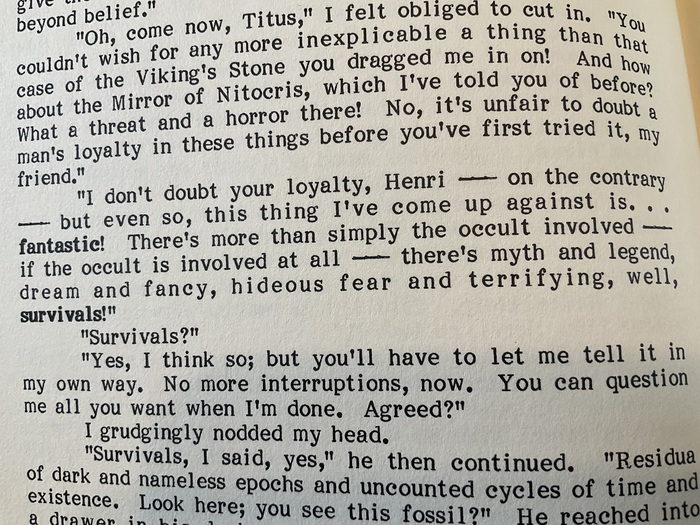
The writing is very British and very excitable; pages are rife with em-dashes, ellipses, exclamation marks, and, in the edition I read, bold markups where one would now expect italics for emphasis instead. The characters too are very excitable, with a lot of "Great Scott!" type ejaculations. It gets a bit silly at times:
Long after its 1974 DAW paperback release, this entire series was republished starting in 1988 by W. Paul Ganley's New York small press, giving them a proper hardcover treatment. I love that Ganley was simply a fan and went to the effort to reissue these books, including a new decades-later final book, Elysia: The Coming of Cthulhu. I collected these over time once I discovered their existence. They're printed on high quality paper in an unusual font, very classic typewriter style:
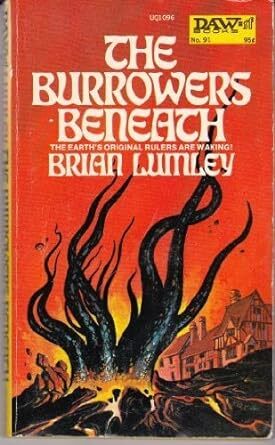
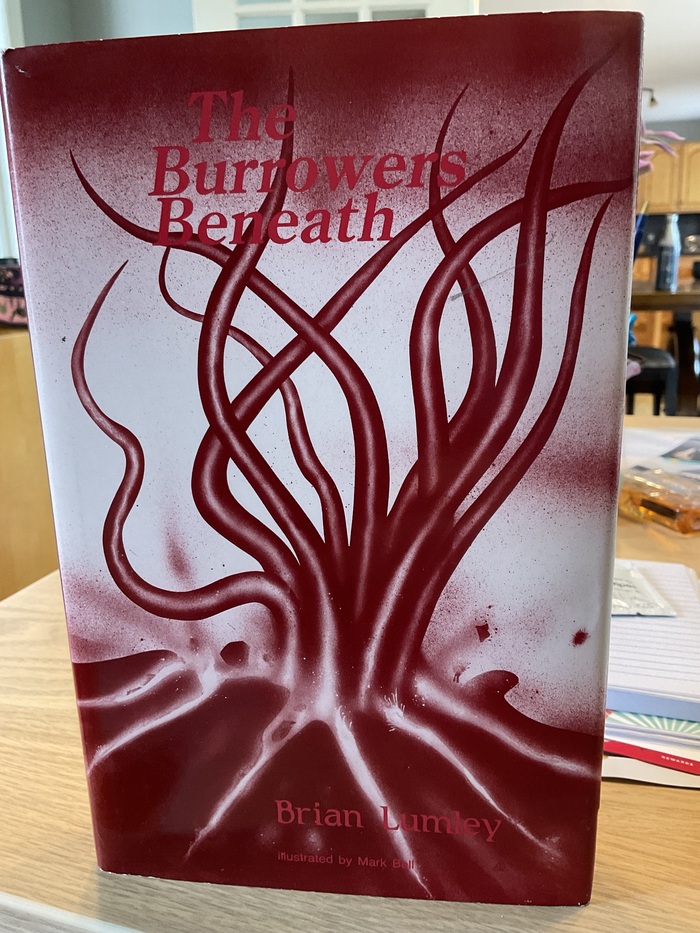
New artwork, internal and external, was commissioned for these books. I'm not a huge fan of the art for this book, by Mark Bell. For one the main cover is duplicative and also much less dynamic and threatening a depiction of tentacles than the original paperback. Old:
New:
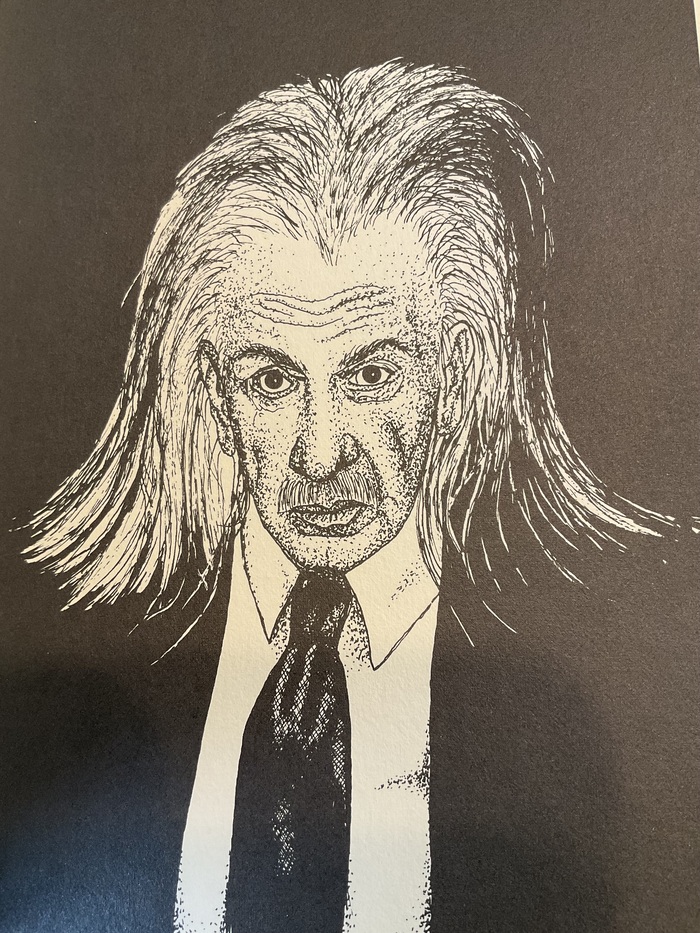
Inside there are multiple illustration plates. One is supposedly of Titus Crow, but I don't know what the Einstein is supposed to be going on here and it's certainly not how I ever pictured him:
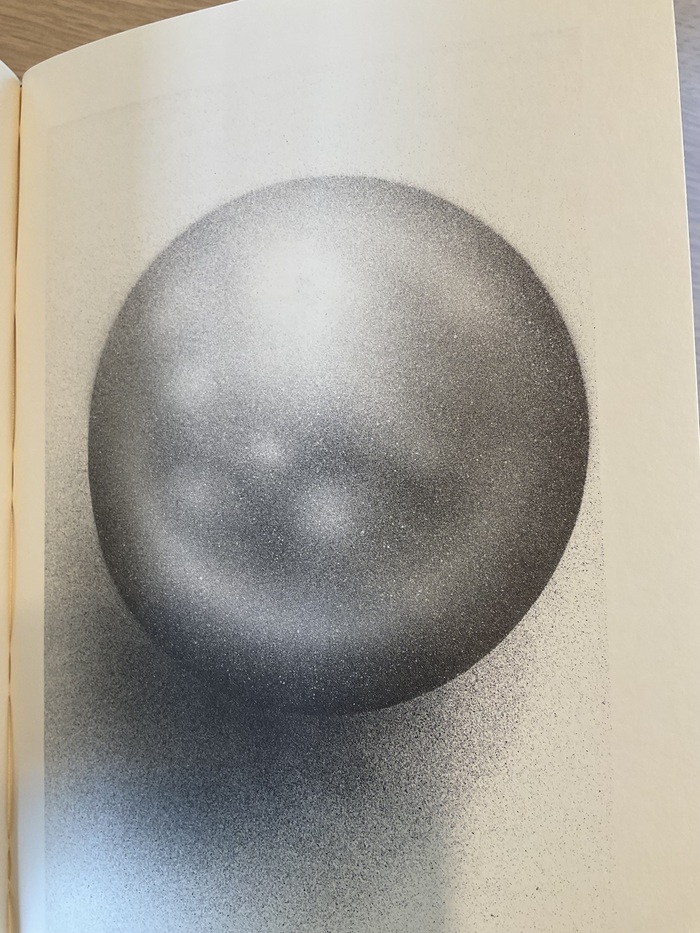
Another early illustration is of a pearl-like sphere, an egg of the titular burrowers, spawn of Shudde-M'ell (one of Lumley's own additions to the Cthulhu Mythos), and sure it's a nice drawing of a sphere but was there no more interesting subject?
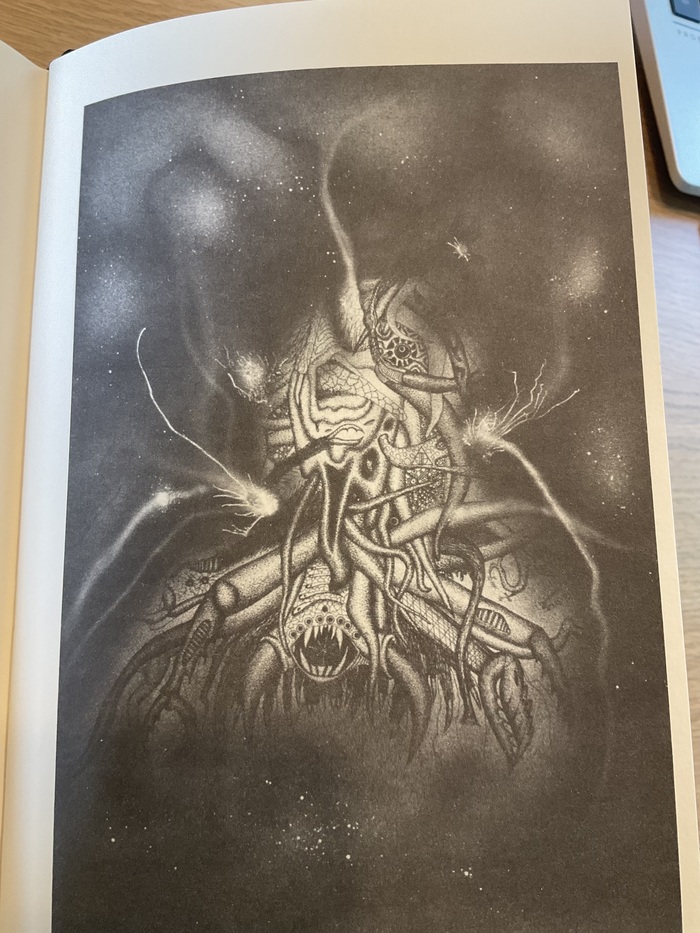
I think this is the best illustration of the bunch, despite that it doesn't seem to depict anything specifically from this book:
And with that, I'm officially into the "Titus Crow" portion of my publication-order Lumley Cthulhu Mythos re-read. I was reminded here of elements of Lumley's later and more popular Necroscope series, in the squishy descriptions, in the use of humans with psychic abilities that they can use, not without risk, to combat inhuman adversaries, in the secret but government-supported organization fighting and keeping the horror from the bulk of human awareness.
If you happen to be interested in this series but balk at the "collector's" prices of the extant single volume editions, the six books were collected in three reprint volumes: Titus Crow: The Burrowers Beneath, the Transition of Titus Crow etc.
This book gradually rolls out this response to the cosmic horrors that inhabit the Earth and ultimately threaten humanity. I don't think it's a great story, considering the book as a single unit. The narration is piecemeal and chopped up. Two previously published short stories, Cement Surroundings and The Night Sea Maid Went Down are popped into the plot, and the book is built from a variety of epistolary pieces. It mostly works all together but it's definitely rough around the edges. I think it hurt my experience to have recently read those two short stories on their own.
My biggest beef is that this is called the "Titus Crow" series, when it would be much more accurately described in terms of his sidekick/mentee, Henri Laurent de Marigny! De Marigny is the narrator of the series (barring one book of 6 that features neither him nor Crow) and it follows his experience directly throughout. He's the main protagonist, despite that Crow is slightly more knowledgeable and psychically gifted. Both of them pale in comparison to the Wilmarth Foundation, a global effort introduced in this book, in terms of ability to counteract the menaces they face. I don't know why Crow ended up with top billing, except that I sense the Lumley wanted him to be the big hero, for all that we're seeing it all through De Marigny's experience, with Crow absent for the greater parts of the series.
Building on that mis-naming, this book is difficult to get into. For the first half, we don't see the source of any horror, merely De Marigny and Crow reacting to research and dreams and feelings of dread, from which they flee and hide on a houseboat. One would be forgiven for thinking it's all in their heads up to that point. Then, in moves a more powerful ally as soon as the horror shows itself, and from then on the protagonists merely go with the flow, led on by a larger group's mission. It works against setting them up well as capable in their own right. "Setting up" is really all this book accomplishes, in terms of Lumley's spin on Cthulhu et al, creating the stage for further adventures.
The writing is very British and very excitable; pages are rife with em-dashes, ellipses, exclamation marks, and, in the edition I read, bold markups where one would now expect italics for emphasis instead. The characters too are very excitable, with a lot of "Great Scott!" type ejaculations. It gets a bit silly at times:
"Now I must be. . . going."I found that I Lumley's best work comes out in the gooshy parts.
"Going? But where?" I babbled. "Back to — Them?"
"No. . . glug, glug, glug. . . not back to Them. That is all. . . glug. . . over. I feel it. And They are angry. I have said too much. A few minutes more and I'll be. . . glug. . . free!" The pitiful horror climbed slowly to its feet, sloping somehow to one side, stumbling and barely managing to keep is balance.
Titus Crow, too, started to his feet. "Wait, you can help us! You must know what they fear. We need to know. We need weapons against them!"
"glug, glug, glug — no time — They have released Their control over this. . . glug. . . body! The protoplasm is. . . glug, glug, ggglug. . . falling apart! I'm sorry, Crow. . . glugggg, aghh. . . I'm sorry."
The next instant I was faced with something so monstrously terrifying that for a moment I thought my heart must stop. To my left, at a distance of no more than fifteen feet, the very limit of my vision in the mist, the face of the pebbly incline burst outward in a shower of stones and earth — and then —
—Horror!
I backed away, unashamedly babbling, screaming Crow's name repeatedly as the — Thing — came after me. It was octopoid, this dweller in the earth. . . flowing tentacles and a pulpy gray-black, elongated sack of a body. . . rubbery. . . exuding a vilely stinking whitish slime. . . eyeless. . . headless, too. . . Indeed, I could see no distinguishing features at all other than the reaching, groping tentacles. Or was there — yes! — a lump in the upper body of the thing. . . a container of sorts for the brain, or ganglia, or whichever diseased organ governed this horror's loathsome life!
Long after its 1974 DAW paperback release, this entire series was republished starting in 1988 by W. Paul Ganley's New York small press, giving them a proper hardcover treatment. I love that Ganley was simply a fan and went to the effort to reissue these books, including a new decades-later final book, Elysia: The Coming of Cthulhu. I collected these over time once I discovered their existence. They're printed on high quality paper in an unusual font, very classic typewriter style:
New artwork, internal and external, was commissioned for these books. I'm not a huge fan of the art for this book, by Mark Bell. For one the main cover is duplicative and also much less dynamic and threatening a depiction of tentacles than the original paperback. Old:
New:
Inside there are multiple illustration plates. One is supposedly of Titus Crow, but I don't know what the Einstein is supposed to be going on here and it's certainly not how I ever pictured him:
Another early illustration is of a pearl-like sphere, an egg of the titular burrowers, spawn of Shudde-M'ell (one of Lumley's own additions to the Cthulhu Mythos), and sure it's a nice drawing of a sphere but was there no more interesting subject?
I think this is the best illustration of the bunch, despite that it doesn't seem to depict anything specifically from this book:
And with that, I'm officially into the "Titus Crow" portion of my publication-order Lumley Cthulhu Mythos re-read. I was reminded here of elements of Lumley's later and more popular Necroscope series, in the squishy descriptions, in the use of humans with psychic abilities that they can use, not without risk, to combat inhuman adversaries, in the secret but government-supported organization fighting and keeping the horror from the bulk of human awareness.
If you happen to be interested in this series but balk at the "collector's" prices of the extant single volume editions, the six books were collected in three reprint volumes: Titus Crow: The Burrowers Beneath, the Transition of Titus Crow etc.

January 28, 2021
Somewhat charming, I guess. This is Cthulhu explained (or overexplained) for beginners. I love the idea of a Sherlock-like figure actually fighting against, or more TRYING to holding out against one of the Great Old Ones, the worm-like burrower Shudde-M’ell. The story has a pacing problem, though, and way too long conversations really do spoil the flow of the story. Still, I somehow like it.

August 19, 2017
Review to Follow
Basically I enjoyed this despite its reading like gifted fan-fiction.
If you're a Lovecraft fan you'll want to read this.
If you're an August Derleth fan (horrors!) this is right up your cavity.
More later. I hope.
Basically I enjoyed this despite its reading like gifted fan-fiction.
If you're a Lovecraft fan you'll want to read this.
If you're an August Derleth fan (horrors!) this is right up your cavity.
More later. I hope.

January 25, 2011
Not sure what happened but I have read this book several times before however for some reason it reverted to a different edition.
Anyway I remember reading this book for the first time so distinctively and have had such fond memories of it since then. I always find it strange how event drive me to pick up an "old" book I have read many time before even when I am surrounded by so many new unread ones.
This is the first of the Titus Crow books by Brian Lumley and I think one of favourites. At the end of the end this is not your usual Cthulhu Mythos story - though now it seems there are so many different variants that is no long a unique point - however I can imagine to some this is not in the vein of the mythos.
However its still great fun and sets the scene for further books following our intrepid heroes.
Anyway I remember reading this book for the first time so distinctively and have had such fond memories of it since then. I always find it strange how event drive me to pick up an "old" book I have read many time before even when I am surrounded by so many new unread ones.
This is the first of the Titus Crow books by Brian Lumley and I think one of favourites. At the end of the end this is not your usual Cthulhu Mythos story - though now it seems there are so many different variants that is no long a unique point - however I can imagine to some this is not in the vein of the mythos.
However its still great fun and sets the scene for further books following our intrepid heroes.

November 11, 2023
I enjoyed this book and I like lumley’s work but the story itself comes off a bit clunky in this one. Titus crow is a good character used to better effect in some of lumley’s short Cthulhu stories and the ending was painfully dragged out. I’m still going to read more of Titus Crow’s adventures.
February 23, 2008
My favorite Cthulhu Mythos writer outside of H.P.L. himself

April 11, 2020
Brian Lumley is probably more well known today as the author of the Necroscope series, but I have also really enjoyed his contributions to Lovecraft's Cthulhu Mythos. The Burrowers Beneath is the first book featuring Lumley's occult "detective" Titus Crow. This novel is all sorts of sinister fun and it is a very good addition to this genre. Also Lumley answers a question that is so central to these stories I never thought to ask it: if mankind is so insignificant and powerless compared to the Elder Gods, how can the spells and magic objects that seem to afford any protection from them actually work? Lumley posits a clever explanation I will not divulge here, but I am delighted to say it actually makes sense.

September 1, 2017
A bit of an old-fashioned gentleman's club tale. An excellent Lovecraftian mythos novel. Honestly, better than Lovecraft.

July 18, 2024
Umpteen years ago in high school I wrote regularly, and had a goal of filling a Mead five-subject spiral bound notebook before graduating. I succeeded (barely), with most of it short stories and a few of novella length, and all of it terrible. This was also the midst of some major Lovecraft discovery and so of course one of them is a pastiche. While I cringe at the thought of looking over it again to see what terrible ideas I imported and completely misinterpreted, the one thing I know is that I did not attach it to any of the sprawling Lovecraft mythology: it stood alone on its own meager merits. In hindsight I deeply admire that decision or that accident.
The greatest damage that Lovecraft did to himself in his writing (other than the racist slant that looks uglier every time I stumble upon it like a glass-topped coffee table in the dark) is the tiebacks and allusions hinting at the Cinematic Universe of shared literature and experience between his own works and those of his friends. It was a license that allowed everyone to graft themselves on to this greater experience and later to graft themselves to some other graft. If you look at the sum, the Lovecraft Occult Cinematic Universe is one crowded place.
Lumley here leverages not just Lovecraft but the August Derleth grafts that dare to classify Cthulhu etc. in terms of classical elements and weird familial relationships and uplifts the grim outlook by setting some Older Outer Other Whatever Gods as some kind of cosmic counterbalance to the Seafood Evil Things.
And at this point in the year 2024 you see someone reach for the usual hoary tomes of forbidden lore bound in human skin and ask yourself what new thing this brings, rather than just adding _more_.
This mostly just adds _more_. It adds a human organization that can and does battle against the cosmic evils. It adds more unspeakable volumes and dangerous creatures from the dawn of the cosmos, but...we've seen those. It adds the spirit of adventure. It adds rather a lot of conversation and sitting down to enjoy meals at the pub. It does start by presuming individuals who don't need to be convinced in shuddersome detail, but then adds the shuddersome detail anyways.
There is, in short, a good short story here--punchy, vivid, outré--that is hitched like a caboose to an existing train and it probably doesn't need any of that, or at least a lot less of it. I am not likely to follow this series further.
The greatest damage that Lovecraft did to himself in his writing (other than the racist slant that looks uglier every time I stumble upon it like a glass-topped coffee table in the dark) is the tiebacks and allusions hinting at the Cinematic Universe of shared literature and experience between his own works and those of his friends. It was a license that allowed everyone to graft themselves on to this greater experience and later to graft themselves to some other graft. If you look at the sum, the Lovecraft Occult Cinematic Universe is one crowded place.
Lumley here leverages not just Lovecraft but the August Derleth grafts that dare to classify Cthulhu etc. in terms of classical elements and weird familial relationships and uplifts the grim outlook by setting some Older Outer Other Whatever Gods as some kind of cosmic counterbalance to the Seafood Evil Things.
And at this point in the year 2024 you see someone reach for the usual hoary tomes of forbidden lore bound in human skin and ask yourself what new thing this brings, rather than just adding _more_.
This mostly just adds _more_. It adds a human organization that can and does battle against the cosmic evils. It adds more unspeakable volumes and dangerous creatures from the dawn of the cosmos, but...we've seen those. It adds the spirit of adventure. It adds rather a lot of conversation and sitting down to enjoy meals at the pub. It does start by presuming individuals who don't need to be convinced in shuddersome detail, but then adds the shuddersome detail anyways.
There is, in short, a good short story here--punchy, vivid, outré--that is hitched like a caboose to an existing train and it probably doesn't need any of that, or at least a lot less of it. I am not likely to follow this series further.
November 8, 2017
The Burrowers Beneath reads like Lovecraft written by Edgar Rice Burroughs, with a dash of John Wyndham. It's pulp adventure with barely a hint of the genuinely mysterious, creepy atmosphere to be found in Lovecraft's best stories. Instead, Lumley turns Lovecraft's strange elder beings into little more than a systematically organized bestiary of monsters (they might as well be in a Godzilla movie) and has a team of informed do-gooders wage war against them. There are some genuinely good ideas in the novel but the Lovecratian name-dropping is laid on thick and the whole affair rapidly becomes tedious. To be honest, I couldn't wait for it to end.

December 12, 2022
The initial dubious promise of Tremors-like dumb fun creature feature stuff is ultimately drowned out by utterly tedious Cthulhu Mythos name-dropping, irrelevant explanations, occult mumbo jumbo and pointless codified connections that serve only to spoil mystery.
Endless junk exposition assigning "Mythos deities" different elements. It's insane to me that people are nostalgic for the Derleth, Lumley, and Carter stuff dealing with the "Mythos". It's shit. Probably the worst novel I've read all year. The four and five star reviews on here are more maddening than any eldritch god.
Endless junk exposition assigning "Mythos deities" different elements. It's insane to me that people are nostalgic for the Derleth, Lumley, and Carter stuff dealing with the "Mythos". It's shit. Probably the worst novel I've read all year. The four and five star reviews on here are more maddening than any eldritch god.

October 22, 2012
A book that, more than any other, demonstrates what can go wrong when you tell rather than show.

February 5, 2018
First foray into Cthulhu pastiche - I enjoyed the ride.

October 19, 2020
3,5
A miner finds a tunnel his coworkers know nothing about and collects some pearls from the walls. He hears some chants. The next day the tunnel collapses bt something follows him. Its in the eggs.
Meanwhile…
All his life Titus haz nightmares of forbidden cities and beasts. Now the dreams intensify and he realizes that whenever he had one of those dreams, natural disasters insued. (chapter 2 by the way is a very good entry point for anyone who wants to start reading cthulhu mythos, because everything that consists it is written down plainly in two paragraphs or three, with all the essentials.)
The eggs belong to the burrowers who start hunting Titus and de Marigny.
An amazing adventure and a refreshing end to the cliché of the mythos: the heroes don’t disappear or die or go crazy but they survive. I loved the pace and especially the chapter before last! The heroes are a nice couple (although they remind me of sherlock and Watson a lot) and the chapter with the talking corpse waz also very nice.
Pity, two of the parts I ve read them in other collections.
A miner finds a tunnel his coworkers know nothing about and collects some pearls from the walls. He hears some chants. The next day the tunnel collapses bt something follows him. Its in the eggs.
Meanwhile…
All his life Titus haz nightmares of forbidden cities and beasts. Now the dreams intensify and he realizes that whenever he had one of those dreams, natural disasters insued. (chapter 2 by the way is a very good entry point for anyone who wants to start reading cthulhu mythos, because everything that consists it is written down plainly in two paragraphs or three, with all the essentials.)
The eggs belong to the burrowers who start hunting Titus and de Marigny.
An amazing adventure and a refreshing end to the cliché of the mythos: the heroes don’t disappear or die or go crazy but they survive. I loved the pace and especially the chapter before last! The heroes are a nice couple (although they remind me of sherlock and Watson a lot) and the chapter with the talking corpse waz also very nice.
Pity, two of the parts I ve read them in other collections.
November 8, 2013
I've just got round to reading this, Lumley’s first novel, but also a bit of a fix-up from previously published stories; “Cement Surroundings” and “The Night Sea-Maid Went Down” were short [good] early Cthulhu Mythos stories. In THE BURROWERS BENEATH, Lumley has linked the stories together and extended their scope, though the novel is largely an expansion of “Cement Surroundings”, concerning the exploits of Shudde-M’ell, a huge octopoid burrowing creature, a Great Old One, and his similar children. When these creatures move around under the surface of the Earth, they produce tremors and earthquakes, and can be tracked with siesomological devices. Lumley’s idea is that these creatures are responsible for many earthquakes and tremors throughout history; originally prisoned by the Elder Gods beneath Africa, they have now broken free and are reproducing and massing.
The main characters here are from some of Lumley’s earlier stories; Titus Crow is a psychic scholar of the Occult, and his friend and coleage, Henri de Marigny. Together, they become more convinced and involved in Shudde-M’ell’s exploits across England, and later are recruited by the Wilmarth Foundation, an organisation emanating from Miskatonic University to identify, track down and destroy [where possible] the wide plethora of Cthulhu Cycle Deities that are still extant and active on Earth. The idea is that these entities [Shudde-M’ell, Cthulhu, Hastur, Azathoth, Ithaqua, etc] and their minions [shoggoths, Deep Ones, Mi-Go, etc] once imprisoned by the Elder Gods, are now breaking free and causing havoc, while the Wilmarth Foundation attempt to hold them at bay and cover-up the whole thing.
Like many writers before him, Lumley has taken the concepts of Lovecraft's Cthulhu Mythos as a centrepiece for his Titus Crow stories, but has taken the ideas in his own, more modern, direction. Lovecrafts protagonists were usually weak, ineffectual, passive, and more likely to faint or ‘not find adequate words to describe the horror’. Lumley’s characters have more of the modern age about them, and fight back; Lovecrafts guys would never have created the Wilmarth Foundation. Lumley’s interpretation of the Mythos is more physical, more real; he has solidified Cthulhu, filled in the jigsaw that Lovecraft, and later Derleth began, and brought a bit of Order to Chaos. Lumley’s interpretation was original and modern but was disliked by many traditional Mythos fans. Personally, I find this new [in the 1970’s] approach to be refreshing; I enjoy very much traditional tales [as does Lumley], but I don’t believe that Lumley should be disparaged because of an innovative approach.
THE BURROWERS BENEATH uses a traditional Lovecraftian device of letters and journals, and though this seems to increase the pace and veracity of the book, there is always a slight detachment to the action, especially in the final chapters which cover an extended period of time in a short space. As a novel, it wobbles a little, it doesn’t seem quite even somehow, but is packed with great ideas and observations on the Mythos [eg, Azathoth is The Big Bang, while Nyarlathotep is telepathy], and is infused with an obvious love for Lovecrafts original stories, many of which he weaves into the narrative. On a more personal note, large parts of the book are set in the North of England, where both Lumley and myself were born, and it’s fun to see local [slightly changed] place names.
Really this novel is the first in a long sequence of six, telling the story of Titus Crow and the Wilmarth Foundation. In addition to that there are a number of short stories telling of more, earlier, exploits of the character. THE BURROWERS BENEATH is a fast, engaging read, ending on a cliffhanger; I look forward to reading more.
NOTE; Though THE BURROWERS BENEATH has never been filmed, I believe that it has been an uncredited inspiration on several films, most notably BEHEMOTH [2011] in which a vast tentacled underground ‘God’ is responsible for tremors and earthquakes, and at the end pops out of the top of a mountain. There are also similarities in the films MONGOLIAN DEATH WORM [2010], THE BURROWERS [2008], and in the popular TREMORS series.
The main characters here are from some of Lumley’s earlier stories; Titus Crow is a psychic scholar of the Occult, and his friend and coleage, Henri de Marigny. Together, they become more convinced and involved in Shudde-M’ell’s exploits across England, and later are recruited by the Wilmarth Foundation, an organisation emanating from Miskatonic University to identify, track down and destroy [where possible] the wide plethora of Cthulhu Cycle Deities that are still extant and active on Earth. The idea is that these entities [Shudde-M’ell, Cthulhu, Hastur, Azathoth, Ithaqua, etc] and their minions [shoggoths, Deep Ones, Mi-Go, etc] once imprisoned by the Elder Gods, are now breaking free and causing havoc, while the Wilmarth Foundation attempt to hold them at bay and cover-up the whole thing.
Like many writers before him, Lumley has taken the concepts of Lovecraft's Cthulhu Mythos as a centrepiece for his Titus Crow stories, but has taken the ideas in his own, more modern, direction. Lovecrafts protagonists were usually weak, ineffectual, passive, and more likely to faint or ‘not find adequate words to describe the horror’. Lumley’s characters have more of the modern age about them, and fight back; Lovecrafts guys would never have created the Wilmarth Foundation. Lumley’s interpretation of the Mythos is more physical, more real; he has solidified Cthulhu, filled in the jigsaw that Lovecraft, and later Derleth began, and brought a bit of Order to Chaos. Lumley’s interpretation was original and modern but was disliked by many traditional Mythos fans. Personally, I find this new [in the 1970’s] approach to be refreshing; I enjoy very much traditional tales [as does Lumley], but I don’t believe that Lumley should be disparaged because of an innovative approach.
THE BURROWERS BENEATH uses a traditional Lovecraftian device of letters and journals, and though this seems to increase the pace and veracity of the book, there is always a slight detachment to the action, especially in the final chapters which cover an extended period of time in a short space. As a novel, it wobbles a little, it doesn’t seem quite even somehow, but is packed with great ideas and observations on the Mythos [eg, Azathoth is The Big Bang, while Nyarlathotep is telepathy], and is infused with an obvious love for Lovecrafts original stories, many of which he weaves into the narrative. On a more personal note, large parts of the book are set in the North of England, where both Lumley and myself were born, and it’s fun to see local [slightly changed] place names.
Really this novel is the first in a long sequence of six, telling the story of Titus Crow and the Wilmarth Foundation. In addition to that there are a number of short stories telling of more, earlier, exploits of the character. THE BURROWERS BENEATH is a fast, engaging read, ending on a cliffhanger; I look forward to reading more.
NOTE; Though THE BURROWERS BENEATH has never been filmed, I believe that it has been an uncredited inspiration on several films, most notably BEHEMOTH [2011] in which a vast tentacled underground ‘God’ is responsible for tremors and earthquakes, and at the end pops out of the top of a mountain. There are also similarities in the films MONGOLIAN DEATH WORM [2010], THE BURROWERS [2008], and in the popular TREMORS series.

Read
October 17, 2023Brian Lumleys ingång till Lovecraft är via äventyret. Titus Crow är ett slags Sherlock Holmes-figur med snillrikhet nog att stå emot den lovecraftska mytvärlden - något som egentligen motsäger allt vad kosmisk skräck heter.
Ändå tycker jag denna är rätt trevlig.
Ändå tycker jag denna är rätt trevlig.

October 27, 2017
I do find the Titus Crow books to be immensely entertaining, being as they are in a long tradition of a particular strain of Lovecraftian pastiche or tribute extending from Derleth to Rawlik. I would like to think it's unashamedly silly, but then I'm not sure how seriously Lumley intended them to be taken.
Citing 'death of the author', though, they're very silly indeed. Purple prose is everywhere, as though from a clearance sale at the adjective store. Every piece of dialogue is framed in apocalyptic histrionics. Ancient tomes of forbidden knowledge are a dime a dozen.
Every monster and location from every mythology seems to exist concurrently in some hidden corner of the earth, such that one wonders how the supernatural isn't common knowledge. And of course characters have time to tell their whole life story on a scribbled note as the horror is about to reach them, taking the time to write down how little time they have to write this down.
Thus, in The Burrowers Beneath, being the first novel of the series (chronologically after a number of the short stories), Titus and his mediocre sidekick de Marigny bravely face the colossal Cthonian worm-spawn of the Great Old One Shudde Me'll by... letting a bunch of other people handle it and being vaguely in the vicinity sometimes.
What's more, they're people who know way more about it and make Titus look laughably under-informed and overrated for a supposed world expert on the occult. Even by the end when they're asked to help out more, they're all 'Nah, we're good. You've got this.' Some protagonists they are.
Truth be told, this is not a great novel. The structure doesn't flow smoothly at all. There are several epistolary excursions, with whole chapters being essentially short stories to fill in background information for the main plot. And it suffers from the Indiana Jones problem wherein our two main characters barely matter at all to the events. Nor is there much in the way of a satisfying conclusion.
For all its faults, though, it's good clean Lovecraftian fun and wallowing in direct ties to the Cthulhu mythos. For the right type of reader, it will tickle their fancy.
Citing 'death of the author', though, they're very silly indeed. Purple prose is everywhere, as though from a clearance sale at the adjective store. Every piece of dialogue is framed in apocalyptic histrionics. Ancient tomes of forbidden knowledge are a dime a dozen.
Every monster and location from every mythology seems to exist concurrently in some hidden corner of the earth, such that one wonders how the supernatural isn't common knowledge. And of course characters have time to tell their whole life story on a scribbled note as the horror is about to reach them, taking the time to write down how little time they have to write this down.
Thus, in The Burrowers Beneath, being the first novel of the series (chronologically after a number of the short stories), Titus and his mediocre sidekick de Marigny bravely face the colossal Cthonian worm-spawn of the Great Old One Shudde Me'll by... letting a bunch of other people handle it and being vaguely in the vicinity sometimes.
What's more, they're people who know way more about it and make Titus look laughably under-informed and overrated for a supposed world expert on the occult. Even by the end when they're asked to help out more, they're all 'Nah, we're good. You've got this.' Some protagonists they are.
Truth be told, this is not a great novel. The structure doesn't flow smoothly at all. There are several epistolary excursions, with whole chapters being essentially short stories to fill in background information for the main plot. And it suffers from the Indiana Jones problem wherein our two main characters barely matter at all to the events. Nor is there much in the way of a satisfying conclusion.
For all its faults, though, it's good clean Lovecraftian fun and wallowing in direct ties to the Cthulhu mythos. For the right type of reader, it will tickle their fancy.

March 17, 2017
To be clear, I cut my "macabre horror" teeth on Lovecraft at 13, and still consider him top of the list...
Brian Lumley has done a so-so job of continuing HPL's Cthulhu mythos. He's not as awful (as in "star struck fan fiction") as August Derleth but he's not very able to capture the TONE of a true HPL story. Only HPL's actual friends seem able to capture and respect that tone (see Clark Ashton Smith, Robert Bloch).
Specific errors Lumley made:
1) The Great Old Ones and the Outer Gods are different classes of entities entirely
2) Neither of them are "elementals"
3) He drops names like August Derleth. EVERY Great Old One, EVERY Outer God, EVERY occult tome and EVERY Lovecraft location is mentioned in this ONE story. Absolutely NO subtlety
4) Hastur is NOT Cthulhu's half brother, nor are they "opposed to each other"
5) There was far too much access by too many characters to the forbidden books
6) Shoggoths and Deep Ones are entirely different species
7) Titus Crow is a pompous ASS. He treats de Marigny with condescension regularly
8) The Outer Gods are not imprisoned by the Elder Gods
9) Elder Signs aren't something to be carried about like a pet rock/crucifix
However, this was a good adventure story, and not completely out of character for a few Call of Cthulhu games I've played, at least when I was a kid.
Brian Lumley has done a so-so job of continuing HPL's Cthulhu mythos. He's not as awful (as in "star struck fan fiction") as August Derleth but he's not very able to capture the TONE of a true HPL story. Only HPL's actual friends seem able to capture and respect that tone (see Clark Ashton Smith, Robert Bloch).
Specific errors Lumley made:
1) The Great Old Ones and the Outer Gods are different classes of entities entirely
2) Neither of them are "elementals"
3) He drops names like August Derleth. EVERY Great Old One, EVERY Outer God, EVERY occult tome and EVERY Lovecraft location is mentioned in this ONE story. Absolutely NO subtlety
4) Hastur is NOT Cthulhu's half brother, nor are they "opposed to each other"
5) There was far too much access by too many characters to the forbidden books
6) Shoggoths and Deep Ones are entirely different species
7) Titus Crow is a pompous ASS. He treats de Marigny with condescension regularly
8) The Outer Gods are not imprisoned by the Elder Gods
9) Elder Signs aren't something to be carried about like a pet rock/crucifix
However, this was a good adventure story, and not completely out of character for a few Call of Cthulhu games I've played, at least when I was a kid.
This entire review has been hidden because of spoilers.

September 23, 2014
The Chthulu Mythos
Many authors have written in the world of the Chthulu Mythos since it was created by H.P. Lovecraft in the first half of the 20th century. This was the first book in Lumley's Titus Crow series about the titular characters experiences fighting against the cosmic horror of the Mythos. I love the universe of the Chthulu Mythos but the overt racism in many of Lovecraft's original stories can be rather jarring to modern readers. This is why I enjoy the creations of modern writers in the genre, like Lumley.
Many authors have written in the world of the Chthulu Mythos since it was created by H.P. Lovecraft in the first half of the 20th century. This was the first book in Lumley's Titus Crow series about the titular characters experiences fighting against the cosmic horror of the Mythos. I love the universe of the Chthulu Mythos but the overt racism in many of Lovecraft's original stories can be rather jarring to modern readers. This is why I enjoy the creations of modern writers in the genre, like Lumley.
June 29, 2024
Amazing. Where has this genre been all my life? Horror and action stories differ by the degree of control possessed by the main character, and in this story the needle moves toward action. This story reads similarly to a Sherlock Holmes story except that the scholarly protagonists are facing Eldritch horrors from the outer darkness instead of more prosaic foes. If you enjoy Victorian style heroes and plenty of occult lore in your Lovecraftian spin-offs, this is for you.

February 19, 2008
Somewhat fun Lovecraftian pastiche, starting out fairly standard, but then the characters decide to fight the elder gods with nuclear weapons and psychic attacks and stuff. A bit too much of the too-blasphemous-to-conceive-without-going-mad. And none of the mystery of Lovecraft. Everything about the elder gods seems explained in exhaustive detail. But, still, a fun 2-day read.

March 22, 2018
Muy en la línea de Lovecraft, utilizando diarios para contar poco a poco los hechos. Tiene todo lo que gusta y cansa de sus historias.
En este caso las criaturas están en el interior de la tierra, se irá descubriendo el por qué de los seísmos continuos. Hasta los fuegos artificiales finales.
En este caso las criaturas están en el interior de la tierra, se irá descubriendo el por qué de los seísmos continuos. Hasta los fuegos artificiales finales.

May 20, 2020
As the first full length novel of Titus Crow, I have to confess that I was expecting more.
Simon Vance is, of course, an excellent narrator. His voices are varied and distinct. His tempo shifts are effective. And if somewhat less (accurate to the text) than I'd like, his inflections are skillful.
I'm a big fan of Lumley's short Mythos fiction, but this story has a very different atmosphere. It truly has a lot more in common with Sherlock Holmes than Cthulhu.
There's very little in the way of cosmic horror, as it reads much more like pulp adventure.
I can't say I'm terribly fond of the narrator. He's dreadfully normal and dull. I really think the book would have been a lot more enjoyable had it been narrated by Titus Crow instead.
Titus himself is definitely a fascinating character. He's been my favorite Lumley character since I was first exposed to him in Lord of the Worms.
I think my main complaint is the dramatic shift in tone from his short fiction to this.
I've always enjoyed the bleak, terrifying nature of Cthulhu Mythos stories but a lot of that is absent here. The tone is entirely too hopeful and optimistic.
I'm still interested enough to read on, largely on the hope that the books will shift to Titus as the narrator and focus more on him.
Simon Vance is, of course, an excellent narrator. His voices are varied and distinct. His tempo shifts are effective. And if somewhat less (accurate to the text) than I'd like, his inflections are skillful.
I'm a big fan of Lumley's short Mythos fiction, but this story has a very different atmosphere. It truly has a lot more in common with Sherlock Holmes than Cthulhu.
There's very little in the way of cosmic horror, as it reads much more like pulp adventure.
I can't say I'm terribly fond of the narrator. He's dreadfully normal and dull. I really think the book would have been a lot more enjoyable had it been narrated by Titus Crow instead.
Titus himself is definitely a fascinating character. He's been my favorite Lumley character since I was first exposed to him in Lord of the Worms.
I think my main complaint is the dramatic shift in tone from his short fiction to this.
I've always enjoyed the bleak, terrifying nature of Cthulhu Mythos stories but a lot of that is absent here. The tone is entirely too hopeful and optimistic.
I'm still interested enough to read on, largely on the hope that the books will shift to Titus as the narrator and focus more on him.

September 17, 2014
I love the idea of a Cthulhu Mythos where the humans fight back. Lumley wrote this in the mid-seventies, and it shows its age in some ways, but it is quite entertaining. Necessarily he had to change the mythos somewhat in order to make his story work, chiefly by introducing a moral axis into the cast of Ancient Ones; this allows for the existence of weapons that are effective against the minions of Cthulhu and his allies, created by beings as powerful as they but less inimical to human life. This is very much counter to Lovecraft's own view of the universe as uncaring and inherently hostile to life, but that's sort of the point.
One definite plus to Lumley's version of the Mythos: the abhorrent racial attitudes of Lovecraft are nowhere to be seen. I guess an extra fifty years of progress helps in that regard.
One definite plus to Lumley's version of the Mythos: the abhorrent racial attitudes of Lovecraft are nowhere to be seen. I guess an extra fifty years of progress helps in that regard.
Displaying 1 - 30 of 105 reviews