

What do you think?

Fortress Israel: The Inside Story of the Military Elite Who Run the Country—and Why They Can't Make Peace
"Once in the military system, Israelis never fully exit," writes the prizewinning journalist Patrick Tyler in the prologue to Fortress Israel. "They carry the military identity for life, not just through service in the reserves until age forty-nine . . . but through lifelong expectations of loyalty and secrecy." The military is the country to a great extent, and peace will only come, Tyler argues, when Israel's military elite adopt it as the national strategy.Fortress Israel is an epic portrayal of Israel's martial culture—of Sparta presenting itself as Athens. From Israel's founding in 1948, we see a leadership class engaged in an intense ideological struggle over whether to become the "light unto nations," as envisioned by the early Zionists, or to embrace an ideology of state militarism with the objective of expanding borders and exploiting the weaknesses of the Arabs. In his first decade as prime minister, David Ben-Gurion conceived of a militarized society, dominated by a powerful defense establishment and capable of defeating the Arabs in serial warfare over many decades. Bound by self-reliance and a stern resolve never to forget the Holocaust, Israel's military elite has prevailed in war but has also at times overpowered Israel's democracy. Tyler takes us inside the military culture of Moshe Dayan, Yitzhak Rabin, Ariel Sharon, and Benjamin Netanyahu, introducing us to generals who make decisions that trump those of elected leaders and who disdain diplomacy as appeasement or surrender.Fortress Israel shows us how this martial culture envelops every family. Israeli youth go through three years of compulsory military service after high school, and acceptance into elite commando units or air force squadrons brings lasting prestige and a network for life. So ingrained is the martial outlook and identity, Tyler argues, that Israelis are missing opportunities to make peace even when it is possible to do so. "The Zionist movement had survived the onslaught of world wars, the Holocaust, and clashes of ideology," writes Tyler, "but in the modern era of statehood, Israel seemed incapable of fielding a generation of leaders who could adapt to the times, who were dedicated to ending . . . [Israel's] isolation, or to changing the paradigm of military preeminence."Based on a vast array of sources, declassified documents, personal archives, and interviews across the spectrum of Israel's ruling class, Fortress Israel is a remarkable story of character, rivalry, conflict, and the competing impulses for war and for peace in the Middle East.
577 pages, Kindle Edition
Published September 18, 2012
Ratings & Reviews
Friends & Following
Create a free account to discover what your friends think of this book!
Community Reviews
Displaying 1 - 21 of 21 reviews
January 8, 2013
Mr. Tyler is a good writer, making his book easy to read. Also, the book provides in a single volume a history of Israeli strategic security thinking and, as such, is informative. However, Mr. Tyler is so biased and so dedicated to the idea that every problem in the Middle East is the fault of an Israeli military perspective, that a reader cannot honestly trust his work. Unfortunately, this conclusion takes priority over the evidence, such that the book apparently conjures the private thoughts of various characters, lacks end notes, and actually contradicts itself practically on the same page. The most glaring effort by Mr. Taylor to blame Isreal is a tortured analogy to Sparta that he wheels out at odd points.
Perhaps Mr. Tyler was attempting to compensate for a perceived bias towards Israel. Unfortunately, because of his one-sided narrative, he fails at a reasonable counter-argument.
Perhaps Mr. Tyler was attempting to compensate for a perceived bias towards Israel. Unfortunately, because of his one-sided narrative, he fails at a reasonable counter-argument.

June 13, 2013
Fantastically entertaining read, chronicling the history of the Israeli state and helping understand why there is still no end in sight to this conflict. The book doesn't try to offer answers where none are possible but relays the stark stubborn streak inbred throughout the Israeli military elite.
Well worth a read for anyone who enjoys modern history and the middle eastern riddle. While the viewpoint has angered many Israeli academics the extensive source material used suggests the book isn't far from the mark.
Highly recommended
Well worth a read for anyone who enjoys modern history and the middle eastern riddle. While the viewpoint has angered many Israeli academics the extensive source material used suggests the book isn't far from the mark.
Highly recommended

March 17, 2016
Please read this. Especially if you've ever considered calling yourself a Zionist, or are always telling people you want to carpet bomb the middle east.
Great history of the State of Israel as it progresses from embattled new nation to hyper military aggressor. War criminals vie with one another for premiership, peace processes and agreements are systematically ignored, hypocritical policies abound.
The Israeli Defense Forces and Mossad (Intelligence and Espionage ... Assassinations) are truly impressive organizations. Too bad that they are the only things that Isreal ever employs for resolving international conflict.
Perhaps too focused - ignores anything to do with religious revival, economics, and other larger global trends. We hear nothing but conflict conflict, and while this is expected because of the premise of the book, it might be important to get a larger context.
Reads like a spy novel, full of declassified Mossad and IDF operatons. Recommended for the information, even for those of you who are afraid of non-fiction.
Great history of the State of Israel as it progresses from embattled new nation to hyper military aggressor. War criminals vie with one another for premiership, peace processes and agreements are systematically ignored, hypocritical policies abound.
The Israeli Defense Forces and Mossad (Intelligence and Espionage ... Assassinations) are truly impressive organizations. Too bad that they are the only things that Isreal ever employs for resolving international conflict.
Perhaps too focused - ignores anything to do with religious revival, economics, and other larger global trends. We hear nothing but conflict conflict, and while this is expected because of the premise of the book, it might be important to get a larger context.
Reads like a spy novel, full of declassified Mossad and IDF operatons. Recommended for the information, even for those of you who are afraid of non-fiction.

July 18, 2014
Just. Unbelievably. Bad.
Not factually, historically, socially, nor linguistically correct, this is a truly excremental hack work devoted solely to smearing the good repute of a noble people.
Not factually, historically, socially, nor linguistically correct, this is a truly excremental hack work devoted solely to smearing the good repute of a noble people.

November 16, 2023
Patrick Tyler argues convincingly that Israel harms its own long-term security interests by prioritizing militaristic solutions over diplomatic engagement, negotiation, and compromise. He details a martial impulse in Israeli society and among its ruling elite that he sees as undermining opportunities for reconciliation, skewing politics toward an agenda of retribution and revenge, and fomenting deliberate acts of provocation designed to disrupt international diplomatic efforts to find a formula for peace.
For better or worse, Tyler's analysis wasn't particularly interested in the plight of the Palestinians. Instead, Tyler sees himself as wanting to help Israel help itself. He wants its leaders to wield and sustain diplomacy instead of robotically limiting itself to sheer military strategy. He sees national policy as being set by military technocrats -- who, on balance, lack aptitude or respect for diplomacy -- that live in an insular world where the main metric of success is lethal force. Almost every page of this book speaks to the idea that the military believes it can and should respond to every potential security threat with overwhelming force. Similar to all other militaries, the IDF operates under the rationale that it lets down country if it does not prepare for the worst case scenario. Similar to all other militaries, the IDF has a tendency to exaggerate complex and ambiguous developments and to inappropriately conflate them with threats to Israel's national existence. And of course it does all of this — it’s the military! It must always be *prepared* to respond. It must always have a plan. But political leaders can have their own potential diplomatic plans, too, and a political leader's main job is to set the country's strategy: do you decide to go with the military's exercise of sheer force, or do you rely on potential diplomacy instead? This is where Tyler comes in. He argues convincingly that Israeli political leaders rely on the military at the exclusion of diplomacy. Of course, this means that Israel overreacts to physically secure its borders and safety through military action. But military solutions can only ever be short-term solutions. Israel's military overreactions breed poverty, hatred, and intolerance among its neighbors. As a result, Israel -- a regional superpower, and one of USA's closest allies -- only acts against its own strategic interests when it continues to respond to threats as though its vulnerabilities haven’t changed since the '50s.
I usually tab my nonfiction books, but I took it a step further and color coded the tabs this time because I wanted to track a few themes that I knew were coming. See below for the tab legend.
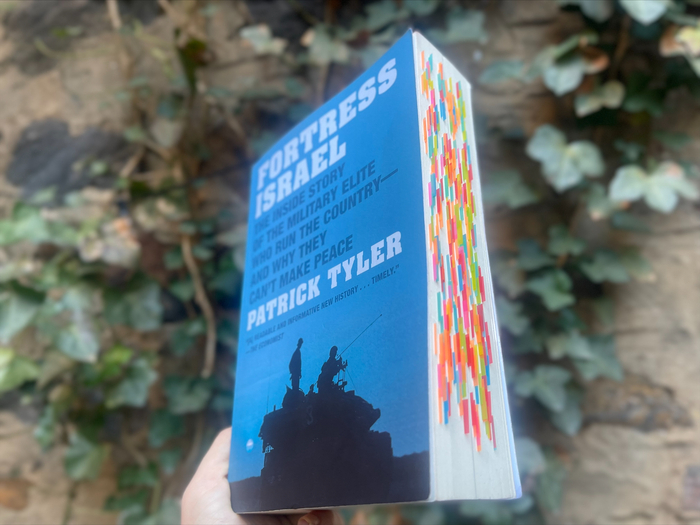
One might ask: where are the tabs related to violence against Israel? Where Hamas or Hezbollah harmed innocent civilians, and Israel's response was necessary and justified in hitting back to remove infrastructure and exact retribution? Those are fair questions, and there are certainly many instances of those events as well. But that doesn't negate the fact that Israel -- in addition to undertaking certain justified responses -- has a history of going past that point. And, sure, it's true that it's not always easy to distinguish whether an action is justified and/or helpful (and yes, those are separate things). This book doesn't claim to have definitive answers on each circumstance. But you can get an informed opinion, and if you do then you can certainly notice some repeating themes. That's why I add tabs for things like "Israel takes provocative action (that's not time-sensitive) as peace process gains momentum" -- see: Sharon at Temple Mount sparking the second Intifada after Arafat made more concessions than ever before; announcing huge new settlement blocs in contested area right as peace deal is about to be clinched; the assassination of Karmi, a militant leader who had been inactive, after months of a Hamas ceasefire. Each of those actions was a choice. Nobody forced their hand. And those were 3 tabs out of the 100+.
This is not the first time that Israel has declared war on Gaza and moved in to clear the "infrastructure" of terror. The infrastructure clearly came back. It will continue to come back again and again until there is finally a true political horizon for Palestinians — and one that’s offered by a government that’s not explicit about its desire to annex the West Bank. We all know that this is ultimately a conflict that the military cannot solve. If Israel continues to allow its military defense establishment to dictate its foreign policy, then it will only weaken its ability to successfully conduct the diplomacy that will be necessary to end this conflict.
For better or worse, Tyler's analysis wasn't particularly interested in the plight of the Palestinians. Instead, Tyler sees himself as wanting to help Israel help itself. He wants its leaders to wield and sustain diplomacy instead of robotically limiting itself to sheer military strategy. He sees national policy as being set by military technocrats -- who, on balance, lack aptitude or respect for diplomacy -- that live in an insular world where the main metric of success is lethal force. Almost every page of this book speaks to the idea that the military believes it can and should respond to every potential security threat with overwhelming force. Similar to all other militaries, the IDF operates under the rationale that it lets down country if it does not prepare for the worst case scenario. Similar to all other militaries, the IDF has a tendency to exaggerate complex and ambiguous developments and to inappropriately conflate them with threats to Israel's national existence. And of course it does all of this — it’s the military! It must always be *prepared* to respond. It must always have a plan. But political leaders can have their own potential diplomatic plans, too, and a political leader's main job is to set the country's strategy: do you decide to go with the military's exercise of sheer force, or do you rely on potential diplomacy instead? This is where Tyler comes in. He argues convincingly that Israeli political leaders rely on the military at the exclusion of diplomacy. Of course, this means that Israel overreacts to physically secure its borders and safety through military action. But military solutions can only ever be short-term solutions. Israel's military overreactions breed poverty, hatred, and intolerance among its neighbors. As a result, Israel -- a regional superpower, and one of USA's closest allies -- only acts against its own strategic interests when it continues to respond to threats as though its vulnerabilities haven’t changed since the '50s.
I usually tab my nonfiction books, but I took it a step further and color coded the tabs this time because I wanted to track a few themes that I knew were coming. See below for the tab legend.
Orange: Israel pursues military option where clear diplomatic action was available or not yet exhausted
Teal: Israeli military overrides or ignores Israeli gov't ("tail wagging the dog" -- see: Sharon) and/or Israeli gov't succumbs to military pressure due to domestic reelection concerns
Yellow: Israeli military action that was arguably unnecessary ends up creating new type of issue it must then contend with ("unintended consequences" -- classic example: Egypt turns to USSR for weapons)
Green: Israeli gov't or military takes particularly provocative (and not time-sensitive) unilateral action that disrupts peace processes that were gaining momentum
Dark Blue: Israel army purposefully lies after the fact (excluding instances where necessary for safety/strategy)
Pink: Israel acts at odds with USA interests or faces int'l condemnation (including from USA)
Light Blue: Israeli military censorship of the press
Red: Israel unwilling to participate (or disingenuously participates) in peace process
One might ask: where are the tabs related to violence against Israel? Where Hamas or Hezbollah harmed innocent civilians, and Israel's response was necessary and justified in hitting back to remove infrastructure and exact retribution? Those are fair questions, and there are certainly many instances of those events as well. But that doesn't negate the fact that Israel -- in addition to undertaking certain justified responses -- has a history of going past that point. And, sure, it's true that it's not always easy to distinguish whether an action is justified and/or helpful (and yes, those are separate things). This book doesn't claim to have definitive answers on each circumstance. But you can get an informed opinion, and if you do then you can certainly notice some repeating themes. That's why I add tabs for things like "Israel takes provocative action (that's not time-sensitive) as peace process gains momentum" -- see: Sharon at Temple Mount sparking the second Intifada after Arafat made more concessions than ever before; announcing huge new settlement blocs in contested area right as peace deal is about to be clinched; the assassination of Karmi, a militant leader who had been inactive, after months of a Hamas ceasefire. Each of those actions was a choice. Nobody forced their hand. And those were 3 tabs out of the 100+.
This is not the first time that Israel has declared war on Gaza and moved in to clear the "infrastructure" of terror. The infrastructure clearly came back. It will continue to come back again and again until there is finally a true political horizon for Palestinians — and one that’s offered by a government that’s not explicit about its desire to annex the West Bank. We all know that this is ultimately a conflict that the military cannot solve. If Israel continues to allow its military defense establishment to dictate its foreign policy, then it will only weaken its ability to successfully conduct the diplomacy that will be necessary to end this conflict.

May 23, 2018
Patrick Tyler has reviewed the entire history of Israel under a military lens. In doing so he's focused on the key dilemma for the State of Israel in coexisting with its neighbors: that a military force needs enemies to justify institutional power; that these must be provoked, if not exactly invented; and that survival of a military establishment is always equated with the survival of the nation it "serves." In doing so Israel has gone from the Zionist premise of secular Messiah to self-inflicted ghetto state; a deep and unrecognized irony as it now walls itself in the footsteps of old South Africa.
Tyler's concluding premise has it that Ben-Gurion, Golda Meir, Rabin, and other founders had a vision of integration with the larger Semitic world; a premise betrayed by the second and third generations following. But his own leader-by-leader survey of Israel's state and military policy belies this hopeful assertion that Israel has "lost its way." The trajectory seemed pretty well set from the start, with the "original sin" of Arab expulsion in Palestine, compounded by the Occupation and the spread of war to Lebanon. Israel has never accepted the neighborhood it moved into and lives in, continuing to see itself as a "nation apart". Its political and military leaders seem to consistently revel in the ensuing rejection, with peace offers as a disarming strategy to be pulled out and played at strategic moments.
Tyler mentions but does not dwell on how American life support has empowered this rejectionist stance, concentrating on Israel's internal military-political dynamics; for if truly left to its own devices Israel would have been forced to see peace more than war as necessary to its survival. Yet as long as Washington foots its bill and "guarantees" its security, Israel's war machine can project force to zany extremes of apocalyptic rhetoric and brutal invasions.
What's the end in sight? Unfortunately this is not a structured work of fiction, with a morally redemptive conclusion. Israel has bought time for seventy years. Yet Scripture teaches that a "man's life is fourscore and ten." Living longer takes recognition of one's age, its limits, and healthy precautions, not pipedreams of past glory. The call to make Israel great again finds echoes in its military sponsor, as the Israelization of American society - at this writing - also finds reflection in walls, threats, xenophobia, and missile-launched backstabbing.
Tyler's concluding premise has it that Ben-Gurion, Golda Meir, Rabin, and other founders had a vision of integration with the larger Semitic world; a premise betrayed by the second and third generations following. But his own leader-by-leader survey of Israel's state and military policy belies this hopeful assertion that Israel has "lost its way." The trajectory seemed pretty well set from the start, with the "original sin" of Arab expulsion in Palestine, compounded by the Occupation and the spread of war to Lebanon. Israel has never accepted the neighborhood it moved into and lives in, continuing to see itself as a "nation apart". Its political and military leaders seem to consistently revel in the ensuing rejection, with peace offers as a disarming strategy to be pulled out and played at strategic moments.
Tyler mentions but does not dwell on how American life support has empowered this rejectionist stance, concentrating on Israel's internal military-political dynamics; for if truly left to its own devices Israel would have been forced to see peace more than war as necessary to its survival. Yet as long as Washington foots its bill and "guarantees" its security, Israel's war machine can project force to zany extremes of apocalyptic rhetoric and brutal invasions.
What's the end in sight? Unfortunately this is not a structured work of fiction, with a morally redemptive conclusion. Israel has bought time for seventy years. Yet Scripture teaches that a "man's life is fourscore and ten." Living longer takes recognition of one's age, its limits, and healthy precautions, not pipedreams of past glory. The call to make Israel great again finds echoes in its military sponsor, as the Israelization of American society - at this writing - also finds reflection in walls, threats, xenophobia, and missile-launched backstabbing.

November 14, 2017
overlong and with too many biographical digressions and probably a little too much conjecture but overall an excellent history of Israel as a brutal and deeply arrogant (in the American sense) military state.
May 26, 2017
Good read. Sometimes one wonders it is a bit overblown account of Israels capability
December 15, 2019
Explains in detail the secret considerations of the Zionist state over the past 70years plus where the same brutal militaristic calculus has been enacted time and again.

October 20, 2013
The headlines over the past week have described an ongoing exchange of missiles between Israel and Hamas. It doesn't matter what day I wrote / posted this review – this isn't the first time something like this has occurred, and I doubt that there's anyone alive who believes it will be the last.
In “Fortress Israel”, Patrick Tyler reviews the history of the conflict between Israel and its Arab neighbors – and residents – going back to its founding in 1948. Readers who subscribe to the opinion that poor Israel is always getting picked on by those darned Arabs will probably hate this book. It makes a strong case that having geared up for a war mentality, the state and its leaders have a difficult time conceiving that there could be another option. It is important to stress that he presents a well documented argument that this stance applies to the government and not its citizens as a group.
Having read that previous paragraph, some potential readers that believe Israel is the devil incarnate sent to test the poor Arabs might rush out to grab this book, believing that they've finally found someone who clearly and sympathetically describes their viewpoint to the masses. These people will also be disappointed, for Mr. Tyler does not claim that anyone else in the region is blameless – not Egypt, not Syria, not the PLO or any other group claiming, justifiably or not, to represent the Palestinian people.
This book is quite lengthy, documenting the events and decisions that led up to the various wars fought by Israel. However, the book does not spend much time documenting the actual wars themselves – fans of non-fiction war books will probably be disappointed.
In my opinion, anyone willing to approach the situation in the Middle East with an open mind, who do not subscribe to the stances produced by the propaganda experts on either side of this contentious situation, will find a lot to think about in this book. Even then, “agree with” is probably too much to expect for everything covered in this book. I suspect that Mr. Tyler would consider his efforts to be a success if someone read the book, thought about it, and then disagreed with everything he wrote – as long as the “thought about it” part was sincere.
RATING: A solid 4 stars, and I was sincerely tempted to toss in an extra 1/2 star.
DISCLOSURE: I won this book in a contest; winners were encouraged to review the book, but there was no requirement to do so (nor, of course, was there any attempt to influence the rating).
In “Fortress Israel”, Patrick Tyler reviews the history of the conflict between Israel and its Arab neighbors – and residents – going back to its founding in 1948. Readers who subscribe to the opinion that poor Israel is always getting picked on by those darned Arabs will probably hate this book. It makes a strong case that having geared up for a war mentality, the state and its leaders have a difficult time conceiving that there could be another option. It is important to stress that he presents a well documented argument that this stance applies to the government and not its citizens as a group.
Having read that previous paragraph, some potential readers that believe Israel is the devil incarnate sent to test the poor Arabs might rush out to grab this book, believing that they've finally found someone who clearly and sympathetically describes their viewpoint to the masses. These people will also be disappointed, for Mr. Tyler does not claim that anyone else in the region is blameless – not Egypt, not Syria, not the PLO or any other group claiming, justifiably or not, to represent the Palestinian people.
This book is quite lengthy, documenting the events and decisions that led up to the various wars fought by Israel. However, the book does not spend much time documenting the actual wars themselves – fans of non-fiction war books will probably be disappointed.
In my opinion, anyone willing to approach the situation in the Middle East with an open mind, who do not subscribe to the stances produced by the propaganda experts on either side of this contentious situation, will find a lot to think about in this book. Even then, “agree with” is probably too much to expect for everything covered in this book. I suspect that Mr. Tyler would consider his efforts to be a success if someone read the book, thought about it, and then disagreed with everything he wrote – as long as the “thought about it” part was sincere.
RATING: A solid 4 stars, and I was sincerely tempted to toss in an extra 1/2 star.
DISCLOSURE: I won this book in a contest; winners were encouraged to review the book, but there was no requirement to do so (nor, of course, was there any attempt to influence the rating).

October 19, 2013
A fine look at the politico-military ideologies that have pervaded the Israeli government basically from its inception. It is indeed a top-heavy approach, favoring ministers and officers over all other players, but in that heft is a necessary density that mostly makes up for the one-sided approach. Also evident is a pro-peace, hindsight-laden cynicism toward Israel, though, especially through the depictions of the various leaders, this point of view comes across as appropriate, if for no other reason than to underscore the narrative of the work as a whole: that rampant militarism and a lack of gumption for peace has led Israel to its current wobbly geopolitical position, particularly in the Middle East. Still, there's more to societies than voting records would bear out, and I feel that could have enhanced Tyler's overall message a bit. In the end, though, this is a sobering reminder of the perils of ideological fervor and quagmire, especially when they fly in the face of harsh realities.

October 15, 2013
I received a free copy of this book through Goodreads Giveaways.
I found Fortress Israel to be a very detailed look at Israel's history, which I enjoyed very much. I didn't really know too much about the early history of Israel as a country and this went very deeply into that, from the very beginning to almost present day.
My problem with this book is, and you can actually tell by the title, that it is a very biased look into this history. It's written to put Israel's leadership in the worst light possible, so some of the situations are spun in such a way that you can't necessarily trust the way the author read into it. He is an expert on the area and the history, but the personal bias feels very think in some spots.
So a really well researched and well documented look into the history of Israel, but take some of the negative spin with a grain of salt and read some other books to get the real picture.
I found Fortress Israel to be a very detailed look at Israel's history, which I enjoyed very much. I didn't really know too much about the early history of Israel as a country and this went very deeply into that, from the very beginning to almost present day.
My problem with this book is, and you can actually tell by the title, that it is a very biased look into this history. It's written to put Israel's leadership in the worst light possible, so some of the situations are spun in such a way that you can't necessarily trust the way the author read into it. He is an expert on the area and the history, but the personal bias feels very think in some spots.
So a really well researched and well documented look into the history of Israel, but take some of the negative spin with a grain of salt and read some other books to get the real picture.

January 3, 2013
The book begins with motorcycle-borne Mossad assassins racing through the crowded streets of Tehran targeting Iranian nuclear scientists.
In the following pages, the script switches to biographical sketches of the Israeli prime ministers and their engagement in the Middle East conflict. Sabra, a tough cactus, is the title ascribed to the rough and tumble military elite who have guarded this narrow strip of land since 1948; sabra captures the mindset of the Israelis and their aggressive approach to defending their nation.
Much of the book goes into the delicate relationship that Israels maintain with the United States and this segment alone warrants reading the book. There is also a short section that discusses the Shi'a Muslim mindset and the impact of this worldview.
In the following pages, the script switches to biographical sketches of the Israeli prime ministers and their engagement in the Middle East conflict. Sabra, a tough cactus, is the title ascribed to the rough and tumble military elite who have guarded this narrow strip of land since 1948; sabra captures the mindset of the Israelis and their aggressive approach to defending their nation.
Much of the book goes into the delicate relationship that Israels maintain with the United States and this segment alone warrants reading the book. There is also a short section that discusses the Shi'a Muslim mindset and the impact of this worldview.

March 13, 2014
I broadly agree with Tyler's thesis that Israel is hindered in its pursuit of a lasting peace by the strength of the military culture established by Ben Gurion et al. I had two problems with the book; the Sparta analogy is horribly laboured and there is no serious attempt made to understand behaviour that does not support the thesis. Rabin, for example, is presented, quite rightly, as a stalwart of the military establishment; however Tyler does not provide any real insight into why he was also keen to begin the Oslo process. This simplistic approach leads to most of the key players appearing cartoonish (Peres is arrogant and snobbish, Barak is ignorant, Sharon is a monster, Olmert is useless). I felt that any human complexity was removed. That said, the book is good but needs to be read alongside other works on the Israel/Palestine problem to get the full picture.

January 5, 2015
An excellent account of modern Israeli strategic thinking that shows the militaristic mental trap that Israel's leaders are in collectively that makes it very difficult for them to make peace with the Palestinians. It shows how this trap developed especially from 1955 when Moshe Sharett Israel's second Prime Minister was overwhelmed a military faction within his government backed by his predecessor David Ben Gurion.
It shows how this trap has caused Israel's leaders to miss many chances to make peace and has led to repeated futile attempts to impose a military solution on a political problem.
It shows how this trap has caused Israel's leaders to miss many chances to make peace and has led to repeated futile attempts to impose a military solution on a political problem.

January 30, 2017
O Izraelu lubię czytać ze względu na determinację ludzi, kórzy żyją w sumie w większości na pustyni, bronią się przed ekstremizmami, chociaż sami też podchodzą do wielu spraw ekstremalnie. Mając za sobą niemal godzinne "przesłuchanie" i "rewizję" na granicy z Egiptem doceniam służby mundurowe, wojsko, Mosad i ludzi, którzy walczą o swój kraj. Książka ciekawie pokazuje kulisy wojskowego lobby w Izraelu, rozgrywki polityczne i szpiegowskie. Bez wychwalania, krytycznie i obiektywnie
October 19, 2013
What's past is prologue. Putin by another name is poised to take over countries from the old USSR. Narrative takes us back 30 years to a young Jack Ryan, Sr. in the Cold War and current days with Jack Ryan, Jr. in the field and Jack Ryan, Sr. in the White House. A good last book in the series, please!

August 15, 2013
A flawed book in some instances, such as the focus on the Soviets arming Iraq under Hussein, but no mention of the U.S. and British arming him too. Overall though, an interesting insight into the machinations of the Sabra elite.

October 15, 2013
I received a free copy of this book through Goodreads Giveaways.
I found Fortress Israel to be a very detailed look at Israel's history, which I enjoyed very much.
I found Fortress Israel to be a very detailed look at Israel's history, which I enjoyed very much.
February 23, 2015
A brilliant piece of work in to the mindset and philosophies of the nation of Israel. Gives you a lot of insights on how and why Israel has shaped its foreign policies ever since its independence.
October 19, 2013
Interesting read!
Displaying 1 - 21 of 21 reviews