

What do you think?

Pandora
Pandora has been warned about the forbidden jar. Although she is surrounded with gifts and has rooms, gardens, and a courtyard to explore, Pandora is drawn to one room--the one that holds that jar. Is Pandora’s curiosity a curse?
In a seamless blend of prose and verse--and drawing from traditional mythological sources--Robert Burleigh dramatically tells Pandora's story for young readers. Complemented by Raul Colón's bold illustrations, Pandora is an unforgettable introduction to the classic myth.
In a seamless blend of prose and verse--and drawing from traditional mythological sources--Robert Burleigh dramatically tells Pandora's story for young readers. Complemented by Raul Colón's bold illustrations, Pandora is an unforgettable introduction to the classic myth.
32 pages, Hardcover
First published May 1, 2002
About the author
Robert Burleigh
74 books47 followersOver the past 35 years, I have published poems, reviews, essays, many filmstrips and videos, and more than 40 children's picture books.
Born and raised in Chicago, I graduated from DePauw University (Greencastle, Indiana) and later received an MA in humanities from the University of Chicago. I've published books for children since the early 1990s. My books - including numerous unpublished ones! - run a broad gamut, from stories geared for pre-schoolers to survival stories and biographies aimed at seven to eleven-year-olds. My work is wide-ranging because, basically, I'm a generalist by experience - and inclination!
In addition to writing, I paint regularly under the art name Burleigh Kronquist and have shown work in one-person and group shows in Chicago, New York, and elsewhere around the country.
-from robertburleigh.com
Born and raised in Chicago, I graduated from DePauw University (Greencastle, Indiana) and later received an MA in humanities from the University of Chicago. I've published books for children since the early 1990s. My books - including numerous unpublished ones! - run a broad gamut, from stories geared for pre-schoolers to survival stories and biographies aimed at seven to eleven-year-olds. My work is wide-ranging because, basically, I'm a generalist by experience - and inclination!
In addition to writing, I paint regularly under the art name Burleigh Kronquist and have shown work in one-person and group shows in Chicago, New York, and elsewhere around the country.
-from robertburleigh.com
Ratings & Reviews
Friends & Following
Create a free account to discover what your friends think of this book!
Community Reviews
Displaying 1 - 26 of 26 reviews

January 9, 2021
Admittedly, I do not have a good foundation in Greek mythology, something I frequently regret in my vast reading. This picture book was an incredible way to absorb Pandora’s mythical tale. As always, I was enchanted by Raúl Colón’s illustrations which melded perfectly with a story from so, so long ago.
My only critique of the book is that I worry that parents may be lured into thinking it is good for toddlers and young children because it is in picture book form. If a focus is placed on the art and words are edited down in the reading, it could be a good introduction. However, this telling will be appreciated more by older children and adults, those with a more developed vocabulary and a tolerance for more lengthy stories.
My only critique of the book is that I worry that parents may be lured into thinking it is good for toddlers and young children because it is in picture book form. If a focus is placed on the art and words are edited down in the reading, it could be a good introduction. However, this telling will be appreciated more by older children and adults, those with a more developed vocabulary and a tolerance for more lengthy stories.

February 26, 2022
Pandora can't stop thinking about the jar. What is in it? Why have the gods instructed her to keep the jar closed? What if she just gave it a peek?
A beautifully illustrated version of a classic myth.
A beautifully illustrated version of a classic myth.

June 30, 2022
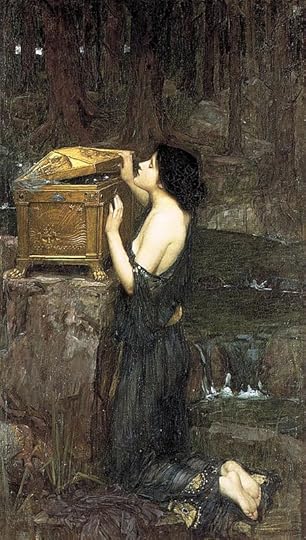
I love the story because anything that comes out of the box, could never be put back into the box. This is true to reality, once an evil is known to the world, it could never be eliminated. We see different evils spring up even today, it'll never get be gone but we still don't lose hope, it's our human nature. The illustrations are ehhhhh.

March 17, 2009
Beautiful images but the telling is poetic rather than dramatic and not as well suited to reading aloud as I had hoped it would be.
Read
November 6, 2016Title (italicize): Pandora
Author: Robert Burleigh
Illustrator (if separate from author): Raul Cólon
Genre: Myth
Theme(s):
Greek Mythology
Evil
Hope
Desire
Curiosity
Opening line/sentence (type directly from text):
Foreword:
It was a long, long, long ago.
Opening:
What was in the jar?
Brief Book Summary (2-3 sentences in your own words):
This myth tells the popular story of Pandora and her forbidden box and explains why destruction exist in our world. Throughout the book the reader follows Pandora as she contemplates and fights with herself as whether or not to look in the jar. Eventually she decides to and all the evils escape in the world but she is still left with hope.
Professional Recommendation/Review #1 (cut & paste):
Andrea Sears Andrews (Children's Literature)
This is the story of the classic Greek myth of Pandora, the beautiful woman obsessed with her own curiosity and ultimately tempted to satisfy it. The author gives a good explanation of the myth's origins at the beginning of the book as well as a glossary of Greek gods' names. All of this not only helps the reader understand the plot better, but also the magnitude of Pandora's crime. The text is almost poetic in its verse-like design. Language is used carefully, precisely and pointedly. This adds to the suspense of the story as the reader feels Pandora's temptation rise. The illustrations resemble gallery oil paintings as each is carefully framed on a page. The entire book gives an aura of seriousness and concern; the magnitude of Pandora's weakness is appreciated. Older children will understand the moral behind this story and acknowledge the strength of temptation and the power of hope. It is a book to be discussed. 2002, Harcourt, $16.00. Ages 6 to 10.
(PUBLISHER: Silver Whistle (San Diego:), PUBLISHED: c2002.)
Professional Recommendation/Review #2 (cut & paste):
Gillian Engberg (Booklist, Jun. 1, 2002 (Vol. 98, No. 19))
The team that created Hercules (1999) offers another fine retelling of a Greek myth. A list of characters and a brief, lyrical foreword give the background, while the story stays focused on the drama of Pandora's longing to open the box and her terror after she succumbs to temptation. In the end, she's left with not only hope but also a steely determination to act and create positive change: "She and her people would find a way." Burleigh gets to the root of the story in spare, poetic language that reads like blank verse. Several of Colon's illustrations, in his signature style (textured, jewel colors and strong forms), lack some of the story's robust immediacy and action, but they are artfully composed, borrowing details from Greek art images, and will show well to a crowd. An elegant, accessible addition to mythology collections and curricular studies. Category: Books for Middle Readers--Nonfiction. 2002, Harcourt/Silver Whistle, $16. Gr. 3-6.
(PUBLISHER: Silver Whistle (San Diego:), PUBLISHED: c2002.)
Response to Two Professional Reviews (3-4 sentences in your own words):
Both reviews note the poetic language of the book, that really allows for the story to flow and for the reader and audience to easily read and listen to this story. There are a lot of different Greek myths and sometimes it may be confusing to keep them straight, but this telling really takes in the reader to want to listen and understand the story and moral. I agree with Andrea Sears Andrews as she points out that this language is used intelligently to add suspense as the story progresses and the reader really gets in the mind of Pandora and is fighting this temptation with her. Both reviewers also point out the list in the beginning of the book explaining who the different Greek Gods are, this was a great way to start the book and aids the readers to understand the story in whole without missing information or becoming confused.
Evaluation of Literary Elements (3-4 sentences in your own words):
As the reviewers pointed out, Burleigh uses poetic language in writing the story as it is actually broken up into verses on the pages allowing the readers to follow the story easily. In addition, the valued thoughts in Pandora’s head are italicized, again helping the reader be able to grasp the story and to understand Pandora’s actions and struggles. The illustrations are also beautifully done as they are detailed and convey a lot of Greek culture.
Consideration of Instructional Application (3-4 sentences in your own words):
This is a exquisitely written story explaining the morals of Pandora’s box, however the language and lessons of the book are better taught to older elementary students if not middle school students. I think this book would fit nicely into a unit on the Greek Gods, it would be even better for the students to have preexisting basic knowledge on the different gods to be able to understand the story in its full. (There is the list at the beginning but just reading this to the students once will not allow them to fully take it in and actually know all of the different Gods.) After reading the story a-loud, I would have the students journal about whether or not they would honestly open the jar or not and to contemplate if Pandora was right or wrong. After the students were done, I would have them share with a partner or their tables their responses and reasonings.

April 10, 2022
I was unfamiliar with the Pandora myth when I picked up this children's book version of it, but wow - I am so glad this was the book I chose as my first exposure. Beautifully written, with soft and true-to-style illustrations, the story was told in both a compelling and sensitive manner. Children and adults both will enjoy it, I believe.

May 14, 2018
Reading a whole bunch of folktales for the ability the tell fascinating tales to my grands.
Check out 398.2 in the juvenile section
Check out 398.2 in the juvenile section
Read
March 9, 2017Burleigh, Robert. Pandora. (2002) Many people know the saying, “You’ve just opened Pandora’s box”, but what does it mean? We are told that Pandora was created from clay by the Gods who then breathed life into her. Each God gave her a gift, some of which are beauty, talents, and curiosity. The Gods have also placed a beautiful jar in Pandora’s home with the caveat that the jar never be opened. The knowledge that the jar must never be opened makes it all that much more intriguing to Pandora. Will she succumb to her curiosity, and if she does, what wondrous or terrible thing will she find in the jar. In this richly illustrated book the illustrations prove that the Gods really did create a beautiful Pandora, as well as the earthly world around her. Uncover the myth of how evil and hope entered the world. This story can generate discussions for all ages regarding trust, curiosity, temptation, good, evil, and hope. Tailor your discussion to your audience. Target Audience: 8-adult

December 17, 2012
Summary: This book is about the classic Greek Myth of Pandora, a girl who is much too curious for her own good. She is tempted by Zeus with a box that she is told not to open. Being the curious person she is, Pandora opens the box and supposedly releases all evil into the world. The only thing that is left at the end is hope.
Commentary: The best part of this book was when hope remained inside the box, representing that with all evil there will always be hope. This book honestly only captured my attention with the illustrations. I didn't care for the myth because it was plain and boring, as most stories with lessons tend to be. This book is very similar to the short story of Narcissus, a handsome Greek man who gets turned into a flower because of his self-obsession. Both stories have great lessons to them and are in the same time period but are otherwise completely different.
The author really could improve this novel by bringing it into a modern-day format so more people can relate to it.
Overall, This book was alright but it wasn't the best read.
Quotes: "What was in the jar?/The jar that was closed tight/And not to be opened!/What was in the jar?/It was all Pandora could think of!" - This was probably my favorite quote because it captures the main point of the whole story.
Commentary: The best part of this book was when hope remained inside the box, representing that with all evil there will always be hope. This book honestly only captured my attention with the illustrations. I didn't care for the myth because it was plain and boring, as most stories with lessons tend to be. This book is very similar to the short story of Narcissus, a handsome Greek man who gets turned into a flower because of his self-obsession. Both stories have great lessons to them and are in the same time period but are otherwise completely different.
The author really could improve this novel by bringing it into a modern-day format so more people can relate to it.
Overall, This book was alright but it wasn't the best read.
Quotes: "What was in the jar?/The jar that was closed tight/And not to be opened!/What was in the jar?/It was all Pandora could think of!" - This was probably my favorite quote because it captures the main point of the whole story.
This entire review has been hidden because of spoilers.
March 15, 2011
I have read yet another wonderful Greek Myth. This book was absolutely amazing. Many people often have heard the term Pandora's Box, but yet so few understand where that term came from. This book would be appropriate for children of all ages and also for the curious adult. The artwork was beautiful and you could truly imagined life as it was thousands of years ago. We could easily relate to the enchanting Pandora and the conflicts that she felt in regards to the jar. She was told not to do so, but don't we all sometimes want to know the truth or contradict what we are told. She gives into her temptations and we yet again learn that doing so often comes with reprecussions. The moral of the story was fabulous as well. When all else has escaped us and all has gone wrong, what we are left with, is hope. The artwork was full of detail, yet it had a grainy and dreamlike quality to it. I absolutely adored this book.
November 13, 2013
Pandora is the story of the first woman on Earth, according to Greek myth. Pandora had a mysterious jar in her room that she was very curious about. Many warned her about the dangers of opening it and advised against it. She was tempted, but was very cautious. One day, she felt emboldened to open it up and see what was hiding inside. Terrible energies such as desire, greed, anger, lies, and other types of harmful evil things escaped. Pandora struggled to put the lid back on and managed to do so. Afterward, a voice from the jar told her “I am hope, and I remain.” Pandora vowed to be brave in this dangerous new world and hang on tightly to her jar of hope.
Pandora can be used when discussing Greek civilization and Greek mythology. It is written at a 3rd-4th grade level.
Pandora can be used when discussing Greek civilization and Greek mythology. It is written at a 3rd-4th grade level.

August 20, 2015
This is a wonderful retelling of the Pandora myth. I love the illustrations by Raul Colon. They perfectly complemented Burleigh's inspired text. We read this as a part of our lesson for the day. The story was a perfect segue to a discussion of various Creation viewpoints. Naomi was a bit frightened at Burleigh's description of Pandora's curiosity, the continued temptation of the jar and the subsequent release of evil into Pandora's world. The swirling illustration is quite vivid, as is the fear on Pandora's face. Hope remaining in the jar is a very important life-lesson. There is always "hope" for a brighter day, in spite of the darkness surrounding one.

June 17, 2014
The story is told in a lyrical style that I would have loved to have heard recited in the traditional Greek bard style. Burleigh has obviously researched his traditional Greek tragedies, and it shows as the inevitable downfall builds and builds up with exquisitely wrought quick phrases that convey action and descriptives that layout a beautiful world about to go downhill.
But it isn’t just the words – the pictures are done in a style that brings mosaics to life, every detail showing ancient Greece with soft colored pencils that still somehow show the tension in the air.
October 21, 2010
This classic Greek myth tells of Pandora who cannot refuse her curiosity as it builds over time. In the end she opens the mysterious jar that she has been forbidden to open and all the ills of the world escape. One small voice remains in the jar; it is hope. The Pandora myth parallels the story of Eve in the Garden of Eden where she succumbs to temptation and eats the forbidden apple from the tree of life.

April 1, 2011
The illustrations in this book are very beautiful, but I really didn't enjoy the story. It had a negative feel to it as I read it, but it did have a good moral to the story at the end.
The book was about gods and goddesses. Pandora was the first woman to be made, and was made the wife of Epimetheus. Epimetheus was very happy, but Zeus was very angry because he felt Epimetheus and taken what belonged to the Gods.
The book was about gods and goddesses. Pandora was the first woman to be made, and was made the wife of Epimetheus. Epimetheus was very happy, but Zeus was very angry because he felt Epimetheus and taken what belonged to the Gods.
February 12, 2012
This folklore tale is a story geared towards Primary (P) aged children. It is the tale of the very curious Pandora and the forbidden jar. I gave this classic five stars as it has a very clear and concise plot for children to understand and relate too. The use of language is clear and easy to understand. The illustrations are very appealing to young readers and they appear mysterious and fitting along with the story.
December 10, 2007
Summary: Pandora is curious of ow she was created. Out o curiousity she opens the jar and greed and needs fill the world. All she is left with is hope.
Reflection: Great reproduction of the myth. Voice inflections will make this more meaningful.
Theme/Connections: Mythology, trust, temptation
Reflection: Great reproduction of the myth. Voice inflections will make this more meaningful.
Theme/Connections: Mythology, trust, temptation
Read
November 27, 2013Very good ! This amazing book is the book which a curious child or every child's, looking for ! Children and even adults like to find out about the things that a girl can't open and will she open. The things that's good is the expressive words ! It has persuade more people to read it !
April 22, 2010
This book is a mythological tale about Pandora opening a jar resulting in evil to be spread throughout the world. This reminds me of other mythological tales I have read in the past.

June 7, 2011
“Curiosity killed the cat” is the theme of the classic myth of Pandora. This is a Greek myth I enjoy and unfortunately, can relate to.

August 2, 2011
About giving in to the temptation of opening the pot that she was forbidden to open. Once opened bad things entered the world, yet she learned that there was also hope.

July 18, 2012
Everyone should know the story of Pandora. A bit long, great art.

October 6, 2012
Pandora was a curious person. So naturally she could not help what was in the jar. She tries to resist but the curiosity is to great. What could possibly be in the jar?

November 22, 2009
Written all in verse.
April 30, 2017
Title: Pandora
Author: Robert Burleigh
Illustrator: Raul Colón
Genre: Myth
Theme(s): Pandora, Greek, Mythology,
Opening line/sentence:
“What was in the jar?”
Brief Book Summary (2-3 sentences in your own words):
Pandora was curious and eager to find out what was in the jar that she saw in her room. Despite the warnings from her husband and her servant, Pandora opened the jar and released everything bad in the world and held onto hope in the jar.
Professional Recommendation/Review #1:
Andrea Sears Andrews (Children's Literature )
This is the story of the classic Greek myth of Pandora, the beautiful woman obsessed with her own curiosity and ultimately tempted to satisfy it. The author gives a good explanation of the myth's origins at the beginning of the book as well as a glossary of Greek gods' names. All of this not only helps the reader understand the plot better, but also the magnitude of Pandora's crime. The text is almost poetic in its verse-like design. Language is used carefully, precisely and pointedly. This adds to the suspense of the story as the reader feels Pandora's temptation rise. The illustrations resemble gallery oil paintings as each is carefully framed on a page. The entire book gives an aura of seriousness and concern; the magnitude of Pandora's weakness is appreciated. Older children will understand the moral behind this story and acknowledge the strength of temptation and the power of hope. It is a book to be discussed.
Professional Recommendation/Review #2:
Kirkus (Kirkus Reviews, May 1, 2002 (Vol. 70, No. 9))
The myth of Pandora is told in compelling free verse with striking, colored-pencil and watercolor illustrations. Burleigh sticks fairly close to his sources, choosing the jar, rather than the box, as the thing-that-must-not-be-opened. It's made clear that Zeus seeks to punish humankind for receiving fire from Prometheus; it is Prometheus' brother who receives Pandora (her name means all-gifted) as his wife. She's beautiful and has many skills, but is obsessed by the jar that she must not open. Why, she reasons, would the goddess Athena give her "the power to think and wonder-And order her not to use it?" She opens the jar, and all manner of evil escapes. Only hope is left behind. Colon uses his colors lightly to show the texture of the paper, creating wonderful, almost iridescent effects: rich purples, golds, blues, and greens. Very different in tone and effect from the lyrical Dora's Box (1998), this is darker but still accessible, though it may have trouble finding its audience because of its mature treatment
Response to Two Professional Reviews (3-4 sentences in your own words):
I agree with both reviews that this specific version of Pandora is written in a poetic way and that the illustrations and words keep the attention of the audience. But, I do not fully agree with the second review that it has mature content. I believe this content can teach children about mythology and why mythology exists.
Evaluation of Literary Elements (3-4 sentences in your own words):
The literary element I enjoyed the most was the verse writing of the story itself. It makes the story flow and build suspense. I also like the texture effect of the illustrations because it gives the illustrations a more realistic look.
Consideration of Instructional Application (3-4 sentences in your own words):
This is a good story to teach a lesson on different types of mythology. This is Greek mythology, but other stories can be used to teach about other mythological origins. A teacher could make a text set of different types of myths and compare and contrast with the class about mythology from different eras or origins.
Author: Robert Burleigh
Illustrator: Raul Colón
Genre: Myth
Theme(s): Pandora, Greek, Mythology,
Opening line/sentence:
“What was in the jar?”
Brief Book Summary (2-3 sentences in your own words):
Pandora was curious and eager to find out what was in the jar that she saw in her room. Despite the warnings from her husband and her servant, Pandora opened the jar and released everything bad in the world and held onto hope in the jar.
Professional Recommendation/Review #1:
Andrea Sears Andrews (Children's Literature )
This is the story of the classic Greek myth of Pandora, the beautiful woman obsessed with her own curiosity and ultimately tempted to satisfy it. The author gives a good explanation of the myth's origins at the beginning of the book as well as a glossary of Greek gods' names. All of this not only helps the reader understand the plot better, but also the magnitude of Pandora's crime. The text is almost poetic in its verse-like design. Language is used carefully, precisely and pointedly. This adds to the suspense of the story as the reader feels Pandora's temptation rise. The illustrations resemble gallery oil paintings as each is carefully framed on a page. The entire book gives an aura of seriousness and concern; the magnitude of Pandora's weakness is appreciated. Older children will understand the moral behind this story and acknowledge the strength of temptation and the power of hope. It is a book to be discussed.
Professional Recommendation/Review #2:
Kirkus (Kirkus Reviews, May 1, 2002 (Vol. 70, No. 9))
The myth of Pandora is told in compelling free verse with striking, colored-pencil and watercolor illustrations. Burleigh sticks fairly close to his sources, choosing the jar, rather than the box, as the thing-that-must-not-be-opened. It's made clear that Zeus seeks to punish humankind for receiving fire from Prometheus; it is Prometheus' brother who receives Pandora (her name means all-gifted) as his wife. She's beautiful and has many skills, but is obsessed by the jar that she must not open. Why, she reasons, would the goddess Athena give her "the power to think and wonder-And order her not to use it?" She opens the jar, and all manner of evil escapes. Only hope is left behind. Colon uses his colors lightly to show the texture of the paper, creating wonderful, almost iridescent effects: rich purples, golds, blues, and greens. Very different in tone and effect from the lyrical Dora's Box (1998), this is darker but still accessible, though it may have trouble finding its audience because of its mature treatment
Response to Two Professional Reviews (3-4 sentences in your own words):
I agree with both reviews that this specific version of Pandora is written in a poetic way and that the illustrations and words keep the attention of the audience. But, I do not fully agree with the second review that it has mature content. I believe this content can teach children about mythology and why mythology exists.
Evaluation of Literary Elements (3-4 sentences in your own words):
The literary element I enjoyed the most was the verse writing of the story itself. It makes the story flow and build suspense. I also like the texture effect of the illustrations because it gives the illustrations a more realistic look.
Consideration of Instructional Application (3-4 sentences in your own words):
This is a good story to teach a lesson on different types of mythology. This is Greek mythology, but other stories can be used to teach about other mythological origins. A teacher could make a text set of different types of myths and compare and contrast with the class about mythology from different eras or origins.
Read
June 27, 2018The story of Pandora, the first woman created by the gods and the jar she was told to never open. But Pandora is overcome with curiosity and eventually gives in and opens the jar. Bad things like war and death and lies escaped the jar and went out into the world. Only 'hope' remained in the jar.
Displaying 1 - 26 of 26 reviews