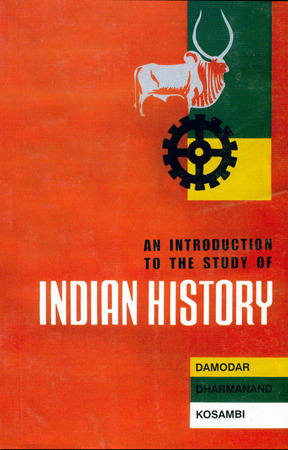
In An Introduction to the Study of Indian History, the author uses a scientific methodology and contemporary techniques of interpretation for the readers to understand Indian history in a more systematic manner. This was one of the few books which propagated the fact that Indian history cannot be studied in a manner similar to the study of European history. The author has written the book in his unique style and with generous use of examples, which makes it easy for students to understand the subject. This book is an ideal read for advanced students and scholars of Indian history.
Damodar Dharmananda Kosambi (31 July 1907 – 29 June 1966) was an Indian mathematician, statistician, philologist, historian and polymath who contributed to genetics by introducing Kosambi map function.He is well known for his work in numismatics and for compiling critical editions of ancient Sanskrit texts. His father, Dharmananda Damodar Kosambi, had studied ancient Indian texts with a particular emphasis on Buddhism and its literature in the Pali language. Damodar Kosambi emulated him by developing a keen interest in his country's ancient history. Kosambi was also a Marxist historian specialising in ancient India who employed the historical materialist approach in his work.He is particularly known for his classic work An Introduction to the Study of Indian History.
He is described as "the patriarch of the Marxist school of Indian historiography".Kosambi was critical of the policies of then prime minister Jawaharlal Nehru, which, according to him, promoted capitalism in the guise of democratic socialism. He was an enthusiast of the Chinese revolution and its ideals, and, in addition, a leading activist in the World Peace Movement.
D.D.Kosambi is credited with guiding Indian history into a new critical direction resulting in new perspectives. Basically trained as a mathematician, Kosambi brought the same method of rigor and intuition into the study of history. He understood history in terms of the dynamics of socio-economics processes. He presents history as a chronological order of changes in the productive base and its impact on the superstructure on the Indian subcontinent.
The first two chapters act as a guide to anthropological field work and how some surviving religious practices and cults give an insight into the pre-class phase of Indian prehistory. He then starts with the foundation of Indus cities and tracks the changes in society, economy and culture in the subcontinent until the British imperialism. His writings on tribe and caste, Buddhism and the modes of ownership in Indian feudalism are very insightful.
The book is somewhat outdated and contains some misrepresentations but is not obsolete. It is especially important in this day where falsification and misrepresentation of history has become an important part of political and commercial rhetoric. Another problem in this book is same as with many books on Indian history, that it is centered on Indo-Gangetic plain and doesn’t give much insight into south Indian history except that of Satavahanas and the Vijayanagara empire.
Lastly, this is an analytical work and I wouldn’t recommend this if you are looking for a narrative Indian history written in an engaging style.
In these times of available but 'uncertain' information; where false facts and artifacts depicting false livelihood of us are shared on public platforms in the name of nationalism so as to gain nothing but petty political bets, this book is a must read for one and all.
This is one of the truest historical accounts of the people (and not just the kings and princes) from whom we have inherited this land -- the ways and trends of which were never stagnant, but for the people of lowest class and caste who could never come out of constant state of suppression. They had to work and pay and didn't matter whether it was to the mythical Aryan leader 'Indra' -- the reliever of 5 rivers, or to an English viceroy.
Busting many prevalent myths of 'Hindu' tradition, a word which only came into use much later, (for even Buddhist didn't call them so!)and with novel methods of ascertaining dates, which never before could be done, D. D. Kosambi was able to give the glimpse of the ancient Indian society out of the courts and diwans of emperors and kings. That how Aryans and Non-Aryans co-mingled and formed the clans we attach ourselves to; that never before or afterwards, something as stupendous an economic system as that of Mauryan's could be replicated; that Asoka did not completely formed a 'Buddhist state'; that how Gupta's age was not so golden after-all; and that how 'the seeds of feudalism sown during the implementation of Arthshastra, gave bitter fruits after 2000 years; that how great empires declined to give rise to small molecules under petty chiefs; and that how the bourgeoisie of the British Empire never allowed any Indian bourgeoisie to flourish, are some of the beads of the necklace this book represents.
Kosambi was able to distinguish between the Feudal structures of Europe and India in exact detail. He was able to explain the concept of two types of Feudalism which came into force here -- Feudalism from above and later, Feudalism from below.
That the basic assumption of this work that all that happened was because of the basic quest for the control of the 'means of production' (and thus of life), was proved right by Mr. Kosambi, as he presented the tale of the'people who talk of atomic age while rubbing elbows of fellow countrymen still in tribal state.'
Should one look for a Kuhn-ian paradigm shifter in Indian Historiography, a figure from outside a field (literally in this case), who altogether alters the direction of thought and pursuit, by introducing new ideas (here, social relations of production), and calling an end to a much-saturated normal science (a nationalist-colonial paradigm where a nameable few typically good or bad: kings and poet-priests who stand apart from an unknown mass of past people constitute history). In Kosambi’s work, the first set of plates are photographs of potters on their wheels, tools of salt-manufacturers, and tanners, and of course his beloved ploughs and harrows from different parts of contemporary India. No mean historian, Kosambi, in his work keeps the amateur’s love for the discipline still alive and lets it breathe in some occasions, e.g. his discussion of folk worship (which to him resembles the religion from the primitive tribal mode of production of the prehistoric Indian) citing examples of aniconic deities (that stand as mere rocks with eyes placed upon them) in Poona, all of which one can be sure he located in the neighbourhoods around his residence. In much zest, he introduces the five stages of production (out of which slave society was apparently always absent of India), that characterised the historical development of human (European) society for Marx, to Indian History. Kosambi in no uncertain terms clarifies that culture and all its constitutent limbs (language, forms of worship, ideology, political aims and prerogatives, literature and art) function as superstructure (they do of course exert influence on the material base, but the latter remains the original cause).
While the book is dense with ideas and concepts that were hitherto not thought of in historiography, I will mention just two trajectories that make up Ancient India’s path for him: the unraveling of the plough as a key means of production and thus expansion of agrarian rural economy, and its cultural parallel: the development of a composite Brahminism. Preharappan primitive Indian society was to him severely totemistic (and thus also all contemporary indigenous communities whether hunting-gathering or not) and all obsession with particular living beings are signs of this totemistic propensity: the cow for the Brahmin and the horse in the name of the Satavahana. The first serious agricultural society was Indus Valley, whose sites barring Harappa and Mohenjodaro apparently never exceeded 25 acres (which we now know to be completely false), bears no extensive string of written data, and not much evidence of true record-keeping. All these features meant for Kosambi a monopoly of surplus, limited transactions between families and groups, and no sharp transformation in socio-economic status of communities, stemming from limited surplus, in turn caused by the non-availability of the plough. Thus when the Rig Veda mentions sita, the plough, it becomes its most important defining feature. Videgha Mathava’s and in the Mahabharata, Arjuna’s burning of the forest in the Kuru-Pancala area and introduction of the plough is mirrored by the usage of two gotra names by some Brahmin characters in the texts. Both these phenomenon in different degrees of transparency, signify the replacement of matrilineal hunting-gathering or primitive agriculture communities by patrilineal sedentary Brahminical societies. Much later, the Arthasastra referral of sharecropping as Arthasitika and its prescription of placing Sudras a labourers on Sita villages all evidence the conquest almost of the plough over other means of production. The plough as much as was an Aryan introduction in Vedic society, in turn transformed it. By raising surplus, it turned agriculture into a more capacious trade. All communities could and had to participate in it, and thus also partake in its productivity. Thus also, Kosambi remarks, the Vedic Yajna an elaborate institution for the wellbeing of the raja was simplified initially into Srauta rituals and finally into gift-giving. Brahminism – not so much a faith as a means of production here – uncorked a process that transformed itself. The introduction of the plough in the Magadha area also spelled a loosening of caste positions in Kosambi’s reading. This is visible not just in the obvious critique of Vedic sacrifice by Buddhism and Jainism but in the foundation of the Magadhan state. Magadha’s vanquishing of other Janapadas was for our scholar a replacement of a Brahmin-Ksatriya North Indian more by non-varna Magadhan elite (where he gets surprisingly close to Bronkhorst’s thesis). Yet this was once again not to be taken as a religion replacing another, for the Sramana systems of thought brought with them shifts to Brahminical modes of production and attitudes to pre-existing modes. The favouring of the Gahapati donor and the prohibition of stealing all in the name of Dharma marked a shift from a collectivist (albeit highly hierarchical and even oppressive) share of surplus to possibilities of private proprietorship of surplus. By the turn of the common era, this was where composite Brahminism and the Plough mode of production stood.
Dhamodar Dharmanand Kosambi ,the Marxist historian who criticised Karl Marx in relation with Asiatic Mode of Production attempts to compare the social system of India with Medieval Europe in the means of production based on feudal mode.The period he begun from Harappan civilization and he ends it in the 6th CAD.That his majour arguements put forward by him is feudalism from above & feudalism from below.An Introduction to the study of Indian History(1956) put forward these consepts.The decline of central power & regional powers are allied in his ideas.R S Sharma together add the ancient period ends with Guptha onwards- Urban Decay ,Decline of Coinage pointed by him.Kosambi here define" History is the presentation in chronological order of successive developments in the means and relations of production" is based on Marxian principles,its presence somtimes reflect in his writing based on material development than the dynastic History .Thus the works on the material mileu rather than any other commen. -Sathyaprathap
"In one of the most compelling exercises in modern historical writing D.D. Kosambi, armed with his notebook and a stout stick (‘fitted with a chisel ferrule for prying artefacts out of the surface … it also serves to discourage the more ambitious village dogs’), conducts his reader on a short walk from his home on the outskirts of Pune (Poona). Chance finds, encounters with neighbouring social groups, careful scrutiny of domestic routines and patient enquiries about local images reveal a three-thousand-year panorama of settlement patterns, trade contacts, and Sanskritic acculturation." (Keay, India: A History)
A unique and surprisingly modern book about Indian history considering that it was written nearly 60 years ago.
Not an actual history, the book is rather about ways to approach Indian history if one was a student or researcher. Favoring a Marxist ('follow the money') approach to history, the author offers a number of hypotheses that would be well worth researching such as the centralized pre-Askokan Mauryan economic state that may be glimpsed in the Arthashastra of Kautilya, the weak and fragmented post-Mauryan city states and kingdoms that may be seen in the Manusmriti and the Kamasutra, etc.
The author paints a compelling but damning view of a society that until very recently didn't manage to escape the narrow confines of class to develop a vibrant bourgeoisie. Throughout history, a few lived in golden splendor, the vast majority in dark poverty. For all, time stood still for millennia until external forces swept aside the cultural inertia.