
What do you think?
Rate this book


320 pages, Paperback
First published April 15, 2014
We are in a race between tipping points in nature and our political systems.
~ Lester R. Brown, Plan B (2008)

Soon, millions of people will have to be relocated from sea coasts and from increasingly arid and hazardous regions of Earth. Agriculture everywhere must be made more resilient and freed of its dependence on fossil fuels. Emergency response capacities everywhere must be expanded. The list of necessary actions and precautionary measures is very long. We are like a ship sailing into a storm and needing to trim sails, batten hatches, and jettison excess cargo.

Whether we can avoid capsizing the frail craft of civilization or not will depend greatly on our ability and that of our descendants to create and sustain effective, agile, and adaptive forms of governance that persist for very long time spans.
Cold, hard data reinforce the sense that humanity is at an unprecedented crossroads that requires a sharp departure from politics and business as usual.
***
Climate and other sustainability questions cannot be seen solely through the prism of environmentalism. The fight for sustainability needs to incorporate dimensions of social justice, equity, and human rights.
Ostrom and her colleagues identified these principles, which, when are in place, local communities do a remarkable job of protecting their resource bases even under intense outside pressure.
Much attention in environmental education and risk communication has been devoted to the “knowledge deficit” theory of social change, when the real issue appears to be a behavior deficit.
Digitization and media access widens the information and engagement gap. At one end of the spectrum are a relatively few highly informed and active citizens, whose information sources are more biased toward their views than was the case before the advent of digital systems. At the other end are the vast majority of citizens, who have relatively little information or interest in politics, and whose views are subject to the messages emanating from an increasingly concentrated mass media.
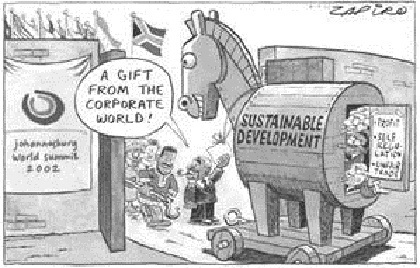
Our task within the Anthropocene is to re-learn what it means to be a citizen; not just of our earthly community, but of the universe. And it raises sharp questions about whether geoengineering is the latest version of the Faustian bargain struck by a wealthy minority who have brought life’s commonwealth to an unwanted and undeserved, yet fateful, choice.

Even the best-intentioned young environmentalists, who often emphasize governance and “efficacy,” tend to scoff at my insistence that they read Thoreau: given the enormity of our problems, what does it matter if one more hermit goes off the grid? But the point of working one’s way through Walden and Thoreau’s other writings is not so much to dwell on his specific actions in the woods as to analyze his way of thinking and his resistance to certain elements of the status quo, to engage with his New England spirit of self-reliance and civil disobedience.
Over the last 20 years or so, pioneering local governments have stepped forward on the global stage to assert their relevance to sustainability initiatives, exemplify commitments, provide and share resources, establish concrete metrics, track progress toward goals, and help spur national and international processes to do the same.
If there is a common theme standing behind the policy ideas and reforms explored in this book, however, it is the necessity of citizen empowerment and citizen responsibility. Call it the first law of political physics: a body at rest will remain at rest until a force is applied to it. When promising governance alternatives are known and seem worth trying out but are not yet happening, then a force needs to be applied to encourage exploratory movement in a new direction. And when governments themselves are unable to muster that force and other actors (such as corporations) are pushing in the wrong direction, an opposing vector can come only from the people.


