This book was converted from its physical edition to the digital format by a community of volunteers. You may find it for free on the web. Purchase of the Kindle edition includes wireless delivery.
Thomas Hardy, OM, was an English author of the naturalist movement, although in several poems he displays elements of the previous romantic and enlightenment periods of literature, such as his fascination with the supernatural. He regarded himself primarily as a poet and composed novels mainly for financial gain.
The bulk of his work, set mainly in the semi-fictional land of Wessex, delineates characters struggling against their passions and circumstances. Hardy's poetry, first published in his 50s, has come to be as well regarded as his novels, especially after The Movement of the 1950s and 1960s.
The term cliffhanger is considered to have originated with Thomas Hardy's serial novel A Pair of Blue Eyes in 1873. In the novel, Hardy chose to leave one of his protagonists, Knight, literally hanging off a cliff staring into the stony eyes of a trilobite embedded in the rock that has been dead for millions of years. This became the archetypal — and literal — cliff-hanger of Victorian prose.
Much more fun than anything this forgotten, or with such a title, deserves to be. This is not the Thomas Hardy you might know. There’s no tragedy of Grecian proportions, no revelations of the worst of human nature, no sheep falling off a cliff or wounded pheasants dropping from branches. I like that Thomas Hardy, but I liked this one, the one of ingenious intrigues, indomitable heroines and humour, too. They have some things in common: outstanding rural descriptions and acute class consciousness.
Ethelberta is a young woman blessed with beauty, brains and the cunning to move herself up in society (she is the child of servants). But she also has nine brothers and sisters in need of setting up and educating, and an invalid mother. She is determined to raise all of their fortunes, first through celebrity (she is a poetess and performer), and when that fails, through the old-fashioned business of a good marriage. She has rich suitors aplenty – unfortunately the one she likes best is a struggling music teacher. Will romance win out over pragmatism? Do we want it to? The novel’s subtitle is “A Comedy in Chapters,” which reassures that nothing too terrible will happen, but it becomes clear that it will be impossible to please everyone.
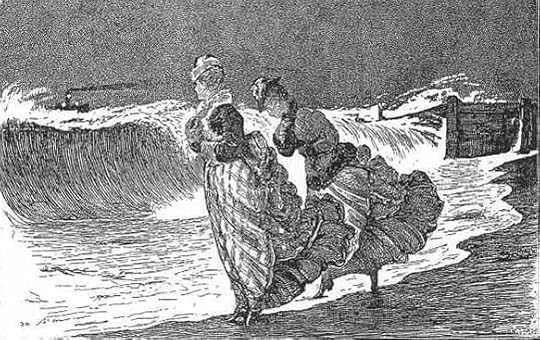
Truthfully, this is not a novel of the stature of Tess of the D’Urbervilles. Hardy was the first to admit that. But neither does it deserve to languish in total oblivion. Fans of nineteenth century novels will find a great deal to surprise and enjoy, from Ethelberta’s clever machinations to some wonderful upstairs/downstairs scenes to a truly excellent chase/stop-them-before-its-too-late scene in the last 100 pages, which was both exciting and funny, featuring a ship in distress, a lord and a labourer forced to share a journey, said lord forced to cook his own breakfast, and a good deal of banter and teeth-gnashing between the classes.
It perhaps should have been shorter, and the secondary character of Ethelberta’s sister Picotee (noone I think enjoyed names as much as Hardy) stood out as being that particularly unstomachable useless kind of stupid Victorian maiden, but all in all, this was a wonderful read.
A very interesting and enjoyable read just in my opinion not a masterpiece like his others x I could talk about this book for a long time though so maybe my rating will increase x A book that I am still thinking of !
“This somewhat frivolous narrative was produced as an interlude between stories of a more sober design...”
This is how Thomas Hardy opens his preface to this novel so no one can say that the reader was not forewarned and so should not be disappointed for not finding here another Jude the Obscure or another Tess. The plot about a young girl who married above her station only to be widowed in the first few weeks of her marriage, her low born family that must be kept a secret if polite society is not to reject her and her four very different suitors is worthy of one of Georgette Heyer’s romps although it gets a very different treatment in Hardy’s hands. His voice is unmistakeable. He is an unsurpassed master at evoking a sense of place with his descriptions and in this novel we get to travel around a bit. Not only around locations in Wessex but also to London, and even to Rouen in France.
In typical Hardy fashion there is a love triangle at the heart of this story. Ethelberta and her unwitting sister Picotee are both in love with the same man, Christopher who reciprocates Ethelberta’s feelings. However, a happy outcome for them is out of the question because he is poor. And there you have it. The author may have endowed Ethelberta with almost all attributes a girl could wish for. She’s beautiful, intelligent, she has an enviable talent for writing, she can remain cool and self possessed in the face of any situation and so can deal with any crisis, she’s strong of purpose and at the same time kind and caring. But all these attributes are not enough to help her realise her ambition to provide a better life for her numerous family. Since she can’t attain the necessary financial security through work the only option she sees is to marry well. Every decision she makes in the course of the novel is governed by this ambition and whether she achieves happiness in the end is for the reader to decide.
This isn’t a novel of brilliant wit but it is quietly funny nevertheless. I liked the way Hardy poked fun at genteel society and their ways and was glad for the implicit criticism of the injustices of the class system of the times, which would reduce the worth of a person to nothing if such worth was not paired with a suitable pedigree. Such criticism might seem self evident today but I suspect it might not have been as well received in the 1870s.
I am not sure whether Hardy wrote Ethelberta with the intention of parodying the ‘sensation novels’ that were popular at the time. I do get the feeling however, that Hardy came up with the idea of a story, some elements he wanted to insert in it, (perhaps inspired by the genre) and then proceeded to have fun putting them all together. As a reader I didn’t find that everything came together quite seamlessly, there were times when I thought that the story was being pulled this or that way a bit too much, once or twice I felt that the narrative sagged a tad (but only a very brief tad). But the overall impression was of a writer who was enjoying himself and that was enough for me to forgive whatever faults the narrative had.
Second read: An enjoyable Hardy novel, but probably not top tier.
First read: I really liked this one - it has a nice balance of emotional depth, interesting complex characters and a very dramatic plot. Very underrated and well worth a read.
I have a fatal weakness for the minor or forgotten work that may turn out to be the proverbial diamond in the dustcart (actually, I think I just made up that proverb). In that spirit, I have been making my way in the past few years through Thomas Hardy’s less visited back list: the novels he himself classed—or dismissed—as “novels of ingenuity” or “romances and fantasies,” by contrast with his more serious “novels of character and environment” (i.e. the ones that we continue to rate now.)
Up till The Hand of Ethelberta, I was doing very well with this experiment. I liked the Wilkie Collins-ish Desperate Remedies (a “novel of ingenuity”), and I loved The Trumpet Major, a surprisingly humorous historical novel (a “romance or fantasy,” in Hardy’s terms.) Even The Well-Beloved, another “romance or fantasy,” was striking, as well as bizarre.
The Hand of Ethelberta (1876) resembles The Well-Beloved in the oddness of its premise, as well as its double location, between an awkwardly rendered London and a far more vivid rural Dorset. Ethelberta is primarily about class. The eponymous heroine owes her would-be aristocratic name to an aspirational housemaid mother, and her father is a butler in a lordly London household. Ethelberta herself has some precarious pretensions to gentility, on the back of a brief, adolescent marriage to the son of a family in which she was acting as governess. Widowed young, she spends much of the novel trying to leverage her ladylike aura, and her beauty, to engineer a second marriage above her birth station. This has farcical aspects, as when Ethelberta sets herself up in a London house, a short let on which she has inherited as a grudging legacy from her husband’s family, with a panoply of servants who turn out to be her many rustic siblings in disguise.
Critics have not been kind to Ethelberta. Coming as it does within Hardy’s oeuvre after Far From the Madding Crowd (1874), and before The Return of the Native (1878), it seemed to many, at the time and afterwards, like an inexplicable backward lurch. (One critic in the 1950s compared Hardy’s technical progress as a writer to “the homing of a drunk.”) An aspect of the novel that has occasioned criticism, in particular, is its inconsistency of tone, and its odd mixture of comedy and melodrama. It is certainly a novel into which it is difficult to settle comfortably; it is as jolting as a nineteenth-century carriage ride.
I didn’t hate this novel, however, despite all its problems; and I think that was in large part due to the character of Ethelberta. She is a strange, ironic creature, who sometimes seems as little caught up in her complicated story as many of her readers are. For all her scheming and plotting, Ethelberta retains a kind of devil-may-care detachment, which is very appealing. She is also an artist—a writer and performer—and some interesting recent critical readings see her as an alter ego for Hardy, which is a distinctly intriguing idea.
Nothing is going to make this a great novel, and I don’t think I’d recommend it, but I’m not sure that anything by Hardy is really going to be worthless. Just when you think you have had enough, he comes up with something quite astonishing, like the hallucinatory scene when Ethelberta and her sister go to check out the country estate of a potential suitor and see a hideous knacker’s yard of ancient horses being kept to feed the hounds—a vision of bleak cruelty that connects in oblique ways with the themes of the novel, and deepens its emotional range precipitously at one stroke.
Well that made a change. No doom and gloom, no tragic shocks, admittedly a certain amount of heartache, but all quite bearable, and everything works out quite well in the end (although there is a last minute twist to the plot).
When I read the introduction I was quite surprised that this was to be light-hearted in manner, and upon reading it I was even more surprised that a large portion of the novel was set in London - and not even just a visit to a solicitor! And furthermore there was time spent in France! Did Hardy really write this? Well it does begin and wind up in Wessex, so yes indeed he did.
The serious aspect of the novel is a comentary on the class system in mid-19th Century England, but even this is treated with some degree of humour, so it all became a bit of a romp. A bit more like Jane Austen I guess than what you might expect from Thomas Hardy, and maybe as enjoyable as the best of either of them.
My aim has been to read through the entire works of Thomas Hardy as he is one of my favored authors. I am very intrigued by him as a person and awed by the details of life from the mid 1800's that would be lost entirely to us were it not for there being recorded in his novels with such poetic detail.
The hand of Ethelberta was an interesting novel. It is one of the few Hardy works that end with some joy for most if not all of the characters. It definitely isn't as profound as his more melancholy yet important works, but it still has a life and beauty that is related in Hardy's lush attention to details that bring the characters and scenes alive.
I particularly enjoyed the chapter relating the steamers passage across the stormy channel and the scenes of intrigue in the last chapters.
The plot concerns a lady of low birth with ambitions to raise herself in the eyes of society through her talents as writer and story teller - all while concealing her lowly origins. She is desirous to have money enough to help her father retire from his position as manservant and to educate her younger siblings. Things do not go the way Ethelberta anticipates.
Hardy is wonderful at creating characters that you care about and want the best for. Ethelberta's sister Picotee, ever denied admirer Christopher Julian, Lord Mountclere- all are vividly brought to life. I couldn't wait to see what was going to happen to them all, particularly since I wasn't sure if this was a "happy" or "sad" Hardy book!
Subtitled “a comedy in chapters”, Hardy’s fifth novel production is not a tremendous piece of sustained prose writing, nor a comedy, unless your sense of humour is Sahara-in-summer-dry. As the unforgiving introduction to the Macmillian edition states, Hardy here writes in his “Harrison Ainsworth style”, meaning a tendency to reach for the florid phrase when a stylish one would better tickle the reader’s eyes. The protagonist, Ethelberta (not her hand as the title states), is a precursor to the sprightlier heroines in later novels, although her character remains elusive throughout, making it tricky to warm to her particular brand of arch trauma. The other characters, from the scheming upper classes, the cardboard suitor, and the sister, are not as appealling as his farmfolk (fresh from his success with Madding Crowd, Hardy’s rustics as usual are the pinnacle of his realist talents). Otherwise, yes.
An enjoyable listen from Librivox, with the excellent narration of Simon Evers. Hardy is one of my favorites, and Ethelberta creates lots of speculation with her many suitors vying for her hand. We hear each of their stories in turn, with enough twists to keep us going. Glad I finally got to this one.
The Hand of Ethelberta is a novel written by Thomas Hardy and first published in 1876. It was written in serial form and appeared in Cornhill Magazine. I am so glad I wasn't around in the days when we had to wait from week to week or month to month to find out what happens to the people I come to know in books. I like my books to come into my hands all at one time. Back to the book that is in my hands now, "The Hand of Ethelberta".
One of the things that struck me right away when beginning the novel was that our heroine's name is Ethelberta. Who names their daughter Ethelberta? The name means "nobly famous", I looked it up. I found that babies are seldom named Ethelberta and that Ethelberta is not in the top 1000 baby names. No kidding. I don't know why the name should have surprised me, her sister's name is Picotee. That's as strange as Ethelberta. I didn't look that one up yet though. Thinking more of the names, Ethelberta's maiden name was Ethelberta Chickerel, then she marries Ralph Petherwin, so then for most of the novel her name is Ethelberta Petherwin. I feel more sorry for this girl all the time. I did feel sorry for her, almost from the beginning. In the first paragraph we learn:
She was the daughter of a gentleman who lived in a large house not his own, and began life as a baby christened Ethelberta after an infant of title who does not come into the story at all, having merely furnished Ethelberta’s mother with a subject of contemplation. She became teacher in a school, was praised by examiners, admired by gentlemen, not admired by gentlewomen, was touched up with accomplishments by masters who were coaxed into painstaking by her many graces, and, entering a mansion as governess to the daughter thereof, was stealthily married by the son. He, a minor like herself, died from a chill caught during the wedding tour, and a few weeks later was followed into the grave by Sir Ralph Petherwin, his unforgiving father, who had bequeathed his wealth to his wife absolutely.
Lady Petherwin, mother of Ethelberta's dead husband, takes the girl by the hand. She sends Ethelberta to a boarding school for a few years to "finish her education", then brings the girl to live with her as a daughter and companion, but under the condition that she never acknowledge her family. Her very large family, for along with a mother and father, Ethelberta also has nine brothers and sisters. Besides the already mentioned Picotee, we have sisters, Emmeline, Gwendoline and Cornelia; brothers Sol, Dan, Joey, and the two youngest children, Georgina and Myrtle. Mr. Chickerel is working as a butler and Mrs. Chickerel is bedridden because of a "spinal complaint", and every one of these people, including Ethelberta herself seems to expect her to find a way to support them all. That's why I spend the entire book feeling sorry for her. Not that the rest of the family just sits and waits for her to give them money, Dan and Sol are carpenters, Gwendoline and Cornelia work as maids, Picotee is a pupil-teacher, for a while anyway, and Mr. Chickerel seems to love his job as butler, maybe because it keeps him away from the house so much. It is amazing to me how this entire family works so hard to keep up Ethelberta's appearance as a grand lady. They call her Mrs. Petherwin, they don't expect any acknowledgement from her in public, they are so proud of their high class sister.
So Ethelberta Petherwin lives as a grand lady with her mother-in-law Lady Petherwin, however when Lady Petherwin dies Ethelberta is left with nothing but the house and furniture, and that only until the lease runs out. Now Ethelberta must think of another way to support herself and her family. She is a poet, she has already published a book of poetry, it was the reason she was cut out of Lady Petherwin's will. She tries storytelling for awhile, which seems to work at first, being quite a novelty among her social circle. All the time she is still keeping the secret of her birth and family. It seemed for a while that Ethelberta may be able to do the things she loves; she loves writing, but gives it up because she knows it isn't the way to support herself and her family. She loves Christopher Julian, a musician, but gives him up because they are both poor. If she didn't have eleven other people to support perhaps her and Christopher could have gone and lived happily in a small cottage somewhere while he supported them with his music.
I'm not going to tell you much more. There's quite a love--- triangle? More than a triangle really, Ethelberta loves Christopher Julian, Picotee loves Julian, Julian loves Ethelberta, so does Mr. Ladywell, Mr. Neigh and Lord Mountclere. They all propose to her. Whether or not she ends up married to any of them you will have to figure out for yourself. I liked the book. There are characters in it that I wish would have been more developed. I would have liked reading more about Dan or Sol or Ladywell even, or perhaps the story of Ethelberta's first husband. Picotee got on my nerves; whenever Christopher came into a room she seemed to go into a trance. I kept getting the impression she was going to start walking into walls when he was around. It wasn't a long novel and I like long novels, but I had a good time reading it.
This novel is quintessential Thomas Hardy in every line. It is so characteristic that it is almost a parody. The descriptions are every bit as evocative as in his more famous rural works, the characters as finely drawn, and the pompousness....well, just as pompous. I loved it, especially the final section where the narrative is distanced by a third person. So why is this novel so less well known? In many ways it is better than, say, Jude: Hardy doesn't wrench his characters quite so ruthlessly into his plot as sometimes. Is it because it is billed as a comedy (odd sense of humour he had)? Surely not, because the thrills, tensions, and misunderstandings are all there. My theory is ........it's a stupid title. Rename it The Butler's Daughter, or maybe An Ambitious Woman, and it's another Hardy hit.
A very interesting and different classic with some comical and dramatic elements and complex characters. I haven't seen the divide between classes explored in this way and it was just fascinating and fun, especially since it isn't a black and white portrayal. I'm not sure yet how I feel about the ending, but I'm glad Hardy didn't go for the expected.
Where do I start? I am astonished that this book is so relatively obscure, how it's not listed with Hardy's other famous novels, how there are hardly any commentaries on it. I think it is an amazing, refreshing, unusual book and I utterly loved it. I was up until three in the morning to finish it.
So, where do I start. Let's start small. One of the merits of this book is what it doesn't contain, what flaws of nineteenth century novels in general and Hardy novels in particular it avoids. For one thing, the word ”undulation” appears only once, even though there were several paragraphs where I imagine Hardy was sorely tempted to use it. Perhaps at the time he wrote this, he was aware it was his pet word and so he restrained himself. He also restrained himself with regard to the not-so-humorous dialogues-between-simple-country folk which blights some of his novels (anyone remember than endless scene in the pub in Far From The Madding Crowd?). There is a little one, towards the beginning, between a milkman and an ostler, but it's mercifully short. More importantly, though, this novel is blissfully free from melodrama, lucky/unlucky coincidences, moping and endlessly agonising characters and nobody has to die to bring about a satisfactory ending even though this seems inevitable at one point.
So far, so good. Apart from these “negative merits,” the book has a lot of what I might call standard merits, things you would expect in a Hardy novel: strong sense of setting, careful characterisation, neat plot development, subtle humour. There is a lovely way in which the theme of deception is varied and mirrored on a number of levels. But what makes this novel stand out is how much it does not follow established patterns, how is breaks with literary conventions in a way that I found fascinating and very, very satisfying.
The most obvious of these departures from convention is that not only is it mainly concerned with a family of artisans and domestic servants, but these are portrayed as neither comical nor meek nor heroic but simply as a normal family who needs to make a living and whose members look after each other. Mr Chickerel, a man of discerning character and considerable intelligence, actually enjoys being a butler. The carpenter brothers are accomplished in and enthusiastic about their trade. Nevertheless they are a family with aspirations and, realising Ethelberta's cleverness, set about to improve her lot through as much education as they can give her. Good for them. They are wonderfully pragmatic and and the same time warm and caring. On the other hand, there is no feeling that Hardy satirised the middle and upper classes or used them as a negative foil. They are equally normal people with strengths and weaknesses, no more concerned with their self-interest than people generally are. I loved the scene where Mr Chickerel's connection with his daughter is discovered by his employers, how the mistress of the house says she will “of course” dismiss him and how her husband replies that she will “of course” do no such thing, that Mr Chickerel is an excellent butler, a replacement would be hard to find and so what that Ethelberta is his daughter? The wife protests that Etherlberta should have told them the truth, to which quite rationally the husband replies, “You didn't tell Mrs Petherwin that your grandfather narrowly escaped hanging for shooting his rival in a duel.” Good stuff, good stuff.
And then there is Ethelberta herself. Rarely have I approved so much of a novel heroine. She likes to enjoy herself as much as the next person, but without any complaint she puts first the responsibility that falls on her by virtue of being the smartest of her family. She is creative and artistic, but she doesn't mould herself into some romantic effigy, but with cool calculation invents a persona and a novel kind of career that will be economically viable. She takes risks, makes quick decisions under pressure, revises decisions as necessary, assesses people realistically without being unkind or judgemental, she is ambitious but never to the point of being selfish or mercenary. She loves Christopher but parts with him because he is not a feasible option in the circumstances, she does so without bitterness though she continues to have tender feelings for him and it is to her great credit that her first impulse to give him up arises from the discovery that her sister is also in love with him. She feels under pressure to marry for money and goes about it pragmatically, but she is determined to play fair and not to deceive her suitors. It is wonderful that in the kind of situation where other novels of the time would have the heroine agonise and toss and turn all night, Ethelberta turns to a philosophical treatise on utilitarianism and decides to marry Lord Mountclere because that's the best option all round for everyone concerned. She is shocked to discover that her new husband keeps a mistress on his estate and decides to flee, but not in a haphazard way and with a view to become a woe-is-me victim of male wickedness, but with a view to securing an advantageous stance from which to negotiate a tolerable arrangement for the future. When this plan does not succeed, she doesn't despair, but sets about to make the best of the situation. And, oh how delicious it is to hear what she makes of it! There is no romantic compensation for her disappointment, no virtuous martyrdom, no sad decline or bitterness and, wonderfully, the less-than-perfect elderly husband does not die. Instead she uses her wit, her energy and her management skills to gain control over the household and the respect of all therein. Lord Mountclere does not exactly become a henpecked husband, but she is clearly in charge, and this is to his advantage, as both his health and his finances improve under her management. Yes, my lady Ethelberta, who has been so good at maths ever since she was little, has her own office and keeps the ledgers and cash books, all power to her! Instead of the typical choices for Victorian heroines (true love, death or endless moral chastisement), Ethelberta makes a successful career out of her marriage.
Other characters are similarly refreshing in their failure to comply with narrative convention. Christopher, instead of endlessly pining for Ethelberta or alternatively turning his former love into hatred, remains a friend and well-wisher. He even goes as far as standing in for her brother when the latter deserts her, but then when Ethelberta doesn't turn up he doesn't go in for some desperate heroic rescue, he simply shrugs his shoulders, says he's done his bit to help and goes home without much fuss. This is admirable. Likewise admirable is Faith. When she first appears, she seems destined for the role of the stereotypical selflessly devoted spinster sister, but as it turns out, she is on the whole more interested in her own scholarly pursuits than in her brother’s heartaches.
I also really like how the title of the book works in so many different ways: it can refer to the hand for which her four suitors are vying, to the hand that writes the poems, to her handwriting (which is contrasted with that of the viscount) and finally in a figurative sense to the way in which she plans and manages her affairs and those of most people around her. Instead of Providence or Fate or the Hand of God or whatever, Ethelberta truly is the mistress of her own life by virtue of her determination, intelligence and firmness of character. Feminists should worship her...
This entire review has been hidden because of spoilers.
“It was one of those hostile days of the year when chatterbox ladies remain miserably in their homes to save the carriage and harness, when clerk’s wives hate living in lodgings, when vehicles and people appear in the street with duplicates of themselves underfoot, when bricklayers, slaters, and other out-door journey-men sit in a shed and drink beer, when ducks and drakes play with hilarious delight at their own family game, or spread one wing after another out in the slower enjoyment of letting the delicious moisture penetrate to their innermost down. The smoke from the flues of Sandbourne had barely strength enough to emerge in the drizzling rain, and hung down the sides of each chimney-pot like the streamer of a becalmed ship; and a troop of rats might have rattled down the pipes from roof to basement with less noise than did the water that day.”
Its descriptions like this that keep me in Hardy’s thrall. Another, for good measure:
“Before this picture sat Ethelberta...sometimes lifting her eyes to the outlook from the window, which presented a happy combination of grange scenery with marine. Upon the irregular slope between the house and the quay was an orchard of aged trees wherein every apple ripening on the boughs presented its rubicund side towards the cottage...Under the trees were a few Cape sheep, and over them the stone chimneys of the village below: outside these lay the tanned sails of a ketch or smack, and the violet waters of the bay, seamed and creased by breezes insufficient to raise waves...By anyone sitting in the room that commanded this prospect a white butterfly among the apple-trees might be mistaken for the sails of a yacht far away on the sea; and in the evening when the light was dim, what seemed like a fly crawling upon the window-pane would turn out to be a boat in the bay.”
I find it hard to believe H. made this scene up, it’s so specific. He had to have seen it for himself? Whatever – however he managed it, I am completely won over. I read these passages over and over, grateful for every word. Hardy never fails to provide a world I want to inhabit – dark as it sometimes can be. This was a completely satisfying book, beginning to end. I don’t know why it’s not more popular. It has all the pent-up suspense of the first chapter of “The Mayor of Casterbridge”, a wonderfully complicated, strong female protagonist, and an outcome that is not predictable – not fairy-tale nor failure-tale. I did miss the sense of nature and rural life that usually infuses Hardy’s writing, but this was a more urban and plot-driven novel than his usual. Loved it. As ever, H. tells a great story, and leaves me thinking, thinking, thinking – he raises so many great questions in this book, about what love really is, what one owes to one’s family, what makes for a good relationship (Ethelberta – geez! That name just sticks out like a pimple – has the choice of several men, and I don’t know that she wouldn’t have been able to make a go of it with any one of them – she seems the type to make her circumstances rather than be made by them.), and of course, the usual question of class distinction, which is taken to its most ironic twist at the dinner where both E. and her father are present. I cannot recommend this book enough. It kept me up till the wee hours, chewing my knuckles in suspense. There was even a Wodehousian moment near the end, when the carriage and dogcart thundering toward Knollsea get locked together...but I don’t want to spoil the story for you.
This is my new favourite Thomas Hardy novel. It's just magnificent. So incredibly beautifully written, so full of amusing dialogue and wit. It's not at all depressive lonely rural wessex but rather a mixture of town and London, Society and servants. Without giving anything away I think it has the best ending of any Victorian novel I've ever read. Just when I thought it couldn't get any better, it did. The plot was lovely, a young widow of 21 (or so) is living in society with her mother-in-law while hiding the fact that her family are actually servants and builders. It's an interesting look at the illusion of class and how people are shaped by how they are perceived. It's quite telling that most of the book her brothers refuse to see her as their equal but rather as a great lady. The characterisation in this book was very good, especially the women (not something Hardy's usually that good at in my past experience). Ethelberta herself was so great, intelligent, witty, creative, and amusing. She always had a plan and while she did spend a little time moping, she was such a great heroine. Her sister Picotee I felt sorry for a lot of the time, living in her sister's shadow but wanting so much more for herself. I did like Lord Montclere the old scoundrel, I could so easily see him as Christopher Lee. I'd not heard of this book before I found it and I'm so glad I did for it was absolutely wonderful. I'd definitely recommend it, even to fans of 19th century literature who haven't gotten on well with Hardy in the past.
There was a time in history that the difference between social classes can be seen as thick and as dense as a sky filled with white fluffy clouds that veneer the clarity of the spotless azure dome before our very eyes, deceitful in its immaculate texture of whiteness as it hides the incandescent hue of true justice. It was a time of strict hierarchical obeisance, a lifetime of avowal thereof to a harsh and imposing norm of classification adhered in tradition and ruled throughout in one's life as practice. To veer away from it meant public scrutiny and animosity concurring in the most harmful infliction of a scandal, to which, the modern times has only but restricted its weight to the mere subtlety of discrepancy between the rich and the poor.
The novel talks in length about this class distinction often played out in humorous tone as it appears almost Dickensian in style, highly unusual when compared side by side with Thomas Hardy's other well known works of mostly melancholic disposition. The Hand of Ethelberta, as considered one of his lesser known works, is an illustration of the challenges involving an ambitious young lady's attempt to climb the higher echelon of social distinction. It is about Ethelberta's own act of defiance against this narrowed view of social tradition that painfully restricts an individual forevermore only to the grounds of her own consanguinity despite the obvious enormity of her wit and beauty and the promise of her many talents.
At first, Hardy's laying out of the character of Ethelberta in the narrative seems hardly discernible. This is in terms of her intention, the true nature of her embarking away from her family's humble beginnings to ensure her rise in the ladder of social stratum, whether the purpose is selfless that which refers to her complete detachment from her own class, appearing as a sacrificial undertaking, an act of offering herself for the sole benefit of her family's future, or perhaps her true intention lies deep within her hidden and unsaid motive, which in truth could not even be recognized nor tolerated by herself as it can be deemed as an act of individual want driven by her selfish whim that denotes her sheer determination and unstoppable nature to penetrate the world of those whom she considers worthy of her own reverence, which in layman's term makes her simply as a social climber.
Between these two, being a devoted daughter and sister and a social climber, Ethelberta seems to oscillate as the case maybe as she sometimes seems to appear as snob as the people she would like to belong with, complete with her diadem and scepter bearing even in trying to administer her own kin in the confines of their own household, displaying her somewhat repressed contempt with regards to the bucolic nature of their wild and rough ways that make her treat them lower than her own, whether by necessity or by choice is no longer important, which in the same manner, Hardy would attempt to salvage from superciliousness in between the narrative by concentrating on her unquestionable devotion by the sacrifices she made even to point of giving up her own happiness for the sake of family. Perhaps, more obliquely conveyed through her avowal of separation from the simple Christopher Julian, the man she truly loves over her other three wealthier suitors including an old nobility stained with notoriety, Lord Mountclere. All in the name of gaining the advantages of higher social distinction that will enable her to secure her family's prospects.
In a way, Hardy seems to identify this ambiguous aspect of Ethelberta to the true nature taking place within one's own intention that is somehow always kept in vigorous vacillation between good and evil, interchangeably moving unseen from the corner of one's mind as it appears incomprehensible from the unknown bottomless depth of one's consciousness that once uprooted from the deep could define, as in the case of Ethelberta, her character whether it is truly behind the noble appearance of familial obligation, or just a glossy cover for her own selfish cravings that divide herself from her own high ambition to the true essence of happiness.
This Hardy seems to stipulate with her sister's character, Picotee enhanced with the pronounced contrasting elements of their characters as the submissive modesty of her own even it appears subjugated to the dominant and devoted force of Ethelberta's amorphous and maneuvering character, is definable in its clarity of vision, a meek form of wisdom, which enable Picotee in her humble grasp to be rewarded in the end with the most perfect sense of happiness that even in its most simple form is seldom found, ending the story of their family's life with the claim to the promise of happily ever after. ☾☯
I really enjoyed this, one of the lesser-known Hardy novels. Ethelberta is an engaging, complicated character who, as a recently widowed young lady who was fortunate to marry into a wealthy family, and who must now navigate the treacherous social waters of Victorian society whilst secretly providing for her large, but decidedly unaffluent, extended family. No less than four men of various positions in society attempt to court her and her attempts to manage these relationships are both amusing and compelling. Mr. Hardy keeps the reader guessing as to which of these suitors will triumph. This is the lighter side of Thomas Hardy, not the heavy-handed tragic tales one usually associates with the author. Kudos and thanks to The Victorians GR reading group for choosing a great summer read. Cheers!
Thomas Hardy wrote The Hand of Ethelberta in 1876, and it ultimately went into the category of one of his lesser-known novels. He had already written Far From the Madding Crowd. I sent off for and read all of his lesser-known novels in 2013, when I had to spend time off work recovering from an injury. I remember that among those books was one that I found particularly less interesting, and I was afraid that this might be it. But this was not the book in question. And I was curious to know what was meant by the title - I thought perhaps "The Hand" referred to some action she was going to take, as in "it was only by the hand of Ethelberta that such and such came about". No, it refers to her "Hand" in marriage.
The Introduction written by Tim Dolan brought out some interesting background on Hardy's aim in writing Ethelberta, and on its reception. To understand Hardy's mindset in writing the novel, it is essential to know that he wrote novels to earn a living, being somewhat beneath his dignity, while he considered that writing poetry was his ultimate and noble calling. Once he was financially established, he concentrated entirely on poetry. Dolan points out that Ethelberta was satirical toward London Society, whose so-called "taste" favored the novel, but even more so toward the recent forms of popular literature itself. He believes that Ethelberta had its psychological origin in Hardy's anger at being a poet who was forced to write novels for money, all the while bargaining with editors over how content aligned with the public's expectations, and in his incredible ambivalence over Far From the Madding Crowd's success, when he had more important things to say, and better ways to say them with poetry. I noticed that Hardy put this revealing line in a character's mouth: "... poets have morals and manners of their own, and custom is no great argument with them", thus asserting the primacy of art over other considerations. All of this will help us understand why a novel whose tone is not humorous came out under the subtitle of "A Comedy in Chapters".
Ethelberta is a 21 year old widow without money who feels a terrible responsibility to care for her family, which includes a handicapped mother, and nine brothers and sisters, while their beloved father supports himself at a distance as a butler. Two of the older brothers have work, but otherwise anything she will be able to accomplish financially she will put to use for the family. Although she did not have the benefit of a formal education, she has made the most of some opportunities to educate herself, and she is quite a talented writer, and later, an orator of "Romances". (This is similar to Thomas Hardy's background.). Her biggest obstacles are not the level of her talent, but her gender, and her unfortunate pride. Her two working class brothers are ashamed of her, because she is ashamed of her own station in life. She feels that her writings and stage recitations are only accepted and praised because the public assumes she's a woman of some means. Her mother-in-law refers to her work as "ribald", and while readers can assume an air of amused titillation at a dignified young lady's imagination, they would be scandalized if they realized they were reading the inventions of a poor girl. Obviously matrimony becomes an important part of the story, although one character is heard to say that any decent woman only marries once. If you read Hardy, you know that one of the beauties of his work is that he writes strong women. Ethelberta must juggle the constant stress of the threat of being "outed" as an imposter, with serious consideration of the merits of marriage proposals. There is a love triangle to entertain us as well, involving one of her suitors and her beautiful younger sister Picotee. The ultimate conflict involves the moral dilemma created between the advisability of a rushed but financially advantageous marriage, and the possible consequences of revealing her lowly status to the gentleman.
Overall, I found it difficult to determine how Hardy wanted us to see Ethelberta. Shouldn't we be cutting her a huge amount of slack, based on the age she lived in, and her overall situation ? I certainly didn't read her as conniving or intentionally fickle. I don't remember that he wrote novels in which a major woman character was used as a cautionary morality tale. When his women did things that society frowned on, he generally stood behind his characters and their decisions. Not blindly, but with extenuating circumstances that we were expected to fully appreciate. Hardy, I believe, was more likely to cite Fate as the cause of tragedy, rather than outright wickedness or stupidity.
On a side note, I was a bit ashamed that I had forgotten that Hardy used physiognomy as a descriptor in his works. As a realist, it surprised me to see him detailing a person's facial structure and overall appearance as likely clues to his or her internal character. I thought that practice more or less ended with earlier Victorian writers. Lo and behold when I went to the "Physiognomy" page on Wikipedia, Hardy's writing is mentioned as a prime example !
Finally, I want to mention a wonderfully inventive and potentially cinematic event in Chapter 46, when Hardy has four men rushing to the town of Knollsea. I imagine a film scene shot from 5,000 feet in the air, showing the tiny carriages converging there.
This is Hardy’s novel that he wrote between Far From the Madding Crowd and The Return of the Native. The title character is a beautiful young women from Wessex who marries up after becoming a servant for a wealthier family. The story involves her career path and marital choice among four suitors after the death of her first husband. Ethelberta struggles to balance romantic interests with her desire to care and provide for her family, including her parents and siblings. This story has a different tone and feel than the standard Hardy novel. Hardy listed this novel as one of his three “Novels of Ingenuity” as compared to his “Novels of Character and Environment” which includes all of Hardy’s best-regarded works. Hardy appears to have made this delineation to indicate which of his novels should be treated as more serious literature. Allegedly, Hardy wrote this novel in an attempt to more mirror the more popular styles of the day, styles which included sensation novels. Hardy is skilled at writing incredibly rich, wonderfully descriptive, poignant, dramatic and tragic stories of rural and small-town Dorset residents that are critical of societal restrictions and customs. Here, Hardy attempts to write a straightforward novel about a young poor girl who tries to balance love and family while trying to succeed in both London and Wessex high society. Hardy avoids his usual tragedy or social criticism. In attempting to adjust his work to the public tastes, Hardy seems a bit out of his comfort zone. He creates characters with less depth and situations that are more contrived than those in his more dramatic novels. Hardy creates scenes set in London parlors and country estates, settings more typical of Trollope or such authors as Braddon and Oliphant than what one finds in Hardy novels. On the positive side, despite the novel’s generally weak characterization, I still really liked Ethelberta as a heroine. She seemed different from the usual Hardy heroine. She has talents; she is a successful poet and skilled stage performer. She seems emotionally stable and doesn’t get overwrought, especially about romantic subjects. I appreciated her practical attitude, her commonsense approach to romance and her desire to care for her parents and siblings. I was quite dismayed that her point-of-view diminished during the last quarter of the book as Hardy chose to focus on the thoughts and antics of the side characters. I thought Hardy erred in not providing more of Ethelberta’s thoughts on the ending events. Also, while not his forte, I did enjoy that Hardy was writing about scenes not shown in other books. I spent the last few years reading 4 of Hardy’s short-story collections. These stories are generally lighter, less dramatic and more melancholy than tragic. They also present a wider variety of characters, settings and overall tones. As a result, I’ve come to appreciate it when Hardy writes about a broader selection of characters and scenes and in a variety of tones. Yes, the overall result of Hardy’s efforts here is a novel that is a bit of a mess and not one of Hardy’s best. I rated this as 3-stars when I first read it 10 years ago, one of two of the 14 Hardy novels I rated as 3 stars. I rated the other 12 Hardy novels as either 4 or 5 stars. Since then, though, I have come to appreciate Hardy’s writing even more. Despite its many flaws, I also really enjoyed myself while reading the book. While this pleasure was likely enhanced by my reading this with a GR group, upon reflection, I feel that re-reading this 2nd rate Hardy has been a more pleasurable experience than reading my other 3-star rated Victorian novels, including several read with GR groups. Based on that, I will rate this second reading of this novel as 3.7 stars rounded up to 4 stars. So, with both a 3-star and a 4-star rating in my 2 readings of this book, my overall rating for this book is 3.5 stars.
hey buddy what's this, huh? what is this??? it's bad. it's different, it's the most un-hardyish hardy but it doesn't work.
does however contain a choice insult i never heard before: 'had the honour of being hung higher up on the Academy walls than any other living painter' #N*CE
This is a very good book that seems to be overlooked for some reason. I rate it far above the clown-heavy Under the Greenwood Tree and rank it most closely with The Woodlanders. It is less thrilling and quieter than Far From the Madding Crowd, The Mayor of Casterbridge, and The Return of the Native, but I enjoyed it as much, and the climax made my heart beat. It includes common Victorian power themes such as wealth, class mobility, and female agency. There's a rake doing rakey things. Also, on nearly every page Hardy gives beautiful descriptions of the natural world and powerful metaphors/similes. Although it is considered one of Hardy's minor works, it is the work of a master writer, storyteller, and thinker.
Ethelberta Petherwin (née Chickerel), widowed at the tender age of 17, becomes the center of attention and toast of London when she anonymously publishes a book of poetry. When her identity is disclosed, a handful of disparate suitors (including one she spurned before her marriage) seek her romantic notice. Ethelberta, meanwhile, struggles to keep her humble origins a secret, while providing for her large family with her writing and public storytelling. When she feels she must give her reluctant hand to one of the men courting her, she is torn when the decision comes down to choosing between her own happiness and the well-being of her parents and nine siblings.
This is not a typical Thomas Hardy novel for a few reasons. For one thing, it's subtitled as "A Comedy in Chapters," which is clarified in Hardy's Preface to mean that it's not so much a comedy in the theatrical sense of the day, but that it's titled as such to indicate a certain lightness of mood (kind of like the Shakespearean comedies, mistaken identities, ironic twists, etc.). I kept thinking that something terrible could and might happen at any moment, but it never really did, at least not in traditional Hardyesque fashion. For another thing, it takes place largely in London or other towns, and not principally in the rural villages and farms of Hardy's Wessex. Another unique aspect of this book is that it focuses heavily on the lives and goings-on of the servants, at least as much as it does on those of the higher class characters. Hardy's love triangle here is expanded to something more like a love pentagon, Ethelberta having no less than four interested parties in Julian, Ladywell, Neigh and Mountclere (a hexagon really, if you include Ethelberta's younger sister Picotee, who unknowingly fixed her eye on one of Ethelberta's suitors). It's interesting to note its historical and chronological placement, right in between two very popular and famous books (Far from the Madding Crowd and The Return of the Native), and it's not really surprising that it's not one of the more well-known works. It was kind of hard for me to really get into this book. On this read-through of Hardy's published works, this is the first one that I wasn't really excited to read every time I picked it up. There were some things I really liked about it. The title itself is kind of odd, like some vague reference to this person's appendage, but taken in the context of the story, I like how her "hand" can be taken to have many different meanings (her hand in marriage, her skill at writing, her influence). It was still a pretty good story, and I liked some of the characters, the writing was of course fantastic, especially in his descriptions of the settings and seasons, and it was fun to read his take on London society for a change, but it meandered a little, some of the pieces didn't fit together, and it seemed inconsistent in style and tone. Sometimes it was downright funny, and sometimes it was kind of Gothic-scary. There were a lot of characters, but they didn't seem completely developed, and a few of them (including two of the main suitors that appear for the bulk of the story, who I presume are present merely to show even more how desirable Ethelberta is) are entirely unnecessary and could have been cut completely. Ethelberta herself is fairly interesting, ambitious and clever and beautiful and sometimes willful and indecisive, though she sways a little bit in character, but her suitors are so numerous that none of them really get the attention they deserve. From the start this book almost felt like a sequel (the story of Ethelberta's doomed first marriage seemed the perfect subject matter for a Thomas Hardy novel), and while the events leading to the climax were interesting and it was nice to see the puzzle coming together, the ending was kind of abrupt and unfitting, though I guess it had a sort of moral to it. Ethelberta kind of gets what she deserves, and does the best she can with it. There are reportedly some autobiographical elements weaved throughout Ethelberta's story and character, which is an interesting point to note. This book is probably for people who really like Thomas Hardy.
So, this wasn't my favorite Thomas Hardy book. Apparently even he recognized its flaws, and it obviously hasn't really held up over the years (I mean, had YOU ever heard of it until now? I even had to try two libraries before I found it). The story of the poetess with a secret and her many suitors has its merits, but the characters and style are a little inconsistent and it tends to drag in parts. They can't ALL be total masterpieces, right? Overall I think I prefer his more decidedly tragic stories. In the end, though, a "bad" Thomas Hardy is still pretty good.
P.S. As a side note, another reason why I probably enjoyed this book at least as much as I did was because I had just finished reading something pretty awful, and it was so nice to read something that was so well-written.
There has to be something in fiction that makes me think it could happen. It could be as fantastic as Dune, but for the time I am reading, I believe. This book just didn't draw me in or make me believe.
We have to look to one of Thomas Hardy’s least-loved books to find his most complex and fascinating heroine. Ethelberta Petherwin’s capricious dithering is far more interesting than the gloomy passivity of Tess D’Urbeyfield or the neurotic modernism of Sue Bridehead.
This may be because Hardy has put something of himself in his heroine. The title yields the clue. Ethelberta, like Hardy, makes a living, by her hand. She is a poet. Notably a poet rather than a novelist, as Hardy saw himself as a poet first.
While Ethelberta is not a self-portrait exactly, she has certain things in common with her author. The maiden name of Hardy’s mother was Hand. There are also some resemblances between Ethelberta’s family and that of Hardy. Perhaps some of her literary travails found resonance in Hardy’s own struggles for recognition.
Curiously Hardy makes not a single attempt to reproduce any of Ethelberta’s poetry. The book frequently quotes other writers, but the skills of its poetess are discussed, and never displayed.
This is surprising since Hardy was one of the greatest poets in the English language, and quite capable of producing good poems. Perhaps he did not feel able to write a convincingly ‘female’ poem, or one that reflected Ethelberta’s lightness of touch.
Ethelberta shares the usual inconstancy of a Hardy heroine, flitting between four admirers and changing her mind, sometimes several times in as many days. However for once there is a good reason for the heroine’s indecision. Ethelberta has a whole family to keep. The family unit is an unusually strong one, where all family members love and support one another, and Ethelberta plays a key part in keeping them in work.
While Ethelberta’s family admittedly mostly work for a living independently, she wishes to raise the standard of their opportunities by having money. This is part of the reason why she is a poet, and why she offers readings of her works. Still Ethelberta knows that the novelty of her work will not last, and that money will become a problem again.
This creates the difficulty for Ethelberta. Who to choose? In an ideal world, she would marry the penniless musician, Christopher Julian, her true love. However she needs money to support her family, and marrying him would involve a reduction in her family’s position, and fewer opportunities for them.
So Ethelberta is obliged to consider a number of richer men, the light and empty Ladywell, the woman-hating Neigh and the much-older Lord Mountclere, the richest of them all, but also a man with an immoral past. Details about this are tantalisingly sketchy. Only one indiscretion is revealed, and that is not too serious.
The various machinations occupy the book, and the conclusion is one that may not please many readers, though by Hardy standards it is less tragic than usual. Given the choice of imperfect options, Ethelberta must select the one she is best able to live with, and that decision is not too tragic for anyone else.
Given the nature of its interesting heroine, why is The Hand of Ethelberta received so unenthusiastically, even by Hardy lovers? I suspect that the problem is an uncertainty of tone and direction. Hardy calls it A Comedy in Chapters, and the character names do seem like they belong in a satirical comedy of manners – Ladywell, Neigh, Menlove etc.
However the book is almost entirely humourless, even when all the characters converge on one event (a non-event as it happens) towards the end. A few contrivances change the outcome at the end, but not in the way that a comedy, or even a tragedy, would.
Nonetheless, its faults notwithstanding, I think The Hand of Ethelberta is one of the better minor Hardy novels. The story seems less like a series of incidents and contrivances designed to bring grief and tragedy, and more like a number of events that arise from the decisions of the characters. Unlike some readers, I found the characters more interesting and sympathetic than in some of Hardy’s other early works.
Having read and loved the major works of Thomas Hardy, I decided to seek out one of his lesser known novels. After making a list, I settled on The Hand of Ethelberta. Written after Far From the Madding Crowd, the book is very different, indeed. This novel is a satire of social customs of the last quarter of the nineteenth century, and to read Hardy being humorous is not only refreshing but it is also a bit disconcerting, for it is not like his other works at all. The novel concerns a young widow Ethelberta, who as a governess, meets the older son of her employer and marries him. He dies soon after. Ethelberta, now supposedly a member of society, spends the rest of the novel—over 400 pages’ worth—trying to make a marriage that will suit her, masquerading as a noble woman though almost penniless. The humor in the novel reminds me of Oscar Wilde’s The Importance of Being Earnest. I have to admit I laughed out loud in a few places and smiled a lot. Those 400 pages, though, are filled with dense descriptions, and I wanted to sometimes skip over a few of them to get to the dialogue that mostly tells the story. This book was serialized, as was the custom, in both an English newspaper and an American newspaper, and I had to wonder if—not being a scholar of the literature of that era—the book was padded a bit because of the serialization. After all, more words would mean a longer “stay” at the newspaper. And we have to remember, too, that reading aloud was a popular pastime then because there were no films or TV. For whatever reason the length, I was wishing it were a bit shorter while being thoroughly entertained.
This book features a very modern heroine, almost as if she time-traveled to the 19th century, and the book could make for a very good BBC mini-series. The book is primarily about class, as Hardy had a real chip on his shoulder about his humble roots. But it’s also a book about the lack choices in lift that were available to women. The book’s eponymous heroine encounters a series of setbacks in her journey, but never gives up. She continues to try to find ways to improve her station in life, and to improve life for her family, with an admirable resilience. The book is self-described as a comedy, but it’s also thoughtful and compelling, with a thrilling rush to prevent a wedding by all means of locomotion available at the time. Despite her humble origins and numerous setbacks, Ethelberta is never a victim, and that is very refreshing.
Definitely my least favourite of the Hardy novels I've read so far. Very typical Hardy plot using devices from both Far From the Madding Crowd and Tess of the D'urbervilles.
"I have seen marriages where happiness might have been said to be ensured, and they have been all sadness afterwards; and I have seen those in which the prospect as black as night, and they have led on to a time of sweetness and comfort. And I have seen marriages neither joyful nor sorry, that have become either as accident forced them to become, the persons having no voice in it at all. Well, then why should I be afraid to make a plunge when chance is as trustworthy as calculation?"
This is an odd Hardy novel - the majority of the plot takes place in London and France as opposed to his fictional county of Wessex, and it's supposed to be a comedy, its subtitle being 'A Comedy in Chapters'. Thomas, I love you but you're not one for comedy. If there was humour in here, it was cloaked in darkness with a sheen of tragedy. I think in the hands of a writer like Austen, this story could very much become a blatant comedy of errors. Four men vying for the hand of a woman who they think is from the same or at least similar social class as they when in actuality, her family are poor, her father a butler and her brothers workmen. However, Hardy's tone doesn't lend itself to humour, and, if it did stray into that territory, it was done so bleakly that it's practicably indiscernible.
I loved many aspects of this novel. The social commentary was fascinating and I found Hardy's depiction of city life interesting as he mostly writes about rural communities and the working classes. It's not quite as large as Dickens' London, though it did have many glimmering moments that stood out to me. You can feel his disdain for London society bristling on the page, and it's a unique Hardy novel in that sense.
Ethelberta herself is a complex heroine, as most of his female characters are, and I found her plight compelling. I felt greatly for Ethelberta as she struggled to do the right thing and support her family in a way that doesn't cost her societal ostracisation or worsen their circumstances. She truly wants to do the right thing, wants to provide for them, but, as a woman, that's not really something she can successfully do without marrying well, which would potentially reveal her humble background. She attempts to do this independently by publishing her poetry and writing stories that she would perform in live readings yet that doesn't grant her any security and, ultimately, offended the one person who could've made her financially comfortable (her late husband's mother-in-law).
Thomas, if this is your idea of a comedy, I really don't know what to say. You left me feeling quite depressed to be honest...which I don't mind, but don't try to tell me you're writing s comedy. I really enjoyed this book though I would say that there were moments where the story lulled and felt like it was going too slowly despite being one of Hardy's shorter works. If you want to pick this up, don't go into it expecting a laugh a minute - it won't bruise you like Tess of the d'Urbervilles or Jude the Obscure but it'll still hurt.