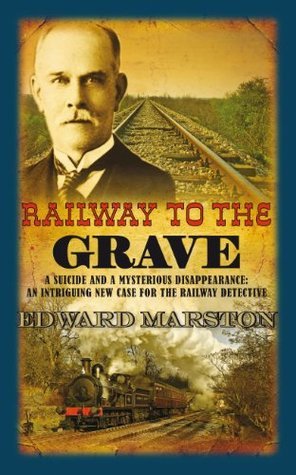
Tragedy strikes close to the Detective Department when an old army friend of Superintendent Tallis walks to meet a speeding train head on. The suicide, prompted by the disappearance of the man s wife, has shocked the local community and leaves plenty for Inspector Robert Colbeck, the Railway Detective, to uncover. Whispers and rumors abound but did the dead man, Captain Randall, really take his own life in repentance for some harm he did his wife?
Keith Miles (born 1940) is an English author, who writes under his own name and also historical fiction and mystery novels under the pseudonym Edward Marston. He is known for his mysteries set in the world of Elizabethan theatre. He has also written a series of novels based on events in the Domesday Book, a series of The Railway Detective and a series of The Home Front Detective.
Enjoyable in a stolid, dependable way which works for me at times. Fairly often, presumably, because I've read many books in this series. It's junk food reading I suppose, although at times the repetitive prose and stilted dialogue are almost self-parodying. Still, I find it hard to dislike a book that makes so few demands of me and helps me idle away a few hours that might be spent succumbing to seasonal depression instead.
Edward Marston's splendid Railway Detective series has one good starting point in that the reader is immediately drawn into the drama and that is very much the case in this, Detective Robert Colbeck's seventh recorded case.
The action takes place in Yorkshire where Colonel Aubrey Tarleton and his wife live with two step-children, on the wife's side, living away. The Colonel's wife disappears and before too long the Colonel himself writes himself into the title of the novel.
Suspicion is placed on the Colonel as having killed his wife and not present to protect himself rumours are rife. But there are plenty of other suspects, including the now returned stepson, and Colbeck and his able assistant Sergeant Victor Leeming go about their business in a professional way, especially when the wife's body is found.
Colbeck's boss, Chief Inspector Tallis, tries to interfere as does the local constabulary sergeant. Colbeck persuades Tallis to return to London and when the bolshy sergeant turns out to be more involved than is at first thought, he, too, is summarily put in his place.
All the while the investigation is taking place Colbeck finds time for a little romance and trips back to London to see his fiancee Maddy Andrews, whose relationship with her engine driving father is fully explored.
Finally there is a surprising twist to the tale and when all is revealed Robert Colbeck is free to resume his regular romantic assignations with Maddy!
As is my unfortunate wont, I found a copy of Railway to the Grave and was immediately captured by the old-style font and design enough to overlook the fact that this was a novel late in a series named after the first novel in said series, The Railway Detective. Yet, I figured I had started in mid-series before and, if I liked the characters, style and plotting, I would go back to the beginning (in this case, I did rather obsessively). Readers of the series will already be familiar with Inspector Colbeck , the protagonist, and his supporting cast of: 1) Victor Leeming, his colleague, bodyguard, and sometime infiltrator; 2) Superintendent Tallis, supervisor, chain cigar-smoker (when upset), and constant thorn-in-the-flesh as provincial-minded, tradition-bound boss; 3) Madeline Andrews, romantic interest, affianced in this book, and unauthorized co-investigator in the tradition of Thomas and Charlotte Pitt (of Anne Perry fame); and 4) Caleb Andrews, train engineer (one-time victim in the first novel as alluded to in this one), father of the prospective bride, and comic relief. Another cast member, the controversial ex-policeman Brendan Mulryne, doesn’t appear in this volume as I recall, but he is very important in others which I will review in time.
As noted in my descriptions of characters, this series is close to the Charlotte and Thomas Pitt mysteries in era and mystery-solving team. At first glance, the major difference is that Colbeck only gets support from “Maddy” while Charlotte usually finds the key which unlocks the whole mystery. Still, it’s the era of discrimination against women when being literate and educated was considered unusual—especially if that woman is “merely” the daughter of a railway worker. Of course, the real differentiation between the two series (and indeed, of Perry’s William Monk series) is that Robert Colbeck is a former barrister who became disillusioned with representing criminals and more involved in apprehending them. He loves trains, has a fabulous library, and dresses in sartorial excellence.
Frankly, I wouldn’t be as obsessed with this series if the mysteries (especially Railway to the Grave) didn’t have a certain freshness to them. Well, that’s not true. I probably would have been hooked just with the railroad backgrounds to each story. In Railway to the Grave, though, the “mystery” begins with a clear-cut suicide. It is not immediately clear why a very respectable member of the upper class would choose to kill himself by walking calmly in front of a train. Inspector Colbeck is called out because it is such a bizarre death (and has the railroad connection) and the “Railway Detective” quickly becomes convinced that there is a murder involved. Indeed, there is significantly more involved than appears at first glance. Is it possible that said member of the nobility was driven inexorably toward suicide and that his choice of death is an important clue? Of course! That’s what is so fascinating about it.
Another satisfying read in Edward Marston's excellent series about Scotland Yard's Detective Inspector Richard Colbeck set in 1850's England (with forays into Wales and France at times).
This book was special because Richard's boss Detective Superintendent Tallis who normally is a gruff, anti-marriage, ill-tempered crank who especially drives Colbeck's assistant Detective Sergeant Victor Leeming up the wall, is shown to have a very human heart and a soft core.
One of Tallis' old military buddies Colonel Aubrey Tarleton has suffered the loss of his wife who disappeared two weeks earlier on the way to visit her best friend Agnes Reader. She had been on her way walking along with her husband who was off to do some shooting. She never showed up at her friend's home and never returned home. The Colonel frantically had the town out searching for her.
Where did she go? This is out in the sticks, way out in the country and the only transport is one's feet, horses, and the train. When the Colonel purposely walks out on the train tracks and deliberately walks into an oncoming train, purposely choosing to show up out of the blue on a curve when they won't be able to stop, he is killed. The note attached to his shirt says to contact Tallis. Tallis, along with Colbeck and Leeming show up and seek to clear the Colonel's name (the locals are saying he murdered his wife then committed suicide over the guilt) and find the missing woman.
As always, there are so many twists and turns and memorable characters. You just never know when a valuable clue will show up and who will offer it. Colbeck and Leeming gather such clues from a half-witted teen boy who thinks the bullet cartridges he plays with are tin soldiers, a lazy daughter of a local cop who sent poison pen letters (along with a number of other people) when the Colonel fires the girl for not doing her work, a snoopy housekeeper, a scared housemaid who sees something while hidden behind a tree after running from an old lecher who tried to rape her, a very pompous and mean-spirited preacher's wife, a farmboy who sneaked off for a roll in the hay with a milkmaid (folks, I am not making any of this stuff up!) and an assortment of odd locals.
There is a tussle with the mean rector of the church, the murder investigation when the Colonel's wife's body is found, the case of the vile hate mail sent to the Colonel, an investment scandal, and a lesbian love affair that shocks everyone but Colbeck who is a live and let live sort of guy even in the 1850's. There is also family drama as the two grown 30 something kids come back -the sweet married daughter Eve and her parasite brother Adam who was estranged from the Colonel and his wife.
Two sources of annoyance to me-
(1) Madeleine Andrews became engaged to Inspector Colbeck in the last book. They are still holding hands and making no wedding plans. It took till the end of the book for Tallis to even know they are engaged! She is like a bossy bitch towards her dad and somewhat disrespectful , apparently forgetting who is supporting her till she's almost 30. I really have hated the bossy comments and some rude comments she made to her dad when Robert was around. She needs to remember who the parent and breadwinner is in the household.
(2) Sergeant Victor Leeming does nothing but whine and carry on when he is required to spend the night or a number of nights away (which occurs in all of the books)because he won't be in bed with his wife Estelle overnight or home with the wife and 2 kids some nights. Hello? This is the nature of the job and he knew it when he took the job. If I was Tallis and Colbeck, I would tell him for once and for all to shut the hell up with the whining or look for another job. Maybe he could be a bouncer at a bar or something. You don't hear Colbeck whining about being away from Madeleine though he is crazy about her. What Leeming really needs is a job where he can have sex with his wife endlessly and get paid for it.
I enjoy listening to these as audiobooks. I especially enjoyed this one - there were plenty of plot twists and turns that I didn’t see coming and I love the little developments in Detective Inspector Robert Colbeck’s relationship with Madeleine Andrews which are in each of the books.
Perhaps three and something stars is a more exact rating. Another book in the Train Detective series with a familiar structure and prose style. The details about trains and the railways are interesting without requiring anorak levels of knowledge and, as always, the main characters are present in all their curious glory. I must confess to liking the Andrews family and Leeming more than the frequently pompous and occasionally irritating Colbeck. The dialogue is sometimes stilted and flat, almost a pastiche of the period, because it lacks drive and nuance, as in the case of Tallis. Where the dialogue does come alive is in the interactions of Maddy Andrews and her father, although I am undecided where I stand on their Cranford/ Dickens debate. The plot and storytelling are solid and there are enough clues to start your own detecting, I did guessed the murderer quite earlier but was completely wrong on the motive and the number of red herrings, more than enough to feed the 5000, made me question my decision. I have to admit I found the grand revelation behind the murder annoying as it was so out of the blue. I also felt it was weakly handled and led to too much moralising just to portray Colbeck as the most enlightened and open-minded character. I have read better books by Marston, but this was still a good diversion. Next time, I think I shall return to the Oceanliners.
Not the best of the bunch. I guessed the connection between Agnes and Miriam pretty early on. Also, maybe Tallis is correct and the engagement is proving a distraction. Colbeck was not at his best, each suspect he had decided was the murderer proving to be innocent until a bunch of letters fell into his hands (he didn't even find them). This case was solved more by luck than anything. One good thing. At least Leeming didn't get knocked in the head this time around.
I am interested to see the changes which will occur once Colbeck and Madeleine marry. I'm hoping there will be a little less of Madeleine's father. He can be a trifle annoying at times.
This entire review has been hidden because of spoilers.
This book had so many twists and turns in it that you are hooked all the way through. Just as you feel the detectives are getting somewhere something else crops up to lead them down a different route
I definitely wasn't expecting the way it ended either
I haven't read any of the other books in this series but I think I would read more of them
Don't know how I missed this one when it was published, but was pleased to discover it when I finally did. Purchased with a greatly appreciated gift card, this book was doubly enjoyed for its addition to my library by thoughtful friends.
This jump back in time was a welcome relief after a period of reading modern, grittier stories. Although I know that books like Marston's over-romanticize the Victorian era, I do enjoy the respite they bring to a harried mind. It may be looking at the time through rose coloured glasses, but hey...it's fiction...and I like the way that Marston tells his stories. Good book.
I am not going to rate this - I only read it because I had purchased four books in this series from a charity shop. This was as I expected. Nothing special, the MC as dull and 'perfect' as in the first book, the secondary characters clichéd. I wanted some tension, something to make me CARE about people, to make me desperate to read to the end, but I didn't get any of that.
Enjoyable tosh - Victorian pulp fiction packed with stereotypical, two-dimensional characters but nevertheless, a rollicking deckchair read, worth the £1 spent in The Works!!
These books are always fairly formulaic and you know what to expect each time - Victor Leming will complain about taking trains and being away from his wife for even one night, Tallis will be a blistering bully of a boss and Colbeck will deliver a “relay of punches” to a suspect. That being said, I’m pleased to say that Railway to the Grave was actually one of the better ones in the series.
The train itself was mostly incidental and the victim’s death that brought Colbeck to the scene initially was merely the effect, so the actual focus of the investigation is on the cause - why did the colonel choose to die like this?
The ultimate cause was actually somewhat unexpected, enough so that I wish there was more time dedicated to fleshing out the once the “shocking twist” was delivered. Most of the story was spent unravelling all the red herrings and uncovering the deep, dark secrets held by various villagers, though the supporting characters were mostly so unlikable that seeing Colbeck take them down one by one was enjoyable in its own way.
This entire review has been hidden because of spoilers.
I love this series like an old friend. I love the recurring characters more and more every time I read a new installment. It may sound masochistic, but I love when mystery writers get to the climax of the novel and suddenly make everyone super suspicious. Marston’s red herrings were fairly obvious but I don’t mind that. There’s always a small part of me that wonders if the author is going to pull a reverse. I'm still waiting for it to happen.
This may be a really girly thing for me to point out, but I love how transparent Colbeck is with Madeleine. He never tries to intentionally shock her, but he also respects her ability to handle the truth and doesn’t treat her like a faint heart that needs to be sheltered.
Also the conversation at the end between Colbeck and Tallis made me giddy. Tallis slightly failing at restraining his paternal-like pride. My heart could barely take it.
Edward Marston’s railway detective, an early Victorian Met officer is a likeable character pleasantly devoid of the mystical insight so often called on by creators of detective fiction. Instead he relies on methodical detecting, often with a twist as in this case hinted at but stretching the narrative evidence a bit far.
In this case we have an old army chum of his boss dead on a train line in North Yorkshire, a missing wife and plenty of small town intrigue. Colbeck and Lemming, the detective pairing, are out of the London comfort zone, hovered over by their boss, and negotiating their way through small town secrets and rivalries. Along the way there’s plenty of red herrings and diversions, skulduggery and deviousness leading to dead ends or murder suspects who are at worst minor offenders. Marston has a format that works well – in this case building an engaging tale that was ideal for a hot summer afternoon: pleasantly diverting.
An easy read where you don't have to think too much. The language can be stilted at times and then we get great swathes of expositional dialogue as various characters explain copious historical facts which didn't sound believable in that would they really speak like that. In other books of the series Colbreck's fiancee Madeleine becomes involved in the investigation or crime, this time she is literally pushed into a siding to discuss domestic issues with her father as Colbreck and Leeming head for North Yorkshire to investigate a murder and suicide. Marston gives us plenty of likely suspects and motives but the ending does have a modern day ending to which Colbreck has suddenly developed a 21st century attitude.
This Railway detective novel is about a man who committed suicide and his missing wife, so the main mystery was about the missing wife to try and clear the man's name. This was interesting enough, though it didn't get my attention as much as some others had done. Tallis was humanised a lot more in this one, which I did appreciate, even if he did get in the way of the actual investigation (but in a reasonable way).
I would never claim that these books are high literature, but they are pure entertainment. The characters are a little two dimensional and the dialogue can be a bit clumsy and stilted. This doesn’t detract too much from what are essentially straightforward detective mysteries, and they are just what I need sometimes when all I want is an easy, entertaining read to cosy up with and escape into. Think soap opera in book form and you get the idea.
Tragedy strikes close to the Detective Department when an old friend of Superintendent Tallis walks to meet a speeding train head on. The suicide, prompted by the disappearance of the man's wife, has shocked the local community and leaves plenty for Inspector Robert Colbeck, the Railway Detective, to uncover. Whispers and rumours abound but did the dead man, Captain Randall, really take his own life in repentance for some harm he did his wife? Another enjoyable book in this series.
This was given to me by a friend who knows I like detective fiction. I did not have a high hopes, as I had not heard of the writer, and it's the 7th in an ongoing series! I tend to like to start at the beginning :). But I was pleasantly surprised. It was well written, with what appeared to be a good knowledge of its setting and no glaring anachronisms. The characters were well written with a good plot. Didn't see that motive!
More cozy shenanigans by the inspector and his protegee. The reveal is a tad off this time but the setting is interesting and a tad closer to Christie than Marston's other entries in the series. Once again, the best feature is the interplay between The Sgt. and the inspector as well as the super-intended, especially since the latter is a tad more involved in the investigation (at least from the get go he is). All in all, you get what you paid for.
While there were no train crashes in this novel someone did get killed by one. Apart from the journeys taken by the Detective and his Sergeant the crimes to be investigated in this story took place away from the railway. The investigation itself made an interesting read and with an abundance of prime suspects it was quite difficult to ascertain who was responsible until the very end. Another good case for Edward Marston's Railway detective.
Just finished this book today. Yet another thoroughly enjoyable Edward Marston Railway Detective story. The ending was totally unexpected. There were plenty of red herrings and I reached the final chapter feeling I knew who the main perpetrator was. I was totally wrong! Looking forward to reading more about Inspector Colbesk and co.
Absolutely loved this book! It has pace all the way through and enough turns to keep you guessing to the last fifteen pages. I hadn’t enjoyed The Silver Locomotive’ (the previous novel in this series) so I hadn’t had the inclination to return to the Inspector Colbeck series very quickly, however this has totally made me fall for them all over again! I really struggled to put it down!
It's not the best of the set so far - the first 80 pages are rather dull, and the killer is telegraphed quite early on as well, even if the motive isn't so obvious. There's plenty of red herrings as usual and an array of weird and wonderful characters. In general, this is a quick gentle mystery that's worth reading as part of the set but you'd not miss anything of importance if you skipped it.
Published in 2010, 'Railway to the Grave' is another instalment in the popular 'Railway Detective' series of murder mysteries set in mid-19th century Britain. As usual, the plot takes second place to the interesting and often eccentric characterisations common to Marston's series. Enjoyable lightweight read.
Colbeck woos fiancee between solving disappearance of Miriam, vicious letters driving suicide of husband Tarleton, regular visits to Doncaster, false mourning of stepson Adam, his friendship with jailbird. Sgt Leeming slogs questioning while missing family in London.
Despite the subject matter, this had the feel of a gentle story lightly told; no great depth to the characters, no complexity in the plot. Occasionally a little heavy handed or lacking in subtlety, but in the end an entertaining enough tale.
I've enjoyed Marston's Railway Detective series. This is the 6th of the series that I have read. This one had a treat because one of the key figures in the book (committed suicide by stepping in front of a moving locomotive) attended many British brass band performances in Yorkshire!
This is the first RD book that I didn't really enjoy. Which disturbs me because I'm obsessed with these books.
Firstly, I usually read one of these when I need a palate cleanser or I've read a lot of dark stuff, and want to balance it out a little bit. But for the first time I read two back to back, and I think that was the mistake.
The link to the railway in this one felt very tenuous and more like it was a standard thriller that the railway detective kind of got shoehorned into. Also, for the first time in this series, Victor Leeming did not get hit over the head whilst undercover, which is something I had been asking for, seeing it as too much of a running joke. And yet here, I found I missed it.
This was not a bad book by any means, but I simply didn't enjoy it. Perhaps I will stick to reading one every month or so from now on, in case it was the back to back read that made it feel boring and too long.