

What do you think?

My Venice and Other Essays
A collection of "entertaining . . . unapologetically opinionated" essays from the New York Times-bestselling author of the Commissario Guido Brunetti novels (The New York Times).
Donna Leon has won legions of fans and waves of critical acclaim for her international bestselling mystery series featuring Venetian Commissario Guido Brunetti--not only for her intricate plots and gripping narratives, but for her insight into the culture, politics, family-life, and history of Venice. But outside of her mystery novels, Leon has also been writing essays on Venetian life and related topics for years.
In My Venice and Other Essays, the best of these essays are more than fifty charming and insightful works ranging in topic from battles over garbage in the canals to the troubles with rehabbing Venetian real estate. Leon shares episodes from her life, explores her love of opera, and recounts tales from in and around her country house in the mountains. With pointed observations and humor, she also explores her family history, her former life in New Jersey, and the idea of the "Italian man."
Sure to please longtime Leon fans as well as anyone who appreciates the wit and wisdom of a master wordsmith, this volume offers "an intriguing glimpse at the strong views of an exceptionally interesting and entertaining novelist" (The Seattle Times).
Donna Leon has won legions of fans and waves of critical acclaim for her international bestselling mystery series featuring Venetian Commissario Guido Brunetti--not only for her intricate plots and gripping narratives, but for her insight into the culture, politics, family-life, and history of Venice. But outside of her mystery novels, Leon has also been writing essays on Venetian life and related topics for years.
In My Venice and Other Essays, the best of these essays are more than fifty charming and insightful works ranging in topic from battles over garbage in the canals to the troubles with rehabbing Venetian real estate. Leon shares episodes from her life, explores her love of opera, and recounts tales from in and around her country house in the mountains. With pointed observations and humor, she also explores her family history, her former life in New Jersey, and the idea of the "Italian man."
Sure to please longtime Leon fans as well as anyone who appreciates the wit and wisdom of a master wordsmith, this volume offers "an intriguing glimpse at the strong views of an exceptionally interesting and entertaining novelist" (The Seattle Times).
240 pages, Kindle Edition
First published January 1, 2007
About the author
Donna Leon
156 books2,987 followersDonna Leon (born September 29, 1942, in Montclair, New Jersey) is an American author of a series of crime novels set in Venice and featuring the fictional hero Commissario Guido Brunetti.
Donna Leon has lived in Venice for over twenty-five years. She has worked as a lecturer in English Literature for the University of Maryland University College - Europe (UMUC-Europe) in Italy, then as a Professor from 1981 to 1999 at the american military base of Vicenza (Italy) and a writer.
Her crime novels are all situated in or near Venice. They are written in English and translated into many foreign languages, although not, by her request, into Italian. Her ninth Brunetti novel, Friends in High Places, won the Crime Writers' Association Silver Dagger in 2000.
Series:
* Commissario Brunetti
Donna Leon has lived in Venice for over twenty-five years. She has worked as a lecturer in English Literature for the University of Maryland University College - Europe (UMUC-Europe) in Italy, then as a Professor from 1981 to 1999 at the american military base of Vicenza (Italy) and a writer.
Her crime novels are all situated in or near Venice. They are written in English and translated into many foreign languages, although not, by her request, into Italian. Her ninth Brunetti novel, Friends in High Places, won the Crime Writers' Association Silver Dagger in 2000.
Series:
* Commissario Brunetti
Ratings & Reviews
Friends & Following
Create a free account to discover what your friends think of this book!
Community Reviews
Displaying 1 - 30 of 161 reviews

September 23, 2014
Donna Leon and I have a strange relationship. She's nowhere near the top of my list of favorite detective writers, yet I've read six of her Commissario Brunetti mysteries (sort of how I really don't like Rent all that much, yet through an odd combination of circumstances have seen the show three times). Her books always leave me feeling unfulfilled, even though at this point I should know better than to expect miracles from them. But I keep coming back to her books, hoping to find that really great one that I know is hidden in the series, and I do this for one reason: Venice. Much in the way that I will happily watch paint dry if the narrator from Bridezillas is providing commentary, I will read just about any book that takes place in Venice. It's a killer setting, especially for a mystery, and despite all her weaknesses as a writer, Leon uses the setting to its full potential in every book.
Which is all a long-winded way of saying that when I found this book, I was delighted - Donna Leon discussing Venice, without the distraction of her half-baked murder mysteries and useless filler scenes? Sign me up.
The book, as the "Other Essays" part of the title suggests, is about more than just the author's experiences in Venice (where she's lived for over twenty years). There's a lengthy section on opera, some stories about Leon's country house in Italy, a lot of essays bashing the United States, and a few essays that get into Leon's childhood and frankly fascinating career history (she was living in Iran at the time of the revolution, and also did a teaching stint in Saudi Arabia - Donna Leon, I am delighted to report, is a badass).
Other reviewers took issue with the negative tone of a lot of the essays, but I found her curmudgeonly air delightful. If she's not complaining about going back home and being surrounded by fat Americans who have probably never even been to Europe, gross, she's expounding on opera and how once a friend forced her to go to a non-Baroque opera, prompting a delightful list of "warnings meant to govern attendance at the opera," the first of which goes like this:
"1. Beware of beds. If, at any time during a performance, a bed appears on stage in a place other than a bedroom it is probably being used as a symbol. Opera directors often use symbols in place of ideas. They are not the same."
My only complaint is that many of the essays feel too short. They're more like anecdotes instead of fully-formed stories, and there are potential essays hidden within the text that I would have enjoyed reading. In one of her opera pieces, Leon gets to the end and mentions that when she was at the reception, she started imagining how a murderer would escape the room, and says that this is one of the perils of being a detective writer. I could have read an entire essay about how Leon can't stop imagining grisly murder scenarios everywhere she goes, but instead it's tacked on at the end of a completely unrelated essay, which was frustrating. She also has some essays about writing at the end of the book, including some advice on writing detective stories. I enjoyed this, although she seemed to have sort of a dismissive attitude towards the detective genre (I forgot to mark it, so I can't quote the line directly, but I remember her implying that mysteries are not "real" books). It was weird to watch Leon essentially bite the hand that feeds her, and it made me wonder if she only started writing mysteries because of the money, which makes me sad. Although it would explain why none of her books have managed to impress me so far.
Which is all a long-winded way of saying that when I found this book, I was delighted - Donna Leon discussing Venice, without the distraction of her half-baked murder mysteries and useless filler scenes? Sign me up.
The book, as the "Other Essays" part of the title suggests, is about more than just the author's experiences in Venice (where she's lived for over twenty years). There's a lengthy section on opera, some stories about Leon's country house in Italy, a lot of essays bashing the United States, and a few essays that get into Leon's childhood and frankly fascinating career history (she was living in Iran at the time of the revolution, and also did a teaching stint in Saudi Arabia - Donna Leon, I am delighted to report, is a badass).
Other reviewers took issue with the negative tone of a lot of the essays, but I found her curmudgeonly air delightful. If she's not complaining about going back home and being surrounded by fat Americans who have probably never even been to Europe, gross, she's expounding on opera and how once a friend forced her to go to a non-Baroque opera, prompting a delightful list of "warnings meant to govern attendance at the opera," the first of which goes like this:
"1. Beware of beds. If, at any time during a performance, a bed appears on stage in a place other than a bedroom it is probably being used as a symbol. Opera directors often use symbols in place of ideas. They are not the same."
My only complaint is that many of the essays feel too short. They're more like anecdotes instead of fully-formed stories, and there are potential essays hidden within the text that I would have enjoyed reading. In one of her opera pieces, Leon gets to the end and mentions that when she was at the reception, she started imagining how a murderer would escape the room, and says that this is one of the perils of being a detective writer. I could have read an entire essay about how Leon can't stop imagining grisly murder scenarios everywhere she goes, but instead it's tacked on at the end of a completely unrelated essay, which was frustrating. She also has some essays about writing at the end of the book, including some advice on writing detective stories. I enjoyed this, although she seemed to have sort of a dismissive attitude towards the detective genre (I forgot to mark it, so I can't quote the line directly, but I remember her implying that mysteries are not "real" books). It was weird to watch Leon essentially bite the hand that feeds her, and it made me wonder if she only started writing mysteries because of the money, which makes me sad. Although it would explain why none of her books have managed to impress me so far.

July 24, 2013
A group of essays divided into six section, Leon writes of everything from trash collecting, obesity, opera, apartment nightmare and yes, even dog poop. Her love of Venice shines through even as she espouses on the various negative practices of her neighbors and government. Despite all its faults, as she states in the first section, there is no place else she would rather live.
Her love for animals is apparent in many of the essays, whether it be dogs,ducks or fish. Some of these essays are extremely short but all interesting as well as diverse. I did love that I could read a few of them here, a few more at a later time, was actually too much to read at one sitting. Kind of overkill. Her essays demonstrate her keen powers of observations as well as her ironic wit.
It would be hard to pick a favorite as I really admired all of them. At book end I felt I had a little glimpse of Venice and a little knowledge on what makes Donna Leon tick.
Her love for animals is apparent in many of the essays, whether it be dogs,ducks or fish. Some of these essays are extremely short but all interesting as well as diverse. I did love that I could read a few of them here, a few more at a later time, was actually too much to read at one sitting. Kind of overkill. Her essays demonstrate her keen powers of observations as well as her ironic wit.
It would be hard to pick a favorite as I really admired all of them. At book end I felt I had a little glimpse of Venice and a little knowledge on what makes Donna Leon tick.
September 28, 2014
I admit that the main reason I was eager to get my hands on this book was to see if the author revealed anything of significance about her personal life, past and present. I’ve known for some time that Donna Leon has led an unconventional life, having lived in a variety of countries all over the world before at last settling in Venice. I’ve always been curious about what prompted her to lead this peripatetic existence, so alien to and remote from her native land.
So, what did I learn from this collection about this gifted, mercurial person?
1. Living in Venice is hard work, especially as you get older. There are no cars to convey you and your parcels from place to place.
2. Italians can be irreverent slobs:
"….no building, regardless of its beauty, age, or condition, is safe from spray paint and mindless graffiti; the rocks of the Alberoni, the only swimmable beach here, are awash with plastic bottles and bags; rivers teem with the same detritus; and both sides of state highways would provide a fortune in bottle deposits, had Italy a policy of placing deposits on glass bottles."
(Never mind all this: she’s had a “thirty-year love affair” with the Italians and has no wish to live anywhere else.)
3. The bureaucracy will drive you crazy.
4. Italians can be very strange on the subject of food. For instance, all foodstuffs seem to be either pesante (heavy) or leggero (light). The determination as to which is which may depend on whether your mother cooked it for you.
5. Tourists are the scourge of the Earth in general and of Venice in particular:
"They have, these countless millions, effectively destroyed the fabric of life known to the inhabitants of the city for a thousand years, have made life intolerable for residents for vast periods of the year, have led to the proliferation of shops that sell masks, plastic gondolas, tinted paper, sliced pizza, vulgar jester’s hats, and ice cream, all but the last of which the residents do not want and no one on the planet needs. They consume enormous amounts of drinking water and produce an endless supply of waste."
6. Visits to America only serve to reinforce her sense that it is, for her, an alien place. She returns mainly for family reasons. There’s a short, poignant piece on her mother’s funeral in New Jersey; Leon’s talons, mercifully, are retracted. In another essay, she profiles several of the more eccentric members of her clan. They all seem to have gotten along with one another reasonably well.
7. Lately, on these infrequent sojourns to her native land, she’s been astounded at the size and slovenliness of the people she sees. From a chapter entitled “Fatties:”
"Americans are fat, but in a way that is peculiar to them, as though a race of hermaphrodites had been squeezed out of pastry bag and badly smoothed into shape with a giant spatula, then stuffed into low-crotched jeans and tent-sized T-shirts before being given bad haircuts and sent on their way."
Talons back out, and how!
8. She taught in China for a year. She lived in Iran for four years and liked the country very much. She lived and taught in Saudi Arabia for a year and loathed the place, loathes it still. Why was she doing this? She needed the money, she says. But surely there are less stressful ways to get it….
9. A section “On Men” got my antennae waving, especially in one essay where she confesses to perusing the “Personals” in the New York Review of Books. But alas, she is not doing this for herself, but on behalf of a widowed friend.
10. In a section on music, Leon pours out her love of baroque opera in general and the works of George Frideric Handel in particular. In an essay on Maria Callas, she refers to Tosca as “a vulgar potboiler I wouldn’t today cross the street to hear.” I admit I laughed out loud when I read this. Tosca, by Giacomo Puccini, is my absolute favorite opera. It’s got passion, jealousy, lust, the highest of high drama, and music that is almost too gorgeous to believe. It invariably reduces me to tears. Ah well – chacun à son goût, as I’m sure Donna Leon would agree – or perhaps not. She is, after all, nothing if not a woman of strong opinions.
When all is said and done, I encountered no startling revelations of a romantic or familial nature. Donna Leon remains something of a mystery to me. She’s keeping her secrets, as she has every right to do. I’m deeply grateful to her for the Guido Brunetti novels; they’re among the most thoughtful, well written, wryly humorous, and ultimately humane works of crime fiction that I know of.
The penultimate essay in My Venice is called “Suggestions on Writing a Crime Novel.” It is, for my money, the best piece in the book, full of useful insights, clearly articulated, concerning the craft of writing crime fiction. (The term ‘craft’ neatly sums up all that I think is not quite right about much contemporary fiction. I refer to the lack of structure, indifferent writing, inconsistent characterization, and a host of other problems.) Here’s Donna Leon on the subject of narrative point of view; specifically, the issues raised by an author’s choice to write in the first person.
"The practical danger resulting from the decision to use the first person should be immediately obvious: the acquisition of information. There are only o many ways a character can obtain information: he can hear it or see it or read it. (Okay, smell and taste, but let’s be serious here.) Does he hear or does he overhear?If he’s going to hear it, then he has to be a character who is sufficiently sympathetic to be trusted by many different people and thus trusted with their confidences. If he’s going to overhear, then he’s got to be lucky to be in the right place at the right time. when the wrong things are said."
I recommend this essay not only to writers, but also to readers in search of criteria to use when evaluating their reading matter. After I read it, I thought to myself, so that’s why Leon’s Guido Brunetti novels are so excellent.
So, what did I learn from this collection about this gifted, mercurial person?
1. Living in Venice is hard work, especially as you get older. There are no cars to convey you and your parcels from place to place.
2. Italians can be irreverent slobs:
"….no building, regardless of its beauty, age, or condition, is safe from spray paint and mindless graffiti; the rocks of the Alberoni, the only swimmable beach here, are awash with plastic bottles and bags; rivers teem with the same detritus; and both sides of state highways would provide a fortune in bottle deposits, had Italy a policy of placing deposits on glass bottles."
(Never mind all this: she’s had a “thirty-year love affair” with the Italians and has no wish to live anywhere else.)
3. The bureaucracy will drive you crazy.
4. Italians can be very strange on the subject of food. For instance, all foodstuffs seem to be either pesante (heavy) or leggero (light). The determination as to which is which may depend on whether your mother cooked it for you.
5. Tourists are the scourge of the Earth in general and of Venice in particular:
"They have, these countless millions, effectively destroyed the fabric of life known to the inhabitants of the city for a thousand years, have made life intolerable for residents for vast periods of the year, have led to the proliferation of shops that sell masks, plastic gondolas, tinted paper, sliced pizza, vulgar jester’s hats, and ice cream, all but the last of which the residents do not want and no one on the planet needs. They consume enormous amounts of drinking water and produce an endless supply of waste."
6. Visits to America only serve to reinforce her sense that it is, for her, an alien place. She returns mainly for family reasons. There’s a short, poignant piece on her mother’s funeral in New Jersey; Leon’s talons, mercifully, are retracted. In another essay, she profiles several of the more eccentric members of her clan. They all seem to have gotten along with one another reasonably well.
7. Lately, on these infrequent sojourns to her native land, she’s been astounded at the size and slovenliness of the people she sees. From a chapter entitled “Fatties:”
"Americans are fat, but in a way that is peculiar to them, as though a race of hermaphrodites had been squeezed out of pastry bag and badly smoothed into shape with a giant spatula, then stuffed into low-crotched jeans and tent-sized T-shirts before being given bad haircuts and sent on their way."
Talons back out, and how!
8. She taught in China for a year. She lived in Iran for four years and liked the country very much. She lived and taught in Saudi Arabia for a year and loathed the place, loathes it still. Why was she doing this? She needed the money, she says. But surely there are less stressful ways to get it….
9. A section “On Men” got my antennae waving, especially in one essay where she confesses to perusing the “Personals” in the New York Review of Books. But alas, she is not doing this for herself, but on behalf of a widowed friend.
10. In a section on music, Leon pours out her love of baroque opera in general and the works of George Frideric Handel in particular. In an essay on Maria Callas, she refers to Tosca as “a vulgar potboiler I wouldn’t today cross the street to hear.” I admit I laughed out loud when I read this. Tosca, by Giacomo Puccini, is my absolute favorite opera. It’s got passion, jealousy, lust, the highest of high drama, and music that is almost too gorgeous to believe. It invariably reduces me to tears. Ah well – chacun à son goût, as I’m sure Donna Leon would agree – or perhaps not. She is, after all, nothing if not a woman of strong opinions.
When all is said and done, I encountered no startling revelations of a romantic or familial nature. Donna Leon remains something of a mystery to me. She’s keeping her secrets, as she has every right to do. I’m deeply grateful to her for the Guido Brunetti novels; they’re among the most thoughtful, well written, wryly humorous, and ultimately humane works of crime fiction that I know of.
The penultimate essay in My Venice is called “Suggestions on Writing a Crime Novel.” It is, for my money, the best piece in the book, full of useful insights, clearly articulated, concerning the craft of writing crime fiction. (The term ‘craft’ neatly sums up all that I think is not quite right about much contemporary fiction. I refer to the lack of structure, indifferent writing, inconsistent characterization, and a host of other problems.) Here’s Donna Leon on the subject of narrative point of view; specifically, the issues raised by an author’s choice to write in the first person.
"The practical danger resulting from the decision to use the first person should be immediately obvious: the acquisition of information. There are only o many ways a character can obtain information: he can hear it or see it or read it. (Okay, smell and taste, but let’s be serious here.) Does he hear or does he overhear?If he’s going to hear it, then he has to be a character who is sufficiently sympathetic to be trusted by many different people and thus trusted with their confidences. If he’s going to overhear, then he’s got to be lucky to be in the right place at the right time. when the wrong things are said."
I recommend this essay not only to writers, but also to readers in search of criteria to use when evaluating their reading matter. After I read it, I thought to myself, so that’s why Leon’s Guido Brunetti novels are so excellent.

February 11, 2014
Leon reminds us what we, the masses, like about the internet and TV criticism today: it is not always politically correct. Leon makes no attempt to please everyone. She is just telling us what she thinks about, and she doesn’t mince words. The woman who writes fascinating and thoughtful police procedurals that dramatize critical issues of our time is intelligent and opinionated. Her personality is out there for us to “take it or leave it.” I like people with considered opinions.
Because Leon is able to articulate her positions, we are convinced we must take her standpoint into consideration when formulating or modifying our own view of the world. And finally, she is amusing, something that is too little valued in polite society these days. One gets the feeling she relishes matching wits: contrary viewpoints will not necessarily be shunned by her, but welcomed by a sardonic smile, a tilt of dark brows which contrast so sharply with her white bob, and the gleaming sword of wit raised as if to kiss. Be prepared to do battle all ye who enter here.
Mostly Leon’s essays are short opinions about this and that, essays that get longer as the book moves along. Her sections are intriguing: “On Venice,” “On America,” “On Music,” “On Mankind and Animals.” In “On Men” we learn what is essential to the Italian male character. We glean details of Leon’s background as an American living abroad. The essays are an excellent counterpoint to the ever longer series featuring police chief Commissario Brunetti of Venice. Brunetti is a nice man, a good father, loving husband, and a thoughtful, effective police chief in an Italian context. That is, criminals are not always brought to justice and official corruption is a way of life. Leon’s essays put these characterizations in context.
The most interesting section of essays might be the last, which Leon entitles “On Books.” One essay in this section has Leon giving her considered (and valuable) opinion on what it takes to be a successful mystery/crime writer, which decisions must be made before beginning a novel, and what level skill is required. Then she adds an essay on “the expert eye” and how critical that is to the success of a crime writer.
Sylvia Poggioli, NPR radio commentator based in Italy, interviewed Leon in 2007. I was surprised to learn that Leon’s books are not translated into Italian, and will not be in her lifetime. She had been writing the Venetian Brunetti series for some time before her books were available in the United States. I’d always assumed her work was for European audiences rather than for American ones…so I was surprised to learn the country where she lives is not privy to her talent.
Donna Leon’s own blog features further links and discussions.
I want to read further in the series, knowing what I do now after these essays. Delightfully piquant.
Because Leon is able to articulate her positions, we are convinced we must take her standpoint into consideration when formulating or modifying our own view of the world. And finally, she is amusing, something that is too little valued in polite society these days. One gets the feeling she relishes matching wits: contrary viewpoints will not necessarily be shunned by her, but welcomed by a sardonic smile, a tilt of dark brows which contrast so sharply with her white bob, and the gleaming sword of wit raised as if to kiss. Be prepared to do battle all ye who enter here.
Mostly Leon’s essays are short opinions about this and that, essays that get longer as the book moves along. Her sections are intriguing: “On Venice,” “On America,” “On Music,” “On Mankind and Animals.” In “On Men” we learn what is essential to the Italian male character. We glean details of Leon’s background as an American living abroad. The essays are an excellent counterpoint to the ever longer series featuring police chief Commissario Brunetti of Venice. Brunetti is a nice man, a good father, loving husband, and a thoughtful, effective police chief in an Italian context. That is, criminals are not always brought to justice and official corruption is a way of life. Leon’s essays put these characterizations in context.
The most interesting section of essays might be the last, which Leon entitles “On Books.” One essay in this section has Leon giving her considered (and valuable) opinion on what it takes to be a successful mystery/crime writer, which decisions must be made before beginning a novel, and what level skill is required. Then she adds an essay on “the expert eye” and how critical that is to the success of a crime writer.
Sylvia Poggioli, NPR radio commentator based in Italy, interviewed Leon in 2007. I was surprised to learn that Leon’s books are not translated into Italian, and will not be in her lifetime. She had been writing the Venetian Brunetti series for some time before her books were available in the United States. I’d always assumed her work was for European audiences rather than for American ones…so I was surprised to learn the country where she lives is not privy to her talent.
Donna Leon’s own blog features further links and discussions.
I want to read further in the series, knowing what I do now after these essays. Delightfully piquant.

April 21, 2014
Donna Leon, to quote her own words, is a harpy. Basically all these essays were written so she could complain about something. She hates American b/c our president (re Bush) is dumb and our people are fat. I'm gonna invoke the Dixie Chicks clause here - bash America all you want, but do it from America. Don't move to Venice for 30 years and still feel like you have a say in how our country is run. The only essay worth anything was the one about Saudi Arabia.
I'm going to Venice is two weeks and I was looking for something to introduce me to the culture. This was not it, and frankly I'm kinda sad I read it. The author obviously hates everything and I didn't need to corrupt my thoughts with her venom.
Pass on this one. Trust me.
I'm going to Venice is two weeks and I was looking for something to introduce me to the culture. This was not it, and frankly I'm kinda sad I read it. The author obviously hates everything and I didn't need to corrupt my thoughts with her venom.
Pass on this one. Trust me.
December 14, 2013
As a big fan of this author's novels, I was shocked by the mean-spiritedness displayed in many of the essays in this book. I well recognize the many faults of our country, but I was quite put off by her blatant contempt of the U.S. Of course, she lives in Italy, the epitome of beautifully-governed, perfectly functioning, and flawlessly-operated life! As far as contempt for tourists, one might well point out that Venice LIVES ON TOURISM! Amazon review uses the word "curmudgeonly" but as a curmudgeon myself, I would use "bitchy and arrogant!" From Amazon: My Venice and Other Essays is an example of one of my favorite genres of book. I love it when novelists take time out from fiction to write essays, articles, or other non-fiction. Even writers whose fiction I am not a fan of, have written some terrific non-fiction collections. Amy Tan's The Opposite of Fate and Stephen King's On Writing are two favorites. Sue Townsend and Barbara Kingsolver are also good in the non-fiction department. I've recently "discovered" Ann Patchett through her journalism and essays in This Is the Story of a Happy Marriage.
Donna Leon is one writer whose fiction I do enjoy, and I also like reading low-key travel narrative (as opposed to adventure travel, which is also fun, but in smaller doses). Her essay on her time in Saudi Arabia is memorable. I enjoyed My Venice and Other Essays, although it is somewhat uneven as a collection. It would be helpful to know who the essays were originally written for, as some seem geared toward a particular audience. For instance, Leon writes in some detail about opera, which she knows a lot about, but presumably her typical reader doesn't know as much about opera. That makes me think a few of the articles here were written for music magazines or some other specialist publication.
Leon often comes across as downright curmudgeonly, when she talks about inconsiderate neighbors or hunters or rodents. Or Americans in general, and tourists in particular. It's quite entertaining.
Donna Leon is one writer whose fiction I do enjoy, and I also like reading low-key travel narrative (as opposed to adventure travel, which is also fun, but in smaller doses). Her essay on her time in Saudi Arabia is memorable. I enjoyed My Venice and Other Essays, although it is somewhat uneven as a collection. It would be helpful to know who the essays were originally written for, as some seem geared toward a particular audience. For instance, Leon writes in some detail about opera, which she knows a lot about, but presumably her typical reader doesn't know as much about opera. That makes me think a few of the articles here were written for music magazines or some other specialist publication.
Leon often comes across as downright curmudgeonly, when she talks about inconsiderate neighbors or hunters or rodents. Or Americans in general, and tourists in particular. It's quite entertaining.

January 10, 2023
Donna Leon is a famous mystery writer that I have never read before. So it's amazing that her essay collection wow'd me without me having any idea who she was. Her voice is undeniable and her deep love, knowledge, and righteousness for the city of Venice, opera, calling out misogyny, and appreciating nature are wonderful to read.
-Mary Kate
-Mary Kate
October 17, 2021
The Mind Behind Brunetti and a Bit of Bio
Review of the Grove Press paperback edition (2014) of the Atlantic Monthly Press hardcover original (2013*)
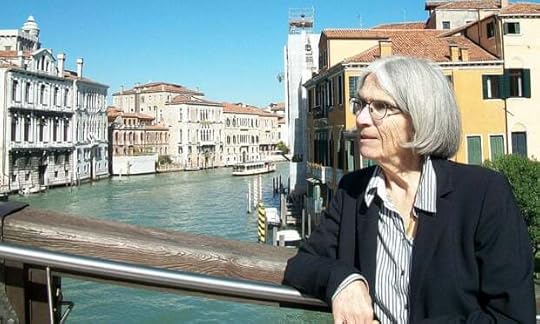
Donna Leon in Venice, Italy. Image sourced from an interview in The Guardian April 15, 2017.
My Venice and Other Essays collects 55 essays written for various magazines and newspapers up to 2013 since Leon became well known for her annual Commissario Brunetti series (1992 - ongoing to date 2021) set in Venice, Italy. The original source publication details and dates are not provided, but some dates may be inferred from the content.
Unless Leon decides to write a full autobiography, My Venice and Other Essays may be the closest we will get to learning something about the personal life of the Brunetti author. In the various essays which have been grouped under some general themes, we get her views on living in Venice, her love of opera, her love of animals, her doubts about men in general and America in particular, and some rather great lessons about writing crime & mystery novels.
The essays are alternatively funny and informative about her loves, but also furious and dismissive about her hates. Only a few glimpses of major personal life events, are seen mostly from the years when she still worked at teaching English literature: she had worked in Iran for 4 years and escaped during the Khomeini revolution; she detests Saudi Arabia and its totalitarian regime based a 1 year teaching contract there; she loves baroque opera the most, especially the works of Handel; etc. There isn't anything too Brunetti-specific, but the general quirkiness of Venetian and Italian customs & bureaucracy are detailed. The essay Non mangiare, ti fa male(Don't Eat It, It is Bad) about Italians dividing food into very arbitrary and personal leggero (light) and pesante (heavy) groups was pretty funny.
The gems here for crime & mystery fiction fans are: the With Barbara Vine essay which finds the pair of writers (Vine being one of the pen-names of crime writer Ruth Rendell (1930-2015) discussing the best murder methods while dining at a restaurant (imagine listening in on that conversation without knowing who they were) and the Suggestions on Writing the Crime Novel, which is like a 10-page mini-course on crime and mystery writing.
CONTENTS
On Venice
My Venice; On the beating heart of the city; Garbage; The casino; Gypsies; Italian bureaucracy; Diplomatic incident; Non mangiare, ti fa male [Don't eat it, it is bad]; Miss Venice Hilton; New neighbors; The house from hell; Shit; Neighbor; Tourists; Da Giorgio; On poor people;
On music
A bad hair night at the opera; On beauty and freedom in the opera; Confessions of an American Handel junkie; Da capo (Callas); Anne Sofie von Otter; Deformazione professionale [Professional Deformation];
On mankind and animals
Mice; Hunters; Gladys; Cesare; Badgers; The woman from Dübendorf (Gastone); Tell me you forgive me, Professor Grzimek; Moles; Battle report; Blitz; My first time eating sheep's eyeball;
On men
Bosoms; The Italian man; Instincts; Oh beautiful little foot; It's a dick thing; A trivial erotic game = okay, so I'm a Puritan; I want a few good men; The developer; Saudi Arabia; The New York man;
On America
My family; Tomato empire; My mother's funeral; Fatties; We'd all be hamburger, Ma'am; On Sprüngli and CNN; The United States of Paranoia;
On books
E-mail monsters ; With Barbara Vine ; No tears for Lady Di ; Suggestions on writing the crime novel ; On dinner with an American physician ;
Trivia and Links
* There are earlier 2007 & 2005 foreign language editions that have been merged with this book, but Mijn Venetië (2007) and Mein Venedig (2005) may only contain some of the Venice related sections. For example, the Mein Venedig (2005) is only a single CD audiobook.
For more background on Brunetti I would recommend this interview with author Donna Leon at ItalianMysteries.Com even if it was done 18 years ago. She discusses all sorts of background to the books and characters and also gives the reason that she won't allow the books to be translated into Italian (and it wasn't because she feared criticism by her neighbours in Venice).
Review of the Grove Press paperback edition (2014) of the Atlantic Monthly Press hardcover original (2013*)
Donna Leon in Venice, Italy. Image sourced from an interview in The Guardian April 15, 2017.
My Venice and Other Essays collects 55 essays written for various magazines and newspapers up to 2013 since Leon became well known for her annual Commissario Brunetti series (1992 - ongoing to date 2021) set in Venice, Italy. The original source publication details and dates are not provided, but some dates may be inferred from the content.
Unless Leon decides to write a full autobiography, My Venice and Other Essays may be the closest we will get to learning something about the personal life of the Brunetti author. In the various essays which have been grouped under some general themes, we get her views on living in Venice, her love of opera, her love of animals, her doubts about men in general and America in particular, and some rather great lessons about writing crime & mystery novels.
The essays are alternatively funny and informative about her loves, but also furious and dismissive about her hates. Only a few glimpses of major personal life events, are seen mostly from the years when she still worked at teaching English literature: she had worked in Iran for 4 years and escaped during the Khomeini revolution; she detests Saudi Arabia and its totalitarian regime based a 1 year teaching contract there; she loves baroque opera the most, especially the works of Handel; etc. There isn't anything too Brunetti-specific, but the general quirkiness of Venetian and Italian customs & bureaucracy are detailed. The essay Non mangiare, ti fa male(Don't Eat It, It is Bad) about Italians dividing food into very arbitrary and personal leggero (light) and pesante (heavy) groups was pretty funny.
The gems here for crime & mystery fiction fans are: the With Barbara Vine essay which finds the pair of writers (Vine being one of the pen-names of crime writer Ruth Rendell (1930-2015) discussing the best murder methods while dining at a restaurant (imagine listening in on that conversation without knowing who they were) and the Suggestions on Writing the Crime Novel, which is like a 10-page mini-course on crime and mystery writing.
CONTENTS
On Venice
My Venice; On the beating heart of the city; Garbage; The casino; Gypsies; Italian bureaucracy; Diplomatic incident; Non mangiare, ti fa male [Don't eat it, it is bad]; Miss Venice Hilton; New neighbors; The house from hell; Shit; Neighbor; Tourists; Da Giorgio; On poor people;
On music
A bad hair night at the opera; On beauty and freedom in the opera; Confessions of an American Handel junkie; Da capo (Callas); Anne Sofie von Otter; Deformazione professionale [Professional Deformation];
On mankind and animals
Mice; Hunters; Gladys; Cesare; Badgers; The woman from Dübendorf (Gastone); Tell me you forgive me, Professor Grzimek; Moles; Battle report; Blitz; My first time eating sheep's eyeball;
On men
Bosoms; The Italian man; Instincts; Oh beautiful little foot; It's a dick thing; A trivial erotic game = okay, so I'm a Puritan; I want a few good men; The developer; Saudi Arabia; The New York man;
On America
My family; Tomato empire; My mother's funeral; Fatties; We'd all be hamburger, Ma'am; On Sprüngli and CNN; The United States of Paranoia;
On books
E-mail monsters ; With Barbara Vine ; No tears for Lady Di ; Suggestions on writing the crime novel ; On dinner with an American physician ;
Trivia and Links
* There are earlier 2007 & 2005 foreign language editions that have been merged with this book, but Mijn Venetië (2007) and Mein Venedig (2005) may only contain some of the Venice related sections. For example, the Mein Venedig (2005) is only a single CD audiobook.
For more background on Brunetti I would recommend this interview with author Donna Leon at ItalianMysteries.Com even if it was done 18 years ago. She discusses all sorts of background to the books and characters and also gives the reason that she won't allow the books to be translated into Italian (and it wasn't because she feared criticism by her neighbours in Venice).

June 20, 2017
Quaint. Having no interest in opera but seeing it written with such passion was rewarding. I can now talk about Handel as if I knew what I was talking about.
May 30, 2018
I've read a number of Donna Leon's Brunetti books, whose strengths are their descriptions of Venice and the gentle kindness of Brunetti. Their weaknesses are plentiful--mundane plotting; the relentlessly perfect Paola; the completely unbelievable computer whiz Elettra, who is little more than a plot device to bring facts to light that Leon can't figure out how to manage any other way; average writing; a general lack of memorability--but the strengths have brought Leon a strong fan base. (That the vast majority of that fan base is American is ironic, given the disdain she expresses here for her native country.) It speaks to the strengths of Venice and Brunetti that they can go as far as they do to offset the rest. But this book of essays contains only a few glancing blurbs about Venice, and once Leon puts aside Brunetti and reveals her own voice, there's little here left to like. Certainly not the author.
Some of the passages read like something a rather vicious sixth-grader would enjoy, like this on fat people: "I am haunted by the fear that, were I to touch one of them, my fingers would sink in up to the second joint and come out oily." I am reminded of historical fears about touching black people and having the color rub off on one's lily-white hand. In another essay, she chortles her way through a story about fixing a female friend up on dates, joining her on those dates, and then dissecting the men as losers afterward.
We are apparently supposed to find all this amusing. It isn't.
In the end, one is left with the impression of a sanctimonious, crabbed individual wisely avoided by her neighbors. Probably the best thing one can say about this book is that it offers a valuable public service in warning overweight people, American men, the tourists she lures to Venice -- really, everyone -- to skip Leon's book signings. No doubt she'd prefer that as well.
Some of the passages read like something a rather vicious sixth-grader would enjoy, like this on fat people: "I am haunted by the fear that, were I to touch one of them, my fingers would sink in up to the second joint and come out oily." I am reminded of historical fears about touching black people and having the color rub off on one's lily-white hand. In another essay, she chortles her way through a story about fixing a female friend up on dates, joining her on those dates, and then dissecting the men as losers afterward.
We are apparently supposed to find all this amusing. It isn't.
In the end, one is left with the impression of a sanctimonious, crabbed individual wisely avoided by her neighbors. Probably the best thing one can say about this book is that it offers a valuable public service in warning overweight people, American men, the tourists she lures to Venice -- really, everyone -- to skip Leon's book signings. No doubt she'd prefer that as well.
September 13, 2016
Donna Leon is the author of the Guido Brunetti series of mysteries which are set in Venice. I love Venice, and I love the characters in her books, but I do not love the author.
I have a personal policy of not reading biographies or autobiographies of people I like or admire because I don't really want to know what's behind the curtain. I should have followed my own rules on this one. This book 't so much about Venice, as it is a series of rantings about the things the author despises, which is pretty much everything. America, tourists in Venice, fat people, neighbors, and people in general. In one essay she confesses that, as a college student, she bought tomatoes from a neighboring tomato grower and sold them in front of her parents' house as home grown and organic. She talks about her disgust at fat people (Americans), and how she is afraid to touch them lest her fingers sink into their flesh and come out greasy. Oy!
How she could concoct a character as gentle as Brunetti is beyond me, and I have 6 more books in the series to read, but it won't be happening anytime soon.
I have a personal policy of not reading biographies or autobiographies of people I like or admire because I don't really want to know what's behind the curtain. I should have followed my own rules on this one. This book 't so much about Venice, as it is a series of rantings about the things the author despises, which is pretty much everything. America, tourists in Venice, fat people, neighbors, and people in general. In one essay she confesses that, as a college student, she bought tomatoes from a neighboring tomato grower and sold them in front of her parents' house as home grown and organic. She talks about her disgust at fat people (Americans), and how she is afraid to touch them lest her fingers sink into their flesh and come out greasy. Oy!
How she could concoct a character as gentle as Brunetti is beyond me, and I have 6 more books in the series to read, but it won't be happening anytime soon.
January 27, 2014
Oh, dear. This, for me, is a case of "Don't get too close to your idols, for you will be disappointed." I love Donna Leon's Brunetti mysteries; I own all of the books of the series, and I have an advance galley of the newest one waiting on my Kindle app. I've read interviews she's given, and I can't say I was surprised by the overall negative tone of the pieces in this book. Some of them I liked (the section "On Venice" was really what I was in it for, and there is an interesting essay in which she talks about what makes for successful crime fiction), but the ones I didn't like ... perhaps someone told her at some point "Well, if you don't like it here, go live somewhere else!", and she took the suggestion, because her pieces on the US are rather nasty. I read this book, but didn't enjoy it much; that said, I'd rate this 2.5 stars if I had the option, rather than the two shown above. Now, to that new mystery ...

February 28, 2021
Ich habe schon so viel von Donna Leon gehört, kenne den Inhalt vieler ihrer venezianischen Krimis, habe schon unzählige ihrer Bücher verkauft und doch noch keins gelesen. Nichtsdestotrotz hat es mich unglaublich interessiert, was sie über Venedig zu erzählen hat. Die Stadt, in der ihre Krimis spielen, wo sie viele Jahre gelebt hat und welche sie aus den Augen einer Schriftstellerin wahrgenommen. Die Sammlung verschiedener Essays hat mir gut gefallen und mich noch einmal einen ganz anderen Blick auf die Stadt werfen lassen. Dabei erzählt sie so prägnant und atmosphärisch von verschiedenen Erlebnissen, dass ich Venedig und seine Bewohner richtig vor Augen hatte. Das allerdings auch mitunter an zwei oder drei Stellen diskriminierend, wodurch ich einen Stern abgezogen habe. Darüber hinaus spürt man trotz der Kritik, die sie hier und da äußert, auch immer wieder ihre Liebe zur Lagunenstadt und ihre Verbundenheit.
Will ich jetzt unbedingt mal einen ihrer Krimis lesen? Ja.
Will ich jetzt unbedingt mal einen ihrer Krimis lesen? Ja.

June 28, 2017
I enjoyed these short essays. She is definitely not afraid of expressing her opinions. Once or twice I found myself re-reading a few lines, as if to say "Did she really say that"? The essays are short - some only a couple of pages long, and include topics as diverse as operas, animals, life in Saudi Arabia, housing in Venice, hunting, and the death of Lady Di. No photos.

November 13, 2013
It can be either an interesting or a tedious experience to read a book from an established novelist in which he/she resorts to non-fiction to expound upon themes touching upon life, men and women, poverty, family, home, books, and music.
In "My Venice and Other Essays", the celebrated mystery novelist Donna Leon speaks with an unflinching honesty on subjects as varied as her beloved Venice (which she has made her home for the past 30 years), animals, men, music, her native land (the U.S.A., which she looks upon with a decidedly critical eye, which is not unlike any expatriate who has become fully acclimated to his/her adapted land, yet still retains a curiosity in the home country), and books.
There was one story Leon relates in one of the essays that made me chuckle. It concerned a woman in a fur coat who took her dog out one day for a walk. At some point, the dog took a dump in front of a man's house, while he was seated by the window of said house, taking his coffee. The woman, for her part, set some space between herself and her dog so as to give the impression to passerby that she had no connection to the dog. Well, the woman lets some time pass and walks back in the direction of her dog when the door to the man's house opens.
"He looked down, saw what was directly in front of his door, looked at the dog, looked at the woman, and asked, 'Excuse me, Signora, is this your dog?'
"She threw up her hands in offended innocence and said, 'No, of course not.'
"The man smiled, called to the dog in a gentle voice, and, when it came, he picked it up and delicately turned it upside down, then used the fur of its back to brush up the s--t. Just as carefully, he set the dog back on its feet, said a polite 'Buon giorno' to the woman, and walked away.
"We five erupted in joy, as though Venice had just won the World Cup. Two pounded the table in their happiness, one cried out 'Vittoria,' and then we lifted our glasses in a toast to the genius of our Venetian Terminator."
In "My Venice and Other Essays", the celebrated mystery novelist Donna Leon speaks with an unflinching honesty on subjects as varied as her beloved Venice (which she has made her home for the past 30 years), animals, men, music, her native land (the U.S.A., which she looks upon with a decidedly critical eye, which is not unlike any expatriate who has become fully acclimated to his/her adapted land, yet still retains a curiosity in the home country), and books.
There was one story Leon relates in one of the essays that made me chuckle. It concerned a woman in a fur coat who took her dog out one day for a walk. At some point, the dog took a dump in front of a man's house, while he was seated by the window of said house, taking his coffee. The woman, for her part, set some space between herself and her dog so as to give the impression to passerby that she had no connection to the dog. Well, the woman lets some time pass and walks back in the direction of her dog when the door to the man's house opens.
"He looked down, saw what was directly in front of his door, looked at the dog, looked at the woman, and asked, 'Excuse me, Signora, is this your dog?'
"She threw up her hands in offended innocence and said, 'No, of course not.'
"The man smiled, called to the dog in a gentle voice, and, when it came, he picked it up and delicately turned it upside down, then used the fur of its back to brush up the s--t. Just as carefully, he set the dog back on its feet, said a polite 'Buon giorno' to the woman, and walked away.
"We five erupted in joy, as though Venice had just won the World Cup. Two pounded the table in their happiness, one cried out 'Vittoria,' and then we lifted our glasses in a toast to the genius of our Venetian Terminator."

July 29, 2015
I'm really enjoying Donna Leon's take on the world. Maybe because many of the things (most?) which make her "vengeful, spiteful and violent" make me the same way. But there are lighthearted wonderful parts too, like her experiences with most animals, some people, and Handel operas. And the section on men...well, you just have to read it.
Re-reading, but had to take it back to library before finishing. Will check it out again. In fact I may just buy it, I enjoy it so. Lovely bedtime reading but laughing may wake you up...
Donna Leon, on writing, p. 107 of large-print edition:
"Make 'em laugh. Make 'em cry. Make 'em wait."
I love it!
Re-reading, but had to take it back to library before finishing. Will check it out again. In fact I may just buy it, I enjoy it so. Lovely bedtime reading but laughing may wake you up...
Donna Leon, on writing, p. 107 of large-print edition:
"Make 'em laugh. Make 'em cry. Make 'em wait."
I love it!

April 18, 2022
Wer einmal Donna Leon gelesen hat, weiß, was für ein unglaubliches Vergnügen es ist, mit ihrem Serienhelden Commissario Guido Brunetti durch Venedig zu streifen, in kleinen Café-Bars einzukehren, die Atmosphäre einzuatmen ... und verzwickte Fälle zu lösen.
In MEIN VENEDIG zeigt Leon in kleinen Vignetten eigene Erfahrungen und erzählt allerlei Amüsantes, Kurioses und Skandalöses. Sie spricht über Wohnungsfehlkäufe, das Altern und eine grässliche Nachbarin, die als Mordopfer Einzug in einen ihrer Romane gehalten hat. (Don't mess with Donna!)
Nach zig gelesenen Brunetti-Krimis war die Lektüre ein kurzweiliges Vergnügen – insbesondere, da ich zufällig am Covermotiv vorbeikam. Das wurde allerdings nicht in Venedig, sondern auf der Nachbarinsel Burano aufgenommen. 😳😂 Scandaloso! Man rufe Brunetti, hier scheint etwas nicht mit rechten Dingen zugegangen zu sein?!
In MEIN VENEDIG zeigt Leon in kleinen Vignetten eigene Erfahrungen und erzählt allerlei Amüsantes, Kurioses und Skandalöses. Sie spricht über Wohnungsfehlkäufe, das Altern und eine grässliche Nachbarin, die als Mordopfer Einzug in einen ihrer Romane gehalten hat. (Don't mess with Donna!)
Nach zig gelesenen Brunetti-Krimis war die Lektüre ein kurzweiliges Vergnügen – insbesondere, da ich zufällig am Covermotiv vorbeikam. Das wurde allerdings nicht in Venedig, sondern auf der Nachbarinsel Burano aufgenommen. 😳😂 Scandaloso! Man rufe Brunetti, hier scheint etwas nicht mit rechten Dingen zugegangen zu sein?!
November 7, 2023
I am not familiar with Donna Leon's other works, I picked this up because I was interested in learning more about everyday life in Venice. It did not disappoint. As other reviews mentioned, the essays are varying lengths, with most on the shorter side - which I found very enjoyable. The book is separated into 6 sections, my favorites were 'On Venice', On Mankind and Animals' and 'On Men'. I found these to be the most engaging sections - I skipped 'On Music' and skimmed 'On America' - I came for Venice and the people and Donna Leon delivered!
This entire review has been hidden because of spoilers.

December 29, 2018
In the earlier essays in the book (can't tell what order they were written in), Leon came across as strident and humorless. However, as I read I became more in tune with her style and approach and enjoyed reading her opinions and observation about the many topics she covered. An interesting, quick read.
October 24, 2022
Ich mag das Buch. Ziemlich.
1. Weil ich dadurch ein bisschen mehr Italienisch lernen kann.
2. Weil Donna echt gut schreibt und lustige Vergleiche einbringt.
Und 3. ist die Erzählerin echt gut ausgesucht hihi
1. Weil ich dadurch ein bisschen mehr Italienisch lernen kann.
2. Weil Donna echt gut schreibt und lustige Vergleiche einbringt.
Und 3. ist die Erzählerin echt gut ausgesucht hihi

August 26, 2023
solid 4 stars
29 Agosto 2023 - I have a confession: I skipped the bulk of the opera-related essays. Zero interest.
The essays about America were a hoot, although there were some cringey bits. My guess is that patriots would denounce Leon, but she wouldn't give a shit.
Once I finish (or DNF) the Andrea Camilleri book, I must read one of Leon's mysteries.
26 Agosto 2023 - Clearly I am on an Italian/Italy reading bender. I started studying Italian again, and I have some notion that immersing myself in stories about Italy will ... What? Make me conversant?
29 Agosto 2023 - I have a confession: I skipped the bulk of the opera-related essays. Zero interest.
The essays about America were a hoot, although there were some cringey bits. My guess is that patriots would denounce Leon, but she wouldn't give a shit.
Once I finish (or DNF) the Andrea Camilleri book, I must read one of Leon's mysteries.
26 Agosto 2023 - Clearly I am on an Italian/Italy reading bender. I started studying Italian again, and I have some notion that immersing myself in stories about Italy will ... What? Make me conversant?
August 12, 2024
I have followed the adventures (and meals) of Commissario Guido Brunetti for many years but these personal essays by Donna Leon still surprised me with their wit & wickedness. I would love to meet this woman but I would definitely want to stay on her good side lest she masterminded some plot to seek my demise!

Did Not Finish
October 31, 2014I REALLY didn't like this. I originally picked this up to learn more about contemporary Venice from the perspective of an expat, but most of the "On Venice" section consists of Donna Leon complaining about garbagemen, her neighbors, tourists, gamblers, and anything that remotely bothers her. If I hadn't been so tired of her, the tourist essay might have made me laugh:
Anyway, the "On Venice" section gave me nothing, and I'm very uninterested in Donna Leon "On America," so I gave up about 30% of the way through.
Granted, they do kill people, but here I must imitate my government’s callous disregard for civilian deaths and argue the possibility that cheap air flights and the construction of thousands of golf courses, swimming pools, and hotels have done far greater harm to the planet than have terrorist bombs.But, instead, because I was thoroughly done with Donna Leon, she really does seem like the type of person who believes tourists (in Venice!!! a city that lives off of tourism!!!) are worse than terrorists.
Anyway, the "On Venice" section gave me nothing, and I'm very uninterested in Donna Leon "On America," so I gave up about 30% of the way through.

October 3, 2016
I wish I hadn't read this book.
I really enjoy reading the Brunetti series. I take comfort in Guido's devotion to his family, and his persistence in doing the best he can at his job despite the barriers of Italian corruption, the willful ignoring of serious and inhumane social conditions. He gets a little depressed and overwhelmed by the hopelessness sometimes, but he eats another fine meal with his family or in a small restaurant with a friend and he is back on the case, undeterred. We all live in an imperfect world, and Guido knows how to set priorities, do his job, live his life. I take comfort in his integrity and character.
Not so much his creator. I found that while I learned about Venice, I also learned that Donna Leon can be snide and superior. I don't hesitate to write this, because I suspect she knows it, and doesn't read these reviews. I wouldn't want to criticize her, but I feel sad that she looks at life in such a sour way. She almost seems to revel in comeuppances; these essays are dour and off-putting.
I really enjoy reading the Brunetti series. I take comfort in Guido's devotion to his family, and his persistence in doing the best he can at his job despite the barriers of Italian corruption, the willful ignoring of serious and inhumane social conditions. He gets a little depressed and overwhelmed by the hopelessness sometimes, but he eats another fine meal with his family or in a small restaurant with a friend and he is back on the case, undeterred. We all live in an imperfect world, and Guido knows how to set priorities, do his job, live his life. I take comfort in his integrity and character.
Not so much his creator. I found that while I learned about Venice, I also learned that Donna Leon can be snide and superior. I don't hesitate to write this, because I suspect she knows it, and doesn't read these reviews. I wouldn't want to criticize her, but I feel sad that she looks at life in such a sour way. She almost seems to revel in comeuppances; these essays are dour and off-putting.

October 3, 2013
I’ve enjoyed every one of Donna Leon’s Commissario Brunetti mysteries, so I was looking forward to getting a deeper understanding of Venice in particular and Leon’s philosophy of life in general from her essays. But this book was disappointing. Most of the pieces in this collection are not well-developed essays, but short musings or observations – some even seem more like diary entries. Many are mere snippets that would serve better as local color in one of her novels than as stand-alone accounts. Most disturbing, however, was that Ms Leon did not take to heart her own advice to aspiring mystery writers that “it is essential that the reader like the narrator.” With a few exceptions, this collection of ‘essays’ is really a catalogue of complaints that leave the reader wondering why the author loves Venice so much, or whether indeed she likes anything.

January 12, 2014
As with a number of Donna Leon's 'other' publications I've gotten the impression that they are just something she's doing for to make more money...maybe so w/ the money dedicated to her passion - Baroque music. That's fine; I bought the book and glad of it but I wish she'd try harder. Especially since I've just finished Ann Patchett's assembled (her declaration, not mine) book of previous stories, musings,, opinions etc and was far Far more engaaged by both the content and the writing itself...I'm disappointed in this...not diswayed, mind you, just disappointed, again.
..and I do Love the cover photo - so shallow of me but I do!!
..and I do Love the cover photo - so shallow of me but I do!!

January 1, 2014
Waspish, highly opinionated commentary that resonated with me. Two pieces in particular made reading this book worth my time all by themselves - " No Tears for Lady Di" and "On Sprungli and CNN". This collection of essays recalls to mind a quote attributed to Alice Roosevelt Longworth "If you can't say something good about someone sit right here by me." This title is a sure fired cure for bland and boring politically correct opinion writing.

January 17, 2016
I thoroughly enjoyed reading each and every one of the generally short, witty, and frank essays in this collection. Her high talent for storytelling is very much in evidence. Her praise of Anne Sophie von Otter inspired me to purchase the Archiv recording of Handel's Ariodante, under the baton of Minkowski. I look forward to listening to it!

April 23, 2017
Disappointing. I did like the early section about Venice and the essay on Saudi Arabia but the tone of this book began to wear me down.
If I want to read mean spirited essays by an American expatriate living in Italy, I will go back and read Gore Vidal. He was funnier and more thought provoking.
If I want to read mean spirited essays by an American expatriate living in Italy, I will go back and read Gore Vidal. He was funnier and more thought provoking.

August 2, 2021
I had enjoyed Leon’s Venice mysteries for years and this book of essays is brilliant writing. Despite the title the book ranges way beyond just a travelogue or portrait of her hometown. The essays are informative, irreverent and laugh out loud funny.
Displaying 1 - 30 of 161 reviews